Space Jazz, a Sonic Sci-Fi Opera by L. Ron Hubbard, Featuring Chick Corea (1983)
The Church of Scientology has a number of fascinatingly distinctive characteristics, including but not limited to its foundation by a science-fiction novelist. That novelist, a certain L. Ron Hubbard, launched his religion in the America of the 1950s, a prosperous place in a Space Age decade when all things science-fictional enjoyed a perhaps unprecedented popularity. Another big mainstream sci-fi wave would wash over the country in the late 1970s and early 80s, when, as Nathan Rabin puts it at Slate, “thanks to the popularity of E.T., Close Encounters of the Third Kind, and the Star Wars and Star Trek franchises, space was the place and science fiction was the hottest genre around. Scientology wanted in, so an ambitious plan was hatched: Hubbard’s epic 1982 Battlefield Earth novel, to be followed by Space Jazz,” an album containing a “sonic space opera” based on the novel. At the top of post, you can hear the track “Earth, My Beautiful Home,” one of the project’s few un-bombastic numbers, and one performed by a genuinely more-than-credible jazz pianist, Chick Corea.
The Church of Scientology counts Corea as a member, as it then did another of Space Jazz’s guest players, bassist (and Corea’s Return to Forever bandmate) Stanley Clarke. This puts the album into the unusual class of works both written and performed by Scientologists, a group which also includes Battlefield Earth’s much later, John Travolta-starring cinematic adaptation, now known as one of the most notable flops in film history. Rabin, in his article, also covers several other albums credited to Hubbard, including 1986’s posthumous Mission Earth, recorded by multi-instrumentalist/Scientologist Edgar Winter, which he calls the only one “that could conceivably be played on the radio without prompting confused cries of, ‘Why?’ and ‘What?’ and ‘Is this even music?’ ” Some say science fiction has undergone another boom in recent years, but alas, we still await the great Scientological concept album of the 21st century.
via Slate
Related Content:
When William S. Burroughs Joined Scientology (and His 1971 Book Denouncing It)
Isaac Asimov Recalls the Golden Age of Science Fiction (1937–1950)
Stanley Kubrick’s Daughter Shares Photos of Herself Growing Up on Her Father’s Film Sets
Colin Marshall hosts and produces Notebook on Cities and Culture and writes essays on cities, language, Asia, and men’s style. He’s at work on a book about Los Angeles, A Los Angeles Primer. Follow him on Twitter at @colinmarshall or on Facebook.
Read More...Vi Hart Explains & Defends Net Neutrality in a New Doodle-Filled Video
Vi Hart is back at it again. Hart has a knack for demystifying complex concepts with her visually-rich mathematical videos. She has previously tackled Stravinsky and Schoenberg’s 12-Tone Compositions and the Space-Time Continuum. This week, she’s taking on the concept of Net Neutrality. The FCC will soon consider whether it wants to end the era of net neutrality and the open web — something that could have far-reaching consequences for you. The web keeps getting more and more corporatized (even by companies that claim to support net neutrality). And by killing net neutrality, the FCC can officially ensure that big corporations run the show.
In the video above, Hart explains the concept of net neutrality and why it’s important to defend. On her blog, she also includes a lot of additional resources — including more videos that explain net neutrality, plus information on how you can tell your political representatives to keep the web open.
Read More...Hear the Voice of Arthur Conan Doyle After His Death
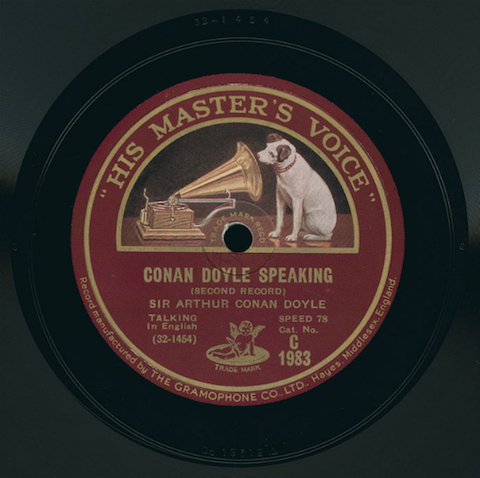
We’ve previously documented the strange case of Arthur Conan Doyle’s fervent Spiritualism, which Mark Strauss of io9 aptly describes as “hard to reconcile [with] the man who created the literary embodiment of empirical thinking,” Sherlock Holmes. Conan Doyle was so eager to believe in the existence of fairies and what he called “psychic matters” that he was frequently taken in by hoaxes. But the physician and novelist’s seemingly odd views obtained widely among his contemporaries who sought confirmation of the afterlife and communion with their dead relatives, millions of whom were lost in the Civil War, then World War I.
Spiritualism provided a comfort to the bereaved, as well as ample opportunity for grifters and charlatans. And yet, Strauss points out, the rise of Spiritualism in the 19th century may also have been due to the rising influence of science in popular culture, as more and more people sought experimental evidence for their supernatural beliefs. Conan Doyle wrote twenty books on the subject, including the two-volume 1924 History of Spiritualism. In a speech he gave in May of 1930, just before his death, he explained the appeal. Hear the audio above and read a transcription below:
People ask, what do you get from spiritualism? The first thing you get is that it absolutely removes all fear of death. Secondly, it bridges death for those dear ones whom we may lose. We need have no fear that we are calling them back, for all that we do is to make such conditions as experience has taught us, will enable them to come if they wish. And the initiative lies always with them.
Two months later at a séance attended by thousands at the Royal Albert Hall, a medium claimed to have communicated with the Sherlock Holmes author. And four years after that, another medium, Noah Zerdin, held a séance attended by hundreds, and Conan Doyle is said to have been one of 44 who spoke from the beyond. This time, the event was recorded, on 26 acetate disks, which were only discovered 67 years later in 2001 by Zerdin’s son, who donated them to the British Library. The 1934 recordings featured in a 2002 BBC radio documentary called What Grandad Did in the Dark.
Just above, you can hear the supposed voice of Arthur Conan Doyle speaking from the spirit world. The audio is seriously spooky, but I’m not inclined to believe that it’s anything more than a hoax, although the technology of the time would make manipulation of the direct recordings difficult. So-called “spirit voices” in recordings such as this are known as EVP (“electronic voice phenomenon”), and there are many such examples of the genre at the British Library, including a batch of 60 tapes made by a Dr. Konstantin Raudive, “who believed that the dead could communicate with the living through the medium of radio waves.”
A post on the British Library site comments that “the recorded evidence is not especially convincing, being short comments or fragments that without the accompanying spoken ‘translation’ would probably not strike the listener as having any meaningful content.” The Conan Doyle audio seems a little more coherent, though it’s difficult to make out exactly what the voice says. Compare the two samples and draw your own conclusions. Or better yet, consider what Sherlock Holmes would make of this alleged “evidence.”
You can find Sherlock Holmes texts in our collections: 600 Free eBooks for iPad, Kindle & Other Devices and 550 Free Audio Books: Download Great Books for Free.
Related Content:
Arthur Conan Doyle Discusses Sherlock Holmes and Psychics in a Rare Filmed Interview (1927)
Arthur Conan Doyle Fills Out the Questionnaire Made Famous By Marcel Proust (1899)
Josh Jones is a writer and musician based in Durham, NC. Follow him at @jdmagness.
Read More...Watch Gumbasia the Jazzy Stop Motion Film That Gave Birth to Gumby (1955)
Like many in the Honeycomb Kids generation, I didn’t properly appreciate children’s television icon Gumby until Eddie Murphy parodied him on Saturday Night Live. This sparked a revival. Watching Gumby episodes in the company of other merry young adults reframed my previously held view of him as a relic from a time when TV was boring. Turns out that Gumby and his equine sidekick Pokey were actually pretty funny, weird-in-a-good-way, and far more soulful than the witless flat animation jamming the airwaves of my 70s childhood.
Then, in 2006, the Museum of the Moving Image had an exhibit devoted to the work of Art Clokey, father of Gumby.
I decided to take the kids, gambling that they might respond to Gumby as I did now, not the way I did when I was their age. Their screen time was pretty limited back then, and as a result, they’d avidly watch just about anything.
The first video we encountered was Gumbasia, the experimental, character-free, stop motion riff above that Clokey made as a student at USC. It was produced in 1953 and released in 1955.
Not exactly what I’d been priming the children to expect on the subway ride over.
“That’s Gumby?” they cried in dismay. “That cube?”
No. But those morphing cubes and squiggles did give birth to an empire, after producer and president of the Motion Picture Producers Association, Sam Engel, offered to bankroll a pilot, declaring Gumbasia the most exciting film he’d ever seen in his life. Clokey was teaching English at the Harvard Military Academy. Engel’s sole wish was to improve the quality of children’s television programming. He asked Clokey if he could “make little clay figures out of that clay and animate them.”
Clokey did just that, with Engel bankrolling the pilot, “Gumby on the Moon.” The producer was so pleased with the result, he refused to take a cut when Gumby was given a seven year contract at NBC.
Imagine a Cinderella story like that happening today!
If this small morsel of Gumby history leaves you craving more, book your flight for the inaugural Gumby Fest in Glendora, California, where Gumby grew to maturity in “an unassuming industrial building.”
You can find Gumbasia in the Animation section of our collection of 675 Free Movies Online: Great Classics, Indies, Noir, Westerns.
Related Content:
Big Bang Big Boom: Graffiti Stop-Motion Animation Creatively Depicts the Evolution of Life
Watch “Bottle,” an Award-Winning Stop Motion Animated Tale of Transoceanic Correspondence
Harder Than It Looks: How to Make a Great Stop Motion Animation
Ayun Halliday is the author of seven books, and creator of the award winning East Village Inky zine. Follow her @AyunHalliday
Read More...An Introduction to 100 Important Paintings with Videos Created by Smarthistory
If you have an interest in how the internet has widened the very concept of education, you may well know about Google’s Art Project, a digital wealth of free visual art information and viewing opportunities we’ve featured before. And you more than likely know about Khan Academy, the highest-profile producer of educational videos on the internet. Now, from the combined power of their learning resources comes this collection of video introductions to over 100 important paintings. Ranging from between two to nine minutes and covering works of art created in eras from 575 B.C.E to the Second World War, these brief but intellectually dense and visually rich lessons bear the label of Smarthistory, “a multimedia web-book about art and art history” that merged with Khan Academy in 2011.
In the video at the top of the post, Smarthistory introduces us to Botticelli’s 1486 Tbe Birth of Venus, “one of the most iconic images in the history of Western art” — its content, its context, and its inspiration. The Birth of Venus might seem like one of those images that needs no introduction, but as all the information revealed in the video reminds us, most of us, if not art historians ourselves, could at least use a refresher.
Just above, we have Vincent van Gogh’s 1889 The Bedroom, a painting that, in the words of the artist himself, “ought to rest the brain — or rather, the imagination.” Though we all know the name of this particular post-Impressionist, we may not have seen this particular canvas of his before, a fact Smarthistory’s experts Beth Harris and Steven Zucker take into account when they explain to us how they themselves think about it. “What you’re talking about is the root of abstraction itself,” says Zucker. “It’s not that this is representative; it’s that the formal qualities of painting itself can have their own experiential aspect.” And they speak just as insightfully on the paintings we encounter, in one form or another, every so often in our daily lives. Edward Hopper’s 1942 Nighthawks, for instance, a replica of which I saw on the side of one coffee mug I used every day for years, gets discussed below as “an expression of wartime alienation” that delivers “an immediate implication that we are alone” that “makes us look for some sign of life, but we don’t see anything.” Smarthistory’s videos manage to reveal a great deal of emotional, technical, and historical knowledge on these and many other paintings in a fraction of the time it takes a student to cross campus for their art history lecture — let alone to sit through its entire slideshow. You can see all 100 videos in the collection here.
Related Content:
Google Puts Over 57,000 Works of Art on the Web
The Rijksmuseum Puts 125,000 Dutch Masterpieces Online, and Lets You Remix Its Art
The Getty Puts 4600 Art Images Into the Public Domain (and There’s More to Come)
Free: The Metropolitan Museum of Art and the Guggenheim Offer 474 Free Art Books Online
Colin Marshall hosts and produces Notebook on Cities and Culture and writes essays on cities, language, Asia, and men’s style. He’s at work on a book about Los Angeles, A Los Angeles Primer. Follow him on Twitter at @colinmarshall or on Facebook.
Read More...Do Rappers Have a Bigger Vocabulary Than Shakespeare?: A Data Scientist Maps Out the Answer
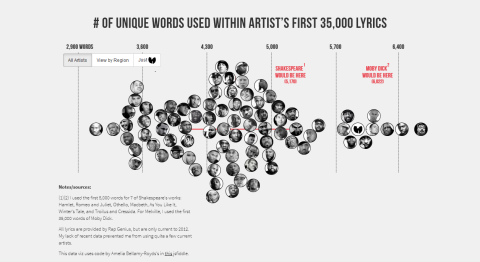
Each year brings us a new list of words that, once hip or subcultural, signal their admission into the mainstream by entering the pages—print or online—of the Oxford English Dictionary or Merriam Webster’s. Many of those come from the world of hip hop. The form is a veritable laboratory of linguistic innovation, spawning dozens of region-specific argots that mutate and evolve beyond the capacity of hip lexicographers to document. One data scientist, Matt Daniels, has made an interesting attempt, however, in a project he calls “The Largest Vocabulary in Hip Hop.” Proceeding from the premise that certain rappers might match or best Shakespeare for the title of “largest vocabulary ever,” Daniels used a methodology called “token analysis” to analyze the lyrical content of “the most famous artists in hip hop.” He relied on Rap Genius transcriptions, which are only current to 2012, to produce a sample size of 35,000 words (the equivalent of 3–5 studio albums).
Topping the list by far with a total of 7,392 unique words used is rapper Aesop Rock, whom, Daniels admits, is somewhat obscure by comparison with Jay Z or Snoop Dog. More well-known artists like Wu Tang Clan, The Roots, and Outkast also rank highly, but what Daniels discovered is that many of the rappers near the top of the scale are underground or obscure artists who don’t sell millions of records. And occupying the lower end are some top-selling artists and household names like Lil Wayne, Kanye West, and Snoop Dog (DMX is dead last at #85). King of the hill Jay‑Z, whose 2013 album Magna Carta…Holy Grail sold half a million copies in its first week, ranks somewhere in the middle, and Daniels quotes from the mega-selling rapper’s “Moment of Clarity” from his Black Album in which he plainly admits that he’ll write middlebrow lyrics for million dollar sales figures, saying “I dumbed down for my audience to double my dollars” (one wonders how many listeners perceived the slight).
Daniels admits in an NPR interview that this is “not a serious academic study” but a project he undertook for the fun of it. And a great many of the “unique words” counted in each rapper’s totals are slang coinages or variants like “pimps, pimp, pimping, and pimpin,” each of which counts separately. Even so, writes Daniels on the project’s site, “it’s still directionally interesting,” as well as sociologically. And of course, literary writers have been contributing made-up words to the general lexicon for centuries. See Daniels’ site for an interactive visualization (screen shot above) of the rankings of all 85 rappers surveyed.
If you’re wondering who has a bigger vocabulary — Shakespeare or rappers — here’s the quick answer in purely numerical terms. In his sample size of 35,000 words per artist, Daniels determined that Aesop Rock used 7,392 unique words (and Wu-Tang Clan, 5,895) against Shakespeare’s 5,000 unique words. And there you have it.
Related Content:
Jay‑Z: The Evolution of My Style
The Greatness of Charles Darwin Explained with Rap Music
The Art of Data Visualization: How to Tell Complex Stories Through Smart Design
Josh Jones is a writer and musician based in Durham, NC. Follow him at @jdmagness.
Read More...Support “Green Reads,” a Program That Finances Libraries by Distributing Used Books in Eco-Friendly Vending Machines

Green Reads has launched a crowd funding campaign on IndieGogo to build 15 eco-friendly, used book vending machines. Invented by Dana Clarke, the machines require no electricity and they’ll allow libraries, charities, and book retailers a way to sell used books and create a sustainable source of revenue. Green Reads is looking to raise $75,000 ($5000 per machine) by May 19. Once operational, the machines will be donated (not sold) to libraries and charities. You can get a lot more information and contribute to this worthy campaign right here.
Related Content:
550 Free Audio Books: Download Great Books for Free
600 Free eBooks for iPad, Kindle & Other Devices
170 Free Textbooks: A Meta Collection
Read More...
15 Free eBooks on New Media Studies & the Digital Humanities
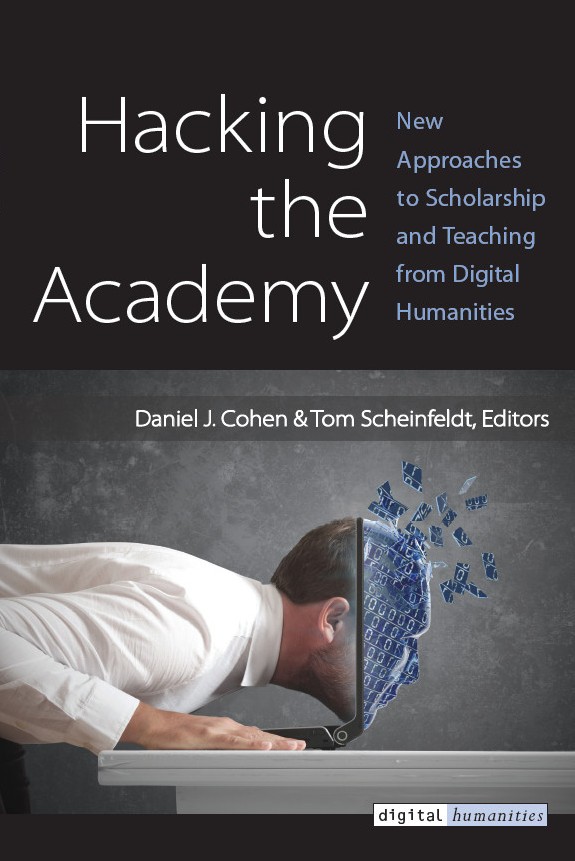
Worth noting: digitalculturebooks is an imprint of the University of Michigan Press dedicated to publishing books on new media studies and digital humanities. Committed to openness, the imprint typically releases its titles under a Creative Commons (CC) license that lets you read the works online for free. You can also make non-commercial use of the texts without getting permission (or paying fees) so long as you give proper attribution. Below, we have listed the texts (and the series in which they appear). Click the links below, then look for the “Read for free online” link beneath each author’s name. And you’ll be good to go. We have more free ebooks in two collections: 600 Free eBooks for iPad, Kindle & Other Devices and 170 Free Textbooks: A Meta Collection.
Digital Humanities
- Pastplay: Teaching and Learning History with Technology by Kevin Kee
- Writing History in the Digital Age by Kristen Nawrotzki and Jack Dougherty
- Hacking the Academy: New Approaches to Scholarship and Teaching from Digital Humanities Edited by Daniel J. Cohen and Tom Scheinfeldt
- Teaching History in the Digital Age by T. Mills Kelly
Landmark Video Games
- DOOM: SCARYDARKFAST by Dan Pinchbeck
- Myst and Riven: The World of the D’ni by Mark J. P. Wolf
- Silent Hill: The Terror Engine by Bernard Perron
The New Media World
- When Media Are New: Understanding the Dynamics of New Media Adoption and Use by John Carey and Martin C. J. Elton
- Broadcasting, Voice, and Accountability: A Public Interest Approach to Policy, Law, and Regulation by
Steve Buckley, Kreszentia Duer, Toby Mendel, and Sean O’Siochru with Monroe E. Price and Marc Raboy - Owning the Olympics: Narratives of the New China by Monroe E. Price and Daniel Dayan, Editors
- The Hyperlinked Society: Questioning Connections in the Digital Age Edited by Joseph Turow and Lokman Tsui
Technologies of the Imagination
- Digital Tools in Urban Schools: Mediating a Remix of Learning by Jabari Mahiri
- Home Truths? Video Production and Domestic Life by David Buckingham, Maria Pini and Rebekah Willett
- My Life as a Night Elf Priest: An Anthropological Account of World of Warcraft by Bonnie A. Nardi
- Skate Life: Re-Imagining White Masculinity by Emily Chivers Yochim
via Metafilter
Read More...Sigmund Freud Appears in Rare, Surviving Video & Audio Recorded During the 1930s
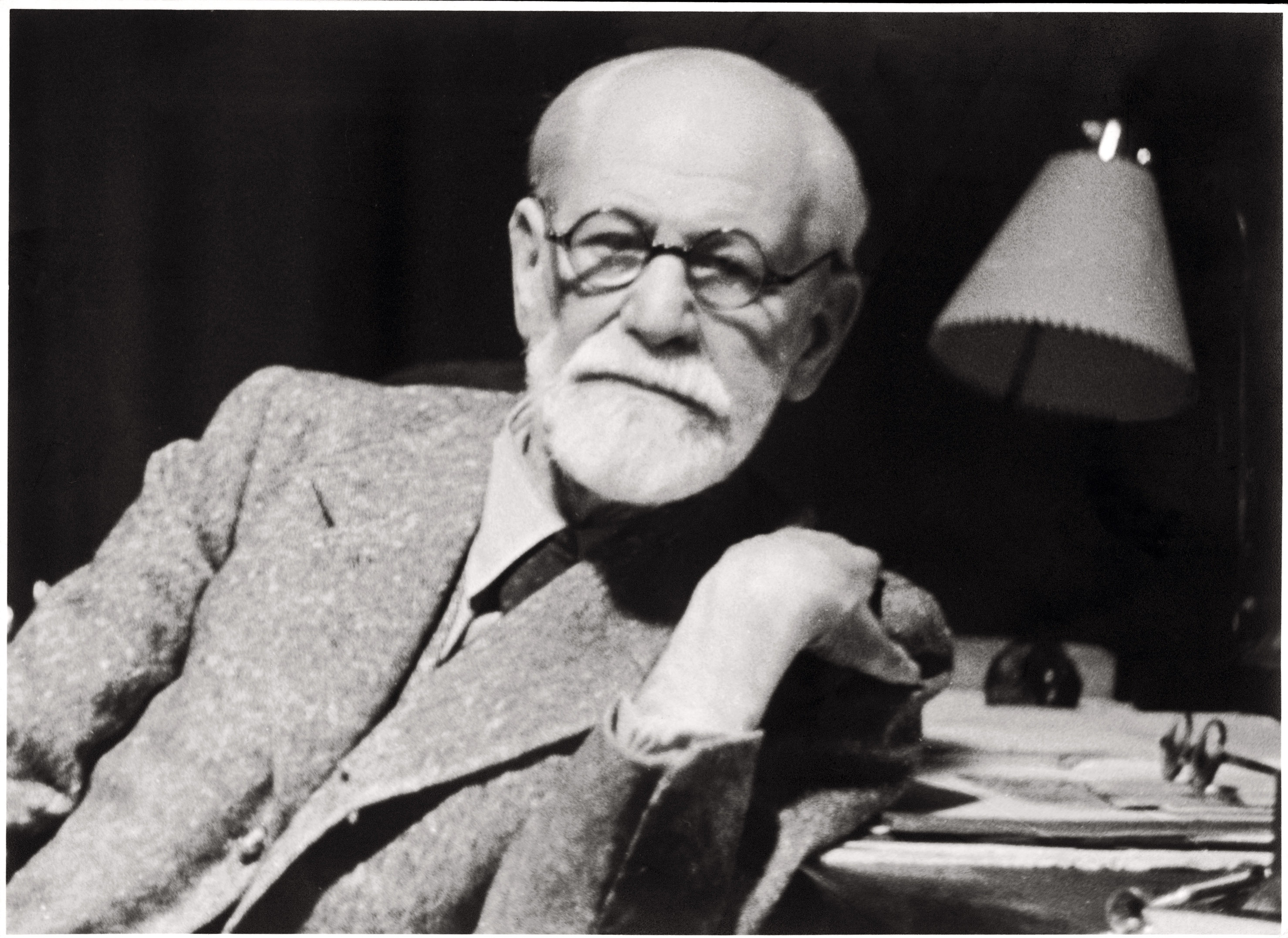
What, I wonder, would Sigmund Freud have made of Hannibal Lector? The fictional psychoanalyst, so sophisticated and in control, moonlighting as a bloodthirsty cannibal… a perfectly grim rejoinder to Freud’s ideas about humankind’s perpetual discontent with the painful repression of our darkest, most antisocial drives. While Freud’s primary taboo was incest, not cannibalism, I’m sure he would have appreciated the irony of an ultra-civilized psychiatrist who gives full steam to his most primal urges.
Freud—who was born on this day in 1856, in the small town of Freiberg—also had a carefully controlled image, though his passionate avocation was not for the macabre, salacious, or prurient, but for the archaeological. He once remarked that he read more on that subject than on his own, an exaggeration, most likely, but an indication of just how much his interest in cultural artifacts and ritual contributed to his theoretical explication of individual and social psychology.
In the film above, we see Freud in conversation with a friend, a professor of archaeology, whom the psychiatrist consulted on his extensive collection of antiquities. Later, we see Freud with his dog, then reclining outdoors with a book. Over this footage we hear the narration of Freud’s daughter Anna, who only allowed this film to be viewed by a small circle until her death in 1982.
Though Freud lived many decades into the era of recording technology, precious little film and audio of the founder of psychoanalysis exists. While the home movies at the top may be the only moving image of him, perhaps the only audio recording of his voice, above, was made in 1938, the year before his death. At 81 years old, Freud’s advanced jaw cancer left him in considerable torment. Nonetheless, he agreed to record this brief message for the BBC from his London home in Maresfield Gardens. Read a transcript of the speech, and see Freud’s handwritten copy, below.
I started my professional activity as a neurologist trying to bring relief to my neurotic patients. Under the influence of an older friend and by my own efforts, I discovered some important new facts about the unconscious in psychic life, the role of instinctual urges, and so on. Out of these findings grew a new science, psychoanalysis, a part of psychology, and a new method of treatment of the neuroses. I had to pay heavily for this bit of good luck. People did not believe in my facts and thought my theories unsavory. Resistance was strong and unrelenting. In the end I succeeded in acquiring pupils and building up an International Psychoanalytic Association. But the struggle is not yet over. –Sigmund Freud.
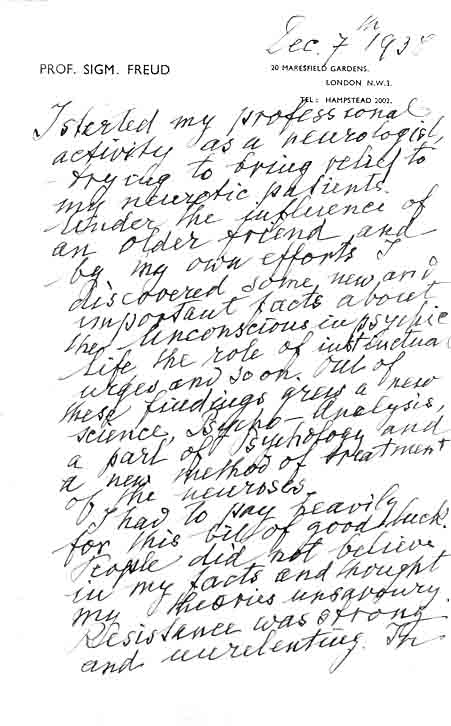
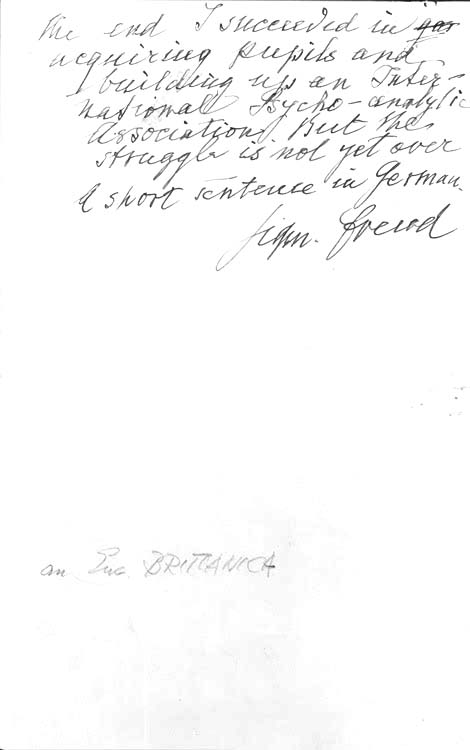
The Library of Congress online exhibit Sigmund Freud: Conflict & Culture has many more primary documents including a holograph page from Freud’s manuscript of Civilization and its Discontents, in which he theorized the bedrock impulse of serial killers, fictional and real: the so-called “Death Drive,” our “human instinct of aggression and self-destruction.”
Many important texts by Freud can be found in our collection, 600 Free eBooks for the iPad, Kindle & Other Devices. And you’ll inevitably find a few courses covering Freud’s thought in our collection of Free Online Psychology Courses, part of our list of 950 Free Online Courses from Top Universities.
Related Content:
How a Young Sigmund Freud Researched & Got Addicted to Cocaine, the New “Miracle Drug,” in 1894
Jean-Paul Sartre Writes a Script for John Huston’s Film on Freud (1958)
Free Online Psychology & Neuroscience Courses
Josh Jones is a writer and musician based in Durham, NC. Follow him at @jdmagness.
Read More...Global Breakfast Radio Lets You Listen to Radio Broadcasts From Wherever the Sun is Rising
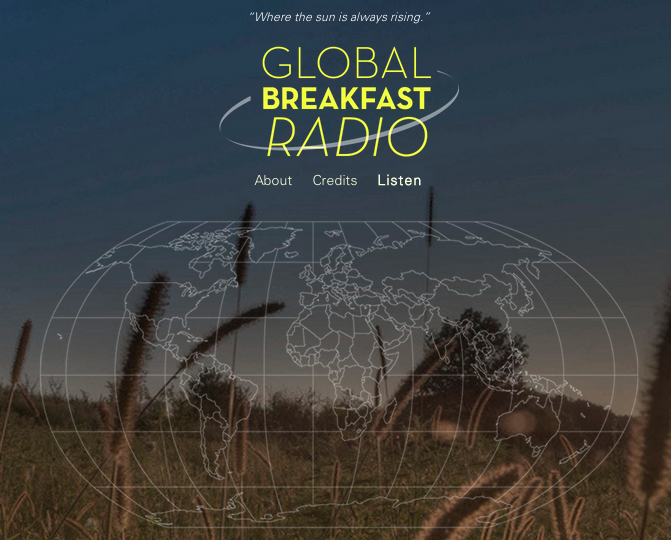
“The sun is always rising somewhere; breakfast is always just about to happen. Dinner time in Dakar is breakfast time in Brisbane.” Enter Global Breakfast Radio, a web site that aggregates and streams radio stations from around the world (over 250 stations from more than 120 countries), airing broadcasts from wherever it’s breakfast time right now. “As the sun rises on the Greenwich Mean Line, you’ll hear breakfast programmes from around the UK, Iceland and West Africa; the broadcast then moves westwards, following the sunrise across the Atlantic islands, sweeping over America and then into the Pacific.” That’s how Daniel Jones, one of the co-founders of Global Breakfast Radio, explains the project to Wired.
Right now, in California, it’s nearly 11:30 pm. But, with a click of the mouse, I can listen to programs kicking off the day in Assisi, Italy. You can start listening right here on your computer. The streamed broadcast should work in any modern web browser. It should also run just fine on your iPhone, iPad and other mobile devices. Enjoy.
via Mefi
Read More...Support Us
We're hoping to rely on loyal readers, rather than erratic ads. Please click the Donate button and support Open Culture. You can use Paypal, Venmo, Patreon, even Crypto! We thank you!

About Us

Open Culture scours the web for the best educational media. We find the free courses and audio books you need, the language lessons & educational videos you want, and plenty of enlightenment in between.
Advertise With Us

FREE UPDATES!
GET OUR DAILY EMAIL
Get the best cultural and educational resources on the web curated for you in a daily email. We never spam. Unsubscribe at any time.
FOLLOW ON SOCIAL MEDIA

Open Culture editor Dan Colman scours the web for the best educational media. He finds the free courses and audio books you need, the language lessons & movies you want, and plenty of enlightenment in between.
Advertise With Us

