Jean-Luc Godard Gives a Dramatic Reading of Hannah Arendt’s “On the Nature of Totalitarianism”
If you have watched any movie by Jean-Luc Godard you know that he’s never been one to hide behind the façade of film narrative. His movies are personal. Sure they are also intellectually demanding, unabashedly political, and occasionally impenetrable but they are definitely personal. This is a guy, after all, who made Pierrot le Fou, a film that is, among other things, a painfully honest investigation of the breakdown of his marriage with Anna Karina starring Anna Karina.
But you wouldn’t think of Godard as a filmmaker who would readily step in front of the camera like Orson Welles or (regrettably) Quentin Tarantino. But if you’ve been itching to see Godard perform an extended monologue then check out the video above.
The piece is from the 1997 movie We’re Still Here (Nous sommes tous encore ici), directed Anne-Marie Miéville who is Godard’s longtime creative and romantic partner, and it shows the rumpled, unshaven director quoting from Hannah Arendt’s essay “On the Nature of Totalitarianism.” The soliloquy, presented on a bare stage to an empty theater, is about tyranny, isolation and free will and is delivered with a surprising amount of skill and emotion. You can read along below:
If it were true that eternal laws existed, ruling everything, human in an absolute way and which only required of each human being complete obedience, the freedom would only be a farce. One man’s wisdom would be enough. Human contacts would no longer have any importance, preserved perfect activity alone would matter, operating within the context set up by this wisdom which recognizes the Law. This is not the content of ideologies, but the same logic which totalitarian leaders use which produces this familiar ground and the certainty of the Law without exception.
Logic, that’s to say pure reason without regard for facts and experience, is the real vice of solitude. But the vices of solitude are caused uniquely by the despair associated with isolation. And the isolation which exists in our world, where human contacts have been broken by the collapse of our common home, again following the disastrous consequences of revolutions, themselves a result of previous collapse.
This isolation has stopped being a psychological question to which we can do justice with the help of nice expressions devoid of meaning, like ‘introverted’ and ‘extraverted’. Isolation as a result of absence of friends and of alienation is, from the point of view of man, the sickness which our world is suffering from, even if it is true, we can notice fewer and fewer people than before who cling on to each other without the slightest support. Those people do not benefit from communication methods offered by a world with common interests. These help us escape together, from the curse of inhumanity, in a society where everyone seems superfluous and considered as such by others.
Isolation is not solitude. In solitude, we are never alone with ourselves. In solitude we are always two in one, and we become one, a complete individual with richness and the limits of its exact features, only in relation to the others and in their company. The big metaphysical questions, the search for God, liberty and immortality, relations between man and the world, being and nothingness or again between life and death, are always posed in solitude, when man is alone with himself, therefore, in the virtual company of all. The fact of being, even for a moment, diverted from one’s own individuality allows it to formulate mankind’s eternal questions, which go beyond the questions posed in different ways by each individual.
The risk in solitude is always of losing oneself. It could be said that this is a professional risk for the philosopher. Since he seeks out truth and preoccupies himself with questions, which we describe as metaphysical but which are indeed the only questions to preoccupy everyone. The philosopher’s solution has been to notice that there is apparently in the human mind itself one element capable of compelling the other and thus creating power. Usually we call this faculty Logic, and it intervenes each time that we declare that a principle or an utterance possesses in itself a convincing force, that is to say a quality which really compels the person to subscribe to it.
Recently we realized that the tyranny, not of reason but argumentation, like an immense compulsive force exercised on the mind of men can serve specifically political tyranny. But this truth also remains that every end in history necessarily contains a new beginning. This beginning is the only promise, the only message which the end can ever give. St Augustine said that man was created so that there could be a beginning. This beginning is guaranteed by each new birth, it is, in truth, each man.
Related Content:
Hannah Arendt Discusses Philosophy, Politics & Eichmann in Rare 1964 TV Interview
Hannah Arendt’s Original Articles on “the Banality of Evil” in the New Yorker Archive
A Young Jean-Luc Godard Picks the 10 Best American Films Ever Made (1963)
Jean-Luc Godard’s After-Shave Commercial for Schick (1971)
Jonathan Crow is a Los Angeles-based writer and filmmaker whose work has appeared in Yahoo!, The Hollywood Reporter, and other publications. You can follow him at @jonccrow.
Read More...Howard Johnson’s Presents a Children’s Menu Featuring Kubrick’s 2001: A Space Odyssey (1968)
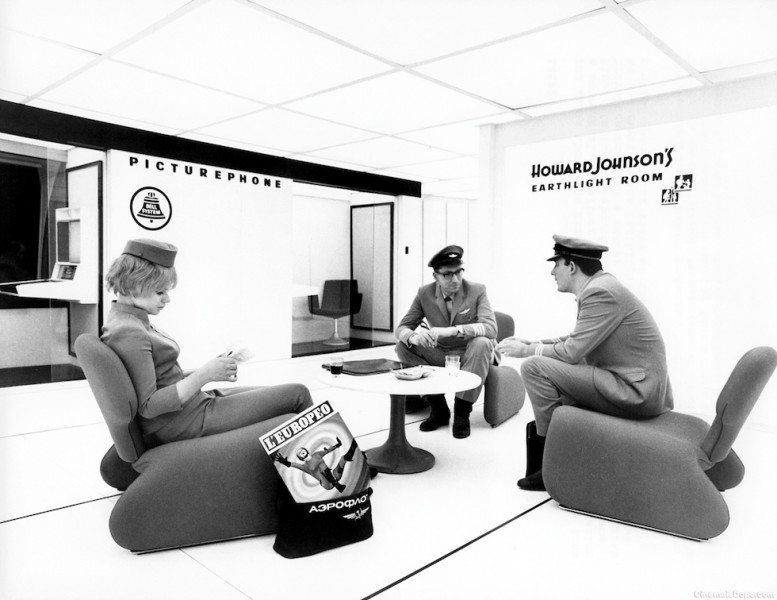
Rumor has it that prominent placement in a science-fiction movie can put a kind of “curse” on a brand: witness the fates, for instance, of Atari, Bell, and Pan American World Airways, all of which went south after appearing in Ridley Scott’s Blade Runner in 1982. (Even the apparently unstoppable Coca-Cola, its logo flashing so brightly on the future Los Angeles skyline, subsequently put the infamous New Coke to market.) Pan Am, then less than a decade from dissolution, had previously played a high-profile part in 2001: A Space Odyssey. Stanley Kubrick and Arthur C. Clarke’s vision of monoliths, Jupiter missions, and too-intelligent artificial intelligence came out in 1968, the tail end of America’s midcentury Space Age of the imagination. At that time, Pan Am enjoyed a reputation as the preferred airline of the new “jet-set” — the natural transportation provider, I suppose, for their seemingly inevitable (and inevitably glamorous) holidays in outer space. But who would provide the lodging so far from Earth? Why, Howard Johnson’s, of course.
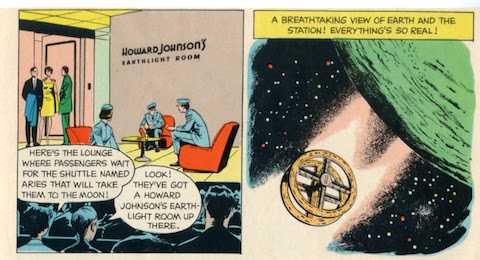
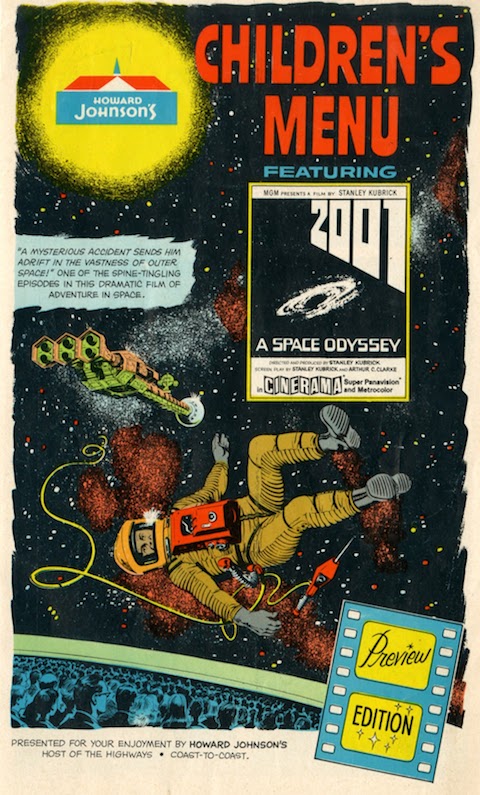
The hotel-restaurant chain, America’s largest in the 1960s and 70s, lent its name to the “earthlight room” built into 2001’s space station. It also offered a special children’s menu (produced by the Amuse-a-Menu Company of Boston, Massachusetts) featuring a comic retelling not of the film itself, but of the experience of attending the film’s premiere. Many of its panels manage impressive recreations of 2001’s then-as-now-impressive visuals, though I suspect the writer and artist had to work with few plot details — they make no mention at all, for instance, of the iconically malevolent supercomputer (and arguably 2001’s star) HAL 9000.

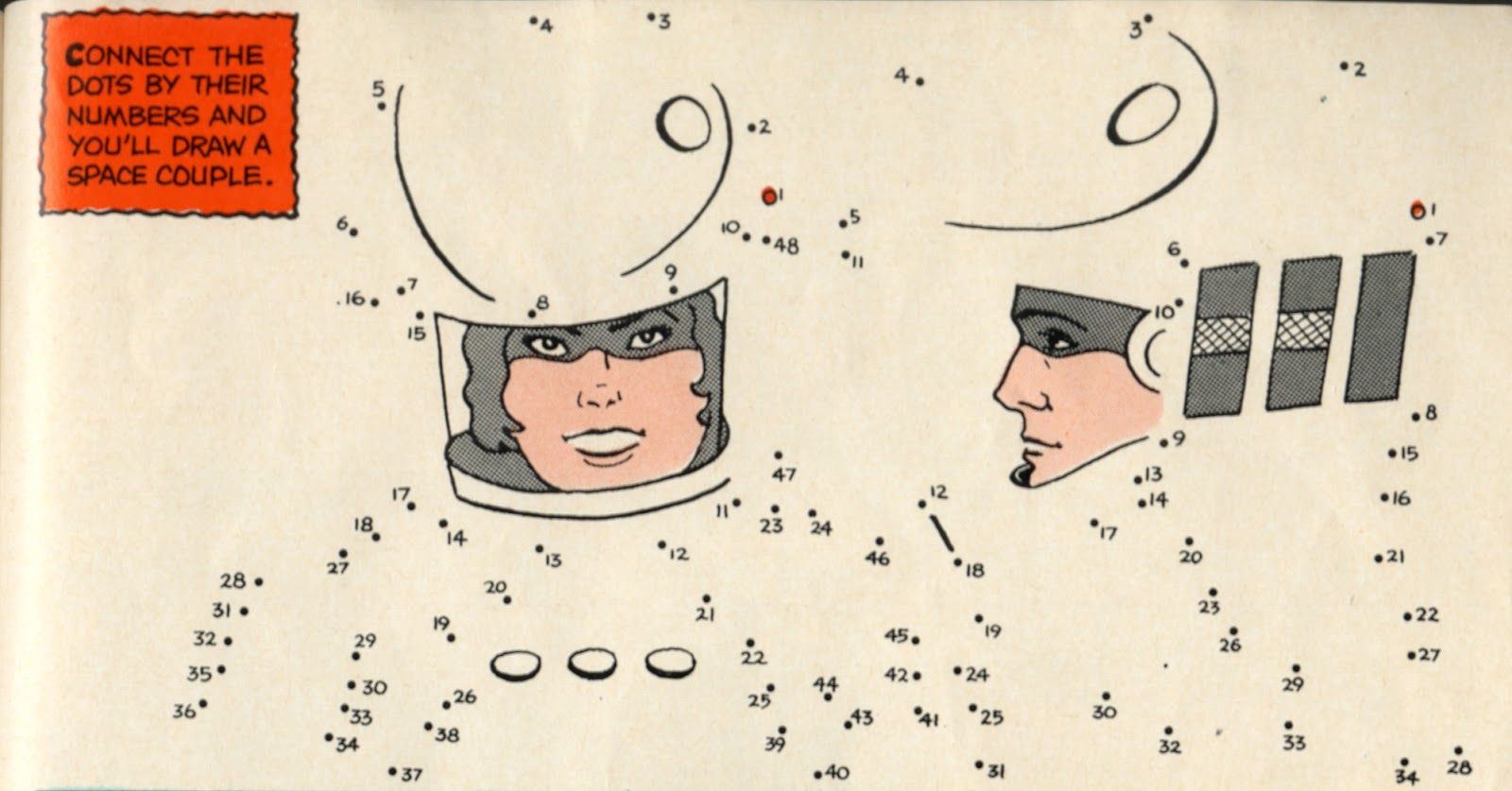
The full menu, which you can browse at Dreams of Space, offers the kids of 1968 an activity page, an opportunity to purchase a 50-cent birthday-themed 45-RPM record, and a host of bland dishes. Born well after 2001’s premiere — and indeed after Blade Runner’s, though I did hear when Pan Am went under — I nevertheless remember eating all these standards from children’s menus everywhere: spaghetti, hot dogs, peanut-butter-and-jelly sandwiches. While I rarely dream of a future where we’ve developed a spacefaring jet set, I often dream of the even less plausible one where we’ve come up with appetizing food for the under-ten set.
Related Content:
Isaac Asimov Predicts in 1964 What the World Will Look Like Today — in 2014
Arthur C. Clarke Predicts the Future in 1964 … And Kind of Nails It
Colin Marshall hosts and produces Notebook on Cities and Culture and writes essays on cities, language, Asia, and men’s style. He’s at work on a book about Los Angeles, A Los Angeles Primer. Follow him on Twitter at @colinmarshall or on Facebook.
Read More...Short Film Takes You Inside the Recovery of Andy Warhol’s Lost Computer Art
A couple weeks back, we told you how Carnegie Mellon’s Computer Club used its tech savoir-faire to recover nearly 30 paintings that Andy Warhol made on the Amiga computer back in the 1980s. It involved restoring some Amiga hardware housed at the Andy Warhol Museum and then performing acts of “forensic retrocomputing,” which meant reverse-engineering the “completely unknown file format” in which Warhol saved his images. The Hillman Photography Initiative captured the whole process on film, and created a short movie called Trapped: Andy Warhol’s Amiga Experiments. It premiered Saturday, May 10 at Pittsburgh’s Carnegie Library Lecture Hall and it’s also now online. Watch it above. One interesting thing you’ll learn along the way: Steve Jobs originally asked Warhol to make his paintings on an early Mac. But the artist opted for the Commodore Amiga instead. Below, you can actually see Warhol paint Debbie Harry on the Amiga.
Related Content:
Andy Warhol Digitally Paints Debbie Harry with the Amiga 1000 Computer (1985)
Andy Warhol’s Lost Computer Art Found on 30-Year-Old Floppy Disks
Find Trapped: Andy Warhol’s Amiga Experiments on our list of Free Documentaries, part of our larger collection: 4,000+ Free Movies Online: Great Classics, Indies, Noir, Westerns, Documentaries & More.
Read More...Such Sweet Thunder: Duke Ellington & Billy Strayhorn’s Musical Tribute to Shakespeare (1957)
The great Duke Ellington and his longtime musical partner Billy Strayhorn performed such musical feats of strength together over the course of nearly three decades that they can seem to dwarf many of their contemporaries. The two co-composers had a knack for turning popular music—jazz, ragtime, the blues—into high art, then transmuting it right back into pop again, via three-minute blasts of swing like their most famous tune “Take the A Train.” In some respects, Ellington and Strayhorn’s compositions are like that of writers who harmonize hip vernacular, popular idiom, and The Great Tradition into works that feel thrillingly fresh and timeless all at once. And so it makes perfect sense that Ellington and Strayhorn would compose a suite of songs based on scenes from William Shakespeare, that most skillful of literary alchemists, and that it would turn out to be, in the words of poet and music critic A.B. Spellman, “one of the most remarkable orchestral pieces in all of American music.”
That piece, Such Sweet Thunder, found its impetus in Shakespeare’s most magical play, A Midsummer Night’s Dream, notably in a line that so well captures the harmonious clashing of styles and languages in both the Duke and the Bard: “I never heard so musical a discord, such sweet thunder.” Dangerous Minds quotes Ellington, who called the piece his “attempt to parallel the vignettes of some of the Shakespearean characters in miniature—sometimes to the point of caricature.” The suite of songs premiered at New York’s Town Hall in April, 1957, at a concert called “Music for Moderns.” Its final number had yet to be written. Soon after, at the Ravinia Music Festival outside Chicago, Ellington introduced the first broadcast performance, which you can hear in full above. See below for the titles of each song and list of soloists.
1:48 Sonnet For Sister Kate [solo: Quentin Jackson]
4:53 Up And Down. Up And Down [solo: Clark Terry]
8:04 Star-Crossed Lovers [solo: Johnny Hodges]
12:38 Madness In Great Ones [solo: Cat Anderson]
16:25 Half The Fun [solo: Johnny Hodges]
20:42 Circle Of Fourths [solo: Paul Gonsalves]
23:23 Jam With Sam [solos: Willie Cook, Paul Gonsalves, Britt Woodman, Russell Procope, Cat Anderson]
Ellington, the CBS radio announcer at the beginning informs us, was first spurred by his attendance at the Stratford Ontario Shakespeare Festival in 1956. But he had been a devotee of theater, and of Shakespeare, for many years. Strayhorn, it seems, was even more so. Spellman tells us that Strayhorn “was deep into Shakespeare […] could quote whole sections of plays [….], vast numbers of sonnets from memory, at the drop of a hat.” Immersed not only in theater, but in classical music, Strayhorn’s first ambition was to become a classical composer. While the color barrier stifled that dream, his move into jazz was certainly no compromise. Strayhorn and Ellington “were so attuned to one another musically,” writes a biography companion to Ken Burn’s Jazz, “that it is now impossible to establish the exact extent of the former’s contribution to Ellington’s oeuvre.” (Ellington called Strayhorn “my right arm, my left arm, all the eyes in the back of my head.”) Given Strayhorn’s deep knowledge of Shakespeare’s work, it’s probably fair to assume that his contribution to Such Sweet Thunder was significant. Above, see selections from a 1959 performance in Switzerland, and just below, see a 1960 avant-garde ballet choreographed to Ellington and Strayhorn’s Shakespeare suite by Maurice Béjart, another artist with a particular talent for bringing high art themes and styles to popular audiences.
Related Content:
Duke Ellington’s Symphony in Black, Starring a 19-Year-old Billie Holiday
Thelonious Monk Plays Duke Ellington: Solo Piano, Berlin 1969
Josh Jones is a writer and musician based in Durham, NC. Follow him at @jdmagness.
Read More...Watch a Restored Version of Un Chien Andalou: Luis Buñuel & Salvador Dalí’s Surreal Film (1929)
When we talk about experimental film, we talk, sooner or later, about Un Chien Andalou. One can hardly overstate the formative impact that Luis Buñuel and Salvador Dalí’s short film had on all cinema, whether “alternative,” “artistic,” or otherwise askew. Loosed upon the unsuspecting filmgoing world back in 1929, it’s 16 to 21 minutes (depending on the version) of pure surreality have been viewed by many, even those of us with no patience for the avant-garde. For the most part, we’ve seen versions of badly inferior quality. Inferior to what, you might ask, and I would direct you to the superior version at the top of the post, a 21st-century restoration by the Filmoteca Española, which offers an Un Chien Andalou not quite like those you’ve seen before, whether in a film studies class, on late-night television, or in some corner or another of the internet.
Video artist and blogging cinephile Blake Williams had that impression, finding what he calls “a markedly different version of this classic than what I came to know on Youtube.” The film “plays in ‘actual time’, slowing down the hyper, 16 minutes cut to a more deliberately paced 21+ minutes” with visuals “less contrast-blown than any version I have seen, not to mention that it is no longer heavily cropped. The score, too, is different, dropping the now iconic tango back-and-forth with Wagner.” If you’ve long since grown used to all the images in Un Chien Andalou’s once-shocking procession — the dragging piano, the ants in the palm, the rotting donkeys, the immortal eyeball slice — prepare to feel at least surprised by them once again. Though they have become much cleaner, they’ve also become no less troubling for it.
For more classic films, please see our collection, 4,000+ Free Movies Online: Great Classics, Indies, Noir, Westerns, Documentaries & More.
(H/T: Israel Nava, who worked on the restoration.)
Related Content:
Two Vintage Films by Salvador Dalí and Luis Buñuel: Un Chien Andalou and L’Age d’Or
The Seashell and the Clergyman: The World’s First Surrealist Film
David Lynch Presents the History of Surrealist Film (1987)
A Tour Inside Salvador Dalí’s Labyrinthine Spanish Home
Watch the Greatest Silent Films Ever Made in Our Collection of 101 Free Silent Films Online
Colin Marshall hosts and produces Notebook on Cities and Culture and writes essays on cities, language, Asia, and men’s style. He’s at work on a book about Los Angeles, A Los Angeles Primer. Follow him on Twitter at @colinmarshall or on Facebook.
Read More...The Evolution of London: 2,000 Years of Change Animated in 7 Minutes
Give “The London Evolution Animation” seven minutes, and it will show you the historical development of London over the course of 2,000 years. The animation moves from the Roman port city of Londinium (circa 50 AD) through the Anglo-Saxon, Tudor, Stuart, Early Georgian, Late Georgian, Early Victorian and Late Victorian periods. It then brings you through the Early 20th Century and into Postwar London. Developed by The Bartlett Centre for Advanced Spatial Analysis, the animation was made with historical data about London’s road networks and buildings. The video recently appeared at the “Almost Lost” Exhibition in London, an exhibition that contemplated how digital maps can help us rethink the past, present and future of great cities.
If you find it difficult to read the text in the animation, you can view the video in a larger format here.
And in case you’re wondering, the enlarging yellow dots show “the position and number of statutorily protected buildings and structures built during each period.” More information on the animation can be found here.
via Metafilter
Related Content:
Prize-Winning Animation Lets You Fly Through 17th Century London
The Curious Story of London’s First Coffeehouses (1650–1675)
Read More...Download 55 Free Online Literature Courses: From Dante and Milton to Kerouac and Tolkien
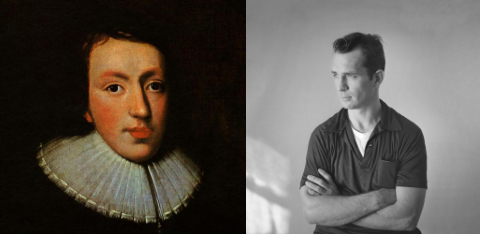
Here at Open Culture, we don’t just feature education in your recommended daily servings of culturally wide-ranging video, audio, text, and image — we also feature it in a form that goes deep: whole courses you can download to your computer or mobile device of choice and experience at your own pace. If you never quite studied all the literature you wanted to — or if you simply can’t get enough study of the stuff — pay a visit to our collection of over 50 free literature courses online. Some of them may even cover the same textual ground as the classes you felt curious about taking in college but could never quite fit into your schedule: “Dante in Translation” (Free Online Video — Free iTunes Audio - Free iTunes Video — Course Materials), for instance, or “Introduction to Theory of Literature” (Free Online Video — Free iTunes Audio – Free iTunes Video — Course Materials), or “Introduction to World Literature (Free Online Video).
Our collection offers courses with relatively broad literary subject matter, such as “American Passages: A Literary Survey” (Free Online Video) and “Contemporary Literature” (Free Online Video – Free Video Download), and others specific to one period or even one writer, like “Oscar Wilde” (Free Online Audio ). and the Allen Ginsberg-taught “Jack Kerouac” (Free Online Audio Part 1 and Part 2). Other offerings in our collection more closely resemble the courses you may have always wanted to take, but never found offered, like these from “Tolkien Professor” Corey Olsen:
- The Hobbit – Free iTunes Video — Free Online Audio — More
- Lord of the Rings I: The Road Goes Ever On — Free iTunes Video & Audio
- Lord of the Rings II: The Two Towers — Free Tunes Video & Audio — Free Online Video & Audio
- Lord of the Rings III: Return of the King — Free iTunes Video & Audio — Free Online Video & Audio
And yes, for those truly intent on continuing their education in Middle-Earth, Olsen also offers a “Silmarillion Seminar” (Free Online Video & Audio). If none of these appeal to your own intellectual curiosity, however, do visit the collection’s page for more options from existentialism to George Eliot to Shakespeare. (Nor should you miss our complete list, 1,700 Free Online Courses from Top Universities, which includes other subjects like philosophy, computer science, psychology, physics, religion and more.) And if you feel like something lighter, might I suggest John Green’s crash course on literature?
Related Content:
Download 100 Free Online Philosophy Courses & Start Living the Examined Life
800 Free eBooks for iPad, Kindle & Other Devices
Colin Marshall hosts and produces Notebook on Cities and Culture and writes essays on cities, language, Asia, and men’s style. He’s at work on a book about Los Angeles, A Los Angeles Primer. Follow him on Twitter at @colinmarshall or on Facebook.
Read More...Golden Apples of the Sun: 2 Hours of Dramatized Ray Bradbury Stories
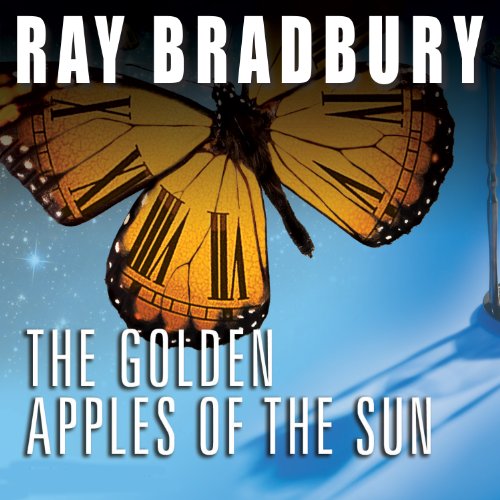
In 1953, Ray Bradbury published The Golden Apples of the Sun, an anthology of 22 short stories. The title (if it sounds familiar) takes inspiration from the final stanza of W. B. Yeats’ 1899 poem “The Song of Wandering Aengus”:
Though I am old with wandering
Through hollow lands and hilly lands,
I will find out where she has gone
And kiss her lips and take her hands;
And walk among long dappled grass,
And pluck till time and times are done
The silver apples of the moon,
The golden apples of the sun.
Some year later, in 1991, the BBC dramatized eight stories from Bradbury’s collection. Adapted by Lawrence Gilbert, the stories were performed by a full cast and aired on the radio. The audio, running almost two hours, can be streamed below thanks to Archive.org. It’s otherwise housed in our collection of 550 Free Audio Books. Enjoy.
Below we have some other radio dramatizations of sci-fi/dystopian classics.
Related Content:
Aldous Huxley Reads Dramatized Version of Brave New World
Free: Isaac Asimov’s Epic Foundation Trilogy Dramatized in Classic Audio
Revisit Orson Welles’ Iconic ‘War of the Worlds’ Broadcast
Read More...Dumbland, David Lynch’s Twisted Animated Series (NSFW)
David Lynch’s cult masterpiece Eraserhead freaked me out the first time I watched it back in high school. Few movies I’ve seen managed to operate so purely on dream logic, and fewer still had such an ability to stir the murky waters of my subconscious. And though the movie gave me nightmares, I was strangely drawn to the film. So I watched it again. And again. By the tenth or so viewing, I found myself laughing as if I were watching a Will Ferrell movie. Eraserhead might evoke all kinds of half-understood primal fears but it is also pretty damned funny.
That thread of black comedy extends in one form or another through all of Lynch’s work, from Frank Booth’s profane insistence on Pabst Blue Ribbon in Blue Velvet to the bumbling hitman who accidentally shoots a woman in the ass in Mulholland Drive. Lynch, like Hitchcock before him, realized that the horrible and the hilarious are, depending on your perspective, a hair’s width apart.
After the Mulholland Drive, Lynch became disenchanted with making movies while at the same time he grew intrigued by the possibilities offered by cheap digital cameras and the internet. In 2002, he made the animated series Dumbland, which Lynch himself called “very stupid, very crude.” Indeed, the simple black and white line drawings of Dumbland make Beavis and Butthead look like something out of Hayao Miyazaki. Lynch did everything himself, including all the voices.
Each short, which lasts around 3 minutes, centers on Randy — a semi-feral, prodigiously flatulent beast of a man who is just as likely to shout profanities at you as punch you in the face. Basically, think Homer Simpson meets Frank Booth. He lives with his unnamed wife, who looks like she’s always on the brink of mental collapse, and his young son. And since this is a David Lynch production, motives are unexplained, the atmosphere is filled with menace, and the dialogue is pregnant with a subtext that is utterly obscure.
The first episode, which you can see above (and be warned, there is a lot of swearing), shows Randy staring covetously at his neighbor’s shed before barking at a helicopter hovering overhead. His reedy neighbor reveals that he’s missing a limb and has some unusual sexual proclivities. The episode is absurd, disquieting and pretty funny. You can see the rest of the series here. You can watch it all in about a half hour.
Related Content:
David Lynch’s Unlikely Commercial for a Home Pregnancy Test (1997)
David Lynch Teaches You to Cook His Quinoa Recipe in a Weird, Surrealist Video
What David Lynch Can Do With a 100-Year-Old Camera and 52 Seconds of Film
Jonathan Crow is a Los Angeles-based writer and filmmaker whose work has appeared in Yahoo!, The Hollywood Reporter, and other publications. You can follow him at @jonccrow.
Read More...Mark Twain Writes a Rapturous Letter to Walt Whitman on the Poet’s 70th Birthday (1889)
May 31, 1889, Walt Whitman’s seventieth birthday, occasioned a celebration of the poet in his hometown of Camden, New Jersey, with a several course dinner called “The Feast of Reason” followed by a program called “The Flow of Soul,” a succession of testimonial speeches and readings by prominent politicians and a few minor literary figures. Whitman himself was in ill health, but he managed to attend during dessert, deliver a brief response, then stay for over two hours afterward (see the event’s original program, with menu, here). While the event itself, writes Ed Folsom in the Walt Whitman Quarterly Review, was intended as a “local celebration of Camden’s most famous personality,” the occasion prompted admirers worldwide to send birthday wishes by wire and letter. Some of the famous literary figures who wrote included John Addington Symonds, William Dean Howells, John Greenleaf Whittier, and Mark Twain.
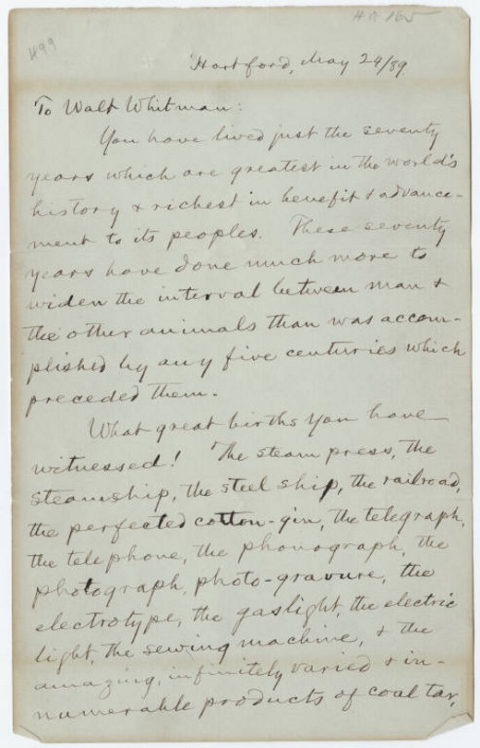
Twain’s letter (first page above) is not only a deeply heartfelt appreciation of the greatest living American poet, it is also, as Letters of Note puts it, “a love letter to human endeavor.” Twain enumerates with awe the astounding technological advances Whitman has witnessed in his lifetime, from steam power to photography to electric light. The letter is characteristic of the optimism of the age—so perfectly captured a little over a decade later in Henry Adams’ memoir chapter “The Dynamo and the Virgin.” Twain, hardly a religious man, evinces an almost rapturous faith in progress, concluding with a Biblical allusion and a somewhat obscure reference to an apocalyptic figure—“him for whom the earth was made”—who would appear in thirty years time. One can’t help but think, in hindsight, of Yeats’ 1919 occult meditation on the loss of that Victorian certainty in “The Second Coming.” As Marc L. Roark observes at The Literary Table, “Twain was correct — thirty years from the letter would see technology like the world never knew. Unfortunately, that technology was that of war.”
Hartford, May 24/89
To Walt Whitman:
You have lived just the seventy years which are greatest in the world’s history & richest in benefit & advancement to its peoples. These seventy years have done much more to widen the interval between man & the other animals than was accomplished by any five centuries which preceded them.
What great births you have witnessed! The steam press, the steamship, the steel ship, the railroad, the perfected cotton-gin, the telegraph, the phonograph, the photograph, photo-gravure, the electrotype, the gaslight, the electric light, the sewing machine, & the amazing, infinitely varied & innumerable products of coal tar, those latest & strangest marvels of a marvelous age. And you have seen even greater births than these; for you have seen the application of anesthesia to surgery-practice, whereby the ancient dominion of pain, which began with the first created life, came to an end in this earth forever; you have seen the slave set free, you have seen the monarchy banished from France, & reduced in England to a machine which makes an imposing show of diligence & attention to business, but isn’t connected with the works. Yes, you have indeed seen much — but tarry yet a while, for the greatest is yet to come. Wait thirty years, & then look out over the earth! You shall see marvels upon marvels added to these whose nativity you have witnessed; & conspicuous above them you shall see their formidable Result — Man at almost his full stature at last! — & still growing, visibly growing while you look. In that day, who that hath a throne, or a gilded privilege not attainable by his neighbor, let him procure his slippers & get ready to dance, for there is going to be music. Abide, & see these things! Thirty of us who honor & love you, offer the opportunity. We have among us 600 years, good & sound, left in the bank of life. Take 30 of them — the richest birth-day gift ever offered to poet in this world — & sit down & wait. Wait till you see that great figure appear, & catch the far glint of the sun upon his banner; then you may depart satisfied, as knowing you have seen him for whom the earth was made, & that he will proclaim that human wheat is worth more than human tares, & proceed to organize human values on that basis.
Mark Twain
See Letters of Note for the remaining images of Twain’s letter. You can peruse all of the speeches, letters, and telegrams addressed to Whitman on his 70th birthday in the collection Camden’s Compliment to Walt Whitman, published that same year.
For many more fascinating historical letters, be sure to check out Letters of Note’s new book, Letters of Note: Correspondence Deserving of a Wider Audience.
Related Content:
Hear Walt Whitman (Maybe) Reading the First Four Lines of His Poem, “America” (1890)
Mark Twain Writes a “Gushing,” “Self-Deprecating” Wedding Announcement to His Family (1869)
Mark Twain Drafts the Ultimate Letter of Complaint (1905)
Josh Jones is a writer and musician based in Durham, NC. Follow him at @jdmagness.
Read More...Support Us
We're hoping to rely on loyal readers, rather than erratic ads. Please click the Donate button and support Open Culture. You can use Paypal, Venmo, Patreon, even Crypto! We thank you!

About Us

Open Culture scours the web for the best educational media. We find the free courses and audio books you need, the language lessons & educational videos you want, and plenty of enlightenment in between.
Advertise With Us

FREE UPDATES!
GET OUR DAILY EMAIL
Get the best cultural and educational resources on the web curated for you in a daily email. We never spam. Unsubscribe at any time.
FOLLOW ON SOCIAL MEDIA

Open Culture editor Dan Colman scours the web for the best educational media. He finds the free courses and audio books you need, the language lessons & movies you want, and plenty of enlightenment in between.
Advertise With Us