Animated Video: Johnny Cash Explains Why Music Became a Religious Calling
Blank on Blank is back with another animated video. This one animates a long lost interview with the great Johnny Cash. Interviewed by Barney Hoskyns back in 1996, Cash talked about music as a religious calling. Playing music was akin to preaching the gospel, and he knew he’d continue making music until his final days. Should we be surprised then, that seven years later, Cash completed more than 60 songs during the last four months of his life? He died with his boots on indeed.
Below we’ve highlighted for you some great Johnny Cash material from our archive.
Related Content:
The First Episode of The Johnny Cash Show, Featuring Bob Dylan & Joni Mitchell (1969)
The 1969 Bob Dylan-Johnny Cash Sessions: Twelve Rare Recordings
Johnny Cash Sings “Man in Black” for the First Time, 1971
Read More...Jim Carrey Sings a Pretty Damn Good Cover of The Beatles “I Am the Walrus”
Back in 1998, the Beatles producer, George Martin, produced an album called In My Life. It’s probably not an LP that ever made it into your record collection, unless you’re a fan of middling covers of Beatles songs. (In which case, you’ll love our old post, The 15 Worst Covers of Beatles Songs: William Shatner, Bill Cosby, Tiny Tim, Sean Connery & Your Excellent Picks.) But the compilation does feature one recording that hasn’t quite faded from view — Jim Carrey’s take on “I Am the Walrus.” There’s a comedic component to his performance. But Carrey also demonstrates a “vocal elasticity” that you might not have expected. If you’ve never heard the Beatles’ original recording (God help you), you can find it here.
Related Content:
Guitarist Randy Bachman Demystifies the Opening Chord of ‘A Hard Day’s Night’
Peter Sellers Reads The Beatles’ “She Loves You” in Four Different Accents
Here Comes The Sun: The Lost Guitar Solo by George Harrison
The Beatles: Unplugged Collects Acoustic Demos of White Album Songs (1968)
Read More...Richard Dawkins’ Documentary The God Delusion Tackles Faith & Religious Violence (2006)
The very title of Richard Dawkins’ 2006 book The God Delusion was intended to provoke, and the Oxford evolutionary biologist has seemingly done nothing but, since taking his stand against religions of all kinds, particularly the big monotheisms that claim most of the world’s inhabitants. Dawkins infuriates theists on the right with his self-assured claim that “there almost certainly is no God” and skeptics on the left, who charge him with sexism and racism. Even journalist and journeyman intellectual Christopher Hedges—no friend to authoritarian religions—accuses Dawkins of the same kind of intolerance as Christian, Jewish, and Islamic fundamentalists.
Meanwhile, thousands of people who may or may not follow Dawkins’ every inflammatory tweet credit him with giving them the courage and conviction to walk away from faiths they found oppressive. In that regard, he’s accomplished his goal, and his Richard Dawkins Foundation continues to advocate strenuously for “scientific education, critical thinking and evidence-based understanding of the natural world in the quest to overcome religious fundamentalism, superstition, intolerance and human suffering.”
If you’ve somehow missed Dawkins’ message amidst the furor over his method, you can get caught up rather quickly with the film above. Titled, like his book, The God Delusion, the film compiles the two 45-minute episodes of a documentary series produced for BBC 4 called Root of All Evil?, first broadcast in 2006 as a companion to the book. (The producers chose the title to create controversy—Dawkins has called the notion of any one thing being the “root of all evil” ridiculous.) In his introduction to the film, Dawkins proposes to explore “a world increasingly polarized by religion,” and to find out why faith has such a grip on the human mind.
Surveying regions from America’s Midwest to Israel, the film “takes a hard look at the very concept of faith: how it behaves like a kind of ‘brain virus,’ infecting generations of young minds, how it perpetuates outdated and dubious moral values.” Why, asks Dawkins, should religion “demand, and usually receive, our society’s respect”? It’s still a question worth asking, even if you don’t like Dawkins’ answers, or Dawkins himself.
You can find The God Delusion in our collection of Free Documentaries, part of our larger collection of 675 Free Movies Online.
Related Content:
Josh Jones is a writer and musician based in Durham, NC. Follow him at @jdmagness
Read More...How the CIA Turned Doctor Zhivago into a Propaganda Weapon Against the Soviet Union

Humanity has long pondered the relative might of the pen and the sword. While one time-worn aphorism does grant the advantage to the pen, most of us have entertained doubts: the sword, metaphorically or literally, seems to have won out across an awfully wide swath of history. Still, the pen has scored some impressive victories, some even in living memory. Take, for example, the CIA’s recently revealed use of Boris Pasternak’s novel Doctor Zhivago as a propaganda weapon. Repressed in Pasternak’s native Russia, the book first appeared in Italy in 1957. The following year, the British suggested to America’s Central Intelligence Agency that the book stood a decent chance of winning hearts and minds behind the Iron Curtain — if, of course, they could get a few copies in there. A CIA memo sent across its own Soviet Russia Division subsequently pronounced Doctor Zhivago as possessed of “great propaganda value, not only for its intrinsic message and thought-provoking nature, but also for the circumstances of its publication. We have the opportunity to make Soviet citizens wonder what is wrong with their government, when a fine literary work by the man acknowledged to be the greatest living Russian writer is not even available in his own country in his own language for his own people to read.”
That evaluation comes from one of the over 130 declassified documents used by Peter Finn and Petra Couvée in their brand new history of this act of real-life literary espionage, The Zhivago Affair: The Kremlin, the CIA and the Battle Over a Forbidden Book. You can read an in-depth article on some of the events involved in this operation — the CIA’s printing of both hardcover and miniature paperback Russian-language editions, the not-so-clandestine distribution of copies at 1958’s Brussels Universal and International Exposition, the CIA’s unexpected alliance with the Vatican in this mission, the inept probing by Soviet “researchers” — at the Washington Post.
You can also watch a CBS This Morning clip on the book just above. Dramatic though this “Zhivago Affair” sounds, it came as neither the first nor last American use of culture as a means of destabilizing the Soviet Union. We’ve even previously featured two others: secretly-funded abstract expressionist painting, and Louis Armstrong’s 1965 East Berlin and Budapest concerts. Cold War America may have had the sword, in the form of its vast nuclear arsenal, polished and ready, but clearly it retained a certain regard for the pen — and brush, and trumpet — as well.
Related Content:
Louis Armstrong Plays Historic Cold War Concerts in East Berlin & Budapest (1965)
How the CIA Secretly Funded Abstract Expressionism During the Cold War
Colin Marshall hosts and produces Notebook on Cities and Culture and writes essays on cities, language, Asia, and men’s style. He’s at work on a book about Los Angeles, A Los Angeles Primer. Follow him on Twitter at @colinmarshall or on Facebook.
Read More...Free: Watch the First Episode of Silicon Valley, Mike Judge’s New HBO Series
Mike Judge’s 1998 movie Office Space struck a nerve with just about anyone who ever wound up in a thankless low-end white collar job. Few movies before or since have been able to articulate the petty indignities, the inanities and the general soul gnawing awfulness of such gigs. Though the film is far from perfect, its abundance of painfully funny jokes along with some eminently quotable lines — “Ummm I’m gonna need you to go ahead and come in tomorrow” — have enshrined Office Space into the canon of cult movies.
Sixteen years later, Mike Judge has a new sitcom that aims its satirical sites on another white-collar ecosystem – Silicon Valley (the home of Open Culture). The series centers on nebbish programmer Richard who unwittingly develops a new revolutionary way to compress files. Soon he finds himself in a bidding war between two of the tech world’s biggest entrepreneurs. Like Office Space, the fun of the show is its wry, acerbic observations about the rarified culture of the valley.
Just like some apps that offer themselves for free before making you pay, the creators of Silicon Valley are offering the first episode of the HBO series for free on YouTube. Check it out above. Now if only they would do the same thing for season four of Game of Thrones.
Recent Posts:
The Secret History of Silicon Valley
Serial Entrepreneur Damon Horowitz Says “Quit Your Tech Job and Get a Ph.D. in the Humanities”
Start Your Startup with Free Stanford Courses and Lectures
Jonathan Crow is a Los Angeles-based writer and filmmaker whose work has appeared in Yahoo!, The Hollywood Reporter, and other publications. You can follow him at @jonccrow.
Read More...Hear Lost Recording of Pink Floyd Playing with Jazz Violinist Stéphane Grappelli on “Wish You Were Here”
Those of you deeply into both jazz violin and progressive rock no doubt jumped right on the play button above. Quite a few more will listen — so experience has taught me — purely out of interest in anything and everything Pink Floyd has done. But on the level of music history, the track above, a version of the cerebral English rock band’s Pink Floyd’s well-known 1975 song “With You Were Here” prominently featuring a solo from the French “Grandfather of Jazz Violinists” Stéphane Grappelli, should fascinate just about anyone. It speaks to the particular kind of high-profile musical experimentalism that thrived in that era, at least in some quarters — or, rather, in some studios. In this case, the Grappelli and the Floyd boys found themselves recording in adjacent ones. Why would the latter invite the former, already an elder statesman of jazz and a collaborator with the likes of Django Reinhardt, to sit in on a session? (Watch Django and Grappelli play together in the 1938 film, Jazz Hot here.) Well… why not? They needed something impressive to follow Dark Side of the Moon, after all.
Still, for all the richness of the result you hear here and all the fan-hours spent listening to Pink Floyd’s Wish You Were Here album in the 35 years after it came out, the public never got to hear Grappelli’s playing foregrounded until Immersion reissued it three years ago. This long-lost but rediscovered mix of the title track marks, to the mind of Pink Floyd founding member Nick Mason, a marked improvement over the version on the original album. “I think that was the jewel in that particular crown,” he said to Sonic Reality. “It was something that I assumed had been lost forever. I thought we’d recorded over it. [ … ] I can’t imagine why we didn’t use it at the time.” In the one they did use at the time, what remains of Grappelli’s playing came out so inaudible that the album’s credits didn’t even name the violinist. I’d like to chalk up another point for the cultural revision made possible by our technological age, but alas, I doubt any sort of rediscovery will break true Floyd acolytes of their adherence to the canon.
If you would like to support the mission of Open Culture, consider making a donation to our site. It’s hard to rely 100% on ads, and your contributions will help us continue providing the best free cultural and educational materials to learners everywhere. You can contribute through PayPal, Patreon, and Venmo (@openculture). Thanks!
Related Content:
Pink Floyd’s David Gilmour Sings Shakespeare’s Sonnet 18
Watch Documentaries on the Making of Pink Floyd’s Dark Side of the Moon and Wish You Were Here
Dark Side of the Rainbow: Pink Floyd Meets The Wizard of Oz in One of the Earliest Mash-Ups
Watch Pink Floyd Play Live in the Ruins of Pompeii (1972)
Jazz ‘Hot’: The Rare 1938 Short Film With Jazz Legend Django Reinhardt
Colin Marshall hosts and produces Notebook on Cities and Culture and writes essays on cities, language, Asia, and men’s style. He’s at work on a book about Los Angeles, A Los Angeles Primer. Follow him on Twitter at @colinmarshall or on Facebook.
Read More...Listen to the Los Angeles Philharmonic Play Through an Earthquake
As they say, the show must go on.…
Writes the LA Philharmonic on their Youtube Channel:
On March 28, 2014 at 9:09pm, a 5.1 magnitude earthquake rocked Los Angeles. The Los Angeles Philharmonic was six minutes into a performance of Ravel’s “Daphnis and Chloé” with guest conductor Charles Dutoit when the quake hit. A strong jolt followed by a minute of rumbling did not unhinge the orchestra or Maestro Dutoit, and the stirring concert continued without a hitch.
What you’ll hear above is an actual recording. Annotations help explain the sequence of events.
via BoingBoing
Read More...Listen to John Cage’s 5 Hour Art Piece: Diary: How To Improve The World (You Will Only Make Matters Worse)
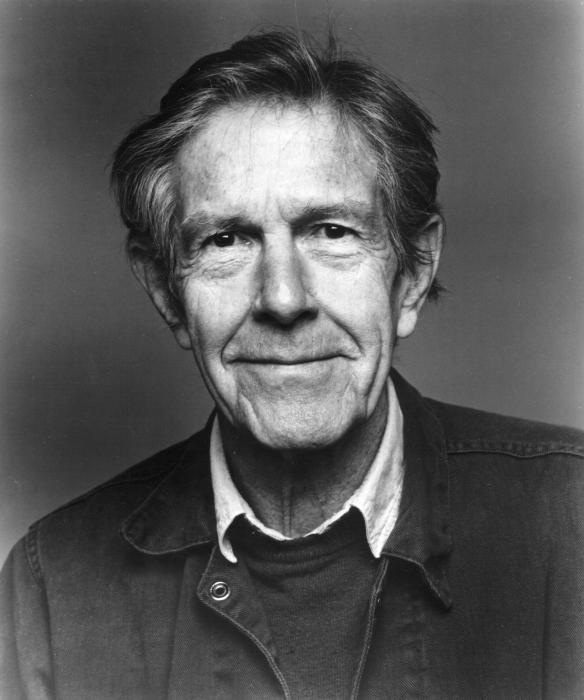
John Cage was born in 1915 and died in 1992. During that intervening time, he changed the face of avant-garde music and art.
An early disciple of Arnold Schoenberg, Cage made his biggest creative breakthrough by studying the I Ching, Zen Buddhism and the art of Marcel Duchamp. The composer decided to let elements of chance into his work. He started to write pieces for a “prepared piano” where things like thumbtacks, nails and forks were placed into the instrument’s strings to alter its sound in unexpected ways.
Cage’s most famous work, 4’33”, took conceptual music about as far as it could go. A musician walks out onto the stage, sits in front of a piano and does absolutely nothing for four minutes and thirty seconds. The sounds of the audience rustling, the traffic outside and any other ambient noise that might happen during that time period become a part of the piece. Watch a performance here.
The folks over at Ubu.com have placed online another one of Cage’s work, Diary: How To Improve The World (You Will Only Make Matters Worse) (1991). Clocking in at over 5 hours total, the piece is something of a Mount Everest of sound art.
Recorded in Switzerland a little over a year before his death, Diary features thoughts, observations and insights along with quotes from the likes of Buckminster Fuller, Henry David Thoreau and Mao Zedong. You can listen to Part 1 below, and click these links to listen to the remaining parts: Part 1, Part 2, Part 3, Part 4, Part 5, Part 6, Part 7, Part 8.
Cage’s diaries appeared previously in print as M: Writings, 1967–72. On the page, the text randomly changed both font and letter size. You can see what this looks like here. Cage and company reproduced this effect in the audio version by changing the position of the microphone and the recording volume. If you listen to Diary on headphones (which I recommend), you’ll hear Cage’s silken voice first behind your left ear, then in front of you and then, disconcertingly, inside your head.
Much of the time, Cage’s words will feel obscure and poetic. And then, as you’re lulled by the rhythm of his voice, he’ll hit you with something as profound as a Zen koan. (“The goal is not to have a goal.”) Just sit back and let the words flow over you.
Related Content:
Hear Joey Ramone Sing a Piece by John Cage Adapted from James Joyce’s Finnegans Wake
Watch a Surprisingly Moving Performance of John Cage’s 1948 “Suite for Toy Piano”
Woody Guthrie’s Fan Letter To John Cage and Alan Hovhaness (1947)
Jonathan Crow is a Los Angeles-based writer and filmmaker whose work has appeared in Yahoo!, The Hollywood Reporter, and other publications. You can follow him at @jonccrow.
Read More...
Human, All Too Human: 3‑Part Documentary Profiles Nietzsche, Heidegger & Sartre
Certainly three of the most radical thinkers of the last 150 years, Nietzsche, Heidegger, and Sartre were also three of the most controversial, and at times politically toxic, for their perceived links to totalitarian regimes. In Nietzsche’s case, the connection to Nazism was wholly spurious, concocted after his death by his anti-Semitic sister. Nevertheless, Nietzsche’s philosophy is far from sympathetic to equality, his politics, such as they are, highly undemocratic. The case of Heidegger is much more disturbing—a member of the Nazi party, the author of Being and Time notoriously held fascist views, made all the more clear by the recent publication of his infamous “black notebooks.” And Sartre, author of Being and Nothingness, has long been accused of supporting Stalinism—a charge that may be oversimplified, but is not without some merit.
Despite these troubling associations, all three philosophers are often held up as representatives—along with Søren Kierkegaard and Albert Camus—of Existentialism, broadly a philosophy of freedom against oppressive religious and political systems that seek to define and order human life according to predetermined values. Whether all three thinkers deserve the label (Heidegger, like Camus, flatly rejected it) is a matter of some dispute, and yet, the BBC documentary series Human, All Too Human, named for Nietzsche’s 1878 collection of aphorisms, loosely uses the term to tie them together, acknowledging that it had yet to be coined in Nietzsche’s time.
The first episode, at the top, introduces the great 19th century German atheist by way of interviews with Nietzsche scholars and biographers. Episode two covers Heidegger, with frank discussions of his Nazi party affiliation and its implications for his thought.
The third episode focuses on Sartre, the only thinker of the three to call himself an existentialist. Both Sartre and his partner Simone de Beauvoir wrote on the subject, defending the philosophical outlook in essays and interviews.
In one of Sartre’s most famous defenses, “Existentialism and Human Emotion,” he emphatically defines his philosophical stance as anti-essentialist and atheistic—unlike the Christian Kierkegaard before him.
Atheistic existentialism, which I represent, is more coherent. It states that if God does not exist, there is at least one being in whom existence precedes essence, a being who exists before he can be defined by any concept, and that this being is man, or, as Heidegger says, human reality. What is meant here by saying that existence precedes essence? It means that, first of all, man exists, turns up, appears on the scene, and, only afterwards, defines himself. If man, as the existentialist conceives him, is indefinable, it is because at first he is nothing. […] Thus, there is no human nature, since there is no God to conceive it. Not only is man what he conceives himself to be, but he is also only what he wills himself to be after this thrust toward existence.
Existentialism has become a wide net, used to capture similarities in the work of otherwise widely divergent thinkers. However, the use of the term historically belongs to the 1940s and 50s, to a movement as much literary as philosophical, and Sartre was its greatest champion and, some would say, the only true Existentialist philosopher. Nevertheless, the label captures something of the daring and the danger of radical philosophy that redefines, or outright rejects, traditional norms. For all their flaws and contradictions, all three of the thinkers profiled above made significant contributions to our understanding of what it means to be human—and to be an individual—in an increasingly mechanized, homogenized, and dehumanizing civilization.
Related Content:
Walter Kaufmann’s Classic Lectures on Nietzsche, Kierkegaard and Sartre (1960)
Martin Heidegger Talks About Language, Being, Marx & Religion in Vintage 1960s Interviews
100 Free Philosophy Courses Online
Josh Jones is a writer and musician based in Durham, NC. Follow him at @jdmagness
Read More...How to Survive the Coming Zombie Apocalypse: An Online Course by Michigan State
These days, the naysayers like to ask: “What is a college education good for? What does it prepare you to do in the world?”
Here’s one compelling answer for you: Survive an Apocalypse.
Starting on May 12, Michigan State students can take an award-winning online course called Surviving the Coming Zombie Apocalypse — Disasters, Catastrophes, and Human Behavior. The course “brings together the latest thinking on how and why humans behave during disasters and catastrophes. Why do some survive and others don’t? What are the implications for planning, preparedness, and disaster management?” Along the way, students will form survival groups whose goal is to escape death, endure catastrophic events, and preserve the future of civilization. Together, they will learn a valuable lesson: survival depends not on the individual, but on the group. Unfortunately, the course is only open to MSU students and guest students for a fee. But you can watch the trailer above for free. Be warned, the film, and especially the Charles Manson-like character, is a little intense.
via Mental Floss
Related Content:
An Animated Survival Guide to the Post Apocalypse
How a Clean, Tidy Home Can Help You Survive the Atomic Bomb: A Cold War Film from 1954
53 Years of Nuclear Testing in 14 Minutes: A Time Lapse Film by Japanese Artist Isao Hashimoto
Duck and Cover, or: How I Learned to Elude the Bomb
Read More...Support Us
We're hoping to rely on loyal readers, rather than erratic ads. Please click the Donate button and support Open Culture. You can use Paypal, Venmo, Patreon, even Crypto! We thank you!

About Us

Open Culture scours the web for the best educational media. We find the free courses and audio books you need, the language lessons & educational videos you want, and plenty of enlightenment in between.
Advertise With Us

FREE UPDATES!
GET OUR DAILY EMAIL
Get the best cultural and educational resources on the web curated for you in a daily email. We never spam. Unsubscribe at any time.
FOLLOW ON SOCIAL MEDIA

Open Culture editor Dan Colman scours the web for the best educational media. He finds the free courses and audio books you need, the language lessons & movies you want, and plenty of enlightenment in between.
Advertise With Us

