Watch Episode #5 of Neil deGrasse Tyson’s Cosmos: Unlocking the Mysteries of Light (US Viewers)
Episode 5 of Neil deGrasse Tyson’s Cosmos series aired last night on Fox. Thanks to Hulu, US viewers can now watch it online. The episode, called “Hiding the Light,” explores the wave theory of light. It moves across 2000+ years of history and eventually gets into the scientific work of Isaac Newton, William Herschel and Joseph von Fraunhofer, before winding up in modern times and touching on big questions contemplated by astronomers. (For a deeper dive into this material, see our collection of Free Astronomy Courses.) If you need to catch up on earlier episodes, you can find them below.
Previous Episodes:
Episode #1: “Standing Up in the Milky Way”
Episode #2: “Some of the Things That Molecules Do”
Episode #3: “When Knowledge Conquered Fear“
Episode #4: “A Sky Full of Ghosts”
Read More...Notebook on Cities and Culture’s In-Depth Podcast Tour of South Korea Kickstarts Today

When not writing here at Open Culture, I host and produce Notebook on Cities and Culture (iTunes link), a globe-traveling podcast dedicated to in-depth conversation with cultural creators, internationalists, and observers of the urban scene about the work they do and the world cities they do it in. Through Kickstarter, I’ve funded the show’s first four seasons, with interviews recorded in places like Los Angeles, Osaka, Vancouver, Mexico City, Copenhagen, and London. Today, a new Kickstarter drive begins to fund the show’s latest and most ambitious venture: the Korea Tour, a season of conversations recorded all around the most fascinating country in Asia today.
You may well have already enjoyed the considerable and often surprising fruits of modern Korean culture through its film (Hong Sangsoo’s work first pulled me in, and boy, does it continue to), its music (which, I can assure you, goes well beyond Girls’ Generation and “Gangnam Style”), its television (which, by the same token, offers more than all reportedly addictive melodramas), or its food (the experience of which doesn’t start and end at barbecue joints). On Notebook on Cities and Culture’s Korea Tour, you’ll go much deeper, hearing from a wide variety of interesting people based in Korea, outside as well as in the vast and undoubtedly exciting capital of Seoul. I’ll talk to as wide a range as possible of Koreans and foreigners alike, including the literarily, technologically, academically, culinarily, and cinematically inclined — to name but a few of their many inclinations.
If you’d like to make the Korea Tour happen, please do visit its Kickstarter page within the week, during which we’ll need to raise its $5000 budget. Should you decide to become a backer, rewards include postcards from Korea, mentions of your project or message on the show, and copies from the very-limited-indeed print run of my textual and photographic Korea Diary. 여러분, 읽어 주셔서 감사합니다. 한국에 갑시다!
Related Content:
“Notebook on Cities and Culture,” a Worldwide In-Depth Interview Podcast, Kickstarting Now
A Wealth of 20th-Century Korean Cinema, Free Online from the Korean Film Archive
Colin Marshall hosts and produces Notebook on Cities and Culture and writes essays on cities, language, Asia, and men’s style. He’s at work on a book about Los Angeles, A Los Angeles Primer. Follow him on Twitter at @colinmarshall or on Facebook.
Read More...Free Online Shakespeare Courses: Primers on the Bard from Oxford, Harvard, Berkeley & More

I had the great good fortune of having grown up just outside Washington, DC, where on a fifth grade class trip to the Folger Library and Theater, I fell in love with Shakespeare. This experience, along with a few visits to see his plays performed at nearby Wolftrap, made me think I might go into theater. Instead I became a student of literature, but somehow, my love of Shakespeare on the stage didn’t translate to the page until college. While studying for a sophomore-level “Histories & Tragedies” class, I sat, my Norton Shakespeare open, in front of the TV—reading along while watching Kenneth Branagh’s stylish film adaptation of Hamlet, which draws on the entire text of the play.
Only then came the epiphany: this language is music and magic. The rhythmic beauty, depths of feeling, humor broad and incisive, extraordinary range of human types.… If we are to believe pre-eminent Shakespeare scholar Harold Bloom, Shakespeare invented modern humanity. If this seems to go too far, he at least captured human complexity with greater inventive skill than any English writer before him, and possibly after. Is there any shame in finally “getting” Shakespeare’s language from the movies? None at all. One of the most excellent qualities of the Bard’s work—among so many reasons it endures—is its seemingly endless adaptability to every possible period, cultural context, and medium.
While engagement with any of the innumerable Shakespeare adaptations and performances promises reward, there’s little that enhances appreciation of the Bard’s work more than reading it under the tutelage of a trained scholar in the playwright’s Elizabethan language and history. Universal though he may be, Shakespeare wrote his plays in a particular time and place, under specific influences and working conditions. If you have not had the pleasure of studying the plays in a college setting—or if your memories of those long-ago English classes have faded—we offer a number of excellent free online courses from some of the finest universities. See a list below, all of which appear in our list of Free Online Literature Courses, part of our larger list of 875 Free Online Courses.
Also, speaking of the Folger, that venerable institution has just released all of Shakespeare’s plays in free, searchable online texts based on their highly-regarded scholarly print editions. And though some beg to differ, I still say you can’t go wrong with Branagh.
- Approaching Shakespeare – Free iTunes Audio — Free Online Audio -Emma Smith, Oxford
- Shakespeare After All: The Later Plays – Free Course in Multiple Formats – Marjorie Garber, Harvard
- Shakespeare’s Principal Plays — Free iTunes Audio – Free Online Audio — Ralph Williams, University of Michigan
- Survey of Shakespeare’s Plays — Free Online Audio – William Flesch, Brandeis
- Not Shakespeare: Elizabethan and Jacobean Popular Theatre –Free iTunes Audio — Free Online Audio — Multiple profs, Oxford
- Shakespeare — Free iTunes Audio — Free Online Audio — Charles Altieri, UC Berkeley
Related Content:
Read All of Shakespeare’s Plays Free Online, Courtesy of the Folger Shakespeare Library
Take a Virtual Tour of Shakespeare’s Globe Theatre
Josh Jones is a writer and musician based in Durham, NC. Follow him at @jdmagness
Read More...Batman Stars in an Unusual Cartoon Adaptation of Dostoyevsky’s Crime and Punishment
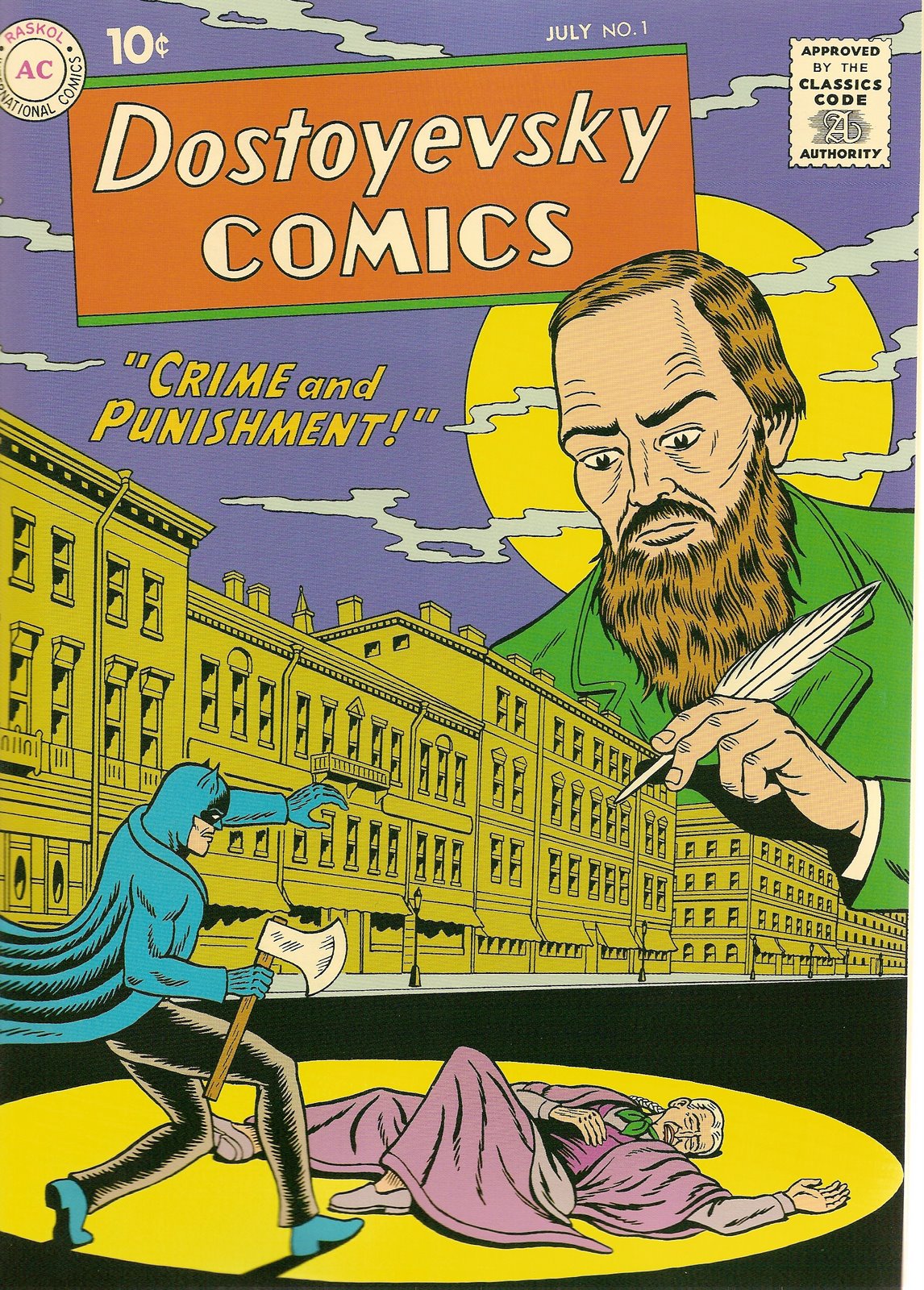
On Friday, Fyodor Dostoyevsky’s Crime and Punishment topped our crowdsourced list of Books Intelligent People Should Read. If you haven’t read Dostoyevsky’s classic novel of murder and guilt, you should give it a go. But if you’re looking for a lighter, more playful take on the novel, we give you Dostoyevsky Comics, a short cartoon adaptation that somehow inserts Batman into the Russian tale. The comic was authored by R. Sikoryak, who specializes in creating comic parodies of literary classics. You can purchase his Masterpiece Comics on Amazon here.
If you would like to support the mission of Open Culture, consider making a donation to our site. It’s hard to rely 100% on ads, and your contributions will help us continue providing the best free cultural and educational materials to learners everywhere. You can contribute through PayPal, Patreon, and Venmo (@openculture). Thanks!
Related Content:
Download 15,000+ Free Golden Age Comics from the Digital Comic Museum
Free Comic Books Turn Kids Onto Physics: Start with the Adventures of Nikola Tesla
Batgirl Fights for Equal Pay in a 1960s Television Ad Supporting The Equal Pay Act
Read More...
Soviet Artists Envision a Communist Utopia in Outer Space
Soviet artists had been toiling for years on a creative, collective future vision by the time David Bowie got around to launching Major Tom into outer space.
As Vincze Miklós reports on io9, their efforts extended the hope of a “worker’s Utopia on Earth” to destinations in the solar system.
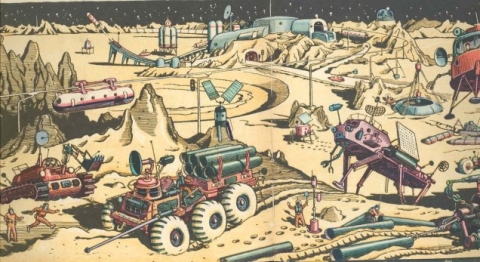
In 1965, filmmaker Pavel Klushantsev’s Stantsiia “Luna” (Station Moon) treated children to a highly satisfying vision of the lunar surface as a bustling construction site.
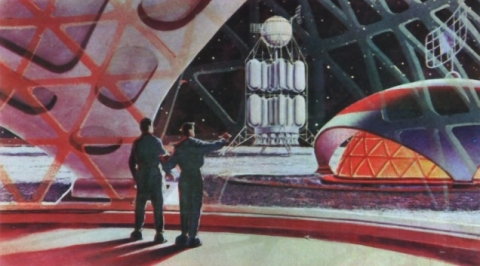
Workers, hell. It’s not hard to imagine Andrei Sokolov, whose paintings were exhibited aboard the Mir station, producing high quality renderings for Mad Men’s Don Draper to show high-rolling Martian clients.

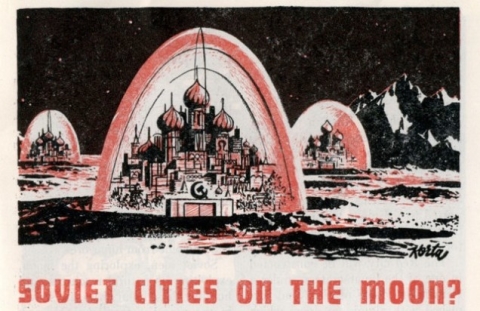
And pop science mag Tekhnika Molodezhi (“Technology for the Youth”) promoted the space race with pages of intriguing four-color images. The dollhouse-like cross section (above) of a communal residence below the moon’s crust is practically screaming Wes Anderson’s name.
Those who’ve never had much stomach for the Jetsons’ primitive aesthetic might find this lush Soviet vision much easier to swallow.
More images can be found at io9.
Related Content:
Watch Dziga Vertov’s Unsettling Soviet Toys: The First Soviet Animated Movie Ever (1924)
Enjoy 15+ Hours of the Weird and Wonderful World of Post Soviet Russian Animation
“Moon Hoax Not”: Short Film Explains Why It Was Impossible to Fake the Moon Landing
Ayun Halliday is the author of seven books, and creator of the award winning East Village Inky zine. Follow her @AyunHalliday
Read More...Old Books Bound in Human Skin Found in Harvard Libraries (and Elsewhere in Boston)
For at least a decade now, the “death of print” has seemed all but inevitable. Amidst all the nostalgia for printed literature, it’s easy to forget that mass-produced books and media, and a literate population, are fairly recent phenomena in human history. Books—whether printed or hand-copied—had a totemic status for thousands of years, given that they were kept under the protection of an educated elite, who were among the few able to read and interpret them. Even after the age of printing, books were rare and hard to come by, largely too expensive for most people to afford until the advent of paperbacks.
A grisly reminder of the book’s status as an almost magical object surfaced in Harvard’s rare book collection a few years ago. In 2006, librarians discovered at least three volumes bound in human skin—and as travel site Roadtrippers reports, “in one case, skin harvested from a man who was flayed alive.” Gruesome as all this seems, the practice of skin-binding was apparently not the sole province of serial killers:
As it turns out, the practice of using human skin to bind books was actually pretty popular during the 17th century. It’s referred to as Anthropodermic bibliopegy and proved pretty common when it came to anatomical textbooks. Medical professionals would often use the flesh of cadavers they’d dissected during their research.
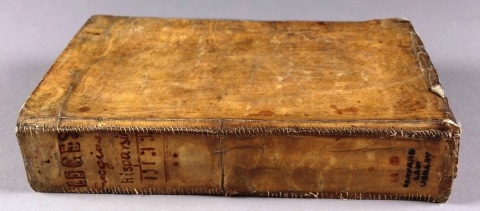
The book supposedly made of flayed skin is a Spanish law text from the seventeenth century titled Practicarum quaestionum circa leges regias (above). Despite an inscription naming the deceased and claiming his skin as the binding, this volume has actually just been identified as sheepskin—according to a Harvard Law Library blog post from yesterday—“thanks to a technique for identifying proteins that was developed in the last twenty years.” Speculates the Law Library post:
Perhaps before it arrived at HLS [Harvard Law School] in 1946, the book was bound in a different binding at some point in its history. Or perhaps the inscription was simply the product of someone’s macabre imagination.
Nevertheless, other human skin-bound books exist—as far as librarians and scientists can determine. Former director of libraries for the University of Kentucky Lawrence S. Thompson claims that the practice dates as far back as a 13th century French Bible and became more common in the 16th and 17th centuries. A 1933 Crimson article mentioned another skin-bound book in a collection of miniature books, including this graphic detail: “removal of 20 square inches of skin from his back failed to impair the health of its donor, who is still alive and in the best of condition.”
Another skin-bound volume, which Thompson calls “the most famous of all anthropodermic bindings,” resides across the river from Harvard at independent library the Boston Athenaeum. Called The Highwayman: Narrative of the Life of James Allen alias George Walton (above), the book is a memoir of the titular outlaw. The author, reports the Crimson, “was impressed by the courage of a man whom he once attacked, and when Walton was facing execution, he asked to have his memoir bound in his own skin and presented to the brave man.” Thumb through (so to speak) a digital copy of Walton’s 1837 memoir above, and imagine being the recipient of such a gift.
via Roadtrippers
Related Content:
How a Book Thief Forged a Rare Edition of Galileo’s Scientific Work, and Almost Pulled it Off
Josh Jones is a writer and musician based in Durham, NC. Follow him at @jdmagness
Read More...The Books You Think Every Intelligent Person Should Read: Crime and Punishment, Moby-Dick & Beyond (Many Free Online)
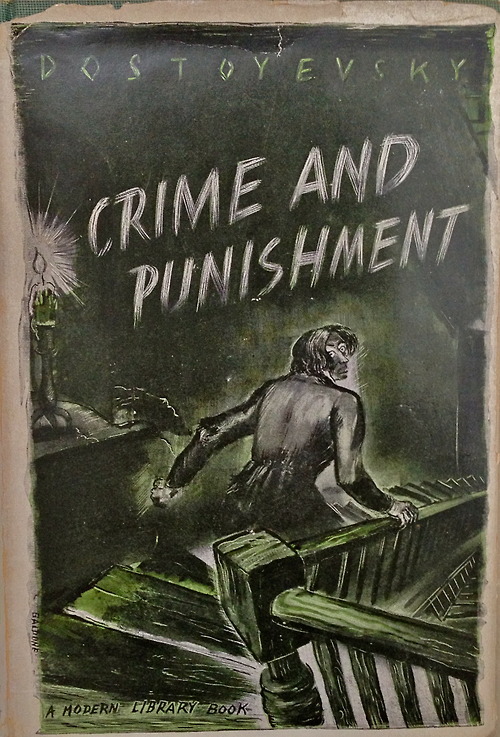
While I normally try not to get involved with comments on web sites (you know what I mean), I’d rather get involved with the comments of some web sites than others. I doubt that underneath any Youtube video, for example, you’d find dozens and dozens of well-considered suggestions for the canon of books every intelligent person should read, as we did here at Open Culture when we put the question to you on Wednesday. In the comments to that post as well as on our Facebook Page, we received a host of responses scattered satisfyingly across the textual map: everything from Michel Foucault to Foucault’s Pendulum, Gibbon’s History of the Decline and Fall of the Roman Empire to Bryson’s Short History of Nearly Everything, 18th-century German philosopher Immanuel Kant to reptilian conspiracy-envisioning ex-footballer David Icke. The top-ranking volume? Fyodor Dostoyevsky’s Crime and Punishment (available, incidentally, in our free eBook collection: Kindle from Amazon – Read Online), followed by Herman Melville’s Moby-Dick (available there too: iPad/iPhone — Kindle + Other Formats). Let none say that Open Culture readers shy away from weighty literature.
Other, shorter novels popularly suggested include Voltaire’s Candide (iPad/iPhone — Kindle + Other Formats), Joseph Conrad’s Heart of Darkness (iPad/iPhone – Kindle + Other Formats), and George Orwell’s 1984 (Read Online). We also received a number of votes for books famously pored over for thousands upon thousands of hours by their enthusiasts, such as the Bible, Dante’s Divine Comedy (iPad/iPhone – Kindle + Other Formats), and Ayn Rand’s Atlas Shrugged. (Given the formidable internet presence of Rand’s readers, I expected more of an inundation of her titles, but they must not have turned out in force this time.) Such classic and deceptively universal guides to strategy as Sun Tzu’s The Art of War (iPad/iPhone — Kindle + Other Formats – Read Online) and Niccolò Machiavelli’s The Prince (iPad/iPhone — Kindle + Other Formats) also placed well, as did books like Plato’s Republic (iPad/iPhone – Kindle + Other Formats — Read Online), Henry David Thoreau’s Walden (iPad/iPhone – Kindle + Other Formats), and Hermann Hesse’s Siddartha (Kindle + Other Formats) — the ones you probably got assigned once, but that you may not then have understood why you should actually read.
The recommendations fascinate, but so do their justifications. (My personal favorite: “It’s a book about shamanism, although it’s not what you would expect from a socially accepted description of shamanism.”) Jo Stafford calls Crime and Punishment and Moby-Dick, the two big winners, “perfect examples of how great fiction can pose the ‘big questions’, particularly around what it means to act morally.” Moira pitches Robert M. Pirsig’s Zen and the Art of Motorcycle Maintenance as a “modern study of the schism between classicist and romanticist thinking.” Nick Williams says Candide “still feeds the inner cynic,” and Jason considers Walden “a better lesson on capitalism than The Wealth of Nations.” Arthur McMillan recommends Julian Barnes’ A History of the World in 10½ Chapters by holding out the promise that it “encapsulates the sheer futility of everything[ness].” Another reader suggests William Godwin’s Political Enquiry “to be reminded what books inspired us to be: free.” Wise words indeed, Mr. Beer N. Hockey.
Related Content:
575 Free eBooks: Download Great Books for Free
What Books Should Every Intelligent Person Read?: Tell Us Your Picks; We’ll Tell You Ours
See Nobel Laureate Joseph Brodsky’s Reading List For Having an Intelligent Conversation
Colin Marshall hosts and produces Notebook on Cities and Culture and writes essays on cities, language, Asia, and men’s style. He’s at work on a book about Los Angeles, A Los Angeles Primer. Follow him on Twitter at @colinmarshall or on Facebook.
Read More...Is the Lecture Hall Obsolete?: Thought Leaders Debate the Question
Update: The debate streamed live earlier this week on our site can now be replayed in its entirety. So if you missed it the first time around, here’s your second chance…
Tonight, at 6:45 East Coast time, you can watch a free, live streamed debate hosted by Intelligence Squared US. The question to be debated: “Is the Lecture Hall Obsolete?” Arguing for the motion will be Anant Agarwal, President of edX and Professor at MIT, and Ben Nelson, Founder and CEO of the Minerva Project; arguing against are Jonathan Cole, Provost and Dean Emeritus of Columbia University, and Rebecca Schuman, columnist for Slate and the Chronicle of Higher Education.
You can watch the debate above, or over at FORA.TV. More information can be found here.
You can also find MOOCs being offered by edX starting in April over at our massive collection of MOOCs from Great Universities.
Read More...Watch The Last 48 Hours of Kurt Cobain on the 20th Anniversary of the Musician’s Suicide
There are few things more fraught for a writer or artist than approaching a subject that has already passed into popular legend and myth. This is surely the case with Kurt Cobain, who—deservedly or not—attained a status as cultural icon unsurpassed by any member of his generation. Cobain committed suicide an almost unbelievable twenty years ago today, and some recent approaches to his memory have been, well, awkward to say the least. First, there is the amateurish commemorative statue in Cobain’s hometown of Aberdeen, Washington. Variously described as “bizarre,” “hideous,” and resembling a “crying wino,” the mawkish statue’s existence is made even more pathetic by the fact that Cobain’s hometown didn’t care much for him in life, and the feeling was mutual. Now Aberdeen wants to cash in, declaring a “Kurt Cobain Day.” Aberdeen Mayor Bill Simpson hopes the statue will become “just as big as Graceland, eventually.” Cobain had a morbid sense of humor, but I doubt knowing he’d be turned into a kitschy tourist destination would have lightened the despair of his last days.
As exhibit B, I offer the media’s cultish fascination with newly-released police photos of Cobain’s death scene. The coverage prompted a CNN article with what Deadspin spin-off The Concourse called “The Worst Kurt Cobain Lede Ever” (they go on to mock said lede mercilessly, and deservedly). Atrocious though such coverage may be, there’s good reason beyond nostalgia, hero-worship, or sick fascination to revisit Cobain’s legacy. On April 10, Michael Stipe will induct Nirvana into the Rock and Roll Hall of Fame, formally enshrining the once scruffy outsiders in the hallowed company of ultimate rock insider-dom. This gesture might make some people (maybe it’s just me) feel a little conflicted. After all, wasn’t it precisely the grandiose, popular-kid culture of halls of fame that drove Cobain to the margins, where he did his best work, and ultimately drove him to hate what he’d become—a star? In his strange suicide note, we see Cobain beating himself up for being unable to live up to the hype—unable, as he put it, to be a “Freddy Mercury” and “relish in the love and adoration from the crowd.” There’s something, perhaps, almost tragically insensitive, however well-intentioned, in posthumously turning Kurt Cobain into Elvis.
One might consider such things while watching the 2006 BBC documentary above, The Last 48 Hours of Kurt Cobain. In contrast to the sensationalism of most Cobain-related media, its tone is dry and unaffected as it canvasses the reluctant rock star’s life and death, interviewing fellow rock stars, band members, and journalists, as well as regular Joes and Janes who knew and interacted with him during his troubled youth in Aberdeen. Much more than its title suggests, the hour and twenty minute doc works well as a biography of Cobain and a brief history of Nirvana and the Seattle scene that birthed them. An Australian magazine accurately describes the film thus:
The documentary includes interviews with Nirvana band members, friends, and witnesses of his whereabouts during that dreadful week. The DVD also focuses on his incredible talents, showing the making of the track Drain You, excerpts from Smells Like Teen Spirit, In Bloom, Come As You Are and more. Also featured is the story behind the controversial Nevermind cover and an interview with the star.
Opinion on the film’s quality is, unsurprisingly, strongly divided among Nirvana fans on Youtube. But as you surely know, with all such widely sensationalized subjects on the internet, it’s generally best if you don’t read the comments.
You can find The Last 48 Hours of Kurt Cobain listed in our collection of Free Documentaries, part of our larger collection of 675 Free Movies Online.
Related Content:
Nirvana’s Home Videos: An Intimate Look at the Band’s Life Away From the Spotlight (1988)
Kurt Cobain’s Isolated Vocal Track From ‘Smells Like Teen Spirit,’ 1991
Josh Jones is a writer and musician based in Durham, NC. Follow him at @jdmagness
Read More...35 Years of Prince’s Hairstyles in 15 Glorious Seconds!
Anyone who’s suffered through the hell of growing out a short style or spent a pre-awards show afternoon getting sewn into extensions will appreciate the brisk pace of London-based illustrator Gary Card’s “Prince Hair Chart” slideshow.
It’s only 15 seconds long, but seriously, can you name another Prince with coiffures amorphous enough to merit such prolonged gaze? Certainly, not Charles, or even the compellingly flame-haired Harry.
As this chronological speed-through of 35 years of hairdos attests, musical chameleon Prince (aka Love Symbol #2, Prince Rogers Nelson) has never shied from standing out in a crowd. Thirty-six looks shimmer and writhe atop his lavender pate, as he stares cooly ahead, more mantis than Medusa.
Not all of them worked. If we were playing Who Wore It Better, I’d have to go with Liza Minelli (1985) and Jennifer Aniston (1990), but the slideshow is richer (and a couple of fractions of a second longer) due to such silliness.
Doubtless Prince will have rearranged his locks before the doves can cry again. His latest look, as evidenced by a recent guest cameo opposite Zooey Deschanel on the TV comedy, ‘New Girl’, is a return to roots, a la 1978.
via Kottke
Ayun Halliday is the author of seven books, and creator of the award winning East Village Inky zine. Prince tweeted about Gary Card’s hairdo overview… so perhaps it’s in the realm of possibility that he’ll be the next to squawk in her direction @AyunHalliday
Read More...Support Us
We're hoping to rely on loyal readers, rather than erratic ads. Please click the Donate button and support Open Culture. You can use Paypal, Venmo, Patreon, even Crypto! We thank you!

About Us

Open Culture scours the web for the best educational media. We find the free courses and audio books you need, the language lessons & educational videos you want, and plenty of enlightenment in between.
Advertise With Us

FREE UPDATES!
GET OUR DAILY EMAIL
Get the best cultural and educational resources on the web curated for you in a daily email. We never spam. Unsubscribe at any time.
FOLLOW ON SOCIAL MEDIA

Open Culture editor Dan Colman scours the web for the best educational media. He finds the free courses and audio books you need, the language lessons & movies you want, and plenty of enlightenment in between.
Advertise With Us