Watch High Maintenance: A Critically-Acclaimed Web Series About Life & Cannabis
Web series might have a reputation for being amateurish, but that’s not entirely fair. High Maintenance, created by husband and wife team Ben Sinclair and Katja Blichfeld, for instance, is a highly polished web series, featuring subtle characterizations, wry humor and some of the tightest writing this side of Louis C.K.’s series Louie.
Each episode, which generally runs between five and fifteen minutes, is about a new character — generally a young professional Brooklynite — who is wrestling with life’s small problems. The one common denominator is their nameless put-upon pot dealer, played by Sinclair. The show operates on the same world of neurosis, self-absorption and loneliness as does Louie and Lena Dunham’s Girls. Marijuana is the thing that makes their urban woes a little more palatable.
Sinclair recently described his series to the New Yorker:
The thing about weed is, we didn’t want to use it as a punch line. Instead, it’s this substance that, like chocolate, causes people to expose their own foibles. People become so human in pursuit of this thing. And the interaction they have with the person bringing it is often tragic, because there are a lot of lonely people out there who order it and then that is their human interaction for the day.
The story of each episode hinges on the character’s interaction with the dealer. In the episode titled “Heidi” (above) – one of my favorites – the dealer tells a guy that the vivacious lass he has fallen for after meeting her on OK Cupid has a dark secret.
The episode “Brad Pitts” operates in an entirely different tone. A woman suffering from cancer is feeling too nauseated to eat until her middle-aged friend calls up Sinclair. The results are not quite what anyone expected.
In “Rachel,” an author, played by Downton Abbey’s Dan Stevens, struggles with both creative and identity issues.
And finally, “Olivia” is about two of the most awful, toxic twits you would ever care to (not) meet:
You can watch all of the episodes here. And at some point this month (probably 4/20) three new episodes are slated to premiere.
H/T @sheerly
Related Content:
Carl Sagan Extols the Virtues of Cannabis (1969)
Alice B. Toklas Talks About Her Famous Recipe for Hashish Fudge
Jonathan Crow is a Los Angeles-based writer and filmmaker whose work has appeared in Yahoo!, The Hollywood Reporter, and other publications. You can follow him at @jonccrow.
Read More...10 Wonderful Illustrations from the Original Manuscript of Antoine de Saint-Exupéry’s The Little Prince
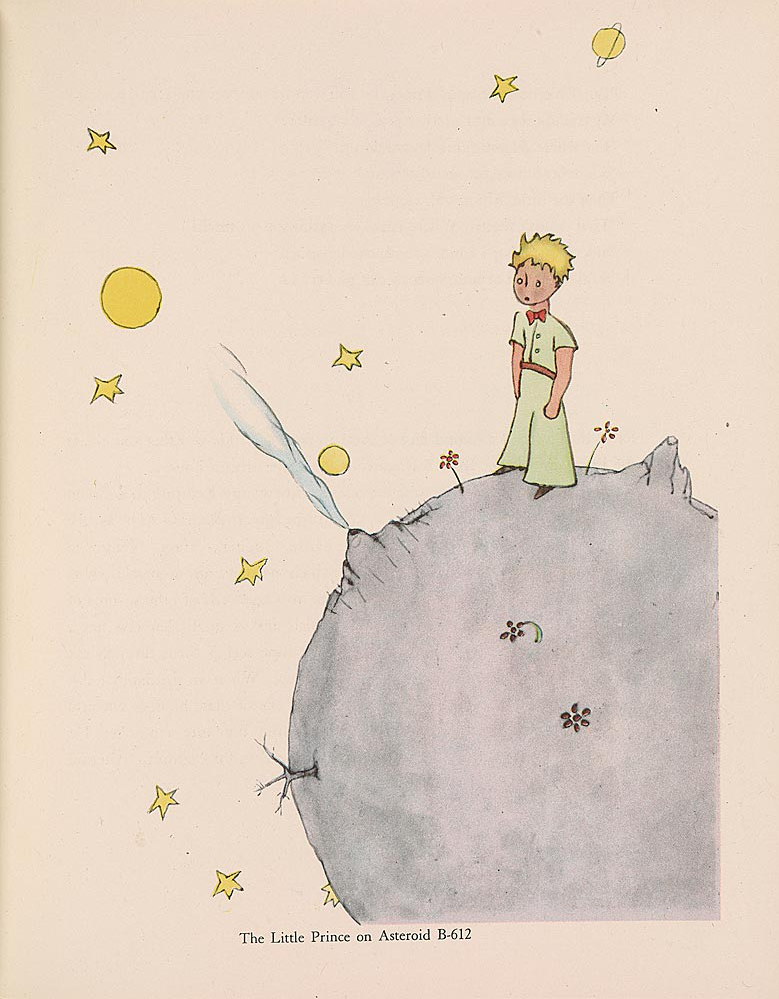
From January 24 through April 27, 2014, The Morgan Library and Museum is staging an exhibition on Antoine de Saint-Exupéry’s The Little Prince, a story that speaks to the hearts and minds of children and adults alike. Though Saint-Exupéry was French, he wrote and published his great tale while living in New York City in 1943. Twenty five years later, in 1968, the Morgan acquired the original manuscript, which is now on display.
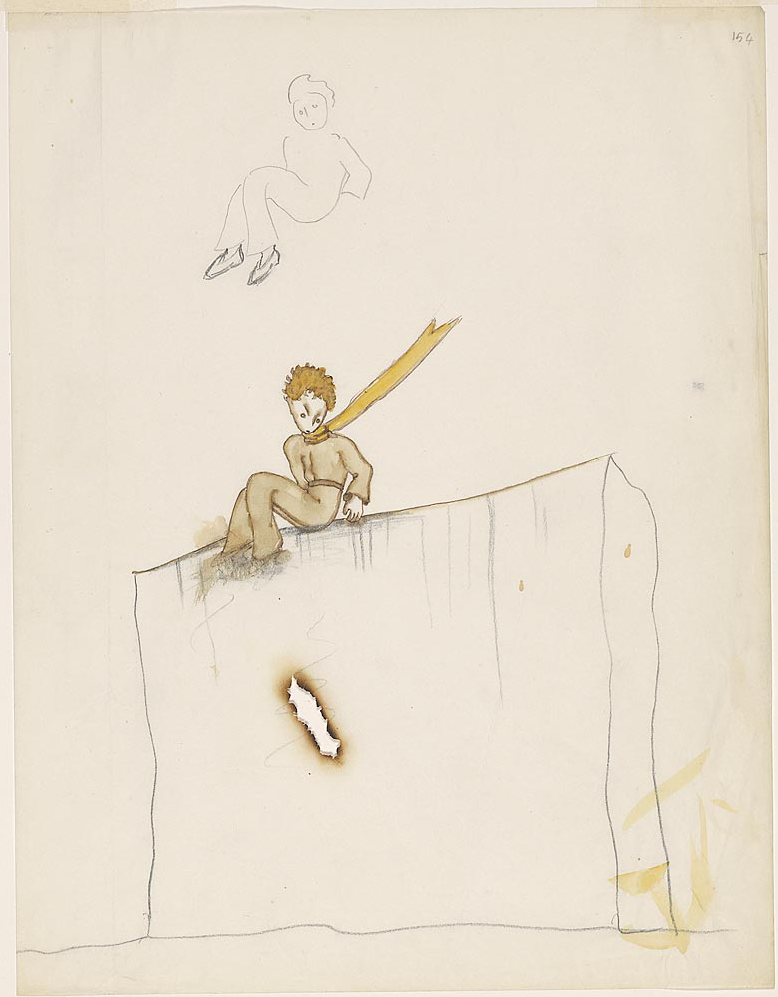
If you can’t travel to New York, you can virtually pore over ten original illustrations from Le Petit Prince online. We’d recommend clicking here, and then clicking on the Full Screen icon in the bottom right-hand side of the first illustration you see. Then start flipping through the pages and enjoy. As the Morgan notes, the pages are “replete with crossed-out words, cigarette burns, and coffee stains.” You’ll find one such burn on the illustration immediately above.
via Metafilter/Brain Pickings
Related Content:
200 Free Kids Educational Resources: Video Lessons, Apps, Books, Websites & More
Watch Animations of Oscar Wilde’s Children’s Stories “The Happy Prince” and “The Selfish Giant”
The International Children’s Digital Library Offers Free eBooks for Kids in Over 40 Languages
Mark Twain Creates a List of His Favorite Books For Adults & Kids (1887)
Read More...Watch the Funky, Oscar-Winning Animated Film Featuring the Music of Herb Alpert & the Tijuana Brass (1966)
The first part of this 1966 Oscar winning animated short is so utterly charming, I’m surprised it hasn’t spawned a contemporary remake. The theme—a brave little flea going up against greedy developers who are transforming his rustic homeland into a high rise vacation paradise for cigar-chomping high rollers and their stacked molls—sounds like the sort of thing that might appeal to Dreamworks.
Of course, we’d need to flesh out the characters if we’re shooting for feature length. Give that shambling donkey and plump-bottomed hen some wisecracking attitude, and maybe some mirrored shades. I’m thinking something in the Chris Rock/Whoopie Goldberg/Nathan Lane-type vein. Get a kid to voice the flea. Doesn’t matter who, as long as he’s relatable and bland. Who’s that kid with the hair?
Obviously, we’re talking 3D CGI. If we thought we could sell the kiddies on a retro 20th-century vibe, we’d bring in Wes Anderson or Tim Burton. They’re sort of into that creepy stop motion deal, right?
Speaking of retro, we could maybe hang onto a bit of the “Spanish Flea” thing out of respect and because of the character being a flea and all. I’m thinking maybe a hip hop remix as the credits roll? Find out if that kid with the hair raps. I forget what he’s famous for…
Enough!
The original is absolutely perfect as is, funky and funny, with loads of loose‑y goose‑y personality. Like the Herb Alpert and the Tijuana Brass sound that drives it, it’s both kid-friendly and a bit adult. (If that gyrating changing cabana puts you in mind of the Dating Game, it’s likely more than the “Spanish Flea”/“Bachelor’s Theme” connection. Surely I was not the only child viewer tantalized by the thought of what might happen when the winning bachelor and bachelorette flew off together to take their shared vacation-prize.)
The other half of the short, a riff on “Tijuana Taxi,” another hit from Alpert’s 1965 album, Going Places, is pretty great too.
Produced by legendary animator John Hubley and his wife, Faith, this little two-for-the-price-of-one gem features contributions by some of the period’s other greats: Gerard Baldwin, Phil Duncan, Emery Hawkins, Barrie Nelson, Rod Scribner, and Ed Smith. If it leaves you with a taste for more, have a look at the Hubleys’ work for Dizzy Gillespie, which we featured last week.
A Herb Alpert and the Tijuana Brass Double Feature won the Academy Award for Best Animated Short Film in 1966. You can find it in our collection of 675 Free Online Movies, plus our collection of 35 Free Oscar Winning Films Online.
Related Content:
Dizzy Gillespie Worries About Nuclear & Environmental Disaster in Vintage Animated Films
Father and Daughter: An Oscar-Winning Animated Short Film
Saul Bass’ Oscar-Winning Animated Short Ponders Why Man Creates
Ayun Halliday was also transfixed by the prurience of Match Game 74. Follow her @AyunHalliday
Read More...Stanley Kubrick Narrates a Promo Reel for Dr. Strangelove: Features Unused Takes
Yesterday we featured a trailer for Citizen Kane narrated by its director, a certain Orson Welles. Today we give you footage of another film that needs no introduction spoken over by another filmmaker who doesn’t need one, either: Stanley Kubrick’s Dr. Strangelove: or, How I Learned to Stop Worrying and Love the Bomb. But instead of a polished trailer, Kubrick put together this nearly twenty-minute “promo reel,” which appears in a two-part playlist above. “Split over two parts and recorded off the wall from the projection of the rare 35mm reel, the promo reel features some alternate takes not used in the final cut,” writes Cain Rodriguez at Indiewire. “While we’re not exactly sure what the reel’s original function was — maybe to placate investors since the satirical elements are somewhat downplayed — we’re glad to see this has surfaced online.” Kubrick recounts the story of Dr. Strangelove — one as deeply familiar as ancient myth to those who have, like me, seen the movie countless times, always theatrically. He does so in a surprisingly flat, straightforward manner, given that the final product turned out so thoroughly shot through with the black comedy of the absurd.
Over audible projector noise, he tells of all the now-familiar elements: the B52‑s circling constantly, refueling in midair; Brigadier General Jack Ripper’s sudden order to bomb Russia; General Buck Turgidson’s wee-hour departure for the “War Room”; the siege of Burpelson Air Force Base; Group Captain Lionel Mandrake’s struggle for the recall code and subsequent confrontation with the “prevert”-fixated Colonel Bat Guano; President Merkin Muffley’s bad news-breaking call to Russian Premier Dmitri Kissoff; the titular German expatriate scientist’s plan to restart society after the nuclear apocalypse. But as Kubrick talks about these scenes, some of the most memorable in 20th-century cinema, we see different versions of them than the ones to which we’ve long grown accustomed: different angles, different cuts, even different lines. Despite downplaying the comedy, this reel does hint at the brilliance of the material, and moreover of Kubrick’s then-counterintuitive treatment of it. But can anyone who saw it have imagined to what an extent the final film would change the way we think about U.S. foreign policy, military intelligence, and the very concept of global thermonuclear war?
Related Content:
Inside Dr. Strangelove: Documentary Reveals How a Cold War Story Became a Kubrick Classic
Watch Orson Welles’ Trailer for Citizen Kane: As Innovative as the Film Itself
675 Free Movies Online: Great Classics, Indies, Noir, Westerns, etc.
Colin Marshall hosts and produces Notebook on Cities and Culture and writes essays on cities, language, Asia, and men’s style. He’s at work on a book about Los Angeles, A Los Angeles Primer. Follow him on Twitter at @colinmarshall or on Facebook.
Read More...How a Young Sigmund Freud Researched & Got Addicted to Cocaine, the New “Miracle Drug,” in 1894
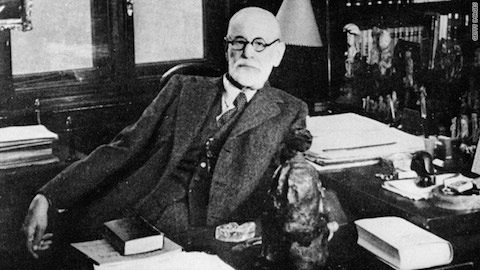
As David Bowie had his cocaine period, so too did Sigmund Freud, beginning in 1894 and lasting at least two years. Unlike the rock star, the doctor was just at the beginning of his career, “a nervous fellow” of 28 “who wanted to make good,” says Howard Markel, author of An Anatomy of Addiction: Sigmund Freud, William Halsted, and the Miracle Drug Cocaine. Markel tells Ira Flatow in the NPR Science Friday episode below that Freud “knew if he was going to get a professorship, he would have to discover something great.”
Freud’s experiments with the drug led to the publication of a well-regarded paper called “Über Coca,” which he described as “a song of praise to this magical substance” in a “pretty racy” letter to his then-fiancé Martha Bernays. (He also promised she would be unable to resist the advances of: “a big, wild man who has cocaine in his body.”) Two years later, his health suffering, Freud apparently stopped all use of the drug and rarely mentioned it again.
[T]he accomplished young phsyiologist Ernst von Fleischl-Marxow, whose morphine addiction Freud had tried to treat with cocaine, with disastrous results. As Freud wrote almost three decades later, “the study on coca was an allotrion” — an idle pursuit that distracts from serious responsibilities — “which I was eager to conclude.”
The drug was at the time touted as a panacea, and Fleischl-Marxow, Markel says, was “the first addict in Europe to be treated with this new therapeutic.” Freud also used himself as a test subject, unaware of the addictive properties of his cure for his friend’s addiction and his own depression and reticence.
While Freud conducted his experiments, another medical pioneer—American surgeon William Halsted, one of Johns Hopkins “four founding physicians”—simultaneously found uses for the drug in his practice. Freud and Halsted never met and worked completely independently in entirely different fields, says Markel in the news segment above, but “their lives were braided together by a fascination with cocaine,” as addicts, and as readers and writers of “several medical papers about the latest, newest miracle drug of their era, 1894.” Halstead is responsible for many of the modern surgical techniques without which the prospect of surgery by today’s standards is unimaginable —the proper handling of exposed tissue, operating in aseptic environments, and surgical gloves. He injected patients with cocaine to numb regions of their body, allowing him to operate without rendering them unconscious.
Halsted, too, used himself as a guinea pig. “No doctor knew at this point,” says Markel above, “of the terrible addictive effects of cocaine” before Freud and Halsted’s experiments. Both men irrevocably changed their fields and almost destroyed their own lives in the process (see a short documentary on Halsted’s medical advances below). In Freud’s case, much of the work of psychoanalysis has come to be seen as pseudoscience—his work on dreams significantly so, as Markel says above: “Cocaine haunts the pages of the Interpretation of Dreams. The model dream is a cocaine dream.” The “talking cure,” however, engendered by the “loosening of the tongue” Freud experienced while on cocaine, endures as, of course, do Halsted’s innovations.
Related Content:
Freud’s Thought Explained in Yale Psych Course (Find Full Course on our List of 875 Free Online Courses)
Sigmund Freud Speaks: The Only Known Recording of His Voice, 1938
Sigmund Freud’s Home Movies: A Rare Glimpse of His Private Life
Jean-Paul Sartre Writes a Script for John Huston’s Film on Freud (1958)
Josh Jones is a writer and musician based in Durham, NC. Follow him at @jdmagness
Read More...80 Massive Open Online Courses Getting Started in April: Enroll in a MOOC Today
We’re seeing about 80 MOOCs getting started in April. It’s a far cry from the 180 that got underway in January. But still not bad. You can visit our comprehensive list of MOOCs here and find a course that speaks to you. Some of the ones that caught our eye include:
- Street Fighting Math – MIT on edx – April 8 (7 weeks)
- Design Thinking – Macromedia University on iversity – April 14 (4 weeks)
- Warhol – University of Edinburgh on Coursera – April 21 (5 weeks)
- Start Writing Fiction – The Open University on Futurelearn – April 28 (8 weeks)
Don’t miss anything from Open Culture in 2014. Sign up for our Daily Email or RSS Feed. And we’ll send cultural curiosities your way, every day.
Read More...What Books Should Every Intelligent Person Read?: Tell Us Your Picks; We’ll Tell You Ours

Back in 2011 we featured astrophysicist Neil DeGrasse Tyson’s list of the books “every single intelligent person on the planet” should read. His picks include the Bible (“to learn that it’s easier to be told by others what to think and believe than it is to think for yourself”); Adam Smith’s The Wealth of Nations (“to learn that capitalism is an economy of greed, a force of nature unto itself”); and Machiavelli’s The Prince (“to learn that people not in power will do all they can to acquire it, and people in power will do all they can to keep it”). The list, which has generated a great deal of interest and discussion, leads you to think about the very nature of not just what constitutes essential reading, but what defines an “intelligent person.” Should every such individual really read any book in particular? Does it matter if others already acknowledge these books as essential, or can they have gone thus far undiscovered?
Admirably, Tyson manages to compile his selections of books well-known across the English-speaking world into a list that, as a whole, somehow avoids dullness or predictability. In eschewing obscurantism, he makes the perhaps daring implication that an intelligent person must connect to a widely shared culture, rather than demonstrating their brainpower by getting through volume upon little-read volume, written in the most labyrinthine language, expounding on the most abstract subject matter, or grappling with the knottiest philosophical problems. This inspires me to highlight five more pieces of reading material, all intellectually stimulating but accessibly written, all referenced frequently in countless areas of human endeavor, and all available in our collection of free eBooks:
- Marcus Aurelius’ Meditations (iPad/iPhone – Kindle + Other Formats), because the ideas that “you have power over your mind, not outside events,” or that “the happiness of your life depends upon the quality of your thoughts,” or that “everything we hear is an opinion, not a fact” and “everything we see is a perspective, not the truth” apply as much today as they did in antiquity.
- Miguel de Cervantes’ Don Quixote (iPad/iPhone (Vol 1 – Vol 2) – Kindle + Other Formats), because we could all use a firmer grasp on what we mean when we label someone “quixotic,” a simple description that takes its name from a surprisingly complex and unexpectedly admirable character.
- James Joyce’s A Portrait of the Artist as a Young Man (iPad/iPhone – Kindle + Other Formats) because, whatever ideas you may have about Joyce — positive or negative — if you haven’t yet cracked his first novel, I guarantee a reading experience unlike any you might expect.
- Michel de Montaigne’s Essays (iPad/iPhone – Kindle + Other Formats), because not only do his pieces exemplify (because they practically invented) the strongest short form to capture the paths of human thought, but they feel especially relevant now in this internet-driven “age of the essay.”
- Alexis de Tocqueville’s Democracy in America (volume 1: iPad/iPhone – Kindle + Other Formats — Read Online; volume 2: iPad/iPhone — Kindle + Other Formats — Read Online), because the Frenchman’s diagnosis of the advantages and liabilities of this then-young and experimental country still give us much to consider today, not just in regard to America, but — now that so many countries have gone democratic, each in their own way — most of the world.
None will have come as news to you, but some it may take you a moment to realize that, hey, you never did get around to them in the first place. Take in books like these, and not only will they resonate richly with everything else already knocking around your brain — you do read Open Culture, after all — but they’ll let you in on what, exactly, all those readers and writers around the world and through history have meant when they cite them so readily.
We also invite you to tell us: which books, freely available or otherwise, do you consider essential reading for the intelligent? Have I missed the boat by failing to include Finnegans Wake (Read Online), say, or the Tractatus Logico-Philosophicus (iPad/iPhone — Kindle + Other Formats — Read Online)? Let loose your own recommendations and we’ll create a compilation of your best picks in the comings days.
Colin Marshall hosts and produces Notebook on Cities and Culture and writes essays on cities, language, Asia, and men’s style. He’s at work on a book about Los Angeles, A Los Angeles Primer. Follow him on Twitter at @colinmarshall or on Facebook.
Read More...Read an Excerpt of J.R.R. Tolkien’s 1926 Translation of Beowulf Before It’s Finally Published Next Month
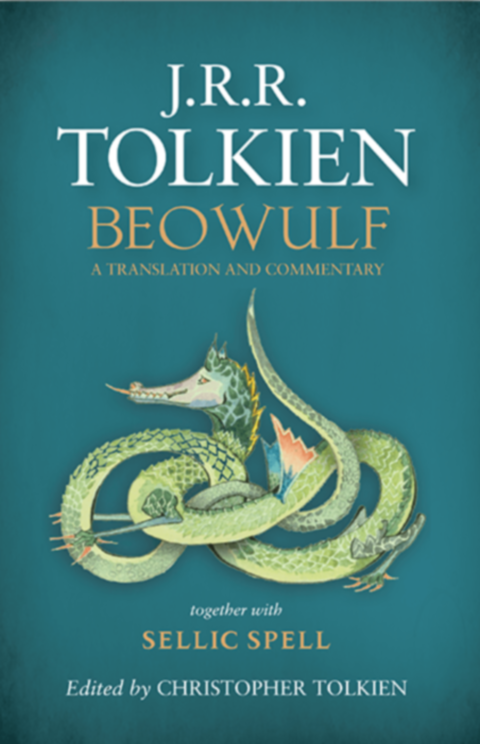
For the first time, J.R.R. Tolkien’s 1926 translation of the 11th century epic poem Beowulf will be published this May by HarperCollins, edited and with commentary by his son Christopher. The elder Tolkien, says his son, “seems never to have considered its publication.” He left it along with several other unpublished manuscripts at the time of his death in 1973. The edition will also include a story called Sellic Spell and excerpts from a series of lectures on Beowulf Tolkien delivered at Oxford in the 1930s. Tolkien did publish one of those lectures, “The Monster and the Critic,” in 1936. In this “epoch-making paper,” writes Seamus Heaney in the introduction to his hugely popular 1999 dual language verse edition, Tolkien treated the Beowulf poet as “an imaginative writer,” not a historical reconstruction. His “brilliant literary treatment changed the way the poem was valued and initiated a new era—and new terms—of appreciation.” This very same thing could be said of Heaney’s translation which, true to his stated goals, brought the poem out of academic conferences and classrooms and into living rooms and coffee shops everywhere. (You can hear Heaney read from that translation here.)
Nowhere in Heaney’s introduction to his version does he mention Tolkien’s translation of the poem, so we must presume he did not know of it. Long before Tolkien’s lectures and translation, Beowulf had been perhaps the most revered poem in the English language, at least since the 18th century, when the sole manuscript was rescued from fire and and translated and disseminated widely. Despite that status, Beowulf was not actually written in English—not an English we would recognize—but in Old English, or Anglo-Saxon. As readers of Heaney’s dual translation will know, that distant provincial ancestor of the modern global language, named for the mixture of Germanic peoples who inhabited England 1000 years ago, appears mostly alien to us now. (To add to the strangeness, its unfamiliar alphabet once consisted entirely of runes).
The poem, moreover, is not set in England, but where Shakespeare set his Hamlet, Denmark. Its titular hero, a prince from Geat (ancient Sweden), stalks a monster named Grendel on behalf of Danish king Hroðgar, killing the monster’s mother along the way. Tolkien’s almost universally beloved body of fiction was deeply influenced by Beowulf. Nevertheless, his translation may be less accessible than Heaney’s, though no less beautiful, perhaps, for different reasons. In Heaney’s verse, one hears Ted Hughes, some echoes of Milton, Heaney’s own voice. If we are to credit the redditor who posted a now-defunct 2003 article from Canadian newspaper National Post that quotes from Tolkien’s translation, the Hobbit author’s verse hews to a more direct correspondence with the Anglo Saxon, a language made of giant rocks and timber and crashing waves, not elegant, elaborated clauses. The National Post article announces the discovery at Oxford of the Tolkien translation by English Professor Michael Drout (a story he’s since debunked), and quotes from both Heaney and Tolkien. See the comparison below:
Heaney’s translation:
Time went by, the boat was
on water,
in close under the cliffs.
Men climbed eagerly up the
gangplank,
sand churned in surf, warriors
loaded
a cargo of weapons, shining
war-gear
in the vessel’s hold, then
heaved out,
away with a will in their
wood-wreathed ship.
Tolkien’s translation of Beowulf and his men setting sail:
On went the hours:
on
ocean afloat
under cliff was their craft.
Now climb blithely
brave man aboard;
breakers pounding
ground the shingle.
Gleaming harness
they hove to the bosom of the
bark, armour
with cunning forged then cast
her forth
to voyage triumphant,
valiant-timbered
fleet foam twisted.
One wonders what the recently departed Irish poet would have said had he lived to read this Tolkien edition. Might it, as Heaney said of his lectures, change the way the poem is valued? Or might he see it resembling other difficult attempts to make modern English replicate the strongly inflected built-in rhythms of Anglo-Saxon—a language, Tolkien once said, from “the dark heathen ages beyond the memory of song.”
You can pre-order a copy of Tolkien’s translation of Beowulf here.
Related Content:
Seamus Heaney Reads His Exquisite Translation of Beowulf and His Memorable 1995 Nobel Lecture
Discover J.R.R. Tolkien’s Personal Book Cover Designs for The Lord of the Rings Trilogy
“The Tolkien Professor” Presents Three Free Courses on The Lord of the Rings
Josh Jones is a writer and musician based in Durham, NC. Follow him at @jdmagness
Read More...Now You Can Learn to Speak Klingon with Rosetta Stone
For only $269, you can learn to speak Klingon with Rosetta Stone.
Our big collection of Free Language Lessons offers tutorials in Bambara, Bulgarian, Icelandic, Yiddish and more. But Klingon? That, sadly, you can only get at Rosetta Stone. Their software is compatible with Windows XP+ and OS X+, requires a CD-Rom drive and a headset with a microphone, and it lets you have live conversation sessions with native speakers. By the time you’re done, you should be able to make small talk in Klingon — order food at a restaurant, make a hotel reservation, ask for directions. You know, the basics.
Read More...Beautiful Equations: Documentary Explores the Beauty of Einstein & Newton’s Great Equations
Like many right-brained people, artist and critic Matt Collings finds higher math mystifying, a word that implies both bewilderment and wonder. Faced with the equations that make, for example, Stephen Hawking’s work possible, most of us are left similarly slack-jawed. Collings aptly describes the realm of theoretical physics—which so contradicts our everyday experience—as “an alien world,” with its equations like “incomprehensible hieroglyphs.” He decided to enter this world, to “learn about some of the most important equations in science.” His angle? He views them as art, “masterpieces” that “explain the world we live in.” Collings spends his hour-long BBC special Beautiful Equations chatting with Stephen Hawking and other theorists about such paradigm-shifting equations as Einstein’s formula for special relativity and Newton’s laws of gravity.
In an era characterized by scientists encroaching on the arts—to claim Marcel Proust as a neuroscientist, Jane Austen as game theorist—it’s refreshing to see a humanities person engage the world of math, using the only schema he knows to make sense of what seems to him unintelligible. Unlike those scientists-turned-literary critics, Collings doesn’t make any large claims or assert expertise. He plays the humble everyman, owning his ignorance, his most endearing and effective tool since it provides the basis for his interlocutors’ remedial, and friendly, explanations. The results are an intelligent primer for layfolk, a refresher for the more knowledgeable, and perhaps an entertaining diversion for experts, who will likely have their quibbles with Collings’ necessarily basic presentation. But he is not on the hunt for complexity—quite the opposite. As the title of the special indicates, Collings’ inquiry seeks to find out just what makes the work of Newton, Einstein, and others so profoundly, simply elegant.
Aesthetic feeling is not at all alien to math—far from it, in fact. As Bertrand Russell famously wrote in his essay “Mysticism and Logic”: “Mathematics, rightly viewed, possesses not only truth, but supreme beauty.” Russell’s point has been empirically validated by recent neuroscience. As BBC.com reported in February, a study in the journal Frontiers in Human Neuroscience found that in the brains of mathematicians, “the same emotional brain centres used to appreciate art” are “activated by ‘beautiful’ maths.” While the concept of beauty itself may be impossible to quantify, when it comes to equations, scientists (or at least their brains) know it when they see it. The rest of us, like Collings, may require an appreciation course to understand the awe inspired by the math that, as our host puts it, so elegantly captures the “enormity of the universe.”
You can find Beautiful Equations listed in our collection of Free Documentaries, part of our larger collection of 675 Free Movies Online.
Related Content:
Seven Questions for Stephen Hawking: What Would He Ask Albert Einstein & More
Josh Jones is a writer and musician based in Durham, NC. Follow him at @jdmagness
Read More...Support Us
We're hoping to rely on loyal readers, rather than erratic ads. Please click the Donate button and support Open Culture. You can use Paypal, Venmo, Patreon, even Crypto! We thank you!

About Us

Open Culture scours the web for the best educational media. We find the free courses and audio books you need, the language lessons & educational videos you want, and plenty of enlightenment in between.
Advertise With Us

FREE UPDATES!
GET OUR DAILY EMAIL
Get the best cultural and educational resources on the web curated for you in a daily email. We never spam. Unsubscribe at any time.
FOLLOW ON SOCIAL MEDIA

Open Culture editor Dan Colman scours the web for the best educational media. He finds the free courses and audio books you need, the language lessons & movies you want, and plenty of enlightenment in between.
Advertise With Us

