Batgirl Fights for Equal Pay in a 1960s Television Ad Supporting The Equal Pay Act
Featured on the Emily’s List Facebook Page today is this “PSA from the 1960s,” where “Batgirl advocates for equal pay while saving Batman and Robin.” Emily’s List, a PAC aiming to put more pro-choice Democrat female candidates into political office, goes on to note, “Over 50 years ago, Congress passed the Equal Pay Act, a law designed to end wage discrimination against women. Unfortunately, the fight’s still got many rounds left.”
Indeed, a 2008 Census Bureau report shows that women’s median annual earnings were 77.5% of men’s earnings, and efforts to address that imbalance with The Paycheck Fairness Act have been filibustered successfully by Republicans in the Senate. Although President Obama supports the measure, data shows women aren’t faring well financially in the Obama White House either. Where’s Batgirl when we need her?
If you would like to support the mission of Open Culture, consider making a donation to our site. It’s hard to rely 100% on ads, and your contributions will help us continue providing the best free cultural and educational materials to learners everywhere. You can contribute through PayPal, Patreon, and Venmo (@openculture). Thanks!
Read More...Eleanor Roosevelt’s Durable Wisdom on Curiosity, Empathy, Education & Responding to Criticism

First Lady Eleanor Roosevelt was a prolific columnist and writer, with an impressive list of clips produced both during FDR’s tenure in the White House and afterwards. George Washington University’s Eleanor Roosevelt Papers Project tallies up her output: 8,000 columns, 580 articles, 27 books, and 100,000 letters (not to mention speeches and appearances). Many of those columns and articles can be found on their website.
Their archive offers every one of Roosevelt’s “My Day” columns, which ran through United Features Syndicate from 1936–1962. These short pieces acted like a daily diary, chronicling Roosevelt’s travels, the books she read, the people she visited, her evolving political philosophy, and, occasionally, her reflections on such topics as education, empathy, apathy, friendship, stress, and the scourge of excessive mail (“I love my personal letters and I am really deeply interested in much of my mail, but when I see it in a mass I would sometimes like to run away! I just closed my eyes in this case and went to bed!”)
The “My Day” archive is a little difficult to navigate—you have to browse by year, or search by keyword—but the archive’s short list of selected longer articles is a bit simpler to survey. Some of my favorites:
“In Defense of Curiosity” (Saturday Evening Post, 1935): Roosevelt often drew fire for her insatiable interest in all areas of national life—a characteristic that people thought of as unladylike. This article argues that women, too, should be curious, and that curiosity is the basis for happiness, imagination, and empathy.
“How to Take Criticism” (Ladies Home Journal, 1944): Roosevelt had a lot of haters. This longer piece mulls over the different types of criticism that she received during her public career, and asks how one should distinguish between worthy and unworthy critiques.
“Building Character” (The Parent’s Magazine, 1931): An editorial on the importance of providing children with challenges, clearly meant to reassure parents worried about the effects of the Depression on their kids.
“Good Citizenship: The Purpose of Education” (Pictorial Review, 1930): Much of this piece is about the importance of fair compensation for good teachers. “There are many inadequate teachers today,” Roosevelt wrote. “Perhaps our standards should be higher, but they cannot be until we learn to value and understand the function of the teacher in our midst. While we have put much money in buildings and laboratories and gymnasiums, we have forgotten that they are but the shell, and will never live and create a vital spark in the minds and hearts of our youth unless some teacher furnishes the inspiration. A child responds naturally to high ideals, and we are all of us creatures of habit.”
Related Content:
“’Nothing Good Gets Away’: John Steinbeck Offers Love Advice in a Letter to His Son (1958)”
“George Washington’s 110 Rules for Civility and Decent Behavior”
Rebecca Onion is a writer and academic living in Philadelphia. She runs Slate.com’s history blog, The Vault. Follow her on Twitter: @rebeccaonion.
Read More...Lists of the Best Sentences — Opening, Closing, and Otherwise — in English-Language Novels
I go to encounter for the millionth time the reality of experience and to forge in the smithy of my soul the uncreated conscience of my race.
— James Joyce, A Portrait of the Artist as a Young Man
For what do we live, but to make sport for our neighbors, and laugh at them in our turn?
— Jane Austen, Pride and Prejudice
There is nothing more atrociously cruel than an adored child.
— Vladimir Nabokov, Lolita
You’ve almost certainly read all three of these sentences before, or even if you don’t remember the lines in particular, you’ve probably read the famous novels they come from. The American Scholar highlights them as three of the ten finest in English-language literature, alongside other sentences composed by the likes of F. Scott Fitzgerald, John Hersey, and Ernest Hemingway. Writing at Poynter.org, Roy Peter Clark explains just what makes these sentences so great, from Joyce’s use of “forge” (“For the narrator it means to strengthen metal in fire. But it also means to fake, to counterfeit, perhaps a gentle tug at [the protagonist’s] hubris”) to Austen’s structural elegance (“Who could not admire a sentence with such a clear demarcation beginning, middle, and end?”) to Nabokov’s reflection of his narrator’s self-delusion.
At The Atlantic, Joe Fassler has separately collected 22 writers’ own favorite novel-opening lines, a list that includes the one from Nabokov’s highly quotable novel and another from later in Joyce’s oeuvre:
Lolita, light of my life, fire of my loins.
— Vladimir Nabokov, Lolita, chosen by Jonathan Santofler
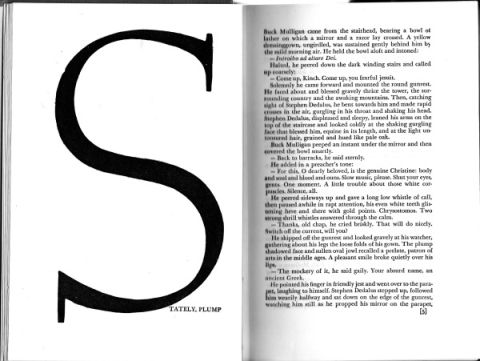
Stately, plump Buck Mulligan came from the stairhead, bearing a bowl of lather on which a mirror and a razor lay crossed.
— James Joyce, Ulysses, chosen by Lydia Davis
I have never seen anything like it: two little discs of glass suspended in front of his eyes in loops of wire.
— J.M. Coetzee, Waiting for the Barbarians, chosen by Anthony Marra
If all these don’t satiate your appetite for well-wrought sentences, the American Book Review has not just its own rundown of the 100 best first lines from novels, but of the 100 best last lines as well, a list that features Coetzee’s grim colonial fable as well as the work of Franzen himself:
This is not the scene I dreamed of. Like much else nowadays I leave it feeling stupid, like a man who lost his way long ago but presses on along a road that may lead nowhere.
— J.M. Coetzee, Waiting for the Barbarians
She was seventy-five and she was going to make some changes in her life.
— Jonathan Franzen, The Corrections
“You can trust me,” R.V. says, watching her hand.” “I’m a man of my
— David Foster Wallace, The Broom of the System
Before you leave a comment pointing out that apparent fragment of Wallace’s sentence just above, let me reassure you that it appears exactly like that in The Broom of the System — the novel just stops there — and that, if you read all the way to that point, you’ll find it a pretty brilliant choice. This just goes to show that the sentence, though undoubtedly the fundamental unit for any writer (“All you have to do is write one true sentence,” Hemingway would say), always needs a context. This meta-list of best-sentence lists at Metafilter has many more high-quality sentences for you to admire, and a fair few intriguing enough to send you right out to go read them in context.
You can find some of the great books mentioned above in our collection of 575 Free eBooks.
Related Content:
Opening Sentences From Great Novels, Diagrammed: Lolita, 1984 & More
Nabokov Reads Lolita, Names the Great Books of the 20th Century
James Joyce Reads From Ulysses and Finnegans Wake In His Only Two Recordings (1924/1929)
Colin Marshall hosts and produces Notebook on Cities and Culture and writes essays on cities, language, Asia, and men’s style. He’s at work on a book about Los Angeles, A Los Angeles Primer. Follow him on Twitter at @colinmarshall or on Facebook.
Read More...Actresses Lucy Lawless & Jaime Murray Perform Jean-Paul Sartre’s “No Exit” for The Partially Examined Life Podcast
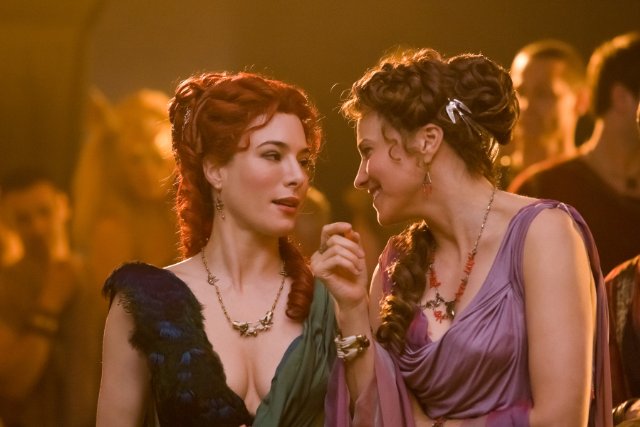
Lucy Lawless (Star of Xena the Warrior Princess and notable contributor to such shows as Spartica, Battlestar Galactica, and Parks & Recreation) previously appeared on the Partially Examined Life Philosophy Podcast in Fall 2012. And, in Spring 2013, she sang with me (under my musician moniker Mark Lint) on an original song called “Things We Should Do Before We Die.” Now she’s joined fellow PEL host Wes Alwan (“The Valet”) and me to create an audioplay of Jean-Paul Sartre’s 1944 play “No Exit,” where she plays the working class, hostile lesbian Inès Serrano with a pretty hilarious off-the-cuff generically European accent against my relatively deadpan Joseph Garcin.
The third damned soul in our one-room hell was played by a delightfully shrieky Jaime Murray, friend and Spartacus co-star of Lucy’s. You likely know Jaime for her role as Lila, the psychotic main guest star in Season 2 of Dexter, and right now she appears in the sci-fi shows Defiance and Warehouse 13.
The play is about three dead people stuck in a room together, any two of which would probably reach some equilibrium. But, as a threesome, they enter into a toxic dynamic where none can get what he or she needs out of the others.
To hear Lucy, Jamie and me perform “No Exit,” click below or listen at Partiallyexaminedlife.com.
The recording was made in support of the Partially Examined Life episode discussing Sartre, covering this play as well as his essays “Existentialism is a Humanism” (1946), and “Bad Faith,” (which constitutes part 1, chapter 2 of Being & Nothingness, 1943). These convey the essence of Sartre’s existentialism and give a picture of his view of man’s radical freedom (we’re condemned to be free!) and what for him serves as some semblance of an ethics.
For the Sartre episode, click below or listen at Partiallyexaminedlife.com.
The audioplay is the second in a series, with the first being the PEL Players’ performance of Plato’s dialogue, The Gorgias.
For those with who want more, PEL offers access to an outtakes reel. The picture above features both actresses in Spartacus.
Mark Linsenmayer is the head honcho at The Partially Examined Life, the #1 downloaded philosophy podcast on the planet, which provides amusing, in-depth discussions of philosophers old and new. Mark is also a musician who wrote a song just for this audioplay.
Related Content:
Jean-Paul Sartre’s No Exit: A BBC Adaptation Starring Harold Pinter (1964)
Walter Kaufmann’s Classic Lectures on Nietzsche, Kierkegaard and Sartre (1960)
100 Free Online Philosophy Courses
Read More...Watch Episode #4 of Neil deGrasse Tyson’s Cosmos: The Big Bang, Black Holes & More (US Viewers)
On Sunday evening, Fox aired the latest episode of Neil deGrasse Tyson’s Cosmos series. This episode, called “A Sky Full of Ghosts,” explored some more out-of-this-world subjects — the speed of light and how it helps us undertand the Big Bang; the scientific work of Isaac Newton, William Herschel, James Clerk Maxwell; Albert Einstein’s Theory of Relativity; dark stars; black holes; and more. US viewers can watch the entirety of Episode 4 online (above), along with previous episodes in the series below (or on Hulu). For viewers outside the US, we have something perhaps better for you: Carl Sagan’s Original Cosmos Series on YouTube. Plus, we have a bunch of Free Online Astronomy Courses in our collection of 875 Free Online Courses. Enjoy.
Previous Episodes:
Episode #1: “Standing Up in the Milky Way”
Episode #2: “Some of the Things That Molecules Do”
Episode #3: “When Knowledge Conquered Fear”
Read More...New York Public Library Puts 20,000 Hi-Res Maps Online & Makes Them Free to Download and Use
When I was a kid, my father brought home from I know not where an enormous collection of National Geographic magazines spanning the years 1917 to 1985. I found, tucked in almost every issue, one of the magazine’s gorgeous maps—of the Moon, St. Petersburg, the Himalayas, Eastern Europe’s ever-shifting boundaries. I became a cartography enthusiast and geographical sponge, poring over them for years just for the sheer enjoyment of it, a pleasure that remains with me today. Whether you’re like me and simply love the imaginative exercise of tracing a map’s lines and contours and absorbing information, or you love to do that and you get paid for it, you’ll find innumerable ways to spend your time on the new Open Access Maps project at the New York Public Library. The NYPL announces the release with the explanation below:
The Lionel Pincus & Princess Firyal Map Division is very proud to announce the release of more than 20,000 cartographic works as high resolution downloads. We believe these maps have no known US copyright restrictions.* To the extent that some jurisdictions grant NYPL an additional copyright in the digital reproductions of these maps, NYPL is distributing these images under a Creative Commons CC0 1.0 Universal Public Domain Dedication. The maps can be viewed through the New York Public Library’s Digital Collections page, and downloaded (!), through the Map Warper.
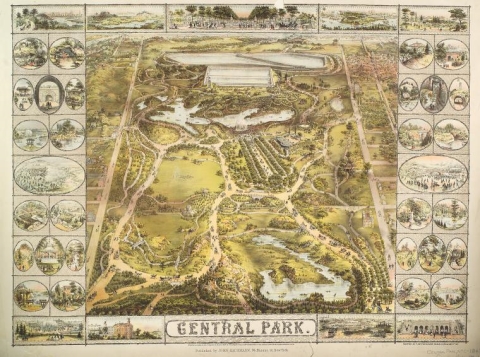
What does this mean? Simply put, “it means you can have the maps, all of them if you want, for free, in high resolution.” Maps like that above, of New York’s Central Park, issued in 1863, ten years before Frederick Law Olmsted and Calvert Vaux completed their historic re-design.
Can you—as I did with my neatly folded, yellowing archive—have all the maps in full-color print? Well, no, unless you’re prepared to bear the cost in ink and paper and have some specialized printing equipment that can render each map in its original dimensions. But you can access something worlds away from what I could have imagined—a digital enhancement technology called “warping,” also known as “georectification.”
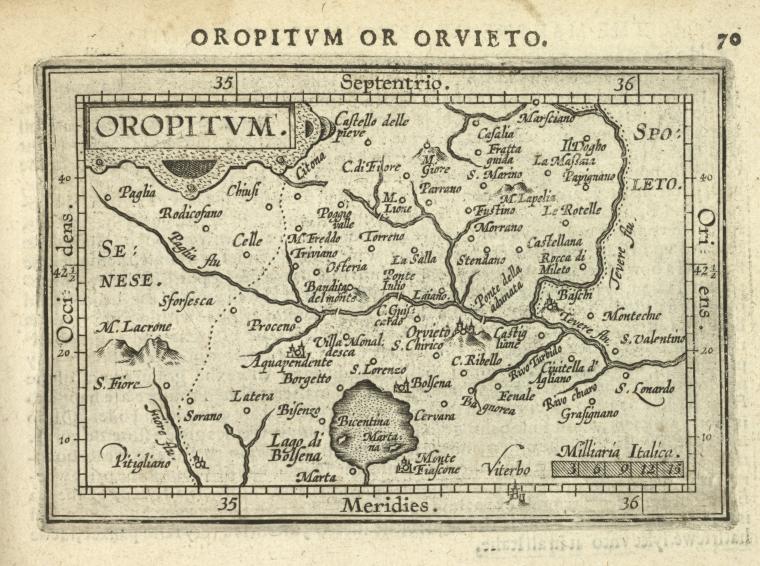
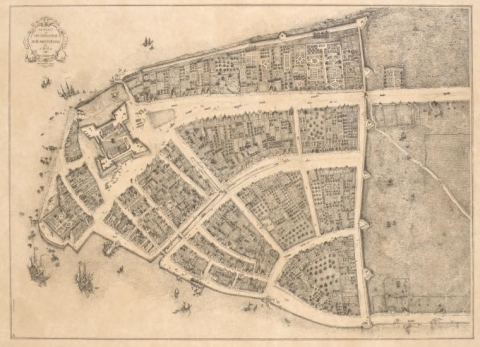
This, explains the NYPL, “is the process where digital images of maps are stretched, placing the maps themselves into their geographic context, rendered either on the website or with tools such as Google Earth.” For example, below see a “warping” of the 1916 Redraft of the 1660 “Castello Plan” for then-New Amsterdam over a current-day Google Earth image of lower Manhattan (and note how much the island has been expanded past its 17th century shores). The “warping” technology is open access, meaning that “anybody with a computer can create an account, log in, and begin warping and tracing maps.” User contributions remain, “a la Wikipedia,” and add “one more piece to this new historical geographic data model.”

The “warper” is a special feature that helps place historical maps in a modern visual field, but it in no way ruins the enjoyment of those maps as archival pieces or art objects. You can see cartographer John Wolcott Adams original 1916 Castello Plan redraft below, and visit NYPL’s Digital Collections for a high resolution image, fully zoomable and, yes, printable. For more on the incredible warping technology NYPL makes available to us, see this extended blog post, “Unbinding the Atlas: Working with Digital Maps.” Over ten thousand of the collection’s maps are of New York and New Jersey, dating from 1852 to 1922, including property, zoning, and topographic maps. In addition, over one thousand of the maps depict Mid-Atlantic cities from the 16th to the 19th centuries, and over 700 are topographic maps of the Austro-Hungarian Empire between 1877 and 1914. That should be enough to keep any amateur or professional map-lover busy for a good long while. Start digging into the maps here.
Related Content:
Download 15,000+ Free Golden Age Comics from the Digital Comic Museum
Download Over 250 Free Art Books From the Getty Museum
14,000 Free Images from the French Revolution Now Available Online
Josh Jones is a writer and musician based in Durham, NC. Follow him at @jdmagness
Read More...Download De La Soul’s New Mixtape “Smell the Da.I.S.Y.” for Free
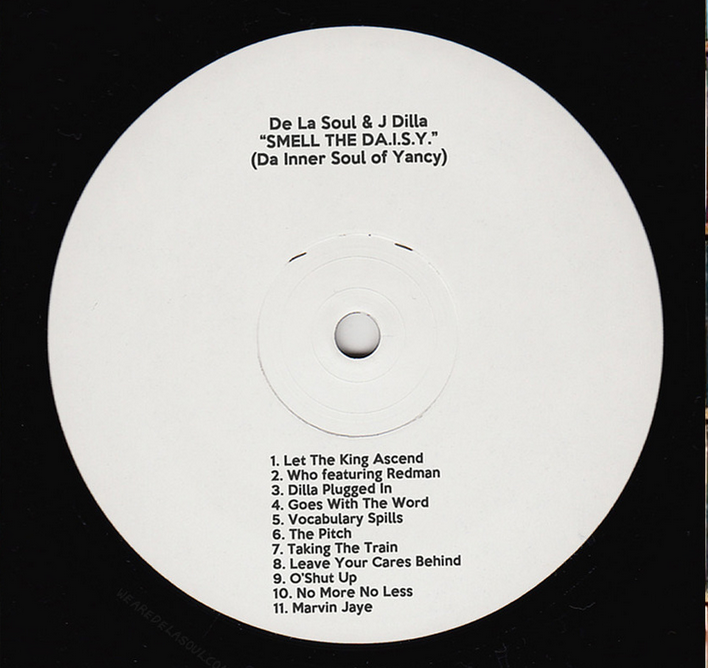
Last month, De La Soul celebrated the 25th anniversary of their debut album 3 Feet High and Rising by letting fans download nearly their entire back catalog of albums for free.
This month, the hip hop trio is giving away new music — their mixtape “Smell the Da.I.S.Y.,” which features their collaborations with the late-great hip hop artist, J Dilla.
Happy downloading.…
Read More...An Introduction to Dylanology, or How to Understand Bob Dylan by Digging Through His Garbage
You may never have heard of “Dylanology” before, but rest assured that the field covers the intellectual territory you suspect it does. Even if you have heard of Dylanology, you may never have heard of A.J. Weberman, the man who holds reasonable claim to having fathered the discipline. In John Reilly’s musically biographical 1969 short film above, The Ballad of A.J. Weberman, we witness the titular Bob Dylan obsessive engaging in one of his many research methods: in this case, the also neologism-anointed pursuit of garbology. This “science” has Weberman go through Dylan’s trash “in order to gather scraps of evidence to support his theories,” says the diligent fan’s entry in the web’s Bob Dylan Who’s Who. These theories include, according to Rolling Stone’s Marc Jacobson, the notion that “Dylan, the most angel-headed head of the generation, had fallen prey to a Manchurian Candidate-style government plot to hook him up to sensibility-deadening hard dope.”
The page also mentions that “after three years of self-publicity” as the “world’s leading Dylanologist,” Weberman “finally met Dylan in 1971.” But much of his notoriety comes not just from having met Dylan in the flesh, not just from habitually digging through Dylan’s garbage, and not just (or so he claims) having taken a rightful beating at the hands of Dylan, but from having conversed with Dylan, candidly and at length, over the telephone. These chats eventually emerged on vinyl as the album Robert Zimmerman vs. A.J. Weberman, and you can hear the whole thing at Ubuweb, or below:
Introduction
January 6, 1971
January 9, 1971
“The conversations were recorded in January, 1971, in the weeks following a demonstration outside Bob’s NYC apartment organized by Weberman [ … ] a misguided 60’s radical who felt (correctly enough) that by the early 70’s, rock music had ceased to be a force for radical political upheaval in the U.S. and had been co-opted by the establishment,” writes one contributor to the Dylan Who’s Who. “Like any of Bob’s songs, they must be heard to be truly understood.”
Related Content:
Bob Dylan Finally Makes a Video for His 1965 Hit, “Like a Rolling Stone”
Bob Dylan Reads From T.S. Eliot’s Great Modernist Poem The Waste Land
Hear the Never-Before-Released Bob Dylan Song “Pretty Saro” (1970)
The 1969 Bob Dylan-Johnny Cash Sessions: Twelve Rare Recordings
Bob Dylan and George Harrison Play Tennis, 1969
Colin Marshall hosts and produces Notebook on Cities and Culture and writes essays on cities, language, Asia, and men’s style. He’s at work on a book about Los Angeles, A Los Angeles Primer. Follow him on Twitter at @colinmarshall or on Facebook.
Read More...Jorge Luis Borges, After Going Blind, Draws a Self-Portrait
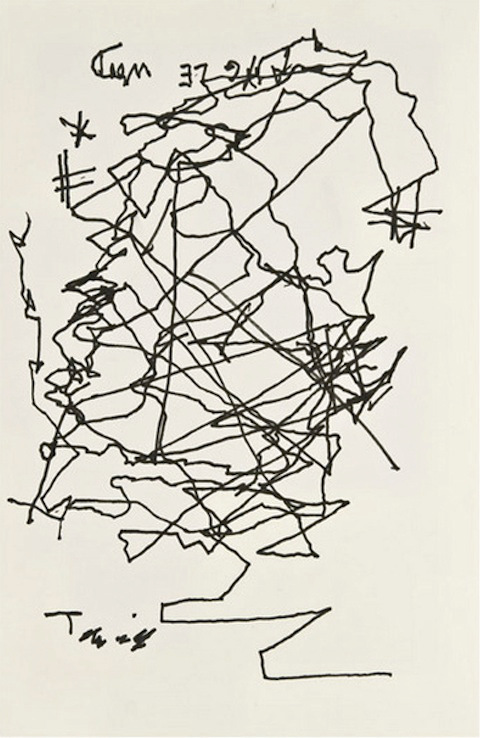
Jorge Luis Borges (1899–1986), one of the great writers to come out of Argentina, went blind when he was only 55 years old. As unsettling as it must have been, it wasn’t particularly a surprise. He once told The New York Times, “I knew I would go blind, because my father, my paternal grandmother, my great-grandfather, they had all gone blind.”
In the years following that life-changing moment, Borges never learned braille and could no longer read. But he did continue to write; he served as the director of Argentina’s National Library; he traveled and delivered an important series of lectures at Harvard on poetry (click to listen); and he even took a stab at drawing — something he did fairly well earlier in life. (See our previous post: Two Drawings by Jorge Luis Borges Illustrate the Author’s Obsessions.)
Above, you can see a self portrait that Borges drew in the basement of the famous Strand Bookstore in New York City. According to the Times, he did this “using one finger to guide the pen he was holding with his other hand.” After making the sketch, Borges entered the main part of the bookstore and started “listening to the room, the stacks, the books,” and made the remarkable observation “You have as many books as we have in our national library.”
If you’ve ever been to The Strand, you know how many books it holds. Indeed, the store boasts of being “New York City’s legendary home of 18 Miles of new, used and rare books.” My guess is that Argentina’s national library might have a few more volumes than that. But who is really counting?
If you would like to support the mission of Open Culture, consider making a donation to our site. It’s hard to rely 100% on ads, and your contributions will help us continue providing the best free cultural and educational materials to learners everywhere. You can contribute through PayPal, Patreon, and Venmo (@openculture). Thanks!
Related Content:
Jorge Luis Borges’ 1967–8 Norton Lectures On Poetry (And Everything Else Literary)
Jorge Luis Borges Chats with William F. Buckley on Firing Line (1977)
Read More...Bill Murray Croons a Soulful Cover of “The House of the Rising Sun”
Bill Murray began his singing shtick on Saturday Night Live back in the 70s. Anyone who watched the show during its heyday will surely remember his “Nick Winter” lounge singer character belting out the tune of the Star Wars theme song. Years later, Mr. Murray tickled us with a karaoke scene in Lost in Translation. And yet another decade later we find him singing “The House of the Rising Sun,” the American folk song recorded numerous times since 1934, but perhaps most famously by The Animals in 1964. Bill’s version took place last night at the annual Caddyshack Celebrity Golf Charity Event. If you enjoy hearing Bill sing, you should really listen to him read poetry. We’ve got the below.
via Rolling Stone
Related Content:
Bill Murray Reads Great Poetry by Billy Collins, Cole Porter, and Sarah Manguso
Bill Murray Reads Poetry at a Construction Site
Read More...Support Us
We're hoping to rely on loyal readers, rather than erratic ads. Please click the Donate button and support Open Culture. You can use Paypal, Venmo, Patreon, even Crypto! We thank you!

About Us

Open Culture scours the web for the best educational media. We find the free courses and audio books you need, the language lessons & educational videos you want, and plenty of enlightenment in between.
Advertise With Us

FREE UPDATES!
GET OUR DAILY EMAIL
Get the best cultural and educational resources on the web curated for you in a daily email. We never spam. Unsubscribe at any time.
FOLLOW ON SOCIAL MEDIA

Open Culture editor Dan Colman scours the web for the best educational media. He finds the free courses and audio books you need, the language lessons & movies you want, and plenty of enlightenment in between.
Advertise With Us

