Enjoy 15+ Hours of the Weird and Wonderful World of Post Soviet Russian Animation
Back during the waning years of the Soviet Union, animator Aleksandr Tatarsky left the state-run studio Écran to form his own animation company called Studio Pilot, the first privately owned company of its kind in Russia. The studio quickly made a name for itself by turning out bizarre, surreal and, at times, downright disturbing animated shorts. If you went to animation festivals during the Clinton presidency, you probably saw something from Studio Pilot.
Metafilter user “Nomyte,” who clearly knows both animation and Russian, put together an exhaustive list of movies on Youtube from Studio Pilot. A whopping 17 hours of footage. Here are a few favorites:
His Wife is a Chicken (1989) — A surrealist domestic drama tale about a guy who rejects his loving, hardworking wife when he realizes that, well, she’s a chicken. Told completely without words, the film (shown above) masterfully fuses everyday banality with some truly unnerving bits of weirdness – like that horrific worm dog creature with a human face. I saw this movie at some point in the early ‘90s and it gave me nightmares.
The Coup (1991) – An animated political cartoon that — 20 some odd years later — has become a fascinating historical document. The short shows a svelte Boris Yeltsin literally flush away the leaders of the doomed 1991 coup attempted against Mikhail Gorbachev. The incident was the last gasp of the Soviet old guard; its failure resulted in the eventual dissolution of the USSR. As the film’s end title points out, all of the short’s animators were personally involved in fighting the coup: “From 19 to 21 of August 1991, all animators who made this film have been [sic] defending the white house of Russia. Only by night on August 21 they could start working on the film.”
Gone with the Wind (1998) – Nothing about romance during the Civil War here. Instead, this movie is about, once again, a chicken. The short animation is a macabre tale about a boiled bird that comes back from the dead and struggles to return to its original unplucked state. You won’t look at eggs in quite the same way again.
2+1= (2003) – A lighthearted comedy about dinosaurs in love.
If you want to see the complete list of Studio Pilot animations, check it out here. Many more great animated shorts can be found on our list of Free Animated Films, part of our bigger collection 4,000+ Free Movies Online: Great Classics, Indies, Noir, Westerns, Documentaries & More.
Related Content:
Watch Dziga Vertov’s Unsettling Soviet Toys: The First Soviet Animated Movie Ever (1924)
Jonathan Crow is a Los Angeles-based writer and filmmaker whose work has appeared in Yahoo!, The Hollywood Reporter, and other publications. You can follow him at @jonccrow.
Read More...Watch Six TED-Style Lectures from Top Harvard Profs Presented at Harvard Thinks Big 5
Harvard has a few propositions it would like you consider. Take, for example, the one expounded on above by Robert Lue, whose titles include Professor of the Practice of Molecular and Cellular Biology, Richard L. Menschel Faculty Director of the Derek Bok Center for Teaching and Learning, and the faculty director of HarvardX. As an Open Culture reader, you might have some experience with that last institution—or, rather, digital institution—which releases Harvard-caliber learning opportunities free in the form of Massive Open Online Courses (or MOOCs). You’ll find some of them on our very own regularly-updated collection of MOOCs from great universities. Perhaps you haven’t enjoyed taking one, but you may well do it soon. What, though, does their increasing popularity mean for universities, one of the oldest of the traditional industries we so often speak of the internet “disrupting”? Lue, who offers eight and a half minutes of the choicest words on the subject, would like you to consider the MOOC’s moment not one of disruption for the university, but one of “inflection, and ultimately a moment of potential transformation.”
Lue’s argument comes laid out in one of the six brief but sharp lectures from Harvard Thinks Big 5, the latest round of the famed university’s series of TED-style talks where “a collection of all-star professors each speak for ten minutes about something they are passionate about.” Jeffrey Miron, Senior Lecturer and Director of Undergraduate Studies in the Department of Economics and senior fellow at the Cato Institute, has a passion for drug legalization. In his talk just above, Miron tells us why we should reconsider our assumptions about the benefits of any kind of drug prohibition — or at least, the benefits we just seem to assume it brings. And as we rethink our positions on the role of government in drug use and technology in the university, why not also rethink the role of large news organizations — and large organizations of any kind — in our lives? Below, Nicco Mele, Adjunct Lecturer in Public Policy at the Shorenstein Center at Harvard’s Kennedy School, explains why all kinds of power, from manufacturing sandals all the way up to gathering news, has and will continue to devolve from institutions to individuals.
The rest of the Harvard Thinks Big 5 lineup includes Senior Lecturer on Education Katherine K. Merseth advocating careers in teaching, Professor of Molecular and Cellular Biology Jeff Lichtman advocating “changing the wiring in your brain,” and African American Studies professor and Hiphop Archive at Harvard University founding director Marcyliena Morgan advocating a richer study of what grown-ups used to call, with a groan, “rap music.” You can read more about the talks and the professors giving them at the Crimson, before watching and deciding whether to agree with them, disagree with them, or simply consider — in other words, to think. The videos are also available on iTunesU.
Katherine K. Merseth
Jeff Lichtman
Marcyliena Morgan
Related Content:
Harvard Presents Free Courses with the Open Learning Initiative
Harvard Thinks Green: Big Ideas from 6 All-Star Environment Profs
Harvard Thinks Big 4 Offers TED-Style Talks on Stats, Milk, and Traffic-Directing Mimes
Harvard Thinks Big 2012: 8 All-Star Professors. 8 Big Ideas
Colin Marshall hosts and produces Notebook on Cities and Culture and writes essays on cities, language, Asia, and men’s style. He’s at work on a book about Los Angeles, A Los Angeles Primer. Follow him on Twitter at @colinmarshall or on Facebook.
Read More...Bruce Springsteen and Pink Floyd Get Their First Scholarly Journals and Academic Conferences

When I first entered college in the mid-‘90s, the phenomenon of pop culture studies in academia seemed like an exciting novelty, bound to the ethos of the Clinton years. Often incisive, occasionally frivolous, pop culture studies made academia fun again, and reinvigorated the world of scholarly publishing and college life in general. All manner of fandom ruled the day: we took classes in hip hop videos and Buffy the Vampire Slayer, Alanis Morrissette redefined irony, and nearly everyone got hired right after graduation (see for reference the cult classic 1994 film PCU). These days I don’t need to tell you that the prospects for new grads are considerably reduced, but I’m very happy to find academic societies and journals still organized around TV shows, fantasy novels, and pop music. Today we bring you two examples from the world of Classic Rock & Roll Studies (to coin a term). First up we have BOSS, or “The Biannual Online-Journal of Springsteen Studies.”
Springsteen Studies is not new. In fact, a massive Springsteen symposium called “Glory Days”—jointly sponsored by Virginia Tech, Penn State, and Monmouth University—has taken place twice in West Long Branch, New Jersey since 2005 and is currently preparing for its next event. BOSS, however, only just emerged, the first scholarly Springsteen journal ever published. The first issue will appear in June of this year, and the editors are now soliciting 15 to 25 page academic articles for their January, 2015 issue. Describing themselves as a “scholarly space for Springsteen Studies in the contemporary academy,” BOSS seeks “broad interdisciplinary and cross-disciplinary approaches to Springsteen’s songwriting, performance, and fan community.” Springsteen scholars: check the BOSS site for deadlines and contact info.
Unlike most scholarly journals, BOSS is open-access, so fans and admirers of all kinds can read the sure-to-be fascinating discussions it fosters as it works toward securing “a place for Springsteen Studies in the contemporary academy.” Springsteen Studies’ advocacy appears to be working—Rutgers University plans to add a Springsteen theology class, covering Springsteen’s entire discography, and other institutions like Princeton and the University of Rochester have offered Springsteen courses in the past.
In another first for a specialized pop culture field, the first-ever academic conference on the work of Pink Floyd will be held this coming April 13 at Princeton University. Called “Pink Floyd: Sound, Sight, and Structure,” the event promises to be a multi-media extravaganza, featuring as its keynote speaker Grammy-award winning Pink Floyd producer and engineer James Guthrie. (See Guthrie and others discuss the production of the surround-sound Super Audio CD of Wish You Were Here in the video above). In addition to Guthrie’s talk, and his surround sound mix of the band’s music, the conference will offer “live compositions and arrangements inspired by Pink Floyd’s music,” an “exhibition of Pink Floyd covers and art,” and a screening of The Wall. Papers include “The Visual Music of Pink Floyd,” “Space and Repetition in David Gilmour’s Guitar Solos,” and “Several Species of Small Furry Animals: The Genius of Early Floyd.” Admission is free, but you’ll need to RSVP to get in. The town of Princeton will join in the festivities with “Outside the Wall,” a series of events and specials on drinks, dining, art, and music.
While these events and publications may seem to locate pop culture studies squarely in New Jersey, those interested can find conferences all over the world, in fact. A good place to start is the site of the PCA (“Pop Culture Association”), which hosts its annual conference next month in Chicago, and the International Conference on Media and Popular Culture will be held this May in Vienna. Pop culture and media studies still seem to me to be particular products of the optimistic ‘90s (due to my own vintage, no doubt), but it appears these academic fields are thriving, despite the vastly different economic climate we now live in, with its no-fun, belt-tightening effects on higher ed across the board.
Related Content:
Heat Mapping the Rise of Bruce Springsteen: How the Boss Went Viral in a Pre-Internet Era
Watch Documentaries on the Making of Pink Floyd’s Dark Side of the Moon and Wish You Were Here
Josh Jones is a writer and musician based in Durham, NC. Follow him at @jdmagness
Read More...The World Concert Hall: Listen To The Best Live Classical Music Concerts for Free
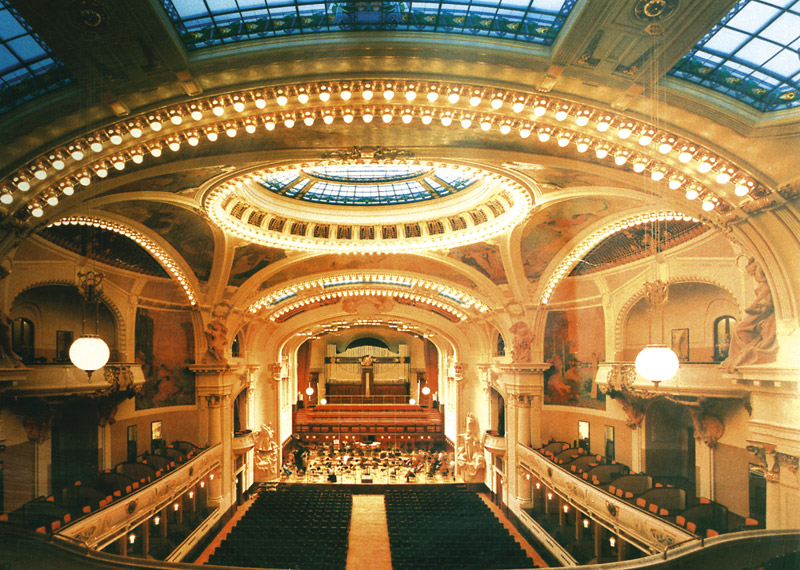
While the Internet may not have helped global music sales, it’s certainly been a boon for fans wanting to listen to otherwise-inaccessible music, especially classical music. We often post classical musical finds on Open Culture. Take for example this compendium of freely downloadable music from over 150 classical composers, this open version of Bach’s Goldberg variations and all of Bach’s organ works, and then this collection of 85,000 free classical scores. Today, we bring you another fantastic resource: the World Concert Hall.
Just over a century after the first radio performance of Ruggero Leoncavallo’s “Il Pagliacci,” and Pietro Mascagni’s “Cavalleria Rusticana” were broadcast live from the Metropolitan Opera House in 1910, the World Concert Hall has made it its mission to bring free live classical concerts to the world. The website contains a collection of links to free radio performances each week, allowing listeners to tune into live concerts performed across the globe. You can browse performances according to the site’s schedule, or choose from a selection of classical radio stations in a large number of countries. As you might expect, the U.S has the largest selection by far, with 80 stations. But for more curious music lovers, World Concert Hall also offers a taste of what other fans are listening to in other countries, like China, Japan, and Israel.
Interested in checking out Mendelssohn’s concerto for violin, piano, and strings at Brussels’ Klara Festival (today, 7pm, GMT) or Irina Iordachescu and the Romanian Radio National Orchestra performing Tchaikovsky’s last works (Friday, 5pm, GMT)? Listen to your heart’s content at World Concert Hall.
Ilia Blinderman is a Montreal-based culture and science writer. Follow him at @iliablinderman, or read more of his writing at the Huffington Post.
Related Content:
Stravinsky’s The Rite of Spring, Visualized in a Computer Animation for Its 100th Anniversary
Debussy Plays Debussy: The Great Composer’s Playing Returns to Life
The Genius of J.S. Bach’s “Crab Canon” Visualized on a Möbius Strip
Newly Discovered Piece by Mozart Performed on His Own Fortepiano
Read More...Thomas Edison & His Trusty Kinetoscope Create the First Movie Filmed In The US (c. 1889)
Thomas Edison is undoubtedly America’s best-known inventor. Nicknamed “The Wizard of Menlo Park” for his prolific creativity, Edison amassed a whopping 1093 patents throughout his lifetime. His most important inventions, such as the incandescent light bulb and the phonograph, were not merely revolutionary in and of themselves: they led directly to the establishment of vast industries, such as power utilities and the music business. It is one of his lesser known inventions, however, that led to the production of the first film shot in the United States, which you can view above.
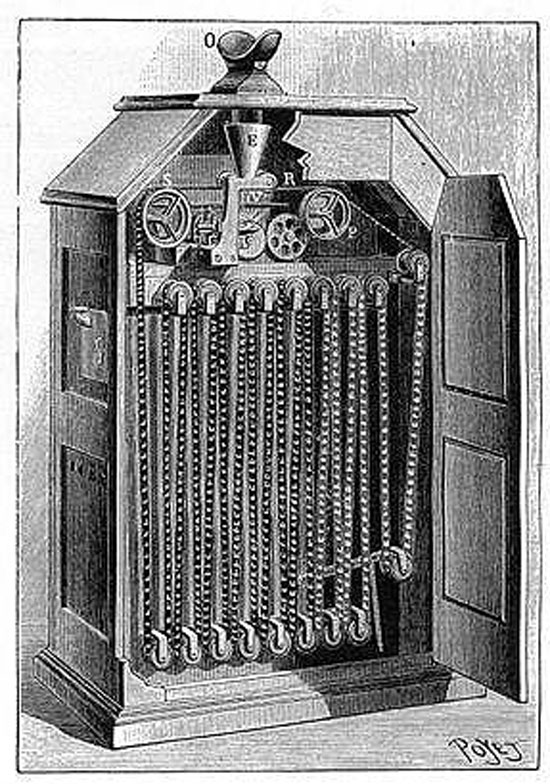
The film, called Monkeyshines, No. 1, was recorded at some point between June 1889 and November 1890. Its creation is the work of William Dickson, an employee of Edison’s, who had been in charge of developing the inventor’s idea for a new film-viewing device. The machine that Edison had conceived and Dickson engineered was the Kinetoscope: a large box that housed a system that quickly moved a strip of film over a light source. Users watched the film whiz by from a hole in the top of the box, and by using sequential images, like those in a flip-book, the Kinetoscope gave the impression of movement.
In the film, which Dickson and another Edison employee named William Heise created, a blurry outline of an Edison labs employee moves about, seemingly dancing. The above clip contains both Monkeyshines, No. 1, and its sequel, apparently filmed to conduct further equipment tests, known as Monkeyshines, No. 2. HD video, this is not. Despite having the honor of being the first films to be shot in the US, the Monkeyshines series has garnered an unenthusiastic reaction from present-day critics: the original received a rating of 5.5/10 stars at IMDB. The sequel? A 5.4.
Ilia Blinderman is a Montreal-based culture and science writer. Follow him at @iliablinderman, or read more of his writing at the Huffington Post.
Related Content:
Thomas Edison and Nikola Tesla Face Off in “Epic Rap Battles of History”
A Brief, Animated Introduction to Thomas Edison (and Nikola Tesla)
Thomas Edison Recites “Mary Had a Little Lamb” in Early Voice Recording
Read More...Billy Joel & Vanderbilt Student Perform Impromptu Duet of “New York State of Mind”
During a visit to Vanderbilt University last year, Billy Joel fielded a question from a freshman, Michel Pollack. To paraphrase: “My favorite song of yours is New York State of Mind. Can I play it for you on the piano while you sing?” To which Joel replied, “Ok.” And off they went. It’s a lovely impromptu moment. But it was a little too much for Pollack. A little overwhelmed by the whole experience, he got a 69 on his calculus exam the next day. But who could blame him. We have more impromptu musical moments below.
Related Content:
Lenny Kravitz Overhears High School Kids Playing His Music and Surprises Them by Joining In
A Paul Simon Feelin’-Very-Groovy Moment with a Fan
Blind Guitarist Lives Out Dream at U2 Show
Read More...Michel Foucault and Alain Badiou Discuss “Philosophy and Psychology” on French TV (1965)
If subtitles don’t play automatically, please click the “CC” button at the bottom of each video.
When Sigmund Freud died in 1939, the year Hitler invaded Poland, W.H. Auden wrote a eulogy in verse and remarked “We are all Freudians now.” One might have said something similar of Michel Foucault after his death in 1984. Foucault became a fiercely political philosopher after the May 1968 Paris student uprising and in a year that saw the Tet Offensive in Vietnam and the assassinations of Martin Luther King Jr. and Robert Kennedy. In the following year—after the Manson murders and the grim events at Altamont—the sixties effectively came to an end as its utopian projects flared up and fizzled.
In the next repressive decade, Foucault published Discipline and Punish (1974) and his History of Sexuality (1976). Even as he used Freudian concepts, he declared Freudian psychoanalysis complicit in what he called “disciplinary society,” another method, like prisons, schools, and hospitals, of keeping masses of people under constant surveillance and in states of submission. It is this post-‘68 Foucault many of us came to know—an anti-philosopher whose deep distrust of all institutional forms of power seemed the perfect ally for post-adolescent college students in comfortable rebellion. This is why it is a little surprising to see the Foucault above, in a 1965 conversation with philosopher Alain Badiou, ensconced in the bourgeois world of a French philosophical culture, with its lineages and ordinary citizens browsing paperback copies of Marx and Hegel, instead of staging Situationist actions to disrupt the social order.
But of course, it’s only logical to infer that the one culture led directly to the other. For all his rhetorical theatrics, Foucault never gave up on the humanist institution of the university, but always made his home in classrooms, lecture halls, and yes, even TV interviews. His topic in conversation with Badiou is “Philosophy and Psychology” and they came together on the educational television program L’enseignement de la philosophie—another testament, like the well-stocked bookstores and cultural landmarks, to a sixties French culture steeped in philosophical attitudes. Unfortunately we have only the first two parts of the interview, above, with English subtitles (the third and final part is still waiting to be translated). You can, however, see the full interview in French below.
The interview opens with the question “What is psychology?” Foucault’s answer, which he would revise many times in the coming decades, along with his terminology, begins by asking that we “interrogate” the discipline of Psychology “like any other type of culture.” Prodded by Badiou, he elaborates: Psychology is yet another institutionalized “form of knowing” that makes up a disciplinary society, the core concept of his philosophy. Foucault’s interviewer Badiou is now an elder statesman of French philosophy, its “greatest living exponent,” writes his publisher. His most recent book documents forty years of what he calls the “’French moment’ in contemporary thought”—one greatly inspired by Michel Foucault.
Related Content:
Clash of the Titans: Noam Chomsky & Michel Foucault Debate Human Nature & Power on Dutch TV, 1971
Free Online Philosophy Courses
Josh Jones is a writer and musician based in Durham, NC. Follow him at @jdmagness
Read More...Watch Episode #3 of Cosmos with Neil deGrasse Tyson: “When Knowledge Conquered Fear” (US Viewers)
Last week’s episode of the Cosmos reboot saw Neil deGrasse Tyson giving Fox viewers a lesson in evolution, a lesson that ended with the quiet but emphatic declaration: “The theory of evolution, like the theory of gravity, is a scientific fact. Evolution really happened.” This week Tyson, the astrophysicist who directs the Hayden Planetarium, introduced viewers to some subjects he holds near and dear: comets and gravity, the work of Edmond Halley and Isaac Newton, and how they changed our understanding of the world.
Related Content:
Episode #1 of Neil deGrasse Tyson’s Cosmos Reboot on Hulu (US Viewers)
Episode #2 of Neil deGrasse Tyson’s Cosmos: Explains the Reality of Evolution (US Viewers)
Neil deGrasse Tyson on the Staggering Genius of Isaac Newton
Read More...Revered Poet Alexander Pushkin Draws Sketches of Nikolai Gogol and Other Russian Artists
Ask an American or an Englishman who the best Russian poet is, and they’ll genuinely consider the question. The same query, when posed to a Russian, invariably yields a single answer: Alexander Pushkin. While his reputation possesses a certain renown amid some rarefied literary circles in the West, in Russia, Pushkin is worshipped: elementary school students memorize his verses, and one would be hard pressed to find a person ignorant of Eugene Onegin’s plot.
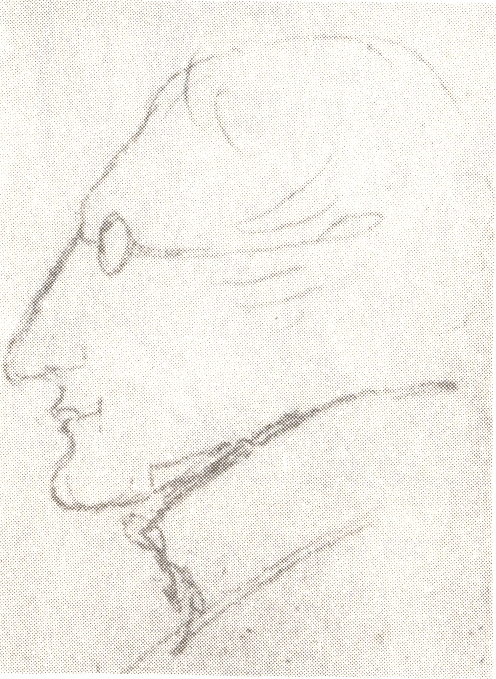
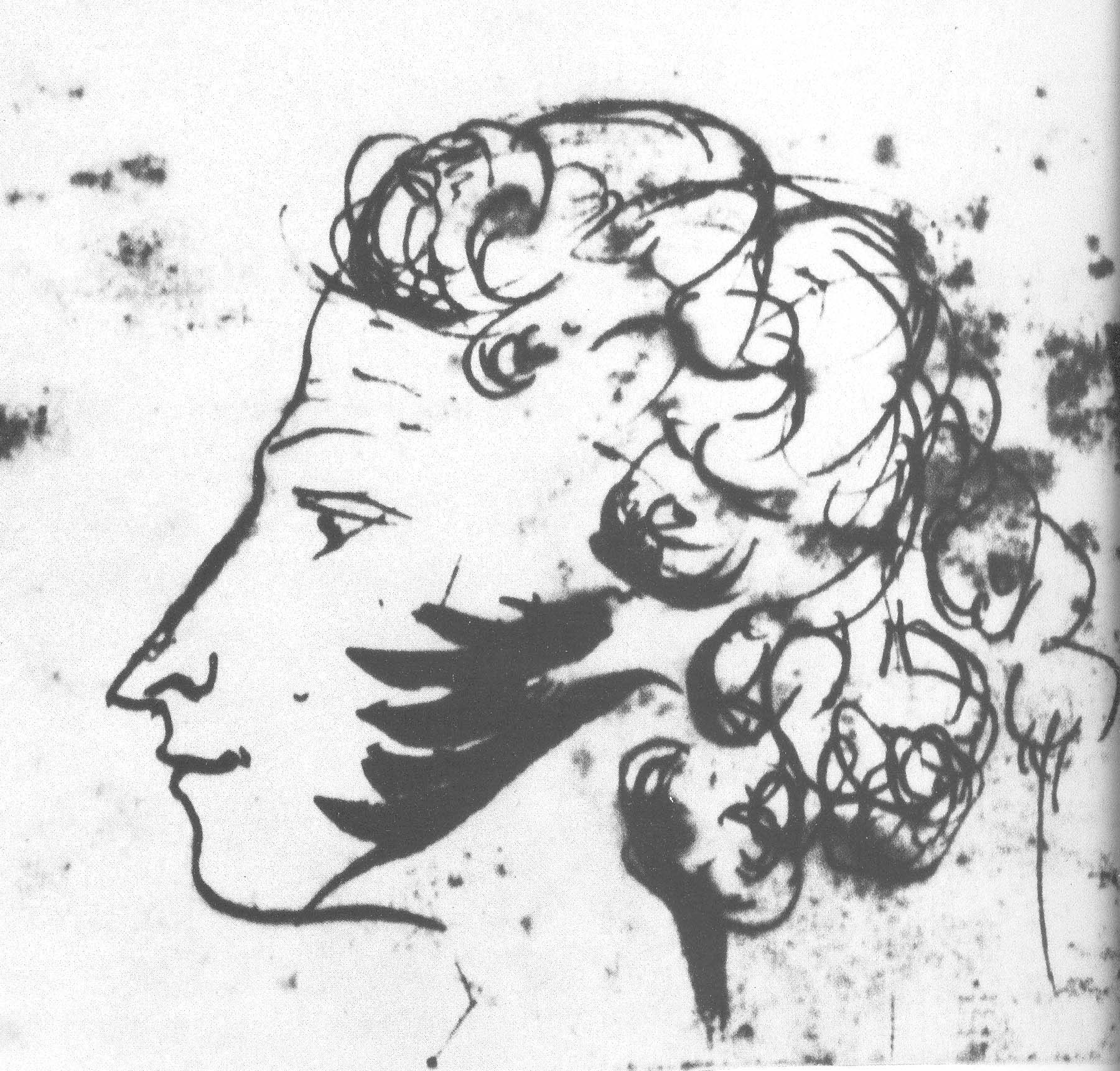
By extension, Pushkin’s sketches — so beloved in Russia that they’ve been compiled and published numerous times — remain almost unheard of elsewhere. Above we’ve included a simple drawing that the poet sketched of the great Russian writer, Nikolai Gogol. In the following image, below, Pushkin depicted another authorial contemporary: Aleksander Griboedov, whose Woe from Wit remains a Russian classic.
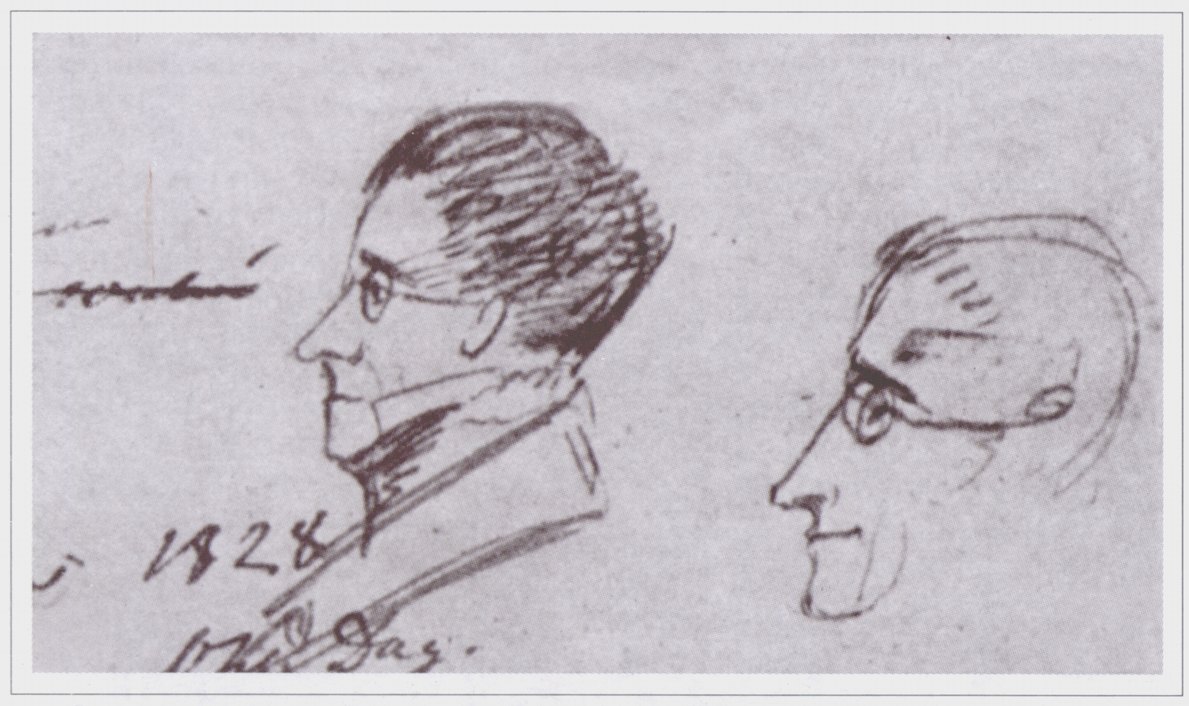
Further down is the poet himself, all curls and sideburns, in a self-portrait that dates from somewhere between 1827 and 1830.
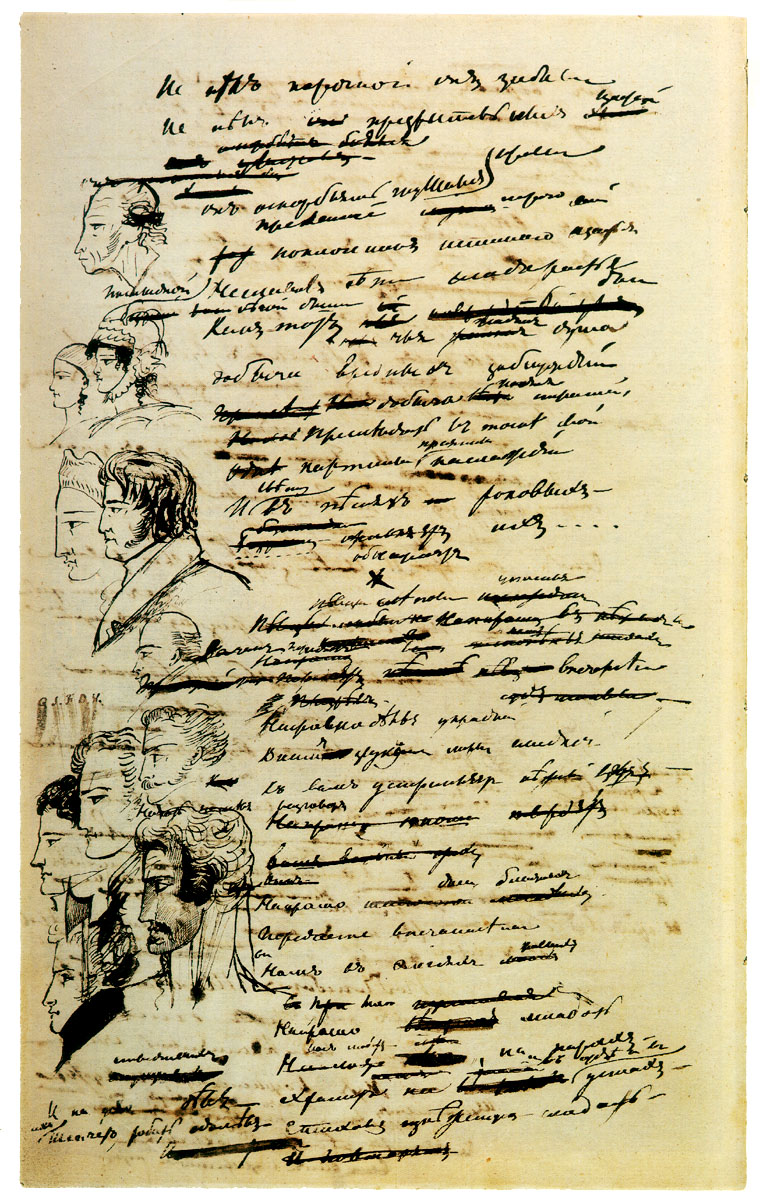
Pushkin would frequently jot down these charming black and white sketches both in his personal writings, and in the margins of his manuscripts. The final image, a page from Eugene Onegin, is a terrific example of his notebooks. Alongside the text, Pushkin included a sketch of a well-known Russian painter and aristocrat, with whom the author was certainly acquainted: Count Fyodor Petrovich Tolstoy (not to be confused with the Leo Tolstoy).
Ilia Blinderman is a Montreal-based culture and science writer. Follow him at @iliablinderman, or read more of his writing at the Huffington Post.
Related Content:
The Historic Meeting Between Dickens and Dostoevsky Revealed as a Great Literary Hoax
George Saunders’ Lectures on the Russian Greats Brought to Life in Student Sketches
Stephen Fry Profiles Six Russian Writers in the New Documentary Russia’s Open Book
Read More...The Chorus Project Features Teenagers Performing Hits by the Kinks, David Byrne, the Jackson 5 & More
The Chorus Project is the sort of opportunity parents dream about—talent-based, high profile, and helmed by visionary adults in tune with teenagers’ emotional and pre-professional needs. The select few—there are 39, leading one to wonder what happened to number 40—range in age from 14–18. They hail from a variety of backgrounds, coming together after school and over the summer to sing, and ultimately record, choral arrangements of rock and pop hits, orchestrated by well known musicians. The 1970s Langley Schools Music Project is a big influence, as is the television show Glee.
Their fresh-faced, orthodontia-enhanced take on the David Byrne / St.Vincent collaboration “Who,” above, embodies the Chorus Project approach, garnering St. Vincent’s stamp, or rather, Tweet, of approval.
Byrne recently advised young musicans to expect that retaining freedom and creative control means taking a financial hit. How comforting to find Chorus Project founder Lauren Bromley Hodge ennumerating that path’s alternate rewards:
Music is a universal language, crossing cultural and income barriers. Singing in a chorus creates community, friendship and trust. In a society where arts based educational opportunities are drastically reduced and threatened, this music project gives young singers the chance to learn about singing, performing and recording from musicians and teachers.
Cultural and income barriers aren’t the only boundaries music transcends. As one Metafilter user remarked after viewing the Chorus Project’s spin on The Kinks’ “Waterloo Sunset,” arranged by the dBs’ Chris Stamey:
Can someone let that adolescent boy singing lead on “Waterloo Sunset” know that my sixteen year-old self called and his heart is broken from the crush he’ll never be able to say hello to?
Because sob.
See, kids? You don’t need leather pants or facial hair to be cool!
My favorite Chorus Project performance thusfar is their cover of the Jackson 5’s “I Want You Back.” The purity of those opening bars reminded me of high school and “You Can’t Always Get What You Want” in equal parts. I dug the cinder blocks in the background. I appreciated the deep look of concentration upon soloist Presyce Baez’s face, as well as the catlike, canary-stuffed expression of his partner, Ally Copenhaver, biding her time until the one-and-a-half minute mark when… leapin’ lizards! That kid’s got an impressive set of pipes, making it all the more gratifying to see her showing up in a supporting capacity elsewhere in her chorus’s oeuvre.
You can enjoy more of the Chorus Project’s videos here, after which you can move to Raleigh-Durham, where project Seamus Kenney, leads a weekly, drop-in Popup Chorus for adults.
Related Content:
Teens Ponder Meaning of Contemporary Art
Ayun Halliday can’t sing, but she can crank out the zines like nobody’s business. Follow her @AyunHalliday
Read More...Support Us
We're hoping to rely on loyal readers, rather than erratic ads. Please click the Donate button and support Open Culture. You can use Paypal, Venmo, Patreon, even Crypto! We thank you!

About Us

Open Culture scours the web for the best educational media. We find the free courses and audio books you need, the language lessons & educational videos you want, and plenty of enlightenment in between.
Advertise With Us

FREE UPDATES!
GET OUR DAILY EMAIL
Get the best cultural and educational resources on the web curated for you in a daily email. We never spam. Unsubscribe at any time.
FOLLOW ON SOCIAL MEDIA

Open Culture editor Dan Colman scours the web for the best educational media. He finds the free courses and audio books you need, the language lessons & movies you want, and plenty of enlightenment in between.
Advertise With Us

