Watch Laurence Olivier, Liv Ullmann and Christopher Plummer’s Classic Polaroid Ads
Before Urban Outfitters and Project Impossible, before the adorable bickering ubiquity of spokespeople James Garner and Mariette Hartley, Polaroid kept things classy by entrusting its reputation to the most serious of serious actors.
Take Laurence Olivier. Who else could have made the phrase “Polaroid SX-70 Land Camera” sound like Shakespeare? Seriously. He could’ve tacked the string of superlatives he unleashes against a black background above onto the end of Henry V’s St. Crispin’s Day speech and I would have been none the wiser.
(And gentlemen in England now a‑bed
Shall think themselves accursed they were not here,
And hold their manhoods cheap whiles any speaks
That fought with us upon Saint Crispin’s day -
Pocket sized, folding, electronically controlled, motor driven…)
According to the late Peter Wensberg, a former Polaroid exec and author of Land’s Polaroid, A Company and the Man Who Invented It, Sir Laurence agreed to the 1972 spot on the condition that it wouldn’t be shown in England. (YouTube wouldn’t be founded for another thirty years.)
Sir Larry was followed in 1979 by actress Liv Ullmann, solemnly praising the SX70 Sonar OneStep’s moment-capturing abilities. Is there a Polaroid somewhere in the Ingmar Bergman Archive of his and Ullmann’s 12-year-old daughter Linn, standing at the sink, washing dishes? Or has YouTube become the sole reliquary for these precious moments?
Christopher Plummer’s 1980 spot seems downright loose by contrast, as he kicks back on a beach, aiming his SX70 Sonar OneStep at a Golden Retriever and a canoe’s worth of kids. (Sir Larry’s subject was a rather fussy porcelain clock.)
Given their history, it’s easy to think of Polaroid’s instant cameras as a gimmick or a fad, but such noted photographers as Ansel Adams, Andy Warhol, Helmut Newton, and Walker Evans were fans of the SX-70.
Related Content:
The Masterful Polaroid Pictures Taken by Filmmaker Andrei Tarkovsky
Ingmar Bergman’s Soap Commercials Wash Away the Existential Despair
Ayun Halliday has the sort of vision that screams out for an unlimited supply of free digital shots. Follow her @AyunHalliday
Read More...Phil Spector’s Gentle Production Notes to George Harrison During the Recording of All Things Must Pass
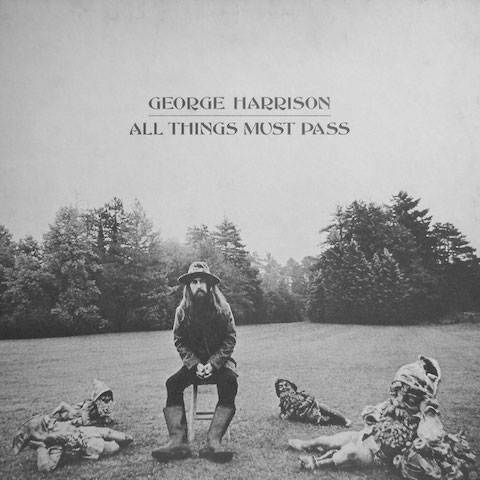
It’s pretty well established by this point that Phil Spector is dangerously insane. But once upon a time, he was also insane in the best possible way, willing to use methods no other record producer would to create his signature sixties “wall of sound” with huge ensembles and off-the-wall effects that turned the studio into an instrument. And for all his documented violence, Spector was also once a surprisingly gentle writer, as you can see in his notes to George Harrison, made during the recording of Harrison’s Spector-produced triple-album All Things Must Pass. In his comments, Spector coaxes Harrison to work harder on his vocal performances and make his voice more prominent throughout the album’s eighteen studio tracks.
Although he’d made significant contributions to The Beatles as a songwriter, Harrison was eager to do his own thing during the band’s demise in the late sixties. All Things Must Pass is generally thought of as his first solo album, but he had actually released two previous records under his name, the 1968 film soundtrack Wonderwall Music and the experimental 1969 Electronic Sound. Both of these, however, are largely instrumental, and Harrison had yet to step out of the The Beatles as a singer in his own right until All Things Must Pass in 1970. Spector’s notes make it clear that Harrison was less than confident in his vocal abilities. In the midst of his technical comments, Spector frequently refers to Harrison’s voice as “buried” in the mix. The letter as a whole is an intriguing glimpse into Spector’s process and, I think, a glimpse of Harrison working to overcome his natural reticence. After his list of notes on each track—some a sentence or two, some paragraph-length—Spector ends with a diplomatic summation that reiterates his desire to put Harrison’s voice front-and-center.
George, on all the 18 numbers I just mentioned, this is what I feel are the most important items on each. Naturally, wherever possible, of main importance is to get a good vocal performance by yourself. Also, if you do any of the background voices, you should spend considerable time on them to make sure they are good…. I think you should spend whatever time you are going to on performances so that they are the very best you can do and that will make the remixing of the album that much easier. I really feel that your voice has got to be heard throughout the album so that the greatness of the songs can really come through. We can’t cover you up too much (and there really is no need to) although as I said, I’m sure excellent mixes can be obtained with just the proper amount of time spent on each one.
The letter finishes on a very warm note:
George, thank you for all your understanding about what we discussed, I appreciate your concern very much and hope to see you as soon as it is possible.
Much love. Regards to everyone. Hare Krishna,
Phil Spector
Read the full letter here.
Related Content:
George Harrison in the Spotlight: The Dick Cavett Show (1971)
Here Comes The Sun: The Lost Guitar Solo by George Harrison
Ravi Shankar (RIP) Gives George Harrison a Sitar Lesson … and Other Vintage Footage
Josh Jones is a writer and musician based in Durham, NC. Follow him at @jdmagness
Read More...Cartoonist R. Crumb Assesses 21 Cultural Figures, from Dylan & Hitchcock, to Kafka & The Beatles

Any fan of “underground” comic artist Robert Crumb knows that the man has no shyness about his preferences: not in jazz music, not in politics, and certainly not in the female form. Alex Wood, co-operator of the official R. Crumb site (pictured with Crumb above), has discovered that the artist’s opinions offer a vivid window into the artist’s mind. “Over the years, talking with Robert about many different things, I’ve been surprised by some of the things he likes and dislikes,” Wood writes. “We all know he loves old music from the early part of the last century, and doesn’t like rock music. But then he says he likes Tommy James and the Shondells, and Sam the Sham and the Pharaohs? So in a discussion in May, 2011, I asked his opinion on a list of people in the news past and present.” This became part one of the series “Crumb on Others,” which has at this point grown to seven full pages.
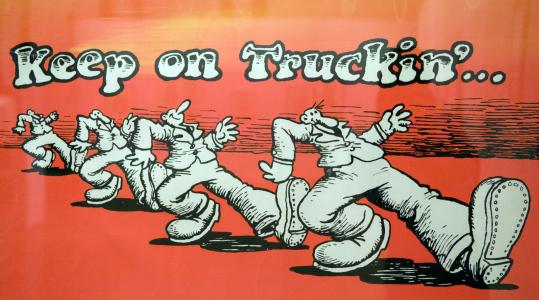
Below, we offer you a selection of the roughly 150 figures from music, film, visual art, and letters Crumb has so far assessed, his reactions ranging from high praise to outright dismissal to amusing anecdotes of his own encounters with the luminaries in question. With these, you can see how your notes on the likes of Bob Dylan, Alfred Hitchcock, Philip K. Dick, and Charles Darwin compare with those of the creator of Fritz the Cat and Mr. Natural, the hand that gave us “Keep on Truckin’,” and the leading light of of Zap Comix — a luminary who has generated no small amount of high praise, outright dismissal, and amusing anecdote himself. Here are the remaining parts. Part 2, Part 3, Part 4, Part 5, Part 6, and Part 7.
On Mark Twain: “Tom Sawyer and Huckleberry Finn don’t do that much for me. But his later stuff, he gets more cranky as he gets older. His critique gets more interesting. When I was 15, I read What Is Man? and it made a profound impression on me. It changed my life. It’s all about predestination versus freewill. He was a big believer in predestination. He didn’t think we had any free will.”
On Bob Dylan: “I hate his voice. I can’t stand to hear him sing. I thought some of the songs that he wrote in the mid-60s were kind of clever, with clever lyrics. But I just can’t stand to hear him or see him perform. And I think his heart is in the right place a lot of times, you know. Someone told me he was an aficionado of old 20s, old time music, and that he listens to the same kind of stuff I like.”
On Walt Disney: “When I was a little kid in the 50s, we were profoundly enthralled by Disney, and profoundly affected by the Disney vision. But to my taste, the whole thing starts to decline in the early 1950s. The last one that I think is a truly visionary work is Alice In Wonderland. Beginning with Peter Pan circa 1953 it starts to slide into something too corporate.”
On Janis Joplin: “Sad case, very sad case. She tried to act like she was hard and tough, but she wasn’t at all. She was soft and vulnerable. She drank a lot, and got a lot of bad advice. She was surrounded by vultures and vampires and scoundrels, and they just did her in. She finally ended up face-down in her own vomit alone in some hotel room; too much heroin and alcohol, 27 years old.”
On Alfred Hitchcock: “I talked to somebody who knew Kim Novak, some older woman, and Kim Novak told her shocking things about Alfred Hitchcock and his sexual proclivities. That kind of surprised me. I don’t know why. I guess when you look at Hitchcock you don’t see a guy with an aggressive sexual libido. Just goes to show you can never tell a book by its cover. I ought to know that by now.”
On The Beatles: “Some of the last stuff they did, you know, it kind of gets dark, and that’s more interesting to me, the last stuff they did before they broke up. Well, that and the music they did before they actually started recording under Brian Epstein. The only way you can hear that, I think, is to see the documentaries where it shows them playing in Hamburg and the Cavern Club. Before Brian Epstein got ahold of them and cleaned them up and made them over into those cute mop-tops and put them in those mod suits. Before that, they were greaser guys – leather jackets and greasy hair. And they just played this sort of driving, hard rock-a-billy music. And they were really good at that.”
On Pablo Picasso: “I once wrote that I envied Picasso, because he was the type of artist who didn’t let anything stand in the way of his art. He would just slam the door on his wives, his girlfriends, his children – anybody, when it was time to do his art. I always envied that about him. Also his powerful, penetrating, hypnotic way with women. I envied that about him too.”
On Franz Kafka: “Before I did that book on Kafka, I had never read him and didn’t know anything about him. But once I took that book project on, then I had to read all his stuff. And then I really got to like him. And while working on that project, I felt a very close kinship with Kafka. It was very strange. I started feeling deeply connected to Kafka somehow. Something I hadn’t expected at all.”
On Charles Bukowski: “Love ’im, love his writing. He was a very difficult guy to hang out with in person, but on paper he was great. One of the great American writers of the late 20th Century. [ … ] The last time I saw Bukowski, he came to this party in San Francisco, it was a poetry reading. And these two women that I knew they just kind of closed in on Bukowski. One was talking to him in one ear and the other was talking to him in his other ear. He was standing there with a beer bottle in each hand and getting drunk as fast as he could. And the last moment I saw him, they were leading him off to the bedroom.”
On William Burroughs: “He was a very eccentric character; very eccentric ideas and thoughts. He tried all kinds of strange, avant-garde psychotherapies. He was into psychic experimentation. He built himself an orgone box based upon the theories of Wilhelm Reich. He later got involved in Scientology and had this E‑meter and used it as a way to psychically clear himself. He said it was his electrical Ouija board. He tried other stuff too, like out of body experience. I can relate to all that stuff because I’m interested in all that fringe, psychic experimentation also. But he was very serious about that stuff.”
On Bettie Page: “She had the most perfect body and the cutest face of all in that pinup era of the 1940s and 1950s. She was the gold standard. There was nobody superior to her physically. And her poses, she always looked cheerful and wholesome, she never looked sleazy. It didn’t matter if she was posing in a sadomasochistic setup with those high heel boots and whips, it always looks like it’s just a funny game to her, you know? She could have a ball-gag in her mouth and she looks like the girl next door just having fun.”
On Woody Allen: “One of my favorite movies of his was Crimes and Misdemeanors. It was a great movie. In that movie, there was an esteemed ophthalmologist, very respected in his profession. He has this mistress, this neurotic woman and she’s threatening to expose him and the secret affair he’s having. She threatens to come over to his house and make a big scene and ruin his life. He also has a brother who’s involved in the crime syndicate. So he goes to the brother and the brother has her killed by a professional. All the main male characters in the movie, I’ve come to suspect that they’re all parts of Woody Allen’s personality. The respected ophthalmologist is part of him; this nerdy, idealistic documentary film-maker — that’s part of him. And there’s this really arrogant comedy writer/director played by Alan Alda who plays such a jerk, and that’s part of Woody Allen also; very interesting. And I suspect that movie is kind of — and I don’t even know how aware of it he was — a confession. It was right around the time that whole scandal with Mia Farrow’s daughter happened — maybe right before — because Mia Farrow was in it. But, the ophthalmologist gets away with it.”
On Philip K. Dick: “I’ve actually never read any of his books. All I ever read was interviews with him and that account he gave of his religious experience — his mystical experience. The whole experience… the way he described it, it was great. I should read his books but I never got around to it. I was never big on science fiction, but he was always more interesting and imaginative than a lot of science fiction writers.” (Crumb illustrated Dick’s “meeting with God.”)
On Charles Darwin: “I never really read Darwin or studied much about him. I have the most broad, general idea about his theories of natural selection and evolution. But I do know that when a lot of upper class English people started reading his books, and his theories began to be widely known in the 1870s, it created a huge change that hasn’t been widely recognized by historians, to my knowledge. People’s attitudes toward religion changed due to his book, particularly in the upper classes in England, they stopped considering it their absolute duty to go to church and be a good church-going person. A lot of the upper class dropped out, let their church membership lapse. Before that. they all went to church, for appearance sake if nothing else. But after Darwin, that all changed.”
On Jack Kerouac: “When I was 17, I read On The Road, and it sickened me, because my reaction was, ‘Oh God, these guys are out there having so much fun. I’m not having any fun at all. I’m just sitting here in my parents house. But them — the girls, the adventures, they’re just like having a fuckin’ lark On The Road.’ ”
On Jean-Paul Sartre: “A funny guy, Sarte’s a funny guy. You know, people don’t think of him as funny because he was so serious about existentialism and communism and stuff like that. [ … ] He wrote a book about his childhood that was pretty funny. It’s very self-deprecating, and he writes about what a little bourgeois, arrogant shit he was as a kid. Funny guy, I like Sarte.”
On Michelangelo: “The guy is just like glorifying the male body. It’s all about writhing, muscular male bodies. And even the women, they have male bodies with tits pasted on. The guy’s not into women, you can tell. He’s not into feminine at all. He’s not interested in the round, elliptical charms of the female form. No, he’s interested in the lumpy, muscular male body. And the whole [Sistine] Chapel is nothing but that.”
On Henry Miller: “Just like Kerouac, I was about nineteen when I read him, and again, I was devastated because he was having too much fucking fun. He was fucking so many women. He was so successful with women, it made me sick. He’d brag about how he came on to some woman on the street and ended up fucking her in the bushes. I thought, ‘God, how does he do that?’ It made me sick with envy. But trying to read him later, I thought he was way, way, too long-winded. I thought he needed serious editing.”
On Orson Welles: “I don’t understand why some people are so impressed by that guy. The most entertaining Orson Welles thing I’ve ever heard was some outtakes from a radio commercial that he was doing. And he’s really in a bad mood and he’s insulting the producers and technicians in the studio and telling them, ‘This is a lot of shit I hope you know.’ ”
On Hunter Thompson: “I met him a couple of times. He used to hang out at that Mitchell Brothers Theater on O’Farrell Street in San Francisco, which was a strip joint run by the Mitchell Brothers. There was this kind of like Irish-Journalist-Mafia that used to hang around there. He and these other Irish characters from San Francisco who were into journalism there, newspaper guys, they hung around there for some reason, I don’t know why. But Thompson did a lot of cocaine and drank, and then he would go on these long ‘cocaine raps,’ ranting and raving. But by the time I met him, y’ know, he was already well-advanced to being really fucking out of his mind.”
On Martin Scorsese: “I think Goodfellas is probably the best film about the modern American crime syndicates. Casino was kind of a follow-up to Goodfellas, and I didn’t think it was quite as good. Probably Goodfellas got so much praise it kind of went to his head so everybody got together and made this indulgent film. It had it’s good parts, it was good, it just wasn’t as good as Goodfellas. For one thing, there were too many close ups on DeNiro’s face. I just kept wanting the camera to back-off. OK, you think the guy’s great looking, but Jesus, OK, it’s enough, back-off!”
Related Content:
Record Cover Art by Underground Cartoonist Robert Crumb
A Short History of America, According to the Irreverent Comic Satirist Robert Crumb
Robert Crumb Illustrates Philip K. Dick’s Infamous, Hallucinatory Meeting with God (1974)
Colin Marshall hosts and produces Notebook on Cities and Culture and writes essays on cities, Asia, film, literature, and aesthetics. He’s at work on a book about Los Angeles, A Los Angeles Primer. Follow him on Twitter at @colinmarshall or on his brand new Facebook page.
Read More...Five Hardcore Deaths Suffered By Roman Emperors
It is ironic that the ancient world that created the adage “moderation in all things” could disregard this counsel in flagrant fashion. We’ve recently written about a number of various Greco-Roman excesses, from certain Roman gastronomic overindulgences to grotesquely imaginative Greek torture methods. Today, continuing this trend, we bring you a short list of the most gruesome deaths of Roman emperors, based on The Awl’s 2012 post, “Roman Emperors, Up To AD 476 And Not Including Usurpers, In Order Of How Hardcore Their Deaths Were” compiled by Josh Fruhlinger.
Without further ado, and in no particular order, here is the list:
Caracalla & Geta (198–217 C.E.) – Unlike some of the other emperors we’ve gathered here, Caracalla really was a jerk of colossal proportions. After reigning over Rome for a few years alongside his father, Septimius Severus, Caracalla took charge of the Roman Empire in tandem with his younger brother, Geta, in 211. The reign of brotherly love didn’t last long: after failing to assassinate Geta during the revelry that was the festival of Saturnalia, Caracalla had him slaughtered in their mother’s arms by loyal centurions during a peace agreement meeting.
To follow with this fratricidal motif, Caracalla himself was murdered in 217 by a man whose brother Caracalla may have had killed just days earlier. Caracalla had stopped on the side of a road to urinate while journeying to Edessa, and was dispatched by Julius Martialis, one of his bodyguards, with a single sword blow. Martialis, in turn, succumbed to an arrow fired by an Imperial Guard archer. We presume that Martialis didn’t have any more brothers, because things seem to have ended there.
Joannes (423–425 C.E.) – By the rare extant accounts, Joannes seems to have been a senior civil servant of some ability who had, to his detriment, failed to establish a firm grip on the Empire. Although Procopius, an antique scholar, had called him “both gentle and well-endowed with sagacity and thoroughly capable of valorous deeds,” Joannes was quickly engulfed in conflict with the eastern part of the Empire. In 425, the eastern Empire’s army captured him, cut off his hands, and placed him on a donkey to be paraded and jeered at in a hippodrome. Having suffered both insult and injury, Joannes was put out of his misery and decapitated.
Commodus (177–192 C. E.) – On paper, Commodus should have made an exemplary emperor. Both his grandfather and father were emperors before him, and his father, Marcus Aurelius, was praised both as a ruler and one of Stoicism’s central thinkers. Commodus, however, inherited neither his father’s philosophical inclinations nor his political smarts. To cap off a reign plagued by political strife, Commodus let himself fall victim to some destructive megalomania: after Rome was engulfed in a conflagration, Commodus declared himself to be the new Romulus and ceremoniously re-founded the city under the new name of Colonia Lucia Annia Commodiana. The renaming of his empire’s foremost city didn’t quite cut it, however, and Commodus resorted to renaming the months of the year after his 12 names. As December of 192 (known, by this point, as Pius of 192) drew to a close, Commodus was poisoned by his concubine, but vomited the substance, whereupon his wrestling training partner was sent in by a number of senators to strangle the emperor in the bathtub.
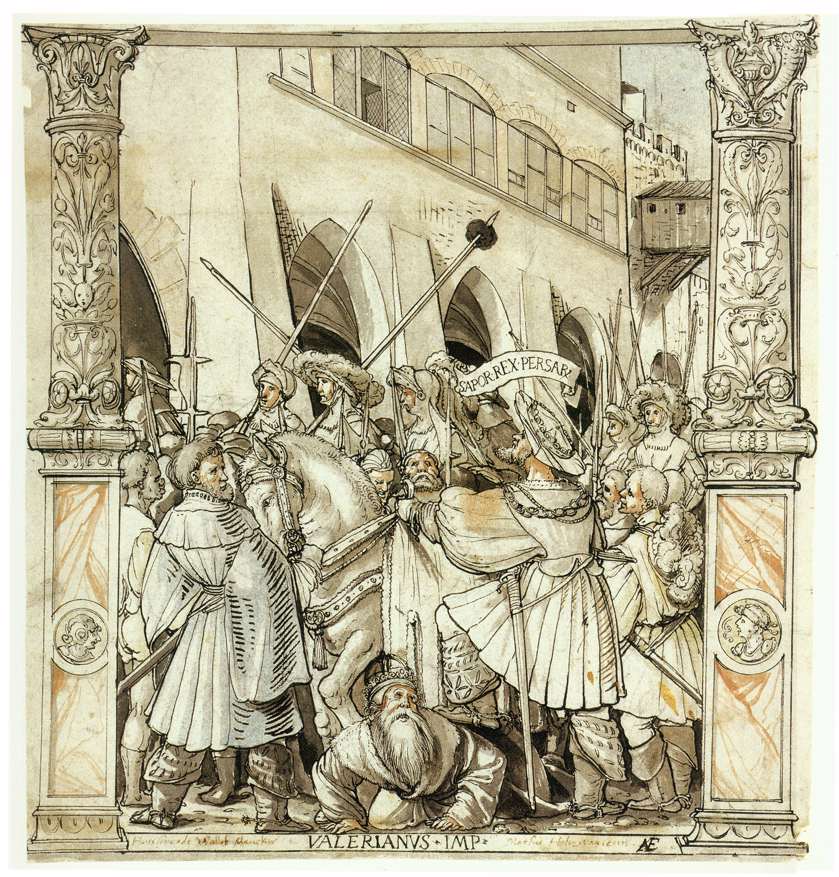
Valerian (253–259 C. E.) – If Joannes’ demise strikes you as having been somewhat undignified, Valerian’s end was a full-blown assault on human decency. Lactantius, an early Christian author, claimed that after his capture by the Persian king Shapur I, Valerian was put to use as a regal footstool to help the Persian ruler mount his horse. Valerian, understandably, expressed some consternation at such treatment, and offered Shapur a hefty sum in exchange for his freedom. There are two versions of what transpired next. In the first, Shapur expresses his disdain for Valerian’s measly offer by pouring molten gold down the former emperor’s throat. In the second, Shapur also expresses his disdain, albeit in a more creative fashion, this time by flaying Valerian’s skin and subsequently stuffing it with straw to be put on display. Thankfully, there’s evidence to contradict Lactantius’ account, which leads some historians to believe that Valerian was used as neither furniture nor gold receptacle, but rather lived a quiet life with some of his soldiers in an indeterminate Persian city. For his sake, we hope they’re right.
Above, you can see “The Humiliation of Valerian by Shapur,” a pen and black ink sketch created by Hans Holbein the Younger in 1521.
For a full list of gory deaths, head on over to The Awl.
Ilia Blinderman is a Montreal-based culture and science writer. Follow him at @iliablinderman.
Related Content:
Cook Real Recipes from Ancient Rome: Ostrich Ragoût, Roast Wild Boar, Nut Tarts & More
The History of Rome in 179 Podcasts
Courses on Roman history can be found in the History section of our collection of 800 Free Online Courses
Read More...Short Film “Syd Barrett’s First Trip” Reveals the Pink Floyd Founder’s Psychedelic Experimentation (1967)
Every musical era has its cautionary tales, and its visionaries. The sixties produced its share of them all, but also a handful of brilliant misfits who were inseparably both, all of them psychedelic pioneers. Skip Spence, for example—the brilliant founding member of Jefferson Airplane, then Moby Grape, who effectively ended his career attacking his bandmates with a fire axe. Then of course, there’s the founding singer/songwriter of Pink Floyd, Syd Barrett, whose decline found him onstage, almost catatonic, with a can of Brylcreem and a crushed bottle of pills called Mandrax dripping down his face. When Barrett passed away in 2006, most of the reaction—after the shock of learning he’d still been alive—centered on the sequence of psychotic breakdowns during 1967 that would leave Barrett changed forever. Spence and several other, more obscure figures, had similarly dramatic, and permanent, shifts in consciousness, and of all of them the same question gets asked: was it the drugs?
Of course we’re asking if the drugs created the mental illnesses or just exacerbated the inevitable, but we’re also asking if the drugs created the music. It’s a worthwhile, if somewhat uncomfortable, inquiry that’s probably impossible to answer. But I must admit, it’s difficult to imagine the first incarnation of Pink Floyd without Barrett’s heavy experimentation. The short film above implies a direct connection and takes us to Syd’s psychedelic inception. Simply titled Syd Barrett’s First Trip, the first part of the film, “Gog Magog Hills,” follows a clean-cut Barrett and several companions as they frolic in a field on LSD. As you probably gathered, it’s his first time. Then the film cuts abruptly to “Abbey Road Studios,” to footage documenting Pink Floyd in London after having just signed their first contract with EMI in 1967. It’s the beginning of the end for Barrett’s career and mental health, but the inauguration of the band as mass-market phenomenon.
According to the filmmaker, Nigel Lesmoir-Gordon, the film “just happened…. It is an unselfconscious film. It was not planned.” Of the ’66 footage, shot by his wife Jenny, he writes on the film’s IMDB page:
I shared the flat with some close friends from Cambridge, including Syd Barrett, who was busy becoming a rock star with Pink Floyd. A few hundred yards down the street at 101 Cromwell Road, our preternaturally cool friend Nigel was running the hipster equivalent of an arty salon. Between our place and his, there passed the cream of London alternative society–poets, painters, film-makers, charlatans, activists, bores and self-styled visionaries.
These are the characters in Syd’s entourage in this “raw, unedited footage,” which was originally silent, though many people have added music such as the new age‑y ambient soundscape in the version above. I happen to think it’s a nice complement, but if you find it intrusive, turn the volume off. The images, as the filmmaker admits, are still “stunning.”
Josh Jones is a writer and musician based in Durham, NC. Follow him at @jdmagness
Related Content:
Psychedelic Scenes of Pink Floyd’s Early Days with Syd Barrett, 1967
Artist Draws Nine Portraits on LSD During 1950s Research Experiment
Aldous Huxley’s LSD Death Trip
Read More...Two Peter Gabriel Albums ‘Scratch My Back … And I’ll Scratch Yours,’ Streaming Free for a Limited Time

Peter Gabriel’s cover album, Scratch My Back, came out in early 2010, and it featured Gabriel’s quite original remakes of songs by David Bowie, Lou Reed, David Byrne, Regina Spektor and other major artists. Now comes the follow-up: Set to be released on January 6, the new album, And I’ll Scratch Yours, flips the concept of the previous album. This time around, artists like Bon Iver, Arcade Fire, Lou Reed, Paul Simon and Feist record some of Peter Gabriel’s biggest hits — songs like “Games Without Frontiers,” “Mercy Street” and “Biko.” The albums can be purchased together here, but, happily, you can stream them online for free — but only for a a limited time — on NPR’s First Listen site. Enjoy.
Don’t miss anything from Open Culture in 2014. Sign up for our Daily Email or RSS Feed. And we’ll send cultural curiosities your way, every day.
Related Content:
Peter Gabriel and Genesis Live on Belgian TV in 1972: The Full Show
Peter Gabriel Plays Full Concert in Modena, Italy (1994)
Peter Gabriel and His Big Orchestra Play Live at the Ed Sullivan Theater
Read More...Chaos Cinema: A Breakdown of How 21st-Century Action Films Became Incoherent
If you read Open Culture, you probably love watching movies. I’d wager, however, that you don’t love watching action movies. I don’t mean that you operate at an intellectual level far above any such paltry entertainments; I mean that the craft of action filmmaking has itself declined. You’ve surely felt that today’s big-budget spectacles of chase, fight, and explosion — Transformers, the Jason Bourne films, last few Bonds, the latest Batman trilogy — don’t thrill you as did those of decades past — Hard Boiled, Raiders of the Lost Ark, The Wild Bunch, Die Hard — but perhaps you can’t pin down quite why. Have action movies changed, you may wonder, or have I? German-born, UCLA-based film scholar Matthias Stork argues for the former, breaking down the corruption of modern action filmmaking in his video essay Chaos Cinema. “Throughout the first century of moviemaking, the default style of commercial cinema was classical,” he begins. “It was meticulous and patient. In theory, at least, every composition and camera move had a meaning, a purpose, and movies did not cut without good reason.”
No longer. Where action filmmakers once “prided themselves on keeping the viewer well-oriented” in time and space, they now throw disparate images together haphazardly, enslaved to “rapid editing, close framings, bipolar lens lengths, and promiscuous camera movement,” trading “visual intelligibility for sensory overload,” leaving it to the soundtrack to provide a semblance of continuity. Stork examines the qualities and effects of this new style of “chaos cinema” in three parts. The first covers the visual disintegration of action sequences themselves; the second covers the deficiency’s penetration even into scenes of dialogue and music and the emergence of the “shaky-cam”; the third summarizes and engages responses to the first two parts. Whether or not mainstream commercial filmmaking will ever cure itself and return to convincing, coherent action rather than the impressionistic “general idea of action,” we now have a fascinating diagnosis of the disease. (For further discussion of Chaos Cinema, consider listening to Stork’s appearance on Battleship Pretension, a favorite film podcast of mine.)
Related Content:
The Dark Knight: Anatomy of a Flawed Action Scene
Alfred Hitchcock’s Seven-Minute Editing Master Class
The 10 Hidden Cuts in Rope (1948), Alfred Hitchcock’s Famous “One-Shot” Feature Film
Colin Marshall hosts and produces Notebook on Cities and Culture and writes essays on cities, Asia, film, literature, and aesthetics. He’s at work on a book about Los Angeles, A Los Angeles Primer. Follow him on Twitter at @colinmarshall or on his brand new Facebook page.
Read More...Robert Plant and Alison Krauss Sing Country Versions of Zeppelin’s “Black Dog” & “When the Levee Breaks”
They make an unlikely duo—the onetime lead singer of the hardest-partying rock band in the world and the soft-voiced contemporary bluegrass singer and fiddler. And yet somehow, the pairing of Robert Plant and Alison Krauss makes perfect sense, if not on paper then certainly on the stage and in the studio. They’ve been collaborating for years and won five Grammies for their 2007 album Raising Sand, which appeared on some of the most prominent critical best-of lists that year. And Plant has gone on record saying that his work with Krauss permanently altered his musical direction and helped him reconnect with his own English country music background.
Both Krauss and Plant get to explore several American roots avenues in Raising Sand, an album of songs by such luminaries as Sam Philips, the Everly Brothers, Townes Van Zandt, and Doc Watson. But in the videos above, the pair—backed by a country band—mosey through two old Led Zeppelin songs renowned for their thunderous loudness and sweeping guitars. “Black Dog” (original here) begins with Jimmy Page’s unmistakable intro riff picked out on a banjo while Plant goofs around and attempts a two-step. It feels like we’re in for a novelty act, but when the two start singing harmonies, the strength of their musical bond is immediately apparent, even in what some might consider a butchering of an iconic tune. Krauss takes the lead vocal in “When the Levee Breaks” (original here) while Plant hangs back and strums a guitar. She turns the song into straight country, and mostly sells it, save the band’s thin, uninspired instrumental breakdowns and guitar solos that only vaguely recall the original. All-in-all it’s an interesting experiment in genre transposition, though I think we’re lucky to have been spared an album of Plant and Krauss re-inventing classic Zeppelin as contemporary Americana.
Related Content:
Dutchman Masters the Art of Singing Led Zeppelin’s “Stairway to Heaven” Backwards
Led Zeppelin Plays One of Its Earliest Concerts (Danish TV, 1969)
Josh Jones is a writer and musician based in Durham, NC. Follow him at @jdmagness
Read More...The Story of Einstein’s Brain: A Japanese Professor Tracks Down the Organ in a Bizarre Documentary
The 1994 documentary above, Einstein’s Brain, is a curious artifact about an even stranger relic, the brain of the great physicist, extracted from his body hours after he died in 1955. The brain was dissected, then embarked on a convoluted misadventure, in several pieces, across the North American continent. Before Einstein’s Brain tells this story, it introduces us to our guide, Japanese scholar Kenji Sugimoto, who immediately emerges as an eccentric figure, wobbling in and out of view, mumbling awed phrases in Japanese. We encounter him in a darkened cathedral, staring up at a backlit stained-glass clerestory, praying, perhaps, though if he’s praying to anyone, it’s probably Albert Einstein. His first words in heavily accented English express a deep reverence for Einstein alone. “I love Albert Einstein,” he says, with religious conviction, gazing at a stained-glass window portrait of the scientist.
Sugimoto’s devotion perfectly illustrates what a Physics World article described as the cultural elevation of Einstein to the status of a “secular saint.” Sugimoto’s zeal, and the rather implausible events that follow this opening, have prompted many people to question the authenticity of his film and to accuse him of perpetrating a hoax. Some of those critics may mistake Sugimoto’s social awkwardness and wide-eyed enthusiasm for credulousness and unprofessionalism, but it is worth noting that he is experienced and credentialed as a professor in mathematics and science history at the Kinki University in Japan and, according to a title card, he “spent thirty years documenting Einstein’s life and person.”
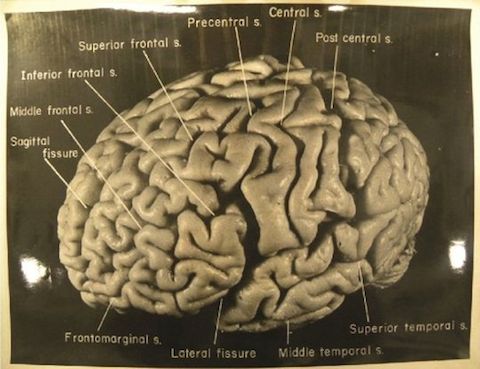
For a full evaluation, see a poorly proofread but very well-sourced article at “bad science blog” Depleted Cranium that tells the complete story of Einstein’s brain, and supports Sugimoto’s tale by reference to several accounts. Of the documentary, we’re told that “based on all available data, the basic premise and the events shown in the documentary are indeed true.” In the film, Sugimoto travels across the U.S. in search of Dr. Thomas Harvey, the man who originally removed Einstein’s brain at Princeton. (See one of the original pathology photos, with added labels, of the brain above). Depleted Cranium continues to set the scene as follows:
Eventually, Sugimoto tracks down Thomas Harvey at his home in Kansas. When he requests to see the brain, Harvey brings out two glass jars containing the pieces. At this point, Sugimoto makes a shocking request: he asks Harvey if he could have a small piece of the brain to keep as a personal memento. Harvey says “I don’t see any reason why not” and proceeds to retrieve a carving knife and a cutting board from his kitchen. He cuts a small section from a sample he identifies as being part of Einstein’s brain stem and cerebellum and gives it to Sugimoto in a small container. In the final scene, Sugimoto celebrates by taking his piece of the brain to a local kereoke [sic] bar and singing a favorite Japanese song.
The notion that the bulk of Einstein’s brain would have ended up in a closet in Kansas seems strange enough. And as for Harvey: the pathologist shopped the brain around for decades—if not for profit, then for notoriety—even driving across the country with journalist Michael Paterniti in 1997 to deliver a large portion of the brain to Dr. Sandra Witelson of McMaster University in Ontario. Paterniti documented the road trip in his book Driving Mr. Albert, which appears to corroborate much of Sugimoto’s narrative, though the trip may itself have been a publicity stunt.
In addition to the brain, Einstein’s eyes were also removed, without authorization, by his ophthalmologist, who kept them in a safety deposit box (where they presumably remain). The entire story of Einstein’s remains is gruesomely outlandish, though one might consider it a modern celebrity example of the centuries-old practice of body snatching. If some or all of this intrigues you, you’ll appreciate Sugimoto’s documentary. Unfortunately, the video upload is rough. It was recorded from Swedish television, has Swedish subtitles, and is generally pretty low-res. However, as a title card at the opening tells us, “due to the extremely limited availability of this documentary, this will have to suffice until a copy of higher quality rises to the surface.”
Related Content:
Albert Einstein Imposes on His First Wife a Cruel List of Marital Demands
The Musical Mind of Albert Einstein: Great Physicist, Amateur Violinist and Devotee of Mozart
Einstein Documentary Offers A Revealing Portrait of the Great 20th Century Scientist
Einstein for the Masses: Yale University Presents a Primer on the Great Physicist’s Thinking
Josh Jones is a writer and musician based in Durham, NC. Follow him at @jdmagness
Read More...What Books, Movies, Songs & Paintings Could Have Entered the Public Domain on January 1, 2014?
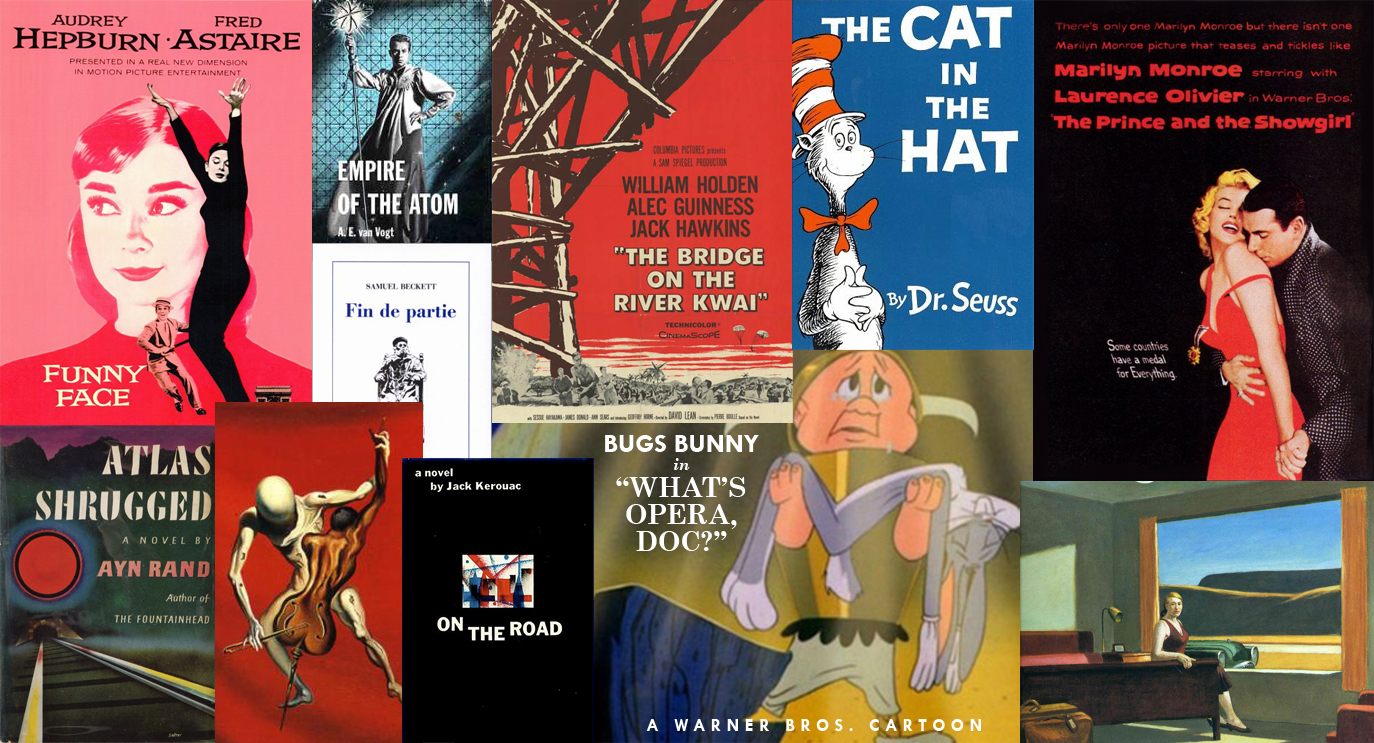
Every year, Duke University’s Center for the Study of the Public Domain highlights major works that would have entered the public domain had the copyright law that prevailed until 1978 still remained in effect today. That law (established in 1909) allowed works to remain under copyright for a maximum of 56 years — which means that 2014 would have welcomed into the public domain works first published in 1957. Some highlights (from the longer list) include:
Books
- Jack Kerouac, On the Road
- Ayn Rand, Atlas Shrugged
- Dr. Seuss, How the Grinch Stole Christmas and The Cat in the Hat
- Studs Terkel, Giants of Jazz
- Ian Fleming, From Russia, with Love
Movies
- 12 Angry Men (Henry Fonda, Lee J. Cobb, Jack Klugman, Ed Begley, and more)
- A Farewell to Arms (Rock Hudson and Jennifer Jones)
- Jailhouse Rock (Elvis Presley)
- The Seventh Seal (written and directed by Ingmar Bergman and starring Max von Sydow and Bengt Ekerot)
- Funny Face (Audrey Hepburn and Fred Astaire)
- Gunfight at the O.K. Corral (Burt Lancaster and Kirk Douglas)
Music
- “That’ll Be the Day” and “Peggy Sue” (Buddy Holly, Jerry Allison, and Norman Petty)
- “Great Balls of Fire” (Otis Blackwell and Jack Hammer)
- “Wake Up, Little Susie” (Felice and Boudleaux Bryant)
- Elvis Presley’s hits: “All Shook Up” (Otis Blackwell and Elvis Presley) and “Jailhouse Rock” (Jerry Leiber and Mike Stoller)
- The musical “West Side Story” (music by Leonard Bernstein, lyrics by Stephen Sondheim, and book by Arthur Laurents)
Art
- Dali’s “Celestial Ride” and “Music: the Red Orchestra”
- Edward Hopper’s “Western Motel”
- Picasso’s “Las Meninas” set of paintings
Under the current copyright regime, you’ll have to wait another 39 years — until 2053 — before these works hit the commons.
You can find a longer list of 1957 works still under copyright on Duke’s website.
Note: If you’re wondering how many works of art entered the public domain in 2014, the answer is simple: 0. As the Duke site notes, “Not a single published work” is entering the public domain in 2014. “In fact, in the United States, no publication will enter the public domain until 2019.”
Related Content:
Sherlock Holmes Is Now in the Public Domain, Declares US Judge
Free Philip K. Dick: Download 13 Great Science Fiction Stories
Read More...Support Us
We're hoping to rely on loyal readers, rather than erratic ads. Please click the Donate button and support Open Culture. You can use Paypal, Venmo, Patreon, even Crypto! We thank you!

About Us

Open Culture scours the web for the best educational media. We find the free courses and audio books you need, the language lessons & educational videos you want, and plenty of enlightenment in between.
Advertise With Us

FREE UPDATES!
GET OUR DAILY EMAIL
Get the best cultural and educational resources on the web curated for you in a daily email. We never spam. Unsubscribe at any time.
FOLLOW ON SOCIAL MEDIA

Open Culture editor Dan Colman scours the web for the best educational media. He finds the free courses and audio books you need, the language lessons & movies you want, and plenty of enlightenment in between.
Advertise With Us