See the Homes and Studies of Wittgenstein, Schopenhauer, Nietzsche & Other Philosophers

Philosophers are quirky creatures. Some become household names, in certain well-educated households, without anyone knowing a thing about their lives, their loves, their apartments. The life of the mind, after all, rarely makes for good theater (or TV). And prior to the creation of whole academic departments devoted to contemplation and regional conferences, a philosopher’s life could be a very lonely one. Or so it would seem to those who shun solitude. But for the bookish among us, the glimpses we have here into the well-kept homes and studies of several famous dead male European thinkers may elicit sighs of wonder, or envy even. It was so much easier to keep a room of one’s own neat before computer paraphernalia and tiny sheaves of Post-it notes cluttered everything up, no?

At the top of the post, we have an austere space for a severely austere thinker, Ludwig Wittgenstein. His desk in Cambridge faces a vaulted triptych of sunlit windows, but the bookshelf has clearly been emptied since his stay, unless Herr Wittgenstein preferred to work free of the distraction of other people’s published work. Above, another angle reveals comfortable seating near the fireplace, since blocked up with what appears to be an electric heater, an appliance the ultra-minimalist Wittgenstein may have found superfluous.

In addition to his philosophy, the German scion of a wealthy and eccentric family had an interest in photography and architecture, and he built his sister Margaret a house (above) that became known for “for its clarity, precision, and austerity—and served as a foil for his written work.” Wittgenstein’s eldest sister Hermione pronounced the house unlivable, as it “seemed indeed to be much more a dwelling for the gods than for a small mortal like me.”

Another polymath, credited along with Goethe for a phase of German thought called Weimar Classicism, poet and philosopher Friedrich Schiller’s studio in his Weimar house above presents us with a light, airy space, a standing desk, and some surprisingly well-tended furnishings. Whether they are original or not I do not know, but the space befits the man who wrote Letters Upon the Aesthetic Education of Man, in which (Fordham University informs us) he “gives the philosophic basis for his doctrine of art, and indicates clearly and persuasively his view of the place of beauty in human life.” The entire house is a study in beauty. A much gloomier character, whose view of humankind’s capacity for rational development was far less optimistic than Schiller’s, Arthur Schopenhauer lived a solitary existence, surrounded by books—a life much more like the caricature of philosophy. Below, see Schopenhauer’s book collection lined up neatly and catalogued.

The façade of Schopenhauer’s birth house in Gdansk, below, doesn’t stand out much from its neighbors, none of whom could have guessed that the strange child inside would prepare the way for Nietzsche and other scourges of the good Christian bourgeoisie. No doubt little Arthur received his portion of ridicule as he shuffled in and out, an odd boy with an odd haircut. And if Schopenhauer didn’t actually write the words attributed to him about the “three stages of truth”—ridicule, violent opposition, and acceptance—he may have fully agreed with the sentiment.

Finally, speaking of Nietzsche, we have below the Nietzsche-Haus in Sils-Maria, Switzerland, where the lover of mountainous climes and hater of the vulgar rabble’s noise holed away to work in the summers of 1881, 1883, and 1888. The house now contains an open library, one of the world’s largest collections of books on Nietzsche. Trip Advisor gives the site four-and-a-half stars, a crowd-sourced score, of course, of which Nietzsche, I’m sure, would be proud.

See many more German (and some French) philosophers’ homes and studies at The Unemployed Philosophers Guild PhLog, A Piece of Monologue, and the excellent photography site of Patrick Lakey.
Related Content:
The Daily Habits of Highly Productive Philosophers: Nietzsche, Marx & Immanuel Kant
Philosopher Portraits: Famous Philosophers Painted in the Style of Influential Artists
Famous Philosophers Imagined as Action Figures: Plunderous Plato, Dangerous Descartes & More
Josh Jones is a writer and musician based in Durham, NC. Follow him at @jdmagness
Read More...Watch After the Ball, the 1897 “Adult” Film by Pioneering Director Georges Méliès (Almost NSFW)
Cinema history now looks back to Georges Méliès, creator of 1902’s A Trip to the Moon and other early motion pictures previously featured here, as the medium’s first master of the fantastical. Visual effects, imagined worlds, and the seemingly impossible made seemingly real remain reliable draws for modern-day filmgoers, but so does something far simpler to produce: skin. But Méliès knew that, and he even demonstrated the extent of his knowledge in 1897’s After the Ball, viewable in all of its 19th-century titillation, and for its entire 1:06 length, here. While not the very first “adult” film — that historical honor goes to Eugène Pirou’s Bedtime for the Bride in France, and Esmé Collings’ A Victorian Lady in Her Boudoir in Britain — it must count as the earliest one by such a distinguished filmmaker. And it’s the only one of the three mentioned here you can watch online.
Michael Brooke’s Georges Méliès blog describes the action, shall we say, as follows: “A woman enters her boudoir, and her maid helps her to undress, peeling off her outer garments until she is clad in a shift and stockings. She sits down, and the maid helps remove the latter. Almost naked aside from skimpy underwear, the woman gets into a tub and the maid pours the contents of a large jug over her, drying her off with a towel afterwards. They leave the room together.” While modern-day adult filmmakers can and do continue to dine out on such premises, After the Ball’s rendition of the circumstances now looks tame enough to play freely on Youtube. Brooke adds that this film, along with Collings’ and probably Pirou’s, was “marketed as being suitable for private screenings to broad-minded bachelors.” Méliès’ contribution to this innovation must have made for a few worthwhile fin de siècle bachelor parties.
Related Content:
A Trip to the Moon (and Five Other Free Films) by Georges Méliès, the Father of Special Effects
Brokeback Before Brokeback: The First Same-Sex Kiss in Cinema (1927)
Silent & Sound Shakespeare: Watch the Very First Film Adaptations of the Bard (1899–1936)
Watch The Pleasure Garden, Alfred Hitchcock’s Very First Feature Film (1925)
Colin Marshall hosts and produces Notebook on Cities and Culture and writes essays on literature, film, cities, Asia, and aesthetics. He’s at work on a book about Los Angeles, A Los Angeles Primer. Follow him on Twitter at @colinmarshall.
Read More...In His Latest Film, Slavoj Žižek Claims “The Only Way to Be an Atheist is Through Christianity”
For some time now, Slavoj Žižek has been showing up as an author and editor of theology texts alongside orthodox thinkers whose ideas he thoroughly naturalizes and reads through his Marxist lens. Take, for example, an essay titled, after the Catholic G.K. Chesterton, “The ‘Thrilling Romance of Orthodoxy’ ” in the 2005 volume, partly edited by Žižek, Theology and the Political: The New Debate. In Chesterton’s defense of Christian orthodoxy, Žižek sees “the elementary matrix of the Hegelian dialectical process.” While “the pseudo-revolutionary critics of religion” eventually sacrifice their very freedom for “the atheist radical universe, deprived of religious reference… the gray universe of egalitarian terror and tyranny,” the same paradox holds for the fundamentalists. Those “fanatical defenders of religion started with ferociously attacking the contemporary secular culture and ended up forsaking religion itself (losing any meaningful religious experience).”
For Žižek, a middle way between these two extremes emerges, but it is not Chesterton’s way. Through his method of teasing paradox and allegory from the cultural artifacts produced by Western religious and secular ideologies—supplementing dry Marxist analysis with the juicy voyeurism of psychoanalysis—Žižek finds that Christianity subverts the very theology its interpreters espouse. He draws a conclusion that is very Chestertonian in its ironical reversal: “The only way to be an atheist is through Christianity.” This is the argument Žižek makes in his latest film, The Pervert’s Guide to Ideology. In the clip above, over footage from Scorsese’s The Last Temptation of Christ, Žižek claims:
Christianity is much more atheist than the usual atheism, which can claim there is no God and so on, but nonetheless it retains a certain trust into the Big Other. This Big Other can be called natural necessity, evolution, or whatever. We humans are nonetheless reduced to a position within the harmonious whole of evolution, whatever, but the difficult thing to accept is again that there is no Big Other, no point of reference which guarantees meaning.
The charge that Christianity is a kind of atheism is not new, of course. It was levied against the early members of the sect by Romans, who also used the word as a term of abuse for Jews and others who did not believe their pagan pantheon. But Žižek means something entirely different. Rather than using atheism as a term of abuse or making a deliberate attempt to shock or inflame, Žižek attempts to show how Christianity differs from Judaism in its rejection of “the big other God” who hides his true desires and intentions, causing immense anxiety among his followers (illustrated, says Žižek, by the book of Job). This is then resolved by Christianity in an act of love, a “resolution of radical anxiety.”
And yet, says Žižek, this act—the crucifixion—does not reinstate the metaphysical certainties of ethical monotheism or populist paganism. “The death of Christ,” says Žižek, “is not any kind of redemption… it’s simply the disintegration of the God which guarantees the meaning of our lives.” It’s a provocative, if not particularly original, argument that many post-Nietzschean theologians have arrived at by other means. Žižek’s reading of Christianity in The Pervert’s Guide to Ideology—alongside his copious writing and lecturing on the subject—constitutes a challenge not only to traditional theistic orthodoxies but also to secular humanism, with its quasi-religious faith in progress and empirical science. Of course, his critique of the vulgar certainties of orthodoxy should also apply to orthodox Marxism, something Žižek’s critics are always quick to point out. Whether or not he’s sufficiently critical of his communist vision of reality, or has anything coherent to say at all, is a point I leave you to debate.
via Biblioklept
Related Content:
Slavoj Žižek’s Pervert’s Guide to Ideology Decodes The Dark Knight and They Live
Noam Chomsky Slams Žižek and Lacan: Empty ‘Posturing’
A Shirtless Slavoj Žižek Explains the Purpose of Philosophy from the Comfort of His Bed
Josh Jones is a writer and musician based in Durham, NC. Follow him at @jdmagness
Read More...Prickly Ernest Hemingway Returns Letter to Critic: “Wipe Your Royal Irish Ass On It. You Are Stupid” (1931)
Despite being the paragon of imperturbable masculinity of his time, Ernest Hemingway had a highly sensitive artistic temperament. Nowhere did he exhibit this more than when discussing his writing. Papa did not suffer fools gladly, and literary critics tended to fare even worse. After Max Eastman dared to write, “Come out from behind that false hair on your chest, Ernest. We all know you,” Hemingway was reported to have slapped him with a book. When Orson Welles—a cinematic firebrand in his own right—decided to chide Hemingway about his script, the author took a swing.
In this YouTube clip, the critic seems to have gotten away with merely a verbal wallop. Although there is no video, the audio is clear, and we hear Hemingway’s measured baritone reading, then commenting on, an Irish critic’s review that he had received in 1931:
‘Your book lies upon my table. I have finished reading it, and I eye it dubiously.’ You’ve got a nice eye, boy!
‘The pages are cut rather unevenly.’ Nice work, you’re in there.
‘The stiff covers and the binding are normal, I think.’ Who are you, kid?
‘The signature on the cover is stamped in gold, or what looks like gold. There is nothing printed on the back side of the jacket.’ Your own backside.
The reviewer, one Walter H. McKay, fails to probe beyond the book’s binding, and Hemingway, in his typical style, tersely rips him a new one (bonus points if you noticed Hem’s Joycean turn of phrase).
Ilia Blinderman is a Montreal-based culture writer. Follow him at @iliablinderman
Related Content:
Hemingway to Fitzgerald: “Kiss My Ass”
Ernest Hemingway Creates a Reading List for a Young Writer, 1934
Ernest Hemingway’s Favorite Hamburger Recipe
Read More...80s Pop Singer Jimmy Somerville Surprises German Street Musician as the Busker Sings Somerville’s Hit
The 80s saw a number of hits by mostly UK synth-pop and new wave bands with prominent gay members (whether their fans knew it or not) like Culture Club, Soft Cell, Frankie Goes to Hollywood, and Wham!. One of the most impressively talented singers on this burgeoning 80s dance scene was Scottish musician Jimmy Somerville who defined the tremulous falsetto disco sound of bands like Bronski Beat and the Communards. Somerville’s first hit, 1984’s “Smalltown Boy,” was something of an early “It Gets Better” message coupled with a hard-edged dance-pop sound and a very autobiographical video (below). The song, writes Allmusic, dealt openly with Somerville’s sexuality, “a recurring theme [in his work] that met with surprisingly little commercial resistance.”
Today, Somerville lives in Berlin with his dog, and he’s still got that tremendous set of pipes. A Berlin street musician found this out recently while busking “Smalltown Boy” on an acoustic guitar, and bystanders happened to catch it on video (at top). As the young street performer hits the chorus, up walks Somerville to casually join in. The singer starts over and they finish the song in harmony. The more cynical corners of the internet swear the whole thing’s staged, perhaps for a Somerville comeback, but I like to think it’s genuine serendipity, especially at the end as the German busker suddenly has a flash of recognition: “it’s you?” he asks. “It’s me,” says Somerville, “it’s a hit.”
via Gawker
Related Content:
Lenny Kravitz Overhears High School Kids Playing His Music and Surprises Them by Joining In
Street Artist Plays Leonard Cohen’s “Hallelujah” With Crystal Glasses
Neil Young Busking in Glasgow, 1976: The Story Behind the Footage
Josh Jones is a writer and musician based in Durham, NC. Follow him at @jdmagness
Read More...James Brown Saves Boston After Martin Luther King’s Assassination, Calls for Peace Across America (1968)
Dr. Martin Luther King, Jr.’s death could not have been more devastating to African American communities across the country hoping to see the civil rights leader live to build on the successes of the movement. Despite King’s painfully prophetic “I’ve Been to the Mountaintop” speech the day before his assassination in Memphis Tennessee, most people hoped to see him finish the work he’d begun. Those hopes were dashed on April, 4 1968. After King’s death, embittered and embattled minorities in cities North and South erupted in rioting. Boston—a city of de facto segregation to rival Birmingham’s—seemed poised to blow up as well in the Spring of ’68, its “race relations… already on a short fuse.” As public radio program Weekend America describes the conditions:
The tension had been escalating in the mid-60s as the city began to desegregate its public schools. The mayoral race in 1967 pitted a liberal reformer, Kevin White, against Louise Day Hicks, an opponent of desegregation. Hicks ran under the evasive slogan “You know where I stand.” White won the race by less than 12,000 votes.
In this starkly divided city, James Brown went onstage to perform the day after King’s death, and it seems, whether that impression is historically accurate or not, that Brown single-handedly quelled Boston’s unrest before it spilled over into rioting.
The city’s politicians may have had something to do with it as well. Before Brown took the microphone, the narrowly-elected Mayor White addressed the restless crowd (top), asking them to pledge that “no matter what any other community might do, here in Boston, we will honor Dr. King’s legacy in peace.” After Councilor Tom Atkin’s lengthy introduction and the mayor’s short speech, the audience seems receptive, if eager to get the show on.
The archival footage was shot by Boston’s WGBH, who broadcast Brown’s performance that night. (The clip comes from a VH1 “rockumentary” called, fittingly, “The Night James Brown Saved Boston.”) Not long after the band kicked in, the scene became chaotic after a Boston police officer shoved a young man off the stage. Brown intervened, calming the cops and the crowd. His drummer John Starks remembers it this way: “It was almost at a point where something bad was going to happen. And he said [to the police] ‘Let me talk to them.’ He had that power.” In the clip above, watch concertgoers and other bandmembers describe their impressions of Brown’s “power” to reach the crowd.
Brown’s calming effect went beyond this particular gig. See him in the footage above address an audience in Washington, D.C. two days after King’s death. “Education is the answer,” he says, and sets up his own exceptional boostrapping rise from poverty as a model to emulate (“today, I own that radio station”). And WFMU’s Beware of the Blog brings us the audio below, from the year before King’s death—a time still fraught with sporadic riots and nationwide unrest against a system increasingly perceived as oppressive, corrupt, and beyond reform.
On the record, which was “probably distributed to radio stations only,” Brown makes an impassioned plea for “black people, poor people” to “organize” against their conditions, rather than riot. While the message from “Soul Brother Number One”—a title he accepts with humility above—failed to douse the flames in cities like Washington, DC, Detroit, Chicago, and Louisville, KY, and over 100 others after King’s murder, in Boston, the audience at his concert and the people watching at home on television seemed to heed his calls for nonviolence. “Boston,” writes Weekend America, “remained quiet.”
An Astronaut’s Guide to Life on Earth by Commander Chris Hadfield: The Viral Book Trailer
As Commander of the International Space Station, Chris Hadfield “captivated the world with stunning photos and commentary from space.” Perhaps you remember him singing David Bowie’s “Space Oddity” on board the International Space Station, or, on a more practical level, explaining what happens when astronauts shed tears in space –an important question, no doubt, but maybe not as headline grabbing as this other Hadfield talk: Everything You Wanted to Know About Going to the Bathroom in Space But Were Afraid to Ask.
Hadfield returned from the ISS in May, and he has apparently been busy writing a book that came out just days ago, An Astronaut’s Guide to Life on Earth: What Going to Space Taught Me About Ingenuity, Determination, and Being Prepared for Anything. To promote the book, Hadfield “enlisted his son to make a video for his new book launch that would be as entertaining as his time in space,” according to Devour. Mission accomplished, we all agree. The video has logged nearly 1,000,000 views and counting in a matter of days.
If you want to get familiar with the material covered in Hadfield’s book, I’d encourage you to listen to his recent interview with Terry Gross on Fresh Air.
Related Content:
Star Gazing from the International Space Station (and Free Astronomy Courses Online)
The Wisdom of Carl Sagan Animated
Read More...Experience Invisible Cities, an Innovative, Italo Calvino-Inspired Opera Staged in LA’s Union Station
The site specific opera Invisible Cities is up and running at LA’s historic Union Station. Location aside, something in this original work demands that I subject it to the New York Magazine Approval Matrix I carry around in my mind. It’s a snarky, quadfurcated rating system for the latest trends and happenings.
The phrase “based on an Italo Calvino novel” should guarantee it a spot in the Highbrow range.
Opera purists might consider the fact that ticket holders must rely on wireless headphones to get the full sound mix as reason enough to send this innovative work to the Despicable end of a “deliberately oversimplified guide to who falls where on our taste hierarchies.” A philistine myself, I think matching wandering singers to an invisible live orchestra (they’re sequestered in a nearby room) sounds Brilliant. It’s as if a silent disco and a flash mob mated, giving birth to a baby with impervious street cred and an incredible set of pipes. Here, have a listen…
Unlike the typical Improv Everywhere lark, the audience here is in on this gag. Though innocent passersby may wonder why various individuals are mooning around the terminal singing, Invisible Cities is a ticketed performance. Indeed, its popularity is such that the producers have needed to add extra free shows. Approval Matrix suggests it’s time to hop a train to LA.
H/T Kim L.
via GigaOm
Related Content:
What Happens When Everyday People Get a Chance to Conduct a World-Class Orchestra
Watch a Whimsical Animation of Italo Calvino’s Short Story “The Distance of the Moon”
Ayun Halliday dreams that her opera-hating 13-year-old son will one day consent to attend another free dress rehearsal at the Met, so that she can chaperone. Follow her @AyunHalliday
Read More...Lou Reed Rewrites Edgar Allan Poe’s “The Raven.” See Readings by Reed and Willem Dafoe
Yes, Halloween is behind us, and some people may desire a break from the Lou Reed tributes in order to mourn him silently. Fair enough. But indulge us once more, because Reed’s best music and the dark imaginative work of Edgar Allan Poe are always relevant, and when they come together, it’s reason to celebrate. And come together they did ten years ago with the recording of Reed’s concept album The Raven, a selection of musical and dramatic pieces put together by Reed. The album notably features actors such as Willem Dafoe, Steve Buscemi, Elizabeth Ashley, and Amanda Plummer and guest artists like David Bowie, Kate and Anna McGarrigle, and Ornette Coleman.
The collaboration, if you can call it such, between Reed and Poe makes perfect sense. As Mark Deming at Allmusic writes, “it’s no wonder why Lou Reed regards Poe as a kindred spirit.” Reed said as much in the liner notes: “I have reread and rewritten Poe to ask the same questions again. Who am I? Why am I drawn to do what I should not? … Why do we love what we cannot have? Why do we have a passion for exactly the wrong thing?” Despite its collection of seemingly mismatched parts, Reed’s The Raven worked, Deming writes, and Reed hadn’t “sounded this committed and engaged” in “over a decade” (Pitchfork had a decidedly different take on the album).
The Raven was originally a commissioned work for a stage production called POEtry, an adaptation of Poe’s work by Robert Wilson (who had previously worked with Tom Waits on The Black Rider). The title recording of Reed’s adapted “The Raven” (top) is actually read by a creepy-voiced Willem Dafoe. Ten years later, we have Reed himself reading his version of “The Raven” (above) at Cannes just this past June. He looks and sounds rather frail, but he’s mentally in top form. He breaks into his own reading to point out the fact that his version of the poem uses Poe’s “exact rhythm.” “If you don’t believe me,” he says, “you can check it line-by-line.” And so you can. Read Reed’s “The Raven” against Poe’s original. Of his modernization, Reed said:
The language is difficult, because there are a lot of arcane words that probably no one knew that they meant, even at the time – architectural terms and whatnot. So I spent a lot of time with the dictionary, to make it more contemporary, easy to read. Or easier, I should say.
The Reed/Poe/Robert Wilson collaboration also produced a 2011 book, also called The Raven and illustrated by artist Lorenzo Mattotti.
Related Content:
Christopher Walken, Iggy Pop, Debbie Harry & Other Celebs Read Tales by Edgar Allan Poe
Lou Reed — Velvet Underground Frontman, Influential Solo Musician — Dead at 71
Watch Red Shirley, Lou Reed’s Short Documentary on His Fascinating 100-Year-Old Cousin (2010)
Nico, Lou Reed & John Cale Sing the Classic Velvet Underground Song ‘Femme Fatale’ (Paris, 1972)
Josh Jones is a writer and musician based in Durham, NC. Follow him at @jdmagness
Read More...Mary Shelley’s Handwritten Manuscripts of Frankenstein Now Online for the First Time
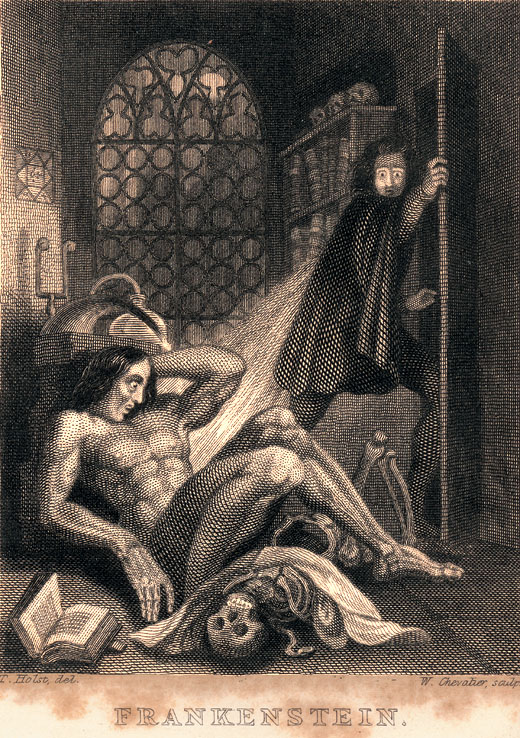
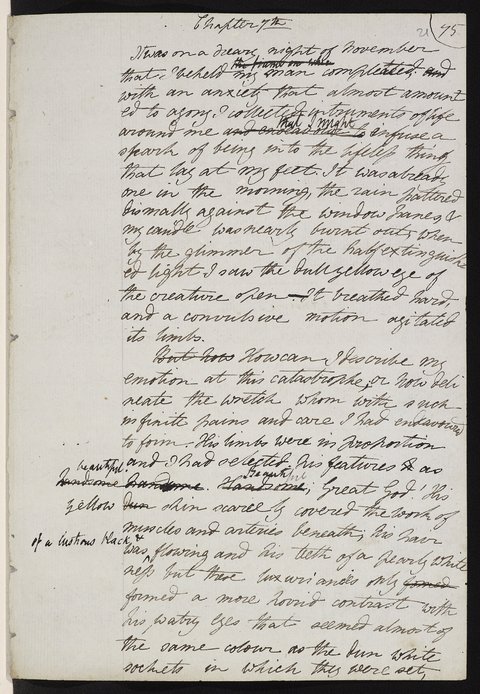
Thanks to the newly-opened Shelley-Godwin Archive, you can read “for the first time in digital form all the known manuscripts of Frankenstein,” Mary Shelley’s finest work and arguably the most famous work of British Romanticism.
The story behind the writing of Frankenstein is famous. In 1816, Mary Shelley and Percy Bysshe Shelley, summering near Lake Geneva in Switzerland, were challenged by Lord Byron to take part in a competition to write a frightening tale. Mary, only 18 years old, later had a waking dream of sorts where she imagined the premise of her book:
When I placed my head on my pillow, I did not sleep, nor could I be said to think. My imagination, unbidden, possessed and guided me, gifting the successive images that arose in my mind with a vividness far beyond the usual bounds of reverie. I saw — with shut eyes, but acute mental vision, — I saw the pale student of unhallowed arts kneeling beside the thing he had put together. I saw the hideous phantasm of a man stretched out, and then, on the working of some powerful engine, show signs of life, and stir with an uneasy, half vital motion.
This became the kernel of Frankenstein; or, The Modern Prometheus, the novel first published in London in 1818, with only 500 copies put in circulation. In writing Frankenstein, Shelley used a series of notebooks that “can now be viewed in high quality, resizable page images.” Each hand-written page comes accompanied by a typed transcript. Find them all here.
Funded by The National Endowment for the Humanities and The Gladys Krieble Delmas Foundation, the new archive was assembled by the University of Maryland’s Institute for Technology in the Humanities, The New York Public Library, the Bodleian Library, The Huntington, and the Harvard University Library.
Down the line, the Shelley-Godwin Archive “will provide the digitized manuscripts of Percy Bysshe Shelley, Mary Wollstonecraft Shelley, William Godwin, and Mary Wollstonecraft, bringing together online for the first time ever the widely dispersed handwritten legacy of this uniquely gifted family of writers.” So stay tuned for more.
Note: The Archive recommends using recent versions of Google’s Chrome browser or the latest version of Safari or Mozilla Firefox when viewing the manuscripts.
Related Content:
Literature: Free Online Courses
The Online Emily Dickinson Archive Makes Thousands of the Poet’s Manuscripts Freely Available
James Joyce Manuscripts Online, Free Courtesy of The National Library of Ireland
Frankenstein: The First Adaptation of Mary Shelley’s Novel to Film (1910)
Find Frankenstein in our Free eBooks and Free Audio Books collections
Read More...Support Us
We're hoping to rely on loyal readers, rather than erratic ads. Please click the Donate button and support Open Culture. You can use Paypal, Venmo, Patreon, even Crypto! We thank you!

About Us

Open Culture scours the web for the best educational media. We find the free courses and audio books you need, the language lessons & educational videos you want, and plenty of enlightenment in between.
Advertise With Us

FREE UPDATES!
GET OUR DAILY EMAIL
Get the best cultural and educational resources on the web curated for you in a daily email. We never spam. Unsubscribe at any time.
FOLLOW ON SOCIAL MEDIA

Open Culture editor Dan Colman scours the web for the best educational media. He finds the free courses and audio books you need, the language lessons & movies you want, and plenty of enlightenment in between.
Advertise With Us

