Jean Genet, France’s Outlaw Poet, Revealed in a Rare 1981 Interview
If subtitles don’t automatically appear, please click the “CC” button at the bottom of the video.
“I like being an outcast,” the French writer Jean Genet once said, “just as, with all due respect, Lucifer liked being cast out by God.”
Genet was a kind of poet laureate of outcasts. He was a champion of the socially alienated and a subverter of traditional morality. His poetic and highly original first novel, Our Lady of the Flowers, was written in prison. It deals frankly with his life as a petty criminal and homosexual. Jean Cocteau recognized Genet’s genius and helped get him published. Jean-Paul Sartre canonized him in Saint Genet, Actor and Martyr. Simone de Beauvoir called him a “thug of genius.”
The son of a prostitute and an unknown father, Genet was abandoned as an infant by his mother and raised in foster homes in a village in central France, where he was made to feel like an outsider. As a young boy he developed the habit of stealing things and running away from home. At the age of 15 he was sent to the Mettray Penal Colony, a reformatory for boys. When he got out, he joined the Foreign Legion, from which he eventually deserted. He spent years as a wandering prostitute and thief before finding fame as a poet, novelist and playwright.
In 1981, Genet agreed to collaborate with actress and film producer Danièle Delorme on a “cinematic poem” based on his writings. Delorme enlisted Genet’s friend Antoine Bourseiller, a prominent theatrical director who had staged Genet’s The Balcony. They filmed a series of sequences meant to evoke the atmosphere of Genet’s novels, but were unhappy with the results. They felt the only way to make the film work was to have Genet speak. The 70-year-old writer, who was suffering from throat cancer and finding it difficult to speak, reluctantly agreed. “I will respond,” Genet said, “to one question only: why am I not in prison?”
In the resulting film, Jean Genet: An Interview with Antoine Bourseiller, Genet explains that by the time he reached a certain age, prisons had lost their erotic appeal. He goes on to explain, somewhat cryptically, of his love of darkness and his special fondness for Greece, where “the darkness mixed with light.” In his notes for the film, Genet writes:
When I spoke of the mixture of shadows and light in Greece, I was of course not thinking of the light from the sun, and not even the milky stream of the Turkish baths. Evoking ancient Greece (which is still present), I was thinking not only of Dionysos in opposition to the shining brilliance and the harmony of Apollo, but of something even more distant than they: the Python snake who had her sanctuary at Delphi, and who never stopped rotting there, stinking up Dionysos, Apollo, the Turkish wali, King Constantine, the colonels, and the suns that followed them.
The first of two interviews for the film was recorded at Delphi in the early summer of 1981. The second was recorded a short time later in France, at the producer’s family home near Rambouillet. Genet talks revealingly about his childhood, his sexual awakening and his rejection of Christianity. He touches briefly on a wide range of subjects, from Arthur Rimbaud to the Black Panthers. Excerpts from his books are read by Roger Blin, Gérard Desarthes and J.Q. Chatelain. Genet supervised the editing of the film, which was first exhibited in the fall of 1982. Jean Genet: An Interview with Antoine Bourseiller will be added to our collection of over 500 free movies online.
Related Content:
Simone de Beauvoir Explains “Why I’m a Feminist” in a Rare TV Interview (1975)
Jean Cocteau’s Avante-Garde Film From 1930, The Blood of a Poet
Read More...The Penultimate Truth About Philip K. Dick: Documentary Explores the Mysterious Universe of PKD
Even readers not particularly well versed in science fiction know Philip K. Dick as the author of the stories that would become such cinematic visions of a troubled future as Blade Runner, Total Recall, Minority Report, and A Scanner Darkly. Dick’s fans know him better through his 44 novels, 121 short stories, and other writings not quite categorizable as one thing or the other. All came as the products of a creatively hyperactive mind, and one subject to more than its fair share of disturbances from amphetamines, hallucinogens, unconventional beliefs, and what those who write about Dick’s work tend to call paranoia (either justified or unjustified, depending on whom you ask). But Dick, who passed in 1982, channeled this constant churn of visions, theories, convictions, and fears into books like The Man in the High Castle, Do Androids Dream of Electric Sheep?, Ubik, and VALIS, some of the most unusual works of literature ever to carry the label of science fiction — works that, indeed, transcend the whole genre.
But what must it have felt like to live with the guy? The Penultimate Truth About Philip K. Dick (named after his 1964 novel of humanity tricked into living in underground warrens) seeks out the writer’s friends, colleagues, collaborators, stepdaughter, therapist, and wives (three of them, anyway), assembling a portrait of the man who could create so many textual worlds at once so off-kilter and so tapped into our real worries and obsessions. Each of these interviewees regards differently Dick’s dedication to the pursuits of both literary achievement and psychonautical adventure, his complicated conception of the true nature of reality, his at times unpredictable behavior, and his penchant for encounters with the divine. Director Emeliano Larre and writer Patricio Vega’s 2007 documentary reveals one of the most fascinating personalities in late 20th-century letters, though, as any professor of literature will tell you, we ultimately have to return to the work itself. Fortunately, Dick’s personality ensured that we have a great deal of it, all of it unsettling but greatly entertaining. Readers taken note. You can Download 14 Great Sci-Fi Stories by Philip K. Dick as Free Audio Books and Free eBooks.
Related Content:
Robert Crumb Illustrates Philip K. Dick’s Infamous, Hallucinatory Meeting with God (1974)
Colin Marshall hosts and produces Notebook on Cities and Culture and writes essays on literature, film, cities, Asia, and aesthetics. He’s at work on a book about Los Angeles, A Los Angeles Primer. Follow him on Twitter at @colinmarshall.
Read More...What Happens When Everyday People Get a Chance to Conduct a World-Class Orchestra
Here’s what ImprovEverywhere did. They:
put a Carnegie Hall orchestra in the middle of New York City and placed an empty podium in front of the musicians with a sign that read, “Conduct Us.” Random New Yorkers who accepted the challenge were given the opportunity to conduct this world-class orchestra. The orchestra responded to the conductors, altering their tempo and performance accordingly.
Improv Everywhere is “a New York City-based prank collective that causes scenes of chaos and joy in public places. Created in August of 2001 by Charlie Todd, the organization “has executed over 100 missions involving tens of thousands of undercover agents.” Find more of their “work” on YouTube.
Follow Open Culture on Facebook and Twitter and share intelligent media with your friends. Or better yet, sign up for our daily email and get a daily dose of Open Culture in your inbox. And if you want to make sure that our posts definitely appear in your Facebook newsfeed, just follow these simple steps.
via Devour
Related Content:
Beethoven’s “Ode to Joy” Movingly Flashmobbed in Spain
Copenhagen Philharmonic Plays Ravel’s Bolero at Train Station
Flashmob Recreates Rembrandt’s “The Night Watch” in a Dutch Shopping Mall
Read More...The Curious Score for John Cage’s “Silent” Zen Composition 4′33″
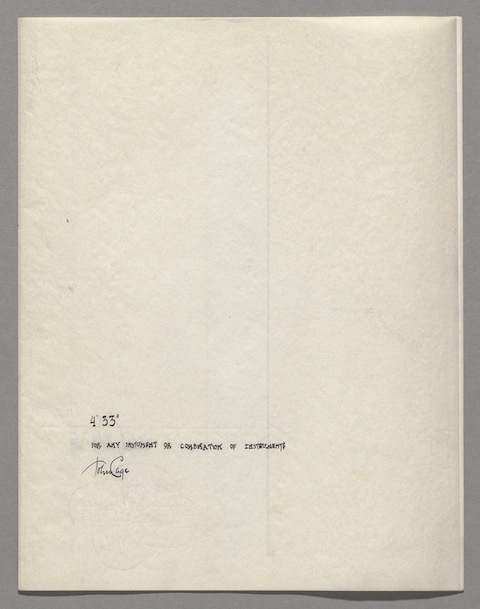
In most of the performances of John Cage’s famously silent composition 4’33”, the performer sits in front of what appears to be sheet music (as in the performance below). The audience, generally prepared for what will follow, namely nothing, may sometimes wonder what could be printed on those pages. Probably also nothing? Now we have a chance to see what Cage envisioned on the page as he composed this piece. Starting on October of this month, New York’s Museum of Modern Art will exhibit Cage’s 1952 score “4’33” (In Proportional Notation).” You can see the first page above.
As you might imagine, subsequent pages (viewable here) look nothing like a typical score, but they are not blank, nor do they contain blank staves; instead they are traversed by carefully hand-drawn vertical lines that seem to denote the units of time as units of space. In fact, this is exactly what Cage did (hence proportional notation). On the fourth page of the score, Cage writes the following formula: “1 page=7 inches=56 seconds.” Artist Irwin Kremen, to whom Cage dedicated the piece, has this to say about the unusual score:
In this score, John made exact, rather than relative, duration, the only musical characteristic. In effect, real time is here the fundamental dimension of music, its very ground. And where time is primary, change, process itself, defines the nature of things. That aptly describes the silent piece — an unfixed flux of sound through time, a flux from performance to performance.
Interpreters of Cage have frequently taken his “silent” piece as a playful bit of conceptual performance art. For example, philosopher Julian Dodd emphatically declares that 4’33” is not music, a distinction he takes to mean that it is instead analytical, “a work about music…,” that it is “a witty, profound work… of conceptual art.” Thinking of Cage’s piece as a kind of meta-analysis of music seems to miss the point, however. Kremen and many others, including Cage himself, call this notion into question. In the interview below, for example, Cage does make an important distinction between “music” and “sound.” He favors the latter for its chance, impersonal qualities, but also, importantly, because it is neither analytical nor emotional. Sound, says Cage, does not critique, interpret, or elaborate—it does not “talk.” It simply is. But the distinction between music and not-music soon collapses, and Cage cites Emmanuel Kant in saying that music “doesn’t have to mean anything,” any more than the chance occurrences of sound.
Cage’s rejection of meaning in music may have played out in a rejection of traditional forms, but it seems mistaken to think of 4’33” as a high concept joke or intellectual exercise. Perhaps it makes more sense to think of the piece as a Zen exercise, carefully designed to awaken what Suzuki Roshi called “the true dragon.” In a 1968 lecture, the Zen master tells the following story:
In China there was a man named Seko, who loved dragons. All his scrolls were dragons, he designed his house like a dragon-house, and he had many pictures of dragons. So the real dragon thought, “If I appear in his house, he will be very pleased.” So one day the real dragon appeared in his room and Seko was very scared of it. He almost drew his sword and killed the real dragon. The dragon cried, “Oh my!” and hurriedly escaped from Seko’s room. Dogen Zenji says, “Don’t be like that.”
The subject of Suzuki’s lecture is zazen, or Zen meditation, a practice that very much influenced Cage through his study of another Zen interpreter, D.T. Suzuki. Instead of practicing zazen, however, Cage practiced what he called his “proper discipline.” He describes this himself in a quotation from a biography by Kay Larsen:
[R]ather than taking the path that is prescribed in the formal practice of Zen Buddhism itself, namely, sitting cross-legged and breathing and such things, I decided that my proper discipline was the one to which I was already committed, namely, the making of music. And that I would do it with a means that was as strict as sitting cross-legged, namely, the use of chance operations, and the shifting of my responsibility from the making of choices to that of asking questions.
Cage, who loved Zen parables and was himself a storyteller, would appreciate Suzuki Roshi’s telling of Zenji’s true dragon story. While much of his compositional work seems to skirt the edges of music, focusing on the negative space around it, for Cage, this space is no less important that what we think of as music. As Suzuki interprets the story: “For people who cannot be satisfied with some form or color, the true dragon is an imaginary animal which does not exist. For them something which does not take some particular form or color is not a true being. But for Buddhists, reality can be understood in two ways: with form and color, and without form and color.” Read against this backdrop, Cage’s “silent” piece is as much a way of understanding reality—as much a true being—as a musical composition expressly designed produce specific formal effects. And while his published collection of lectures and writings is titled Silence, as Cage himself said of 4’33”, in a remark that provides the title for the MoMA’s exhibit, “there will never be silence.” In the absence of formalized music, 4′33″ asks us to hear the true dragon of sound.
Related Content:
Hear Joey Ramone Sing a Piece by John Cage Adapted from James Joyce’s Finnegans Wake
Watch a Surprisingly Moving Performance of John Cage’s 1948 “Suite for Toy Piano”
Woody Guthrie’s Fan Letter To John Cage and Alan Hovhaness (1947)
Josh Jones is a writer and musician based in Durham, NC. Follow him at @jdmagness
Read More...Mark Twain’s Advice to Little Girls: Witty Counsel to Young Ladies of 1865
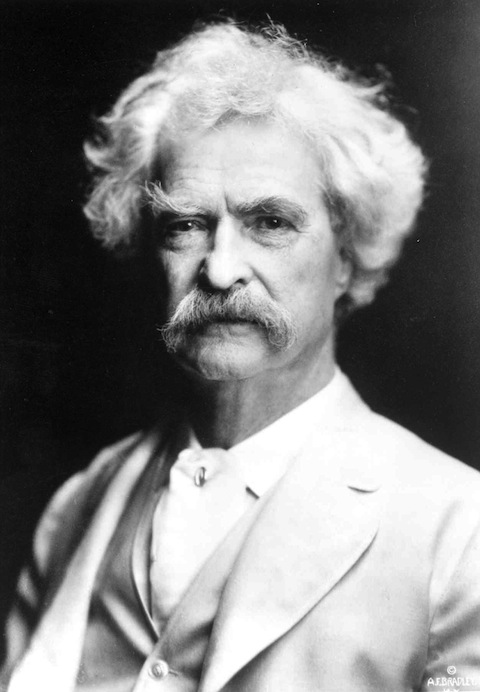
Every American has appreciated at least a little bit of the oeuvre of late-19th- and early-20th-century humorist Samuel Clemens, better known as Mark Twain. Some only manage to get through the chapters of The Adventures of Huckleberry Finn their English classes test them on, but even those give them the inkling that they hold before them the work of a writer worth reading. Others go as far as to become enthusiasts of all things Twain, but perhaps stop just short of reading his “Advice to Little Girls,” a brief piece that offers the following points of counsel to the young ladies of 1865:
- Good little girls ought not to make mouths at their teachers for every trifling offense. This retaliation should only be resorted to under peculiarly aggravated circumstances.
- If you have nothing but a rag-doll stuffed with sawdust, while one of your more fortunate little playmates has a costly China one, you should treat her with a show of kindness nevertheless. And you ought not to attempt to make a forcible swap with her unless your conscience would justify you in it, and you know you are able to do it.
- You ought never to take your little brother’s “chewing-gum” away from him by main force; it is better to rope him in with the promise of the first two dollars and a half you find floating down the river on a grindstone. In the artless simplicity natural to this time of life, he will regard it as a perfectly fair transaction. In all ages of the world this eminently plausible fiction has lured the obtuse infant to financial ruin and disaster.
- If at any time you find it necessary to correct your brother, do not correct him with mud—never, on any account, throw mud at him, because it will spoil his clothes. It is better to scald him a little, for then you obtain desirable results. You secure his immediate attention to the lessons you are inculcating, and at the same time your hot water will have a tendency to move impurities from his person, and possibly the skin, in spots.
- If your mother tells you to do a thing, it is wrong to reply that you won’t. It is better and more becoming to intimate that you will do as she bids you, and then afterward act quietly in the matter according to the dictates of your best judgment.
- You should ever bear in mind that it is to your kind parents that you are indebted for your food, and for the privilege of staying home from school when you let on that you are sick. Therefore you ought to respect their little prejudices, and humor their little whims, and put up with their little foibles until they get to crowding you too much.
- Good little girls always show marked deference for the aged. You ought never to “sass” old people unless they “sass” you first.
“American children’s literature in those days was mostly didactic,” writes children’s-book author and illustrator Vladimir Radunsky in a post at the New York Review of Books. It was often addressed to some imaginary reader, an ideal girl or boy, who, “upon reading the story, would immediately adopt its heroes as role models. Twain did not squat down to be heard and understood by children, but asked them to stand on their tiptoes — to absorb the kind of language and humor suitable for adults.” And Twain also understood that, humor, at the height of the craft, limits itself to no one audience in particular. Just as anyone, even today, can enjoy Huckleberry Finn — anyone, that is, without a teacher looking over their shoulder — “Advice to Little Girls” plays, like everything Twain wrote, to both girls and boys, to both the little and the big, at once irresistibly entertaining and viciously satirizing the whole of what he called “the damned human race.”
Then again, Twain also knew, as any master humorist does, that nothing funny ever benefited from too much explanation. We’ll thus leave you with a link to Project Gutenberg’s collection of 216 free e‑books of his work, among which a bit of time spent should turn any one of us into enthusiasts of all things Twain.
via the NYRB
Related Content:
Mark Twain Shirtless in 1883 Photo
Mark Twain Wrote the First Book Ever Written With a Typewriter
Mark Twain Drafts the Ultimate Letter of Complaint (1905)
Mark Twain Captured on Film by Thomas Edison in 1909. It’s the Only Known Footage of the Author.
Colin Marshall hosts and produces Notebook on Cities and Culture and writes essays on literature, film, cities, Asia, and aesthetics. He’s at work on a book about Los Angeles, A Los Angeles Primer. Follow him on Twitter at @colinmarshall.
Read More...94-Year-Old Pete Seeger Sings “This Land is Your Land” at Farm Aid
On September 21, Pete Seeger performed the Woody Guthrie classic, “This Land is Your Land,” at Farm Aid while being joined on stage by John Mellencamp, Willie Nelson, Dave Matthews and Neil Young. “Friends,” he told the audience, “at 94, I don’t have much of a voice left. But here’s a song I think you know, and if you sing it, why, we’ll make a good sound.” And that’s just what the singer and audience did. Seeger, who still has his wits about him, even improvised a bit and added a new verse, “New York was made to be frack free!” Bless him.
For some vintage Seeger, don’t miss this film featuring the folk legend when he was only 27 years old. Released in 1946, To Hear Your Banjo Play is an engaging 16-minute introduction to American folk music, written and narrated by Alan Lomax.
Related Content:
Willie Nelson, Pete Seeger, and Arlo Guthrie at Occupy Wall Street
House of Earth: Hear Woody Guthrie’s Lost Novel, Published by Johnny Depp, as an Audio Book
17-Year-Old Joan Baez Performs at Famous “Club 47″ in Cambridge, MA (1958)
Woody Guthrie’s Fan Letter To John Cage and Alan Hovhaness (1947)
Alan Lomax’s Music Archive Houses Over 17,400 Folk Recordings From 1946 to the 1990s
Read More...“David Bowie Is” — The First Major Exhibit Dedicated to Bowie Spans 50 Years & Features 300 Great Objects
Attention David Bowie fans: If you’re going to be in Toronto between now and November 27th, you’re in for quite a treat. AGO, the Art Gallery of Ontario, just opened the exhibit “David Bowie Is,” a hugely comprehensive multimedia show “Spanning five decades and featuring more than 300 objects from Bowie’s personal archive,” including handwritten lyrics, instruments, photos like that of Bowie and William Burroughs below, and lots and lots of costumes like the bodysuit at the bottom. Originating at London’s Victoria and Albert Museum, this is the first international exhibit solely devoted to Bowie.

If you can’t make it to the show, you can see a brief preview here and at AGO’s own site. In the short video at the top, Curator Victoria Broackes describes the title of the exhibit as “both an unfinished sentence and a statement.” The exhibit, she says, illustrates “Bowie’s own belief that we all have within us so many different personalities, and we should work hard to figure out what they are and bring them out.” It’s difficult to imagine anyone but Bowie bringing out so many uniquely fascinating personalities as he has in one lifetime. As Broackes’ fellow curator Geoffrey Marsh comments, Bowie is “an astonishingly hard worker” who “performed on average once every 11 nights” for 32 years, all while recording album after album and becoming an international movie star. Bowie may inspire, but he also blows most performers away with his seemingly endless supplies of creative energy and single-minded focus.

H/T Ken
Related Content:
David Bowie Releases Vintage Videos of His Greatest Hits from the 1970s and 1980s
David Bowie Recalls the Strange Experience of Inventing the Character Ziggy Stardust (1977)
David Bowie Celebrates 66th Birthday with First New Song in a Decade, Plus Vintage Videos
Josh Jones is a writer and musician based in Durham, NC. Follow him at @jdmagness
Read More...Alan Lomax’s Music Archive Houses Over 17,400 Folk Recordings From 1946 to the 1990s
The work of folklorists and musicologists like Alan Lomax, Stetson Kennedy, and Harry Smith has long been revered in countercultural communities and libraries; and it occasionally reaches mainstream audiences in, for example, the Coen Brother’s 2000 film Oh Brother, Where Art Thou? and its attendant soundtrack, or the playlists of purists on college radio and NPR. But their recordings are much more than historical novelties.
Archives like Lomax’s Association for Cultural Equity—which we’ve featured before—help remind us of our origins as much as bottom-up accounts like Howard Zinn’s A People’s History of the United States. Lomax and his colleagues believed that folk art and music infuse and renew “high” art and provide bulwarks against the cynical destitution of mass-market commercial media that can seem so deadening and inescapable.
That is not to say that notions of authenticity aren’t fraught with their own problems of exploitation. Approaching folk art as tourists, we can demean it and ourselves. But the problem is less, I think, one of gentrification than of neglect: it’s simply far too easy to lose touch, a much-remarked-upon irony of the age of social networking. Lomax understood this. He founded ACE “to explore and preserve the world’s expressive traditions with humanistic commitment and scientific engagement.” The organization resides at NYC’s Hunter College and, since Lomax’s retirement in 1996, has been overseen by his daughter, Anna Lomax Wood. Through an arrangement with the Library of Congress, which houses the originals, ACE has access to all of Lomax’s collection of field recordings and can disseminate them online to the public. Lomax’s association has also long been active in repatriating recorded artifacts to libraries and archives in their places of origin, giving local communities access to cultural histories that may otherwise be lost to them.
Lomax underscored the significance of his organization’s name in a 1972 essay entitled “An Appeal for Cultural Equity,” in which he lays out the importance of preserving cultural diversity against the “oppressive dullness and psychic distress” imposed upon “those areas where centralized music industries, exploiting the star system and controlling the communication system, put the local musician out of work and silence folk song.” Are we any more improved forty years later for the shocking monopolization of mass media in the hands of a few conglomerates? I’d answer unequivocally no but for one important qualification: mass media in the form of open online archives allows us unprecedented access to, for example, the awesome late-seventies film of R.L. Burnside (top), who like many Mississippi Delta bluesmen before him, would only achieve recognition much later in life. Or we can see native North Carolinian Cas Wallin (above) sing a version of folk song “Pretty Saro” in 1982, a song Bob Dylan recorded and only recently released. Then there’s one of my favorites, “Make Me A Pallet On Your Floor,” picked and sung below by Mississippian Sam Chatmon—a song played and recorded by countless black and white blues and country artists like Mississippi John Hurt and Gillian Welch.
These and thousands of other examples from the ACE archive bring musicologists, historians, folklorists, activists, educators, and everyone else closer to Lomax’s ideal—that we “learn how we can put our magnificent mass communications technology at the service of each and every branch of the human family.” The ACE catalog contains over 17,400 digital files, beginning with Lomax’s first tape recordings in 1946, to his digital work in the 90s. The archive includes songs, stories, jokes, sermons, interviews and other audio artifacts from the American South, Appalachia, the Caribbean, and many more locales. The archive features recordings from famous names like Woody Guthrie and Lead Belly but primarily consists of folk music from anonymous folk, representing a variety of languages and ethnicities. And the archive is ever-expanding as it continues to digitize rare recordings, and to upload vintage film, like the videos above, to its YouTube channel.
Related Content:
Legendary Folklorist Alan Lomax: ‘The Land Where the Blues Began’
Woody Guthrie at 100: Celebrate His Amazing Life with a BBC Film
Hear Zora Neale Hurston Sing the Bawdy Prison Blues Song “Uncle Bud” (1940)
Josh Jones is a writer and musician based in Durham, NC. Follow him at @jdmagness
Read More...Stanley Kubrick to Ingmar Bergman: “You Are the Greatest Filmmaker at Work Today” (1960)
If you saw our post on Stanley Kubrick’s ten favorite films in 1963, you may remember that Ingmar Bergman ranked high on his list, specifically with 1957’s Wild Strawberries. Three years earlier, Kubrick had mailed the Swedish filmmaker a fan letter praising his “vision of life,” “creation of mood and atmosphere,” “avoidance of the obvious,” and “truthfulness and completeness of characterization.” Could a screening of Wild Strawberries, a film which stands as evidence of all those qualities, have moved the 31-year-old Kubrick to write to Bergman such words of appreciation about his “unearthly and brilliant” work? The dream sequence above, made haunting in a way only Bergman could do it, showcases just one of the many facets of that picture’s mood, atmosphere, and unearthliness.
Alongside Victor Sjöström as the bad-dreaming professor Isak Borg, Wild Strawberries stars Ingrid Thulin as his contemptuous daughter-in-law Marianne. Kubrick singles Thulin out as one of the Bergman regulars who “live vividly in my memory,” though she may also have attained her place in that creatively hyperactive mind on the strength of her gender boundary-crossing performance in 1958’s The Magician, viewable just above. Read all that Kubrick wrote to Bergman below, or visit the original post featuring it at Letters of Note. You’ll notice that Kubrick also name-checks Max von Sydow, as any serious Bergman enthusiast should: not only did the man appear in both Wild Strawberries and The Magician, but by 1960 he’d also starred as a vengeful father in Bergman’s The Virgin Spring and, of course, as the Crusades-weary knight Antonius Block in The Seventh Seal, which would become a signature film for both actor and director. Whether those particular performances captured Kubrick’s imagination I don’t know, but I feel sure of one thing: play chess with Death, and you rightfully earn the admiration of the next big auteur.
February 9, 1960
Dear Mr. Bergman,
You have most certainly received enough acclaim and success throughout the world to make this note quite unnecessary. But for whatever it’s worth, I should like to add my praise and gratitude as a fellow director for the unearthly and brilliant contribution you have made to the world by your films (I have never been in Sweden and have therefore never had the pleasure of seeing your theater work). Your vision of life has moved me deeply, much more deeply than I have ever been moved by any films. I believe you are the greatest film-maker at work today. Beyond that, allow me to say you are unsurpassed by anyone in the creation of mood and atmosphere, the subtlety of performance, the avoidance of the obvious, the truthfullness and completeness of characterization. To this one must also add everything else that goes into the making of a film. I believe you are blessed with wonderfull actors. Max von Sydow and Ingrid Thulin live vividly in my memory, and there are many others in your acting company whose names escape me. I wish you and all of them the very best of luck, and I shall look forward with eagerness to each of your films.
Best Regards,
(Signed, ‘Stanley Kubrick’)
Stanley Kubrick
via Letters of Note
Related Content:
Stanley Kubrick’s List of Top 10 Films (The First and Only List He Ever Created)
Rare 1960s Audio: Stanley Kubrick’s Big Interview with The New Yorker
Stanley Kubrick’s Very First Films: Three Short Documentaries
Ingmar Bergman’s Soap Commercials Wash Away the Existential Despair
Colin Marshall hosts and produces Notebook on Cities and Culture and writes essays on literature, film, cities, Asia, and aesthetics. He’s at work on a book about Los Angeles, A Los Angeles Primer. Follow him on Twitter at @colinmarshall.
Read More...Statistics Explained Through Modern Dance: A New Way of Teaching a Tough Subject
You want a gentle introduction to statistics, and maybe those Khan Academy videos aren’t quite working out for you. Well, here’s another approach: statistics explained with modern dance. That’s the novel approach explored by Lucy Irving (Middlesex University) and Andy Field (University of Sussex), who produced four short films demonstrating different statistical concepts through dance. The films touch on Correlation, Frequency Distributions, Sampling and Standard Error, and Variance. Speaking about the project, Irving explained: “We worked with the choreographer and experimented with the dancers to find ways of communicating the concepts. Our hope is that, as well as being fun and educational, the films will demystify and take some of the fear out of statistics. Students often report that ‘the stats’ are the most difficult part of their psychology degree and these the films aim to challenge this by demonstrating that thinking about them in new ways may make them easier to comprehend.” You can follow Lucy on Twitter at @statsdancer.
Frequency Distributions:
Sampling and Standard Error
Variance
Related Content:
Free Math Courses from Great Universities
Calculus Lifesaver: A Free Online Course from Princeton
Harvard Thinks Big 4 Offers TED-Style Talks on Stats, Milk, and Traffic-Directing Mimes
Read More...Support Us
We're hoping to rely on loyal readers, rather than erratic ads. Please click the Donate button and support Open Culture. You can use Paypal, Venmo, Patreon, even Crypto! We thank you!

About Us

Open Culture scours the web for the best educational media. We find the free courses and audio books you need, the language lessons & educational videos you want, and plenty of enlightenment in between.
Advertise With Us

FREE UPDATES!
GET OUR DAILY EMAIL
Get the best cultural and educational resources on the web curated for you in a daily email. We never spam. Unsubscribe at any time.
FOLLOW ON SOCIAL MEDIA

Open Culture editor Dan Colman scours the web for the best educational media. He finds the free courses and audio books you need, the language lessons & movies you want, and plenty of enlightenment in between.
Advertise With Us


