A Bluegrass Version of Metallica’s Heavy Metal Hit, “Enter Sandman”
On the strength of its hit single Enter Sandman, Metallica’s eponymous 1991 album eventually went platinum, and the band became one of the biggest heavy metal acts around. Since then, the influence of “Enter Sandman” has rippled out into the larger culture. Since 1999, Mariano Rivera, surely the greatest relief pitcher in the history of baseball, has ritually made his entrance to the game with “Enter Sandman” providing the soundtrack. (Perhaps a strange pick for a mild-mannered, deeply religious man. But somehow it works.) And the song has been covered umpteen times — by other metal bands (most notably Motörhead) but also by Weird Al Yankovic, Pat Boone, and the bluegrass band called Iron Horse.
Formed over a decade ago in the recording capital of Muscle Shoals, Alabama, Iron Horse features Tony Robertson on mandolin, Vance Henry on guitar, Ricky Rogers on bass, and Anthony Richardson on banjo. And, together, they’ve taken some risks along the way.
In 2003, they released Fade to Bluegrass: Tribute to Metallica, a collection of ten Metallica songs done in bluegrass fashion — “or at least as bluegrass as it’s possible for Metallica songs to be.” Speaking about the album on their website, they write:
Metallica’s thundering drums, heart-pounding guitars and anguished vocals tell the story of people lost in the hustle of modern society. Bluegrass music sings the tale of people stuck between heaven and hell, the farm and the city and love and hate. In many ways Metallica and bluegrass are brothers, one raised in the urban jungle and the other in the country. So what happens when these two estranged siblings get together? Fade to Bluegrass: Tribute to Metallica has the answer. Banjo and mandolin replace electric guitars and high lonesome harmonies soar in place of growling vocals to create a surprising and moving tribute. Performed with passion and skill by Alabama bluegrass band Iron Horse, and featuring classics such as “Unforgiven,” “Enter Sandman” and “Fade to Black,” Fade to Bluegrass: Tribute to Metallica is a family reunion between brothers heavy metal and bluegrass.
You can watch Iron Horse perform “Enter Sandman” above. And below you can see that Metallica’s lead guitarist Kirk Hammett approves:
via Devour
Related Content:
Steve Martin on the Legendary Bluegrass Musician Earl Scruggs
Pickin’ & Trimmin’ in a Down-Home North Carolina Barbershop: Award-Winning Short Film
Steve Martin Writes Song for Hymn-Deprived Atheists
Read More...The Curious History of Punctuation: Author Reveals the Beginnings of the #, ¶, ☞, and More
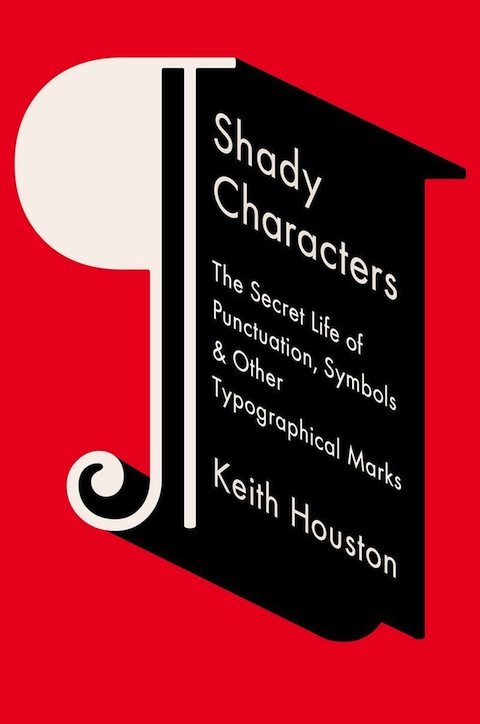 All things we humans use, from our advanced mobile phones to our very arms and legs, reached their current states through a process of evolution. The same, naturally, goes for our punctuation marks. These tools we use to separate, connect, or draw attention to our words and sentences had different forms and uses in bygone times, and Scotland-based medical visualization software programmer Keith Houston has taken it upon himself to trace paths through all of them. In the introduction to his history-of-punctuation blog Shady Characters, he recounts his unlikely source of inspiration in Eric Gill’s Essay on Typography: “my interest was piqued by the unusual character resembling a reversed capital ‘P’ — ‘¶’ — which peppered the text at apparently random intervals.” This little-discussed mark, called a pilcrow, led Houston to ask the sort of questions that drive his project: “How did the pilcrow’s curious reverse‑P form come about? What were the roots of its pithy, half-familiar name? What caused it to fall out of use, and having done just that, why did Eric Gill see fit to place them seemingly at random in his only published work on typography? What, in other words, was the pilcrow all about?”
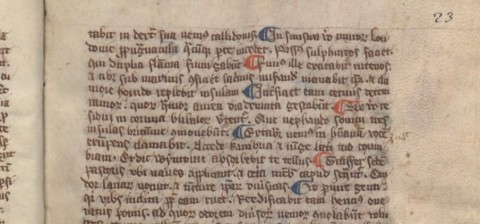
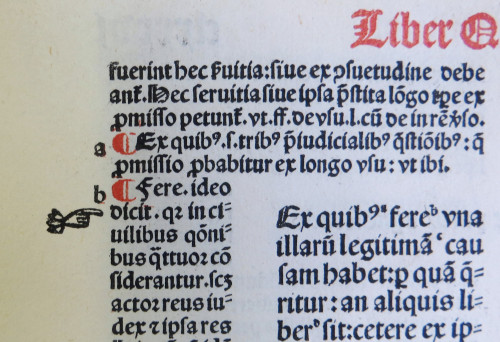
In a recent New Yorker post, Houston works toward the answers by looking back to the pilcrow’s precursors. “Before there was any other punctuation there was the paragraphos—from the Greek para-, ‘beside,’ and graphein, ‘write’,” he explains. “A simple horizontal stroke placed in the left margin beside a line of text, the paragraphos was used in ancient Greece to call attention to conceptual changes in an otherwise unbroken block of text: a new topic, perhaps, or a new stanza in a poem.” This, over the centuries, became the pilcrow, just as “the Latin abbreviation ‘lb,’ for the Roman term libra pondo, or ‘pound weight,’ ” turned into the #, or the hash mark, or — better yet —the octothorpe. As for ☞, that little hand, Houston tells us its proper name: manicule, “taken,” naturally enough, “from the Latin maniculum, or ‘little hand.’ ” With earliest use found in the Domesday Book of 1086, the manicule, “a mark that readers drew to call out points of interest,” enjoyed great prevalence until the fifteenth-century printing press came along, when, “with printed versions of the symbol—and of other reference marks such as * and †—now available to writers, ‘authorized’ notes began to spring up in the margins, encroaching upon the space once available to the reader.”
Houston’s work on the history of punctuation has now taken the form of a book: Shady Characters: The Secret Life of Punctuation, Symbols & Other Typographical Marks. But you can still read a wealth of his scholarship on the pilcrow, octothorpe, the manicule, and other symbols both current and forgotten, on his blog, all clearly organized on its table of contents. Who could turn down that good day’s reading‽
via The New Yorker
Related Content:
Cormac McCarthy’s Three Punctuation Rules, and How They All Go Back to James Joyce
Colin Marshall hosts and produces Notebook on Cities and Culture and writes essays on literature, film, cities, Asia, and aesthetics. He’s at work on a book about Los Angeles, A Los Angeles Primer. Follow him on Twitter at @colinmarshall.
Read More...Captain Beefheart Issues His “Ten Commandments of Guitar Playing”
If you do not believe in Captain Beefheart, I doubt the 1974 Old Grey Whistle Test appearance above will convert you. If you are a Beefheart believer, you know. And if you don’t know where you stand on Beefheart, get to know this wild-eyed rock and roll shaman, poet, bluesman, painter, and childhood friend of Frank Zappa. (Start with his fairly straightforward take on Delta blues and sixties garage rock, 1967’s Safe as Milk.)
Beefheart’s Magic Band, a shifting collection of musicians that initially included Ry Cooder (who served as something of a musical director) created some of the most warped music of the last few decades, much of it very recognizably blues-based and much of it (such as the freak outs on Beefheart’s Trout Mask Replica) occupying a space all its own—a space that only exists, really, in Captain Beefheart’s head and heart. While Beefheart acquired a reputation as an uncompromising, and singularly demanding, employer of musicians, speaking as a musician, there are few others that I wish I’d had the chance to play with in their heyday.
Despite his demonically inspired weirdness and storied difficulty, what attracted musicians to Beefheart was his ability to push concepts so far beyond the bounds of intelligibility so as to make insanity make perfect sense. Take, for example, his list of instructions, or rather “commandments,” issued to Moris Tepper when the guitarist joined Beefheart’s band in 1976. This is not an obnoxious practical joke—it is the technique of a Zen master, disorienting his student with nonsensical truths mixed in with some very practical advice. Which one is which is for the student to decide.
Captain Beefheart’s “Ten Commandments of Guitar Playing”
1. Listen to the birds
That’s where all the music comes from. Birds know everything about how it should sound and where that sound should come from. And watch hummingbirds. They fly really fast, but a lot of times they aren’t going anywhere.
2. Your guitar is not really a guitar.
Your guitar is a divining rod. Use it to find spirits in the other world and bring them over. A guitar is also a fishing rod. If you’re good, you’ll land a big one.
3. Practice in front of a bush.
Wait until the moon is out, then go outside, eat a multi-grained bread and play your guitar to a bush. If the bush doesn’t shake, eat another piece of bread.
4. Walk with the devil.
Old Delta blues players referred to guitar amplifiers as the “devil box.” And they were right. You have to be an equal opportunity employer in terms of who you’re brining over from the other side. Electricity attracts devils and demons. Other instruments attract other spirits. An acoustic guitar attracts Casper. A mandolin attracts Wendy. But an electric guitar attracts Beelzebub.
5. If you’re guilty of thinking, you’re out.
If your brain is part of the process, you’re missing it. You should play like a drowning man, struggling to reach shore. If you can trap that feeling, then you have something that is fur bearing.
6. Never point your guitar at anyone.
Your instrument has more clout than lightning. Just hit a big chord then run outside to hear it. But make sure you are not standing in an open field.
7. Always carry a church key.
That’s your key-man clause. Like One String Sam. He’s one. He was a Detroit street musician who played in the fifties on a homemade instrument. His song “I Need a Hundred Dollars” is warm pie. Another key to the church is Hubert Sumlin, Howlin’ Wolf’s guitar player. He just stands there like the Statue of Liberty — making you want to look up her dress the whole time to see how he’s doing it.
8. Don’t wipe the sweat off your instrument.
You need that stink on there. Then you have to get that stink onto your music.
9. Keep your guitar in a dark place.
When you’re not playing your guitar, cover it and keep it in a dark place. If you don’t play your guitar for more than a day, be sure you put a saucer of water in with it.
10. You gotta have a hood for your engine.
Keep that hat on. A hat is a pressure cooker. If you have a roof on your house, the hot air can’t escape. Even a lima bean has to have a piece of wet paper around it to make it grow.
If any of the above leads you to think you need to know more about Beefheart, then watch the documentary above, introduced and narrated by the legendary tastemaker John Peel, a true Beefheart believer if one there ever was.
Via Letters of Note
Related Content:
A Young Frank Zappa Plays the Bicycle on The Steve Allen Show (1963)
Frank Zappa Reads NSFW Passage From William Burroughs’ Naked Lunch (1978)
Josh Jones is a writer and musician based in Durham, NC. Follow him at @jdmagness
Read More...Jack Kerouac Reads American Haikus, Backed by Jazz Saxophonists Al Cohn & Zoot Sims (1958)
In the spring of 1958 Jack Kerouac went into the studio with tenor saxmen Al Cohn and Zoot Sims to record his second album, a mixture of jazz and poetry called Blues and Haikus. The haiku is a traditional Japanese poetry form with three unrhyming lines in five, seven, and five syllables. But Kerouac took a freer approach. In 1959, the year Blues and Haikus was released, he explained:
The American haiku is not exactly the Japanese Haiku. The Japanese Haiku is strictly disciplined to seventeen syllables but since the language structure is different I don’t think American Haikus (short three-line poems intended to be completely packed with Void of Whole) should worry about syllables because American speech is something again … bursting to pop.
Above all, a Haiku must be very simple and free of all poetic trickery and make a little picture and yet be as airy and graceful as a Vivaldi Pastorella.
The opening number on Blues and Haikus is a 10-minute piece called “American Haikus.” It features Kerouac’s expressive recitation of a series of poems punctuated by the improvisational saxophone playing of Cohn and Sims. The video above is animated by the artist Peter Gullerud. For more of Kerouac’s haikus — some 700 of them — see his Book of Haikus.
via The Allen Ginsberg Project
Related Content:
Jack Kerouac’s Naval Reserve Enlistment Mugshot, 1943
Jack Kerouac Reads from On the Road (1959)
Jack Kerouac’s 30 Beliefs and Techniques For Writing Modern Prose
Read More...Google & edX to Create MOOC.Org: An Open Source Platform For Creating Your Own MOOC

Almost exactly a year ago, we told you about Google’s release of Course Builder, an open source platform that would let you build your own online courses/MOOCs for free. This week, Google has a new announcement: it’s joining forces with edX, (the MOOC provider led by Harvard and MIT), to work on a new open source platform called MOOC.org. The new service will go live in the first half of 2014. And it will allow “any academic institution, business and individual to create and host online courses.” This will give innovative educators the opportunity to put a MOOC online without necessarily making a steep investment in a course. (When added all up, the costs can otherwise be enormous.) If MOOC.org sounds of interest to you, you can put your name on a waiting list, and they’ll contact you when the service launches next year.
Meanwhile, let me mention that 125 MOOCs will be launching between now and the end of October. To see a full list, visit or our collection of 625 MOOCs/Certificate Courses from Great Universities. You’ll find many interesting titles on the list — History of Chinese Architecture: Part 1; Søren Kierkegaard – Subjectivity, Irony and the Crisis of Modernity; Dark Matter in Galaxies: The Last Mystery, and Exploring Engineering, just to name a few. If you have questions about what MOOCs are all about, please see our new MOOC FAQ.
via The Chronicle of Higher Ed
Related Content:
Harvard and MIT Create EDX to Offer Massive Open Online Courses (MOOCs) Worldwide
Stephen Colbert Tries to Make Sense of MOOCs with the Head of edX
Read More...Radical Thinkers: 5 Videos Profile Max Horkheimer, Alain Badiou & Other Radical Theorists
If you’ve ever considered drawing up a list of the most debased words, allow me to nominate radical. If you call someone a “radical thinker,” for instance, a great many listeners might assume you mean something along the lines of “cool thinker.” While we do tend to find thinkers cool here at Open Culture, more interesting usages exist. Some interpret the meaning of “radical thinker” as closer to “thinker of very different thoughts than everyone else,” and hit closer to the mark though they may, you can bet that someone else nearby has readied themselves to denounce the thinker in question as not nearly radical enough to qualify for the label. Like any complex word, phrase, or other element of language, we may have to define radical by looking at examples. Luckily, the Guardian and Verso Books have put together Radical Thinkers, a series of three-minute videos profiling exactly those.
In each video, a modern academic delivers a three-minute lecture on a radical thinker of choice, drawing on a book in Verso’s Radical Thinkers editions. “Ordinarily, we are more or less resigned to the world as it is,” says Peter Hallward of Kingston University, standing in London’s Housmans (“Radical Booksellers Since 1945”), summarizing Alan Badiou’s Ethics. “We adapt as best we can to the existing logic of the system, of the established order of things. We get a job, we go through life as best we can, we get by. What Badiou calls ethics is essentially the discipline and resources you need in order to resist those temptations to abandon or betray or give up on something.” Stella Stanford, also of Kingston, takes on Wilhelm Reich’s Sex-Pol in the Freud Museum. This radical thinker, she says, “argued against Freud’s view that sexual repression was the condition of possibility for all civilization. He used the same kind of anthropological work that Freud himself used to argue that sexual freedom and civilization were compatible.”
The Radical Thinkers series has three more videos: Esther Leslie in Camden Market on Max Horkheimer’s Critique of Instrumental Reason (above), an indictment of the Enlightenment’s failure to deliver a rational society.
Federico Campagna in his kitchen on Simon Critchley’s Infinitely Demanding, a look into the inevitably disappointed heart of modern liberal democracy.
And Nina Power on Ludwig Feuerbach’s Christianity-criticizing collection of writings The Fiery Brook.
Related Content:
Hear Theodor Adorno’s Avant-Garde Musical Compositions
Download 90 Free Philosophy Courses and Start Living the Examined Life
The History of Philosophy Without Any Gaps – Peter Adamson’s Podcast Still Going Strong
Take First-Class Philosophy Lectures Anywhere with Free Oxford Podcasts
Colin Marshall hosts and produces Notebook on Cities and Culture and writes essays on literature, film, cities, Asia, and aesthetics. He’s at work on a book about Los Angeles, A Los Angeles Primer. Follow him on Twitter at @colinmarshall.
Read More...The Complete Works of Leo Tolstoy Online: New Archive Will Present 90 Volumes for Free (in Russian)
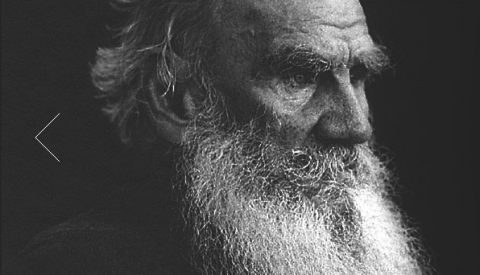
This is surely worth a quick heads up: Leo Tolstoy’s entire body of work – all 46,000 pages of it – will appear on the Tolstoy.ru web site. According to Tolstoy’s great-great-granddaughter Fyokla Tolstaya, all of the author’s novels, short stories, fairy tales, essays and personal letters will be made freely available in PDF, FB2 and EPUB formats (which you can easily load onto a Kindle, iPad or almost any other ebook reader). She goes on to tell the Russian newspaper RIA Novosti that the “90-volume edition was scanned and proofread three times by more than 3,000 volunteers from 49 countries.” Truly an incredible crowdsourcing feat.
What’s the rub? You have to read Russian. Yes, it’s potentially a downer. But you can always find Tolstoy’s major works in translation in our Free eBooks and Free Audio Books collections.
And if that doesn’t make you feel better, see the excellent bonus material below.
via The Paris Review
Related Content:
Rare Recording: Leo Tolstoy Reads From His Last Major Work in Four Languages, 1909
The Last Days of Leo Tolstoy Captured on Video
How Leo Tolstoy Learned to Ride a Bike at 67, and Other Tales of Lifelong Learning
Read More...Download Free Music from 150+ Classical Composers, Courtesy of Musopen.org
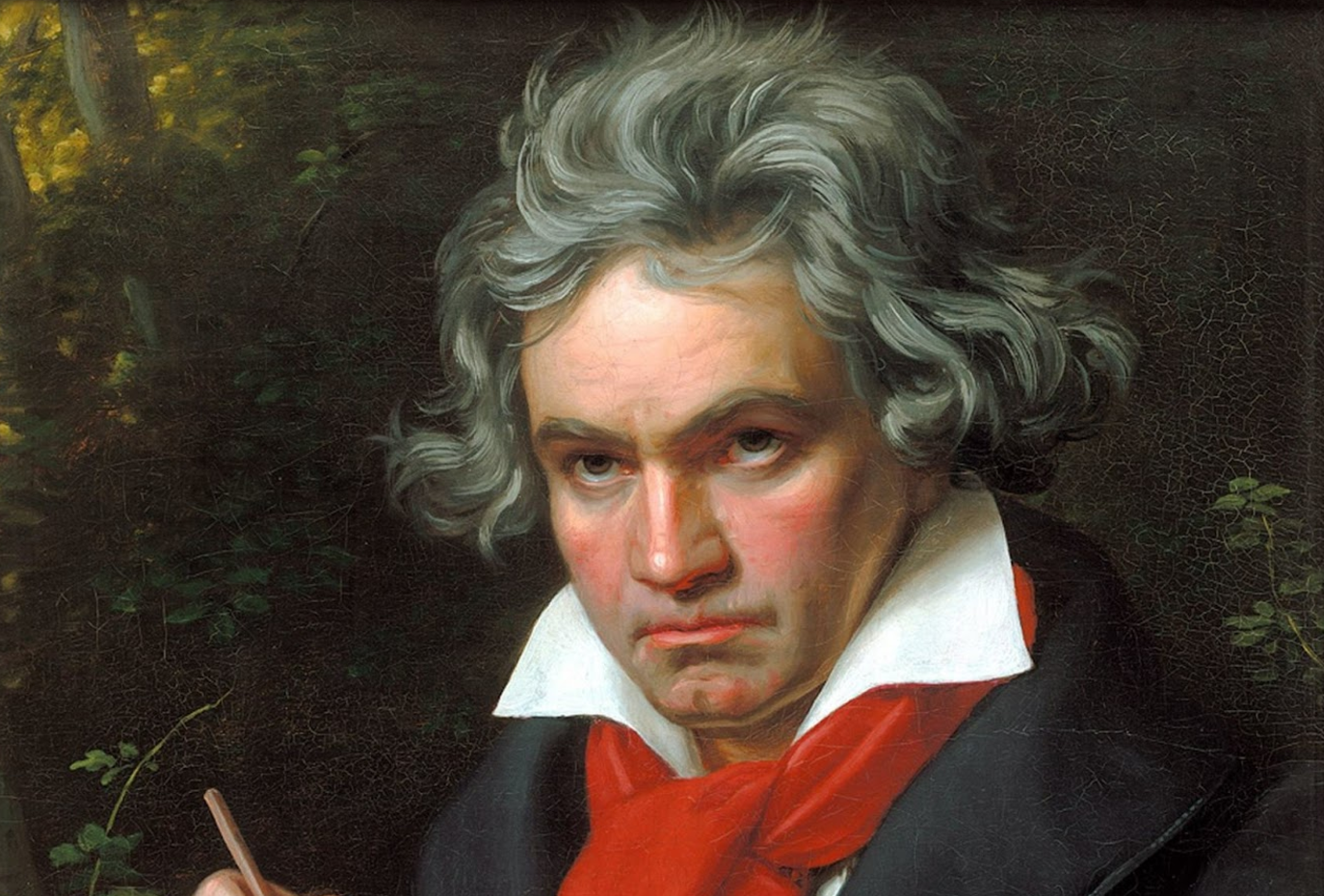
Yesterday, we told you about a new Kickstarter campaign that intends to put 245 pieces by Frédéric Chopin into the public domain. The campaign is being spearheaded by Musopen.org, a non-profit located a few miles up the road from us, in Palo Alto, CA. Operating since 2005 (a year before we took flight), Musopen provides free public domain scores and a library of recordings by classical composers that you’ll want to check out.
The library is best accessed via this page where you can browse recordings organized by composer, performer, instrument, form, and time period As you’ll see, Bach, Beethoven, and Mozart — they’re all there. So is Debussy, Ravel and Copland, not to mention another 140+ composers.
Music can be streamed online for free. But if you become a registered user for the site, you can download 5 tracks per day in standard audio quality. Or, if you pay $55 per year, you can enjoy unlimited downloads in high quality audio. Paying members help sustain the site, and they also get to help determine what music will be made available online in the future. Have more questions? Check out Musopen’s FAQ.
If you would like to support the mission of Open Culture, consider making a donation to our site. It’s hard to rely 100% on ads, and your contributions will help us continue providing the best free cultural and educational materials to learners everywhere. You can contribute through PayPal, Patreon, and Venmo (@openculture). Thanks!
Related Content:
85,000 Classical Music Scores (and Free MP3s) on the Web
A Big Bach Download: All of Bach’s Organ Works for Free
The Open Goldberg Variations: J.S. Bach’s Masterpiece Free to Download
Read More...“The Autobiography of Jane Eyre” Adapts Brontë’s Heroine for Vlogs, Tumblr, Twitter & Instagram
Lest you remain unaware, Jane Eyre has a vlog. And though I would fain speak well of it, the truth must out. I prefer my Jane with bonnet strings knotted firmly beneath her chin. This Jane, as embodied by project co-creator, Alysson Hall, often seems like a fan putting together a homemade audition tape for Girls.
I suspect that’s the demographic most likely to appreciate Charlotte Brontë’s reinvented heroine. Like The Lizzie Bennet Diaries, a self-declared “online modernized adaptation” of Pride and Prejudice, The Autobiography of Jane Eyre takes a transmedia approach, serializing across multiple digital platforms.
In addition to the YouTube channel, Jane tweets to over 1500 followers, and uploads photos to Instagram. Her video diary might not be my cup of tea, but I must confess, I do rather enjoy her tumblr. Perhaps not as much as I’d enjoy rereading the novel (find it in our collection Free eBooks and Free Audio Books collections), but it’s not a bad way to while away a minute or two.
Put another way, anyone who likes reading Brontë is probably amenable to pictures of tea cups, dead trees, and Tim Burton’s animated dolls.
Jane’s embrace of social media is shared by many in her orbit, including Mr. Rochester’s employee, Grace Poole, and his 8‑year-old daughter, Adele, whose (illegal) Twitter feed will appeal to any precocious little smartypants eager for random facts regarding Bernese Mountain Dogs and Uranus’ moons.
The veil is lifted somewhat on the series’ Facebook page, where the creators interact with fans out-of-character and address modern technical difficulties, such as software issues and audio glitches.
Related Content:
20 Books People Pretend to Read (and Now Your Confessions?)
Ayun Halliday was gobsmacked to learn that her second book, No Touch Monkey! has been made available in ebook form. Follow her @AyunHalliday
Read More...Miles Davis Plays Music from Kind of Blue Live in 1959, Introducing a Completely New Style of Jazz
Miles Davis’ Kind of Blue broke new ground in the world of jazz in a year that saw an unusual number of groundbreaking jazz releases, 1959. Following up his experiments on 1958’s Milestones, Davis’ move from bop to modal jazz improvisational techniques shifted the terms of the genre, and, as many critics have argued since, the terms of Western music, popular and classical. Released in August of ’59, Kind of Blue was recorded in New York by Davis’ famous sextet in March and April of that year, and before listeners had a chance to hear the record, those few people lucky enough to be in attendance at the April performance above—at CBS’s Studio 61—got a chance to hear what Davis was up to. Doubtless those lucky attendees were few indeed, but one of them, producer and presenter Robert Herridge showcased the performance for a July, 1960 broadcast of his show The Robert Herridge Theater.
The Davis sextet play a few versions of “So What” from Kind of Blue, previewing the album Quincy Jones would call his “orange juice” for its daily jolt of inspiration. The remainder of the performance consists of compositions by Dave Brubeck, Gil Evans, and Ahmad Jamal. See the full track list below.
1 So What
2 Introduction (Robert Herridge)
3 The Duke
(D. Brubeck)
4 Blues for Pablo
(G. Evans)
5 New Rhumba
(A. Jamal)
6 Announcement (Robert Herridge)
7 So What (reprise)
8 So What (reprise)
9 Orchestral fragment
The style of “So What” and the other compositions from Kind of Blue have been credited with creating, in Chick Corea’s words, “a new language of music.” But Davis cannot take all of the credit. He must share it with pianist and educator George Russell who published a theoretical account of a new way of improvising in 1953 called Lydian Chromatic Concept of Tonal Organization. Davis was greatly influenced by Russell’s theories and found in them a way out of the manic style of bop that had begun to tire him. Russell’s “modal” jazz moved away from basing jazz improvisation on chords and traditional major and minor scales. Though the theory was new, its basis, the Lydian mode, is as ancient as the Greeks. In the video above, see Russell in an interview discussing his modal theory, which Ben Ratliff in Russell’s 2009 New York Times obit describes as “simple”:
[Russell] believed that a new generation of jazz improvisers deserved new harmonic techniques, and that traditional Western tonality was running its course. The Lydian chromatic concept — based on the Lydian mode, or scale, rather than the familiar do-re-mi major scale — was a way for musicians to improvise in any key, on any chord, without sacrificing the music’s blues roots.
Without Russell, we’d have no Kind of Blue, but it’s probably safe to say that without Davis’ brilliant appropriation of modal theory, Russell’s ideas may have faded into obscurity. The collaboration between the humble theorist, the flamboyant composer and bandleader, and his tremendously talented 1959 ensemble produced one of the most enduring musical documents of all time, and in the archival footage above, we can see some of its critical pieces come together.
Related Content:
The Miles Davis Story, the Definitive Film Biography of a Jazz Legend
Miles Davis and His ‘Second Great Quintet,’ Filmed Live in Europe, 1967
Rare Miles Davis Live Recordings Capture the Jazz Musician at the Height of His Powers
Josh Jones is a writer and musician based in Durham, NC. Follow him at @jdmagness
Read More...Support Us
We're hoping to rely on loyal readers, rather than erratic ads. Please click the Donate button and support Open Culture. You can use Paypal, Venmo, Patreon, even Crypto! We thank you!

About Us

Open Culture scours the web for the best educational media. We find the free courses and audio books you need, the language lessons & educational videos you want, and plenty of enlightenment in between.
Advertise With Us

FREE UPDATES!
GET OUR DAILY EMAIL
Get the best cultural and educational resources on the web curated for you in a daily email. We never spam. Unsubscribe at any time.
FOLLOW ON SOCIAL MEDIA

Open Culture editor Dan Colman scours the web for the best educational media. He finds the free courses and audio books you need, the language lessons & movies you want, and plenty of enlightenment in between.
Advertise With Us

