Edward Said Speaks Candidly about Politics, His Illness, and His Legacy in His Final Interview (2003)
In an excerpt from her memoir published in Salon last month, Najla Said—daughter of literary critic and Palestinian-American political activist Edward Said—recalls her father’s legacy:
To very smart people who study a lot, Edward Said is the “father of postcolonial studies” or, as he told me once when he insisted I was wasting my college education by taking a course on postmodernism and I told him he didn’t even know what it was:
“Know what it is, Najla? I invented it!!!”
I still don’t know if he was joking or serious.
Most likely Said was only half serious, but it’s impossible to overstate the impact of his 1978 book Orientalism on the generations of students and activists that followed. As Najla writes, it’s “the book that everyone reads at some point in college, whether in history, politics, Buddhism, or literature class.” Said’s “postmodernism,” unlike that of Francois Lyotard or many others, avoided the pejorative baggage that came to attach to the term, largely because while he called into doubt certain ossified and pernicious categorical distinctions, he never stopped believing in the positive intellectual enterprise that gave him the tools and the position to make his critiques. He stubbornly called himself a humanist, “despite,” as he writes in the preface to the 2003 edition of his most famous book, “the scornful dismissal of the term by sophisticated post-modern critics”:
It isn’t at all a matter of being optimistic, but rather of continuing to have faith in the ongoing and literally unending process of emancipation and enlightenment that, in my opinion, frames and gives direction to the intellectual vocation.
In that same preface Said also writes of his aging, of the recent death of two mentors, and of “the necessary diminutions in expectations and pedagogic zeal which usually frame the road to seniority.” He does not write about the leukemia that would take his life that same year at the age of 67, ten years ago this month.
For the interview above, however, Said’s last, he speaks candidly about his illness. Fittingly, the video opens with a quote from Roland Barthes: “The only sort of interview that one could, if forced to, defend would be where the author is asked to articulate what he cannot write.” Said tells interviewer Charles Glass that his main preoccupation in the past few months had been his illness, something he thought he had “mastered” but which had forced him to confront the incontrovertible fact of his mortality and sapped him of his will to work.
Said, as always, is articulate and engaging, and the conversation soon turns to his other preoccupations: the situation of the Palestinian people and the politics and personal toll of living “between worlds.” He also expresses his disappointment in friends who had become “mouthpieces of the status quo,” banging the drums for war and Western Imperialism in this, the first year of the war in Iraq. One suspects that he refers to Christopher Hitchens, among others, though he is too discreet to name names. Said has a tremendous amount to say on not only the current events of the time but on his entire career as a writer and thinker. Though he’s given dozens of impassioned interviews over the decades, this may be the most honest and unguarded, as he unburdens himself during his final days of those things, perhaps, he could not bring himself to write.
Thanks to Stephanos for sending this video our way.
Related Content:
Stephen Fry & Friends Pay Tribute to Christopher Hitchens
Christopher Hitchens: No Deathbed Conversion for Me, Thanks, But it was Good of You to Ask
Noam Chomsky Calls Postmodern Critiques of Science Over-Inflated “Polysyllabic Truisms”
Josh Jones is a writer and musician based in Durham, NC. Follow him at @jdmagness
Read More...The Art of Handwriting as Practiced by Famous Artists: Georgia O’Keeffe, Jackson Pollock, Marcel Duchamp, Willem de Kooning & More

Click each image for a larger version
Didn’t we used to hear all sorts of grumbling about the disappearance of the handwritten letter? What a relief those complaints seem now to have subsided, leaving us in peace to efficiently type to one another about how we find pieces of longhand correspondence fascinating purely as artifacts of our favorite historical figures. If you share that fascination, have a look at The Art of Handwriting, an exhibit from the Smithsonian’s Archives of American Art now on display through October 27 at Washington D.C.‘s Lawrence A. Fleischman gallery, which showcases not only the artistic aspects of handwriting, but the handwriting of actual artists. “An artist might put pen to paper just as he or she would apply a line to a drawing,” says the exhibition’s site. “For each artist, a leading authority interprets how the pressure of line and sense of rhythm speak to that artist’s signature style. And questions of biography arise: does the handwriting confirm assumptions about the artist, or does it suggest a new understanding?” Plus, we have here the ideal test of those handwriting analysis booths at county fairs — could they detect these artistic personalities?

Just above, we have a page of abstract expressionist painter Willem de Kooning’s missive in light-blue ink of March 28, 1966 to friend and fellow abstract expressionist Michael Loew. (They’ve even included the envelope.) At the top of the post, you’ll find a page another painter, the famously blossom-focused Georgia O’Keeffe, wrote to New Mexico modernist Cady Wells in 1939. The subject of the letter? “O’Keeffe worries that Wells doesn’t like a painting she has bought and suggests replacements; and describes an argument she had with a friend.” That description comes from the Smithsonian’s catalog, as does this one: “[Jackson] Pollock writes with descriptions of his new home in Springs, on Long Island, and discusses his work and that of other artists.” You can also view both pages of that evidently unscandalous piece of communication on the site. They’ve even got letters composed by hand in other languages, such as Marcel Duchamp writing to his sister Suzanne (below) on January 15, 1916. Don’t worry if you can’t read French, or if you think you can’t contextualize the personal content of any of the letters at all; focus on, as the Archives of American Art suggests, how “every message brims with the personality of the writer at the moment of interplay between hand, eye, mind, pen, and paper.” That, and the that hope schoolchildren won’t have to endure cursive lessons many generations longer.

Related Content:
Virginia Woolf’s Handwritten Suicide Note: A Painful and Poignant Farewell (1941)
Francis Ford Coppola’s Handwritten Casting Notes for The Godfather
Colin Marshall hosts and produces Notebook on Cities and Culture and writes essays on literature, film, cities, Asia, and aesthetics. He’s at work on a book about Los Angeles, A Los Angeles Primer. Follow him on Twitter at @colinmarshall.
Read More...Man Shot in Fight Over Immanuel Kant’s Philosophy in Russia

In the Russian port city of Rostov-on-Don two men were having a beer this weekend and talking about the philosophy of Immanuel Kant (of course), when something went terribly wrong. An argument broke out, critical reason went out the window, and one man ended getting shot with rubber bullets. He’s in the hospital with non life-threatening injuries. The shooter now faces up to 10 years in jail, where he’ll have lots of time to ponder Kant’s theories.
If you would like to contemplate Kant in a more serene manner, we would invite you to check out his texts listed in our Free eBook collection:
- Critique of Judgement
- Critique of Practical Reason
- Critique of Pure Reason
- Perpetual Peace
- What is Enlightenment?
And see courses dealing with Kant in our collection of 750 Free Online Courses:
- Kant — Web Site — Leo Strauss, U Chicago
- Kant: Political Philosophy – Web Site — Leo Strauss, U Chicago
- Kant’s Critique of Judgment – Web Site – JM Bernstein, New School
- Kant’s Critique of Pure Reason – iTunes Video – iTunes Audio- Video/Audio on Web – Dan Robinson, Oxford
- Kant’s Critique of Pure Reason – Web Site – Richard Dien Winfield, University of Georgia
- Kant’s Critique of Pure Reason – Web Site – JM Bernstein, New School
- Kant’s Epistemology – iTunes – Dr Susan Stuarts, University of Glasgow
Follow us on Facebook, Twitter and now Google Plus and share intelligent media with your friends! They’ll thank you for it.
Read More...Enter E.O. Wilson’s Encyclopedia of Life: Free Access to All The World’s Knowledge About Life
One of the treasures of our time, biologist E.O. Wilson, the folksy and brilliant author of two Pulitzer Prize-winning books and the world’s leading authority on ants, is 84 years old and retired from his professorship at Harvard. But even in retirement he came up with one of the most innovative new scientific resources available today: the Encyclopedia of Life, a networked encyclopedia of all the world’s knowledge about life.
Six years ago Wilson announced his vision for such a project while accepting the 2007 TED Prize. He expressed a wish for a collaborative tool to create an infinitely expandable page for each species—all 1.9 million known so far—where scientists around the world can contribute text and images.
Wilson’s dream came true, not long after he announced it, and the EOL was so popular right away that it had to go off-line for a spell to expand its capacity to handle the traffic. The site was redesigned to be more accessible and to encourage contributions from users. It’s vision: to continue to dynamically catalog every living species, as research is completed, and to include the roughly 20,000 new species discovered every year.
Wilson’s vision is manifest in a fun and well-designed site useful for educators, academics, and any curious person with access to the Internet.
Search for a species or just browse. Each EOL taxonomy page features a detailed overview of the species, research, articles and media. Media can be filtered by images, video, and sound. There are 66 different pieces of media about Tasmanian Devils, for example. A group of Tassies, as they’re known, get pretty devilish over their dinner in this video, contributed by an Australian Ph.D. student.
As E.O. Wilson so eloquently puts it, the EOL has the potential to inspire others to search for life, to understand it, and, most importantly, to preserve it.
Related Content:
E.O. Wilson’s Olive Branch: The Creation
Central Intelligence: From Ants to the Web
Kate Rix writes about digital media and education. Follow her on Twitter.
Read More...F. Scott Fitzgerald’s Handwritten Manuscripts for The Great Gatsby, This Side of Paradise & More
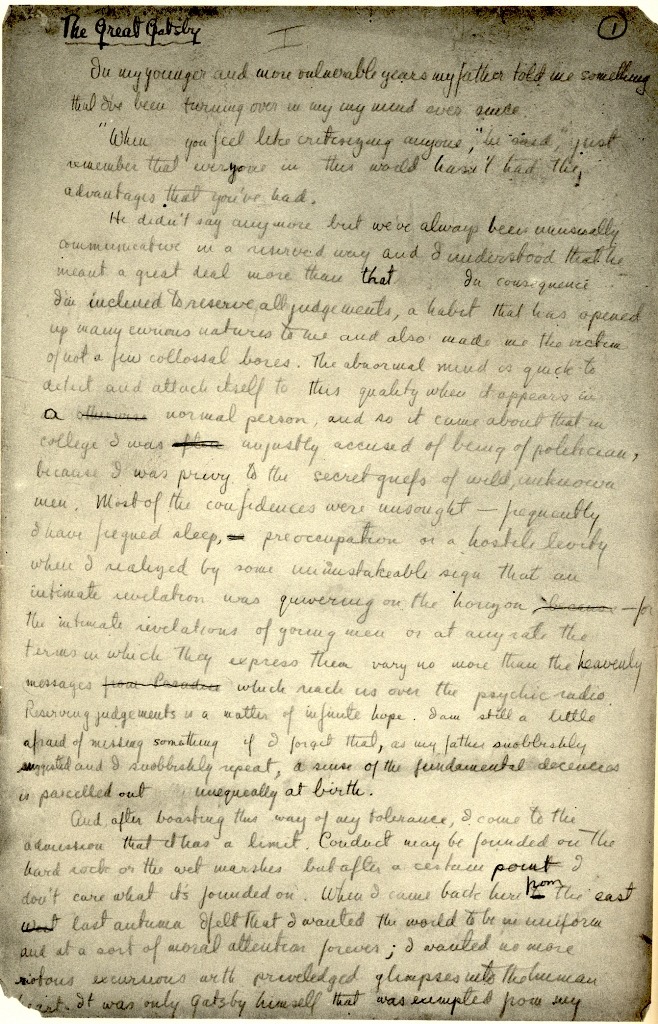
We rarely think about where F. Scott Fitzgerald’s hard-living, often tragic generation of American writers went to school. This year, however, Fitzgerald’s own almost-alma mater merits a note: the novelist began his studies at Princeton exactly one hundred years ago this fall, beginning classes on his birthday, September 24, 1913. To mark the occasion, that Ivy League institution has digitized their The Great Gatsby-writing alumnus’ manuscripts. Earlier this year, in fact, they completed the process on Fitzgerald’s manuscript, or manuscripts, of Gatsby itself. “We can see Fitzgerald at work on his third novel over a four-year period,” says the announcement from Princeton University Library’s Department of Rare Books and Special Collections (RBSC), which offers “Ur-Gatsby (2‑page fragment), the author’s abandoned effort, conceived in 1922 and written in 1923; The Great Gatsby autograph manuscript (302 pages), which he largely wrote in France and completed by September 1924;” and “corrected galleys of ‘Trimalchio,’ the novel’s working title when it was typeset by Charles Scribner’s Sons in 1924, only to be much reworked by the author early in 1925.”
You can find these online in the Princeton University Digital Library. There you can also, naturally, find papers associated with This Side of Paradise, the novel Fitzgerald began, under the working title The Romantic Egoist, while still at Princeton. The book, says the RBSC, “still stands as the most famous literary work about Princeton University. While Fitzgerald was not a good student and never graduated, dropping out in 1917 to join the U.S. Army during World War I, he began learning the craft of writing as an undergraduate and befriended other students who were aspiring authors, Edmund Wilson, Class of 1916, and John Peale Bishop, Class of 1917. Fitzgerald came to form a deep affection for Princeton that lasted until his untimely death in Hollywood.” They’ve digitized the corrected 1918 typescript of The Romantic Egoist, and the manuscript of This Side of Paradise. You can peruse all of these online in the PUDL’s Fitzgerald collection. Some regard Gatsby as a perfect novel; Edmund Wilson called Paradise “one of the most illiterate books of any merit every published.” (“Hastily written” and “somewhat disjointed,” says the RBSC itself.) But seeing how either became the Fitzgerald books we know today will prove instructive to readers and writers, academics and (like Fitzgerald, evidently) non-academics alike.
You can find Gatsby and This Side of Paradise in our collection of 500 Free eBooks.
via Paris Review
Related Content:
Read F. Scott Fitzgerald’s Story “May Day,” and Nearly All of His Other Work, Free Online
Seven Tips From F. Scott Fitzgerald on How to Write Fiction
The Evolution of F. Scott Fitzgerald’s Signature: From 5 Years Old to 21
Gertrude Stein Sends a “Review” of The Great Gatsby to F. Scott Fitzgerald (1925)
F. Scott Fitzgerald Creates a List of 22 Essential Books, 1936
Ernest Hemingway to F. Scott Fitzgerald: “Kiss My Ass”
Colin Marshall hosts and produces Notebook on Cities and Culture and writes essays on literature, film, cities, Asia, and aesthetics. He’s at work on a book about Los Angeles, A Los Angeles Primer. Follow him on Twitter at @colinmarshall.
Read More...Rules for Teachers in 1872 & 1915: No Drinking, Smoking, or Trips to Barber Shops and Ice Cream Parlors
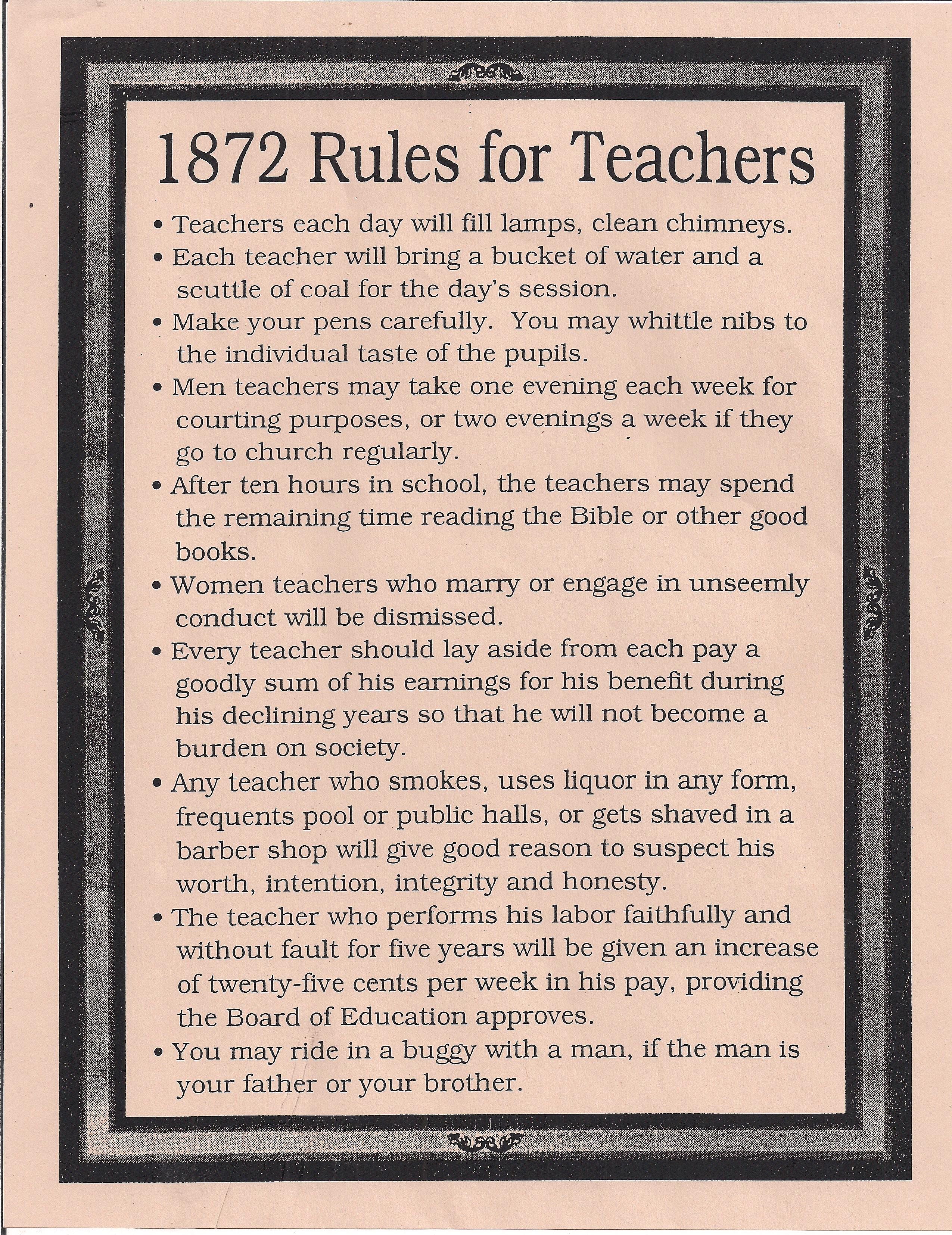
No one would call this the golden era of teaching, not with school budgets getting slashed, state governors routinely scoring political points at teachers’ expense, and the federal government forcing schools to teach to the test. But if today’s teachers are feeling beleaguered, they can always look back to a set of historical “documents” for a little comfort. For decades, museums and publishers have showcased two lists — one from 1872 (above) and another from 1915 (below) — that highlight the rigorous rules and austere moral codes under which teachers once taught. You couldn’t drink or smoke. In women’s cases, you couldn’t date, marry, or frequent ice cream parlors. And, for men, getting a shave in a barber shop was strictly verboten.
But are these documents real?
On its web site, the New Hampshire Historical Society writes that “the sources for these ‘rules’ are unknown; thus we cannot attest to their authenticity—only to their verisimilitude and charming quaintness.” “The rules from 1872 have been variously attributed to an 1872 posting in Monroe County, Iowa; to a one-room school in a small town in Maine; and to an unspecified Arizona schoolhouse. The 1915 rules are attributed to a Sacramento teachers’ contract and elsewhere to an unspecified 1915 magazine.” According to Snopes, the fact-checking web site, the 1872 list has been “displayed in numerous museums throughout North America,” over the past 50 years, “with each exhibitor claiming that it originated with their county or school district.” Heck, the lists even appeared in the venerated Washington Post not so long ago. Here are the rules:
Rules for Teachers — 1872
1. Teachers will fill the lamps and clean the chimney each day.
2. Each teacher will bring a bucket of water and a scuttle of coal for the day’s sessions.
3. Make your pens carefully. You may whittle nibs to the individual tastes of the pupils.
4. Men teachers may take one evening each week for courting purposes, or two evenings a week if they go to church regularly.
5. After ten hours in school, the teachers may spend the remaining time reading the Bible or other good books.
6. Women teachers who marry or engage in improper conduct will be dismissed.
7. Every teacher should lay aside from each day’s pay a goodly sum of his earnings. He should use his savings during his retirement years so that he will not become a burden on society.
8. Any teacher who smokes, uses liquor in any form, visits pool halls or public halls, or gets shaved in a barber shop, will give good reasons for people to suspect his worth, intentions, and honesty.
9. The teacher who performs his labor faithfully and without fault for five years will be given an increase of twenty-five cents per week in his pay.
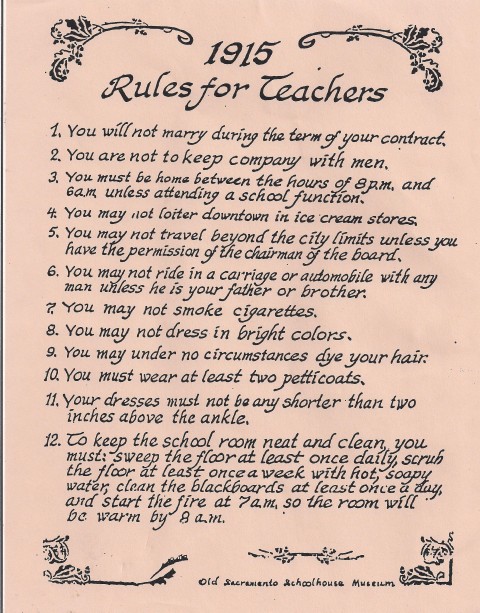
Rules for Teachers — 1915
1. You will not marry during the term of your contract.
2. You are not to keep company with men.
3. You must be home between the hours of 8 PM and 6 AM unless attending a school function.
4. You may not loiter downtown in ice cream stores.
5. You may not travel beyond the city limits unless you have the permission of the chairman of the board.
6. You may not ride in a carriage or automobile with any man except your father or brother.
7. You may not smoke cigarettes.
8. You may not dress in bright colors.
9. You may under no circumstances dye your hair.
10. You must wear at least two petticoats.
11. Your dresses may not be any shorter than two inches above the ankles.
12. To keep the classroom neat and clean you must sweep the floor at least once a day, scrub the floor at least once a week with hot, soapy water, clean the blackboards at least once a day, and start the fire at 7 AM to have the school warm by 8 AM.
via Peter Kaufman, mastermind of the Intelligent Channel on YouTube.
Related Content:
200 Free Kids Educational Resources: Video Lessons, Apps, Books, Websites & More
750 Free Online Courses from Top Universities
Read More...The Famous Feynman Lectures on Physics: The New Online Edition (in HTML5)

Image by Tamiko Thiel, via Wikimedia Commons
Caltech and The Feynman Lectures Website have joined forces to create an online edition of Richard Feynman’s famous lectures on physics. First presented in the early 1960s as part of a two-year introductory physics course given at Caltech, the lectures were eventually turned into a book that became a classic reference work for physics students, teachers and researchers. You can still purchase the 560 page book online, or enjoy a new web edition for free.
Created with HTML5, the new site gives readers access to “a high-quality up-to-date copy” of Feynman’s lectures.” The text “has been designed for ease of reading on devices of any size or shape,” and you can zoom into text, figures and equations without degradation. Dive right into the lectures here. And if you’d prefer to see Feynman (as opposed to read Feynman), we would encourage you to watch ‘The Character of Physical Law,’ Feynman’s seven-part lecture series recorded at Cornell in 1964. Another 37 physics courses, most in video, can be found in our collection of Free Online Courses.
Feynman’s lecture are now listed in our collections of Free eBooks and Free Textbooks.
Photograph by Tom Harvey. Copyright © California Institute of Technology.
via Boing Boing
Related Content:
Richard Feynman Presents Quantum Electrodynamics for the NonScientist
Read More...Visualizing Slavery: The Map Abraham Lincoln Spent Hours Studying During the Civil War

If you look closely at Francis Bicknell Carpenter’s 1864 painting “First Reading of the Emancipation Proclamation by President Lincoln” (see above — click image for a larger version) you will notice a map in the lower right-hand corner, next to the group that includes Lincoln and his cabinet.
The map in the painting was a document Lincoln consulted often during the Civil War. It was created by the United States Coast Survey using data from the 1860 Census to show the geographic distribution of the South’s vast slave population.
Carpenter lived in the White House for six months while working on his painting, and according to historian Susan Schulten, author of Mapping the Nation: History and Cartography in 19th Century America, the artist encountered Lincoln poring over the map on more than one occasion.
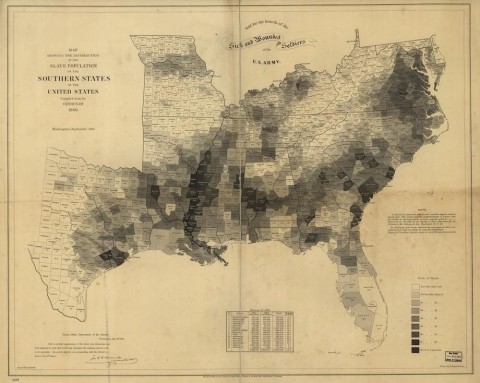
The map (click it to see a larger version) is an early example of statistical cartography. The slave population of each county is represented numerically and through a graded scale of shading. The higher the number of slaves, the darker the shade. In a 2010 piece in the New York Times “Opinionator” blog, Schulten writes:
The map reaffirmed the belief of many in the Union that secession was driven not by a notion of “state rights,” but by the defense of a labor system. A table at the lower edge of the map measured each state’s slave population, and contemporaries would have immediately noticed that this corresponded closely to the order of secession. South Carolina, which led the rebellion, was one of two states which enslaved a majority of its population, a fact starkly represented on the map.
The map helped Lincoln visualize what he was up against. Areas along the Atlantic coast and Mississippi River, for example, are darkly shaded. The white populace in those areas was fanatically resistant to emancipation. “Conversely,” writes Schulten, “the map illustrated the degree to which entire regions — like eastern Tennessee and western Virginia — were virtually devoid of slavery, and thus potential sources of resistance to secession. Such a map might have reinforced President Abraham Lincoln’s belief that secession was animated by a minority and could be reversed if Southern Unionists were given sufficient time and support.”
For more on Lincoln’s map, visit Rebecca Onion’s post at Slate.
Related Content:
“Ask a Slave” by Azie Dungey Sets the Historical Record Straight in a New Web Series
The Civil War and Reconstruction: A Free Course
The Poetry of Abraham Lincoln
The Last Surviving Witness of the Lincoln Assassination
African-American History: Modern Freedom Struggle – YouTube – iTunes – Clay Carson, Stanford (in our collection of 750 Free Online Courses)
Read More...Dark Side of the Rainbow: Pink Floyd Meets The Wizard of Oz in One of the Earliest Mash-Ups
Dude, I’m serious; you cue up The Wizard of Oz, you cue up Dark Side of the Moon, and you start ’em up at the same time. It totally works. Too many synchronicities to explain away. Blow your mind, man.
Laugh though we may at those who consider it an intense evening to enter their preferred state of mind, shall we say, and feel for resonances between a 1939 MGM musical and Pink Floyd’s eighth album, we can’t deny that the mash-up Dark Side of the Rainbow, as they call it (when they don’t call it Dark Side of Oz or The Wizard of Floyd), has become a serious, if modest, cultural phenomenon.
In fact, since enthusiasm for playing Dark Side of the Moon while watching The Wizard of Oz goes back at least as far as Usenet discussions in the mid-nineties, it may well count as the first internet mash-up ever. Word of the viewing experience’s uncanniness has, since then, extended far beyond the wood-paneled-basement set; even an institution as ostensibly square as the cable channel Turner Classic Movies once aired The Wizard of Oz with Dark Side of the Moon as its soundtrack.
Clearly, people get something out of the combination no matter their state of mind. At the very least, they get amusement at the coincidences where the album’s sounds and lyrical themes meet and seemingly match the events of the picture. Dark-side-of-the-rainbow.com offers a thoroughly annotated list of these intersections, from the fading-in heartbeat that opens the album aligning with the appearance of the movie’s title:
In this concept album, we have [symbolically] the beginning of human life. Many parents begin the process of naming the child, as soon as they become aware of its existence, often before they even know the sex of the child. Here, we have the name of a movie, which just happens to be the name of one of the characters in the movie, just as we are becoming aware of this new life.
To the lyric that accompanies Dorothy’s entry into Munchkinland:
“Get a job with more pay and you’re OK”: Dorothy doesn’t know it yet, but she is about to be promoted from farm girl to slayer of wicked witches.
To the album-closing heartbeat that plays as the Tin Man receives a heart of his own:
On the album, this heartbeat going dead represents death. Tin Man’s new heart, which we can hear ticking, symbolizes rebirth. Once again, this contrast of what we see in the movie, and what we hear on the album is about providing balance. And as this is how the story ends, this balance speaks of how, in the end, the fairytale has indeed overcome the tragedy.
Pink Floyd themselves have disavowed any compositional intent in this matter (Alan Parsons, who engineered the recording, calls the very idea “a complete load of eyewash”), and even Dark Side of the Rainbow’s most dedicated enthusiasts seldom doubt them. Some may insist that the band, already adept at composing film scores, did it all subconsciously, but to me, the enduring popularity of this early mash-up stands as evidence of something far more interesting: mankind’s unending tendency — compulsion, even — to find patterns where none may exist. “When coincidences pile up in this way, one cannot help being impressed by them—for the greater the number of terms in such a series, or the more unusual its character, the more improbable it becomes.” Carl Jung wrote that about the psychological concept of synchronicity. If only he’d lived to watch this.
Related Content:
BBC Radio Play Based on Pink Floyd’s Dark Side of the Moon Streaming Free For Limited Time
Pink Floyd Provides the Soundtrack for the BBC’s Broadcast of the 1969 Moon Landing
Watch Pink Floyd Plays Live in the Ruins of Pompeii (1972)
Colin Marshall hosts and produces Notebook on Cities and Culture and writes essays on literature, film, cities, Asia, and aesthetics. He’s at work on a book about Los Angeles, A Los Angeles Primer. Follow him on Twitter at @colinmarshall.
Read More...“Ask a Slave” by Azie Dungey Sets the Historical Record Straight in a New Web Series
Anyone whose job involves interaction with the general public will be subjected to a certain number of boneheaded questions on any given day. Those numbers skyrocket when one must remain in both costume and character, charged with bringing history to life.
Azie Dungey, the creator and star of the new web series, Ask a Slave, claims to have “played every black woman of note that ever lived” when she was employed as an historic interpreter in the Washington DC area. These included Caroline Branham, Martha Washington’s enslaved lady’s maid, a gig that compelled her to keep a record of questions posed by visitors to Mount Vernon.
Now, as the tea-sipping, fictional Lizzie Mae, Dungey is able to answer those questions with greater freedom. A middle-aged, seemingly educated white man wonders if a newspaper ad is what led to Lizzie Mae’s position in the home of “such a distinguished Founding Father” as George Washington.
“Did I read the advertisement in the newspaper?” Lizzie Mae echoes pleasantly. “Why, yes. It said Wanted: One housemaid. No pay. Preferably mulatto, saucy with breeding hips. Must work 18 hour a days, seven days a week, no holidays. But you get to wear a pretty dress, and if you’re lucky you just might carry some famous white man’s bastard child. So, you better believe I read that and I ran right over and said, “Sign me up!””
Her default tone is one of professionally patient indulgence, though occasionally, the mask slips, as when another visitor asserts that “slavery isn’t really that bad.”
Sticking to the historic interpreter’s schtick of not recognizing non-period inventions like cameras pays dividends when the subject turns to internships, the underground railroad, and what George Washington thinks of Abraham Lincoln freeing all his slaves.
The best material, as they say, writes itself.
Related Content:
The American Founders and Their World
Ayun Halliday documents an unexpected detour to Mount Vernon in The Big Rumpus. Follow her @AyunHalliday
Read More...Support Us
We're hoping to rely on loyal readers, rather than erratic ads. Please click the Donate button and support Open Culture. You can use Paypal, Venmo, Patreon, even Crypto! We thank you!

About Us

Open Culture scours the web for the best educational media. We find the free courses and audio books you need, the language lessons & educational videos you want, and plenty of enlightenment in between.
Advertise With Us

FREE UPDATES!
GET OUR DAILY EMAIL
Get the best cultural and educational resources on the web curated for you in a daily email. We never spam. Unsubscribe at any time.
FOLLOW ON SOCIAL MEDIA

Open Culture editor Dan Colman scours the web for the best educational media. He finds the free courses and audio books you need, the language lessons & movies you want, and plenty of enlightenment in between.
Advertise With Us


