Trace Darwin’s Footsteps with Google’s New Virtual Tour of the Galapagos Islands
As famously studied as they are, the 18 Galapagos Islands haven’t been well mapped. And research in the Galapagos, situated more than 500 miles west of Ecuador, is expensive and difficult. Maybe that’s part of the islands’ allure—that and the stunning biodiversity.
In partnership with the Charles Darwin Foundation and Galapagos National Park, Google sent a team armed with Street View Trekker cameras to create an entirely new 360 degree Street View experience that makes three major islands, a fragile tortoise breeding area and coastal areas, available to visitors located anywhere with an Internet connection.
Darwin made his first expedition to the islands 178 years ago. This might have been his first view of San Cristobal Island.

After exploring San Cristobal’s rocky coast, Google trekkers made their way to Galapaguera, a giant tortoise breeding center, where they saw newly hatched babies and adults munching on leaves and stalks.
Off the coast of Floreana Island, trekkers went underwater and caught images of seals playing in the water. They also shot images inside the Charles Darwin Research Station’s vertebrate, invertebrate and plant collections.
Google does a good job of documenting its own process. Trekkers traveled to Galapagos in May and spent 10 days hiking, boating, and diving. It’s fun to watch them climb and scoot around the islands loaded with a geodesic camera backpack.
Scientists get really excited when they find new tools to do their work. And why shouldn’t they? These islands are amazing and are home to so many unique species, like the Marine Iguana. We landlubbers may not get there anytime soon, but this is the next best thing.
Related Content:
Read the Original Letters Where Charles Darwin Worked Out His Theory of Evolution
The Genius of Charles Darwin Revealed in Three-Part Series by Richard Dawkins
Darwin: A 1993 Film by Peter Greenaway
Kate Rix writes about education and digital media. Follow her on Twitter.
Read More...10th Graders Draw Pictures Imagining Philosophers at Work
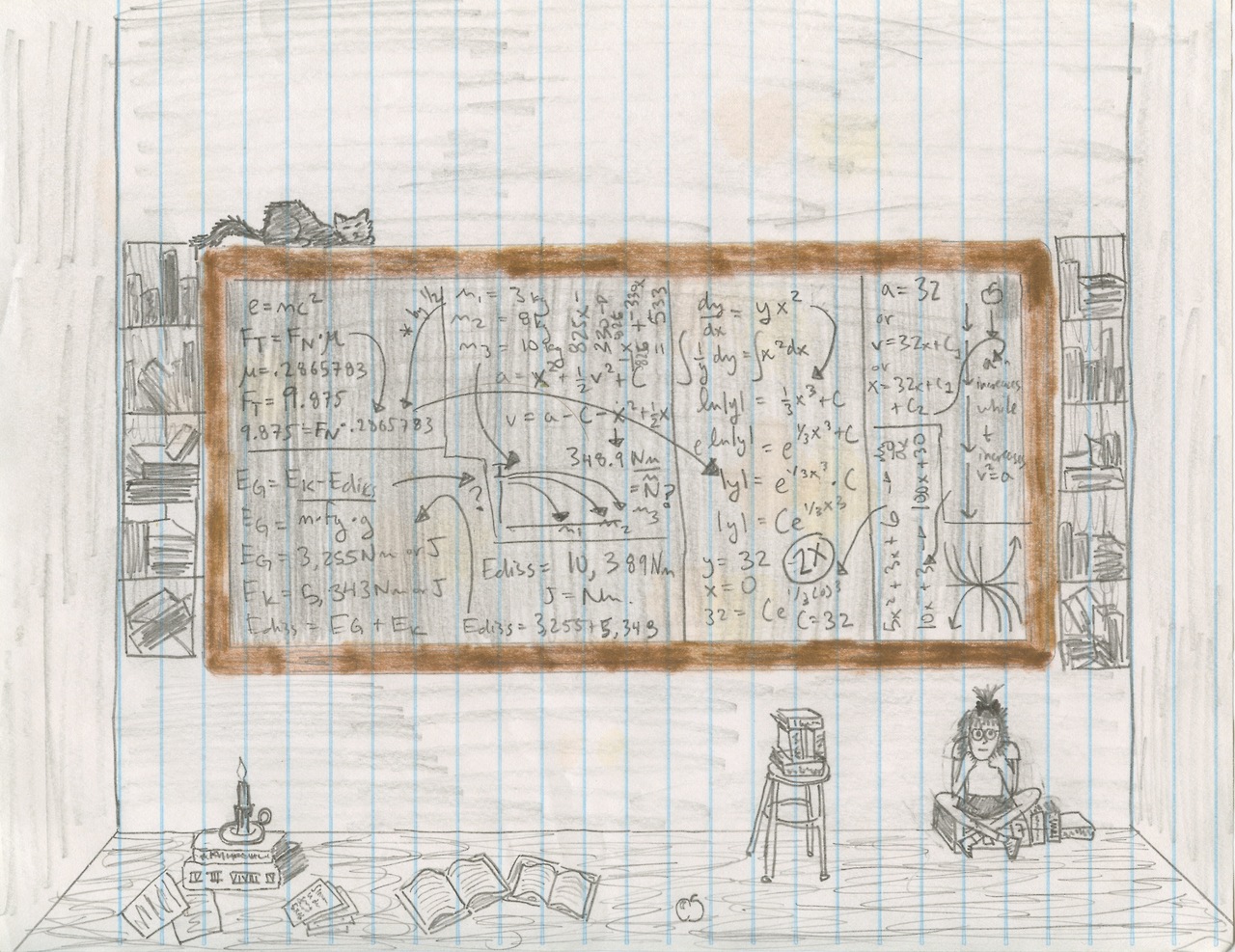 The Tumblr called Philosophers at Work has gathered together a fun series of drawings by 10th graders from Madison WI, who were asked by their teacher to — you guessed it — “draw a philosopher at work.” I will leave it to you to peruse the gallery of drawings. But I’ll just say this: Whatever their virtues, the drawings don’t look anything like real philosophers. (For some pictures of real philosophers, see, of course, the Looks Philosophical tumblr.) Nor do tenth graders, no disrespect to them, depict philosophers nearly as artistically as Renée Jorgensen Bolinger, whose paintings of Wittgenstein, Frege and Russell we showed you a few weeks back. If you missed her paintings, I’d encourage you to see Philosopher Portraits: Famous Philosophers Painted in the Style of Influential Artists. Enjoy your weekend.
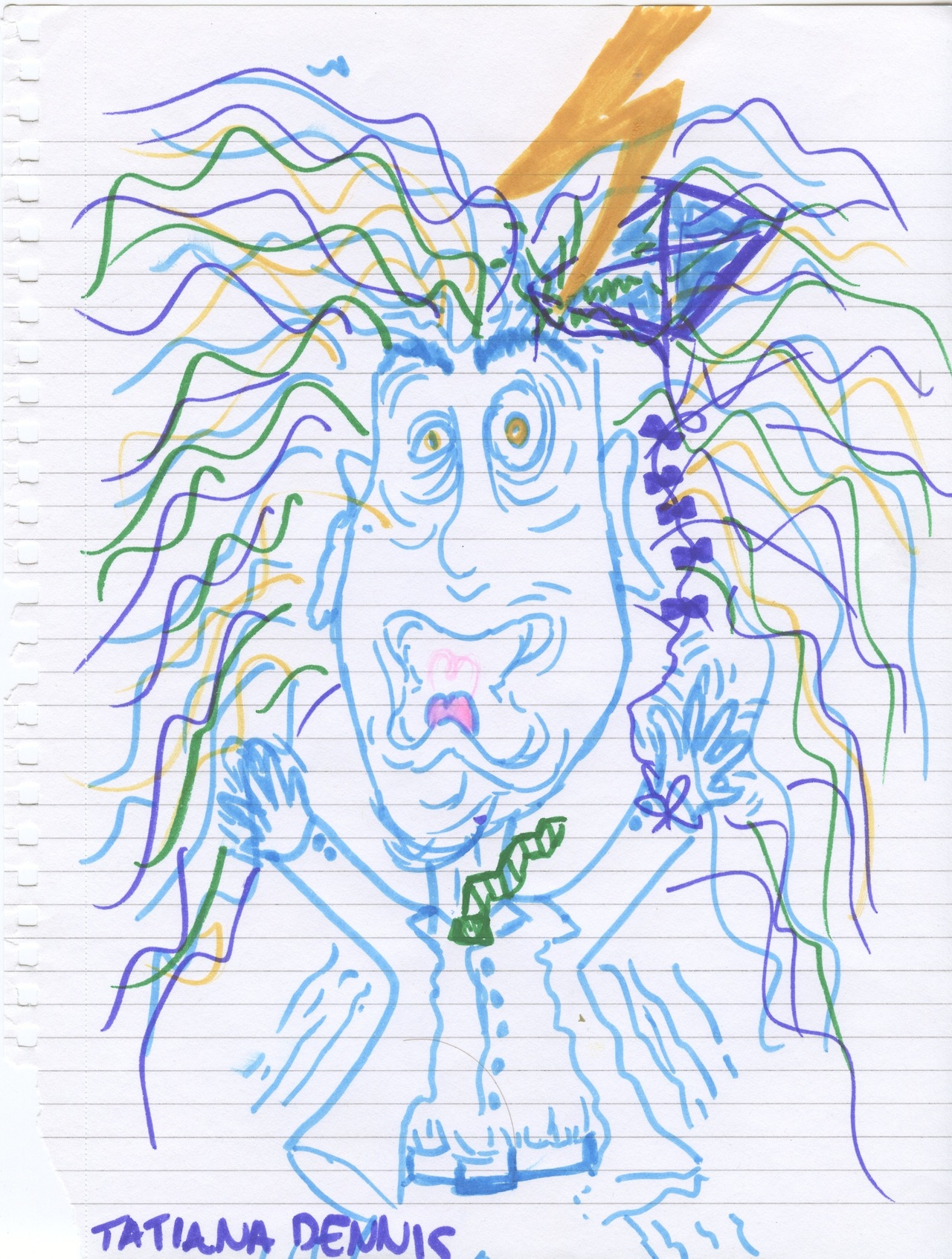
Note: if you click on the images above and below, you can see each in an expanded format.
via Leiter Reports
Related Content:
10 Famous Philosophers in Words and Images
Photography of Ludwig Wittgenstein Released by Archives at Cambridge
The History of Philosophy … Without Any Gaps
Read More...William S. Burroughs Explains What Artists & Creative Thinkers Do for Humanity: From Galileo to Cézanne and James Joyce
The interview clip above, from the 1991 documentary Commissioner of Sewers, puts a two-part question to Naked Lunch author, “cut-up writing” master, and counterculture eminence William S. Burroughs: “What is the original feel of the writer? What mechanisms should he consider, work on?” That may sound like a slightly odd line of inquiry — the interviewer, bear in mind, doesn’t speak English natively — but Burroughs responds with an important point, clearly made. “The word should should never arise,” he first insists, though perhaps self-contradictorily. “There is no such concept as should in regard to art — or anything — unless you specify. If you’re trying to build a bridge, then you can say we should do this and we should do that, with respect to getting a bridge built, but it doesn’t float in a vacuum.” All well and good for engineering. But what can art do, if not build a bridge?
“One very important aspect of art is that it makes people aware of what they know and what they don’t know that they know,” Burroughs says. “This applies to all creative thinking. For example, people on the sea coast in the middle ages knew the Earth was round. They believed the Earth was flat because the church said so. Galileo tells them the Earth was round, and nearly was burned at the stake for saying so.”
Burroughs summons as examples Cézanne, whose studies of what “objects look like seen from a certain angle and in a certain light” at first made viewers think “he’d thrown paint on canvas,” and Joyce, who “made people aware of their stream of consciousness, at least on a verbal level,” but “was first accused of being unintelligible.” Yet Burroughs found he lived in a world where, this art already having expanded humanity’s consciousness, “no child would have any difficulty in seeing a Cézanne” and few “would have any difficulty with Ulysses. The artist, then, expands awareness. Once the breakthrough is made, this becomes part of the general awareness.” Such insight makes Burroughs, as one Youtube commenter puts it, “so down-to-earth that he’s far-out.”
If you would like to support the mission of Open Culture, consider making a donation to our site. It’s hard to rely 100% on ads, and your contributions will help us continue providing the best free cultural and educational materials to learners everywhere. You can contribute through PayPal, Patreon, and Venmo (@openculture). Thanks!
Related Content:
When William S. Burroughs Joined Scientology (and His 1971 Book Denouncing It)
Commissioner of Sewers: A 1991 Profile of Beat Writer William S. Burroughs
William S. Burroughs on the Art of Cut-up Writing
William S. Burroughs’ Short Course on Creative Reading
Colin Marshall hosts and produces Notebook on Cities and Culture and writes essays on literature, film, cities, Asia, and aesthetics. He’s at work on a book about Los Angeles, A Los Angeles Primer. Follow him on Twitter at @colinmarshall.
Read More...What Was Your First Live Concert? We’ll Show You Ours, Share Yours.
I’m gonna tell you something. Most of my life I’ve been a snob. A music snob. I know, people like me can suck the fun out of a five-year-old’s birthday party. But I wasn’t always such a twisted killjoy. For a couple years of my life, between the tender ages of 11 and 13, I was a wide-eyed naïf, grooving to whatever late eighties R&B power ballad rap hits happened to come on the radio, and it all sounded pretty good to me. Sure, I should’ve known better—I grew up folk and blues and golden age rock and roll. But that was my parents’ music. To paraphrase Morrissey, it had nothing to say about my life.
No, in that excruciatingly earnest yet also oh-so painfully awkward way, the first band I believed spoke to me was INXS. Yes, that’s right, those ridiculous Aussie arena rockers whose tumble from cheesy to morbidly tawdry to Reality TV we all know so well. At 13, I was convinced that Michael Hutchence was my generation’s Jim Morrison. And so one night in March, dressed in a sleeveless INXS t‑shirt, ripped jeans and high-top sneakers, my hair teased into some kind of Prince-like pompadour, I told my parents I was going to a sleepover. Instead, I rode with a few neighborhood friends to the Patriot Center at George Mason University, the ticket I’d had a buddy’s older brother buy with the last of my paper route money tucked neatly into the fold of my black Velcro INXS wallet. I mounted the stairs to a section so high that our view of the stage looked like a Georges Seurat up close, all disorienting little colored dots.
But I was there, man, in the throng, in the thick of a rock and roll show, hearing the hits blare across acres of screaming heads. And it was magical. Not very long after, I would turn to harder stuff, become jaded and crusty and look back with disdain on the smooth sounds of INXS. But that feeling then… standing there amidst those crowds, almost everyone older than me, wobbling in the haze of surreptitious pot smoke and the slightly nauseating high of cheap beer drunk fast in an old muscle car… I had arrived. I told my parents about this years later, when the statute of limitations ran out. And they laughed. And so did I. Because, c’mon. It’s INXS. Then again, watching the footage above from 1988, the same year I saw them at 13, I have to admit that they don’t sound half bad. But goodness, those outfits. Probably for the best I couldn’t actually see them on the stage back then.
So there’s my story, readers, inspired by this Metafilter thread. Now that I’ve told you mine, please tell me yours. What was your very first concert? There’s no shame here, friends. Only nostalgia. Extra points to those who provide links to live concert footage.
Josh Jones is a writer and musician based in Durham, NC. Follow him at @jdmagness
Read More...Dewars Channels the Ghost of Charles Bukowski to Sell Scotch
In 1993, the GAP used the ghost of Jack Kerouac to help sell khakis to desk jockeys across the nation. That was odd. 20 years later, Dewars has called upon Charles Bukowski, dead since 1994, to peddle Scotch. That makes complete sense. As you may recall, Bukowski once told Sean Penn in a 1987 Interview magazine piece: “Alcohol is probably one of the greatest things to arrive upon the earth — alongside of me. Yes…these are two of the greatest arrivals upon the surface of the earth. So…we get along.” Bukowski liked to drink. He also liked to talk about his memorable hangovers. Dead or alive, Bukowski has the creds to sell Scotch.
As the Dewars ad rolls (above), you’ll hear lines from Bukowski’s poem “so you want to be a writer?” (below). And if you’re familiar with the poem, you’ll notice that the narration in the commercial is abridged. They’ve removed various lines referring to the writing life, making it so that the narration speaks to a broader audience. Rock climbers. Motorcycle mechanics. Musicians. Journalists. People who aspire — or need to be inspired — to “live true.”
Two quick notes: If I’m not mistaken, you can hear the same voice in the clips above and below. That would make it the voice of “Tom O’Bedlam,” who runs the Spoken Verse channel on YouTube. Also, you can view a Spanish version of the Dewars ad here.
Related Resources:
So You Want to Be a Writer?: Charles Bukowski Explains the Dos & Don’ts
Charles Bukowski Tells the Story of His Worst Hangover Ever
“Don’t Try”: Charles Bukowski’s Concise Philosophy of Art and Life
550 Free Audio Books: Download Great Books for Free
Drinking with William Faulkner
Read More...Watch Audio Ammunition: A Documentary Series on The Clash and Their Five Classic Albums
The Clash are big in music news again with the arrival of their box set Sound System, which Mick Jones promises will be their final official release of all time. Jones also tells The Guardian it’s the “best box set ever,” and I just might believe it. It’s certainly one of the coolest looking. The band’s music holds up perfectly well; in fact it’s taken on renewed relevance as so much of the cultural and economic conflicts they wrote in response to have emerged like zombies from the grave to torment us again (this time, perhaps, pace Marx, as zombie farce).
In light of their renewed relevance, Google brings us a five-part documentary series on the band, called Audio Ammunition, and it looks fantastic.
Each part covers the making of their five classic studio albums (excluding 1985’s misguided Cut the Crap). Here’s Google’s official description:
In this exclusive documentary featuring never-before-seen footage of the late, great Joe Strummer, all four members of “the only band that matters” walk us through the making of each of their classic albums. Newly re-mastered versions of those albums are available below, along with a new hits collection based on the set list from one of Joe’s favorite gigs. Plus, four contemporary bands inspired by the Clash’s legacy offer their own takes on the band’s songs. If you already love the Clash, watch and listen and we guarantee you’ll hear something new. If you don’t, you’ll hear why you should.
See Part One, “The Clash,” at the top and part 2, “Give ‘Em Enough Rope,” above, and below find part 3, “London Calling,” part 4, “Sandinista,” and part 5, “Combat Rock.” And visit the Google Play site for the film and to find other goodies like Kurt Vile’s fuzzed-out take on “The Guns of Brixton” and other exclusive covers of Clash songs by contemporary artists. The documentary series will be added to our collection of 575 Free Movies Online.
London Calling
Sandinista
Combat Rock
via Boing Boing
Related Content:
Surviving Members of The Clash Recount the Making of “London Calling” & Discuss New Box Set
The Clash: Westway to the World
Mick Jones Plays Three Classics by The Clash at the Public Library
Josh Jones is a writer and musician based in Durham, NC. Follow him at @jdmagness
Read More...Death of An Adjunct: A Sobering, True Story

The Pittsburgh Post-Gazette ran a sad and galling story yesterday about Mary Margaret Vojtko who died of a heart attack at the age of 83. At the time of her death, Daniel Kovalik writes:
She was receiving radiation therapy for the cancer that had just returned to her, she was living nearly homeless because she could not afford the upkeep on her home, which was literally falling in on itself, and now, she explained, she had received another indignity — a letter from Adult Protective Services telling her that someone had referred her case to them saying that she needed assistance in taking care of herself.
Vojtko had ended up in poverty after spending 25 years working as an adjunct professor of French at Duquesne University, a Catholic school located in Pittsburgh, Pa. Until she was terminated last spring, she worked “on a contract basis from semester to semester, with no job security, no benefits and with a salary of between $3,000 and just over $3,500 per three-credit course.” When teaching three classes a semester and two during the summer, Vojtko never earned more than $25,000 a year. (A pittance compared to the pay package of Duquesne’s president — reportedly about $700,000 per year in salary and benefits.) Meanwhile, Duquesne thwarted attempts by adjuncts to unionize, claiming that the school should have a religious exemption.
As Kovalik goes on to note: “Adjuncts now make up well over 50 percent of the faculty at colleges and universities.” And that statistic is bound to increase. You can — and should — read the full story at the Post-Gazette. Read Death of an Adjunct here.
via @stevesilberman
Read More...Vladimir Nabokov’s Delightful Butterfly Drawings
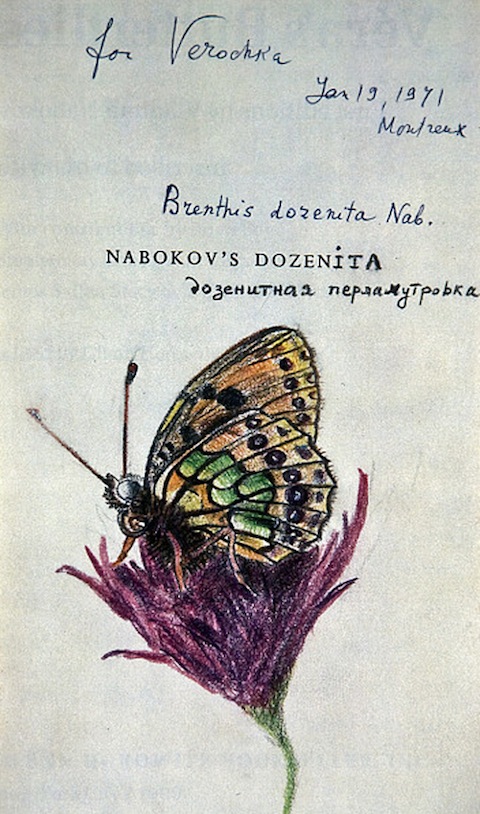
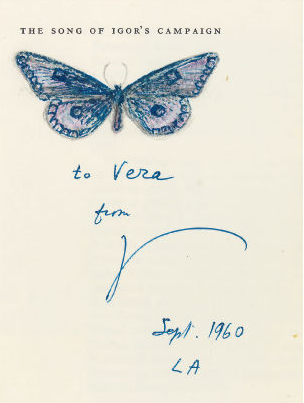
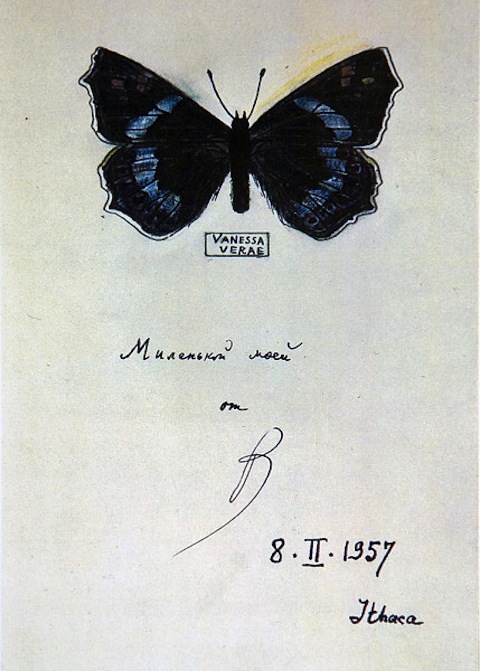
We don’t often talk about the hobbies (other than drinking, anyway) of respected twentieth-century writers. But do you know a single Nabokov reader, or even an aspiring Nabokov reader, ignorant of the lepidopterist leanings of the author of Lolita, The Gift, and Pale Fire? The man liked butterflies, as any of the widely seen photographs of him wielding his comically oversized net can attest. But when his eyes turned toward these striking, delicate insects, he didn’t necessarily put down his pen. Nabokov’s wife Vera, according to a Booktryst post on the sale of his book and manuscript collections, “treasured nature, art, and life’s other intangibles more highly than material possessions, and Vladimir knew that for Christmas, birthdays and anniversaries” — in Montreux in 1971, Ithaca in 1957, Los Angeles in 1960, or anywhere at any time in their life together — “Vera appreciated his thoughtful and delicate butterfly drawings much more than some trinket. She delighted in these drawings in a way she never did for the landscapes he used to paint for her in earlier days.” For the woman closest to his heart, Nabokov drew the creatures closest to his heart.
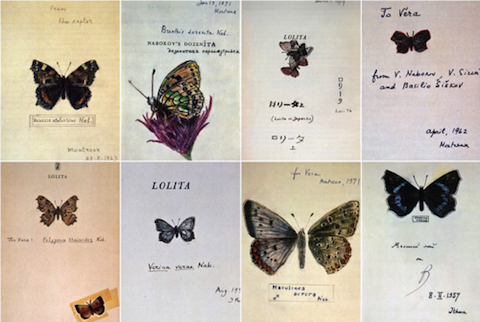
“From the age of seven, everything I felt in connection with a rectangle of framed sunlight was dominated by a single passion. If my first glance of the morning was for the sun, my first thought was for the butterflies it would engender.” This he declares in his autobiography Speak, Memory. “I have hunted butterflies in various climes and disguises: as a pretty boy in knickerbockers and sailor cap; as a lanky cosmopolitan expatriate in flannel bags and beret; as a fat hatless old man in shorts.” Despite the passion with which Nabokov pursued lepidoptery, it seemed, in his lifetime, his accomplishments in the field would remain mostly non-professional; he began one book called Butterflies of Europe and another called Butterflies in Art, but finished neither.
But in 2000, out came the 782-page Nabokov’s Butterflies, which collects, as its co-editor Brian Boyd writes in the Atlantic, “his astonishingly diverse writing about butterflies, whether scientific or artistic, published or unpublished, carefully finished or roughly sketched, in poems, stories, novels, memoirs, scientific papers, lectures, notes, diaries, letters, interviews, dreams.” And in 2011, a hypothesis he had about butterfly evolution had its vindication under the Royal Society of London. But to understand how much butterflies meant to him, we need look no further than the title pages of the volumes he gave his wife.
via Book Tryst
Related Content:
Vladimir Nabokov Creates a Hand-Drawn Map of James Joyce’s Ulysses
Vladimir Nabokov Marvels Over Different Lolita Book Covers
Vladimir Nabokov (Channelled by Christopher Plummer) Teaches Kafka at Cornell
Colin Marshall hosts and produces Notebook on Cities and Culture and writes essays on literature, film, cities, Asia, and aesthetics. He’s at work on a book about Los Angeles, A Los Angeles Primer. Follow him on Twitter at @colinmarshall.
Read More...Train Your Brain This Fall with Free Online Courses, eBooks, Audio Books, Language Lessons & More

For years now, the buzzword “Neuroplasticity” has crossed the lips of many major thinkers in psychology, neurology, and educational theory. Maybe, as some allege, it is a “dirty word”—vague and in need of specific clarification. Maybe. But the contexts in which it arises point to an important idea: that we are capable of learning new things, all the time, at any stage of life, and that those new learning experiences change and renew our brains in ways we can’t predict or imagine. So today, for those students returning to school and those lifelong learners for whom every season beckons with new opportunities to acquire new skills and knowledge, we present to you our collections of free online courses, books, films, language lessons, textbooks, and other resources to exercise your neuroplastic mind.
Free Online Courses: This list brings together over 750 free online courses from leading universities, including Stanford, Yale, MIT, UC Berkeley, Oxford and more. These courses range across all disciplines – history, physics, philosophy, psychology and beyond. Most all of these courses are available in audio, and roughly 75% are available in video. In total, you will find over 2o,000 hours of free lectures from world-class institutions here.
Free MOOCs: Whatever you’re into (philosophy?, behavioral economics?, music history?), you’ll likely find a MOOC (Massive Open Online Course) to suit you in our list of classes from leading universities. Many MOOCs offer certificates of completion (though rarely course credits that will actually transfer to universities). 125 MOOCs will be launching between now and the end of October. See our complete list.
Free Language Lessons: Perhaps learning a new language is high on your list this fall. Well, here is a great way to do it. Take your pick of 46 languages including, Spanish, French, Italian, Mandarin, English, Russian, Dutch, even Finnish, Yiddish and Esperanto. The lessons are all free and ready to download.
Free Audio Books: What better way to spend your free time than listening to some of the greatest books ever written? Our collection 1,000 Free Audio Books: Download Great Books for Free includes works by Arthur Conan Doyle, James Joyce, Jane Austen, Edgar Allan Poe, George Orwell and more recent writers — Italo Calvino, Vladimir Nabokov, Raymond Carver, etc. You can download these classic books straight to your gagdets, then listen as you go.
[Note: If you’re looking for a contemporary book, you can download one free audio book from Audible.com. Find details on Audible’s no-strings-attached deal here.]
Free eBooks: You have always wanted to read the great works. And now is your chance. When you dive into our collection of 800 Free eBooks for iPad, Kindle & Other Devices you will find great works by some classic writers (Dickens, Dostoevsky, Shakespeare and Tolstoy) and more modern writers (F. Scott Fitzgerald, Philip K. Dick, Isaac Asimov, and Kurt Vonnegut). The collection also gives you access to the 51-volume Harvard Classics.
Free Textbooks: We have scoured the web and pulled together a list of 150 Free Textbooks. It’s a great resource particularly if you’re looking to learn math, computer science or physics on your own. There might be a diamond in the rough here for you.
Free K‑12 Resources: Parents, teachers, and young students seeking excellent free online educational resources, look no further. We’ve gathered free apps, quality YouTube channels; test prep materials; and free web resources in academic subjects like literature, history, science and computing.
Free Movies: With a click of a mouse, or a tap of your touch screen, you will have access to 500 great movies. The collection hosts many classics, westerns, indies, documentaries, silent films and film noir favorites. It features work by some of our great directors (Alfred Hitchcock, Orson Welles, Andrei Tarkovsky and David Lynch) and performances by cinema legends: John Wayne, Jack Nicholson, Audrey Hepburn, Charlie Chaplin, and beyond. On this one page, you will find thousands of hours of cinema bliss.
Enjoy stretching your brains in new and interesting ways this season.
Read More...David Lynch Lists His Favorite Films & Directors, Including Fellini, Wilder, Tati & Hitchcock
At least a few of you — more than a few, I’d wager — think of David Lynch as your favorite filmmaker. Back when we posted about the greatest films of all time as named by Stanley Kubrick, Martin Scorsese, Woody Allen, and Quentin Tarantino, you probably wondered what selections the Eraserhead auteur would make. You can get an idea from the interview clip above, in which Lynch considers the questions “Whose work do you admire?” and “What movies have you watched over and over and could still watch a hundred times more?” Well-asked, since the movies we actually watch most often reveal more about us than the movies we happen to call “favorites.” “I love Stanley Kubrick,” he replies. “I can watch his movies over and over. I love Billy Wilder, Sunset Boulevard in particular, and I’ve watched it over and over. I loved the world Billy Wilder created.”
“I love Fellini,” Lynch continues. “Watched ’em over and over. If you want to see some great comedies, check out Jacques Tati’s Mr. Hulot’s Holiday. I like W.C. Fields. I like the movie It’s a Gift. I like Hitchcock, particularly Rear Window.” And after a moment of reflection: “I like a lot of different filmmakers, but those are… some of them.” MUBI.com also offers a post on Lynch’s favorite films, drawn from Lynch on Lynch, Chris Rodley’s book-length interview with the director, and Catching the Big Fish, Lynch’s own volume on meditating your way to interesting ideas.
Here he provides more details on his fellow filmmakers of choice:
- In 8½, “Fellini manages to accomplish with film what mostly abstract painters do – namely, to communicate an emotion without ever saying or showing anything in a direct manner, without ever explaining anything, just by a sort of sheer magic.”
- In Sunset Boulevard, Wilder “manages to accomplish pretty much the same abstract atmosphere, less by magic than through all sorts of stylistic and technical tricks. The Hollywood he describes in the film probably never existed, but he makes us believe it did, and he immerses us in it, like a dream.”
- Monsieur Hulot’s Holiday wins his favor “for the amazing point of view that Jacques Tati casts at society through it. When you watch his films, you realize how much he knows about – and loved – human nature, and it can only be an inspiration to do the same.”
- Rear Window does the same “for the brilliant way in which Alfred Hitchcock manages to create – or rather, re-create – a whole world within confined parameters. James Stewart never leaves his wheelchair during the film, and yet, through his point of view, we follow a very complex murder scheme. Hitchcock manages to take something huge and condense it into something really small. And he achieves that through a complete control of film making technique.”
Communicating without directly saying, showing, or explaining? Crafting abstract atmosphere? Evoking a dreamlike version of Hollywood? Casting an eye on society that sees things differently? Creating worlds in tight confines? Seems to me, as someone who’s experienced more than his share of screenings of such films as Eraserhead, Blue Velvet, Lost Highway, and Mulholland Drive, that you could ascribe new versions of not one but all of these cinematic tendencies to Lynch himself. We call imitation the sincerest form of flattery, but surely it counts as a whole other order of compliment to take the accomplishments of the creators who inspire you and somehow make them completely your own. It takes, as the man says, a sort of sheer magic.
Related Content:
The 10 Greatest Films of All Time According to 846 Film Critics
David Lynch Talks About His 99 Favorite Photographs at Paris Photo 2012
David Lynch Explains How Meditation Enhances Our Creativity
David Lynch’s Surreal Commercials
Colin Marshall hosts and produces Notebook on Cities and Culture and writes essays on literature, film, cities, Asia, and aesthetics. He’s at work on a book about Los Angeles, A Los Angeles Primer. Follow him on Twitter at @colinmarshall.
Read More...Support Us
We're hoping to rely on loyal readers, rather than erratic ads. Please click the Donate button and support Open Culture. You can use Paypal, Venmo, Patreon, even Crypto! We thank you!

About Us

Open Culture scours the web for the best educational media. We find the free courses and audio books you need, the language lessons & educational videos you want, and plenty of enlightenment in between.
Advertise With Us

FREE UPDATES!
GET OUR DAILY EMAIL
Get the best cultural and educational resources on the web curated for you in a daily email. We never spam. Unsubscribe at any time.
FOLLOW ON SOCIAL MEDIA

Open Culture editor Dan Colman scours the web for the best educational media. He finds the free courses and audio books you need, the language lessons & movies you want, and plenty of enlightenment in between.
Advertise With Us