Bo Diddley’s Essential Tips for Surviving Life & the Music Business
Some people think Chuck Berry invented rock and roll. Chuck Berry sure thinks so. But I say it was Bo Diddley. At least Diddley invented the rock and roll I love—throbbing, dirty, hypnotic, hovering in some space between the blues, gospel and African rhythms but also with its feet firmly planted on any industrial city streetcorner. Bo Diddley invented irony in rock (his first band was called “The Hipsters”). Bo Diddley never pandered to the teenybopper crowd (though he did go commercial in the 80s). Even his biggest hits have about them an otherworldly air of echo‑y weirdness, with their signature beat and one-note drone. Also something vaguely sleazy and maybe a little sinister, essential elements of rock and roll worthy of the name.
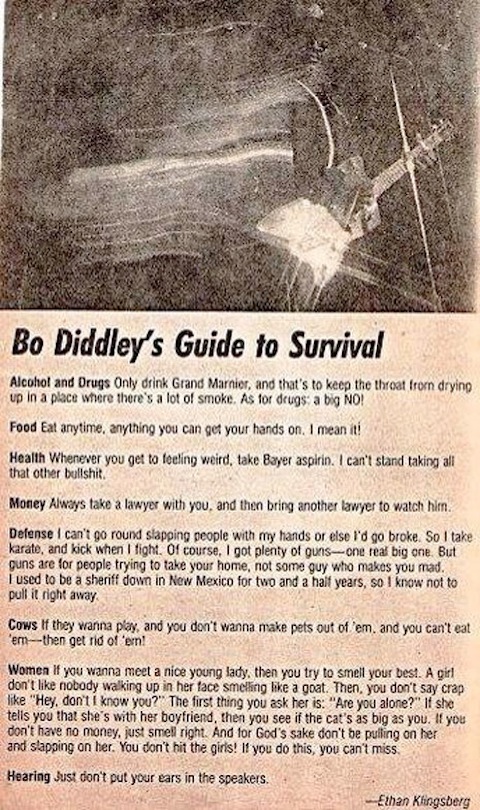
So, as a man who made his own rhythm, his own tones, his own studio, and his own guitar—who was so much his own man that one of his best known songs is named after him—it stands to reason that he would also make his own set of rules for surviving the music business. Called “Bo Diddley’s Guide to Survival,” the list covers all the bases: drugs and booze (“NO!”), food (“anything you can get your hands on”), health, money, defense, cows, women, and hearing. What more is there, really?
The list, clearly part of a magazine feature, has circulated on the internet for some time, but no one has managed to track down the source. It’s probably genuine, though; it sounds like the perfect mix of the down-to-earth and far-out funny that was Bo Diddley. I’m particularly intrigued by his very specific defense techniques (Elvis obviously took notes). It is true, by the way, that Diddley once served as a sheriff in New Mexico, a fact that adds so much to the mystique. Where “Defense” and “Women” get lengthy (and respectful) treatments, his succinct take on “Hearing” is as practical as it gets.
See the original list at the top and read the full transcript below. As you do, listen to the timeless weirdness of “Bo Diddley” above. There’s nothing else like it.
Alcohol and Drugs Only drink Grand Marnier, and that’s to keep the throat from drying up in a place where there’s a lot of smoke. As for drugs: a big NO!
Food Eat anytime, anything you can get your hands on. I mean it!
Health Whenever you get to feeling weird, take Bayer aspirin. I can’t stand taking all that other bullshit.
Money Always take a lawyer with you, and then bring another lawyer to watch him.
Defense I can’t go around slapping people with my hands or else I’d go broke. So I take karate, and kick when I fight. Of course, I got plenty of guns — one real big one. But guns are for people trying to take your home, not some guy who makes you mad. I used to be a sheriff down in New Mexico for two and a half years, so I know not to pull it right away.
Cows If they wanna play, and you don’t wanna make pets out of ‘em, and you can’t eat ‘em — then get rid of ‘em!
Women If you wanna meet a nice young lady, then you try to smell your best. A girl don’t like nobody walking up in her face smelling like a goat. Then, you don’t say crap like “Hey, don’t I know you?” The first thing you ask her is: “Are you alone?” If she tells you that she’s with her boyfriend, then you see if the cat’s as big as you. If you don’t have no money, just smell right. And for God’s sake don’t be pulling on her and slapping on her. You don’t hit the girls! If you do this, you can’t miss.
Hearing Just don’t put your ears in the speakers.
Related Content:
Chuck Berry Takes Keith Richards to School, Shows Him How to Rock (1987)
Keith Richards Waxes Philosophical, Plays Live with His Idol, the Great Muddy Waters
A History of Rock ‘n’ Roll in 100 Riffs
Josh Jones is a writer and musician based in Durham, NC. Follow him at @jdmagness
Read More...Watch Dating Dos and Don’ts: An Old-School Instructional Guide to Teenage Romance (1949)
From the mid-1940s to the mid-1970s, Coronet Instructional Media, that formidable factory of classroom educational films, taught America’s schoolchildren how to study, how to land a job, how to perform their societal and filial duties, how to bathe. Certain generations no doubt retain vivid memories, fond or otherwise, of such 16-millimeter standbys as Good Eating Habits, Joan Avoids a Cold, Are You Popular? and Communism. In 1949, Coronet came up with a short subject rather closer to the eternal interests of the teenager: Dating: Do’s and Don’ts. This twelve-minute film, directed Gilbert Altschul with the assistance of Reuben Hill, Research Professor of Family Life at the University of North Carolina, navigates the garden of forking paths formed by all the choices, from ideally gentleman-like to potentially disastrous, that confront young Woody on his very first date.
Who, for instance, should Woody ask to join him at Central High’s Hi-Teen Carnival? “Whose company would you enjoy?” asks the voice-of-midcentury-authority narrator.” “Well, one thing you can consider is looks. Woody thought of Janice, and how good-looking she was. He really had to rate to date somebody like her.” Still: “It’s too bad Janice always acts so superior and bored. She’d make a fellow feel awkward and inferior.” Perhaps the more grounded Betty? “And yet, it just doesn’t seem as if she’d be much fun. What about Anne? She knows how to have a good time.” Even 64 years on, I daresay fellows would still do well to cleave to the Annes of the world. But given how far the pendulum of sexual politics has swung since Coronet’s heyday, other pieces of of Dating: Do’s and Don’ts advice seems more quaint than current. For a more modern perspective, see also How to Be a “Mr. Good-Date,” a Looney Tunes parody starring Bugs Bunny as the hopeful suitor Reggie Gerandevu and Elmer Fudd as the protective homeowner of whom he runs afoul.
When you’re done watching Dating: Do’s and Don’ts, don’t miss Coronet’s 1951 sequel of sorts “Going Steady.”
Related Content:
The Story Of Menstruation: Walt Disney’s Sex Ed Film from 1946
Duck and Cover, or: How I Learned to Elude the Bomb
How to Spot a Communist Using Literary Criticism: A 1955 Manual from the U.S. Military
Colin Marshall hosts and produces Notebook on Cities and Culture and writes essays on literature, film, cities, Asia, and aesthetics. He’s at work on a book about Los Angeles, A Los Angeles Primer. Follow him on Twitter at @colinmarshall.
Read More...The 10 Greatest Books Ever, According to 125 Top Authors (Download Them for Free)
Earlier this month, we highlighted The 10 Greatest Films of All Time According to 846 Film Critics. Featuring films by Hitchcock, Kubrick, Welles and Fellini, this master list came together in 2012 when Sight & Sound (the cinema journal of the British Film Institute) asked contemporary critics and directors to name their 12 favorite movies. Nearly 900 cinephiles responded, and, from those submissions, a meta list of 10 was culled.
So how about something similar for books, you ask? For that, we can look back to 2007, when J. Peder Zane, the book editor of the Raleigh News & Observer, asked 125 top writers to name their favorite books — writers like Norman Mailer, Annie Proulx, Stephen King, Jonathan Franzen, Claire Messud, and Michael Chabon. The lists were all compiled in an edited collection, The Top Ten: Writers Pick Their Favorite Books, and then prefaced by one uber list, “The Top Top Ten.”
Zane explained the methodology behind the uber list as follows: “The participants could pick any work, by any writer, by any time period.… After awarding ten points to each first-place pick, nine to second-place picks, and so on, the results were tabulated to create the Top Top Ten List — the very best of the best.”
The short list appears below, along with links to electronic versions of the works (and traditional published editions). There’s one notable exception, Vladimir Nabokov’s Lolita. We couldn’t provide that electronic text, but we do have something special — an audio recording of Nabokov reading a chapter from his controversial 1955 novel.
The texts listed below are permanently housed in our collection of Free eBooks, along with many other classics. In many cases, you’ll find audio versions of the same works in our ever-growing collection of Free Audio Books. If you have questions about how to load files onto your Kindle, please see this related instructional video.
Got an issue with any of the selections? Tell us all about it in the comments section below.
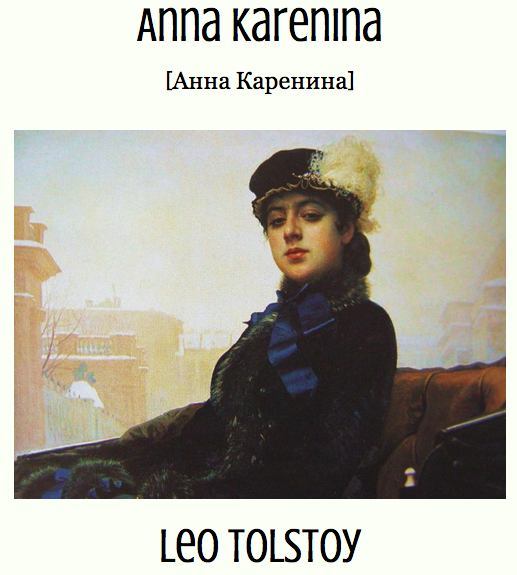
1. Anna Karenina, by Leo Tolstoy
iPad/iPhone — Kindle + Other Formats
2. Madame Bovary, by Gustave Flaubert
3. War and Peace, by Leo Tolstoy
4. Lolita, by Vladimir Nabokov
- Hear Nabokov read the next to final chapter here. 26 minutes of classic audio.
5. The Adventures of Huckleberry Finn, by Mark Twain
6. Hamlet, by William Shakespeare
7. The Great Gatsby, by F. Scott Fitzgerald
8. In Search of Lost Time, by Marcel Proust
9. The Stories of Anton Chekhov
10. Middlemarch, by George Eliot
Related Content:
1,700 Free Online Courses from Top Universities.
The Ten Greatest Films of All Time According to 358 Filmmakers
1,000 Free Audio Books: Download Great Books for Free.
Nabokov Reads Lolita, Names the Great Books of the 20th Century
18 (Free) Books Ernest Hemingway Wished He Could Read Again for the First Time
Neil deGrasse Tyson Lists 8 (Free) Books Every Intelligent Person Should Read
F. Scott Fitzgerald Creates a List of 22 Essential Books, 1936
Download 55 Free Online Literature Courses: From Dante and Milton to Kerouac and Tolkien
Read More...Portraits of Virginia Woolf, James Joyce, Walter Benjamin & Other Literary Legends by Gisèle Freund

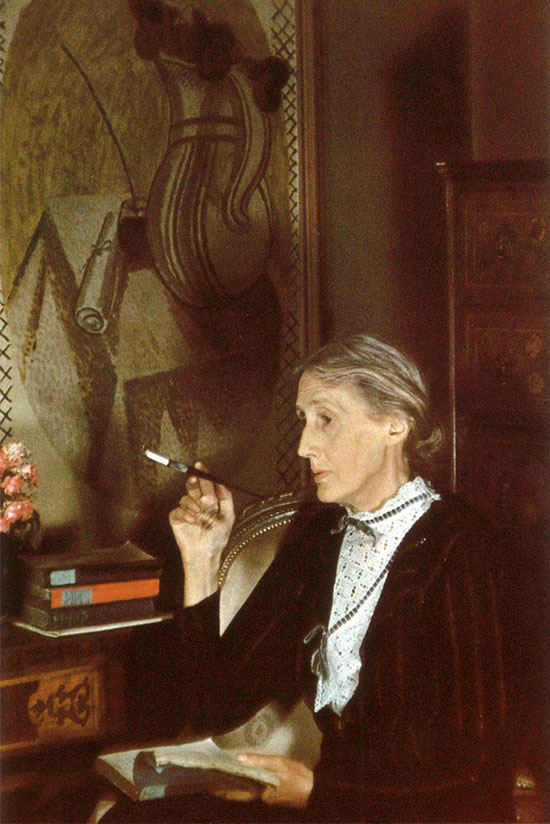
“Gisèle Freund, the German-born photographer who died in 2000 at 91, is both famous and not famous enough,” writes Katherine Knorr in the New York Times. “She was sometimes chagrined to be best known for some of her portraits,” whose luminary subjects included artists, film stars, and writers. At the top, we have Freund’s 1938 shot of James Joyce with his grandson in Paris. Just below, her photograph of a pensive Walter Benjamin from that same year. At the bottom, her 1939 portrait of a smoking Virginia Woolf. (French novelist, theorist and, Minister for Cultural Affairs André Malraux also sported a cigarette in his 1935 portrait by Freund, an image which made it to a postage stamp in 1996, though with his smoke carefully removed.) Former President Jacques Chirac publicly praised Freund’s ability to “reveal the essence of beings through their expressions.” In Woolf’s case, Freund produced the being in question’s first-ever color portrait.

“[Freund] was an early adapter to color, in 1938, and her first exhibition was in fact a projection of color portraits given in Monnier’s book shop,” Knorr writes. She goes on to describe another exhibition, in 2011, that “similarly projects the portraits within its mock bookshop, turning the show into a guessing game since some of those photographed have enormously famous faces,” while others “are a lot of French intellectuals that most young French people today would not recognize.” While we naturally assume that you, as an Open Culture reader, recognize a fair few more French intellectuals than the average gallery-goer, we can’t help but focus on the fact that so many of the writers of whom Freund’s eye saw the definitive images — not just Joyce, Benjamin, and Woolf, but Beckett, Eliot, Hesse, the list goes on — became the defining writers of their era. Freund herself had just one question: “Explain to me why writers want to be photographed like stars,” she wrote, “and the latter like writers.”
Images by Freund have been collected in the book, Gisèle Freund: Photographs & Memoirs. You can also visit the Freund website to view a collection of portraits.
Related Content:
Philosopher Portraits: Famous Philosophers Painted in the Style of Influential Artists
A‑List Authors, Artists & Thinkers Draw Self Portraits
Colin Marshall hosts and produces Notebook on Cities and Culture and writes essays on literature, film, cities, Asia, and aesthetics. He’s at work on a book about Los Angeles, A Los Angeles Primer. Follow him on Twitter at @colinmarshall.
Read More...The Evolution of the Rock Guitar Solo: 28 Solos, Spanning 50 Years, Played in 6 Fun Minutes
In this fun new video from CDZA, guitarist Mark Sidney Johnson takes us on an entertaining romp through more than fifty years of the rock guitar solo, from Chuck Berry to John Mayer.
Along the way Johnson rips through a succession of famous riffs and solos by Keith Richards, Jimi Hendrix, Carlos Santana, Jimmy Page, Eric Clapton, Mark Knopfler, Randy Rhoads, Eddie Van Halen, Slash … and those are only a few from the first half of the video.
Johnson is an English multi-instrumentalist and songwriter based in New York. He works regularly as a session guitarist and plays with The Brit Pack as well as the experimental music video group CDZA, short for Collective Cadenza. For more examples of their offbeat and innovative work, visit the CDZA Web site.
via That Eric Alper
Related Content:
Guitar Stories: Mark Knopfler on the Six Guitars That Shaped His Career
The Story of the Guitar: The Complete Three-Part Documentary
Here Comes The Sun: The Lost Guitar Solo by George Harrison
A History of Rock ‘n’ Roll in 100 Riffs
Read More...Discover Thomas Jefferson’s Cut-and-Paste Version of the Bible, and Read the Curious Edition Online
Had he lived during the Inquisition, Thomas Jefferson would have been burned at the stake. His ideas about Jesus and Christianity were far from orthodox. A product of the Enlightenment, Jefferson believed that everything, including religion, should be examined in the light of reason.
When Jefferson examined the Gospels he came away with a strongly divided opinion. “I find many passages of fine imagination, correct morality, and of the most lovely benevolence,” he wrote in an 1820 letter to William Short, “and others again of so much ignorance, so much absurdity, so much untruth, charlatanism, and imposture, as to pronounce it impossible that such contradictions should have proceeded from the same being.”
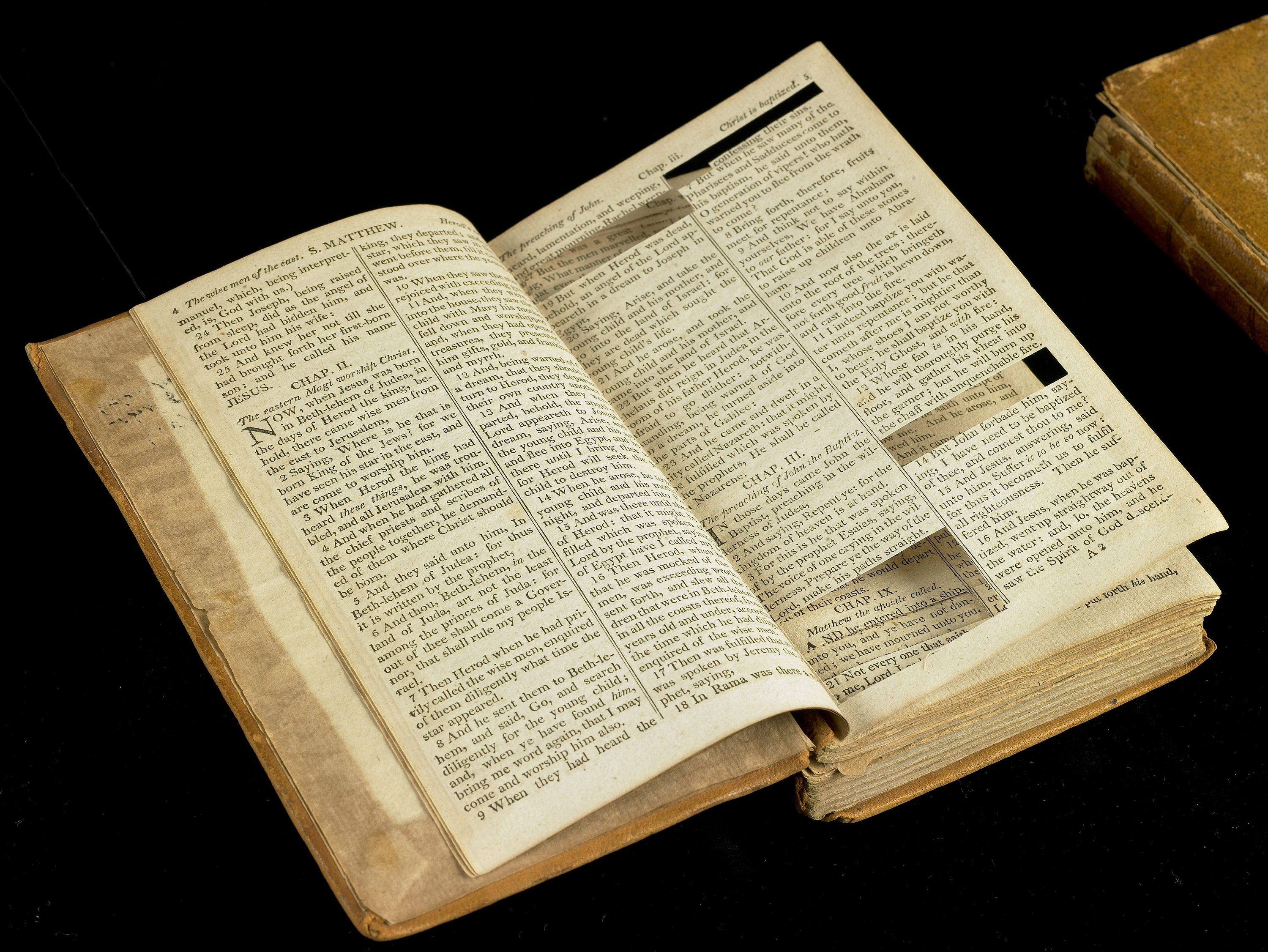
As early as 1804, when he was still president, Jefferson began separating “the diamond from the dunghill,” as he later put it, to assemble his own version of the Bible. He continued the project in earnest during his later years at Monticello, poring over various editions in Greek, Latin, French and King James English. He clipped the passages he thought were genuine teachings of Jesus and pasted them, in the four languages side by side, onto pages.
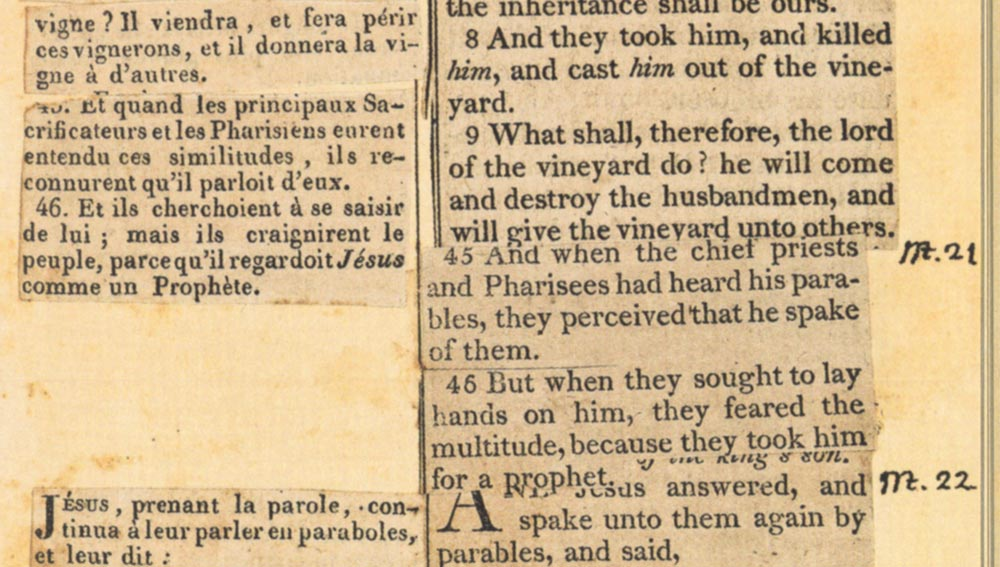
In 1820 — six years before his death at the age of 83 — Jefferson produced a leather-bound, 84-page volume titled The Life and Morals of Jesus of Nazareth, Extracted Textually From the Gospels in Greek, Latin, French & English. Jefferson eliminated everything in the Bible concerning miracles. He ended the Gospel story with the execution and burial of Jesus, omitting the resurrection. The retained passages, Jefferson explained in an 1813 letter to John Adams, contain “the most sublime and benevolent code of morals which has ever been offered to man.”
You can examine and read Jefferson’s complete 1820 Bible online by visiting the Smithsonian Institution’s interactive Web display.
Reproductions of Jefferson’s Bible can be purchased online.
The images above come courtesy of The Smithsonian.
Read More...Watch The Surreal 1960s Films and Commercials of Jim Henson
Today marks the 77th anniversary of Jim Henson’s birth. To celebrate the puppeteer, filmmaker, and Muppet inventor’s life and career, we offer here three of his early short works. Most of us know only certain high-profile pieces of Henson’s oeuvre: The Muppet Show, the Muppet movies, Sesame Street, or perhaps such pictures now much attended on the camp revival circuit as Labyrinth and The Dark Crystal. But even by the Muppet Show’s 1974 debut, Henson (1936–1990) had already put in decades developing his distinctive aesthetic of puppets and puppetry. We’ve previously featured the uncharacteristically violent commercials he produced for Wilkins Coffee between 1957 and 1961 and Limbo, the Organized Mind, his seventies trip of a Johnny Carson segment. But unless you count yourself as a serious Henson, fan, you probably haven’t yet seen the likes of Memories, The Paperwork Explosion, and Ripples. Creating each of these shorts, the young Henson collaborated with pianist, jazz composer, and sound engineer Raymond Scott, now remembered as a pioneer in modern electronic music.
The particular sound of Scott, no stranger to scoring cartoons (we’ve by now heard it in everything from Looney Tunes to Ren and Stimpy to The Simpsons), also suited the sorts of visions Henson realized for his various projects of the sixties. Memories, which plunges into a man’s mind as he remembers (with narration by Henson himself) one particularly pleasant afternoon nearly ruined by a headache, appeared in 1967 as a continuation of Henson’s commercial career; the pain reliever Bufferin, you see, literally saved the day. That same year, the commercial (and in form, almost mini-documentary) The Paperwork Explosion illustrates the time- space‑, and labor-saving advantages of IBM’s then-new word-processing system, the MT/ST. Ripples Henson and Scott put together for Montreal’s Expo 1967. It takes place, like Memories and Limbo, inside human consciousness: an architect (Sesame Street writer-producer Jon Stone) drops a sugar cube in his coffee, and its ripples trigger a memory of throwing pebbles into a pond, which itself sends ripples through a host of his other potential thoughts. You’ve got to watch to understand how Henson and Scott pulled this off; conveniently, they only take one minute to do it.
For more early works by Henson, see this Metafilter post.
Related Content:
Jim Henson’s Animated Film, Limbo, the Organized Mind, Presented by Johnny Carson (1974)
Jim Henson’s Original, Spunky Pitch for The Muppet Show
Jim Henson Pilots The Muppet Show with Adult Episode, “Sex and Violence” (1975)
Jim Henson’s Zany 1963 Robot Film Uncovered by AT&T: Watch Online
Colin Marshall hosts and produces Notebook on Cities and Culture and writes essays on literature, film, cities, Asia, and aesthetics. He’s at work on a book about Los Angeles, A Los Angeles Primer. Follow him on Twitter at @colinmarshall.
Read More...F. Scott Fitzgerald Tells His 11-Year-Old Daughter What to Worry About (and Not Worry About) in Life, 1933

Born 117 years ago today in St. Paul, Minnesota, F. Scott Fitzgerald, that somewhat louche denizen—some might say inventor—of the “Jazz Age,” has been immortalized as the tender young man we see above: Princeton dropout, writer of The Great Gatsby, boozy companion to beautiful Southern belle flapper Zelda Sayre. Amidst all the glamorization of his best and worst qualities, it’s easy to forget that Fitzgerald was also the father of a daughter, Frances Scott Fitzgerald, who went on to have her own successful career as a writer. Unlike the children of some of Fitzgerald’s contemporaries, Frances thrived, which must be some testament to her father’s parenting (and to Zelda’s as well, though she allegedly hoped, like Daisy Buchanan, that her daughter would become a “beautiful little fool”).
We get more than a hint of Fitzgerald’s fatherly character in a wonderful little letter that he sent to her in August of 1933, when Frances was away at summer camp. Fitzgerald, renowned for his extremes, counsels an almost Epicurean middle way—distilling, perhaps, hard lessons learned during his decline in the thirties (which he wrote of candidly in “The Crack Up”). He concludes with a list of things for his daughter to worry and not worry about. It’s a very touching missive that I look forward to sharing with my daughter some day. I’ll have my own advice and silly in-jokes for her, but Fitzgerald provides a very wise literary supplement. Below is the full letter, published in the New York Times in 1958. The typos, we might assume, are all sic, given Fitzgerald’s penchant for such errors:
AUGUST 8, 1933
LA PAIX RODGERS’ FORGE
TOWSON, MATYLAND
DEAR PIE:
I feel very strongly about you doing duty. Would you give me a little more documentation about your reading in French? I am glad you are happy– but I never believe much in happiness. I never believe in misery either. Those are things you see on the stage or the screen or the printed page, they never really happen to you in life.
All I believe in in life is the rewards for virtue (according to your talents) and the punishments for not fulfilling your duties, which are doubly costly. If there is such a volume in the camp library, will you ask Mrs. Tyson to let you look up a sonnet of Shakespeare’s in which the line occurs Lilies that fester smell far worse than weeds…
I think of you, and always pleasantly, but I am going to take the White Cat out and beat his bottom hard, six times for every time you are impertinent. Do you react to that?…
Half-wit, I will conclude. Things to worry about:
Worry about courage
Worry about cleanliness
Worry about efficiency
Worry about horsemanship…
Things not to worry about:
Don’t worry about popular opinion
Don’t worry about dolls
Don’t worry about the past
Don’t worry about the future
Don’t worry about growing up
Don’t worry about anybody getting ahead of you
Don’t worry about triumph
Don’t worry about failure unless it comes through your own fault
Don’t worry about mosquitoes
Don’t worry about flies
Don’t worry about insects in general
Don’t worry about parents
Don’t worry about boys
Don’t worry about disappointments
Don’t worry about pleasures
Don’t worry about satisfactions
Things to think about:
What am I really aiming at?
How good am I really in comparison to my contemporaries in regard to:
(a) Scholarship
(b) Do I really understand about people and am I able to get along with them?
© Am I trying to make my body a useful intrument or am I neglecting it?
With dearest love,
Related Content:
F. Scott Fitzgerald Creates a List of 22 Essential Books, 1936
“Nothing Good Gets Away”: John Steinbeck Offers Love Advice in a Letter to His Son (1958)
Read F. Scott Fitzgerald’s Story “May Day,” and Nearly All of His Other Work, Free Online
Josh Jones is a writer and musician based in Durham, NC. Follow him at @jdmagness
Read More...The Recipes of Iconic Authors: Jane Austen, Sylvia Plath, Roald Dahl, the Marquis de Sade & More
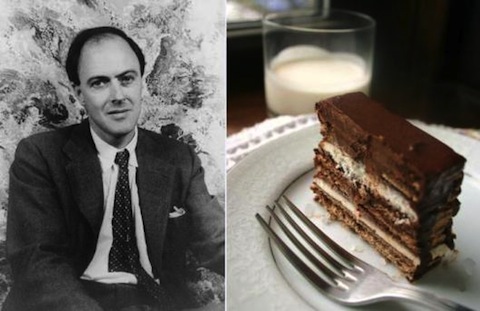
It comes as no surprise that Roald Dahl, author of Charlie and the Chocolate Factory, possessed a sweet tooth. Having dazzled young readers with visions of Cavity-Filling Caramels, Everlasting Gobstoppers, and snozzberry-flavored wallpaper, Dahl’s candy of choice was the more pedestrian Kit-Kat bar. In addition to savoring one daily (a luxury little Charlie Bucket could but dream of, prior to winning that most golden of tickets) he invented a frozen confection called “Kit-Kat Pudding.”
The original recipe is, appropriately, simple enough for a child to make. Stack as many Kit-Kats as you like into a tower, using whipped cream for mortar, then shove the entire thing into the freezer, and leave it there until solid.
Book publicist and self-described literary fangirl Nicole Villeneuve does him one better on Paper and Salt, a food blog devoted to the recipes of iconic authors. Her re-imagined and renamed Frozen Homemade Kit-Kat Cake adds bittersweet chocolate ganache, replacing Dahl’s beloved candy bars with high quality wafer cookies. It remains a pretty straight-forward preparation, not quite as decadent as the Marquis de Sade’s Molten Chocolate Espresso Cake with Pomegranate, but surely more to Dahl’s liking than Jane Austen’s Brown Butter Bread Pudding Tarts would have been. (The author once wrote that he preferred his chocolate straight.)
Villeneuve spices her entry with historical context and anecdotes regarding early 20th-century candy marketing, Dahl’s hatred of the Cadbury Crème Egg, and his dog’s hankering for Smarties. Details such as these make Paper and Salt, which features plenty of savories to go with the sweet, a delicious read even for non-cooks.
Meanwhile, dessert chefs unwilling to source their ingredients from Rite-Aid’s Halloween aisle might try Sylvia Plath’s Lemon Pudding Cakes (“Is it taboo to write about baking and Sylvia Plath?” Villeneuve wonders), C.S. Lewis’ Cinnamon Bourbon Rice Pudding, Willa Cather’s Spiced Plum Kolache or Wallace Stevens’ Coconut Caramel Graham Cookies.
Related Content:
Ernest Hemingway’s Favorite Hamburger Recipe
Allen Ginsberg’s Personal Recipe for Cold Summer Borscht
How to Make Instant Ramen Compliments of Japanese Animation Director Hayao Miyzaki
Ayun Halliday documented her own sweet tooth in Dirty Sugar Cookies: Culinary Observations, Questionable Taste. Follow her @AyunHallliday
Read More...Frida Kahlo Writes a Personal Letter to Georgia O’Keeffe After O’Keeffe’s Nervous Breakdown (1933)

Click for larger image
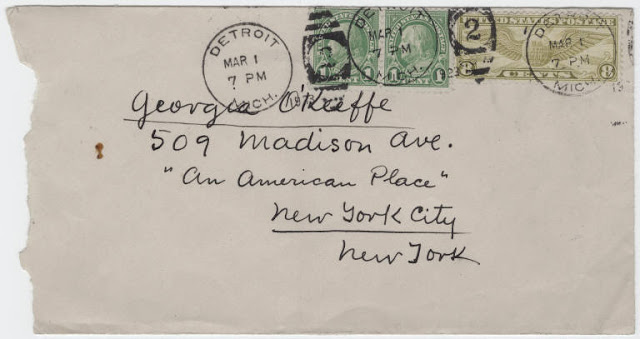
Important twentieth-century painters, as every student of art history learns, didn’t tend to sail smoothly through existence. Those even a little interested in famed Mexican self-portraitist Frida Kahlo have heard much about the travails both romantic and physical she endured in her short life. But in this lesser-known instance, another artist suffered, and Kahlo offered the solace. Available to view from Yale’s Beinecke Rare Book & Manuscript Library, we have here a letter Kahlo sent to Georgia O’Keeffe, painter of blossoms and southwest American landscapes (and more besides), on March 1st, 1933. At that time, O’Keeffe, who the year before had struggled and failed to complete a mural project for Radio City Music Hall on time, lived through the aftermath of a nervous breakdown which had hospitalized her (diagnosis: “psychoneurosis”), sent her to no less remote a locale than Bermuda to recuperate, and prevented her from painting again until 1934.
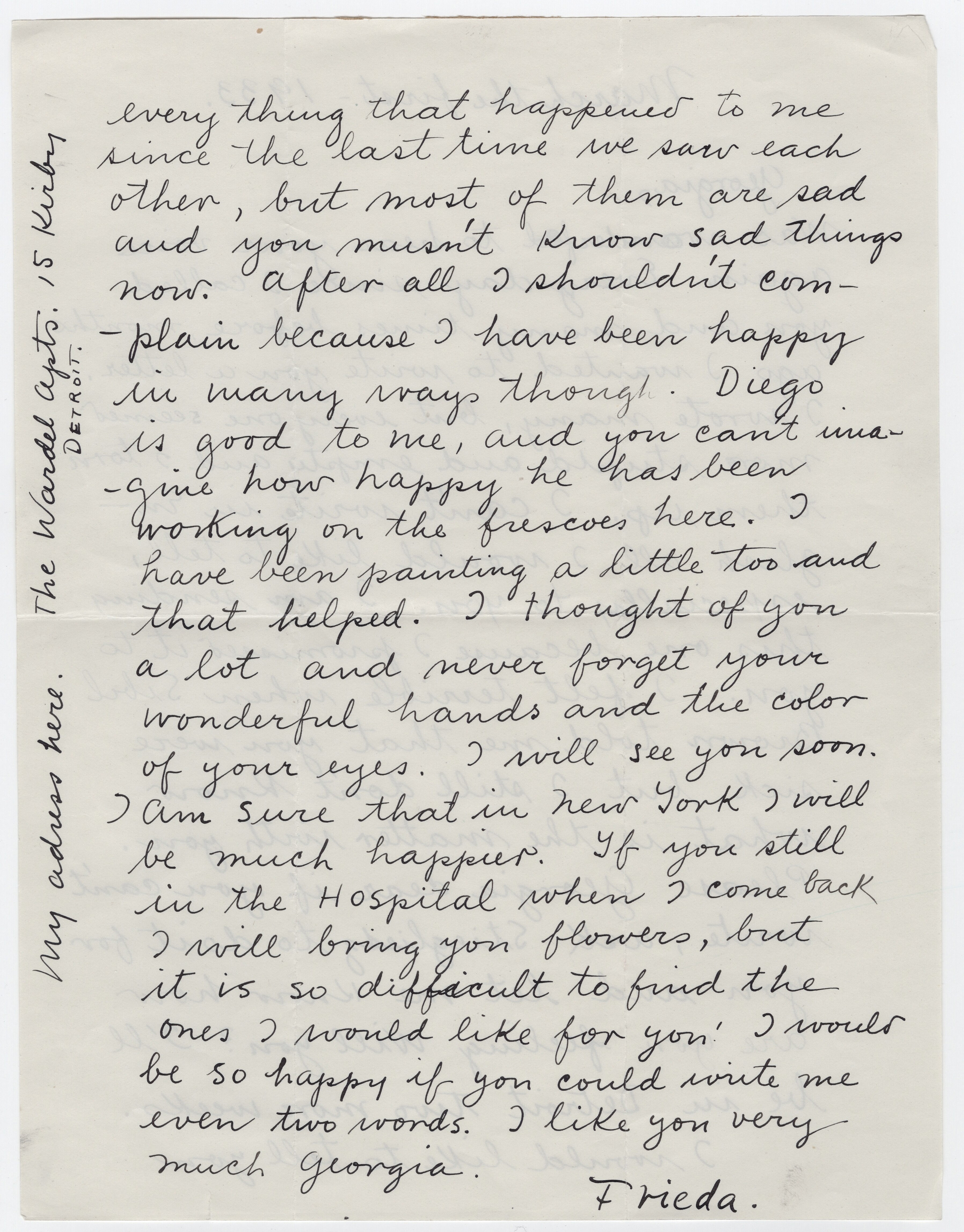
Kahlo’s letter, sent from Detroit where her muralist husband Diego Rivera had taken a commission for 27 frescoes at the Institute of the Arts, runs as follows:
Georgia,
Was wonderful to hear your voice again. Every day since I called you and many times before months ago I wanted to write you a letter. I wrote you many, but every one seemed more stupid and empty and I torn them up. I can’t write in English all that I would like to tell, especially to you. I am sending this one because I promised it to you. I felt terrible when Sybil Brown told me that you were sick but I still don’t know what is the matter with you. Please Georgia dear if you can’t write, ask Stieglitz to do it for you and let me know how are you feeling will you ? I’ll be in Detroit two more weeks. I would like to tell you every thing that happened to me since the last time we saw each other, but most of them are sad and you mustn’t know sad things now. After all I shouldn’t complain because I have been happy in many ways though. Diego is good to me, and you can’t imagine how happy he has been working on the frescoes here. I have been painting a little too and that helped. I thought of you a lot and never forget your wonderful hands and the color of your eyes. I will see you soon. I am sure that in New York I will be much happier. If you still in the hospital when I come back I will bring you flowers, but it is so difficult to find the ones I would like for you. I would be so happy if you could write me even two words. I like you very much Georgia.
Frieda
“Clearly Kahlo hoped for a deeper friendship, or perhaps more, with O’Keeffe, when she and Diego went to New York a few weeks later,” writes Sharyn Rohlfsen Udall in Carr, O’Keeffe, Kahlo: Places of Their Own. “From there, she wrote to a friend on 11 April (by which time O’Keeffe had gone to Bermuda to convalesce) that because of O’Keeffe’s illness there had been no lovemaking between them that time. A boastful exaggeration of their closeness? Knowing Kahlo’s predilection for sexual hyperbole, this seems likely.”
via A Piece of Monologue, A Writer’s Ruminations
Related Content:
The Real Georgia O’Keeffe: The Artist Reveals Herself in Vintage Documentary Clips
Watch Moving Short Films of Frida Kahlo and Diego Rivera at the “Blue House”
Frida Kahlo and Diego Rivera Visit Leon Trotsky in Mexico, 1938
Colin Marshall hosts and produces Notebook on Cities and Culture and writes essays on literature, film, cities, Asia, and aesthetics. He’s at work on a book about Los Angeles, A Los Angeles Primer. Follow him on Twitter at @colinmarshall.
Read More...Support Us
We're hoping to rely on loyal readers, rather than erratic ads. Please click the Donate button and support Open Culture. You can use Paypal, Venmo, Patreon, even Crypto! We thank you!

About Us

Open Culture scours the web for the best educational media. We find the free courses and audio books you need, the language lessons & educational videos you want, and plenty of enlightenment in between.
Advertise With Us

FREE UPDATES!
GET OUR DAILY EMAIL
Get the best cultural and educational resources on the web curated for you in a daily email. We never spam. Unsubscribe at any time.
FOLLOW ON SOCIAL MEDIA

Open Culture editor Dan Colman scours the web for the best educational media. He finds the free courses and audio books you need, the language lessons & movies you want, and plenty of enlightenment in between.
Advertise With Us


