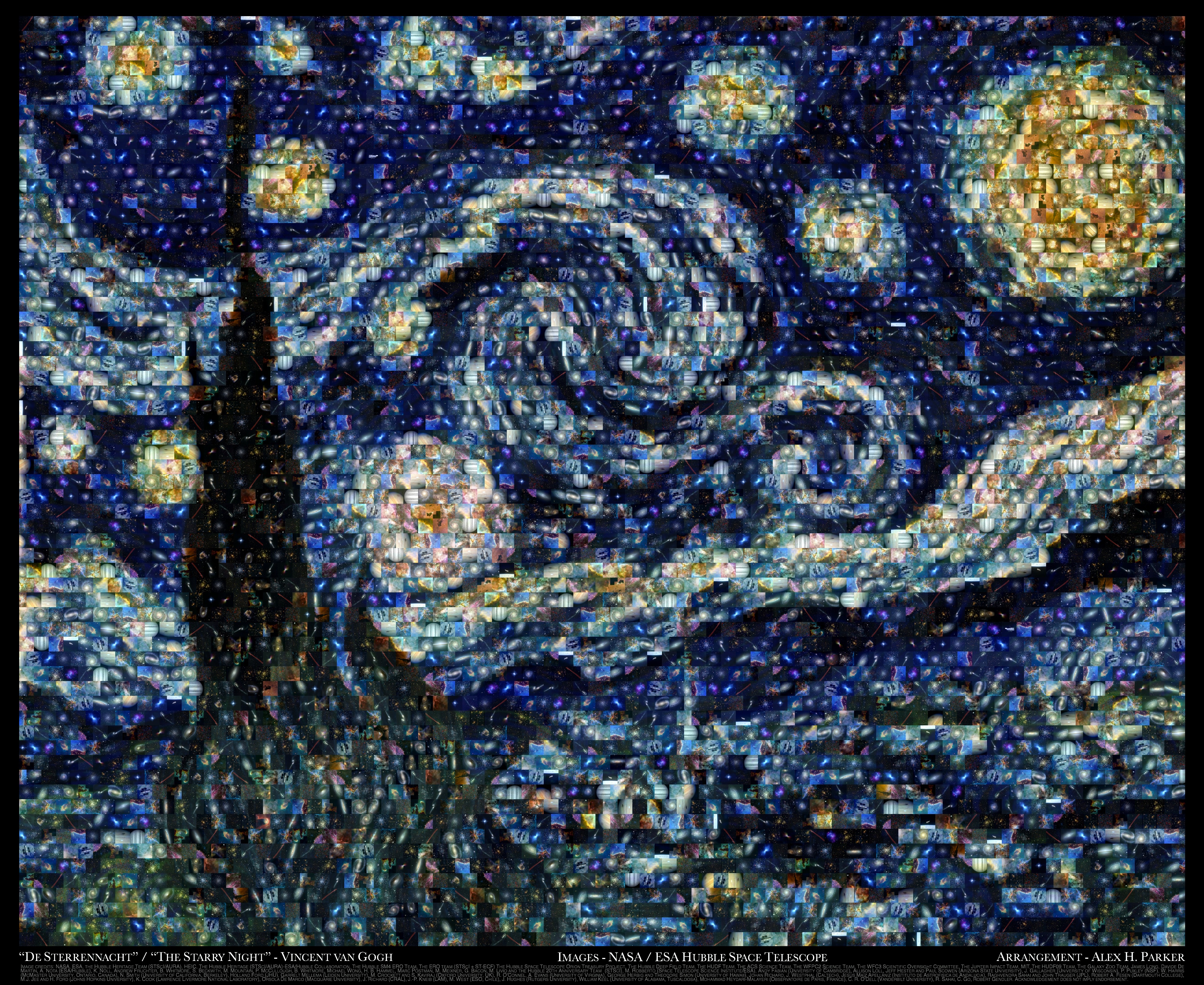
Van Gogh’s ‘Starry Night’ Re-Created by Astronomer with 100 Hubble Space Telescope Images
Last week, I traveled to New York City to gaze into The Starry Night. Obviously I’m not talking about the skies above Manhattan, not when my hotel was based in Times Square. No, I’m talking about Vincent van Gogh’s post-impressionist masterpiece that hangs in the MoMA on 53rd Street. Although van Gogh seemingly felt ambivalent about his 1889 painting, many now consider it one of the most important works of art produced in the 19th century. And like any other great painting, it has become a fetishized object, sometimes in ways that we can find endearing. Take this little project for example. Last year, Alex Parker, a post-doctoral fellow at the Harvard-Smithsonian Center for Astrophysics, created a mosaic of Starry Night using 100 Hubble photos. He downloaded the photos from the European Space Agency’s website, popped them into a free digital art software package called AndreaMosaic and, voila, produced the image above. You can — and should — view it in a larger, high-res format here.
H/T Robin and Wired
Related Content:
Simon Schama Presents Van Gogh and the Beginning of Modern Art
Perpetual Ocean: A Van Gogh-Like Visualization of our Ocean Currents
Van Gogh to Rothko in 30 Seconds
Read More...
The Very Concise Suicide Note by Kodak Founder George Eastman: “My Work is Done. Why Wait?” (1932)
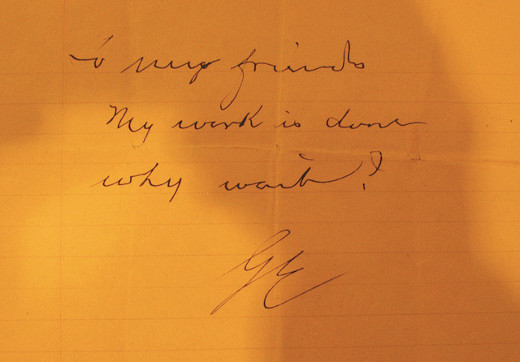
In 1932 George Eastman, the 77 year old entrepreneur who established the Eastman Kodak Company, popularized the use of roll film, and brought photography to the mainstream, found himself in declining health. Suffering from lumbar spinal stenosis, a narrowing of the spinal canal that can lead to considerable back pain and difficulty walking, Eastman was depressed and increasingly disabled. On March 14th, he committed suicide by firing a single gunshot through his heart. An act as brief, and to the point, as the note he left behind. It read:
To my friends
My work is done
Why wait?
GE
If you would like to support the mission of Open Culture, consider making a donation to our site. It’s hard to rely 100% on ads, and your contributions will help us continue providing the best free cultural and educational materials to learners everywhere. You can contribute through PayPal, Patreon, and Venmo (@openculture). Thanks!
Related Content:
How Film Was Made: A Kodak Nostalgia Moment
Early Experiments in Color Film (1895–1935)
Anne Sexton, Confessional Poet, Reads “Wanting to Die” in Ominous 1966 Video
Read More...Inside the Rhapsody: A Short Documentary on the Making of Queen’s Classic Song, ‘Bohemian Rhapsody’ (2002)
“Bohemian Rhapsody” by Queen is one of the most audacious pop songs ever made. Part ballad, part opera, part heavy metal orgasm, the song has six distinct sections and took over a month to record. At just under six minutes, “Bohemian Rhapsody” was considered too long for pop radio. “The record company, in their infinite ignorance, of course immediately suggested that we cut it down,” said Queen drummer Roger Taylor, who stood by his bandmates and refused to let the song be cut. “It really was hit or miss. It was either going to be massive or it was going to be nothing.”
“Bohemian Rhapsody,” of course, went on to become one of the most popular songs in music history. It spent nine weeks at number one in the UK following its release in the fall of 1975, and went back to number one after the death of singer Freddie Mercury in 1991. In America the song peaked at number nine in 1976 and re-entered the charts at number two in 1992, when it was featured in the movie Wayne’s World. Last year, an ITV poll in Great Britain listed “Bohemian Rhapsody” as “The Nation’s Favorite Number One” song in 60 years of music.
Above, in the 3‑part mini documentary Inside the Rhapsody, Queen takes you inside the making of the song. And, along the way, guitarist Brian May goes back to the mixing board to explain the complexity of layers that went into realizing Mercury’s vision for the song. The original 24-track analogue recording system was far too limited, so the band used the ping-pong technique to “bounce” literally hundreds of overdubs into the mix. May explains how the operatic vocal layers were inspired by the “cascading strings” effect made famous by Annunzio Paolo Mantovani, a technique May first tried out in 1974 with the guitar solo on “Killer Queen.”
For more on the making of “Bohemian Rhapsody,” please see our post, “Listen to Freddie Mercury’s Wondrous Piano and Vocal Tracks for ‘Bohemian Rhapsody’ (1975).” And for a reminder of how it all came together, here’s the official video:
Inside the Rhapsody has been added to our collection, 285 Free Documentaries Online.
Related content:
Queen Documentary Pays Tribute to the Rock Band That Conquered the World
Read More...Revisit Futuria Fantasia: The Science Fiction Fanzine That Ray Bradbury Published as a Teenager
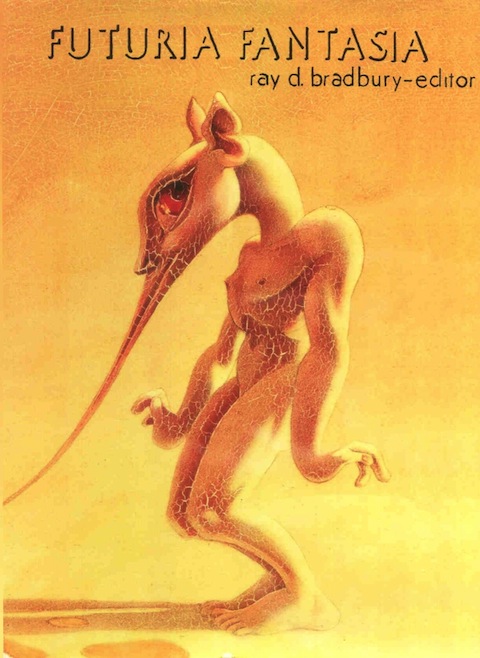
Budding science-fiction authors today know that, to get their start, they should probably go online and publish themselves. But even before the advent of the modern internet, many writers eager to tell speculative tales of humanity’s future struggle with technology, knowledge, and its own nature showed a similar self-starting bent. They made especially advantageous use of photocopiers and staplers in the seventies and eighties, the decades commonly considered the heyday of those low-circulation publications known as zines. But long before before that, the format already incubated serious science-fiction talent. Take Futuria Fantasia, which published four issues between 1939 and 1940. Its editor? A certain Ray Bradbury, before Fahrenheit 451, before The Martian Chronicles — before everything.
“Released in 1939 shortly after Bradbury graduated from high school,” says Zinewiki’s entry on the magazine, “Futuria Fantasia was published with the help of [sci-fi promoter] Forrest J. Ackerman, who lent Bradbury $90.00 for the fanzine.” The first issue, available free from Project Gutenberg, includes Bradbury’s story “Let’s Get Technatal” (written under the pseudonym “Ron Reynolds”) and poem “Thought and Space.”
The second issue includes an article he wrote under “Guy Amory” and his story “The Pendulum.” The third includes a Bradbury editorial, the fourth another editorial and the pseudonymous stories “The Piper” and “The Flight of the Good Ship Clarissa.” “I hope you like this brain-child, spawned from the womb of a year long inanimation,” the ambitious young Bradbury writes in his introduction to the summer 1939 issue. “This is only the first issue of FuFa … if it succeeds there will be more, better issues coming up.” Three more would, indeed, emerge, but surely even such a predictive mind as Bradbury’s couldn’t imagine what his career really held in store.
You can hear all ten stories from the Spring 1940 edition of Futuria Fantasia in the playlist below. It includes “Gorgono and Slith” by Ray Bradbury:
Related Content:
Ray Bradbury Reads Moving Poem on the Eve of NASA’s 1971 Mars Mission
Ray Bradbury: Story of a Writer 1963 Film Captures the Paradoxical Late Sci-Fi Author
Ray Bradbury Gives 12 Pieces of Writing Advice to Young Authors (2001)
Colin Marshall hosts and produces Notebook on Cities and Culture and writes essays on literature, film, cities, Asia, and aesthetics. He’s at work on a book about Los Angeles, A Los Angeles Primer. Follow him on Twitter at @colinmarshall.
Read More...Librarians Pay Tribute to Classic Beastie Boys Video; Name Henry Rollins Keynote Speaker at Conference
http://vimeo.com/66169135?r44b=no
Librarians are breaking the mold lately and flirting with the world of hip hop and punk. Courtesy of The New York Public Library Tumblr, we have Chicago librarians paying homage to The Beastie Boys’s 1994 video, “Sabotage,” directed by Spike Jonze. Of course, the original 1994 video paid comedic tribute to TV crime shows of the 1970s, shows like Hawaii Five‑O and Starsky and Hutch. So what we have above is a tribute to a tribute.
In other librarian news, The California Library Association recently announced that Henry Rollins, the former frontman of the punk band Black Flag (see vintage performance here), will be the keynote speaker at its conference in November. If you’re a regular Open Culture reader, you might not be entirely surprised. These days, Rollins has been pitching education as the key to reviving our withering democracy and also explaining why tenacity, discipline and hard work can take youngsters a long way. He also has 15 books to his credit. You can sample his writing by picking up a copy of The Portable Henry Rollins.
via Media Bistro and Boing Boing
Related Content:
Henry Rollins Pitches Education as the Key to Restoring Democracy
‘Beastie Boys on Being Stupid’: An Animated Interview From 1985
Read More...
CBGB’s: The Roots of Punk Lets You Watch Vintage Footage from the Heyday of NYC’s Great Music Scene
There’s a new film coming out about the rise of CBGB as the premier site of New York punk, new wave, and art rock. And I have to agree with Dangerous Minds, it looks like this might just be “AWFUL.” But then again, maybe not. Who am I to make a critical appraisal of a work I haven’t seen yet? Watch the trailer and make your own pre-judgments.
No matter how this fictionalized version of the CBGB story turns out, we are lucky to have copious footage from the real heyday of the dirty Bowery club that made the careers of The Ramones, Patti Smith, Television, Blondie, the Talking Heads and countless other New York bands who rose to semi-stardom, or local notoriety, from CBGB’s famous, filthy bowels. Although Alan Rickman must surely do a fine job as CBGB’s owner Hillel Kristal, there’s nothing like hearing from the real thing, and you can, in the documentary CBGB’s: The Roots of Punk (part one above, part two below).
Kristal, who intended to create a space for “Country, BlueGrass, and Blues,” ended up managing a very different beast when he realized that no one in lower Manhattan cared about his tastes. Instead, to keep the lights on, he was forced to let the lowlifes in, the “derelicts, lost souls… hookers and pimps and junkies,” who came from the flophouses and tenements to hear music that spoke to them.
Sometimes they got it, sometimes they didn’t, but for the musicians who used Kristal’s dive bar as a live rehearsal space, the opportunity to play, night after night, and create their own sounds and identities, the CBGB’s experience was invaluable. You’ll hear a few of them reflect on those heady times in the film, but mostly, CBGB’s: The Roots of Punk is a carnival of vintage performances from New York’s seminal punk bands. Maybe the Hollywood version won’t be so bad, eh? Even so, I’d rather watch, and listen to, the real thing.
Related Content:
Debbie Harry Turns 68 Today. Watch Blondie Play CBGB in the Mid-70s in Two Vintage Clips
The Talking Heads Play CBGB, the New York Club that Shaped Their Sound (1975)
The Ramones in Their Heyday, Filmed “Live at CBGB,” 1977
Josh Jones is a writer and musician based in Washington, DC. Follow him at @jdmagness
Read More...
Discover Alexander Calder’s Circus, One of the Beloved Works at the Whitney Museum of American Art
Alexander Calder’s Calder’s Circus, a toy theater piece the artist constructed between 1926 and 1931, and performed for decades, has the rag bag appeal of a much-repaired stuffed animal who’s loved into a state of baldness. This charm presented conservators at the Whitney Museum of American Art with a unique set of challenges. Not only were the cloth and wire structures fragile with age, they’d taken a beating during the period when they were on active duty. Should the work be restored to its pristine state or should the artist’s clumsy, on-the-fly patch jobs be preserved as evidence of use?
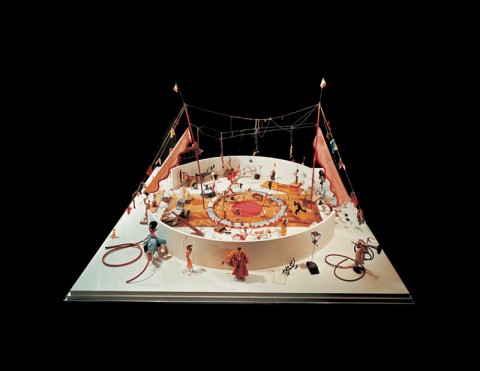
As part of the restoration effort, the Whitney’s team of conservators, archivists and historians delved into circus history, learning that Calder’s ringmaster, tightrope dancer, bareback rider, and lion tamer were all based on circus stars of the period.
They also leaned on two films depicting the work in motion, Jean Painleve’s Le Grand Cirque Calder 1927 and Le Cirque de Calder by Carlos Vilardebo. But with more than two hundred live performances, it seemed a good bet that the characters could be manipulated in ways other than the ones captured on film. An acrobat who was consulted agreed, but also concluded that some of the moves of which these little wire figures were capable would be impossible for human beings.
As archivist Anita Duquette notes above, even in its restored state the Circus will now be a static affair, partly from the ongoing effort to conserve its delicate materials, but more because the master who apparently took such pleasure in bringing it to life is not available for an encore performance.
- Ayun Halliday will take a cork-wire-and-fabric-scrap tabletop circus over a 3D CGI any old day. Follow her @AyunHalliday
Read More...New Animation Explains Sherry Turkle’s Theories on Why Social Media Makes Us Lonely
Last fall Sherry Turkle, an MIT psychologist who explores how technology shapes modern relationships, published Alone Together: Why We Expect More from Technology and Less from Each Other. The third in a trilogy of books, Alone Together tries to make sense of a paradox. The more friends and acquaintances we gather on social platforms like Facebook and Twitter, the more we feel alone. We’re connected to other people more than ever, and yet we feel isolated in a new solitude. If you’re looking for a primer on Turkle’s thinking, you can watch a new animation (above) created by Shimi Cohen. It was made as a final project for a course taken at Shenkar College of Engineering and Design in Tel Aviv. Another way to get up to speed on Turkle’s thinking is to watch Turkle’s own TED Talk recorded in February, 2012. Find it right below. And, of course, you could always read her book, Alone Together, in print or digital format. A novel idea that.
If you would like to support the mission of Open Culture, consider making a donation to our site. It’s hard to rely 100% on ads, and your contributions will help us continue providing the best free cultural and educational materials to learners everywhere. You can contribute through PayPal, Patreon, and Venmo (@openculture). Thanks!
Read More...Slick Data Visualization Reveals Scientific Collaborations Taking Place Around the Globe
 A few years ago, digital humanists at Stanford mapped the Republic of Letters, carefully detailing the social networks that connected thinkers during the Enlightenment of the eighteenth century. Now Olivier Beauchesne, a data scientist in Canada, has used data visualization techniques to map out a more modern set of relationships — collaborations taking place among scientists across the globe.

What’s an example of such a collaboration? Beauchesne writes: “If a UCLA researcher published a paper with a colleague at the University of Tokyo, this would create an instance of collaboration between Los Angeles and Tokyo.” By checking out this cool zoomable map, you can see thousands of these collaborations taking place worldwide between 2005 and 2009, and pretty soon you realize the extent to which modern science is an international affair. The data was pulled from Science-Metrix database.
H/T Pavel
Related Content:
The Art of Data Visualization: How to Tell Complex Stories Through Smart Design
The History of Philosophy Visualized
Visualizing WiFi Signals with Light
New MOOC Introduces You to the Wonderful World of Infographics & Data Visualization
Watch a Cool and Creepy Visualization of U.S. Births & Deaths in Real-Time
Read More...Documentary Viva Joe Strummer: The Story of the Clash Surveys the Career of Rock’s Beloved Frontman
I vividly remember learning the first song my high school garage band covered, The Clash’s “Clash City Rockers.” We spent hours deciphering the lyrics, and never got them right. This was, if you can believe it, a pre-Google age. While the exercise was frustrating, I never resented Joe Strummer’s slurred, gravelly vocals for making us work hard at getting his meaning. For one thing, I loved his voice, and as a student of the blues and Dylan, never really cared if rock singers could actually sing. For another, Strummer never seemed to care much himself if you could understand him, though his lyrics blasted through mountains of BS. This is not because he was an egotist but quite the opposite: he passionately hated rock clichés and wasn’t making pop records.
The first scene in the documentary above, Viva Joe Strummer (later released as Get Up, Stand Up), gives us The Clash frontman deconstructing the genre. “Well, hi everybody, ain’t it groovy,” he says to a cheering crowd, followed by, “ain’t you sick of hearing that for the last 150 years?” The documentary’s narrator describes Strummer as “the man who put credible rock and roll into the bastard cultural orphan that was called punk,” but this seems an inaccurate description.
For one thing, rock and roll is itself a bastard genre, something Strummer always recognized, and for another The Clash, fueled by Strummer’s ecumenical interest in world cultures, drew liberally from other kinds of music and stuck their middle fingers up at establishment rock and everything it came to represent.
Viva Joe Strummer gives us loads of concert footage and interviews with band members and close friends like the Sex Pistols’ Glen Matlock. The focus remains on Strummer, a frontman with tremendous charisma but also, paradoxically, with a tremendous amount of humility. One reviewer of the film says as much:
Joe Strummer always projected himself as a humble man. Even at the height of The Clash‘s megalomania, when he fired guitarist Mick Jones, Strummer came across like a better read, more worldly Bruce Springsteen. The everyman image has made eulogizing the singer difficult.
This suggests that Strummer’s everyman persona may have been part of his showmanship, but even so, he was respected and admired by nearly everyone who knew him. And his proletarian politics were genuine. As one interviewee says above, “he always had a corner to fight in. He always had someone to stick up for.”
The original DVD included a CD with interview clips from 1979 to 2001, such as the 1981 Tom Snyder Show interview above. Viva Joe Strummer lacks the powerful dramatic arc and tight direction of Julian Temple’s 2007 The Future is Unwritten, but it’s still well worth watching for interview footage you won’t see anywhere else. Despite the film’s original subtitle, The Story of The Clash, the documentary follows Strummer’s career all the way through the dissolution of the band that made him famous and through his successive musical endeavors with Joe Strummer and the Mescaleros. And it documents the reactions to his sudden, tragic death in 2002. I still remember getting the news. I happened, oddly enough, to be drinking at the bar where the Joe Strummer mural would go up in New York’s East Village in 2003. I walked outside and lit a cigarette, put on my headphones, cued up “Clash City Rockers,” and shed a tear for the punk rock everyman who everybody loved.
Related Content:
“Joe Strummer’s London Calling”: All Eight Episodes of Strummer’s UK Radio Show Free Online
Remembering The Clash’s Frontman Joe Strummer on His 60th Birthday
The Clash Live in Tokyo, 1982: Watch the Complete Concert
Josh Jones is a writer and musician based in Washington, DC. Follow him at @jdmagness
Read More...Support Us
We're hoping to rely on loyal readers, rather than erratic ads. Please click the Donate button and support Open Culture. You can use Paypal, Venmo, Patreon, even Crypto! We thank you!

About Us

Open Culture scours the web for the best educational media. We find the free courses and audio books you need, the language lessons & educational videos you want, and plenty of enlightenment in between.
Advertise With Us

FREE UPDATES!
GET OUR DAILY EMAIL
Get the best cultural and educational resources on the web curated for you in a daily email. We never spam. Unsubscribe at any time.
FOLLOW ON SOCIAL MEDIA

Open Culture editor Dan Colman scours the web for the best educational media. He finds the free courses and audio books you need, the language lessons & movies you want, and plenty of enlightenment in between.
Advertise With Us