Alfred Hitchcock Talks with Dick Cavett About Sabotage, Foreign Correspondent & Laxatives (1972)
On the list of the most interviewable auteurs in film history, Alfred Hitchcock must rank particularly high. I wouldn’t necessarily want to find myself on the business end of that sardonically stern gaze myself, but when Hitchcock agreed to sit down and talk, he really sat down and talked. For the ultimate case in point, we have his big interview with cinematic colleague François Truffaut, available both as twelve hours of MP3s and, in book form, as that mainstay of the cinephile’s shelf, Hitchcock/Truffaut. Those two filmmakers had their immortal series of interviews in 1962; a decade later, Hitchcock would turn up on national television for a chat with that auteur of the national chat show, Dick Cavett. You can watch choice segments of their conversation on Youtube.
At the top of the post, Hitchcock tells Cavett about the formative trauma visited upon him by his mother. “I think my mother scared me when I was 3 months old,” he recalls. “You see, she said, ‘Boo!’ It gave me the hiccups. And she apparently was very satisfied.” (No prizes for guessing what effect it made this master of suspense want his work to have on audiences.) Just above, you can hear Hitchcock’s thoughts on a laxative commercial that ran during one of the show’s breaks: “I wonder why all those people doing sports and all that sort of thing — where they would need a laxative after such vigorous movement all over the place.” Rest assured that he does get around to talking filmmaking, specifically about the processes behind Foreign Correspondent (below) and Sabotage, but perhaps nothing here reveals the workings of Hitchcock’s mind more than his conviction that “puns are the highest form of literature.”
Related Content:
Alfred Hitchcock: The Secret Sauce for Creating Suspense
Alfred Hitchcock’s Rules for Watching Psycho (1960)
Ingmar Bergman Visits The Dick Cavett Show, 1971
Woody Allen on The Dick Cavett Show Circa 1970
Alfred Hitchcock’s Seven-Minute Editing Master Class
Colin Marshall hosts and produces Notebook on Cities and Culture and writes essays on literature, film, cities, Asia, and aesthetics. He’s at work on a book about Los Angeles, A Los Angeles Primer. Follow him on Twitter at @colinmarshall.
Read More...Patrick Stewart Talks Candidly About Domestic Violence in a Poignant Q&A Session at Comicpalooza
Patrick Stewart came to Comicpalooza (aka The Texas International Comic Convention) as a special guest. It’s not hard to imagine why, especially given his roles on Star Trek: The Next Generation and the X‑Men film series.
During a Q&A session with convention attendees, Stewart fielded a question that asked everyone to leave behind the fantasy world and confront some cold realities. Since 2006, Stewart has worked with Amnesty International and Refuge, a UK charity for abused women, to make a meaningful dent in the levels of domestic violence experienced in our societies. Still haunted, Stewart personally witnessed domestic violence in his own home as a child. As a youngster, he felt powerless to stop it. But, as an adult, he can now put his celebrity on the line and ask men to be part of the solution, not the problem. The video, which gets more moving as it goes along, also makes the case for improving treatment of PTSD — a problem unto itself, and also something that contributes to domestic violence, especially during times of prolonged war.
Note: the influential speech referenced in the conversation appears below.
via Reddit
Related Content:
Shakespeare’s Satirical Sonnet 130, As Read By Stephen Fry and Patrick Stewart
Read More...Oprah Winfrey’s Harvard Commencement Speech: Failure is Just Part of Moving Through Life
If you watch enough commencement speeches, if you gather the collective wisdom of people who “have made it” in life, you start to see a trend. The key to life isn’t being smarter than the rest, though that doesn’t hurt. The key is resilience — your ability to deal with inevitable failures, learn from your mistakes, dust yourself off emotionally, physically or financially, and then move forward. It’s easier said than done, but essential. J.K. Rowling, who went from homelessness to writing Harry Potter, delivered that message at Harvard several years ago. Now Oprah Winfrey, who emerged from the Jim Crow South to become America’s most enduring TV personality, returns to Harvard to tell students her version of that story:
There is no such thing as failure. Failure is just life trying to move us in another direction. Now, when you’re down there in the hole, it looks like failure. … Give yourself time to mourn what you think you may have lost, but then here’s the key: Learn from every mistake because every experience, encounter and particularly your mistakes are there to teach you and force you into being more who you are. And then figure out what is the next right move. And the key to life is to develop an internal moral, emotional GPS that can tell you which way to go.
For more insights into constructively managing failure, you can visit these talks below:
Paulo Coelho on The Fear of Failure
Conan O’Brien’s Harvard Graduation Speech
Stephen Fry: What I Wish I Knew When I Was 18
via Harvard Gazette
Read More...Carl Jung’s Fascinating 1957 Letter on UFOs
Deities, conspiracies, politics, space aliens: you don’t actually have to believe in these to find them interesting. Just focus your attention not on the things themselves, but in how other people regard them, what they say when they talk about them, and why they think about them the way they do. Psychotherapist and onetime Freud protégé Carl Gustav Jung treated UFOs this way when he wrote his book Flying Saucers: A Modern Myth of Things Seen in the Skies, which examines “not the reality or unreality” of the titular phenomena, but their “psychic aspect,” and “what it may signify that these phenomena, whether real or imagined, are seen in such numbers just at a time” — the Cold War — “when humankind is menaced as never before in history.” As what Jung called a “modern myth,” UFOs qualify as real indeed.
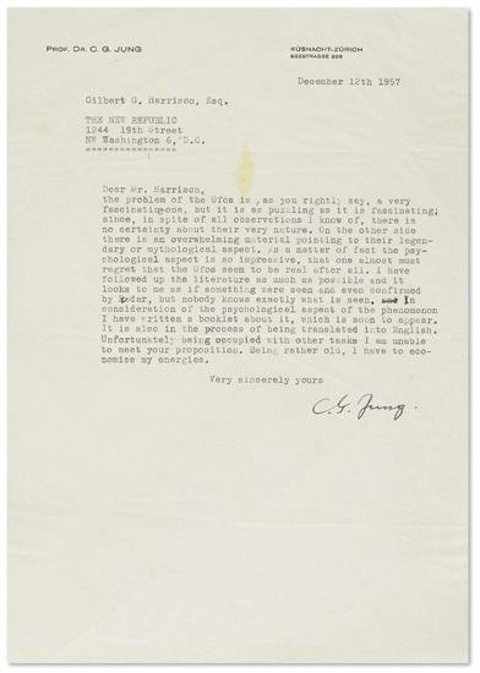
In 1957, with Flying Saucers to appear the following year, New Republic editor Gilbert A. Harrison wanted to get this Jungian perspective on UFOs in his magazine. At the top of this post, you can see (via The Awl) a scan of Jung’s response to Harrison’s query, the text of which follows:
the problem of the Ufos is, as you rightly say, a very fascinating one, but it is as puzzling as it is fascinating; since, in spite of all observations I know of, there is no certainty about their very nature. On the other side, there is an overwhelming material pointing to their legendary or mythological aspect. As a matter of fact the psychological aspect is so impressive, that one almost must regret that the Ufos seem to be real after all. I have followed up the literature as much as possible and it looks to me as if something were seen and even confirmed by radar, but nobody knows exactly what is seen. In consideration of the psychological aspect of the phenomenon I have written a booklet about it, which is soon to appear. It is also in the process of being translated into English. Unfortunately being occupied with other tasks I am unable to meet your proposition. Being rather old, I have to economize my energies.
Jung, as you can see, doubled his own interest in the subject by not only considering flying saucers a social phenomenon, but as a real physical phenomenon as well. Serious enthusiasts of both Jung and UFOs might consider bidding on the original letter, now up for auction. Estimated sale price: $2,000 to 3,000.
Related Content:
Face to Face with Carl Jung: ‘Man Cannot Stand a Meaningless Life’
Carl Gustav Jung Ponders Death
Colin Marshall hosts and produces Notebook on Cities and Culture and writes essays on literature, film, cities, Asia, and aesthetics. He’s at work on a book about Los Angeles, A Los Angeles Primer. Follow him on Twitter at @colinmarshall.
Read More...Watch Phish Play All of The Rolling Stones’ Classic Album, Exile on Main Street, Live in Concert
I’m riding a mighty big bandwagon when I tell you that Exile on Main Street is my favorite Stones record. It’s like championing the virtues of Sgt. Pepper’s or Dark Side of the Moon. Really, those are great albums? Wow, who knew. But here’s the thing… my favorite Stones songs—“Street Fighting Man,” “No Expectations,” “Get off of My Cloud” (hell, I even love “Shattered”)—do not appear on Exile. It is a perfect (double) album without one perfect single on all of its 18 tracks. Exile is a string of beautifully flawed pearls—gospel sketches, country weepers, barroom stompers, bare-bones blues. And this is why I think that any band approaching the album with ideas about cover versions should just go ahead and play the whole damn thing.
This is what Pussy Galore, one of my favorite New York scuzz-rock bands, did in 1986, with a cassette-only release that “sounds like it was recorded in the tank of a Lower East Side toilet.” If that seems like hyperbole, you have no idea how trashy, and thus, in a way, how perfectly apt, their take on the 1972 classic is (find out here). But now let’s take the case of Phish, who offer their own live version of Exile (above) from their 2009 “Festival 8” tour. I’ve never been much of a Phish fan, I’ll aver, but I must also cop to a grudging respect for them. Partly that’s due to their respect for music not their own. Per a longstanding tradition, Phish dons a different musical “costume” every Halloween show, playing a full album from a band they admire. For example, we’ve previously featured their 1996 live cover of the Talking Heads’ classic Remain in Light. Does it work? Not entirely, but their love for the material shines through.
They seem much more at home with the Stones, and the almost note-for-note live set is a hell of a lot of fun to watch, I have to say. Phish is not by any stretch a hip band, and they avoid any kind of experimentation in this loving tribute. But that’s kind of what makes it great. While the unpretentious enthusiasm, tight musicianship, and professionalism might seem to mark this as the antithesis of what L.A. Times Randall Roberts calls Pussy Galore’s “criminally unpracticed rock and roll stunt,” what unites them both is that both groups “obviously loved the original album,” whether their take on it is mangled parody or well-rehearsed, fun-loving rock out.
The original Exile is, yes, a masterpiece. It’s also a great conversation piece. Ask any die-hard Stones fan about its recording and you’re sure to hear anecdote after decadent anecdote (as fully documented in the 2010 film Stones in Exile). The band recorded the album in 1971 at Keith Richards’ rented villa, Nellcôte, in the South of France, where they’d relocated to evade taxes in Britain. During months of all-night sessions, thousands of dollars of heroin flowed through the house, along with visitors like William S. Burroughs, Terry Southern, and Stones’ country-rock muse Gram Parsons (who managed to get himself thrown out). It’s a true testament to the band’s fortitude and razor-sharp creative focus that their extended stay in a rock star playground produced such a brilliantly economical record, instead of the bloated mess it could have been.
Related Content:
Watch Phish Play the Entirety of the Talking Heads’ Remain in Light (1996)
Jean-Luc Godard Films The Rolling Stones Recording “Sympathy for the Devil” (1968)
Keith Richards Waxes Philosophical, Plays Live with His Idol, the Great Muddy Waters
Josh Jones is a writer and musician based in Washington, DC. Follow him at @jdmagness
Read More...Tilda Swinton Recites Poem by Rumi While Reeking of Vetiver, Heliotrope & Musk
If anyone should ask you how to promote a celebrity fragrance without losing face, click play and whisper, “Like This.”
It helps if the celeb in question is generally acknowledged to be a class act. Imagine a drunken starlet emerging from her limo sans-drawers to stumble through her favorite poem by a 13th century Sufi mystic. Which would you rather smell like?
(Personally, I’d go with Team Swinton! )
Some scholars quibble with the accuracy of this Tilda Swinton-approved translation, but there’s no denying that Coleman Barks’ “perfect satisfaction of all our sexual wanting” stands to move a lot more scent than A.J. Arberry’s terse reference to Houris, viriginal and numerous though they may be.
Speaking of comparisons, take a peek at how another celebrity promotes her fragrance in a video of similar length.
Team Swinton for the win. Definitely.
Related Content:
Tilda Swinton and Barry White Lead 1500 People in Dance-Along to Honor Roger Ebert
Hear Sylvia Plath Read Fifteen Poems From Her Final Collection, Ariel, in 1962 Recording
Ayun Halliday marks her territory @AyunHalliday
Read More...Bach’s Brandenburg Concerto #4, Visualized by the Great Music Animation Machine
Yesterday we featured videos visualizing Igor Stravinsky’s now hundred-year-old The Rite of Spring. They came from acknowledged master of music visualization Stephen Malinowski, inventor of the Music Animation Machine. Have a look at Malinowski’s Youtube page and you’ll find other videos showcasing how his software, by translating musical sounds into instinctively understandable graphics, allows us to better grasp the intricate workings of famous pieces. Today, let’s go back not just one hundred but about three hundred years, to Johann Sebastian Bach’s Brandenburg Concertos, the ingenious intricacy of which has, since the Baroque period, only won more and more devotion from musical scholars.
At the top, you can hear, and more importantly see, the first movement of Bach’s fourth Brandenburg concerto. Just above, you’ll find its second movement, below, its third. (This video presents the movement whole.) Watch as you listen, and you can experience through shape and color (I can only imagine the kick synesthetes get out of this sort of thing) the way that the concerto’s various voices, meant for violins, viola, cello, violone, and basso continuo, trade off, overlap, interact, giving each movement, and the whole piece, its shape. Though Bach’s musical accomplishments can sometimes seem impressive to the point of feeling forbidding, Malinowski’s graphical scores offer a way into comprehension, especially for the visually inclined.
Related Content:
The Genius of J.S. Bach’s “Crab Canon” Visualized on a Möbius Strip
Visualizing Bach: Alexander Chen’s Impossible Harp
Colin Marshall hosts and produces Notebook on Cities and Culture and writes essays on literature, film, cities, Asia, and aesthetics. He’s at work on a book about Los Angeles, A Los Angeles Primer. Follow him on Twitter at @colinmarshall.
Read More...James Brown, the Godfather of Soul, Extols Some Odd Virtues of Ronald Reagan in New Animated Video
“Sir,” says James Brown to a reporter who had just made the mistake of calling him James, “I’m going to call you by your last name as long as you call me by mine. One thing I fought for was respect, Okay? I didn’t have that all the time.”
So begins the latest animated feature from Blank on Blank, a nonprofit project that brings forgotten interviews back to life. In this episode, ABC radio journalist Rocci Fisch takes us back to a little interview he and a few other reporters had with Brown before a concert in 1984. The location was Washington D.C., so perhaps it should come as no surprise when the brief interview veers into politics. At one point Fisch asks Brown what he thinks of the man who was president then, Ronald Reagan.
“I think he’s the most intelligent…I think he’s the most well-coordinated president we’ve ever had in history,” says Brown.
“You think he’s going to win again?” says Fisch.
“I’m not here to endorse. I just know he’s the most well-organized president we’ve ever had in history. His acting ability taught him the whole structure of the country.”
“Communication, you mean?”
“Huh?”
“Communication?”
“He knows what everybody wants. You see, every American, every American man is still a cowboy. See you’ve got to remember that.”
Related content:
James Brown Brings Down the House at the Paris Olympia, 1971
Animations Revive Lost Interviews with David Foster Wallace, Jim Morrison & Dave Brubeck
Read More...Rediscovered: The First American Anti-Nazi Film, Banned by U.S. Censors and Forgotten for 80 Years
On March 5, 1933, Germany held its last democratic elections until the end of WWII, and the National Socialists gained a plurality in the Reichstag, with 43.9% of the vote and 288 seats. This event paved the way for the Enabling Act later that month, which effectively empowered Hitler as dictator. It would seem in hindsight that this turn—with all its attendant violence, coercion, and hysterical nationalist rhetoric—might have alarmed the Western powers. And yet the opposite was true.
At least one newsman was alarmed, however. And on the day of the 1933 elections, he gained a brief audience with the future Fuhrer. That man was Cornelius “Neil” Vanderbilt IV, great-great-grandson of the railroad tycoon. Fed up with the malaise of his privileged peers, Vanderbilt had moved to journalism from his position as a driver during the First World War. His name gave him access to Mussolini, Stalin, and Hitler, whose impending Reich became the subject of Vanderbilt’s documentary film, called Hitler’s Reign of Terror, released on April 30, 1934, a short portion of which you can see above.
The New Yorker obtained the clip from Brandeis University professor Thomas Doherty, who rediscovered the film in a Belgian archive while researching a recent book. Vanderbilt’s documentary might well be the first American anti-Nazi film, but its contemporary reception speaks volumes about how criticism of the new Nazi regime was suppressed in the mid-thirties; the film was censored across the U.S., denied a license, and banned.
What Vanderbilt saw first-hand and chronicled in his film is mild in comparison to what was to come. Nevertheless, his take was prescient. He describes his anxious but partially successful endeavor to smuggle footage across the German border, prefacing the story by saying “there isn’t money enough in Hollywood to get me to go through it again.” (The scene above is a reenactment, as is, quite obviously, the scene of Vanderbilt’s meeting with Hitler.) Asked about his impressions of Hitler, Vanderbilt has this to say:
Unquestionably he is a man of real ability, of force. But the way I sized him up after interviewing him is that he is a strange combination of Huey Long, Billy Sunday, and Al Capone…. I had never heard a man so able to sway people.… In the hour and a half that Hitler talked to that packed audience that night, he was as effective as a barker in a sideshow traveling with a circus.
Vanderbilt says above that the rising Nazi tide, “demanded revenge” and would not rest until they had it, to which his interviewer responds, “It all seems a ghastly, incredible nightmare.” Vanderbilt’s vision seemed like a sensationalistic fever dream to his critics as well.
Read the full story of the film over at The New Yorker’s Culture Desk.
Related Content:
Watch Lambeth Walk—Nazi Style: The Early Propaganda Mash Up That Enraged Joseph Goebbels
The Nazis’ 10 Control-Freak Rules for Jazz Performers: A Strange List from World War II
The Enigma Machine: How Alan Turing Helped Break the Unbreakable Nazi Code
Josh Jones is a writer and musician based in Washington, DC. Follow him at @jdmagness
Read More...Punk Meets High Fashion in Metropolitan Museum of Art Exhibition PUNK: Chaos to Couture
Whatever else British punk rock gave pop culture, it was always a revolution in fashion, engineered by Sex Pistols svengali Malcolm McLaren and his partner, designer Vivienne Westwood. The two pioneered punk’s S&M‑inspired look from their Chelsea boutique, SEX, a onetime record shop that morphed into the epicenter of London street fashion. McLaren passed away in 2010, but his former partner Westwood is still designing—only now her work is haute couture nostalgia, its shocking sneer at uptight British culture a museum piece. Her latest collection, Chaos, revisits many of the iconic designs of the mid-seventies made famous by the Sex Pistols, such as the “tits square” and “cowboy square” t‑shirts and the ubiquitous safety pin.
The name of Westwood’s retro latest work is reflected in a current exhibition at the Metropolitan Museum of Art called PUNK: Chaos to Couture, which began May 9th and runs until August 14th. In the video above, curator Andrew Bolton discusses the exhibition’s staging of low and high culture crossover. In the press materials, Bolton is frank about the contradictory aims of punk and high fashion:
Since its origins, punk has had an incendiary influence on fashion… Although punk’s democracy stands in opposition to fashion’s autocracy, designers continue to appropriate punk’s aesthetic vocabulary to capture its youthful rebelliousness and aggressive forcefulness.
This is not the first time Bolton has appropriated punk fashion for high art or worked with Vivienne Westwood. In 2006, Bolton curated a Met exhibit called AngloMania (catalog here), which drew its name and inspiration from another of Westwood’s collections.
Related Content:
Malcolm McLaren: The Quest for Authentic Creativity
Josh Jones is a writer and musician based in Washington, DC. Follow him at @jdmagness
Read More...Support Us
We're hoping to rely on loyal readers, rather than erratic ads. Please click the Donate button and support Open Culture. You can use Paypal, Venmo, Patreon, even Crypto! We thank you!

About Us

Open Culture scours the web for the best educational media. We find the free courses and audio books you need, the language lessons & educational videos you want, and plenty of enlightenment in between.
Advertise With Us

FREE UPDATES!
GET OUR DAILY EMAIL
Get the best cultural and educational resources on the web curated for you in a daily email. We never spam. Unsubscribe at any time.
FOLLOW ON SOCIAL MEDIA

Open Culture editor Dan Colman scours the web for the best educational media. He finds the free courses and audio books you need, the language lessons & movies you want, and plenty of enlightenment in between.
Advertise With Us

