Watch Sir Edmund Hillary Describe His Everest Ascent, on the 60th Anniversary of His Climb
Sixty years ago today, New Zealand explorer Sir Edmund Hillary and his Sherpa guide Tenzing Norgay became the first climbers to ever reach the summit of Mount Everest. This feat may not seem so significant now, when upwards of 150 people may reach the top of the 29,000-foot mountain on the best climbing day. In fact the summit has become so overcrowded that officials are even debating installing a ladder for descents (to the horror of serious mountaineers). But in 1953, Hillary and Norgay’s ascent was a pretty big deal, you might say. In the video above, excerpted from Hillary’s appearance on the educational program Omnibus, watch the famous explorer nonchalantly tell the story of his and Norgay’s conquering of Everest.
And if you’re in a mood to do some virtual exploring yourself, from the comfort of your own home, you can look around the Everest summit courtesy of Google Earth.
Related Content:
Climb Three of the World’s Highest Peaks on Google Street View
Josh Jones is a writer and musician based in Washington, DC. Follow him at @jdmagness
Read More...Eric Clapton’s Isolated Guitar Track From the Beatles’ ‘While My Guitar Gently Weeps’ (1968)
George Harrison of the Beatles was an accomplished guitar player with a distinctive soloing style. So you might think that with a song as personal and guitar-centric as “While My Guitar Gently Weeps,” he would do his own playing. In fact, the song features guitar playing by Eric Clapton.
It was recorded on September 6, 1968, during the acrimonious White Album sessions. Harrison had been struggling off and on for over a month to get the song right. He first tried it with his own playing on a Gibson J‑200 guitar along with an overdubbed harmonium. He later experimented by running the guitar solo backwards. Nothing seemed to work.
So finally Harrison asked his friend Clapton for a little help. When Harrison walked into Abbey Road Studios with Clapton, the other Beatles started taking the song seriously. In a 1987 interview with Guitar Player magazine, Harrison was asked whether it had bruised his ego to ask Clapton to play on the song.
No, my ego would rather have Eric play on it. I’ll tell you, I worked on that song with John, Paul, and Ringo one day, and they were not interested in it at all. And I knew inside of me that it was a nice song. The next day I was with Eric, and I was going into the session, and I said, “We’re going to do this song. Come on and play on it.” He said, “Oh, no. I can’t do that. Nobody ever plays on the Beatles records.” I said, “Look, it’s my song, and I want you to play on it.” So Eric came in, and the other guys were as good as gold–because he was there. Also, it left me free to just play the rhythm and do the vocal. So Eric played that, and I thought it was really good. Then we listened to it back, and he said, “Ah, there’s a problem, though; it’s not Beatley enough”–so we put it through the ADT [automatic double-tracker], to wobble it a bit.
For the impression of a person weeping and wailing, Clapton used the fingers on his fretting hand to bend the strings deeply, in a highly expressive descending vibrato. He was playing a 1957 Gibson Les Paul, a guitar he had once owned but had given to Harrison, who nicknamed it “Lucy.” You can hear Clapton’s isolated playing above. And for a reminder of how it all came together, you can listen to the official version here.
Related Content:
The Beatles: Unplugged Collects Acoustic Demos of White Album Songs (1968)
A Young Eric Clapton Demonstrates the Elements of His Guitar Sound
Read More...The Beauty of Space Photography
So many of the images we see of outer space are either cold and flat—a planet sphere surrounded by scores of pinpoint stars against the backdrop of black space—or they’re artists’ renderings.
The pictures featured in The Beauty of Space Photography are neither of those. They’re more like conceptual art: beautiful, mysterious, and intriguing.
The video above is the latest episode of PBS’s Off Book, a web series that explores new Internet culture. In this episode, the producers interview three astrophysicists, and they are anything but the pocket-protector types. These scientists are articulate, thoughtful, and passionate about space and about photographing what they see through super-powerful telescopes.
Working for different institutions, each scientist uses photography as a major tool to study space. The images have functional value of course, to assist with measuring and documenting findings. But there’s no denying their beauty. Astrophysics also touches on philosophical questions, so the pictures trigger a sense of awe that borders on the existential.
The blue and pink swirls of cloud dust and deep spiral-shaped galaxies in these pictures are breathtaking because, as astrophysicist Emily Rice says, we know what they are and yet they are unfathomable.
The images are of such high quality that they convey some of the depth and grandeur of space. The pictures seem to contain the unbelievable immensity and allow us to focus in on just a small, beautiful piece of what is all around out there.
But that’s just part of the fun of this short video. Listening to the scientists talk about their work is like having an expert guide you through the universe, a docent who’s excited and educated about things that none of us can truly comprehend even as we gape at their beauty.
The other scientists featured in this short are David Hogg (NYU) and Zolt Levay (Space Telescope Science Institute).
Related Content:
Find Courses on Astronomy and Physics in our Collection of 700 Free Online Courses
125 Great Science Videos: From Astronomy to Physics & Psychology
An Animated Visualization of Every Observed Meteorite That Has Hit Earth Since 861 AD
Kate Rix writes about digital media and education. Visit her website or follow her on Twitter @mskaterix.
Read More...Stravinsky’s The Rite of Spring, Visualized in a Computer Animation
Even those of us who only took half a music appreciation course in college know about the impact of Igor Stravinsky’s The Rite of Spring, the orchestral ballet that nearly caused a brawl at its debut. Ah, but how times have changed in the exactly one hundred years since that May evening at the Théâtre des Champs-Élysées. Now no music, no matter how radically it breaks from tradition, causes anything like a riot; at worst, listeners shuffle out early, and that’s making the debatable assumption that such a piece would draw an audience in the first place. Today’s musicophiles like what they like, often to the point of obsession, and simply ignore what they don’t. The past century, of course, has proven Stravinsky’s compositional instincts ahead of their time, now that we all know the name of the The Rite of Spring, and the complex work itself has attracted plenty of obsessive musicophiles of its own.
Some have gone as far as to turn the music into imagery. In 1913, we had no more technologically advanced way to visualize a piece of music than through dance, such as The Rite of Spring’s ballet. In 2013, the art of computer graphics greatly expands the quest for an ever more perfect way to represent music not just to the ear, but to the eye. Composer, pianist and software engineer Stephen Malinowski has long led the way with the various iterations of his Music Animation Machine. At the top of the post, you can see a visualization of The Rite of Spring’s first part, “The Adoration of the Earth.” Just above appears its second part, “The Exalted Sacrifice.” “I was not aware of the kind of harmonic things Stravinsky has going on,” Malinowski told NPR, explaining what he learned about the piece in the process. “It’s incredible — Stravinsky continually torques you, startles you, and frustrates your anticipations.” Imagine how it would have blown those early-twentieth-century Parisian minds to see this at the debut.
Related Content:
The Genius of J.S. Bach’s “Crab Canon” Visualized on a Möbius Strip
Visualizing Bach: Alexander Chen’s Impossible Harp
Stephen Hawking’s Universe: A Visualization of His Lectures with Stars & Sound
Colin Marshall hosts and produces Notebook on Cities and Culture and writes essays on literature, film, cities, Asia, and aesthetics. He’s at work on a book about Los Angeles, A Los Angeles Primer. Follow him on Twitter at @colinmarshall.
Read More...The Religious Affiliation of Comic Book Heroes
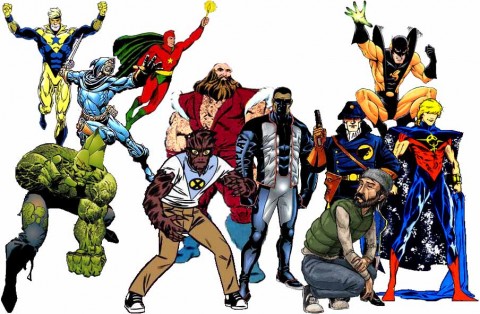
Spider-Man, he was apparently a Protestant. The Hulk, a lapsed Catholic. Thor, a worshipper of a Teutonic deity. The X‑Men, an assemblage of Catholics and Episcopalians. And Stanley Lee, the creator of these famous comic book figures, he’s Jewish. If you’re a comic book fan with a thing for trivia, you can peruse this database of over 10,000 characters and figure out the religious affiliation of Batman and Wonder Woman, plus lesser-known characters like Chameleon Boy, Swamp Thing, and Poison Ivy.
P.S. The creatures in the image above, they’re atheists, a category also tracked by this most thorough database.
via @wfmu
Related Content:
Nine Classic Superman Cartoons Restored and Now on YouTube
When Super Heroes Get Old and Retire to Miami
Read More...Lou Reed, John Cale & Nico Reunite, Play Acoustic Velvet Underground Songs on French TV, 1972
By 1972, the Velvet Underground, arguably the most influential cult band of all time, was effectively dead, all of the original members having departed the project. Reports of animosity and rancor at the end may be exaggerated; whether the tensions that split the band apart were primarily inner or outer hardly matters at this point. But the still-performing members continued to support each other in some fashion for the remainder of their careers, and the band’s three singers even reunited for a one-off acoustic concert in Paris of that year to perform a set of classic Velvet tracks as well as songs from their solo albums.
The audio of this reunion circulated for years as a bootleg before its official release in 2004. Video of the concert at Le Bataclan, originally broadcast on French television, preserves the evening, edited into segments and shuffling the original song order.
First, Lou Reed sings “Berlin” (top), a torch song he purportedly wrote about Nico (watch her look on as he sings). Reed calls it his “Barbara Streisand song.” Next, watch Cale and Reed do a version of “Waiting for My Man” (above).
You can watch a longer version of the concert broadcast here, with performances from Reed, Cale, and Nico intercut with talky segments between French journalists. This concert, and the various bootlegs and official live releases, may not be essential listening for casual VU fans, but Philip Shelley’s comment on the live recordings may apply equally to the film: “if you appreciate the fleeting revelations to be found in snapshots, then this may be just the bit of quicksilver for you, a unique moment in musical history just before these three erstwhile Jekylls became forever Hydes.”
Related Content:
Nico Sings “Chelsea Girls” in the Famous Chelsea Hotel
Rock and Roll Heart, 1998 Documentary Retraces the Remarkable Career of Lou Reed
Josh Jones is a writer and musician based in Washington, DC. Follow him at @jdmagness
Read More...Hear the Classic Winnie-the-Pooh Read by Author A.A. Milne in 1929
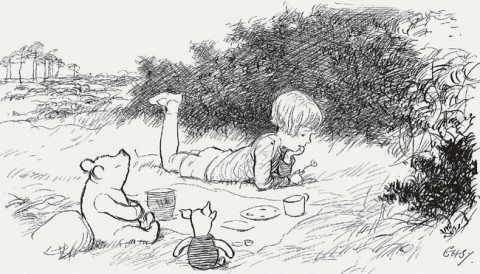 Here’s a rare recording from 1929 of the British author A.A. Milne reading a chapter of his beloved children’s book, Winnie-the-Pooh. Milne was a prolific writer of plays, novels and essays, but he was most widely known–much to his chagrin–as the creator of a simple and good-natured little bear.
Pooh was inspired by his son Christopher Robin’s favorite teddy bear. In Milne’s imagination, the stuffed bear comes alive and enters into little adventures (or one might say misadventures) with Christopher Robin and his other stuffed animals. The name “Winnie” was borrowed from a famous resident of the London Zoo: a black bear from Canada named for the city of Winnipeg. The young Christopher Robin liked visiting Winnie at the zoo. He also liked a graceful swan he saw swimming in a pond at Kensington Gardens, who he named “Pooh.” His father combined the two names to create one of the most popular characters in children’s literature.
Winnie-the-Pooh first appeared in stories and poems in popular magazines. In 1926 Milne collected them in a book, Winnie-the-Pooh, with illustrations by E.H. Shepard. Each chapter in the book is a self-contained episode or story. In the recording below, Milne reads Chapter Three (click here to open the text in new a window) “In Which Pooh and Piglet Go Hunting and Nearly Catch a Woozle.”
Looking for free, professionally-read audio books from Audible.com? Here’s a great, no-strings-attached deal. If you start a 30 day free trial with Audible.com, you can download two free audio books of your choice. Get more details on the offer here.
And note this: Audiobooks.com also has a free trial offer where you can download a free audiobook. Details.
Related Content:
200 Free Kids Educational Resources: Video Lessons, Apps, Books, Websites & More
The Epistemology of Dr. Seuss & More Philosophy Lessons from Great Children’s Stories
Morgan Freeman Teaches Kids to Read in Vintage Electric Company Footage from 1971
Read More...Black Coffee: Documentary Covers the History, Politics & Economics of the “Most Widely Taken Legal Drug”
“It’s not hard to brew a great cup of coffee,” writes Kelefa Sanneh in a recent New Yorker post on the Melbourne International Coffee Expo. “At least, it shouldn’t be.” He adds that “there’s no such thing as a foolproof process though: even coffee professionals are forever tweaking and rethinking their brew methods, as they get better at identifying, in each cup, what went wrong and what went right.” Even casual coffee drinkers, including those who have never made a cup for themselves, know how complicated the preparation process can become when one really starts to think about it. But the field of coffee studies boasts even more information to master when it comes to the history of the cultivation and usage of the beans themselves. You can begin your own coffee education with this tripartite television documentary, Black Coffee.
A Canadian production aired on PBS, Black Coffee (purchase on DVD here) examines “the world’s most widely taken legal drug,” a beverage whose intellectually intense die-hard enthusiasts give wine’s a run for their money, from historical, political, social, and economic angles.
Part one, “The Irresistible Bean,” follows coffee’s spread from Ethiopa out across the entire world. Part two, “Gold in Your Cup,” looks at the “coffee barons” of the nineteenth century and the rise of coffee-house culture.
Part three, “The Perfect Cup,” brings us up to date with the modern “romantic age of coffee” and what entrepreneurs (such as Starbucks’ Howard Schultz, who appears in the documentary) have done to, depending on your inclination, either democratize or cheapen the pursuit of a worthwhile sip. While a bit of knowledge always enriches the enjoyment of even something as common as coffee — and, in this case, also raises occasional thorny moral and agricultural questions — let us never lose sight of the simple sentiment expressed in expressed in Bach’s Coffee Cantata:
Lovelier than a thousand kisses,
smoother than muscatel wine.
Coffee, I must have coffee,
and if anyone wants to give me a treat,
ah!, just give me some coffee!
Related Content:
Everything You Wanted to Know About Coffee in Three Minutes
“The Vertue of the COFFEE Drink”: London’s First Cafe Creates Ad for Coffee in the 1650s
The History of Coffee and How It Transformed Our World
This is Coffee!: A 1961 Tribute to Our Favorite Stimulant
The Fine Art of Painting Portraits on Coffee Foam
Colin Marshall hosts and produces Notebook on Cities and Culture and writes essays on literature, film, cities, Asia, and aesthetics. He’s at work on a book about Los Angeles, A Los Angeles Primer. Follow him on Twitter at @colinmarshall.
Eight Radiohead Albums Reimagined as Vintage Paperback Books
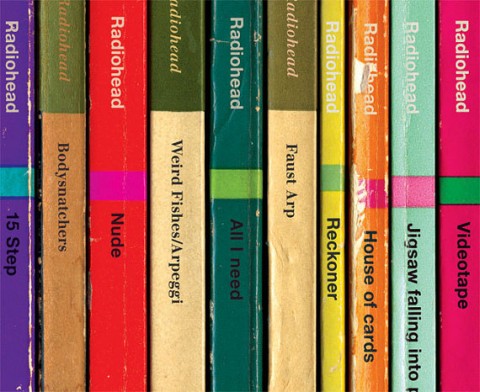
Simon James, an artist living and working in London, has a penchant for taking albums and envisioning them as vintage Penguin & Pelican-style books. So far, he has covered The Smiths, Joy Division, New Order, The Cure and Kraftwerk. And now comes his favorite band, Radiohead. Here, he takes Pablo Honey, The Bends, OK Computer, Kid A, Amnesiac, Hail to the Thief, In Rainbows and The King of Limbs and then turns each track, on each album, into its own novel. You can find the images on Etsy. Just follow the links above. Individual prints can also be purchased for $19.38.
If you would like to support the mission of Open Culture, consider making a donation to our site. It’s hard to rely 100% on ads, and your contributions will help us continue providing the best free cultural and educational materials to learners everywhere. You can contribute through PayPal, Patreon, and Venmo (@openculture). Thanks!
Related Content:
Radiohead’s Thom Yorke Gives Teenage Girls Endearing Advice About Boys (And Much More)
A Middle-Eastern Version of Radiohead’s 1997 Hit “Karma Police”
Radiohead-Approved, Fan-Made Film of the Band at Roseland for 2011′s The King of Limbs Tour
Read More...Leonard Cohen and U2 Perform ‘Tower of Song,’ a Meditation on Aging, Loss & Survival
Here’s a rare collaboration between the Canadian singer and poet Leonard Cohen and the Irish supergroup U2. It was staged for the 2005 Lian Lunson documentary, Leonard Cohen: I’m Your Man. The musicians are performing “Tower of Song,” a spiritual meditation on aging, loss, and survival, originally released on Cohen’s 1988 album I’m Your Man. Like Jorge Luis Borges’s Library of Babel, Cohen’s Tower of Song is something unfathomable.
Well my friends are gone and my hair is grey
I ache in the places where I used to play
And I’m crazy for love but I’m not coming on
I’m just paying my rent every day
Oh in the Tower of Song
I said to Hank Williams: how lonely does it get?
Hank Williams hasn’t answered yet
But I hear him coughing all night long
A hundred floors above me
In the Tower of Song
In addition to the U2 collaboration, Leonard Cohen: I’m Your Man includes interviews with Cohen and tribute performances of some of his greatest songs by Martha and Rufus Wainwright, Nick Cave, Beth Orton and others. You can watch the complete film here.
Related Content:
Street Artist Plays Leonard Cohen’s “Hallelujah” With Crystal Glasses
Leonard Cohen Recounts “How I Got My Song,” or When His Love Affair with Music Began
Ladies and Gentlemen… Mr. Leonard Cohen, a 1965 Documentary
Leonard Cohen Reads “The Future” (Not Safe for Work)
Read More...Support Us
We're hoping to rely on loyal readers, rather than erratic ads. Please click the Donate button and support Open Culture. You can use Paypal, Venmo, Patreon, even Crypto! We thank you!

About Us

Open Culture scours the web for the best educational media. We find the free courses and audio books you need, the language lessons & educational videos you want, and plenty of enlightenment in between.
Advertise With Us

FREE UPDATES!
GET OUR DAILY EMAIL
Get the best cultural and educational resources on the web curated for you in a daily email. We never spam. Unsubscribe at any time.
FOLLOW ON SOCIAL MEDIA

Open Culture editor Dan Colman scours the web for the best educational media. He finds the free courses and audio books you need, the language lessons & movies you want, and plenty of enlightenment in between.
Advertise With Us

