Dennis Hopper Reads From Rainer Maria Rilke’s Timeless Guide to Creativity, Letters to a Young Poet
For almost a century, writers and other creative people have found inspiration and a profound sense of validation in the Bohemian-Austrian poet Rainer Maria Rilke’s posthumously published Letters to a Young Poet. Many a sensitive soul has felt as if Rilke’s letters, written to a young man who had asked him for advice on whether to become a poet, were addressed directly to him or her. One of those people was the actor Dennis Hopper.
“Rilke’s Letters to a Young Poet is a great book,” Hopper says in this short film from 2007. “For me the letters are a credo of creativity and a source of inspiration. After reading Rilke it became clear to me that I had no choice in the matter. I had to create.” The ten-minute film, Must I Write?, was directed by Hermann Vaske and photographed by Rain Li. Hopper reads the first of the book’s ten letters, in which Rilke tells the young man to stop seeking approval from others:
You are looking outward, and that above all you should not do now. Nobody can help and counsel you, nobody. There is only one single way. Go into yourself. Search for the reason that bids you write; find out whether it is spreading out its roots in the deepest places in your heart, acknowledge to yourself whether you would have to die if it were denied you to write. This above all–ask yourself in the stillest hour of your night: must I write? Delve into yourself for a deep answer. And if this should be affirmative, if you may meet this earnest question with a strong and simple “I must,” then build your life according to this necessity; your life even into its most indifferent and slightest hour must be a sign of this urge and a testimony to it.
Hopper is reading from the 1934 translation by M.D. Herter Norton. There are a few minor slips, in which Hopper deviates slightly from the text. Most seriously, he inverts the meaning of a passage near the end by adding (at the 7:23 mark) the word “not” to Rilke’s phrase, “Perhaps it will turn out that you are called to be an artist.” That passage, one of the most memorable in the book, reads:
A work of art is good if it has sprung from necessity. In this nature of its origin lies the judgement of it: there is no other. Therefore, my dear sir, I know no other advice for you save this: to go into yourself and test the deeps in which your life takes rise; at its source you will find the answer to the question whether you must create. Accept it, just as it sounds, without inquiring into it. Perhaps it will turn out that you are called to be an artist. Then take that destiny upon yourself and bear it, its burden and its greatness, without ever asking what recompense might come from outside. For the creator must be a world for himself and find everything in himself and in Nature to whom he has attached himself.
Related content:
Dennis Hopper Reads Rudyard Kipling on the Johnny Cash Show
Read More...Read and Hear Famous Writers (and Armchair Sportsmen) J.M. Coetzee and Paul Auster’s Correspondence
“Why waste my time slumped in front of a television screen watching young men at play?” writes one man. “I have an experience (a secondhand experience), but it does me no good that I can detect. I learn nothing. I come away with nothing.” From the other man comes a reply: “I agree with you that it is a useless activity, an utter waste of time. And yet how many hours of my life have I wasted in precisely this way, how many afternoons have I squandered just as you did?” This epistolary conversation about sports continues, touching on the power of familiarity to endure boredom, performance art, heroism, ethics versus aesthetics, activity versus passivity, the “big business” of the NFL against the subsidization of ballet, childhood sexual identification, the visiblity of the human ideal, chess mania, the pleasure of maximum effort, and genre literature versus “the kinds of books you and I try to write.” What kind of books do these men try to write? Being the novelists Paul Auster and J.M. Coetzee, they write books, we can safely say, in their very own genres.
We now have a new volume from both Auster and Coetzee called Here and Now: Letters (2008–2011), from which a substantial sports-related excerpt appears on the New Yorker. Though not sui generis like the contributors’ own novels, the book does its part for the current mini-revival of collections of letters between men of letters. (2011 saw a similar French project from Michel Houellebecq and Bernard-Henri Lévy. “Who would we end up with?” asked the Observer’s Tim Adams, imagining a British equivalent. “Irvine Welsh and Alain de Botton?”) Fans of the lauded, private Auster and the highly lauded, intensely private Coetzee surely feel grateful for these new pieces of direct insight into the authors’ personalities, and they can get a little more by watching the reading of Here and Now at the New York State Writers Institute at the top of the post. Do see also Auster’s Big Think clips on what keeps him up at night, the fate of the novel, and how he stares down the challenges of writing (above). As for a solo performance from Coetzee, could we do any better than his Nobel lecture?
Related Content:
Nobel Prize Winner Reads From His New Novel
Hear Paul Auster Read the Entirety of The Red Notebook, an Early Collection of Stories
Paul Auster Reads from New Novel, Sunset Park
Colin Marshall hosts and produces Notebook on Cities and Culture and writes essays on literature, film, cities, Asia, and aesthetics. He’s at work on a book about Los Angeles, A Los Angeles Primer. Follow him on Twitter at @colinmarshall.
Read More...Creative Uses of the Fax Machine: From Iggy Pop’s Bile to Stephen Hawking’s Snark
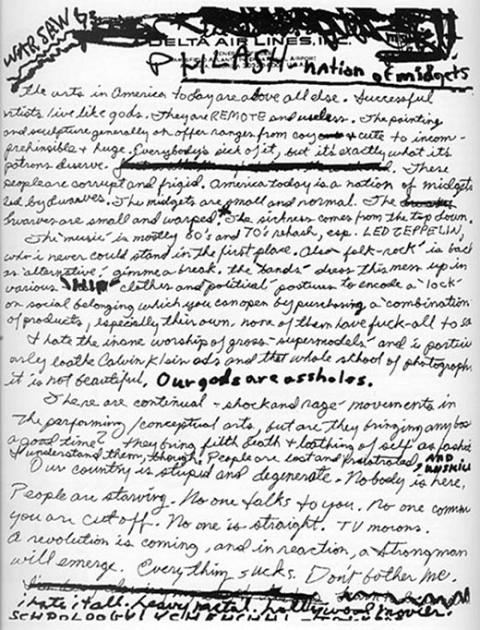
Unlike the typewriter, the lowly fax machine never pulled itself out of the hive-like existence of utilitarian office machines and into literary celebrity. With their bland, functional styling, fax machines will not have their impending obsolescence capped with museum exhibitions. And as little more than conduits for wonky, unglamorous communiqués, fax machines rarely conduct a piece of text that inspires people to savor, and want to save, the words, as with personal letters. While we often feature historic correspondence of a time before email from one of our favorite sites, Letters of Note, the risible, profound, and shocking sentiments expressed by famous figures when they think that no one’s looking rarely make it into office memoranda.
However, inspired by our recent post on Mark Twain’s typewriter, a reader alerted us to a Letters of Note subgenre of sorts, “faxes of note.” These oddball messages defy the workaday conventions of the fax. Take, for example, the fax above sent by Iggy Pop to Plazm magazine writer Joshua Berger as an addendum to a 1995 interview. Scrawled with his fevered thoughts, on Delta Airlines stationary, Pop’s fax amounts to what Letters of Note calls “a rant so rich with quotable lines, it’s amazing he was able to contain it all on a single sheet.”
You can click here for a full transcript of Iggy’s take on American cultural decadence, but here are just a few highlights from his faxed get-off-my-lawn moment: Pop—on tour in Europe at the time—calls his home country “a nation of midgets,” and decries the ‘90s rehash of ‘60s and ’70s music (“none of them have fuck-all to say”); he rails against the Calvin Klein aesthetic, adding “our gods are assholes” (maybe some professional jealousy here—Pop more or less invented heroin chic). Finally, he signs off with some cranky onomatopoeia: “i hate it all. heavy metal. hollywood movies. SCHPOLOOGY! YeHEHCHH!” This is archival-worthy vitriol, for sure.
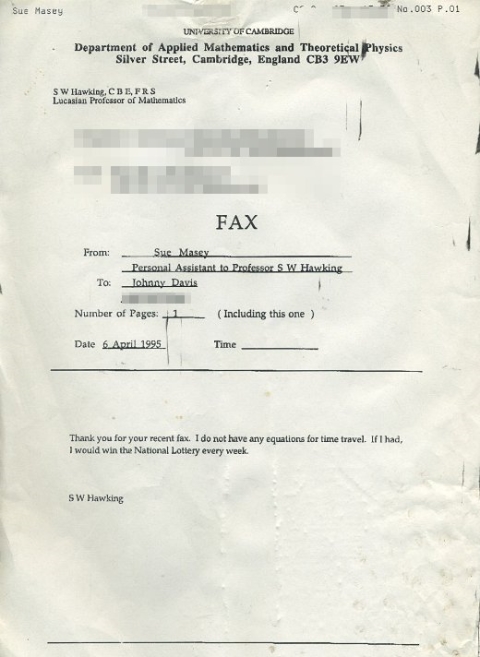
Another fax of note uses the medium to opposite effect; Stephen Hawking’s fax (above), also from 1995, responds to a request from erstwhile British music and fashion magazine The Face for the formula for time travel. Hawking replies, via his personal assistant, “Thank you for your recent fax. I do not have any equations for time travel. If I had, I would win the National Lottery every week.” Unlike Iggy’s explosion of handwritten bile, Hawking’s missive retains all the formal properties of the fax—appropriate institutional letterhead, “from” and “to” lines, etc—which makes his pithy retort all the more incongruous.
While the 1980s and ’90s were boom times for fax transmissions, the machine actually dates back to 1843, when it was patented by Scottish inventor Alexander Bain. As early as 1902, fax technology allowed photographs to be sent over telephone lines. And yes, as every frustrated administrative assistant knows too well, the humble fax machine is still in use in offices around the world, transmitting blearingly boring messages, as well as the occasional flash of individuality. For more on famous faxes, see this helpful infographic from our reader.
H/T @jaclynlambert
Related Content:
From The Stooges to Iggy Pop: 1986 Documentary Charts the Rise of Punk’s Godfather
Seven Questions for Stephen Hawking: What Would He Ask Albert Einstein & More
David Bowie’s First American Fan Letter And His Evolving Views of the U.S. (1967–1997)
Josh Jones is a writer, editor, and musician based in Washington, DC. Follow him @jdmagness
Read More...Tom Waits, Playing the Down-and-Out Barfly, Appears in Classic 1978 TV Performance
Musically, Tom Waits has come a long way since the 1970s. Absorbing a range of influences, Waits has reinvented himself several times over to become one of the most influential writers and performers of our time.
Along the way he has also made his mark as a character actor. But “parallel career” would be the wrong phrase to describe Waits’s film and television work, for his music and acting have always intersected. Never was this more apparent than in the 1970s, when Waits cultivated the persona of a down-and-out barfly with the soul of a Beat poet.
That early phase of Waits’s career is preserved in this highly theatrical 54-minute television performance. It was recorded on December 5, 1978 at the University of Texas for a March 24, 1979 broadcast of Austin City Limits. The program was later released on DVD as Burma Shave. Waits is joined by Herbert Hardesty on trumpet and tenor saxophone, Arthur Richards on guitar, Greg Cohen on bass, and Big John Thomassie on drums. Here’s the set list:
- Summertime Blues
- Burma Shave
- Annie’s Back in Town
- I Wish I Was in New Orleans
- Ain’t Gonna Rain
- Bullets
- On the Nickel
- Romeo is Bleeding
- Silent Night
- Christmas Card from a Hooker in Minneapolis
- Small Change
- Hey Big Spender
- Small Change
Related content:
Tom Waits Makes Comic Appearance on Fernwood Tonight (1977)
Tom Waits’s Classic Appearance on Australian TV, 1979
Tom Waits and Keith Richard Sing Sea Song ‘Shenandoah’ for New Pirate-Themed CD
Read More...Font Based on Sigmund Freud’s Handwriting Coming Courtesy of Successful Kickstarter Campaign
Doctor, what does it mean if you dream of creating a font of Freud’s handwriting?
This is exactly what German typographer Harald Geisler has in mind, and, in the spirit of self-actualization, he’s funding the project on Kickstarter. His charisma is such that he’s already raised over eight times the original $1500 goal that will allow him to travel to Vienna, where he will create the typeface in a borrowed apartment within walking distance from Freud’s former home at Berggasse 19. That address is now home to the Sigmund Freud Museum, where the romantically-minded Geisler plans to visit the hard copies of the eight letters from which his alphabet will be assembled.
Don’t let the project’s fully-in-the-black status keep you from visiting its fundraising page. In addition to being an inadvertent tutorial on the elements of a top-notch Kickstarter campaign, it also provides some interesting information with regard to penmanship, font creation, and the difference between Kurrent, the German-style script Freud learned as a schoolboy, and the Latin-style cursive that was standard among his North American patients.
Geisler says it cracks him up to imagine someone jotting a note to his or her shrink in Freud’s handwriting. Perhaps those of us not currently under the care of a psychiatry professional could use it to write our mothers.
Related Content:
Sigmund Freud Speaks: The Only Known Recording of His Voice, 1938
Jean-Paul Sartre Writes a Script for John Huston’s Film on Freud (1958)
Sigmund Freud’s Home Movies: A Rare Glimpse of His Private Life
Ayun Halliday has never regretted her childish decision to ape her mother’s highly idiosyncratic hand.
Read More...Drones Over America!: Two Animated Satires of Misguided American Policy
Drones over America –they’re a high tech assault on American constitutional rights, and they deserve to be met with a modern form of dissent, something more than a cranky op-ed in the pages of The New York Times. In this case, animated satire feels just about right. Enter Drew Christie, who created a satirical “Op-Doc” for the Times that mocks plans to use drones to police America. Christie hails from Seattle, whose police force recently announced it would adopt an aerial drone program. When the plan was later scuttled, K.G.B. agents everywhere were very upset. Who could blame them, seeing that we were so close to achieving our brave new world?
If Mr. K.G.B. feels a little too severe, then why not have a little fun with Mr. Blasty? He’s adorable, a barrel of laughs, but he pulls no punches. “While you’re all suddenly wondering about me and my drone friends blowing you to bits in Bowling Green, I’ve been busy abroad for years killing thousands!…” “Don’t worry, they’re usually just foreigners though. But whether they’re foreigners or citizens– first comes firepower [blam], then comes legalese! And if the legalese doesn’t work, there’s always “state secrets” where nobody knows nothin’–.” The more the administrations the change, the more they stay the same.
Read More...Frank Zappa Reads NSFW Passage From William Burroughs’ Naked Lunch (1978)
You may struggle to find two more iconoclastic countercultural figures than William S. Burroughs and Frank Zappa. The well-known names conceal often less well-known and at times inaccessible or downright infuriating work and personalities. Despite their sometimes too-easy association with the movements they helped birth, neither Burroughs nor Zappa fits comfortably with free-wheeling Beat sensibilities or flowery California hippie culture. They were both simply too contrary, cultivated or, at times, too weird and antisocial for that.
But these confounding tendencies make both artists perennially interesting. Despite their differences—in medium, age, and background—both share at least two significant traits: a wry, blasphemous sense of humor and descent from families integral to U.S. technocratic supremacy: Burroughs the grandson of the inventor of the adding machine and Zappa the son of a chemist and mathematician who helped make chemical weapons. Maybe it’s historical irony that the Burroughs and Zappa families produced such errant offspring, maybe it’s a dialectical inevitability. But it’s certainly fitting that the two come together in the audio above, where Zappa reads a particularly funny and profane passage from Burroughs’ most famous novel Naked Lunch.
The occasion of this reading was the Nova Convention in 1978, three days and nights of readings, panel discussions, film screenings, and performances that, The New York Times wrote at the time, “sought to grapple with some of the implications of the writing” of Burroughs. In addition to Burroughs and Zappa, the convention featured such notable countercultural names as Terry Southern, Patti Smith, Philip Glass, Brion Gysin, John Cage, Timothy Leary, and Robert Anton Wilson. A good bit of the happening (including the audio above) was recorded for posterity and released as a double-LP by Giorno Poetry Systems.
Related Content:
Beat Writer William S. Burroughs Spreads Counterculture Cool on Nike Sneakers, 1994
William S. Burroughs Shows You How to Make “Shotgun Art”
Frank Zappa Debates Censorship on CNN’s Crossfire (1986)
Josh Jones is a writer, editor, and musician based in Washington, DC. Follow him @jdmagness
Read More...Philip K. Dick Previews Blade Runner: “The Impact of the Film is Going to be Overwhelming” (1981)

Click the image to view larger version
Last week we featured studio-executive notes on Blade Runner. “This movie gets worse every screening,” they said. “Deadly dull,” they said. “More tits,” they said. These remarks now offer something in the way of irony and entertainment, but they only give even the most avid Blade Runner enthusiast so much to think about. For a more interesting reaction, and certainly a more articulate one, we should turn to Philip K. Dick, the prolific writer of psychologically inventive science fiction whose Do Androids Dream of Electric Sheep? provided Blade Runner’s source material. Dick, alas, would not live to see the film open in theaters, much less ascend to the top of the canon of sci-fi cinema decades later, but he did get a good look, before moving on to other realms, at the script and some of the footage. With just those, he managed to outguess everyone — audiences, critics, and especially studio executives — about the film’s fate.
“This indeed is not science fiction,” Dick wrote in a letter available on his official site. “It is not fantasy; it is exactly what [star] Harrison [Ford] said: futurism. The impact of Blade Runner is simply going to be overwhelming, both on the public and on creative people — and, I believe, on science fiction as a field. [ … ] Nothing we have done, individually or collectively, matches Blade Runner. This is not escapism; it is super realism, so gritty and detailed and authentic and goddam convincing that, well, after the segment I found my normal present-day ‘reality’ pallid by comparison.” 32 years on, many of us frequent Blade Runner-watchers feel just the same way, and Dick wrote that after catching nothing more than a segment about the picture on the news. “It was my own interior world,” he later told interview John Boonstra. “They caught it perfectly.” And, at this point, all of our interior worlds look a little more Blade Runner-esque.
H/T to Marianne for the lead on the PKD letter.
Related Content:
The Blade Runner Sketchbook: The Original Art of Syd Mead and Ridley Scott Online
Colin Marshall hosts and produces Notebook on Cities and Culture and writes essays on literature, film, cities, Asia, and aesthetics. He’s at work on a book about Los Angeles, A Los Angeles Primer. Follow him on Twitter at @colinmarshall.
Read More...Dan Ariely’s MOOC, “A Beginner’s Guide to Irrational Behavior,” Starts Monday
Back in November we gave you a heads up on A Beginner’s Guide to Irrational Behavior, a MOOC being created by Dan Ariely. If you’re a frequent visitor to our site, you know that Ariely is a professor of psychology and behavioral economics at Duke University, who has previously explained by why well-intentioned people lie, and why CEOs repeatedly get outsized bonuses that have no basis in rationality. Ariely’s six-week course finally begins tomorrow (Monday the 25th), so, before you miss the boat, reserve your free seat today.
A Beginner’s Guide to Irrational Behavior now appears on our list of 300 Free MOOCs from Great Universities.
Read More...100 Metropolitan Museum Curators Talk About 100 Works of Art That Changed How They See the World
Which best describes your museum-going experience? Inspiration and spiritual refreshment? Or a soul crushing attempt to fight your way past the hoards there for the latest blockbuster exhibit, with a too-heavy bag and a whining, foot sore companion in tow?
Wouldn’t it be wonderful to lose yourself in contemplation of a single work? What about that giant one at the top of the Metropolitan Museum of Art’s Grand Staircase? For every visitor who pauses to take it in, another thousand stream by with hardly a glance.
The above commentary by curator of Italian paintings, Xavier Salomon, may well turn Giovanni Battista Tiepolo’s The Triumph of Marius into one of the Met’s hottest attractions. It’s often difficult for the average museum-goer to understand what the deal is in one of these densely populated, 19th century oils. Salomon supplies the needed historical context—general Gaius Marius parading captive Numidian king Jugurtha through the streets upon his triumphal return to Rome.
Things get even more interesting when he translates the Latin inscription at the top of the canvas: “The Roman people behold Jugurtha laden with chains.” In other words, you can forgo the hero worship of the title and concentrate on the bad guy. This, Salomon speculates, is what the artist had in mind when swathing Jugurtha in that eye-catching red cape. Jugurtha may be the loser, but his refusal to be humbled before the crowd is winsome.
As is 82nd and 5th, an online series that aims to celebrate 100 transformative works of art from the museum’s collection before year’s end. In addition to Salomon’s compelling thoughts on The Triumph of Marius, some pleasures thus far include Melanie Holcomb, Associate Curator of Medieval Art and The Cloisters, geeking out over illustrated manuscript pages and fashion and costume curator Andrew Bolton recalling his first encounter with one of designer Alexander McQueen’s most extreme garments. Each video is supplemented with a tab for further exploration. You can also find the talks collected on YouTube.
Brilliantly conceived and executed, these commentaries provide virtual museum-goers with a highly personal tour, and can only but enrich the experience of anyone lucky enough to visit in the flesh.
Related Content:
Download Hundreds of Free Art Catalogs from The Metropolitan Museum of Art
Google Art Project Expands, Bringing 30,000 Works of Art from 151 Museums to the Web
Free: The Guggenheim Puts 65 Modern Art Books Online
Ayun Halliday has her fingers crossed for some commentary on the Met’s hunky Standing Hanuman.
Read More...Support Us
We're hoping to rely on loyal readers, rather than erratic ads. Please click the Donate button and support Open Culture. You can use Paypal, Venmo, Patreon, even Crypto! We thank you!

About Us

Open Culture scours the web for the best educational media. We find the free courses and audio books you need, the language lessons & educational videos you want, and plenty of enlightenment in between.
Advertise With Us

FREE UPDATES!
GET OUR DAILY EMAIL
Get the best cultural and educational resources on the web curated for you in a daily email. We never spam. Unsubscribe at any time.
FOLLOW ON SOCIAL MEDIA

Open Culture editor Dan Colman scours the web for the best educational media. He finds the free courses and audio books you need, the language lessons & movies you want, and plenty of enlightenment in between.
Advertise With Us

