Watch the New Pirate Bay Documentary Free Online
Last Friday night, TPB AFK: The Pirate Bay Away From Keyboard premiered at the Berlin Film Festival. Moments later, the indie documentary became freely available online, which left the film’s director, Simon Klose, grinning, not grumbling. It makes sense when you consider the premise of the film. Pirate Bay is, of course, the web site that allows users to share media (music, movies, games, software) through a peer-to-peer file sharing protocol, some of it copyrighted, some of it not. And the new film, writes Wired, documents “the hectic trial of Pirate Bay administrators Fredrik Neij, Gottfrid Svartholm Warg, and Peter Sunde, who were eventually convicted in a civil and criminal copyright case in Sweden in 2009 that pitted them against the government and the entertainment industry.”
TPB AFK is available on YouTube and Pirate Bay too. It’s also listed in our collection of Free Documentaries, part of our collection of 635 Free Movies Online.
Read More...When Orson Welles Met H.G. Wells in 1940: Hear the Legends Discuss War of the Worlds, Citizen Kane, and WWII
What connects Orson Welles, that quintessential American auteur of radio and film, to H.G. Wells, the far-seeing English proto-science fiction novelist? You’ve got the near-identical surnames, for one, but even more obviously, Welles adapted The War of the Worlds, Wells’ seminal tale of alien invasion, into a famously country-spooking 1938 radio production of the same name. You can hear it below. Thanks to KTSA in San Antonio, these two luminaries were able to make a direct connection on the radio two years after that broadcast, and you can hear a clip of this Wells/Welles conversation with the video above. On the country-wide freakout Welles caused with Wells’ source material, the writer has this to say: “We [in England] had articles about it, and people said, ‘Have you never heard of Halloween in America, when everybody pretends to see ghosts?’ ”
Though this recording runs for only seven and a half minutes, it makes clear that Wells has plenty to say to the man he calls “my little namesake, Orson.” The enthusiasm goes both ways; they trade remarks on Welles’ broadcasts, Wells’ ideas, Hitler, and the war in Europe. Wells wonders aloud if Americans can only still enjoy a thrill at War of the Worlds-style terror because — the year was 1940 — “You haven’t got the war right under your chins.” When he asks after Welles’ next project, the director describes it as “a new sort of motion picture, with a new method of presentation, and a few new technical experiments.” He refers, of course, to a certain upcoming entertainment by the name of Citizen Kane. This little dialogue reveals one skill Orson Welles and H.G. Wells, for all the differences between their areas of mastery, have in common: understatement.
Related content:
The War of the Worlds on Podcast: How H.G. Wells and Orson Welles Riveted A Nation
Orson Welles Explains Why Ignorance Was the Genius Behind Citizen Kane
The Dead Authors Podcast: H.G. Wells Comically Revives Literary Greats with His Time Machine
Raymond Chandler & Ian Fleming in Conversation (1958)
Colin Marshall hosts and produces Notebook on Cities and Culture and writes essays on literature, film, cities, Asia, and aesthetics. He’s at work on a book about Los Angeles, A Los Angeles Primer. Follow him on Twitter at @colinmarshall.
Read More...Download Eight Free Lectures on The Hobbit by “The Tolkien Professor,” Corey Olsen
The name Corey Olsen may already be familiar to some readers—or at least those readers who venerate the literary accomplishments of one J.R.R. Tolkien. And if you don’t know Olsen by his real name, you may know him as “The Tolkien Professor,” his internet moniker since 2009, when Olsen, an English Professor at Washington College and lifelong student of Tolkien’s writing, decided to share his own scholarly work with a public “eager to be included in thoughtful, literary conversation” about The Hobbit and The Lord of the Rings trilogy.
For the past four years, Olsen has published specifically online lectures about Tolkien’s work, as well as recordings of his Washington College seminars on Tolkien’s fiction and academic work. He has most recently founded Signum University, an online, non-profit Liberal Arts college that aims to open the experience of high-quality higher ed to everyone, regardless of their means or their location. Signum has, in turn, spawned the Mythgard Institute, which seems (as the name implies) more exclusively focused on the fantasy and science fiction genres that are Olsen’s métier. (There are also college prep options in Signum and Mythgard Academies).
So, Professor Olsen is busy, and he’s happy to be sharing his wealth of Tolkien knowledge with a very receptive public. His most recent course, an eight-part lecture series on The Hobbit, is now available on his site. (iTunes U also has it as of January 31st. Watch the promo for the course above. We also have the class listed in our collection of 650 Free Courses Online.) The course comes via the Mythgard Institute and begins at the beginning in a lecture entitled “Took & Baggins” focused on The Hobbit’s first chapter, “An Unexpected Party.” Recorded before the release of Peter Jackson’s first installment of his trilogy of Hobbit films, the lecture starts with Olsen’s speculations about what those films might look like. He says:
From the beginning, I have thought this was a mistake… a big mistake to go backwards. It seems to me that an audience familiar with the epic grandeur of Peter Jackson’s trilogy is going to bring expectations to a new Tolkien movie that’s going to set a Hobbit film up for one of two very likely failures. Either the movie is going to try tell Bilbo’s story in the mode and register of the Lord of the Rings, and therefore strip the story of the light-heartedness and whimsicality that makes it so delightful, or it’s going to try to be true to the tone and spirit of the book, and will therefore seem kind of silly and childish to an audience hoping for a successor to Peter Jackson’s films.
This is a very canny prediction, and such canniness distinguishes Olsen’s approach to everything Tolkien. He is attuned not only to all of the scholarly minutiae that distinguishes academic Tolkien studies, but he is also well-aware of issues of audience reception and the ever-evolving role of Tolkien’s work in popular culture. As his first lecture continues, Professor Olsen makes it quite clear that The Hobbit was deliberately written as a children’s story, and the successive books were meant to be as well. The Lord of the Rings books became more adult, darker and more fraught with heavy theological and mythical significance, as Tolkien composed them. This happened in part because Tolkien was writing with his own children in mind as his readers, and as he wrote, his kids grew up.
Tolkien, Olsen points out, was by training a philologist—a scholar who specializes in the study of languages—so he thought about not only what words mean, but where they come from and when. As such, he intended The Hobbit to possess a “linguistic playfulness,” mixing ancient and modern words and usages, making up words a la Lewis Carroll, to create a lighthearted and comic atmosphere from the beginning of the novel. Olsen provides us with several examples of this method in his first lecture. Overall, his analysis is a thorough evaluation of the novel in the terms of its language, its composition, its many layers of genre and style—drawing from Tolkien’s explicitly articulated theories of narrative—and its historical and literary allusions. All presented in a very enthusiastic and accessible style that is aimed at every adult reader and lover of Tolkien, not just fellow scholars, who tend to speak a specialized language that excludes nearly everyone outside their narrow coterie.
In the video above—a TED talk Olsen delivered at TEDx Chester River—he discusses how the world of academe, that specialized world that excludes almost everyone, had become a stifling and rather meaningless place for him when he decided to become the online Tolkien Professor. Olsen had what he calls an existential crisis about academia and scholarly publishing—What’s the point?, he thought. Who’s going to read it? Since most people can’t access scholarly publications even if they wanted to, and since he was writing on Tolkien, one of the world’s most popular authors, he felt doubly irrelevant as a cloistered academic, since Tolkien fans are everywhere. Then he discovered something everybody else already knew about the internet—it’s an ideal medium for publishing and disseminating any kind of information, and it’s crowded with people desperate to learn about and discuss the liberal arts. As more and more academics discover this as well, more also cure their existential malaise by opening up their work to everyone online, becoming resources, not gatekeepers, for knowledge.
Related Content:
Listen to J.R.R. Tolkien Read a Lengthy Excerpt from The Hobbit (1952)
Fantastic BBC Footage of J.R.R. Tolkien in 1968
Free Audio: Download the Complete Chronicles of Narnia by C.S. Lewis
Josh Jones is a writer, editor, and musician based in Washington, DC. Follow him @jdmagness
Read More...Ella Fitzgerald Sings ‘Summertime’ by George Gershwin, Berlin 1968
Here’s a beautiful performance by Ella Fitzgerald of “Summertime,” the famous lullaby from the 1935 George Gershwin opera Porgy and Bess. The lyrics are by DuBose Heyward, who wrote the novel the opera is based on.
Summertime,
And the livin’ is easy
Fish are jumpin’
And the cotton is high
Oh, your daddy’s rich
And your mamma’s good lookin’
So hush little baby
Don’t you cry
It was filmed on February 11, 1968 at the Deutschlandhalle in Berlin. Fitzgerald was on a 21-city tour of Eastern and Western Europe, presented by Norman Granz. She was accompanied by the Tee Carson Trio, with Carson on piano, Keter Betts on bass and Joe Harris on drums.
If you would like to support the mission of Open Culture, consider making a donation to our site. It’s hard to rely 100% on ads, and your contributions will help us continue providing the best free cultural and educational materials to learners everywhere. You can contribute through PayPal, Patreon, and Venmo (@openculture). Thanks!
Related Content:
Gershwin Plays Gershwin: The Piano Version of ‘Rhapsody in Blue,’ 1925
Read More...Alain de Botton Presents Ten Virtues for the Modern Day
At the end of my college years, I found I needed to take one final political science course to complete my major. I chose a small summer session on the subject of virtue. Having enrolled with no idea what to expect, I finished the quarter less changed by the assigned readings and classroom discussions than by the very — and very unusual — task of having to think about virtue at all. Jokes about the distance of virtue from modern college students’ minds write themselves, but Alain de Botton, a man given to much thought and writing about such lost topics, suspects that the same condition afflicts all of us. Hence his introducing, under the banner of his institution The School of Life, the Virtues Project. It emerges into an unreceptive environment. As de Botton puts it in this introductory post, “In the modern world, the idea of trying to be a ‘good person’ conjures up all sorts of negative associations: of piety, solemnity, bloodlessness and sexual renunciation, as if goodness were something one would try to embrace only when other more difficult but more fulfilling avenues had been exhausted.”
“Throughout history,” he continues, “societies have been interested in fostering virtues, in training us to be more virtuous, but we’re one of the first generations to have zero public interest in this.” In order to bring that number up, de Botton and The School of Life have enumerated ten simple but universal virtues — resilience, empathy, patience, sacrifice, politeness, humor, self-awareness, forgiveness, hope, and confidence — and embedded them in a manifesto, of which you can download a handsome PDF version. This provides the foundational text of the Virtues Project, a component of de Botton’s larger mission, laid out in his recent book Religion for Atheists, to repurpose for modern society the elements of faith that have demonstrated practical value throughout history. Since my adult life, which effectively began as that last poli-sci course ended, has chiefly presented the challenge of winning and maintaining my own self-respect, I’ll be committing these ten virtues to memory, and no doubt watching for the Virtues Project’s lectures and public events to come.
Related content:
Alain de Botton Wants a Religion for Atheists: Introducing Atheism 2.0
Socrates on TV, Courtesy of Alain de Botton (2000)
Alain de Botton Proposes a Kinder, Gentler Philosophy of Success
Colin Marshall hosts and produces Notebook on Cities and Culture and writes essays on literature, film, cities, Asia, and aesthetics. He’s at work on a book about Los Angeles, A Los Angeles Primer. Follow him on Twitter at @colinmarshall.
Read More...Hear Walt Whitman (Maybe) Reading the First Four Lines of His Poem, “America” (1890)
Of all American poets, almost no one looms larger than Walt Whitman. As I once heard an old poet acquaintance say, American poets don’t need Shakespeare and the Bible; we’ve got Dickinson and Whitman. Indeed, Whitman’s voice emerges from the past like some American Moses, showing the way forward, opening his arms to hold his fractious countrymen together. One can bloviate all day about Walt Whitman. He tends to have that effect. But even Whitman, he of the serpentine lines full of the cargo of the continent, stretching from left margin to right, ocean to ocean, could be relatively succinct, and even about his favorite subject, America. Take his poem “America” from 1888:
Centre of equal daughters, equal sons,
All, all alike endear’d, grown, ungrown, young or old,
Strong, ample, fair, enduring, capable, rich,
Perennial with the Earth, with Freedom, Law and Love,
A grand, sane, towering, seated Mother,
Chair’d in the adamant of Time.
Now, believe it or not, you can hear what may well be the voice of Walt Whitman, American Moses, emerging from the past to read the first four lines of “America,” from a wax cylinder recording above. Most likely captured in 1889 or 1890 by Thomas Edison, this reading was originally found on a cassette called “The Voice of the Poets,” discovered in a library by Whitman scholar Larry Don Griffin. The cassette, made in 1974 and including the voices of Edna St. Vincent Millay and William Carlos Williams, takes the Whitman audio from a 1951 NBC radio program, whose announcer, Leon Pearson, claims comes from a wax cylinder recording made in 1890.
Surprisingly, the ’74 cassette tape, which landed in libraries across the country, seemed to go unnoticed by scholars until Griffin mentioned it in the Walt Whitman Quarterly Review in 1992. This mention sparked debate about the authenticity of the recording, and once scholarly debate is sparked, the fire can burn for decades, whole careers built on its embers. In this case, some scholars, including historian Allen Koenigsberg, argued that since no original wax cylinder has appeared, and mention of the recording in Edison’s correspondence is inconclusive, the provenance is suspect. Furthermore, Koenigsberg argued, the recording quality seems too good for the period. His conclusion comes backed by the analysis of audio experts. According to The Edisonian, a Rutger’s University Edison newsletter:
Analysts for both the Library of Congress and the Rodgers and Hammerstein Archives consulted on the case and agreed that the clarity of the recording was beyond what could be achieved in 1889 or 1890… the sound analysis along with the documentation difficulties led Koeningsberg to conclude that “the supposed Whitman recording is a fascinating fake.”
On the other side of this debate is the editor of the Walt Whitman Quarterly Review, Ed Folsom, who presents his case in an article simply titled “The Whitman Recording,” in which he discusses problems with the Library of Congress analysis. Yet another partisan for authenticity, William Grimes—who covered the controversy for The New York Times points out that the voice sounds like what Whitman’s would have, and he makes a compelling argument that the poem would not at all be the obvious choice for a fake. Grimes cites unnamed “specialists in the history of the phonograph,” whom, he writes, “agree… that the possibility of outright fraud or a hoax is unlikely.”
And on it goes. No one can definitively settle the case, unless new evidence should come to light. With no intention of maligning Ed Folsom’s good faith, I can imagine the Whitman Quarterly editor wanting this to be true more than historian Koenigsberg and the LOC analysts. But I also want it to be Whitman, and so I’m glad to make an exuberant leap of American faith and think it’s him. From Edison wax cylinder recording, to radio broadcast, to cassette, to mp3, over more than a century of American poetry—it would be a perfectly Whitmanesque journey.
via @stevesilberman
Related Content:
Voices from the 19th Century: Tennyson, Gladstone, Whitman & Tchaikovsky
Thomas Edison Recites “Mary Had a Little Lamb” in Early Voice Recording
Mark Twain Captured on Film by Thomas Edison in 1909.
Josh Jones is a writer, editor, and musician based in Washington, DC. Follow him @jdmagness
Read More...Backed by 157 Musicians, Beck Reimagines David Bowie’s 1977 Classic, “Sound and Vision”
The last time we looked, the singer-songwriter known as Beck contributed to the fall musical production, Rework: Philip Glass Remixed, before publishing Song Reader, a series of 20 songs released not as recorded music, but as sheet music meant for other musicians to interpret and perform. (Listen here to what the Portland Cello Project did with the Song Reader collection.) Now, Beck turns to an entirely different project. On Sunday night, the versatile musician appeared on a soundstage at 20th Century Fox in L.A., where he performed David Bowie’s 1977 song, “Sound and Vision,” backed by a 157-piece orchestra conducted by his own father, the composer and arranger David Campbell. According to Rolling Stone, the event was sponsored by Lincoln, the Detroit carmaker, who is using Beck’s version of “Sound and Vision” for a new ad campaign. Happily, David Bowie gave his enthusiastic blessing to the project.
Related Content:
The Story of Ziggy Stardust: How David Bowie Created the Character that Made Him Famous
Hear Beck’s Song Reader Songbook Performed by the Portland Cello Project
How “Space Oddity” Launched David Bowie to Stardom: Watch the Original Music Video From 1969
Read More...Musicians Re-Imagine the Complete Songbook of the Beatles on the Ukulele
We hold this truth to be self-evident—if every citizen spent a little bit of time playing the ukulele, the world would be a nicer place.
Such is the declaration of the The Beatles Complete on Ukulele, an online project that pretty much does what it says: compiles ukulele covers of every Beatles song—individually or in album form—from a surprising variety of amateur and obscure artists. As an owner, occasional strummer, and general enthusiast of the uke myself, I do believe these folks are onto something with their vision of a “nicer place.” Just listen to The Fort Green Children’s Choir’s cover of “Yellow Submarine” and try to stop yourself from smiling. If simply listening to the uke can make you calm and happy, imagine what playing one can do?
Now, if you’re thinking of the whole thing as Tiny Tim in the tulips, think again. Sure, there’s a novelty aspect to the idea, as the goofy video above—with The Cars’ keyboardist Greg Hawkes’ doing his rendition of “Eleanor Rigby”—attests; but as it also attests, these covers can be fully realized and quite beautiful arrangements (Hawkes recorded an entire album of Beatles songs on the uke).
While the ukulele’s humorously small size and frequent use in prop comedy, faux-Hawaiian surf movies, and twee indie folk revivalism has rendered it a little ridiculous, this image deceives. Make no mistake, the tiny Polynesian four-string guitar (which comes in four sizes and registers: soprano, concert, tenor, and baritone) is a seriously versatile instrument with a full range of timbres and tones. If you’re still unconvinced, then prepare to be blown away by renowned virtuoso uke-player Jake Shimabukuro’s take on George Harrison’s “While My Guitar Gently Weeps” (below).
As you can see, the ukulele is suited to the task of interpreting the Beatles’ catalogue, especially since the band themselves had such a high regard for ukes. Harrison loved the instrument, as Paul McCartney tells us in the video below. Watch as Macca—live, in tribute to Harrison—strums out a lovely version of “Something” on his ukulele.
Related Content:
The Beatles: Unplugged Collects Acoustic Demos of White Album Songs (1968)
Download The Beatles’ Yellow Submarine as a Free, Interactive eBook
Josh Jones is a writer, editor, and musician based in Washington, DC. Follow him @jdmagness
Read More...Kerouac Wore Khakis: Ghost of the Beat Writer Stars in 1993 Gap Advertising Campaign
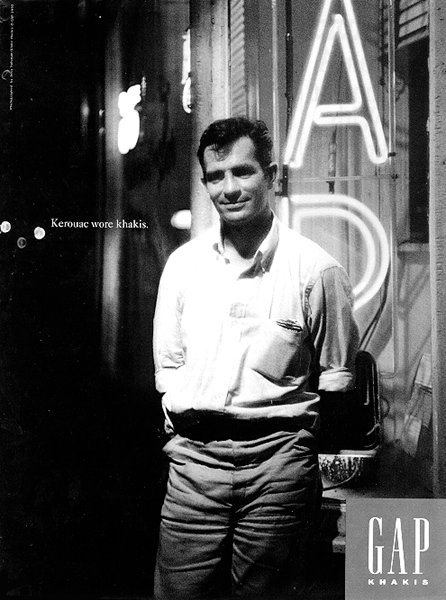
“When [Jack] Kerouac died in 1968 at the age of 47, he was a broken alcoholic, his literary reputation so depleted he was unable even to find a paperback publisher for his last novel, Vanity of Duluoz,” writes The Telegraph. “Unsure of what value to put on his estate, the bank valued it at a nominal $1. Over the years, it would rise to an estimated $20m.” As The Telegraph goes on to describe, the Kerouac estate started generating its wealth when, during the 1990s, feuding relatives, exercising questionable authority over the writer’s literary remains, began auctioning things off. The original manuscript of On The Road was sold to James Isray, owner of the Indianapolis Colts, for $2.43 million. Johnny Depp paid $50,640 for Kerouac’s raincoat, tweed overcoat and other personal belongings. And photos were licensed off to corporations.
Enter the Gap’s 1993 “Kerouac Wore Khakis” advertising campaign. The campaign drew on images taken in 1958, when Jerry Yulsman followed Jack Kerouac around Greenwich Village, taking pictures for Pageant Magazine. (See originals here and here.) 35 years later, Madison Ave. marketers airbrushed the images, stripped them of color, and, somehow found a way to graft onto stodgy pants, worn by desk jockeys nationwide, the illusion of freedom. That sleight of hand would make Don Draper proud. As for what happened in Kerouac’s grave, we can only conjecture.
We’ll have more from the annals of commercializing the Beats tomorrow.
Related Content:
Jack Kerouac’s Naval Reserve Enlistment Mugshot, 1943
Bob Dylan and Allen Ginsberg Visit the Grave of Jack Kerouac (1979)
Jack Kerouac’s Hand-Drawn Cover for On the Road
Kerouac Reads from On the Road (1959)
Read More...Hear Sylvia Plath Read ‘Lady Lazarus’ on the 50th Anniversary of Her Death
In the early morning hours of Monday, February 11, 1963, Sylvia Plath brought food and drink into the bedroom of her two sleeping young children. She opened a window in their room and attached a note with her doctor’s name and phone number to a baby carriage in the hallway. She then went into the kitchen and sealed it off with tape and wet towels. She turned on the gas and put her head into the oven.
It was a sad ending for a woman who had struggled for much of her life with mental illness. She was 30 years old. But with the critical and popular success of Ariel, the posthumously published collection of poems written during the last months of her life, Plath’s suicide became one of the most mythologized events in the history of 20th century letters. The grim event of 50 years ago is inextricably bound up with Plath’s legacy as a poet.
In recognition of that fact, we mark the anniversary with a recording Plath made at the BBC studios in December, 1962, of one of her most celebrated poems–one she had only recently written, called “Lady Lazarus.” The version Plath reads contains two lines that were cut from the published poem. (You can open the text in a new window to read while you listen.) “Lady Lazarus” is a disturbing poem, with imagery from the Holocaust grafted onto personal–one might say narcissistic–revelations of suicidal obsession. The sinister, malevolent tone is especially chilling when you hear it in Plath’s own voice:
Herr God, Herr Lucifer
Beware
Beware.
Out of the ash
I rise with my red hair
And I eat men like air.
For more on Plath’s life and her complicated and contentious literary legacy, and to hear another of her readings, see our October 27, 2012 post, “For Sylvia Plath’s 80th Birthday, Hear Her Read ‘A Birthday Present.’ ”
Read More...Support Us
We're hoping to rely on loyal readers, rather than erratic ads. Please click the Donate button and support Open Culture. You can use Paypal, Venmo, Patreon, even Crypto! We thank you!

About Us

Open Culture scours the web for the best educational media. We find the free courses and audio books you need, the language lessons & educational videos you want, and plenty of enlightenment in between.
Advertise With Us

FREE UPDATES!
GET OUR DAILY EMAIL
Get the best cultural and educational resources on the web curated for you in a daily email. We never spam. Unsubscribe at any time.
FOLLOW ON SOCIAL MEDIA

Open Culture editor Dan Colman scours the web for the best educational media. He finds the free courses and audio books you need, the language lessons & movies you want, and plenty of enlightenment in between.
Advertise With Us