Albert Einstein Expresses His Admiration for Mahatma Gandhi, in Letter and Audio
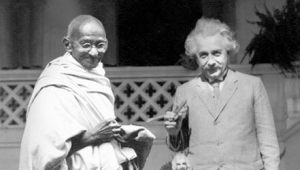
In 1931, Albert Einstein wrote to Mohandas K. Gandhi to express his great admiration for the Indian leader’s methods. Translated from German, the letter reads in part:
You have shown through your works, that it is possible to succeed without violence even with those who have not discarded the method of violence.
The letter long precedes the first atomic bombs and Einstein’s letters to F.D.R. warning of their development and use; though often discussed only in relation to the horrific events of World War II, the physicist’s opposition to violence and war was a longstanding passion for him. Einstein called his pacifism an “instinctive feeling” based only on his “deepest antipathy to every kind of cruelty and hatred,” rather than any “intellectual theory.” His politics often paralleled those of fellow intellectual giant and anti-war activist Bertrand Russell (the two collaborated on a 1955 “Manifesto” for peace).
Gandhi remained an important influence on Einstein’s life and thought. In the audio clip above from 1950, he again offers generous praise for the man known as “Mahatma” (great soul). In the recording, Einstein says of Gandhi:
I believe that Gandhi’s views were the most enlightened of all the political men of our time. We should strive to do things in his spirit: not to use violence in fighting for our cause, but by non-participation in anything you believe is evil.
Gandhi’s concept of satyagraha, which roughly translates as “devotion to the truth,” appealed to Einstein, perhaps, because of its principled stand against political expediency and for a kind of moral commitment that depended on self-scrutiny and inquiry into cause and effect. Like the counter-intuitive theories of Einstein and Russell, Gandhi biographer Mark Shepard writes that the concept of satyagraha is “a hard one to grasp”–Especially, “for those used to seeing power in the barrel of a gun.”
For more archival recordings of Einstein expressing his views on religion, war and peace, and science, visit American Public Media’s On Being website.
Related Content:
How Bertrand Russell Turned The Beatles Against the Vietnam War
Face to Face with Bertrand Russell: ‘Love is Wise, Hatred is Foolish’
Josh Jones is a writer, scholar, and musician. He recently completed a dissertation on land, literature, and labor.
Watch the Only Known Footage of the Legendary Bluesman Lead Belly (1935 and 1945)
Huddie Ledbetter, better known as “Lead Belly,” was one of the greatest blues musicians of all time. His songs have been covered by hundreds of artists, ranging from Frank Sinatra to Led Zeppelin. Lead Belly is also famous for what his biography at the Rock and Roll Hall of Fame describes as “the mythic outline of his life”:
Born circa 1885 in rural northwest Louisiana, Lead Belly rambled across the Deep South from the age of 16. While working in the fields, he absorbed a vast repertoire of songs and styles. He mastered primordial blues, spirituals, reels, cowboy songs, folk ballads and prison hollers. In 1917, Lead Belly served as Blind Lemon Jefferson’s “lead boy”–i.e., his guide, companion and protégé–on the streets of Dallas. A man possessed with a hot temper and enormous strength, Lead Belly spent his share of time in Southern prisons. Convicted on charges of murder (1917) and attempted murder (1930), Lead Belly literally sang his way to freedom, receiving pardons from the governors of Texas and Louisiana. The second of his releases was largely obtained through the intervention of John and Alan Lomax, who first heard Lead Belly at Angola State Prison while recording indigenous Southern musicians for the library of Congress.
In 1935 the March of Time newsreel company told the story of John Lomax’s discovery of Lead Belly in the short film above. Although the scripted film will strike modern viewers as dubious in some respects (March of Time founder Henry Luce once described the series as “fakery in allegiance to the truth”), the newsreel is nevertheless a fascinating document of Lead Belly, who was about 50 years old at the time, along with Lomax and Martha Promise, Lead Belly’s wife. At one point Lead Belly sings his classic song, “Goodnight, Irene.”
According to Sharon R. Sherman in Documenting Ourselves: Film, Video, and Culture, the 1935 Lead Belly newsreel is the earliest celluloid document of American folklore. Lead Belly did work for Lomax after his second release from prison, as the newsreel says, accompanying him back East to serve as his chauffeur. In New York Lead Belly performed in Harlem and also came into contact with leftist folk singers like Woody Guthrie and Pete Seeger. Lead Belly became known as the “King of the Twelve-String Guitar.”
Three Songs by Leadbelly, the only other film known to exist of the great bluesman, was made ten years after the newsreel. The footage of Lead Belly performing was shot in 1945 by Blanding Sloan and Wah Mong Chang, and edited two decades later by Pete Seeger. The film begins with scenes of the graveyard in Mooringsport, Louisiana, where Lead Belly was buried after his death in 1949, accompanied by an instrumental version (with humming) of “Where Did You Sleep Last Night?” Lead Belly actually performed six songs for the film, but only three could be salvaged. Seeger is quoted by Charles Wolfe and Kip Lornell in The Life and Legend of Leadbelly as describing Sloan’s work as “pretty amateurish”:
I think that he recorded Leadbelly in a studio the day before, then he played the record back while Leadbelly moved his hands and lips in synch with the record. He’d taken a few seconds from one direction and a few seconds from another direction, which is the only reason I was able to edit it. I spent three weeks with a Movieola, up in my barn, snipping one frame off here and one frame off there and juggliing things around. I was able to synch up three songs: “Grey Goose,” “Take This Hammer,” and “Pick a Bale of Cotton.”
If you would like to support the mission of Open Culture, consider making a donation to our site. It’s hard to rely 100% on ads, and your contributions will help us continue providing the best free cultural and educational materials to learners everywhere. You can contribute through PayPal, Patreon, and Venmo (@openculture). Thanks!
Related content:
Legendary Folklorist Alan Lomax: The Land Where the Blues Began
Hear 17,000+ Traditional Folk & Blues Songs Curated by the Great Musicologist Alan Lomax
The Story of Bluesman Robert Johnson’s Famous Deal With the Devil Retold in Three Animations
Read More...The Best of Open Culture 2012: Free Music, Film, Books, Life Advice & More
Another year gone by. Another 1200+ cultural blog posts in the books. Which ones did you like best? We let the data decide. Below, you’ll find the 17 that struck a chord with you.
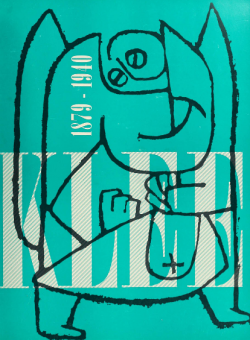 Free Art Books from The Guggenheim and The Met: Way back in January, the Guggenheim made 65 art catalogues available online, all free of charge. The catalogues offer an intellectual and visual introduction to the work of Calder, Munch, Bacon, and Kandinsky, among others. Then, months later, The Met followed suit and launched MetPublications, a portal that now makes available 370 out-of-print art titles, including works on Vermeer, da Vinci, Degas and more.
The Best Animated Films of All Time, According to Terry Gilliam: Terry Gilliam knows something about animation. For years, he produced wonderful animations for Monty Python (watch his cutout animation primer here), creating the opening credits and distinctive buffers that linked together the offbeat comedy sketches. Given these bona fides, you don’t want to miss Gilliam’s list, The 10 Best Animated Films of All Time.
The Higgs Boson, AKA the God Particle, Explained with Animation: Hands down, it was the biggest scientific discovery of the year. But what is the Higgs Boson exactly? Are you still not sure? Phd Comics explains the concept with animation.
Here Comes The Sun: The Lost Guitar Solo by George Harrison: Here’s another great discovery — the long lost guitar solo by George Harrison from my favorite Beatles’ song, “Here Comes the Sun.” In this clip, George Martin (Beatles’ producer) and Dhani Harrison (the guitarist’s son) bring the forgotten solo back to life. When you’re done taking this sentimental journey, also see another favorite of mine: guitarist Randy Bachman demystifying the opening chord of ‘A Hard Day’s Night’.
18 Animations of Classic Literary Works: From Plato and Shakespeare, to Kafka, Hemingway and Calvino: Over the years we have featured literary works that have been wonderfully re-imagined by animators. Rather than leaving these wondrous works buried in the archives, we brought them back and put them all on display. And what better place to start than with a foundational text — Plato’s Republic.
Ray Bradbury Offers 12 Essential Writing Tips and Explains Why Literature Saves Civilization: In June, we lost Ray Bradbury, who now joins Isaac Asimov, Arthur C. Clarke, Robert A. Heinlein, and Philip K. Dick in the pantheon of science fiction. In this post, we revisit two moments when Bradbury offered his personal thoughts on the art and purpose of writing — something he contemplated during the 74 years that separated his first story from the last.
Free Science Fiction Classics on the Web: Speaking of science fiction, we brought you a roundup of some of the great Science Fiction, Fantasy and Dystopian classics available on the web in audio, video and text formats. They include Orwell’s 1984, Huxley’s Brave New World, Asimov’s Foundation Trilogy, C.S. Lewis’ Chronicles of Narnia, many stories by Philip K. Dick and Neil Gaiman, and much more. Find more great works in our collections of Free Audio Books and Free eBooks.
This is Your Brain in Love: Scenes from the Stanford Love Competition: Can one person experience love more deeply than another? That’s what Stanford researchers and filmmaker Brent Hoff set out to understand when they hosted the 1st Annual Love Competition. Seven contestants, ranging from 10 to 75 years of age, took part. And they each spent five minutes in an fMRI machine. It’s to hard watch this short film and not shed a happy tear.
Rare 1959 Audio: Flannery O’Connor Reads ‘A Good Man is Hard to Find’: In April of 1959–five years before her death at the age of 39 from lupus–Flannery O’Connor ventured away from her secluded family farm in Milledgeville, Georgia, to give a reading at Vanderbilt University. She read one of her most famous and unsettling stories, “A Good Man is Hard to Find.” The audio is one of two known recordings of the author reading that story.
33 Free Oscar Winning Films Available on the Web: On the eve of the 2012 Academy Awards, we scouted around the web and found 33 Oscar-winning (or nominated) films from previous years. The list includes many short films, but also some long ones, like Sergei Bondarchuk’s epic version of War & Peace. Sit back, enjoy, and don’t forget our collection of 500 Free Movies Online, where you’ll find many great noir films, westerns, classics, documentaries and more.
The Story Of Menstruation: Walt Disney’s Sex Ed Film from 1946: Staying with movies for a second, we also showed you a very different mid-1940s Disney production – The Story of Menstruation. Made in the 1940s, an estimated 105 million students watched the film in sex ed classes across the US.
30 Free Essays & Stories by David Foster Wallace on the Web: We spent some time tracking down 23 free stories and essays published by David Foster Wallace between 1989 and 2011, mostly in major U.S. publications like The New Yorker, Harper’s, The Atlantic, and The Paris Review. Enjoy, and don’t miss our other collections of free writings by Philip K. Dick and Neil Gaiman.
Everything I Know: 42 Hours of Buckminster Fuller’s Visionary Lectures Free Online (1975): In January 1975, Buckminster Fuller sat down to deliver the twelve lectures that make up Everything I Know, all captured on video and enhanced with the most exciting bluescreen technology of the day. The lecture series is now online and free to enjoy, so please do so.
10 Great Performances From 10 Legendary Jazz Artists: Django, Miles, Monk, Coltrane & More: It’s pretty much what the title says. Great performances by some of our greatest jazz artists. It starts with Billie Holiday singing “Strange Fruit.”
Sigmund Freud Speaks: The Only Known Recording of His Voice, 1938: On December 7, 1938, a British radio crew visited Sigmund Freud at his newhome at Hampstead, North London. He was 81 years old and suffering from incurable jaw cancer. Every word was an agony to speak. The recording is the only known audio recording of Freud, the founder of psychoanalysis and one of the towering intellectual figures of the 20th century. Also see: Sigmund Freud’s Home Movies: A Rare Glimpse of His Private Life.
Serial Entrepreneur Damon Horowitz Says “Quit Your Tech Job and Get a Ph.D. in the Humanities”: Philosophy professor and “serial entrepreneur” Damon Horowitz explains why he left a highly-paid tech career, in which he sought the keys to artificial intelligence, to pursue a Ph.D. in Philosophy at Stanford. Readers will also enjoy The Illustrated Guide to a Ph.D.
Leonard Bernstein’s Masterful Lectures on Music (11+ Hours of Video Recorded in 1973): Delivered at Harvard in ’73, Leonard Bernstein’s lecture series, “The Unanswered Question,” covered a lot of terrain, touching on poetry, linguistics, philosophy and physics. But the focus inevitably comes back to music — to how music works, or to the underlying grammar of music. The masterful lectures run over 11 hours. They’re added to our collection of 650 Free Online Courses. You can also find Borges’ lectures at Harvard here.
Kurt Vonnegut’s Eight Tips on How to Write a Good Short Story: When it came to giving advice to writers, Kurt Vonnegut was never dull. He once tried to warn people away from using semicolons by characterizing them as “transvestite hermaphrodites representing absolutely nothing.” In this brief video, Vonnegut offers eight tips on how to write a short story.
Free Online Certificate Courses & MOOCs from Great Universities: A Complete List: We gathered a list of 200 free massive open online courses (MOOCs) offered by leading universities. Most of these free courses offer “certificates” or “statements of completion.” Many new courses start in January 2013. So be sure to check it out. Also don’t miss our other new resource collection: 200 Free Kids Educational Resources: Video Lessons, Apps, Books, Websites & Beyond.
Read More...The Clock, the 24-Hour Montage of Clips from Film & TV History, Introduced by Alain de Botton
To fully experience the clip above, you’ll need to be awake and pressing play at precisely 12:04 am. What you’ll be seeing is a very small segment of The Clock, a 24-hour video assemblage that keeps time with clips culled from a century’s worth of film history. Some of these markers are in the dialogue, but most are shots of clocks and watches in which a specific time is clearly visible.
If viewing the complete piece sounds like a marathon, consider that artist Christian Marclay and a phalanx of assistants spent three years locating and placing the clips and smoothing out the resulting soundtrack. Some of these moments came preloaded with the import of a High Noon. Others were of a more incidental, background-type nature prior to being cast in Marclay’s project.
Those unable to spend quality time with The Clock at the Museum of Modern Art this January can get a feel for it via philosopher and writer Alain de Botton’s brief chat with Marclay below.
- Ayun Halliday resolves to use it better in 2012. Perhaps you shouldn’t follow her on Twitter @AyunHalliday.
Read More...Stephen Colbert Brings Laughs and Book Tour to Google
Stephen Colbert is one of the most refreshing comedians working today. He maintains his character’s obnoxiousness during his own show, riffing and improvising during interviews with everyone from Bill O’Reilly to Elijah Wood, building his character to deadpan heights even with Jane Fonda’s tongue in his ear.
But in the hot seat himself, as an interviewee on Letterman, Oprah or even with Playboy magazine, Colbert is authentic, candid, funny and a fast-on-his-feet smartie. In early December Colbert visited Google’s New York offices and taped an interview for At Google Talks. Colbert fans will want to check out the unedited version recently posted by Google. As a guest, Colbert is funnier than Jon Stewart and we get an honest look at the bright guy behind the buffoon. The uncut interview has its highlights, including the point when Colbert’s reaction to Eric Schmidt’s suggestion that The Colbert Report launch its own YouTube show. His answers to questions from the audience are engaging, funny and revealing. It’s wonderful to hear the personal story about the moment he realized he wanted to make people laugh.
Colbert was also conducting business. The interview was part of his book tour to promote America Again: Re-Becoming the Greatness We Never Weren’t. Below, you can see Colbert give his comedic pitch for the book. And, if you want to download a free audio copy, you can always do so by starting a Free 30-Day Trial with Audible.com. We have details here.
Kate Rix writes about digital media and education. Read more of her work at and at thenifty.blogspot.com.
Read More...The Genius of Charles Darwin Revealed in Three-Part Series by Richard Dawkins
Evolutionary biologist Richard Dawkins has, over the past decade or so, grown closely associated in the public mind with atheism, and specifically with the cause of taking down creationism. While he has no doubt courted this fame by writing books like The God Delusion (wheraeas thirty years ago he wrote books like The Selfish Gene), we forget at our own peril that Dawkins can argue for things as well or better than he can argue against them. If Dawkins’ intellectual bête noire, the notion that an intelligent designer deliberately created life on Earth, already holds no appeal for you, you’ll enjoy The Genius of Charles Darwin, his celebration of the father of evolutionary theory, all the more. Even hardcore creationists, in referring to the acceptance of evolutionary theory as “Darwinism,” acknowledge the nineteenth-century naturalist’s extensive influence. Dawkins, an even more ardent Darwin admirer than he is a creationism detractor, lays it unambiguously out at the beginning: “This series is about perhaps the most powerful idea ever to occur to a human mind. The idea is evolution by natural selection, and the genius who thought of it was Charles Darwin.”
This British Broadcast Award-winning Channel 4 documentary series comes in three parts: “Life, Darwin & Everything” (the title a nod to Dawkins’ late friend, Hitchhikers’ Guide to the Galaxy author and biology fan Douglas Adams), “The Fifth Ape,” and “God Strikes Back.” Beginning with the basics, it has Dawkins explain how, exactly, species evolve by way of natural selection, at one point to a dubious high school classroom. After taking the students on a field trip to check out the fossil record for themselves, he returns to his colonial birthplace of Nairobi, Kenya — coincidentally, the geographical origin of homo sapiens itself. He explores the religious implications of of evolution, the wrongheaded nature of what’s called “social Darwinism,” and the even wronger-headed nature of eugenics. He interviews figures like evolutionary psychologist Steven Pinker, Creation Research president John Mackay, and Concerned Women for America president Wendy Wright. All have something to say about Darwin’s observation, whether for or against, and if against, Dawkins has a response. Call him overconfident if you must, but in a show like this, he certainly does take pains to approach his subject from every possible angle.
Related Content:
Darwin: A 1993 Film by Peter Greenaway
Richard Dawkins & John Lennox Debate Science & Atheism
Richard Dawkins Explains Why There Was Never a First Human Being
Darwin’s Legacy, a Stanford course in our collection of 650 Free Online Courses
Colin Marshall hosts and produces Notebook on Cities and Culture and writes essays on literature, film, cities, Asia, and aesthetics. Follow him on Twitter at @colinmarshall.
Read More...The Top 10 New Year’s Resolutions Read by Bob Dylan
From 2006 to 2009, Bob Dylan hosted the Theme Time Radio Hour on Sirius Satellite Radio. Each show featured “an eclectic mix of songs, from a wide variety of musical genres, … along with Dylan’s on-air thoughts and commentary interspersed with phone calls, email readings, contributions from special guests and an array of classic radio IDs, jingles and promos from the past.” That eclectic mix also gave us this: Dylan reading, in his distinctive, quirky way, a list of the most oft-cited New Year’s Resolutions, ones that we annually make and sometimes break.
Happy New Year to all! And best of luck with the resolutions. If you need some help, check out this post: The Science of Willpower: 15 Tips for Making Your New Year’s Resolutions Last from Dr. Kelly McGonigal.
Follow us on Facebook, Twitter and Google Plus and share intelligent media with your friends. Or better yet, sign up for our daily email and get a daily dose of Open Culture in your inbox.
Read More...The Recycled Orchestra: Paraguayan Youth Play Mozart with Instruments Cleverly Made Out of Trash
“One man’s trash is another man’s treasure” — it’s a saying they’re taking to heart in Cateura, Paraguay, a small town where impoverished families live along a vast landfill. Cateura’s residents can’t afford many things that American families often take for granted, and that includes buying new musical instruments for their kids. Indeed, in Cateura, your garden variety violin costs more than the average home. But that hasn’t stopped the town from assembling a youth chamber orchestra that performs music by Mozart, Beethoven and the Beatles. The instruments they play are made from the trash that surrounds them. Oil cans become cellos; aluminum bowls get forged into violins. And the music they make suffers not one bit. This inspirational story will be told in an upcoming feature-length documentary called Landfill Harmonic. You can keep an eye out for the film by following its Facebook page, and learn more about The Recycled Orchestra by reading this interview. H/T Kim
Read More...Richard Pryor Does Early Stand-Up Comedy Routine in New York, 1964
Yesterday we featured one of the final performances of Lenny Bruce, the so-called “sick comedian” who was hounded out of work in the mid-sixties for his supposed obscenity. While Bruce was fighting and losing his legal battles, going bankrupt, and sinking into depression, one of his successors was just getting his start in New York City, playing Greenwich Village coffee houses alongside Woody Allen and Bob Dylan. Richard Franklin Lennox Thomas Pryor arrived in New York in 1963, leaving behind him a grim, abusive childhood in Peoria, Illinois and a very troubled army stint (most of which he spent locked in the brig). But watching Pryor’s early act—like the 1964 performance above—you’d hardly know that he came from such hardscrabble places as he did. We get the classic Pryor gestures, mannerisms, and expressions: the full immersion of his arms and malleable face in every punchline. But the jokes…. Well, it’s safe material. Tame one-liners and middlebrow, sanitized bits about childhood, bachelorhood, life in New York, and TV commercials. If there is a glimmer of the absurdism and tragicomedy of Pryor’s later wit, it’s a faint one. But who can blame him after what happened to Lenny Bruce?
But, as we all know, something changed. According to Pryor himself, he had an “epiphany” while standing onstage in front of a full audience (which included Dean Martin) in Las Vegas in 1967. Apparently, before he started his act, he looked out into the crowd, exclaimed into the microphone, “what the f*ck am I doing here?” and walked off stage. For the remainder of his career, he built his onstage act around the brutal, unsparing honesty–about race, poverty, drug abuse, his troubled past (and present), and everything in-between–that audiences loved. Even when the bits were painful, they were painfully funny (though not always so funny off stage). That he managed to cultivate such a profane and controversial persona while achieving mainstream Hollywood movie success is further credit to his versatility. He even did the alphabet on Sesame Street in 1976. But he never went back to the unthreatening and generic material from his early New York days. Even his roles in the most kid-friendly films had plenty of edge and that vein of dopey-but-dangerous craziness that ran through all of Pryor’s work after he found his voice.
For a vintage clip of the Richard Pryor we remember, take a look back to the 1979 film Richard Pryor: Live in Concert, recorded the previous year at the Terrace Theater in Long Beach, California. It’s NSFW, of course.
Josh Jones is a writer and scholar currently completing a dissertation on landscape, literature, and labor.
Read More...Sid Vicious and Nancy Spungen Take Phone Calls on New York Cable TV (1978)
I don’t know about you, but when I think of Sid Vicious, I picture a young Gary Oldman. The Sex Pistols bassist certainly made an outsized cultural mark in his 21 short years, and Oldman’s performance in the Alex Cox-directed Sid and Nancy has become, for those too young or distant to catch the band at the time, the authoritatively vivid depiction of him. Though arguments routinely erupt about the license Cox may have taken with the facts of Vicious’ life and death, you need only watch a clip of the genuine article to understand how expertly Oldman captured his distinctive kind of surly vitality. I recommend the above late-seventies broadcast from The Efrom Allen Show on New York cable television (part one, part two, part three), which finds the shirtless Vicious sitting on a panel with his girlfriend Nancy Spungen (the titular Nancy of the film), Stiv Bators of the Dead Boys, and Cynthia Ross of the B Girls. “THAT’S SID VICIOUS ON YOUR SCREENS, FOLKS,” scrolling text tells the viewers. “IS SID VICIOUS? WHO CARES? CALL 473‑5386 TO SPEAK TO THE PUNK OF YOUR CHOICE.”
And call they do. Vicious responds with the same oscillation between articulacy and inarticulacy you may recall from Oldman’s portrayal, and Spungen seems to possess the same behaviorally concealed core of intelligence that Chloe Webb gave her in the movie. She takes up the role of his defender when, lit cigarette in hand, she unhesitatingly shoots down a caller who asks the faintly zoned-out punk icon why he’s “so derivative”: “He’s as original as you get! He’s not derivative of anything!” As the show goes on, this proves not to be the only accusation of its kind. Other calls include inquiries about post-Pistols projects, a suggestion to collaborate with Ron Wood (of all people), and prompts for predictions about the direction of punk rock. “How should I know?” Vicious blurts. “I live my life day by day. I don’t plan years ahead.” Indeed, he didn’t need to. The program aired on September 18, 1978, eight months after the Sex Pistols dissolved. Less than a month later, Spungen would be gone, and less than five months later, so too would he.
Related content:
An Acoustic History of Punk Rock Sheds Light on NYC’s Lower East Side (NSFW)
Take a Virtual Tour of CBGB, the Early Home of Punk and New Wave
The Talking Heads Play CBGB, the New York Club that Shaped Their Sound (1975)
Colin Marshall hosts and produces Notebook on Cities and Culture and writes essays on literature, film, cities, Asia, and aesthetics. Follow him on Twitter at @colinmarshall.
Read More...Support Us
We're hoping to rely on loyal readers, rather than erratic ads. Please click the Donate button and support Open Culture. You can use Paypal, Venmo, Patreon, even Crypto! We thank you!

About Us

Open Culture scours the web for the best educational media. We find the free courses and audio books you need, the language lessons & educational videos you want, and plenty of enlightenment in between.
Advertise With Us

FREE UPDATES!
GET OUR DAILY EMAIL
Get the best cultural and educational resources on the web curated for you in a daily email. We never spam. Unsubscribe at any time.
FOLLOW ON SOCIAL MEDIA

Open Culture editor Dan Colman scours the web for the best educational media. He finds the free courses and audio books you need, the language lessons & movies you want, and plenty of enlightenment in between.
Advertise With Us

