Watch The Nine Lives of Ozzy Osbourne: A Free Documentary on the Heavy Metal Pioneer (RIP)
“This is supposed to be my farewell tour,” says Ozzy Osbourne in a clip included in the Biography television documentary above. He then gives the finger and adds, “We’ll see.” The year was 1993, and indeed, there turned out to have been much more to come for the former frontman of Black Sabbath, the band that opened the floodgates — or perhaps hellgates — of heavy metal. After an impoverished childhood spent playing in the bomb sites of postwar Birmingham, Osbourne hopped from job to job, including one failed stint at a slaughterhouse and another as a criminal. He then turned singer, receiving a PA system from his father and forming a blues group with a few local musicians. People pay good money to see scary movies, they one day reckoned, so why not make scary music?
The time was the late nineteen-sixties, when listeners approached record albums as quasi-cinematic experiences. Taking their name from Mario Bava’s anthology horror film, which had come out a few years before, Black Sabbath delivered on expectations many weren’t even aware they had. Today, anyone can put on an early Black Sabbath album and identify the music as heavy metal, not a world apart from any of its newer variants.
But more than half a century ago, the world had never heard anything quite like it: there was the much-intensified low end of the sound, with its tuned-down, distorted guitars liable to break into energetic riffs, as well as the flamboyantly dark themes. On top of it all, Osbourne somehow managed to imbue the words, even when delivered in a wallowing or mumbled manner, with a paradoxical clarity and exuberance.
Osbourne’s existing tendencies toward disorder were sent into self-destructive overdrive by success. Anyone would have put money on the odds of his early death, yet he managed to come back from disasters both personal and professional — many of them inflicted by his own substance-fueled Jekyll-and-Hyde personality — again and again. Hence the title of the Biography episode, The Nine Lives of Ozzy Osbourne. For fans who missed out on Black Sabbath’s reign, there was Ozzfest, Osbourne’s rock festival that occurred around the world between the mid-nineties and the late twenty-tens. The reality show The Osbournes made him a pop-cultural icon beloved even by viewers with no interest in his music. Ultimately, his real farewell didn’t come to pass until Black Sabbath’s final live set, which came as the culmination of a day-long festival put on in his hometown less than three weeks before his death. And though Ozzy Osbourne may now be gone, the Prince of Darkness persona he created will remain heavy metal’s animating spirit.
The Nine Lives of Ozzy Osbourne will be added to our collection of Free Documentaries, a subset of our collection, 4,000+ Free Movies Online: Great Classics, Indies, Noir, Westerns, Documentaries & More.
Related content:
Ozzy Osbourne’s Guitarist Zakk Wylde Plays Black Sabbath on a Hello Kitty Guitar
Who Invented Heavy Metal Music?: A Search for Origins
Kids Orchestra Plays Ozzy Osbourne’s “Crazy Train” and Zeppelin’s “Kashmir”
1980s Metalhead Kids Are Alright: Scientific Study Shows That They Became Well-Adjusted Adults
Based in Seoul, Colin Marshall writes and broadcasts on cities, language, and culture. His projects include the Substack newsletter Books on Cities and the book The Stateless City: a Walk through 21st-Century Los Angeles. Follow him on the social network formerly known as Twitter at @colinmarshall.
Read More...The Devilish History of the 1980s Parental Advisory Sticker: When Heavy Metal & Satanic Lyrics Collided with the Religious Right
Frank Zappa called them the “Mothers of Prevention,” the group of wives married to members of Congress who decided in the mid-80s to go to war against rock lyrics and whip up some good ol’ conservative hysteria.
We’ve talked about this time before on this site, especially as Zappa himself testified in front of Congress and sparred on the Sunday Beltway shows like Crossfire.
Vox’s Earworm series tackles this moment in a time that would have little ramification before the design-ugly “Parental Advisory: Explicit Content” sticker. (Just an aside: I know their headline is click-baity, but really? Heavy metal and Satan gave us this sticker? More like Tipper Gore and their family’s presidential ambitions gave us it. Oy.)
Anyway, Gore’s Parents Music Resource Center (PMRC) gave us a list of the “Filthy Fifteen,” including songs like Sheena Easton’s “Sugar Walls” and Madonna’s “Dress You Up,” which either contained lyrics “promoting” violence, sexual references, drugs and alcohol, and Satan’s favorite, the “occult.”
Estelle Caswell explores that last category and dives into the increasing popularity during the ‘80s of heavy metal music, which was often invoking Satan in its lyrics, or creating occult-like atmospheres in its production.
This campy, horrorshow culture ran right into the growing power of conservative Christians and evangelical preachers who made a *lot* of money whipping up “Satanic Panic” among their national flock. They listened to rock records backwards, believing they heard subliminal messages.
Of course, none of this would have gone much further than churches if it wasn’t for the major networks turning a nothing story into headlines–the Vox video reminds us how complicit Ted Koppel, Barbara Walters, Geraldo Rivera, et al were in promoting it. They also looked at the rising teenage suicide rate and used heavy metal as a scapegoat, instead of–as the video explains–family breakups, drug abuse, economic uncertainty, and increasing access to guns.
The warning label itself appeared in 1990, just as rap was taking off and a new lyrical boogeyman appeared. Digital media and file sharing, along with YouTube and other sites, muted this kind of censorship. And parents, in the end, still need to do the job over what their children see or don’t.
However, censorship is back, but there are no Washington Wives acting as scolds. Now it is the whims of capital, or it is a faulty algorithm that censors old master paintings filled with nudity, just as guilty as porn, that are our new decency guardians. Where are those congressional hearings?
Note: An earlier version of this post appeared on our site in 2019.
Related Content:
1980s Metalhead Kids Are Alright: Scientific Study Shows That They Became Well-Adjusted Adults
A Brief History of Hollywood Censorship and the Ratings System
Ted Mills is a freelance writer on the arts.
Read More...The Heavy-Metal Band Disturbed Covered Simon & Garfunkel’s “The Sound of Silence” Ten Years Ago, and It’s Still Topping the Charts
“The Sound of Silence” Is the Most Metal Song of the Past Decade”: imagine that headline, and the contrarian culture piece practically writes itself. Not so long ago, Slate was notorious for publishing that kind of thing, but it seems they’ve now put that sensibility behind them — or at least mostly behind them. “If you’re in the mood for an underdog story,” writes that site’s Luke Winkie, “I recommend perusing Billboard’s Hard Rock Digital Song Sales chart. It is home to, genuinely, one of the most substantial feats of endurance in the history of popular music, and it shows no sign of slowing down anytime soon. I speak, of course, of Disturbed’s cover of the Simon & Garfunkel classic ‘The Sound of Silence,’ which has been at, or near, the apex of that chart since 2015.”
While you almost certainly know Simon & Garfunkel, you may not know Disturbed, who’ve been steadily popular in the metal world since the release of their debut album The Sickness in 2000. Listen to that album’s big single “Down with the Sickness,” and you’re instantly transported back to the turn of the millennium, when the exaggeratedly rhythmic and aggressive subgenre of “nu metal” reigned supreme.
Entertaining though the sheer incongruity of a nu-metal version of “The Sound of Silence” would be, that movement had long since flamed out by 2015, when Disturbed recorded their cover of Simon & Garfunkel’s signature song. Instead, they take the haunting austerity of the original in a grandly mournful direction, driven by piano, strings, and the kind of cavernous sensitivity in which metal acts occasionally indulge.
“Simon & Garfunkel’s version is best suited for The Graduate,” writes Winkie, “while Disturbed’s take seems tuned for the end-credits scroll of a Transformers flick.” Inclusion in a Hollywood blockbuster might have explained the song’s decade-long dominance of the aforementioned Hard Rock Digital Song Sales chart: a minor arena in itself, but one in which this perpetual victory reflects a wider cultural phenomenon. Though young people may never have heard Disturbed’s “The Sound of Silence” — or indeed Simon & Garfunkel’s — it’s drawn intense and abiding enthusiasm from listeners in their sixties, seventies, and eighties, for whose approval metal bands haven’t conventionally angled. Nevertheless, it had to mark a high point in Disturbed’s career when, after performing the song on Conan, they received high praise from one particularly distinguished member of that demographic: a certain Paul Simon.
Related content:
Paul Simon Tells the Story of How He Wrote “Bridge Over Troubled Water” (1970)
Paul Simon Deconstructs “Mrs. Robinson” (1970)
Fred Armisen & Bill Hader’s Comedic Take on the History of Simon and Garfunkel
Who Invented Heavy Metal Music?: A Search for Origins
Based in Seoul, Colin Marshall writes and broadcasts on cities, language, and culture. His projects include the Substack newsletter Books on Cities and the book The Stateless City: a Walk through 21st-Century Los Angeles. Follow him on the social network formerly known as Twitter at @colinmarshall.
Read More...“The Virtues of Coffee” Explained in 1690 Advertisement: The Cure for Lethargy, Scurvy, Dropsy, Gout & More
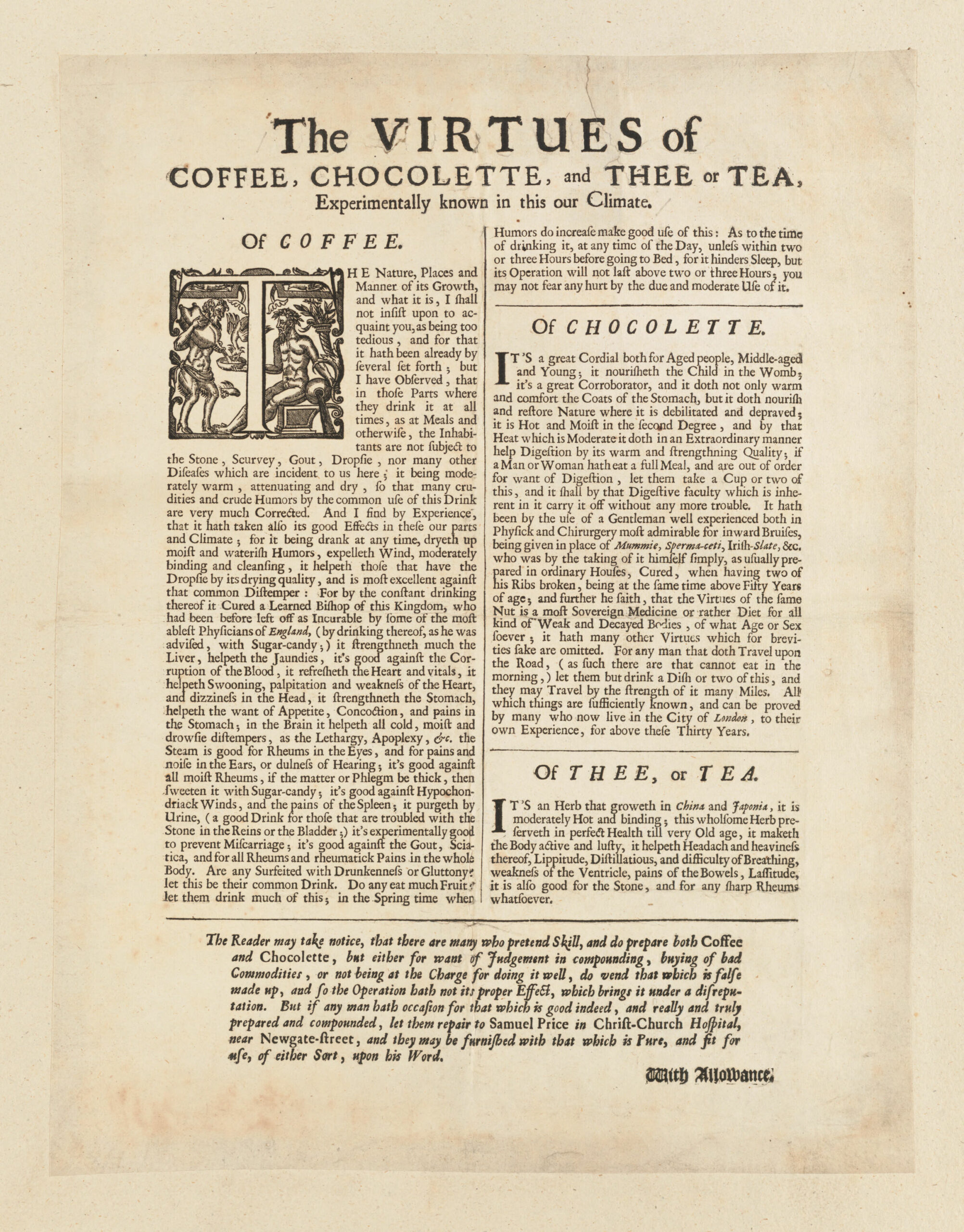
According to many historians, the English Enlightenment may never have happened were it not for coffeehouses, the public sphere where poets, critics, philosophers, legal minds, and other intellectual gadflies regularly met to chatter about the pressing concerns of the day. And yet, writes scholar Bonnie Calhoun, “it was not for the taste of coffee that people flocked to these establishments.”
Indeed, one irate pamphleteer defined coffee, which was at this time without cream or sugar and usually watered down, as “puddle-water, and so ugly in colour and taste [sic].”
No syrupy, high-dollar Macchiatos or smooth, creamy lattes kept them coming back. Rather than the beverage, “it was the nature of the institution that caused its popularity to skyrocket during the seventeenth and eighteenth centuries.”
How, then, were proprietors to achieve economic growth? Like the owner of the first English coffee-shop did in 1652, London merchant Samuel Price deployed the time-honored tactics of the mountebank, using advertising to make all sorts of claims for coffee’s many “virtues” in order to convince consumers to drink the stuff at home. In the 1690 broadside above, writes Rebecca Onion at Slate, Price made a “litany of claims for coffee’s health benefits,” some of which “we’d recognize today and others that seem far-fetched.” In the latter category are assertions that “coffee-drinking populations didn’t get common diseases” like kidney stones or “Scurvey, Gout, Dropsie.” Coffee could also, Price claimed, improve hearing and “swooning” and was “experimentally good to prevent Miscarriage.”
Among these spurious medical benefits is listed a genuine effect of coffee—its relief of “lethargy.” Price’s other beverages—“Chocolette, and Thee or Tea”—receive much less emphasis since they didn’t require a hard sell. No one needs to be convinced of the benefits of coffee these days—indeed many of us can’t function without it. But as we sit in corporate chain cafes, glued to smartphones and laptop screens and mostly ignoring each other, our coffeehouses have become somewhat pale imitations of those vibrant Enlightenment-era establishments where, writes Calhoun, “men [though rarely women] were encouraged to engage in both verbal and written discourse with regard for wit over rank.”
Related Content:
“The Vertue of the COFFEE Drink”: An Ad for London’s First Cafe Printed Circa 1652
Philosophers Drinking Coffee: The Excessive Habits of Kant, Voltaire & Kierkegaard
How Humanity Got Hooked on Coffee: An Animated History
The Birth of Espresso: The Story Behind the Coffee Shots That Fuel Modern Life
Josh Jones is a writer and musician based in Durham, NC. Follow him at @jdmagness.“The Virtues of Coffee” Explained in 1690 Ad: The Cure for Lethargy, Scurvy, Dropsy, Gout & More
Read More...GWAR Performs a Tiny Desk Concert: When Heavy Metal Meets NPR
In February 2020, a parody news site posted the headline: “GWAR asks NPR’s Tiny Desk Staff if They’re Ready to Get Their A******* Ripped Open.” In July 2023, NPR made good on the joke, inviting the heavy metal band to perform their own tiny desk concert. NPR writes: “As the band of intergalactic monsters strapped guitars to their battle-worn bodies, thunder and rain pounded the NPR building outside. As if the late Oderus Urungus was pissing his blessing from Valhalla, the prophecy had finally been fulfilled: GWAR came to destroy the Tiny Desk once and for all.” Enjoy.
Related Content
Read More...Great Mixtapes of 1970s Japanese Jazz: 4 Hours of Funky, Groovy, Fusion‑y Music
Like American jazz, Japanese jazz started with earlier styles like foxtrot and ragtime. Jazz was an international music, spreading across the Atlantic to London, Paris, and Berlin and across the Pacific to Shanghai, Manilla, and Tokyo. Luxury liners crossed the ocean and their house bands ferried new styles of dance music with them. “There was precious little improvisation,” in early Japanese jazz, “but that wasn’t as big a deal, as you know, in American jazz of the 1910s or ’20s,” historian E. Taylor Atkins tells NPR.
Japan even had its own jazz age. The word first entered the country in a 1929 “popular song attached to a movie called Tokyo March,” says Atkins. “The lyrics refer to jazz, and … that’s sort of where it came into mass consciousness. It was associated with dance halls, it was associated with ‘modern girls’ and ‘modern boys’ — the Japanese version of flappers and dandies — and the urban leisure classes: excess, and dogs and cats sleeping together, and all those sorts of portents of future calamity.”
When calamity came in the form of World War II, jazz was banned in Japan as the music of the enemy. On August 15, 1945, when the Emperor went on the radio to announce Japan’s surrender, Hattori Ryoichi, “Japan’s premier jazz composer and arranger,” found himself stuck in Shanghai, “the city that since the late 1920s had served as the jazz Mecca of Asia,” Michael Bourdaghs writes in a history of Japanese pop music. “From now on,” Ryoichi supposedly toasted his fellow musicians upon hearing the news, “we can carry out our musical activities in freedom.”
How little Ryoichi could have predicted the kind of musical freedom Japanese jazz would find. But first there was a period of imitation. “In the early postwar years, Japanese musicians were essentially copying the Americans they admired,” notes Dean Van Nguyen at The Guardian. Some of the most popular bands on TV and film were comic acts like Frankie Sakai and the City Slickers, a big band formed in 1953 in imitation of Spike Jones & The City Slickers. Another popular jazz comedy act, Hajime Hana & The Crazy Cats “are significant,” writes Atkins, “for capitalizing and purveying an image of jazz musicians as clownish, slang-singing ne’er-do-wells.”
Pianist Toshiko Akiyoshi was “the first Japanese artist to break away from simply copying American artists and develop a distinctive sound and identity that incorporated Japanese harmonies and instruments,” Van Nguyen writes. By the later 60s and 70s, economic development led to a “renaissance” of Japanese jazz, writes the Sabukaru Guide to 1970’s Japanese Jazz. “The unique creative landscape in the jazz community, along with Japanese music as a whole becoming simultaneously more experimental and mainstream, led to an abundance of excellent Japanese jazz music in the 1970s.”
In the four playlists here, you can hear hours of this groundbreaking music from some of the greatest names you’ve probably never heard in Japanese jazz. These include trombonist Hiroshi Suzuki, “one of the most-revered Japanese jazz artists,” notes the blog Pink Wafer Club, “even if most listers are only familiar with his work thanks to the number of times his music has been sampled.” Suzuki’s 1975 album Cat is one of the funkiest jazz albums from any country released in the decade.
These playlists also include fusion keyboardist Mikio Masuda, saxophonist Sadao Watanabe, and other musicians who, like Akiyoshi, helped spur “young artists to evolve away from Blue Note mimicry towards free jazz, fusion, funk, spiritual, modal and bebop,” writes Van Nguyen. “These daring virtuosos implanted rock and electronic elements, or took influences from Afrobeat and flamenco music.” Their international influences reflected 1970s jazz experiments around the globe. The music also benefitted from the excellent recording quality of Japanese studios and the rise of smaller labels, which allowed for more experimental artists to record and release albums.
Find out above why “many young Japanese musicians cite the jazz innovators from this era as influences,” Sabukaru writes. Read about ten of the best 1970s Japanese jazz records here. See a huge guide to Japanese jazz from all eras at Rate Your Music, and find tracklists with timestamps for each of the playlists above at their YouTube page.
Related Content:
Sonic Explorations of Japanese Jazz: Stream 8 Mixes of Japan’s Jazz Tradition Free Online
Acclaimed Japanese Jazz Pianist Yōsuke Yamashita Plays a Burning Piano on the Beach
Josh Jones is a writer and musician based in Durham, NC. Follow him at @jdmagness
Read More...A Harp Played with a Heavy Distortion Pedal
You’ve had the thought experiment in your head. What would happen if you run a harp through a heavy distortion pedal? Now you can see how it all plays out. Emily Hopkins has been playing the harp for over 20 years and has recently taken to experimenting with harp distortion. Above, you can watch her experiment with the Nepenthes by Electrofoods, the heaviest distortion pedal she could find. Other pedal distortion experiments can be found here.
If you would like to support the mission of Open Culture, consider making a donation to our site. It’s hard to rely 100% on ads, and your contributions will help us continue providing the best free cultural and educational materials to learners everywhere. You can contribute through PayPal, Patreon, and Venmo (@openculture). Thanks!
Related Content:
Two Guitar Effects That Revolutionized Rock: The Invention of the Wah-Wah & Fuzz Pedals
Visualizing Bach: Alexander Chen’s Impossible Harp
Read More...Who Invented Heavy Metal Music?: A Search for Origins
Where exactly did “heavy metal” start? Like a similar question—“what is the first rock and roll song?”–there’s not so much a direct answer as a spreading of ingredients over a number of years, all of which combine to create “heavy metal,” and its numerous sub-genres that have sprung forth from it. There’s not so much a year of origin as there is a year after which one cannot claim a beginning. (Now that’s a sentence!)
If you’re confused, this quick history by Polyphonic will answer all of your questions, and hopefully turn you on to a few tracks you’ve never heard before.
So what makes a heavy metal track? Well, first you have to have some loud, heavy, distorted guitars. Polyphonic goes back to blues musicians, as so many rock guitarists continue to do, to suggest the guitar sounds of Pat Hare and Joe Hill Lewis as precursors to that sound. Next you have to have some lighting-fast fingerwork all over the frets—maybe the hyperfast riffage of surf rock legend Dick Dale will do?
That’s all fine and good. But we need to get *heavy* in this metal. And it was the Brits who took on this job. Creating a mood and experimenting with sound marked bands like the Beatles, Stones, and The Who, as they tried to out-do each other. When Paul McCartney heard that The Who had delivered the heaviest song so far in “I Can See for Miles” (which now sounds surprisingly twee compared to later Who songs), he sat down with the band and blasted out “Helter Skelter.” Take that, Pete Townshend.
The Beatles weren’t steeped in the blues, but so many other British bands were, and here’s where blues picked up the gauntlet thrown down by these heavy, droning, bass-laden sounds. While the British Invasion bands wore their Englishness on their (record) sleeves, trad- and psych-blues bands like Cream and Led Zeppelin wanted to sound American. Things got louder, crunchier, slower, and darker. They got really dark with Black Sabbath, which named themselves after the Mario Bava horror film, and brought another ingredient to the stew: dark, fantastic, Satanic imagery. Finally, Deep Purple brought the banshee screechings of Ian Gillan as a final part to the puzzle. Put it all together and what you have is heavy metal, man.
Heavy Metal has gone on to delight generations and piss off all the right people at the same time. It’s given rise to a new sub genre every year, and come out of it with a hard-earned respectability.
The above animated video from Pitchfork will get you caught up with the evolution into chart domination and back out into purist obscurity.
And for those who would rather listen to a history rather than watch one, check this out.
Polyphonic hits most of the well known signposts on the journey, but if you think an essential song is missing, let us know in the comments.
Related Content:
Ted Mills is a freelance writer on the arts who currently hosts the Notes from the Shed podcast and is the producer of KCRW’s Curious Coast. You can also follow him on Twitter at @tedmills, and/or watch his films here.
Read More...When Jack Johnson, the First Black Heavyweight Champion, Defeated Jim Jeffries & the Footage Was Banned Around the World (1910)
“Being born Black in America… we all know how that goes.…”
—Miles Davis, liner notes for A Tribute to Jack Johnson
When Muhammad Ali saw James Earl Jones play a fictionalized Jack Johnson on Broadway in Howard Sackler’s Pulitzer Prize-winning The Great White Hope in 1968, he reportedly exclaimed, “You just change the time, date and the details and it’s about me!” In Johnson’s time, however, most white heavyweight fighters flat-out refused to fight Black boxers. Heavyweight champion Jim Jeffries swore he would retire “when there were no white men left to fight.” He left the sport in 1905, refusing to fight Johnson even after Johnson had knocked his younger brother out in 1902 and taunted him from the ring, saying, “I can whip you, too.”
After Jeffries retired undefeated, the next heavyweight world champion, Tommy Burns, agreed to fight Johnson in 1908 and lost when police stopped the fight. Two years later, lured out of retirement by the press and a $40,000 purse, Jeffries finally agreed to fight Johnson, who was then the heavyweight champion of the world. By that time, the bout had been framed as an existential racial crisis. Johnson was “the white man’s despair” and his challenger “The Great White Hope.” Jeffries played the part, saying, “I am going into this fight for the sole purpose of proving that a white man is better than a Negro.”
Novelist Jack London dreamed of a magical scenario in which the full force of European history would inhabit Jeffries’ body. He “would surely win” because he had “30 centuries of tradition behind him — all the supreme efforts, the inventions and the conquests, and, whether he knows it or not, Bunker Hill and Thermopylae and Hastings and Agincourt.” Bluster and mythmaking do not win boxing matches. Out of shape and outclassed in the ring, Jeffries lost in 15 rounds in front of 22,000 fans on July 4, 1910, in what was known as the “Fight of the Century.” Johnson walked away with $117,000 and held the title for another five years.
Johnson’s victory was a triumph for African Americans, who staged parades and celebrations, and a profound defeat for “white boxing fans who hated seeing a black man sit atop the sport,” notes a Johnson biography. They took out their rage in “race riots” that evening, attacking Black people in cities around the country as collective punishment for a perceived collective humiliation. Hundreds of people were injured and around 20 killed. The videos above from Vox and Black History in Two Minutes (featuring Henry Louis Gates Jr.) tell the story.
White boxing fans’ rage had been building since the Burns fight, Vox explains, stoked by the newest form of mass media, commercial motion pictures, which came of age at the same time as professional boxing. Film reels of prizefights circulated the country at the turn of the century, and paying audiences cheered their heroes on the screen: “Boxing, going back centuries, has been wrapped up in themes of identity and pride.” Boxers represented their community, their nationality, their race. Spectators “imagined,” says American University historian Theresa Runstedtler, “that boxers in the ring, particularly for interracial fights, were almost engaged in this kind of ‘Darwinian struggle’” for dominance.
As a result of the violence on July 4, authorities attempted to ban film of the Johnson vs. Jeffries fight, and “police were instructed to break up screening events.” The ostensible reason was that the film caused “rioting,” as though the perpetrators could not themselves be held responsible, and as if the film were itself incendiary. But what it showed, the Black press of the time pointed out, was nothing more or less than a fair fight, something Jeffries and boxing legend John L. Sullivan immediately conceded in the press afterward. (“I could never have whipped Johnson at my best,” said Jeffries.)
In truth, “white authorities were worried,” says Runstedtler, “about the symbolic implications…. They worried that any demonstration of Black victory and any demonstration of white weakness or defeat would undercut the narratives of white supremacy, not just in the United States,” but also in colonies abroad. The film had to be banned worldwide, but the fight to suppress it only pushed it underground where it proliferated. Finally, in 1912, Congress banned the distribution of all prize-fight films, with Southern members of Congress “especially interested in the proposed law,” it was reported, “because of the race feeling stirred up by the exhibition of the Jeffries-Johnson moving pictures.”
Aside from the extremely fragile reaction to a boxing film, what might strike us now about the violence and the controversy surrounding the screenings is the vehemence of racist invective among many commentators, who mostly followed London’s lead in openly extolling white supremacy. This was not at all unusual for the time. The narrative was woven into the fight before it began. And when the “Great White Hope” went down, he did not do so as an individual contender, standing or falling on his own merit. The fight’s announcer, in audio paired with the fight reel above, pronounced him “humiliated, beaten, a betrayer of his race.”
Related Content:
Muhammad Ali Gives a Dramatic Reading of His Poem on the Attica Prison Uprising
Josh Jones is a writer and musician based in Durham, NC. Follow him at @jdmagness
Read More...John Cleese Revisits His 20 Years as an Ivy League Professor in His New Book, Professor at Large: The Cornell Years
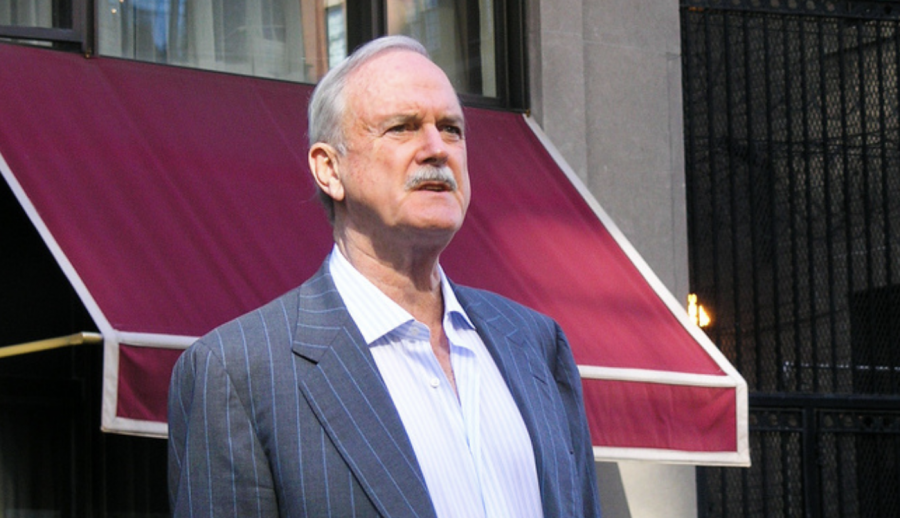
Creative Commons image by Paul Boxley
It takes real intelligence to successfully make dumb comedy. John Cleese and his Monty Python colleagues are a premium example. You can call sketches like the “Ministry of Silly Walks” and “Dead Parrot” surrealist, and they are comparable to the absurdist stunts favored by certain early 20th century modern artists. But you can also call them very smart kinds of stupid, a description of some of the highest forms of comedy, I’d say, and one that applies to so much of Cleese’s best work, from the Pythons, to Fawlty Towers, to A Fish Called Wanda. We are moved by stupidity, Cleese believes, and silliness is the engine of good comedy. “Sometimes very, very silly things,” he says in the interview with Cornell University Press director Dean Smith below, “have the power to touch us deeply.” Then he tells the old joke about a grasshopper named Norman.
Is Cleese still funny? Depends. Many listeners of a recent BBC Radio 4 show found his act a little stale. He has also come off lately as a “classic old man yelling at a cloud,” writes Fiona Sturges at The Guardian. (He called, surely in jest, for the hanging of EU president Jean Claude Juncker, for example, during the Brexit campaign).
In curmudgeonly interviews, he complains about hypersensitivity with examples of jokes contemporary audiences simply don’t find amusing, or at least not coming from him. Cleese has railed about the evils of political correctness, especially on college campuses, while spending the past 20 years as a “professor-at-large” on the prestigious campus of Cornell University, where he has delivered “incredibly popular events and classes—including talks, workshops, and an analysis of A Fish Called Wanda and The Life of Brian.”
These appearances draw hundreds of people, and their enormous popularity should offer Cleese some reassurance that he may not need to fear censorship, and that his wit—while it might not be as well appreciated in today’s mass entertainment—still has plenty of currency in places where smart people gather. From seminars on script writing to lectures on psychology and human development, Cleese’s appearances at Cornell lead to riveting, sometimes hilarious, and often controversial conversations.
In the episodes here from the Cornell University Press podcast, you can hear Cleese’s full conversation with Smith, part of the promotion of his 2018 book Professor at Large: The Cornell Years, in which he includes an interview with Princess Bride screenwriter William Goldman, a lecture about creativity called “Hare Brain, Tortoise Mind,” a discussion of facial recognition technology, and a talk on group dynamics with business students and faculty. Like Cleese’s mind, these lectures and discussions range far and wide, demonstrating, once again in his long career, that it takes real smarts to not only speak with ease on several academic subjects, but to understand the mechanics of stupidity. You can pick up a copy of Professor at Large: The Cornell Years here.
Related Content:
John Cleese Explains the Brain — and the Pleasures of DirecTV
John Cleese’s Philosophy of Creativity: Creating Oases for Childlike Play
Josh Jones is a writer and musician based in Durham, NC. Follow him at @jdmagness
Read More...Support Us
We're hoping to rely on loyal readers, rather than erratic ads. Please click the Donate button and support Open Culture. You can use Paypal, Venmo, Patreon, even Crypto! We thank you!

About Us

Open Culture scours the web for the best educational media. We find the free courses and audio books you need, the language lessons & educational videos you want, and plenty of enlightenment in between.
Advertise With Us

FREE UPDATES!
GET OUR DAILY EMAIL
Get the best cultural and educational resources on the web curated for you in a daily email. We never spam. Unsubscribe at any time.
FOLLOW ON SOCIAL MEDIA

Open Culture editor Dan Colman scours the web for the best educational media. He finds the free courses and audio books you need, the language lessons & movies you want, and plenty of enlightenment in between.
Advertise With Us


