The 150 Best Podcasts to Enrich Your Mind
Feed your brain with great podcasts on art, music, history, philosophy, plus captivating true and imagined stories. This is a soft launch of a new page. If we’re missing important podcasts, please let us know here.
Art, Design & Fashion
99 Percent Invisible — Apple — Spotify — Google — Web Site — RSS — Design is everywhere in our lives, perhaps most importantly in the places where we’ve just stopped noticing. 99% Invisible is a weekly exploration of the process and power of design and architecture. From award winning producer Roman Mars.
A History of the World in 100 Objects — Apple — Spotify — Google — Web Site — This podcast uses the British Museum’s collection to tell an epic history of humanity spanning over two million years. This 100-part series is narrated by Neil MacGregor, Director of the British Museum, and was originally broadcast on BBC Radio 4.
Articles of Interest — Apple — Spotify — Google — Web Site — A show about what we wear. It’s a six-part series from 99% Invisible, looking at clothing.
ArtCurious — Apple — Spotify — Google — Web Site — Think art history is boring? Think again. It’s weird, funny, mysterious, enthralling, and liberating. Join us as we cover the strangest stories in art. Is the Mona Lisa fake? Did Van Gogh actually kill himself? And why were the Impressionists so great?
Art Detective — Apple — Spotify — Understanding art allows us to understand history: to pin it with images, and pepper it with the faces, colors, drama and expression of its time. This series is designed to give bite-sized insights into the world of Art History, bringing one image to life across 20 minutes through discussion with experts.
Art History for All — Apple — Spotify — Google — Web Site — From art lovers to art haters to art-is-just-okay-ers, Art History for All aims to get all kinds of people thinking about art and what it means to them. Each episode, Allyson Healey tackles a single work of art and its history and larger significance, always asking the question: so what? Art History for All takes you beyond the art historical canon and helps you find the way in which art speaks to you (even if it’s never spoken to you before).
Design Matters — Apple — Google — Web Site — Hosted by Debbie Millman, Design Matters is the world’s first podcast about design and an inquiry into the broader world of creative culture through wide-ranging conversations with designers, writers, artists, curators, musicians, and other luminaries of contemporary thought.
Dressed: The History of Fashion — Apple — Spotify — Google — Web Site — With over 7 billion people in the world, we all have one thing in common. Every day we all get dressed. Join Dressed as they explore the social and cultural histories behind the who, what, when of why we wear.
Last Seen — Apple — Spotify — Google — Web Site — RSS — It remains the most valuable — and confounding — art heist in history: 13 artworks stolen from Boston’s Isabella Stewart Gardner Museum. Twenty-eight years later, not a single piece in a haul worth half a billion dollars has surfaced. The art, and the thieves who made off with it, remain at large. With first-ever interviews, unprecedented access, and more than a year of investigative reporting, “Last Seen” takes us into the biggest unsolved art heist in history. A joint production from WBUR and The Boston Globe. Read more here.
Raw Material — Apple — Spotify — Google — Web Site — RSS — Raw Material is an arts and culture podcast from the San Francisco Museum of Modern Art (SFMOMA). Each season focuses on a different topic, featuring voices of artists working in all media and exploring the inspiration and stories behind modern and contemporary art.
Recording Artists — Apple — Spotify — Google — Web Site — What was it like to be a woman making art as the feminist and civil rights movements were transforming American society? In this first season of Recording Artists, from the Getty, this podcast uses archival interviews to explore the lives of six women artists—Alice Neel, Lee Krasner, Betye Saar, Helen Frankenthaler, Yoko Ono, and Eva Hesse. Read more here.
The Lonely Palette — Apple — Spotify — Google — Web Site — The Lonely Palette returns art history to the masses, one painting at a time. Each episode, host Tamar Avishai picks a painting du jour, interviews unsuspecting museum visitors in front of it, and then dives deeply into the object, the movement, the social context, and anything and everything else that will make it as neat to you as it is to her.
The Modern Art Notes Podcast — Apple — Spotify — Google — Web Site — RSS — A weekly, hour-long interview program featuring artists, historians, authors, curators and conservators. Pulitzer Prize-winning art critic Sebastian Smee called The MAN Podcast “one of the great archives of the art of our time.”
Audio Dramas
Alice Isn’t Dead — Apple — Spotify — Google — Web Site — A truck driver searches across America for the wife she had long assumed was dead. In the course of her search, she will encounter not-quite-human serial murderers, towns literally lost in time, and a conspiracy that goes way beyond one missing woman.
Asking for It — Apple — Spotify — Google — Web Site — A queer contemporary take of the Goldilocks tale: about love, music, and breaking the cycle of abuse. Goldie escapes a chaotic childhood only to go from a partner who starves her of love to a partner who nearly drowns her in it, before learning to be just right on her own. From CBC Podcasts and Mermaid Palace.
Blackout — Apple — Spotify — Google — Academy Award winner Rami Malek stars in this apocalyptic thriller as a small-town radio DJ fighting to protect his family and community after the power grid goes down nationwide, upending modern civilization.
LifeAfter/The Message — Apple — Spotify — Google — The Message and its sequel, LifeAfter, take listeners on journeys to the limits of technology. n The Message, an alien transmission from decades ago becomes an urgent puzzle with life or death consequences. In LifeAfter, Ross, a low level employee at the FBI, spends his days conversing online with his wife Charlie – who died eight months ago. But the technology behind this digital resurrection leads Ross down a dangerous path that threatens his job, his own life, and maybe even the world. Winner of the Cannes Gold Lion.
Homecoming — Apple — Spotify — Google — Homecoming centers on a caseworker at an experimental facility, her ambitious supervisor, and a soldier eager to rejoin civilian life — presented in an enigmatic collage of telephone calls, therapy sessions, and overheard conversations. Starring Catherine Keener, Oscar Isaac, David Schwimmer, David Cross, Amy Sedaris, Michael Cera, Mercedes Ruehl, Alia Shawkat, Chris Gethard, and Spike Jonze.
Limetown — Apple — Spotify — Google — Web Site — The premise: Ten years ago, over three hundred men, women and children disappeared from a small town in Tennessee, never to be heard from again. In this podcast, American Public Radio reporter Lia Haddock asks the question once more, “What happened to the people of Limetown?”
Motherhacker — Apple — Spotify — Google — Web Site — The plot: Bridget’s life is a series of dropped calls. With a gift for gab, an ex-husband in rehab, and down to her last dollar, Bridget’s life takes a desperate turn when she starts vishing over the phone for a shady identity theft ring in order to support her family.
Passenger List — Apple — Spotify — Google — Web Site — Atlantic Flight 702 has disappeared mid-flight between London and New York with 256 passengers on board. Kaitlin Le (Kelly Marie Tran), a college student whose twin brother vanished with the flight, is determined to uncover the truth.
Sandra — Apple — Spotify — Web Site — Co-stars Kristen Wiig, Alia Shawkat, and Ethan Hawke. Here’s the plot: Helen’s always dreamed of ditching her hometown, so when she lands a job at the company that makes Sandra, everyone’s favorite A.I., she figures it’s the next-best thing. But working behind the curtain isn’t quite the escape from reality that Helen expected.
The Angel of Vine — Apple — Spotify — Google — Web Site — A present day journalist uncovers the audio tapes of a 1950s private eye who cracked the greatest unsolved murder mystery Hollywood has ever known… and didn’t tell a soul. Starring Joe Manganiello, Alfred Molina, Constance Zimmer, Alan Tudyk, Camilla Luddington, and more.
The Bright Sessions — Apple — Spotify — Google — Web Site — A science fiction podcast that follows a group of therapy patients. But these are not your typical patients — each has a unique supernatural ability. The show documents their struggles and discoveries as well as the motivations of their mysterious therapist, Dr. Bright.
The Orbiting Human Circus — Apple — Spotify — Google — Discover a wondrously surreal world of magic, music, and mystery. This immersive, cinematic audio spectacle follows the adventures of a lonely, stage-struck janitor who is drawn into the larger-than-life universe of the Orbiting Human Circus, a fantastical, wildly popular radio show broadcast from the top of the Eiffel Tower. WNYC Studios presents a special director’s cut of this joyous, moving break from reality. Starring John Cameron Mitchell, Julian Koster, Tim Robbins, Drew Callander, Susannah Flood, and featuring Mandy Patinkin and Charlie Day.
The Truth — Apple — Spotify — Google — Web Site — The Truth makes movies for your ears. They’re short stories that are sometimes dark, sometimes funny, and always intriguing. Every story is different, but they all take you to unexpected places using only sound. If you’re new, some good starting places are: Silvia’s Blood, That’s Democracy, Moon Graffiti, Tape Delay, or whatever’s most recent. Listening with headphones is encouraged!
The Walk — Apple — Spotify — “Dystopian thriller, The Walk, is a tale of mistaken identity, terrorism, and a life-or-death mission to walk across Scotland. But the format of this story is — unusual. The Walk is an immersive fiction podcast, and the creators want you to listen to it while walking. It begins with a terrorist attack at a train station; you are the protagonist, known only as Walker, and the police think you’re a member of a shadowy terror group called The Burn.” “Author Naomi Alderman, whose latest novel was a bestseller called The Power, is the creator of The Walk.”
We’re Alive — Apple — Spotify — Google — An award-wining audio drama, originally released in podcast form. Its story follows a large group of survivors of a zombie apocalypse in downtown Los Angeles, California.
Welcome to Night Vale — Apple — Spotify — Google — Web Site — Twice-monthly community updates for the small desert town of Night Vale, where every conspiracy theory is true. Turn on your radio and hide. Never listened before? It’s an ongoing radio show. Start with the current episode, and you’ll catch on in no time.
Wolf 359 — Apple — Spotify — Google — A science fiction podcast created by Gabriel Urbina. Following in the tradition of Golden Age radio dramas, Wolf 359 tells the story of a dysfunctional space station crew orbiting the star Wolf 359 on a deep space survey mission.
Audio Reads: Fiction & Non-Fiction
LeVar Burton Reads — Apple — Spotify — Google — Web Site — The best short fiction, handpicked by the best voice in podcasting. In every episode, host LeVar Burton (Roots, Reading Rainbow, Star Trek) invites you to take a break from your daily life, and dive into a great story. LeVar’s narration blends with gorgeous soundscapes to bring stories by Neil Gaiman, Haruki Murakami, Octavia Butler, Ray Bradbury and more to life. So, if you’re ready, let’s take a deep breath.
New Yorker Fiction Podcast — Apple — Web Site — This podcast features readings of classic fiction published in The New Yorker.
Selected Shorts — Apple — Spotify — Google — Web Site — RSS — Great actors read great fiction in front of a live audience.
Books & Language
A Way with Words — Apple — Spotify — Google — Web Site — A fun and funny radio show and podcast about language. Co-hosts Martha Barnette and Grant Barrett talk with callers from around the world about linguistics, slang, new words, jokes, riddles, word games, grammar, old sayings, word origins, regional dialects, family expressions, books, literature, folklore, and speaking and writing well.
Lexicon Valley - Apple — Spotify — RSS — A show about language, from pet peeves, syntax, and etymology to neurolinguistics and the death of languages. Hosted by linguist John McWhorter.
Literature and History — Apple — Spotify — Google — Web Site — A podcast covering Anglophone literature and its roots, from ancient times to the present! Each episode covers an influential work of world literature, featuring summaries of the texts, historical analysis of the cultures that produced them, and some original music and goofiness thrown in to keep you entertained.
The Allusionist — Apple — Spotify — Google — Web Site — The Allusionist scratches the surface of why we say the things we say. English is a big messy mutt of a language, formed by military invasion after military invasion, plus countless tiny idiosyncratic decisions made by its users along the way. The Allusionist is the latest from award-winning host Helen Zaltzman. Based in London, UK.
The History of English Podcast — Apple — Spotify — Google — A chronological history of the English language examined through the lens of historical events that shaped the development and spread of the language from the Eurasian steppe to the entire world.
The Penguin Podcast — Apple — Spotify — Google — The Penguin Podcast features conversations with some our of leading authors and creative thinkers, as we seek to understand how they write and where their ideas come from. Guests bring to the interview a handful of objects that have inspired their work. Recent guests include Noam Chomsky, Paul McCartney, William Gibson, Arundhati Roy and more.
Ideas
Against the Rules with Michael Lewis — Apple — Spotify — Google — Web Site — Journalist and bestselling author Michael Lewis (Liar’s Poker, Moneyball) takes a searing look at what’s happened to fairness. It feels like there’s less of it every day—whether it comes to lending practices, college admissions, professional sports, or psychological well-being. Who are the people trying to level the playing field, and are they making an impact? Lewis interviews referees (Season 1) and coaches (Season 2) from many walks of life, bringing his trademark insight and wry humor to their stories of (in)equality today.
Akimbo — Apple — Spotify — Google — Akimbo is an ancient word, from the bend in the river or the bend in an archer’s bow. It’s become a symbol for strength, a posture of possibility, the idea that when we stand tall, arms bent, looking right at it, we can make a difference. Seth Godin’s Akimbo is a podcast about our culture and about how we can change it. About seeing what’s happening and choosing to do something. The culture is real, but it can be changed. You can bend it.
Benjamen Walker’s Theory of Everything — Apple — Spotify — Google — Web Site — Theory of Everything plunges listeners into a whirl of journalism, fiction, art, interviews, and the occasional exploding pipe dream. Host Benjamen Walker connects the dots in a hyper-connected world, featuring conversations with philosophers, friends, and the occasional too-good-to-be-real guest.
Complexity — Apple — Google — Spotify — Web Site — RSS — Far-reaching conversations with a worldwide network of scientists and mathematicians, philosophers and artists developing new frameworks to explain our universe’s deepest mysteries. Created by the Santa Fe Institute.
Entitled Opinions — Apple — Google — Web Site — Entitled Opinions is a literary talk show on Stanford University Radio, KZSU, in which Professor Robert Harrison interviews guests about issues that range from literature and philosophy to politics and sports. Read more here.
Flash Forward — Apple — Spotify — Google — Web Site — RSS — A show about possible (and not so possible) future scenarios. What would the warranty on a sex robot look like? How would diplomacy work if we couldn’t lie? Hosted and produced by award winning science journalist Rose Eveleth, each episode combines audio drama and journalism to go deep on potential tomorrows, and uncovers what those futures might really be like.
Freakonomics Radio — Apple — Spotify — Google — Web Site — RSS — Discover the hidden side of everything with Stephen J. Dubner, co-author of the Freakonomics books. Each week, Freakonomics Radio tells you things you always thought you knew (but didn’t) and things you never thought you wanted to know (but do) — from the economics of sleep to how to become great at just about anything. Dubner speaks with Nobel laureates and provocateurs, intellectuals and entrepreneurs, and various other underachievers.
Fresh Air — Apple — Spotify — Google — Web Site — RSS — Fresh Air from WHYY, the Peabody Award-winning weekday magazine of contemporary arts and issues, is one of public radio’s most popular programs. Hosted by Terry Gross, the show features intimate conversations with today’s biggest luminaries.
Here’s the Thing — Apple — Spotify — Google — Web Site — Alec Baldwin takes listeners into the lives of artists, policy makers and performers. Alec sidesteps the predictable by going inside the dressing rooms, apartments, and offices of people we want to understand better: Ira Glass, Patti Smith, David Brooks, Roz Chast, Chris Rock and others.
Hidden Brain — Apple — Spotify — Google — Web Site — RSS — NPR’s Shankar Vedantam uses science and storytelling to reveal the unconscious patterns that drive human behavior, shape our choices and direct our relationships.
Imaginary Worlds — Apple — Spotify — Google — Web Site — SoundCloud — A bi-weekly podcast about science fiction and other fantasy genres. Host Eric Molinsky talks with novelists, screenwriters, comic book artists, filmmakers, and game designers about their craft of creating fictional worlds. The show also looks at the fan experience, exploring what makes us suspend our disbelief, and what happens when that spell is broken.
In Our Time - Apple — Spotify — Web Site — In Our Time is a live BBC radio discussion series exploring the history of ideas, presented by Melvyn Bragg since October 1998. It is one of BBC Radio 4’s most successful discussion programs, acknowledged to have “transformed the landscape for serious ideas at peak listening time.’” Read more here.
Intelligence Squared — Apple — Spotify — Web Site — The world’s leading forum for debate and intelligent discussion. Live and online we take you to the heart of the issues that matter, in the company of some of the world’s sharpest minds and most exciting orators.
Longform — Apple — Spotify — Google — Web Site — Interviews with writers, journalists, filmmakers, and podcasters about how they do their work. Hosted by Aaron Lammer, Max Linsky, and Evan Ratliff.
Making Sense Podcast — Apple — Spotify — Web Site — Join Sam Harris—neuroscientist, philosopher, and best-selling author—as he explores some of the most important questions about the human mind, society, and current events.
On Being — Apple — Spotify — Google — Web Site — Groundbreaking Peabody Award-winning conversation about the big questions of meaning — spiritual inquiry, science, social healing, and the arts. Each week a new discovery about the immensity of our lives. Hosted by Krista Tippett.
Revisionist History — Apple — Spotify — Web Site — RSS — Malcolm Gladwell’s journey through the overlooked and the misunderstood. Every episode re-examines something from the past—an event, a person, an idea, even a song—and asks whether we got it right the first time.
Radiolab — Apple — Spotify — Web Site — RSS — A two-time Peabody Award-winner, Radiolab is an investigation told through sounds and stories, and centered around one big idea. In the Radiolab world, information sounds like music and science and culture collide. Hosted by Jad Abumrad and Robert Krulwich, the show is designed for listeners who demand skepticism, but appreciate wonder.
Sean Carroll’s Mindscape — Apple — Spotify — Web Site — RSS — Ever wanted to know how music affects your brain, what quantum mechanics really is, or how black holes work? Do you wonder why you get emotional each time you see a certain movie, or how on earth video games are designed? Then you’ve come to the right place. Each week, Sean Carroll will host conversations with some of the most interesting thinkers in the world. From neuroscientists and engineers to authors and television producers, Sean and his guests talk about the biggest ideas in science, philosophy, culture and much more.
Solvable — Apple — Spotify — Google — RSS — Solvable showcases the world’s most innovative thinkers and their proposed solutions to the world’s most daunting problems. The interviews, conducted by journalists like Malcolm Gladwell and Jacob Weisberg, will launch a dialogue that both acknowledges the complexity of the issues while inspiring hope that the problems are, in fact, solvable
TED Radio Hour — Apple — Spotify — Web Site — TED Radio Hour investigates the biggest questions of our time with the help of the world’s greatest thinkers. Can we preserve our humanity in the digital age? Where does creativity come from? And what’s the secret to living longer? In each episode, host Manoush Zomorodi explores a big idea through a series of TED Talks and original interviews, inspiring us to learn more about the world, our communities, and most importantly, ourselves.
The Joy of X — Apple — Spotify — Web Site — Hosted by Steven Strogatz, The Joy of X podcast opens a window into the inner worlds of top-tier scientists and mathematicians while shining light on universal themes like creativity, collaboration or navigating professional challenges.
The New Yorker Radio Hour — Apple — Spotify — Web Site — David Remnick is joined by The New Yorker’s award-winning writers, editors and artists to present a weekly mix of profiles, storytelling, and insightful conversations about the issues that matter.
The Wild — Apple — Spotify — Google — Web Site — Chris Morgan takes listeners around the world to Italy, Germany and his own backyard of the Pacific Northwest to explore the beauty and wonder of the outdoors and its inhabitants. From beavers to wolves to grizzly bears we experience up close the resilient power of nature and our relationship with it.
WTF — Apple — Spotify — Web Site — RSS — Marc Maron welcomes comedians, actors, directors, writers, authors, musicians and folks from all walks of life to his home for amazingly revealing conversations. Marc’s probing, comprehensive interview style allows guests to express themselves in ways listeners have never heard.
History
1619 — Apple — Spotify — Web Site — In August of 1619, a ship carrying more than 20 enslaved Africans arrived in the English colony of Virginia. America was not yet America, but this was the moment it began. No aspect of the country that would be formed here has been untouched by the 250 years of slavery that followed. On the 400th anniversary of this fateful moment, it is time to tell the story.
BackStory — Apple — Spotify — Google — Web Site — There’s the history you had to learn, and the history you want to learn — that’s where BackStory comes in. Each week BackStory takes a topic that people are talking about and explores it through the lens of American history. Through stories, interviews, and conversations with our listeners, BackStory makes history engaging and fun. Based at the University of Virginia, it’s created by U.S. historians Ed Ayers, Brian Balogh, Nathan Connolly and Joanne Freeman.
Hope, Through History — Apple — Spotify — Hosted by Pulitzer Prize winning historian Jon Meacham, this podcast explores some of the most historic and trying times in American history, and how this nation dealt with these moments, the impact of these moments and how we came through these moments a unified nation. Season One takes a look at critical moments around the 1918 Flu Pandemic, the Great Depression, World War II, the polio epidemic and the Cuban Missile Crisis.
Revolutions — Apple — Spotify — Web Site — RSS — A weekly podcast exploring great political revolutions. It’s created by the New York Times best selling author Mike Duncan.
The Dollop — Apple — Spotify — RSS — Comedians Dave Anthony and Gareth Reynolds pick a subject from history and examine it.
The History of Byzantium — Apple — Spotify — Web Site — RSS — A podcast telling the story of the Roman (Byzantine) Empire from 476 AD to 1453.
The History of Rome — Apple — Spotify — 192 episodes tracing the history of the Roman Empire, beginning with Aeneas’s arrival in Italy and ending with the exile of Romulus Augustulus, last Emperor of the Western Roman Empire. Now complete!
The Bowery Boys — Apple — Spotify — Web Site — RSS — New York City history is America’s history. It’s the hometown of the world, and most people know the city’s familiar landmarks, buildings and streets. Why not look a little closer and have fun while doing it? Now has 300+ episodes.
The Last Archive — Apple — Spotify — Web Site — A podcast about history and epistemology by New Yorker contributor and Harvard historian Jill Lepore. It’s is a show about the history of truth, and the historical context for our current fake news, post-truth moment. It’s a show about how we know what we know, and why it seems, these days, as if we don’t know anything at all anymore.
This Day in Esoteric Political History — Apple — Spotify — Web Site — From a global pandemic upending society to an especially intense U.S. presidential election cycle, we’re living in an unprecedented time. Maybe. In this show, Jody Avirgan, political historian Nicole Hemmer, and special guests rescue stories from the entirety of U.S. political history to map our journey through this era. Each episode takes one moment, big or small, from that day in the past and explores how it might inform our present –– and it does so in under ten minutes.
Throughline — Apple — Spotify — Google — Web Site — RSS — The past is never past. Every headline has a history. Join NPR’s Throughline every week as they go back in time to understand the present. These are stories you can feel and sounds you can see from the moments that shaped our world.
Uncivil — Apple — Spotify — Web Site — America is divided, and it always has been. We’re going back to the moment when that split turned into war. This is Uncivil: Gimlet Media’s new history podcast, hosted by journalists Jack Hitt and Chenjerai Kumanyika. We ransack the official version of the Civil War, and take on the history you grew up with. We bring you untold stories about covert operations, corruption, resistance, mutiny, counterfeiting, antebellum drones, and so much more. And we connect these forgotten struggles to the political battlefield we’re living on right now.
You’re Dead To Me — Apple — Spotify — Web Site — From the BBC. The history podcast for people who don’t like history… and those who do. Greg Jenner brings together the best names in comedy and history to learn and laugh about the past.
Music, TV & Film
All Songs Considered - Apple — Spotify — Google — Web Site — Hosts/nerds Bob Boilen and Robin Hilton are your friendly music buddies with the week’s best new music discoveries, including conversations with emerging artists, icons and more. Hear songs that can completely change your day, with humor, heart and (sometimes) a whole lot of noise. Directions for use: Morning commute, the gym, or alone time. (If rash persists, discontinue use.)
Broken Record — Apple — Spotify — Web Site — Broken Record is hosted by producer Rick Rubin, the writer Malcolm Gladwell, and New York Times former editor Bruce Headlam. It features musicians you love talking about their life, inspiration, and craft.
Hit Parade — Apple — Spotify — Web Site — What makes a song a smash? Talent? Luck? Timing? All that—and more. Chris Molanphy, pop-chart analyst and author of Slate’s “Why Is This Song No. 1?” series, tells tales from a half-century of chart history. Through storytelling, trivia and song snippets, Chris dissects how that song you love—or hate—dominated the airwaves, made its way to the top of the charts and shaped your memories forever.
Mogul - Apple — Spotify — Web Site- An engaging show about hip hop’s most iconic moments, told by the people who lived them.
Nakedly Examined Music — Apple — Web Site — Why do musicians create what they do? Why do they create in that particular way? Mark Linsenmayer (aka songwriter Mark Lint, and host of The Partially Examined Life) talks to songwriters and composers about specific recordings, which are played in full. They cover lyric meanings, writing and recording techniques, arrangements, band dynamics, the stories behind the songs, and even music theory.
Office Ladies — Apple — Spotify — Web Site — The Office co-stars and best friends, Jenna Fischer and Angela Kinsey, are doing the ultimate The Office re-watch podcast for you. Each week Jenna and Angela will break down an episode of The Office and give exclusive behind-the-scenes stories that only two people who were there, can tell you.
Pop Culture Happy Hour — Apple — Spotify — Web Site — RSS — A fun and freewheeling chat about the latest movies, television, books, and music.
Pretty Much Pop — Apple — Web Site — RSS — A philosopher, an actor/musician, and a sci-fi writer (often with entertainment industry guests) talk about media and how we consume it: TV, film, music, novels, games, comics, comedy, theater, podcasts, online video, and more. Most of what (other) people like is pretty weird when you think about it, so thinking about it is what they do.
Settling the Score — Apple — Spotify — Web Site — Join Jon and Andy as they explore the world of film music, one score at a time. Each episode is an in-depth discussion of a classic film score: what makes it tick, how it serves the movie, and whether it’s, you know, any good. It’s a freewheeling, opinionated conversation with an analytical bent, richly illustrated with musical examples. No expertise required.
Slash Film — Apple — Spotify — Web Site — In the Slashfilmcast, hardcore geeks David Chen, Devindra Hardawar, and Jeff Cannata debate, pontificate, and delve into the latest films, TV shows, and other entertainment-related items from the past week. Weekly guests include everyday bloggers, webmaster luminaries, film directors, and movie stars from all walks of life
Sodajerker on Songwriting — Apple — Spotify — Web Site — A program devoted to the art and craft of songwriting. The show, created and hosted by the UK songwriting team Sodajerker, features interviews with some of the most successful songwriters and musicians in the world.
Song Exploder — Apple — Spotify — Web Site — RSS — A podcast where musicians take apart their songs, and piece by piece, tell the story of how they were made.
Sound Opinions — Apple — Spotify — Web Site — RSS — The world’s only rock and roll talk show, hosted by Jim DeRogatis and Greg Kot.
Soundtracking with Edith Bowman — Apple — Spotify — Google — Web Site — In a unique weekly podcast, Edith Bowman sits down with a variety of film directors, actors, producers and composers to talk about the music that inspired them and how they use music in their films, from their current release to key moments in their career.
Stay Free: The Story of the Clash — Spotify — The rise and fall of the punk band, The Clash, narrated by Public Enemy’s Chuck D. Read more here.
Switched on Pop — Apple — Spotify — Web Site — RSS — A Vox podcast that reveals the secret formulas that make pop songs so infectious. Every Tuesday, musicologist Nate Sloan and songwriter Charlie Harding pull back the curtain on how pop hits work their magic. You’ll fall in love with songs you didn’t even know you liked.
Talking Sopranos — Apple — Spotify — Google — Web Site — Sopranos co-stars Michael Imperioli and Steve Schirripa host the definitive Sopranos re-watch podcast. Michael and Steve follow the Sopranos series episode by episode giving fans all the inside info, behind the scenes stories and little-known facts that could only come from someone on the inside.
‘The Wire: Way Down in the Hole’ — Apple — Spotify — Jemele Hill and Van Lathan recap, breakdown, and analyze every episode of the iconic HBO hit series, The Wire, starting from the beginning with season one.
Philosophy
Hi-Phi Nation - Apple — Spotify — Google Play — Web Site — A philosophy podcast that turns stories into ideas. It begins with a story, from ordinary life, law, science, or culture, and then transforms it into an examination of philosophical ideas. The show is created by Barry Lam, a PhD in philosophy at Princeton University, and Associate Professor of Philosophy at Vassar College. Read more here.
History of Philosophy Without Any Gaps — Apple – Spotify — RSS Feed — Peter Adamson, Professor of Philosophy at King’s College London, takes listeners through the history of philosophy, “without any gaps.” The series looks at the ideas, lives and historical context of the major philosophers as well as the lesser-known figures of the tradition. With more than 300+ episodes, it covers both western and eastern traditions. Read more here.
In Our Time: Philosophy — Apple — Spotify — Downloads — The storied BBC show covers everything from Altruism to Wittgenstein, philosophers, theories and key themes.
Partially Examined Life - Apple — Spotify — Web Site — Philosophy, philosophers and philosophical texts. This podcast features an informal roundtable discussion, with each episode loosely focused on a short reading that introduces at least one “big” philosophical question, concern, or idea. Recent episodes have focused on Nietzsche, Sartre and Aldous Huxley, and featured Francis Fukuyama as a guest.
Philosophy Bites — Apple — Spotify — Web Site — RSS — David Edmonds (Uehiro Centre, Oxford University) and Nigel Warburton (freelance philosopher/writer) interview top philosophers on a wide range of topics. Two books based on the series have been published by Oxford University Press. There are over 400 podcasts in this collection. Read more here.
Philosophize This! — Apple — Spotify — Web — RSS — Libsyn — Beginner friendly if listened to in order! For anyone interested in an educational podcast about philosophy where you don’t need to be a graduate-level philosopher to understand it. In chronological order, the thinkers and ideas that forged the world we live in are broken down and explained. Read more here.
Very Bad Wizards — Apple — Spotify — Google — Web Site — Very Bad Wizards is a podcast featuring a philosopher (Tamler Sommers) and a psychologist (David Pizarro), who share a love for ethics, pop culture, and cognitive science, and who have a marked inability to distinguish sacred from profane. Each podcast includes discussions of moral philosophy, recent work on moral psychology and neuroscience, and the overlap between the two.
True Stories & Storytelling
13 Minutes to the Moon — Apple — Spotify — Web Site — Epic stories of Nasa’s missions to the Moon. Season 1: the first Moon landing, Apollo 11. Season 2: the near disaster of Apollo 13. Presenter: Kevin Fong. Theme music: Hans Zimmer.
Cautionary Tales — Apple — Spotify — Google — Web Site — We tell our children unsettling fairy tales to teach them valuable life lessons, but these Cautionary Tales are for the education of the grown ups – and they are all true. Tim Harford (Financial Times, BBC, author of “Messy” and “The Undercover Economist”) brings you stories of awful human error, tragic catastrophes, daring heists and hilarious fiascos. They’ll delight you, scare you, but also make you wiser.
Crimetown — Apple — Spotify — Web Site — RSS — A serial documentary podcast looks at how organized crime has shaped particular American cities.
Criminal — Apple — Spotify — Web Site — RSS — A podcast about crime. Not so much the “if it bleeds, it leads,” kind of crime. Something a little more complex. Stories of people who’ve done wrong, been wronged, and/or gotten caught somewhere in the middle.
Ear Hustle — Apple — Spotify — Google — Web Site — Ear Hustle brings you the daily realities of life inside prison shared by those living it, and stories from the outside, post-incarceration. The podcast is a partnership between Nigel Poor, a Bay Area visual artist, and Earlonne Woods, formerly incarcerated at San Quentin State Prison, and was co-founded with former San Quentin resident Antwan Williams.
Futility Closet — Apple — Spotify — Web Site — RSS — Forgotten stories from the pages of history. Join us for surprising and curious tales from the past and challenge yourself with our lateral thinking puzzles.
Heavyweight — Apple — Spotify — Web Site — RSS — A podcast created and produced by humorist Jonathan Goldstein where he helps people try to resolve a moment from their past that they wish they could change.
HumaNature — Apple — Spotify — Web Site — RSS — HumaNature is the podcast that explores where humans and our habitat meet. The show tells real stories about human experiences in nature. Along the way, we’ll meet people whose encounters help us reflect on our own place in the natural world.
Invisibilia — Apple — Spotify — Web Site — RSS — Unseeable forces control human behavior and shape our ideas, beliefs, and assumptions. Invisibilia—Latin for invisible things—fuses narrative storytelling with science that will make you see your own life differently.
Modern Love — Apple — Spotify — Google — Web Site — RSS — Modern Love features top actors performing true stories of love, loss, and redemption. It has included performances by Kate Winslet, Uma Thurman, Angela Bassett, Jake Gyllenhaal, Sterling K. Brown, and more. A collaboration between WBUR and The New York Times.
Mystery Show — Apple — Spotify — Google — Web Site — Voted the top podcast of the year, this podcast features Starlee Kine solving mysteries.
Myths and Legends — Apple — Spotify — Google — Web Site — Jason Weiser tells stories from myths, legends, and folklore that have shaped cultures throughout history. Some, like the stories of Aladdin, King Arthur, and Hercules are stories you think you know, but with surprising origins. Others are stories you might not have heard, but really should. All the stories are sourced from world folklore, but retold for modern ears.
Outside — Apple — Spotify — Web Site — RSS — Outside’s longstanding literary storytelling tradition comes to life in audio with features that will both entertain and inform listeners. The podcast offers a range of story formats, including interviews with the biggest figures in sports, adventure, and politics, as well as reports from our correspondents in the field.
S‑Town — Apple — Spotify — Web Site — RSS — From Serial and This American Life, this podcast tells you about a man named John who despises his Alabama town and decides to do something about it. He asks Brian to investigate the son of a wealthy family who’s allegedly been bragging that he got away with murder. But when someone else ends up dead, the search for the truth leads to a nasty feud, a hunt for hidden treasure, and an unearthing of the mysteries of one man’s life.
Serial — Apple — Google — Web Site — Hosted by Sarah Koenig, Serial unfolds one story — a true story — over the course of a whole season. The show follows the plot and characters wherever they lead, through many surprising twists and turns. Sarah won’t know what happens at the end of the story until she gets there, not long before you get there with her.
Snap Judgment — Apple — Spotify — Google — Web Site — This podcast mixes real stories with killer beats to produce cinematic, dramatic, kick-ass radio. Snap’s raw, musical brand of storytelling dares listeners to see the world through the eyes of another. Also see their spinoff podcast, Spooked.
StoryCorps — Apple — Spotify — Web Site — RSS — Stories of the human heart. A candid, unscripted conversation between two people about what’s really important in life: love, loss, family, friendship. When the world seems out of hand, tune in to StoryCorps and be reminded of the things that matter most.
The Ballad of Billy Balls — Apple — Spotify — Web Site — It’s 1982, and a man bursts into an East Village storefront apartment and shoots punk musician Billy Balls. Author and activist iO Tillett Wright and Crimetown Producer Austin Mitchell unravel a mystery of love and loss, the tender binds of family, and the stories we tell ourselves just to survive.
The Clearing — Apple — Spotify — When April Balascio was 40 years old, something she’d feared for decades was finally proven true. Her father, Edward Wayne Edwards, really was a murderer. The Clearing is about what came after April called a detective in 2009 to tell him about her suspicions — a call that led to her father’s arrest and eventual conviction on multiple murders.
The Kitchen Sisters Present — Apple — Spotify — Web Site — RSS — The Kitchen Sisters Present… Stories from the b‑side of history. Lost recordings, hidden worlds, people possessed by a sound, a vision, a mission. The episodes tell deeply layered stories, lush with interviews, field recordings and music.
The Leap — Apple — Spotify — Google — Web Site — RSS — From a doctor’s controversial LSD treatments to a mother’s high-risk efforts to recover her abducted child to a punk rock pioneer’s radical career reinvention, these are stories of people making dramatic, risky changes—and the big and small decisions that change the course of lives. Hosted by award-winning journalist Judy Campbell.
The Memory Palace — Apple — Spotify — Web Site — RSS — Short, surprising stories of the past, sometimes heartbreaking, sometimes hysterical, often a little bit of both.
The Moth — Apple — Spotify — Web Site — RSS — Since its launch in 1997, The Moth has presented thousands of true stories, told live and without notes, to standing-room-only crowds worldwide. Moth storytellers stand alone, under a spotlight, with only a microphone and a roomful of strangers. The storyteller and the audience embark on a high-wire act of shared experience which is both terrifying and exhilarating. Since 2008, The Moth podcast has featured many of our favorite stories told live on Moth stages around the country.
This American Life — Apple — Spotify — Web Site — RSS — A famous weekly public radio program and podcast. Each week they choose a theme and put together different kinds of stories on that theme.
This is Love — Apple — Spotify — Web Site — RSS — From the makers of the award-winning podcast Criminal, This is Love investigates life’s most persistent mystery. Stories of sacrifice, obsession, and the ways in which we bet everything on each other.
White Lies — Apple — Spotify — Google — Web Site — RSS — In 1965, Rev. James Reeb was murdered in Selma, Alabama. Three men were tried and acquitted, but no one was ever held to account. Fifty years later, two journalists from Alabama return to the city where it happened, expose the lies that kept the murder from being solved and uncover a story about guilt and memory that says as much about America today as it does about the past.
You Must Remember This — Apple — Spotify — Web Site — This is a storytelling podcast exploring the secret and/or forgotten histories of Hollywood’s first century. It’s the brainchild and passion project of Karina Longworth (founder of Cinematical.com, former film critic for LA Weekly), who writes, narrates, records and edits each episode. It is a heavily-researched work of creative nonfiction: navigating through conflicting reports, mythology, and institutionalized spin, Karina tries to sort out what really happened behind the films, stars and scandals of the 20th century.
Business & Economy
a16z — Apple — Spotify — Google — Web Site — The a16z Podcast discusses tech and culture trends, news, and the future – especially as ‘software eats the world’. It features industry experts, business leaders, and other interesting thinkers and voices from around the world. This podcast is produced by Andreessen Horowitz (aka “a16z”), a Silicon Valley-based venture capital firm.
Harvard Business Review IdeaCast — Apple — Spotify — Google — Web Site — RSS — A weekly podcast featuring the leaders in business and management.
How I Built This — Apple — Spotify — Google — Web Site — RSS — From NPR. Guy Raz dives into the stories behind some of the world’s best known companies. The podcast weaves a narrative journey about innovators, entrepreneurs and idealists—and the movements they built.
Marketplace — Apple — Spotify — Web Site — RSS — Hosted by Kai Ryssdal, NPR’s flagship program is all about providing context on the economic news of the day. Through stories, conversations and newsworthy numbers, we help listeners understand the economic world around them.
Masters of Scale — Apple — Spotify — Web Site — The best startup advice from Silicon Valley & beyond in a podcast hosted by host Reid Hoffman — LinkedIn cofounder, Greylock partner and legendary Silicon Valley investor. The show features iconic CEOs — from Nike to Netflix, Starbucks to Slack — sharing the stories & strategies that helped them grow from startups into global brands.
Pivot — Apple — Spotify — Web Site — Kara Swisher and NYU Professor Scott Galloway offer sharp, unfiltered insights into the biggest stories in tech, business, and politics.
Planet Money — Apple — Spotify — Google — Web Site — RSS — The economy explained by NPR. Imagine you could call up a friend and say, “Meet me at the bar and tell me what’s going on with the economy.” Now imagine that’s actually a fun evening.
The Journal — Apple — Spotify — Web Site — A Wall Street Journal podcast on the most important stories, explained through the lens of business. A podcast about money, business and power.
WorkLife with Adam Grant — Apple — Spotify — Web Site — Organizational psychologist Adam Grant takes you inside the minds of some of the world’s most unusual professionals to explore the science of making work not suck. From learning how to love criticism to harnessing the power of frustration, one thing’s for sure: You’ll never see your job the same way again.
Personal Development (Including creativity)
Finding Mastery — Apple — Spotify — Web Site — RSS — Michael Gervais is a high performance psychologist. His podcast is built around a central goal: unpacking and decoding how the greatest performers in the world use their minds to create amazing journeys while they pursue the boundaries of human potential.
Magic Lessons- Apple — Google — Web Site — Writer Elizabeth Gilbert’s creativity podcast “features her interviewing people about how they overcome the fears that are inherent in the creative process, and calling up famous creatives to get their input.”
The Happiness Lab with Dr. Laurie Santos — Apple — Spotify — Google — Web Site — You might think you know what it takes to lead a happier life… more money, a better job, or Instagram-worthy vacations. You’re dead wrong. Yale professor Dr. Laurie Santos has studied the science of happiness and found that many of us do the exact opposite of what will truly make our lives better. Based on the psychology course she teaches at Yale–the most popular class in the university’s 300-year history–Laurie will take you through the latest scientific research and share some surprising and inspiring stories that will change the way you think about happiness.
The Jordan Harbinger Show — Apple — Spotify — Google — The Jordan Harbinger Show (Apple’s Best of 2018) is where self-motivated people, just like you, dig deep into the untapped wisdom of the world’s sharpest minds- from legendary creators to intelligence operatives, iconoclastic writers to visionary change-makers. They bring amazing stories and brilliant personalities to the table, and help you demystify what they do and how they do it.
The Moment with Brian Koppelman — Apple — Spotify — Google — Interviews about the pivotal moments that fueled fascinating creative careers. Hosted by Brian Koppelman.
The Tim Ferriss Show — Apple — Spotify — Web Site — YouTube — RSS — This popular podcast covers topics ranging from personal and character development, to morning routines and meditation habits of celebrities, CEOs and cultural figures like Neil Gaiman, Brene Brown, Michael Lewis, Amanda Palmer, Alain de Botton and more.
Unlocking Us with Brené Brown — Apple — Spotify — Web Site — RSS — Join researcher and #1 New York Times best-selling author Brené Brown as she unpacks and explores the ideas, stories, experiences, books, films, and music that reflect the universal experiences of being human, from the bravest moments to the most brokenhearted.
Sports
30 for 30 — Apple — Spotify — Web Site — Original audio documentaries from the makers of the acclaimed 30 for 30 film series, featuring stories from the world of sports and beyond. 30 for 30 offers captivating storytelling for sports fans and general interest listeners alike, going beyond the field to explore how sports, competition, athleticism and adventure affect our lives and our world. Sports stories like you’ve never heard before.
The Bill Simmons Podcast — Apple — Spotify — Web Site — HBO and The Ringer’s Bill Simmons hosts the most downloaded sports podcast of all time, with a rotating crew of celebrities, athletes, and media staples.
We Came to Win — Apple — Spotify — Every four years, people all over the world turn their eyes, ears, and hearts toward the most exciting sports competition on the planet: The World Cup. We Came to Win tells the stories behind the tournament’s most memorable moments.
News & Current Events
538 — Apple — Spotify — Web Site — Nate Silver and the FiveThirtyEight team cover the latest in politics, tracking the issues and “game-changers” every week.
Deep Background with Noah Feldman — Apple — Spotify — Google — Web Site — Every story has a backstory, even in today’s 24-hour news cycle. In Deep Background, Harvard Law School professor and Bloomberg View columnist Noah Feldman will bring together a cross-section of expert guests to explore the historical, scientific, legal, and cultural context that help us understand what’s really going on behind the biggest stories in the news.
Embedded — Apple — Spotify — Google — Web Site — RSS — NPR host Kelly McEvers takes a story from the news and goes deep. Whether that means digging into the Trump administration’s past, the stories behind police shootings caught on video, or visiting a town ravaged by the opioid epidemic, Embedded takes you where the news is happening.
Reveal — Apple — Spotify — Google — Web Site — From prisons to protests, immigration to the environment, Peabody Award-winning Reveal goes deep into the pressing issues of our times. The Atlantic says “the experience of each episode is akin to a spoonful of sugar, even when it’s telling a story about Richard Spencer’s cotton farms or a man’s final days as a heroin addict.” Reveal is a project of The Center for Investigative Reporting.
Stay Tuned with Preet — Apple — Google — Spotify — Web Site — Join former U.S. Attorney Preet Bharara as he breaks down legal topics in the news and engages thought leaders in a podcast about power, policy, and justice.
The City — Apple — Spotify — The City is an investigative podcast from USA TODAY that tells true stories about how power works in urban America.
The Daily — Apple — Spotify — Google — RSS — From The New York Times, this is what the news should sound like. The biggest stories of our time, told by the best journalists in the world. Hosted by Michael Barbaro.
Read More...Nikola Tesla’s Grades from High School & University: A Fascinating Glimpse
In the history of science, few people got a rawer deal than Nikola Tesla. Cruelly cheated and overshadowed by Edison and Marconi (who patented the radio technology Tesla invented), the brilliant introvert didn’t stand a chance in the cutthroat business world in which his rivals moved with ease. Every biographer portrays Tesla as Edison’s perfect foil: the latter played the consummate showman and savvy patent hog, where Tesla was a reclusive mystic and, as one writer put it, “the world’s sorcerer.”
“Unlike Tesla,” writes biographer Michael Burgan, “Edison had barely gone to school: Tesla was amazed that a man with almost no formal education could invent so brilliantly.” (He would have a different opinion of Edison years later.)
Tesla began his own education, as you can learn in the survey of his high school and university grades above, with much promise, but he was forced to drop out after his third year in college when his father passed away and he was left without the means to continue. As PBS writes, Tesla showed precocious talent early on.
Passionate about mathematics and sciences, Tesla had his heart set on becoming an engineer but was “constantly oppressed” by his father’s insistence that he enter the priesthood. At age seventeen, Tesla contracted cholera and craftily exacted an important concession from his father: the older Tesla promised his son that if he survived, he would be allowed to attend the renowned Austrian Polytechnic School at Graz.
It was during his time at technical school that Tesla first devised the idea of alternating current, though he could not yet articulate a working design (he was told by a professor that the feat would be akin to building a perpetual motion machine). He solved the engineering challenge after leaving school and going to work for the Central Telephone Exchange in Budapest.
While walking through a city park with a friend, reciting Goethe’s Faust from memory, Tesla recounts in his autobiography, a passage inspired him “like a flash of lightening” and he “drew with a stick on the sand the diagram shown six years later in my address before the American Institute of Electrical Engineers.” The story is one of many in which Tesla, a voracious reader and infinitely curious autodidact, draws on the extensive knowledge that he gathered through self-education.
His patent applications—Croatian scholar Danko Plevnik notes in the introduction to a series of essays on Tesla’s self-schooling—show “the erudition of a learned man, broad knowledge which by far surpassed the knowledge he could acquire through formal education only.” In his lectures, articles, and speeches, Tesla demonstrates a “familiarity with philosophy, science history and invention-related thought, methodology of science, as well as other areas of knowledge that were not included in the subjects and courses he attended through his schooling.”
Not only did he memorize entire books of poetry, but he could accurately foresee the future of technology, his keen insight honed both by his studies of the sciences and the humanities. Until fairly recently Plevnik writes, “Tesla’s education was referred to sporadically, as if it had not influenced his scientific reflection, experimenting and inventions.” That is in large part, many Tesla scholars now argue, because the best education Tesla received was the one he gave himself.
Related Content:
The Electric Rise and Fall of Nikola Tesla: As Told by Technoillusionist Marco Tempest
Nikola Tesla Accurately Predicted the Rise of the Internet & Smart Phone in 1926
Electric Photo of Nikola Tesla, 1899
Albert Einstein’s Grades: A Fascinating Look at His Report Cards
Josh Jones is a writer and musician based in Durham, NC. Follow him at @jdmagness
Read More...Breathtakingly-Detailed Tibetan Book Printed 40 Years Before the Gutenberg Bible

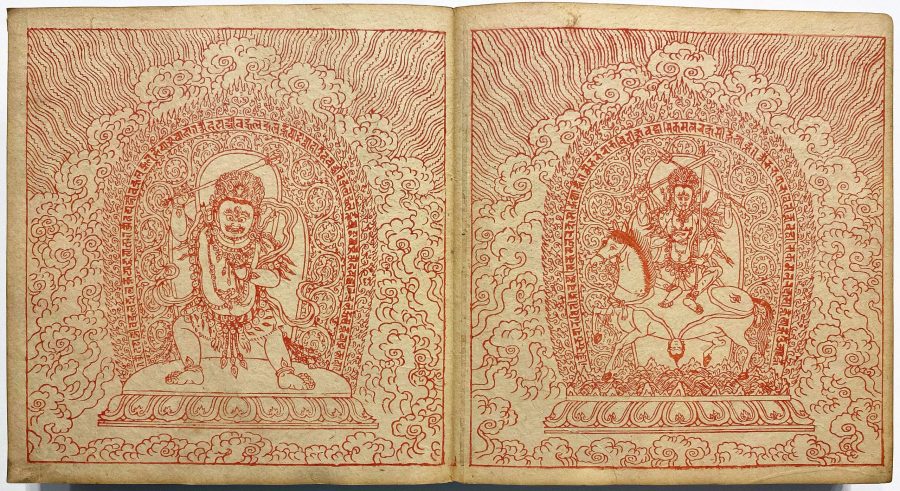
The Gutenberg Bible went to press in the year 1454. We now see it as the first piece of mass media, printed as it was with the then-cutting-edge technology of metal movable type. But in the history of aesthetic achievements in book-printing, the Gutenberg Bible wasn’t without its precedents. To find truly impressive examples requires looking in lands far from Europe: take, for instance, this “Sino-Tibetan concertina-folded book, printed in Beijing in 1410, containing Sanskrit dhāranīs and illustrations of protective mantra-diagrams and deities, woodblock-printed in bright red ink on heavy white paper,” whose “breathtakingly detailed printing” predates Gutenberg by 40 years.
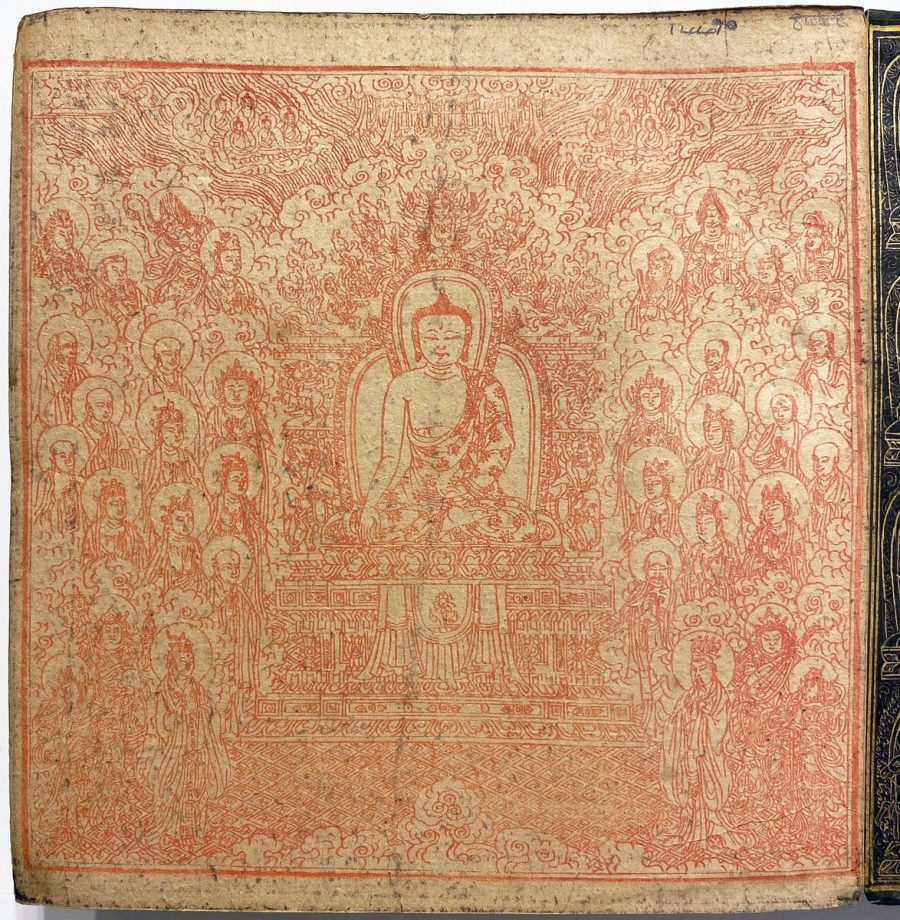
That description comes from a Twitter user called Incunabula (a term referring to early books), a self-described bibliophile and rare book collector who posts about “the history of writing, and of the book, from cave painting to cuneiform tablet to papyrus scroll to medieval codex to Kindle.”
Incunabula’s six-tweet thread on this early 15th-century Sino-Tibetan book includes both pictures and descriptions of this remarkable artifact’s interior and exterior.
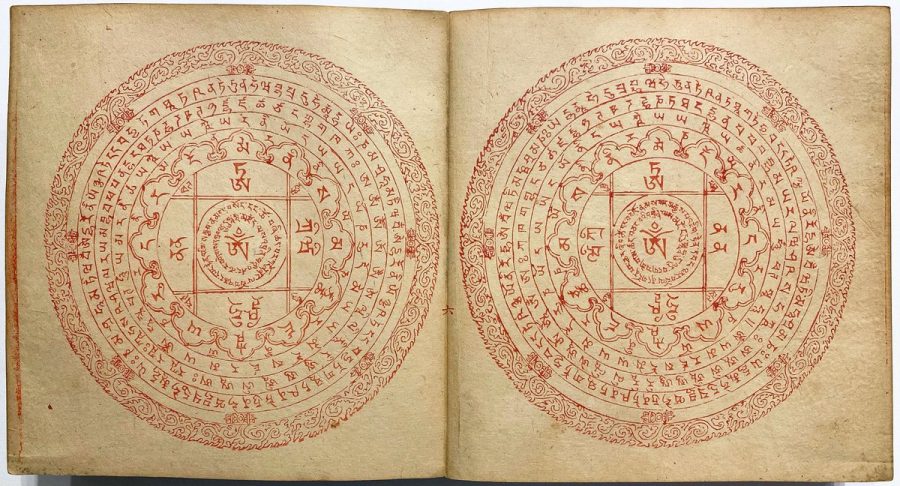
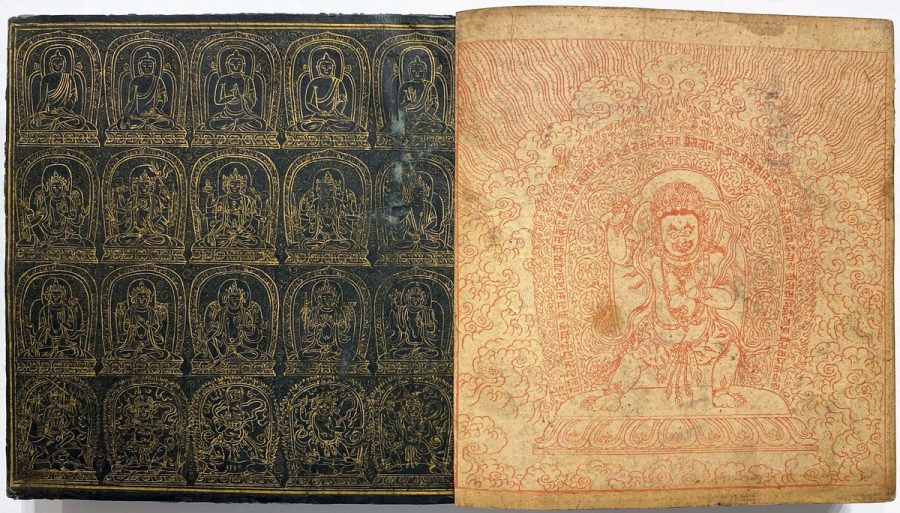
Its text, written in the Tibetan and Nepalese Rañjanā script, “is printed twice, once on each side of the paper, so that the book may be read in the Indo-Tibetan manner by turning the pages from right to left or in Chinese style by turning from left to right.” The book’s content is “a sequence of Tibetan Buddhist recitation texts,” or chants, all “protected at front and back by thicker board-like wrappers,” each “covered in fine pen-drawings in gold paint on black of 20 icons of the Tathāgatas.”
Incunabula has also posted extensively about Buddhist texts from other times and lands: a Thai folding manuscript from the mid-19th century telling of a monk’s journeys to heaven and hell; a Mongolian manuscript from the same period that translates the Čoyijod Dagini, “a popular Buddhist text about virtue, sin and the afterlife”; an example of “Japanese Buddhist printing 150 years before Gutenberg”; an “8th century Khotanese amuletic scroll from the Silk Road.” The creators of these texts would have meant the words they were preserving to survive them — but our marveling at them hundreds, even more than a thousand years later, would surely have come as a surprise.
Related Content:
The World’s Largest Collection of Tibetan Buddhist Literature Now Online
Free Online Course: Robert Thurman’s Introduction to Tibetan Buddhism (Recorded at Columbia U)
Tibetan Musical Notation Is Beautiful
Oxford University Presents the 550-Year-Old Gutenberg Bible in Spectacular, High-Res Detail
Based in Seoul, Colin Marshall writes and broadcasts on cities, language, and culture. His projects include the book The Stateless City: a Walk through 21st-Century Los Angeles and the video series The City in Cinema. Follow him on Twitter at @colinmarshall, on Facebook, or on Instagram.
Read More...John Mayer Teaches Guitarists How to Play the Blues in a 45-Minute Masterclass
Playing the blues is easy, many a budding guitarist thinks—their starry eyes fixed on the mathiest, proggiest, djent-iest (or whatever) guitar pyrotechnics of their favorite 7- or 8‑string slinger. Learn a minor pentatonic blues scale, a few barre chords, some sexy bends, a 12-bar progression and you’re off, right? Why spend time trying to play like Albert King (Jimi Hendrix’s idol) or Buddy Guy when you’re reaching for the ultimate sweep-picking technique, or whatever, in the competitive gamesmanship of guitar heroics?
I’ve encountered this kind of thinking among guitar players quite often and find it baffling given the blues essential place in rock and roll, metal included—and given how much more there is to playing blues than the stereotypical formulas to which the music gets reduced. Black Sabbath started as a blues band, Led Zeppelin never stopped being one, and it was Robert Johnson who turned the devil into rock’s brooding, Byronic hero.
The crossroads story has been told in hindsight as a metaphor for Johnson’s troubled, cursedly short life. But at the time, it was about envy on the part of his fellow bluesmen, who couldn’t believe how good he’d gotten in seemingly no time. Want to emerge from quarantine and inspire similar envy? The devil isn’t offering online lessons, but you can learn the blues from contemporary legend, John Mayer, who posted the lesson above on his Instagram Live a few days back.
As with all such online lessons, everyone will respond differently to the teacher’s style. The format does not allow for Q&A, obviously, but you can pause and rewind indefinitely. Mayer doesn’t move too quickly; if you’re an intermediate player with a grasp on the basics, it won’t be too hard to keep up. He comes across as easygoing and humble (not a quality he’s always been known for), and explains concepts clearly, relating them back to the fretboard each time.
As always, one will get out of the lesson what they put into it. Maybe no one will accuse you of conspiring with the evil one when you’ve mastered some of these techniques and incorporated them into your own playing. But you won’t have to lie, exactly, if you tell people you’ve been jamming with John Mayer. Or, if that’s not cool in your circles, come up with your own legend—abduction by a conspiracy of blues-playing aliens, perhaps.
However you explain it to your friends when we get out of the woodshed, I have no doubt that becoming a better blues player can improve whatever else you plan to do with the guitar.
Related Content:
Pete Seeger Teaches You How to Play Guitar for Free in The Folksinger’s Guitar Guide (1955)
Josh Jones is a writer and musician based in Durham, NC. Follow him at @jdmagness
Read More...Hyperland: The “Fantasy Documentary” in Which Douglas Adams and Doctor Who’s Tom Baker Imagine the World Wide Web (1990)
Thirty years ago, the internet we use today would have looked like science fiction. Now as then, we spend a great deal of time staring at streams of video, but the high-tech 21st century has endowed us with the ability to customize those streams as never before. No longer do we have to settle for traditional television and the tyranny of “what’s on”; we can follow our curiosity wherever it leads through vast, ever-expanding realms of image, sound, and text. No less a science-fiction writer than Douglas Adams dreams of just such realms in Hyperland, a 1990 BBC “fantasy documentary” that opens to find him fast asleep amid the mindless sound and fury spouted unceasingly by his television set — so unceasingly, in fact, that it keeps on spouting even when Adams gets up and tosses it into a junkyard.
Amid the scrap heaps Adams meets a ghost of technology’s future: his “agent,” a digital figure played by Doctor Who star Tom Baker. “I have the honor to provide instant access to every piece of information stored digitally anywhere in the world,” says Baker’s Virgil to Adams’ Dante. “Any picture or film, any sound, any book, any statistic, any fact — any connection between anything you care to think of.”
Adams’ fans know how much the notion must have appealed to him, unexpected connections between disparate aspects of reality being a running theme in his fiction. It became especially prominent in the Dirk Gently’s Holistic Detective Agency Series, whose wide range of references includes Samuel Taylor Coleridge’s Kubla Khan — one of the many pieces of information Adams has his agent pull up in Hyperland.
Adams’ journey along this proto-Information Superhighway also includes stops at Beethoven’s 9th Symphony, Picasso’s Guernica, and Kurt Vonnegut’s theory of the shape of all stories. Such a pathway will feel familiar to anyone who regularly goes down “rabbit holes” on the internet today, a pursuit — or perhaps compulsion — enabled by hypertext. Already that term sounds old fashioned, but at the dawn of the 1990s actively following “links” from one piece of information, so common now as to require no introduction or explanation, struck many as a mind-bending novelty. Thus the program’s segments on the history of the relevant technologies, beginning with U.S. government scientist Vannevar Bush and the theoretical “Memex” system he came up with at the end of World War II — and first described in an Atlantic Monthly article you can, thanks to hypertext, easily read right now.
Though to an extent required to stand for the contemporary viewer, Adams was hardly a technological neophyte. An ardent early adopter, he purchased the very first Apple Macintosh computer ever sold in Europe. “I happen to know you’ve written interactive fiction yourself,” says Baker, referring to the adventure games Adams designed for Infocom, one of them based on his beloved Hitchhiker’s Guide to the Galaxy novels. Though Adams’ considerable tech savvy makes all this look amusingly prescient, he couldn’t have known just then how connected everyone and everything was about to become. “While Douglas was creating Hyperland,” says his official web site, “a student at CERN in Switzerland was working on a little hypertext project he called the World Wide Web.” And despite his early death, the man who dreamed of an electronic “guidebook” containing and connecting all the knowledge in the universe lived long enough to see that such a thing would one day become a reality.
Related Content:
Play The Hitchhiker’s Guide to the Galaxy Video Game Free Online, Designed by Douglas Adams in 1984
Pioneering Sci-Fi Author William Gibson Predicts in 1997 How the Internet Will Change Our World
Sci-Fi Author J.G. Ballard Predicts the Rise of Social Media (1977)
Arthur C. Clarke Predicts the Internet & PC in 1974
Based in Seoul, Colin Marshall writes and broadcasts on cities, language, and culture. His projects include the book The Stateless City: a Walk through 21st-Century Los Angeles and the video series The City in Cinema. Follow him on Twitter at @colinmarshall, on Facebook, or on Instagram.
Read More...How Music Unites Us All: Herbie Hancock & Kamasi Washington in Conversation
For the indefinite time being, we live with fear atop anxiety, anxiously looking for order in the past and in the future. But some people with newfound leisure in their coronavirus isolation have returned to what matters to them most here and now, and started to imagine a world no policy proposal can describe. The internet has given us greater and greater access to people who have been doing this all along. Even before the current pandemic, artists like Herbie Hancock and Kamasi Washington were expanding our notions of the possible in music and in life.
After leaving Miles Davis and going solo, Hancock was sometimes unfairly derided as a popularizer. In 1974, after his first gold record Head Hunters came out, critic Lee Underwood gave him the backhanded nickname “Mr. Communicate-With-A-Wider-Audience.” But as an early adopter of synthesizer technology, he was instrumental in keeping jazz in the spotlight throughout the 70s and integral to its influence on 80s pop. Likewise, Washington has been on the vanguard of a resurgent jazz as conversant with hip hop as it is with its forebears.
Part of a “bilingual generation,” as John Lewis writes at The Guardian, fluent in the old and new, Washington built cultural bridges as the musical director for Kendrick Lamar’s groundbreaking To Pimp a Butterfly. And both Hancock and Washington have worked with producer Flying Lotus, the grand-nephew of Alice Coltrane and grandson of singer-songwriter Marilyn McLeod. In their collaborations with other artists and their career-spanning world tours, they know their subject intimately when they talk about music as a uniting force, a fact we’ve all remarked on as people in infected areas emerge from windows to serenade their neighbors.
Maybe music is even more powerful than we allow in our communally joyful appreciation of Italian opera singers on balconies. Not only does it unite generations and genres, as Washington says in his short, animated conversation with Hancock above, it shuts down bigotry. When racists hear James Brown, he jokes, they become temporarily embarrassed out of their hate. (“I’ll go back to being a bigot when the song is over.”) Hancock replies that “music has a job to do,” and it’s to keep people together. How does it do this? Not only through mutual appreciation but also mutual creation.
“Music, and the arts in general,” says Hancock, can combine cultures, religions, and other differences uniquely such that “what comes out is something that neither one can take credit for. What comes out is a third thing. So it’s like one plus one equals three. That’s a new kind of math,” he says, and laughs. Hancock and Washington both draw from sources of spiritual wisdom that inform their music and broader views. Hancock’s Buddhist practice constitutes for him, he said in his Harvard Norton Lectures in 2014, a way of “being open to the myriad opportunities that are available on the other side of the fortress.”
Washington, whom The Fader hyperbolically calls “the wisest man on earth,” casually shared his philosophy of possibility in a recent interview. Transcending prejudice requires more than digging James Brown together. Maybe we need to readjust our whole perspective, he suggests:
I’m kind of a science-fiction guy and was thinking, “One day we’re going to travel to all these places and see the universe.” So there’s a side of myself that’s really infatuated with all the amazing things that I will do and the world can do — the idea of our endless potential. And the other side sees the struggle and is always problem-solving and poking holes, because I think of myself as being able to plug those holes. I imagine the world as a place of never-ending struggle because I have endless potential.
It’s a quote that calls to mind the Bodhisattva’s vows. And what do we do? we might demand of this visionary vagueness. What do we do with the spectacles of gross negligence, corruption, and criminal mismanagement all around us? His answer involves acceptance as much as action.
We don’t live in the whole world so we have a whole lot of control — ultimate control — over our little pocket. The people who seem to have a lot of power don’t actually have a lot of power; someone like Trump only has the power people give him and at any point we can take that back.
We might imagine the larger conversation between Hancock and Washington, who began a tour together last year, elaborating on ways to act locally but think with limitless potential, to emerge from fortresses of prejudice and exercise collective power. We would do well to pay attention to artists now, especially those like Hancock and Washington who have been soundtracking the future for decades, and who seem to think that it still has a chance.
Related Content:
Josh Jones is a writer and musician based in Durham, NC. Follow him at @jdmagness
Read More...Salvador Dalí’s Tarot Cards, Cookbook & Wine Guide Re-Issued as Beautiful Art Books
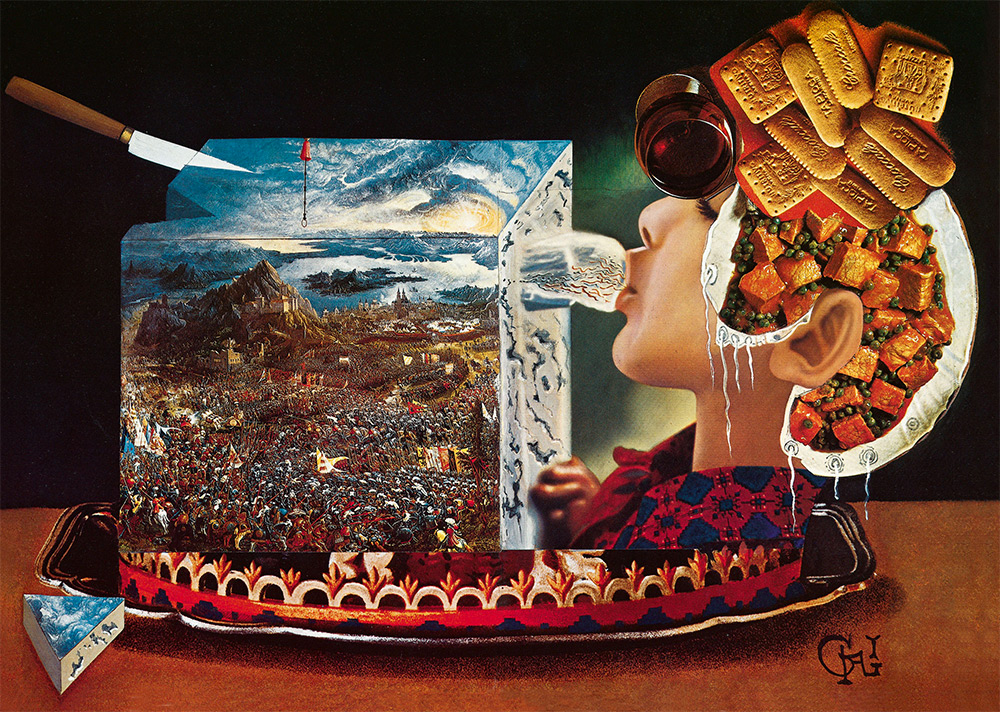
Maintaining an aggressively upward-waxed mustache; making a surrealist film with Luis Buñuel that Buñuel described as “nothing more than a desperate impassioned call for murder”; bringing an anteater on The Dick Cavett Show: Salvador Dalí can be described as a master of attention-grabbing gambits, by his admirers and detractors alike. No wonder, then, that he appears to have some serious admirers at Taschen. Known as a publisher of books that draw a great deal of press for their boundary-pushing size, content, and production values, Taschen would seem to be a natural home for Dalí’s legacy, or at least the parts of it that fit between two covers.
Besides his well-known and much-reprinted paintings, Dalí left behind a body of work also including not just film but sculpture, photography, architecture, and books. His first published volume, 1938’s The Tragic Myth of the Angelus of Millet, offers a “paranoiac-critical” interpretation of the titular pastoral painting by Jean-François Millet. In the 1940s he wrote, among other books, The Secret Life of Salvador Dalí, a kind of autobiography, and Hidden Faces, a novel set among aristocracy in France, Morocco, and California.
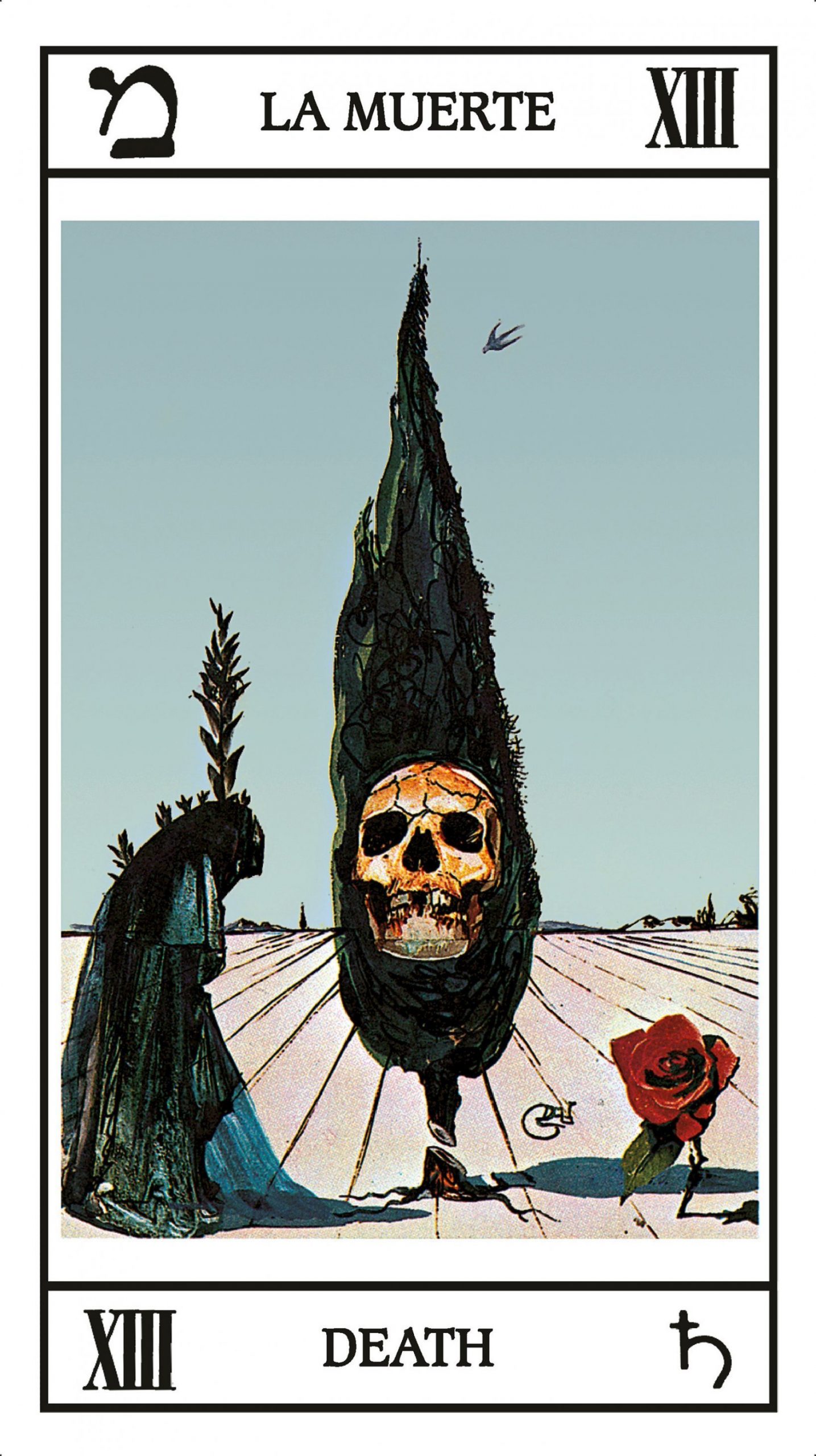
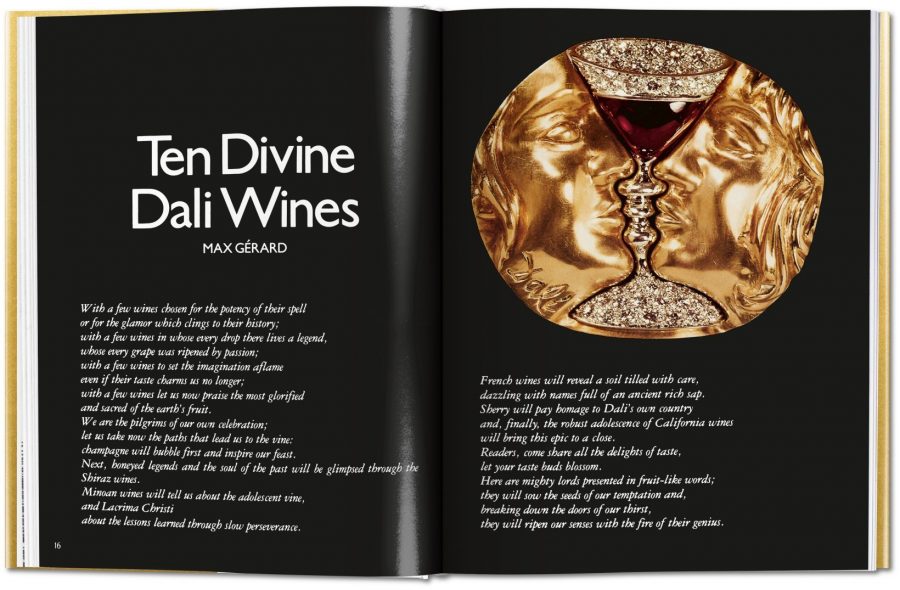
It was in the 1970s that Dalí’s literary efforts took a less predictable turn: 1973 saw the publication of his Les Diners de Gala, a cookbook featuring such recipes as “Veal Cutlets Stuffed with Snails,” “Thousand Year Old Eggs,” and “Toffee with Pine Cones.” In 1978 came The Wines of Gala, a personal guide to “Wines of Frivolity,” “Wines of Sensuality,” “Wines of Aestheticism,” and others besides. In recent years, Taschen has reprinted Dalí’s food and wine books with characteristic handsomeness. Those two now sit in the Taschen Dalí collection alongside Dalí: The Paintings, the most complete such collection ever published, and Dalí Tarot, a package that includes not just the Dalí-designed tarot deck originally published in 1984 but a companion book by tarot scholar Johannes Fiebig.
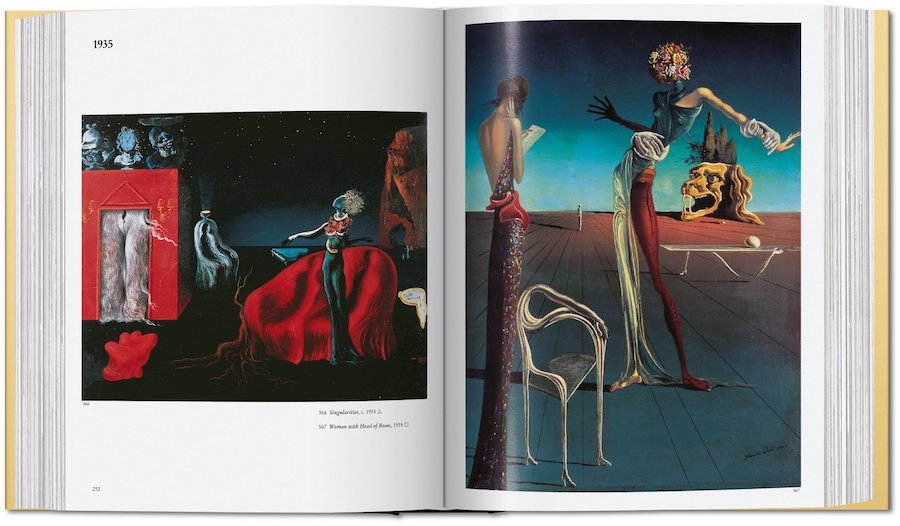
Dalí’s wife and savvy business manager Gala — she of all those dinners and wines — would surely approve of the skill and taste that Taschen has put into packaging even the artist’s minor work as a viable 21st-century product. Well-heeled Dalí enthusiasts will surely continue to pay Taschen prices for such packages, and even the less well-heeled ones can’t help but wonder what future reprints are on the table: lavish new editions of Hidden Faces, The Secret Life, or even 1948’s 50 Secrets of Magic Craftsmanship (with its endorsement of power napping)? Dare we hope for the definitive Salvador Dalí Bible?
Related Content:
Salvador Dalí’s 1973 Cookbook Gets Reissued: Surrealist Art Meets Haute Cuisine
Salvador Dalí’s Illustrations for The Bible (1963)
Based in Seoul, Colin Marshall writes and broadcasts on cities, language, and culture. His projects include the book The Stateless City: a Walk through 21st-Century Los Angeles and the video series The City in Cinema. Follow him on Twitter at @colinmarshall, on Facebook, or on Instagram.
Read More...Download Free Doctor Who Backgrounds for Virtual Meetings (Plus Many Other BBC TV Shows)

Enthusiasm for British television is a force of nature. That goes even more so for British television fandom outside Britain. All of us have known someone, or indeed been someone, who shifted their cultural allegiances wholesale after watching a single episode of, say, Monty Python’s Flying Circus. But even that hugely influential comedy series commands only low-intensity worldwide devotion when set alongside Doctor Who, which has aired on the BBC in one form or another since 1963. One can express one’s membership in the global Doctor Who fandom in many ways, now including, in this period of all-digital professional and social interaction, one’s choice of virtual backgrounds on Zoom or other videoconferencing software.

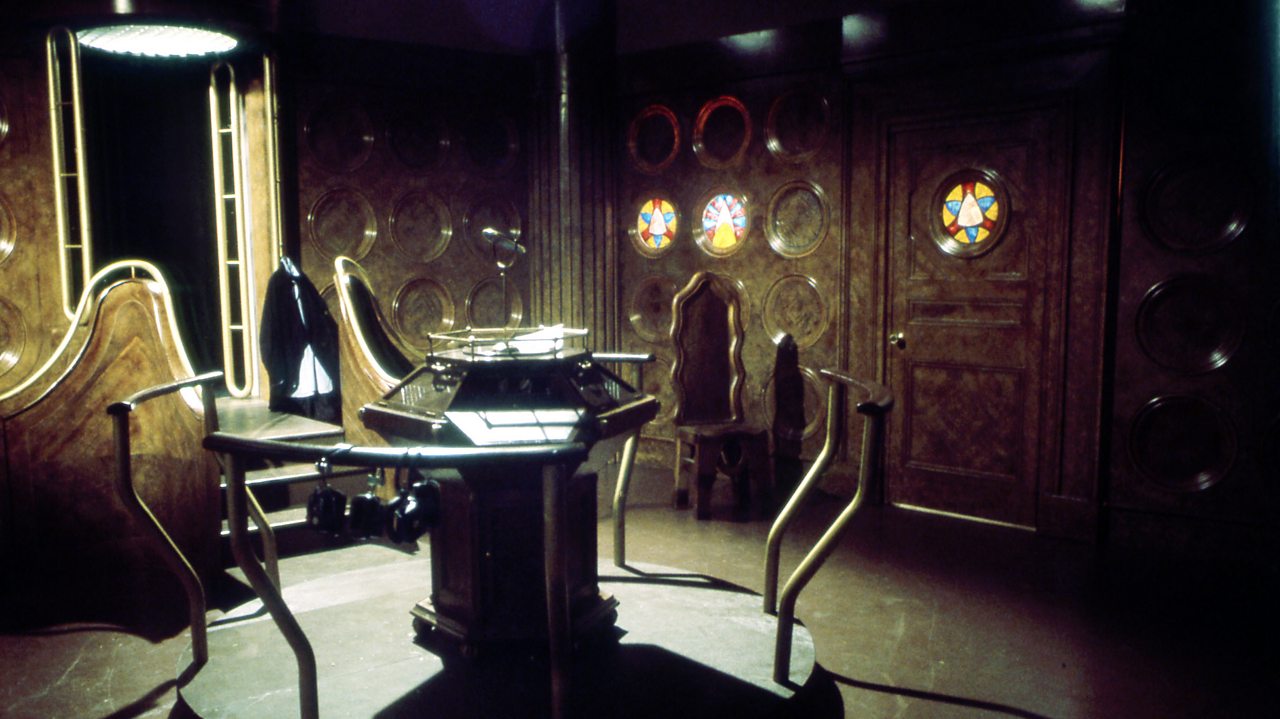
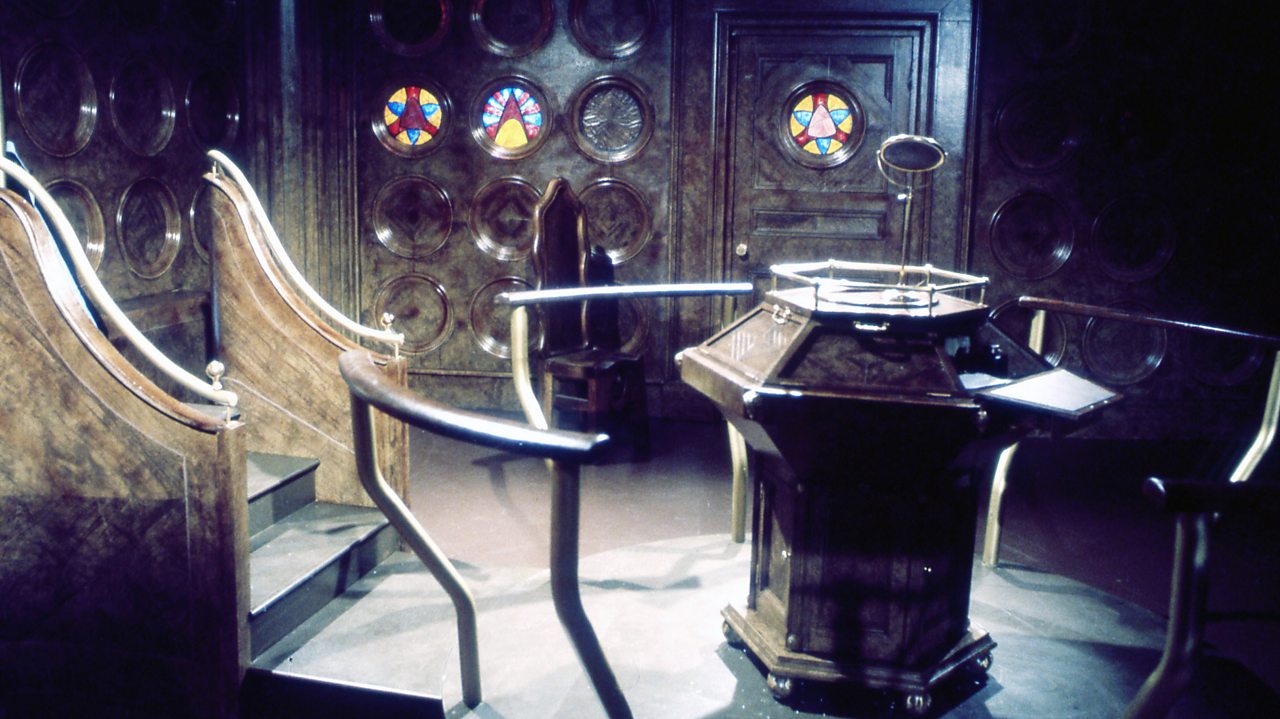
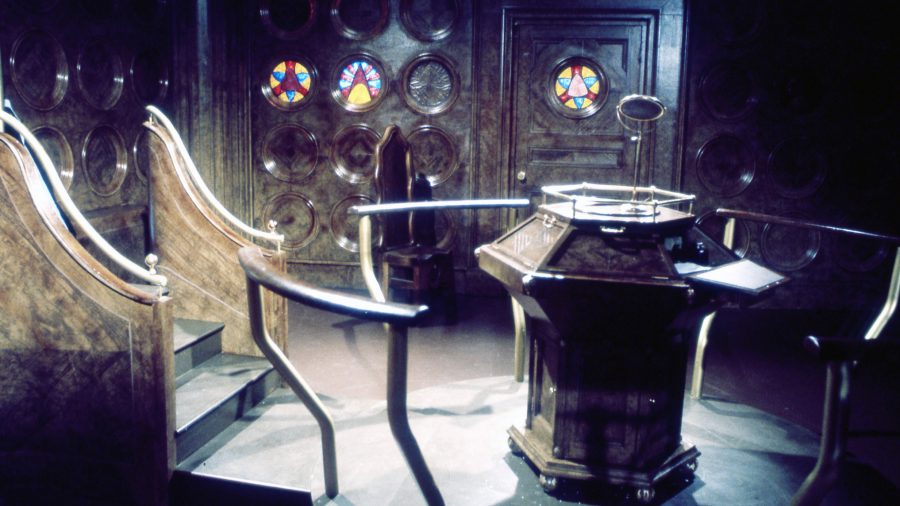
You can, in other words, make a call from inside the TARDIS. The expansive interior of the Doctor’s time-traveling space ship — which, as fans know, materializes in different lands and eras as a humble London police box — is just one of the free virtual backgrounds now offered by the BBC.
In fact, they’ve made available not just one TARDIS background but six: the 1980 version, the 1983 version, two views of the 2019 version, and two views of it as it appeared in the 1976 serial-within-the-series The Masque of Mandragora. If none of this means anything to you, you might consider browsing the BBC’s other virtual-background categories, which feature empty sets from the network’s other science-fiction productions as well as its sitcoms, light-entertainment programs, children’s shows, and sports broadcasts.
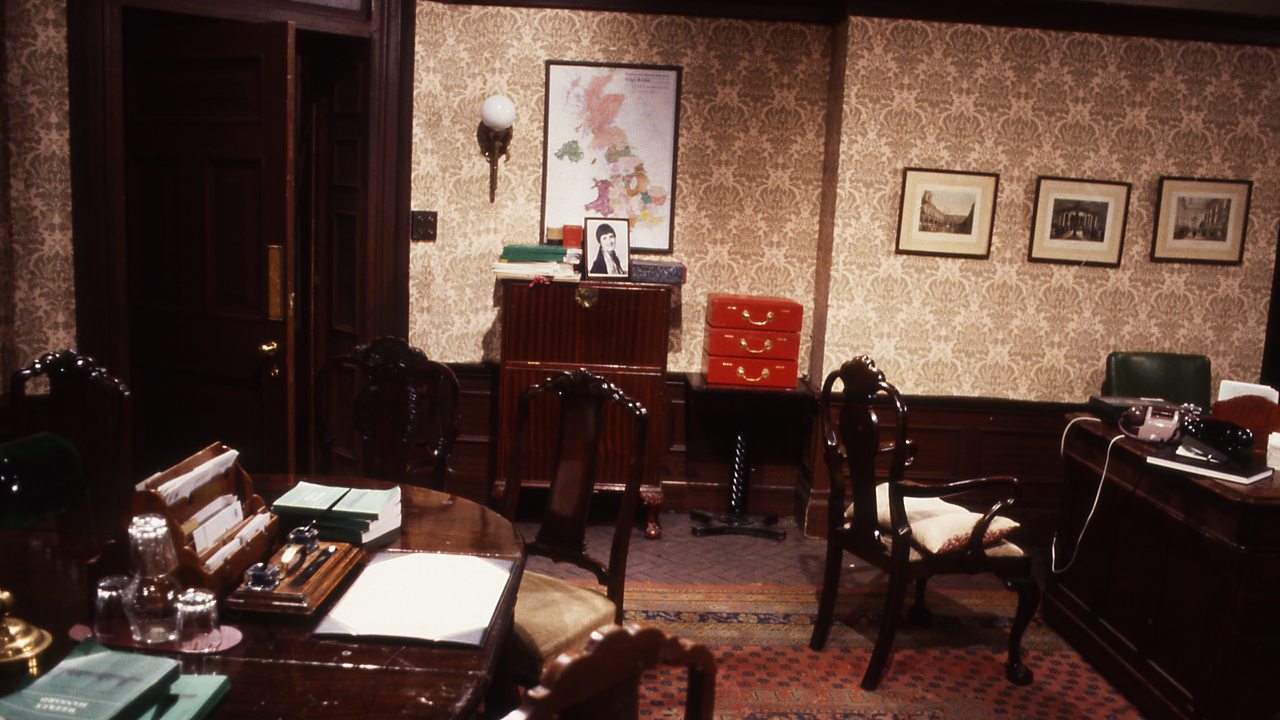
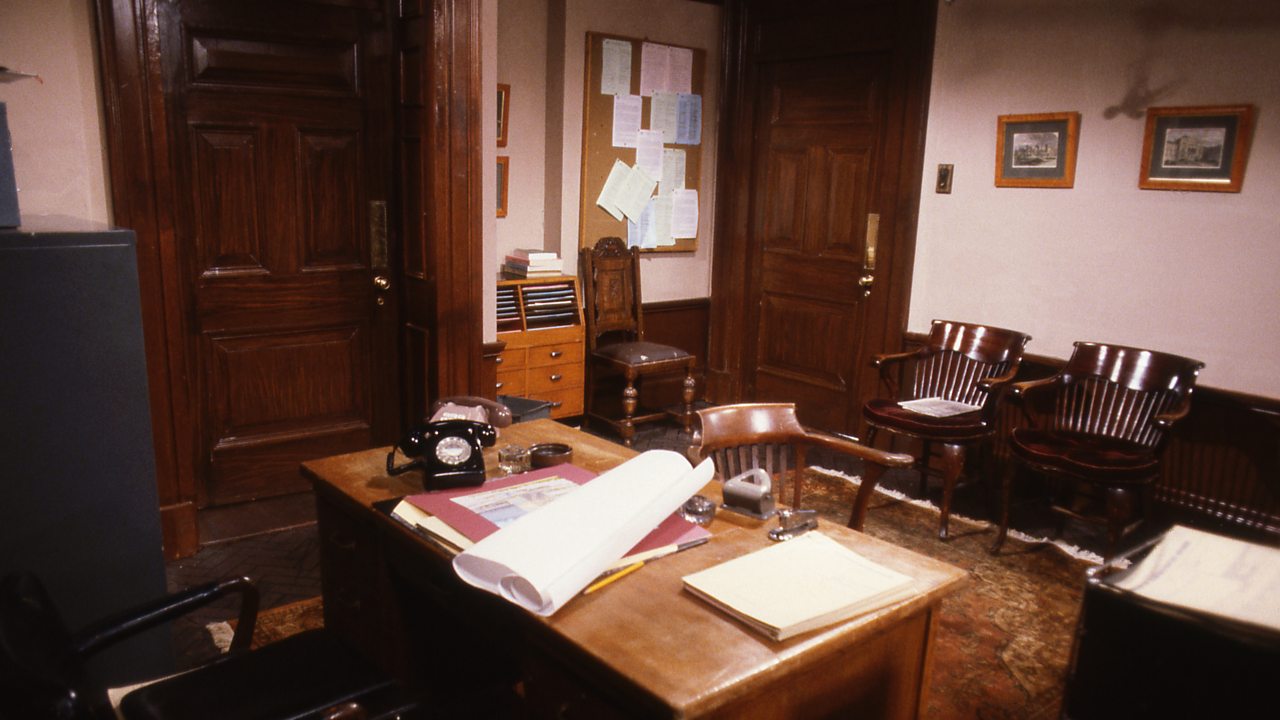
No Brits will be surprised at the presence of an entire category of backgrounds from the long-running soap opera EastEnders: the laundrette, the Branning Brothers car lot, and of course the Queen Victoria pub. But non-Brits will probably opt to make their video calls from familiar places created for more widely traveled programs, like the dining room at Fawlty Towers or Eddy and Patsy’s wine-filled refrigerator. Personally, I yield to none — or at least to no other American — in my appreciation of Yes Minister, a political satire that has only grown more incisive over the decades; I’d surely make my calls from one of the five Whitehall office sets the BBC has put up. Browsing its complete selection of virtual backgrounds, even the most obsessive British-TV aficionados will come across sets from shows of which they’ve never even heard. Luckily, many of us now have the time to binge-watch them all.
Related Content:
BritBox Now Streaming Now Streaming 550 Episodes Doctor Who and Many Other British TV Shows
30 Hours of Doctor Who Audio Dramas Now Free to Stream Online
Customize Your Zoom Virtual Background with Free Works of Art
Based in Seoul, Colin Marshall writes and broadcasts on cities, language, and culture. His projects include the book The Stateless City: a Walk through 21st-Century Los Angeles and the video series The City in Cinema. Follow him on Twitter at @colinmarshall, on Facebook, or on Instagram.
Read More...Watch Florian Schneider (RIP) in Classic Early Kraftwerk Performances
The seventies, am I right….?
Not that I can claim to have experienced it firsthand. But if I could have been a witness to any period in pop history it would have been the decade in which experimental fusion movements invaded rock and roll. There was Miles Davis and his protegees, of course. But there was much more besides: The Wailers’ fusion of rock, reggae, and soul; Fela Kuti’s fusion of Ghanaian high life, James Brown funk, and Nigerian jazz; Ryuchi Sakamoto’s fusion of indigenous, classical, and electronic dance music….
Few of these influential international artists became widely known among U.S. audiences at the time, but we have their music to thank for some of the most interesting directions post-punk and New Wave bands would take.
One of the most influential artists of the seventies, the recently departed Florian Schneider, who resembled an office manager at a German Dunder-Mifflin, was truly an unlikely character for major international stardom. And yet the mild-mannered flautist from Düsseldorf co-founded one of the most famous experimental fusion bands of all time with classmate Ralf Hütter.
I’m talking about Kraftwerk, of course, though the label “fusion” may not especially come to mind when thinking of the robotic German funk of the band’s major eighties’ releases. But Kraftwerk first emerged from the psych-blues-jazz-conceptual-electronic hybrid of the so-called “krautrock” scene, a somewhat derisive label applied to bands like Popul Vuh, Tangerine Dream, Can, and Neu!, one of the most obscurely influential bands of the decade, and one whose two members—guitarist Michael Rother and drummer Klaus Dinger—played in an early version of Kraftwerk. “We had no father figures,” says Hütter. “We were part of this ’68 movement, where suddenly there were possibilities, and we performed at happenings and art situations.”
For a brief time, in fact, Kraftwerk consisted only of Rother, Dinger, and Florian Schneider on the flute. They made one appearance in this configuration on the German TV program Beat Club. See them at the top play “Rückstoss-Gondoliere.” No, it’s not at all like “Autobahn,” although synthesizers were always central to the band’s sound. It’s a lot more like Pink Floyd, and they look the part. To what might we compare the sound of the band’s first TV appearance, above, live at Rockpalast in 1970? Hütter, looking like a Ramone, plays some sort of keytar-like synth that sounds like a dying goose; Dinger shows off his strict-yet-funky, now world-famous “motorik” beat; and Schneider lays down some very heavy flute grooves.
Rother and Dinger took these experiments and turned them into what David Bowie would call “the sound of the eighties.” He might have said the same of Kraftwerk, who heavily influenced Bowie, especially after Schneider and Hütter adopted their tongue-in-cheek businessmen/technician personae, inspired by po-faced artists Gilbert & George. Kraftwerk brought a deadpan sense of humor to New Wave that was adopted by every eighties synthpop star from Gary Numan to Depeche Mode to New Order, whose “Blue Monday” was partly inspired by “Uranium” from 1975’s Radio-Activity. This is a strange, transitional album, and one perhaps most often cited by other musicians inspired by Kraftwerk. It was their fifth album, but only the first in which they went fully electronic, and featured members Karl Bartos and Wolfgang Flür, who would complete the classic lineup of the late seventies and early eighties.
As you can see in the “Radioactivity” video further up, they have not become robots just yet. These are clearly humans, still a little loose and shaggy around the edges. (If Hütter’s delivery, haircut, and the band’s sound in general, make you think of Joy Division’s Ian Curtis—he was a huge fan.) How silly were Kraftwerk’s later concepts? Tremendously silly. But so too was Radio-Activity, an album full of punning banalities and geeky astrophysics references. By the time of The Man-Machine, Schneider and Hütter had so committed to their roles that we might almost, for a moment, believe the fan-made video above is a “rare pilot for the uncommissioned Kraftwerk sitcom, ‘Ralf and Florian.’” The single “Das Model,” below, has a bit more of a 70s Cabaret feel to it. And maybe a bit more dancing than we’re used to seeing from Kraftwerk.
They were in on the joke, but also so musically and technologically savvy they could update its premise every few years and shift pop music in new, weirder, funnier, and more danceable directions. “Do you want to know what the eighties will sound like?” they asked in 1981. And there was Computer World, which you can see the band perform in part below in Nagoya, Japan. Schneider’s flute is nowhere to be seen, but his penchant for penetrating, repetitive grooves and waves of weird synthesized sounds still drives the sound. Kraftwerk’s fusion of influences evolved principally through the partnership of Schneider and Hütter, the Richards and Jagger of experimental electronic pop.
Kraftwerk was not a band, Hütter insisted, but a “multi-media project.” Their onstage act was what Rolling Stone’s Rob Sheffield calls “cerebral technocrats” very much derived from their personalities, especially Schneider’s, magnified into performance art. “Kraftwerk is not a band,” Schneider said back in 1975. “It’s a concept. We call it ‘Die Menschmaschine,’ which means ‘the human machine.’ We are not the band. I am me. Ralf is Ralf. And Kraftwerk is a vehicle for our ideas.” Yet those ideas, which Schneider tended to express in coldly analytic terms, also produced some of the most joyfully danceable music ever made. That is the paradox of Kraftwerk, and their genius, from Dinger’s motorik beats to the pulsing synths built by Hütter and Schneider. They truly achieved a musical synthesis, one that honored the human desire for groove and melody and the machine’s desire for inhuman sounds and robotic precision.
Related Content:
Kraftwerk’s First Concert: The Beginning of the Endlessly Influential Band (1970)
Kraftwerk’s “The Robots” Performed by German First Graders in Adorable Cardboard Robot Outfits
The Case for Why Kraftwerk May Be the Most Influential Band Since the Beatles
Josh Jones is a writer and musician based in Durham, NC. Follow him at @jdmagness
Read More...A Michigan Family Makes Everyone Passing Their House Do Monty Python Silly Walks, and Then Puts Recordings on Instagram
Even if you don’t know the Beatles, you know “Love Me Do.” Even if you don’t know the Rolling Stones, you know “Satisfaction.” Even if you don’t know Monty Python, you know “The Ministry of Silly Walks.” Like an AM radio hit, the sketch works on several different aesthetic and intellectual levels while captivating audiences of disparate ages and cultures, all within the span of a few minutes. As a satire of British government bureaucracy it compares, in its way, to Antony Jay and Jonathan Lynn’s series Yes Minister, which would debut on the BBC a decade later. As sheer physical comedy, it draws its power, as all those old songs do, from the innate characteristics of its performers. Or rather, from John Cleese, who not only looks the part of a born establishment figure, but stands nearly six and a half feet tall.
Though few of us can sing like Paul McCartney or Mick Jagger, it doesn’t stop us from joining in when their songs come on the radio. By the same token, though few of us possess the sheer leg length to walk as silly as Cleese does, we can all generate our own kind of levity by giving our best. And much of the United States, locked down by the coronavirus pandemic, levity is just what’s needed. Hence the establishment of Yorkshire Silly Walks, which announces itself in no uncertain terms: “YOU HAVE ENTERED THE JURISDICTION OF THE MINISTRY OF SILLY WALKS,” reads its signs. “COMMENCE SILLY WALKING IMMEDIATELY.” All who pass through this territory are captured by a video camera, and some will later find themselves posted to Yorkshire Silly Walks’ Instagram page — as long as they’ve walked with sufficient silliness.
They don’t have to do it for long: the jurisdiction of this Ministry of Silly Walks extends only across the sidewalk in front of a single house in Grosse Pointe Park, Michigan. The home’s Yorkshire Road address will conjure up memories of another beloved sketch in the minds of serious Python fans — a group to which Liz Koto and her family, the house’s occupants, must belong. They’ve posted to Instagram well over 100 videos, each capturing a different silly walk executed by the people of their suburban neighborhood out for a stroll — just about the only thing many Americans can do to get out of the house these days. And they do it more joyfully than Cleese himself, who has spoken of how, like a rock star condemned to play the same hit over and over again, he grew deeply weary of playing the Minister of Silly Walks on stage for Monty Python’s live shows over the decades. After having undergone two hip replacements, he’s surely happy to leave silly-walking to the fans.
via Laughing Squid
Related Content:
John Cleese on The Importance of Making and Embracing Mistakes
Based in Seoul, Colin Marshall writes and broadcasts on cities, language, and culture. His projects include the book The Stateless City: a Walk through 21st-Century Los Angeles and the video series The City in Cinema. Follow him on Twitter at @colinmarshall, on Facebook, or on Instagram.
Read More...Support Us
We're hoping to rely on loyal readers, rather than erratic ads. Please click the Donate button and support Open Culture. You can use Paypal, Venmo, Patreon, even Crypto! We thank you!

About Us

Open Culture scours the web for the best educational media. We find the free courses and audio books you need, the language lessons & educational videos you want, and plenty of enlightenment in between.
Advertise With Us

FREE UPDATES!
GET OUR DAILY EMAIL
Get the best cultural and educational resources on the web curated for you in a daily email. We never spam. Unsubscribe at any time.
FOLLOW ON SOCIAL MEDIA

Open Culture editor Dan Colman scours the web for the best educational media. He finds the free courses and audio books you need, the language lessons & movies you want, and plenty of enlightenment in between.
Advertise With Us