When Debbie Harry Combined Artistic Forces with H.R. Giger
After four years of phenomenal chart success, the band Blondie went on hiatus in 1981. While Debbie Harry pursued the acting she had started in punk rock filmmaker Amos Poe’s works, she also went the solo album route. On paper, this album, KooKoo, must have looked like a surefire hit: Nile Rogers and Bernard Edwards from the band Chic were brought in to write and produce, hot on the heels of their successful resuscitation of Diana Ross’s career the year before. Harry and boyfriend/band member/guitarist Chris Stein wrote tracks as well, and fully indulged in the Black music genres they had already been toying with on Blondie’s Autoamerican, like “Rapture” and “The Tide Is High.”
But here’s where it gets a bit weird, and everything goes off kilter. The choice for the album art and promotional videos was H.R. Giger, the artist who had rattled moviegoers’ brains the previous year with his designs for Ridley Scott’s Alien.
The couple had met Giger in 1980 at a reception for his paintings at New York’s Hansen Gallery.
“There I was introduced to a very beautiful woman, Debbie Harry, the singer of the group Blondie, and her boyfriend, Chris Stein,” Giger said in an interview. “They were apparently excited about my work and asked me whether I would be prepared to design the cover of the new Debbie Harry album.”
Though he didn’t know the group–Giger preferred to listen to jazz–he agreed to the cover and to the promo videos, even directing when the original director didn’t show.
The album cover is probably better known than the music inside, and no wonder: it features Harry’s face pierced horizontally by four spikes. Her expression is ambiguous, possibly ecstatic. It was in one way a throwback to Giger’s other famous record cover, the one for Emerson, Lake, and Palmer’s Brain Salad Surgery. But the cover also would see its influence in films like Hellraiser, the rise of what was called the “modern primitive” movement, and help cultivate the dark masochistic character Harry would play in David Cronenberg’s Videodrome. It was a feeling that would flourish in the decadent ‘80s.
Harry wrote about this in Heavy Metal magazine, which often featured the artist, saying “Giger’s work has a subconscious effect: it engenders the fear of being turned into metal.”
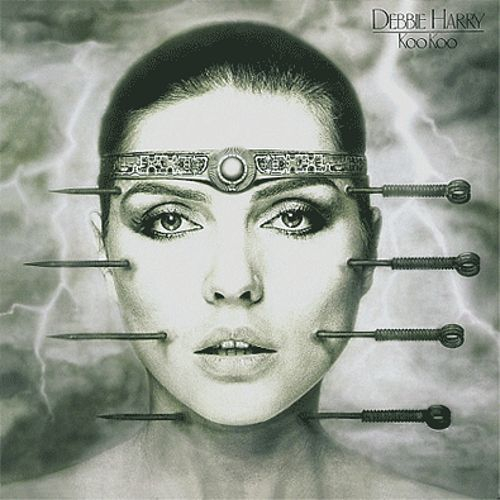
The cover was a taster for more menacing things, however. It’s the videos where Harry goes full Giger. First of all, the blonde hair is gone, replaced by black. And Giger puts Harry in a bodysuit, half flayed-human, half machine. The music videos are simple, performance based, though the sunny, alluring Harry has disappeared and a proto-Goth being has taken her place.
But that leaves us with the music, which one has to admit, is completely unsuited for this design. If Harry had made an album closer to Danielle Dax, for example, then we might have seen one of the oddest mid-career shifts in ‘80s music. Instead the commercial flatlining of the album threw Harry off-track, while Giger went on to be the go-to album artist for metal and punk bands, from the Dead Kennedys to Bloodbath.
Related Content:
How Blondie’s Debbie Harry Learned to Deal With Superficial, Demeaning Interviewers
Ted Mills is a freelance writer on the arts who currently hosts the Notes from the Shed podcast and is the producer of KCRW’s Curious Coast. You can also follow him on Twitter at @tedmills, and/or watch his films here.
Read More...Pretty Much Pop: A Culture Podcast #49 Considers Conspiracy Theories as Pop
Ex-philosopher Al Baker works at the UK-based Logically, a company that fights misinformation.
He joins your hosts Mark Linsenmayer, Erica Spyres, and Brian Hirt to try to answer such questions as: What’s the appeal of conspiracy theories? How similar is being consumed them to being a die-hard fan of some pop culture property? What’s the relation between pernicious conspiracy theories and fun speculation (like, maybe Elvis is alive)? Is there a harmless way to engage in conspiracy theorizing as a hobby? Is something still a conspiracy theory in the pejorative sense if it turns out to be true?
We touch on echo chambers, the role of irony and humor in spreading these theories, how both opponents and proponents claim to be skeptics, Dan Brown Novels, Tom Hanks, the Mel Gibson film Conspiracy Theory, and documentaries like Behind the Curve (about Flat Earthers) and The Family.
For expert opinions on the psychology of conspiracy theories, try The Conversation’s Antill Podcast, which had a whole series on this topic. For even more podcast action, try FiveThirtyEight, BBC’s The Why Factor podcast, Skeptoid, and The Infinite Monkey Cage.
Here are some more articles:
- “Why We Should Not Treat All Conspiracy Theories the Same” by Jaron Harambam
- “We’re Keeping A Running List Of Hoaxes And Misleading Posts About The Nationwide Police Brutality Protests” by Jane Lytvyneko and Craig Silverman
- “The Greatest Celebrity Conspiracy Theories of All Time” by Matt Miller
- “My Father, the QAnon Conspiracy Theorist” by Reed Ryley Grable
- “COVID-19 and the Turn to Magical Thinking” by Hugh Gusterson
- A new podcast called Wind of Change claims that the CIA wrote the Scorpions song by that name.
If you enjoy this, try Pretty Much Pop #14 on UFOs. The Partially Examined Life episodes referred to in this discussion are #96 on Oppenheimer and the Rhetoric of Science Advisers and #82 on Karl Popper.
Learn more at prettymuchpop.com. This episode includes bonus discussion that you can only hear by supporting the podcast at patreon.com/prettymuchpop. This podcast is part of the Partially Examined Life podcast network.
Pretty Much Pop: A Culture Podcast is the first podcast curated by Open Culture. Browse all Pretty Much Pop posts or start with the first episode.
Read More...Construct Your Own Bayeux Tapestry with This Free Online App
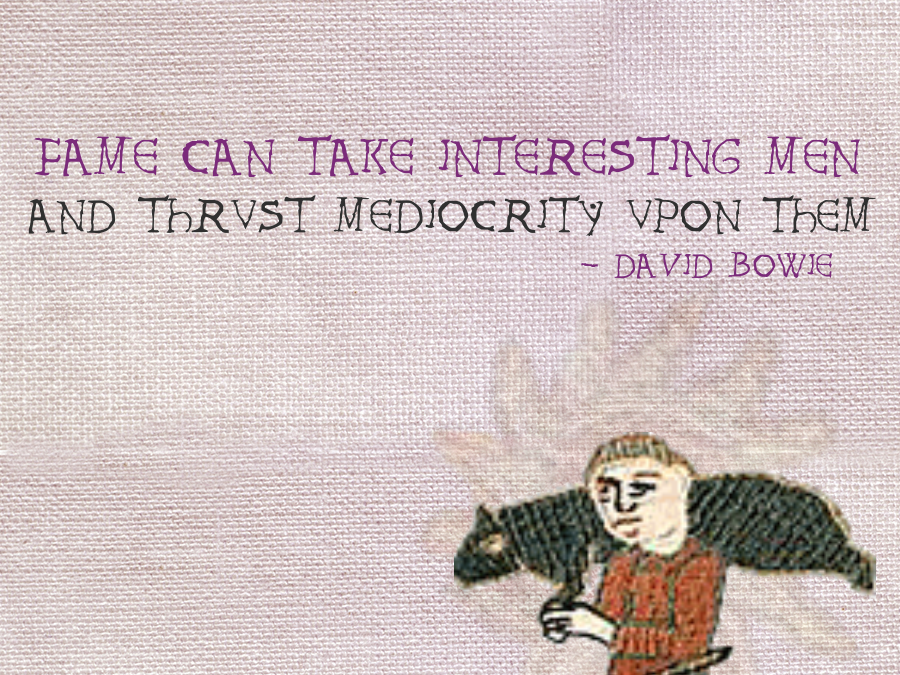
A wise woman once quoth that one man’s adult coloring book is another’s Medieval Tapestry Edit.
If taking crayons to empty outlines of mandalas, floral patterns, and forest and ocean scenes has failed to calm your mind, the Historic Tale Construction Kit may cure what ails you.
Programmers Leonard Allain-Launay and Mathieu Thoretton and software engineer Maria Cosmina Etegan created the online kit as a tribute to a late, great, early 21st-century application designed by Academy of Media Arts Cologne students Björn Karnebogen and Gerd Jungbluth.
They separated out various elements of the Bayeux Tapestry, allowing you to freely mess around with 1000-year-old images of warriors, commoners, beasts, and buildings:
Craft thy own Bayeux Tapestry
Slay mischievous beasts
Rule the kingdom
Choose a background, add some text in your choice of Bayeux or Augusta font and you’ll have done your bit to revive the fading art of the Medieval Macro (or meme.)
The original tapestry used some 224 feet of wool-embroidered linen to recount the Battle of Hastings and the events leading up to it.
You need not have such lofty aims.
Perhaps test the waters with a Father’s Day greeting, resizing and rotating until you feel ready to export as a PNG.
The interface is extremely user friendly, kind of like a tech-savvy 11th-century cousin of the online drag-and-drop graphic design tool, Canva.
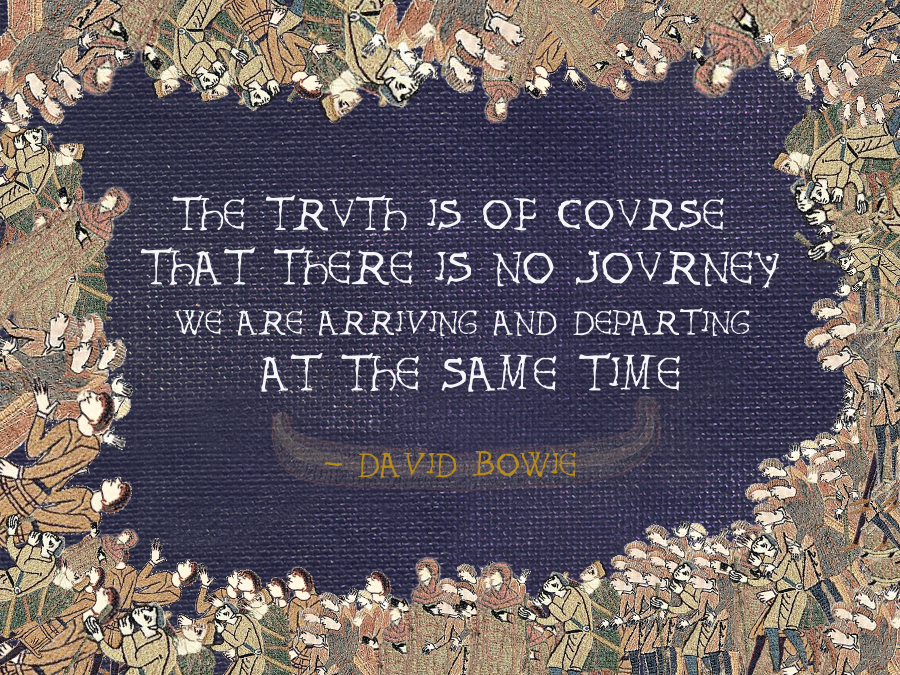
The Historic Tale Construction Kit’s most impressive bells and whistles reside in the paintbrush tool in the lower left corner, which allows you to lay down great swaths of folks, birds, or corpses in a single sweep.
Your palette will be limited to the shades deployed by the Bayeux embroiderers, who obtained their colors from plants—dyer’s woad, madder, and dyer’s rocket (or weld).
The text, of course, is entirely up to you.
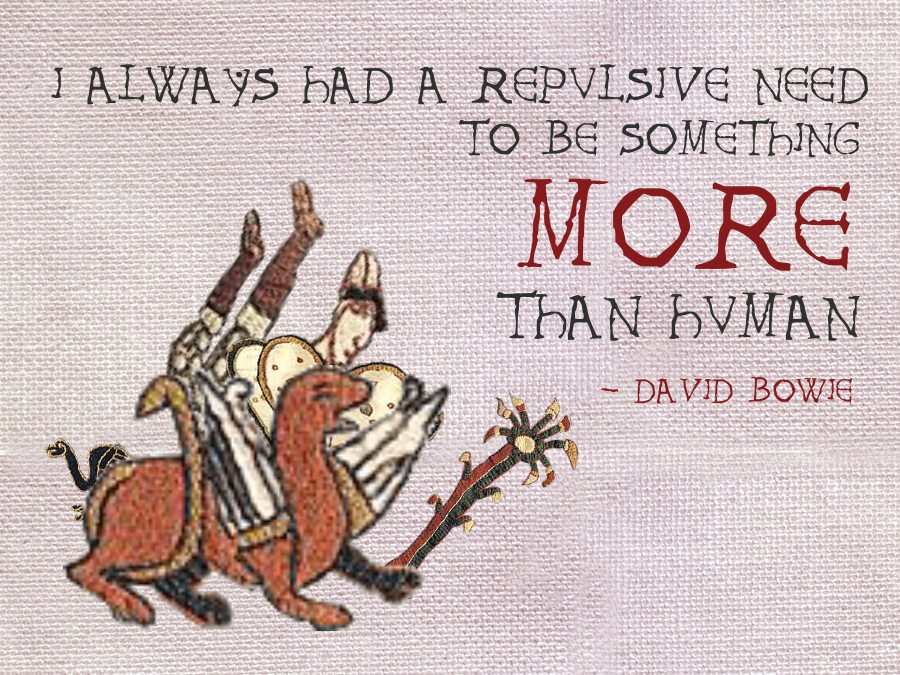
It pleased us to go with the eminently quotable David Bowie, and only after we groped our way into the three fledgling efforts you see above did we discover that we’re not the only ones.
Presenting Early Pre-Bowie References to “Space Oddity”
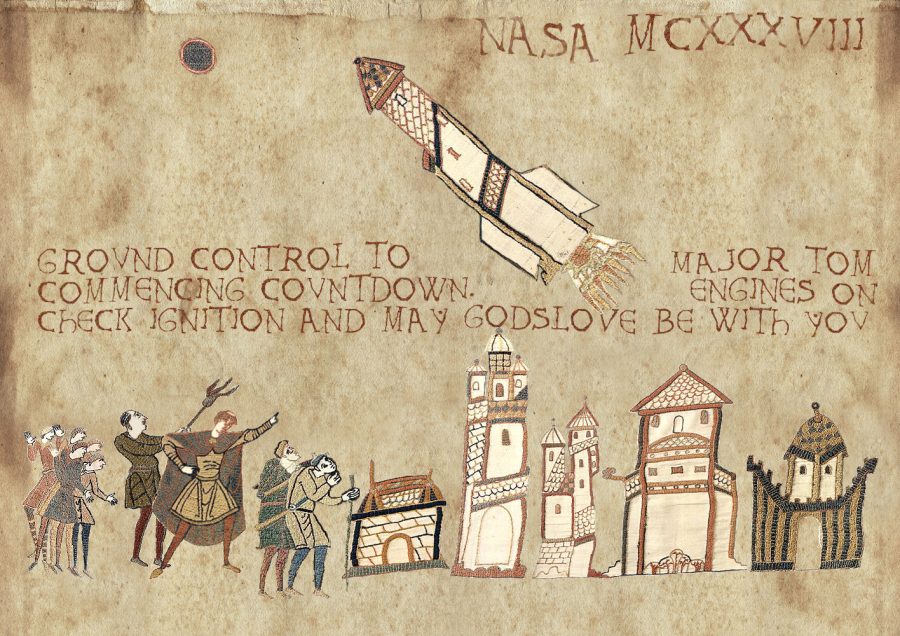

Throw on some Bardcore and begin reworking the Bayeux Tapestry with the Historic Tale Construction Kit here.
If you are interested in something a bit more technical, the designers have put the opensource code on GitHub for your customizing pleasure.
The Bayeux Tapestry has also been recently digitized. Explore it here: The Bayeux Tapestry Gets Digitized: View the Medieval Tapestry in High Resolution, Down to the Individual Thread
Related Content:
Why Knights Fought Snails in Illuminated Medieval Manuscripts
Ayun Halliday is an author, illustrator, theater maker and Chief Primatologist of the East Village Inky zine. Follow her @AyunHalliday.
Read More...Take a Virtual Drive through London, Tokyo, Los Angeles & 45 Other World Cities
When asked once about his beliefs, This American Life creator Ira Glass replied that he believes “the car is the best place to listen to the radio.” That seems to be a culturally supported perception, or at least it has been in over the past half-century in America. But does it hold true in other countries? Does listening to the radio in the car feel as good in London, Buenos Aires, Mumbai, and Tokyo as it does in Chicago, New York, Miami, and Los Angeles?
You can see and hear for yourself with the wealth of virtual urban-driving-and-radio-listening experiences on offer at Drive & Listen, where you can take your pick from any of the aforementioned cities and 40 others besides. The site makes this possible by bringing together two forms of media that have come into their own on the internet of the 21st century: streaming radio and streaming video.
In most every major metropolitan area, radio stations now make their broadcasts available online. At the same time, Youtubers have by now shot and uploaded a great many through-the windshield views of all those places, creating the once-unlikely entertainment genre of the driving video.
Here we’ve included some prime examples from popular Youtube driver J Utah, whose scope includes American cities large and small as well as such world capitals as Tokyo, Paris, Singapore, Hong Hong, and São Paulo. All in 4K video.
Click on one of the cities on Drive & Listen’s menu, and chances are you’ll see one of J Utah’s videos. It will come with a streaming-radio soundtrack, sourced from one of the stations in the city or country on display. Your virtual Havana drive may be accompanied by announcements of the news of the day, your virtual Istanbul drive by Turkish rock, your virtual Chicago drive by an NPR affiliate (perhaps even WBEZ, home of This American Life), your virtual Guadalajara drive by soccer scores, your virtual Miami drive by straight-ahead jazz, your virtual Berlin drive by Patti Smith.
Each time you select a city, you’ll get a different combination of radio station and driving footage. As every driver knows, day driving and night driving — to say nothing of rush hour versus the wee hours — feels completely different, and so the drivers of Youtube have shot at all possible times. Some of their routes thread right between downtown skyscrapers, while others stick to freeways along the outskirts. As a resident of Seoul, I can tell you that Drive & Listen accurately conveys the experience of riding in a cab through that city — provided you first crank the video speed up to 2x.
Enter Drive & Listen here.
Related Content:
Take a Drive Through 1940s, 50s & 60s Los Angeles with Vintage Through-the-Car-Window Films
London Mashed Up: Footage of the City from 1924 Layered Onto Footage from 2013
Reading While Driving, Seriously?
Based in Seoul, Colin Marshall writes and broadcasts on cities, language, and culture. His projects include the book The Stateless City: a Walk through 21st-Century Los Angeles and the video series The City in Cinema. Follow him on Twitter at @colinmarshall, on Facebook, or on Instagram.
Read More...Revisiting The Wire During 2020’s Black Lives Matter Movement
George Floyd’s murder while under arrest for allegedly passing a counterfeit bill of small denomination sparked massive worldwide demonstrations against police brutality and in support of Black Lives Matter.
It also led to the abrupt cancellation of television’s recent hit, Live PD, and its longest-running reality show, Cops.
As Amanda Hess recently observed in The New York Times, public opinion has turned on any show that promotes an image of police officers as universally decent forces for good, “lovable goofballs,” or anti-heroes whose rough edges make a play for viewers’ allegiance by suggesting the characters are realistically flawed and thus, relatable:
The “good cop” trope is a standard of both police procedurals and real-life police tactics, and now crowdsourced video of the protests has given cops a new stage for performing the role. In recent days, supposedly uplifting images of the police have spread wildly across the internet, competing for views with evidence of cops beating, gassing and arresting protesters. In Houston, an officer consoled a young black girl at a rally: “We’re here to protect you, OK?” he told her, enveloping her in a hug. “You can protest, you can party, you can do whatever you want. Just don’t break nothing.” In Nashville, the police tweeted a photo of cops kneeling next to a black boy with a “Black Lives Matter” sign, smiling from behind their riot helmets. And in Atlanta, a line of National Guard soldiers did the Macarena. On the final rump shake, a black rifle slung over one soldier’s back swung to the beat.
These images show cops engaging in a kind of pantomime of protest, mimicking the gestures of the demonstrators until their messages are diluted beyond recognition. They reframe protests against racist police violence into a bland, nonspecific goal of solidarity. These moments are meant to represent the shared humanity between officers and protesters, but cops already rank among the most humanized groups in America; the same cannot be said for the black Americans who live in fear of them. Cops can dance, they can hug, they can kneel on the ground, but their individual acts of kindness can no longer obscure the violence of a system. The good-cop act is wearing thin.
According to Hollywood Reporter critic Inkoo Kang, almost any portrayal of cops on TV right now rankles, even one that was lauded for its realistic portrayal of corruption and abuse on the force, HBO’s critically acclaimed The Wire—Barack Obama’s avowed favorite.
In the first season of The Wire, just about every on-the-ground cop participates in police brutality — often as a kind of professional prerogative. Their violence is meant to add darker streaks to the characters’ otherwise heroic gloss, but it also has the effect of normalizing police brutality as a part, even a perk, of the job.
Her comments touched a nerve with actor Wendell Pierce, whose character was based on a Baltimore homicide detective, Oscar Requer, who achieved his position at a time when black officers routinely faced racial harassment from within the force. Pierce published his response on Twitter:
How can anyone watch “The Wire” and the dysfunction of the police & the war on drugs and say that we were depicted as heroic. We demonstrated moral ambiguities and the pathology that leads to the abuses. Maybe you were reacting to how good people can be corrupted to do bad things.
If The Wire did anything right, it depicted the humanity of the Black lives so easily profiled by police and the destruction of them by the so-called war on drugs; a deliberate policy of mass incarceration to sustain a wealth disparity in America that thrives keeping an underclass.
The Wire, if anything, was the canary-in-the-mine that forecasts the institutional moral morass of politics and policing that lead us to the protests of today. “The bigger the lie, the more they believe” was a line of mine that is so salient and profound in today’s climate.
“The Wire” is a deep dive study of the contributing variables that feed the violence in our culture: in the streets and at the hand of police. Classism, racism, destruction of public education, and moral ambiguity in our leadership all feed this paradigm of American decline.
I know I sound defensive and I probably am, The Wire is personal for me. The Wire is also Art. The role of Art is to ignite the public discourse. Art is where we come together as a community to confront who we are as a society, decide what our values are, and then act on them.
The critique here is that television seems to follow behind the current events of the day. I would ask that you consider that maybe The Wire was a precursor to the discussion that is mandatory now. It was an indicator, a warning light, of the implosion we are feeling today.
At a time when the world is called upon to listen carefully to what black people are saying, and much of the world has shown themselves ready to do so, Pierce’s words carry extra weight.
His assertion that the show, which ran from 2002 to 2008, accurately depicted a system so rotten that collapse was inevitable, is echoed in interview clips with creator and one-time police reporter, David Simon, above.
The video essay was put together by aspirant screenwriter Nehemiah T. Jordan whose Behind the Curtain series aims to provide insights on how celebrated scripts for both the big and small screens—Fight Club, Uncut Gems, The Sopranos, Breaking Bad—come by their aesthetic quality.
Simon’s ambition for The Wire was that it truthfully convey what he had observed as a reporter, as well as the lives of the people he interacted with—both Baltimore cops and those they mostly failed to serve.
In a 2015 White House conversation with then-President Obama, Simon remarks that an emphasis on drug-related offenses led to an epidemic of presumptive police work, and a decline in “competent retroactive investigation of felonies.” A disproportionate number of young black and Latino men were incarcerated during this time, and upon their release, their felony histories meant that few of them were able to secure meaningful employment. America’s problems were compounded.
Whether or not you are moved to watch, or rewatch The Wire, we heartily recommend Where We Go from Here, a recent New York Daily News op-ed by actor Michael K. Williams, who played fan favorite Omar Little, and whose real life counterpart Simon discusses with Omar-fan Obama.
New York native Williams, who has worked to end mass juvenile incarceration, foment collaboration between police and at-risk youth and serves as an ambassador for The Innocent Project, possesses a deep understanding of the New York Police Department’s structure, chain of command, and day to day workings. Stating that tangible action is needed to “shift police culture” and “transform the relationships between law enforcement and communities of color,” he makes a case for six concrete reforms:
- Overhaul CompStat, the NYPD’s crime tracking mechanism.
- Eliminate plainclothes units.
- Create an independent body to investigate “use of force” incidents at the time they occur.
- Reimagine the duties of civilians within the department tasked with community-building.
- Implement ongoing trauma-centered training, education and activities for officers, executives and the communities they serve.
- Make racial justice a core component of NYPD training and education.
Read Michael K. William’s Op-Ed here.
Related Content:
The Wire as Great Victorian Novel
Ayun Halliday is an author, illustrator, theater maker and Chief Primatologist of the East Village Inky zine. Follow her @AyunHalliday.
Read More...Is This the Most Accurate Fan Cover of the Beatles Ever? Hear a Faithful Recreation of the Abbey Road Medley
I once thought I might be from the last generation to have spent a good part of their youth in front of a pair of speakers, playing their parents’ Beatles records until they memorized every note. Abbey Road was a special favorite in our house. I must have heard the outro medley a hundred thousand times or more. Now that reissue vinyl is everywhere, or something resembling the original records, there are loads of people who can say the same thing—and loads more who have streamed Abbey Road on repeat until it’s seared into their memories.
I ask those people now, young and old and middle-aged, whose familiarity with Paul McCartney’s voice on “Golden Slumbers/Carry that Weight/The End” comes from this kind of obsessive listening: do you think the cover version above posted on YouTube by AndyBoy 63 sounds exactly like the recording made at EMI Studios (renamed Abbey Road after the album) in 1969? Answer before listening to the original “Golden Slumbers,” below. A fair number of YouTube commenters say they mistook this for the album version or an outtake.
DUDE I THOUGHT I WAS LISTENING TO THE REAL THING I DIDNT REALIZE IT WAS A COVER!!! YOU SOUND JUST LIKE PAULIE
By far the most accurate cover ever of any song.
I thought this was the Beatles for about three minutes.… I knew it wasn’t Abbey Road but thought it was some track off the anthology. This is good enough to make me think it’s actually the Beatles!
It sounds to me like a cover version that approximates the timbre of dynamics of the original, impressively so, but is also clearly not The Beatles.
We can hear the differences between Sir Paul’s voice and piano and Andy’s recording in the first few phrases, but it’s not as if Andy has set out to deceive listeners, marking the songs as covers in the description. His intention is to pay tribute. “As a child,” he writes on his YouTube channel, “I always wanted to learn to play guitar, bass, drums and piano so that I could play and sing my favourite Beatles songs.” You’ll find several more, including “Sgt. Pepper’s Lonely Hearts Club Band/With a Little Help from My Friends,” just above. Again, it sounds to me like a faithfully earnest cover created as a labor of love. And again, for many reasons, not the Beatles. (His cover of “Help!” on the other hand is scarily good. I think he does a better Lennon impression.)
You’ve got to hand it to Andy for taking his fandom to this level of imitation. The sincerest form of flattery may not produce the best cover version, but it is an excellent way to show off one’s musicianship. Still, no one does McCartney better than McCartney (see him play himself below).
Other artists playing his songs might sound best doing it as themselves. But as an exercise in studious recreation of Beatles arrangements, AndyBoy 63’s proves he’s even more of a fan than those who can hum every bar of Abbey Road without missing a note. While we warble “Here Comes the Sun” in the shower, he’s single-handedly, persuasively rerecorded some of The Beatles’ most famous songs. He’s also covered Lennon’s solo hits and songs by Buddy Holly and Elvis, as well as releasing original music. Check it out here.
And for an absolutely fab version of the Abbey Road medley, watch the Fab Faux’s pretty impeccable version right below.
Related Content:
Paul McCartney’s Conceptual Drawings For the Abbey Road Cover and Magical Mystery Tour Film
Hear 100 Amazing Cover Versions of Beatles Songs
209 Beatles Songs in 209 Days: Memphis Musician Covers The Beatles’ Songbook
The Band Everyone Thought Was The Beatles: Revisit the Klaatu Conspiracy of 1976
Josh Jones is a writer and musician based in Durham, NC. Follow him at @jdmagness
Read More...Imagining the Martin Luther King and Malcolm X Debate That Never Happened
American history as it’s usually taught likes to focus on rivalries, and there are many involving big personalities and major historical stakes. Abraham Lincoln and Stephen Douglas, Thomas Jefferson and Alexander Hamilton, W.E.B. DuBois and Booker T. Washington. These figures are set up to represent the “both sides” we expect of every political question. While the issues are oversimplified (there are always more than two sides and politics isn’t a sport) the figures in question genuinely represented very different perspectives on power and progress.
When it comes to the history of the Civil Rights movement, we are given another such rivalry, between Martin Luther King, Jr. and Malcolm X. Their ideas and influence are pitted against each other as though they had shared a debate stage. In fact, the two leaders met only once, during Senate debates on the Civil Rights Act of 1964. “King was stepping out of a news conference,” writes DeNeen L. Brown at The Washington Post, when Malcolm X, dressed in an elegant black overcoat and wearing his signature horn-rimmed glasses, greeted him.”
“Well, Malcolm, good to see you,” King said.
“Good to see you,” Malcolm X replied.
Cameras clicked as the two men walked down the Senate hall together.
“I’m throwing myself into the heart of the civil rights struggle,” Malcolm X told King.
Later, King would express his disagreement with Malcolm’s “political and philosophical views—at least insofar as I understand where he now stands.” The comment allowed for an evolution in X’s thought that would, in fact, occur that year, while later events would push King in a far more radical direction. As Brown writes:
Although the two men held what appeared to be diametrically opposing views on the struggle for equal rights, scholars say by the end of their lives their ideologies were evolving. King was becoming more militant in his views of economic justice for black people and more vocal in his criticism of the Vietnam War. Malcolm X, who had broken with the Nation of Islam, had dramatically changed his views on race during his 1964 pilgrimage to Mecca.
“Much of America did not know the radical King—and too few know today,” writes Cornell West in his introduction to The Radical King, a collection of lesser-known speeches and writings. But “the FBI and US government did. They called him ‘the most dangerous man in America.’” Malcolm X’s extremely harsh criticism of King as “a 20th-century or modern Uncle Tom” is even more unfair and unwarranted against this background, especially given the title of King’s final, undelivered, sermon: “Why America May Go to Hell.”
In the years after X’s death, King fought for labor rights and advocated for “a better distribution of wealth,” writing in 1966, “America must move toward democratic socialism.” His anti-imperialist, anti-colonial stance alienated many former supporters and enraged the government, but “he refused to silence his voice in his quest for unarmed truth and unconditional love,” West writes. Maybe Malcolm’s unrelenting criticisms played a part in King’s radicalization.
The video “debate” above—actually a 9‑minute edit of their interview discussions of each other—begins with one of Malcolm X’s withering statements about King’s nonviolent resistance, which he characterizes as “defenselessness.” One can see, given the ad hominem attacks, why King refused requests for a debate. Had it happened, however, it might have gone something like this, with questions focused solely on violence vs. nonviolence as effective and/or morally justifiable tactics for the Civil Rights struggle.
The nuances and sickening historical ironies of the question get lost when disagreement is staged as a zero-sum prizefight, as the Rocky theme in the intro not-so-subtly suggests it is. King, X, and virtually every other civil rights leader throughout history, understood the practical importance of self-defense in a violently racist state. “Even the pacifist King was a firm advocate of black gun ownership,” writes John Merfield at Wisconsin Public Radio,” although he, like others, drew a sharp distinction between self-defense, which he saw as legitimate, and political violence, which he called folly.”
King also staunchly refused to address the question of violence outside the larger question of justice, without which, he said, there could be no peace. Movement leaders like Angela Davis who carried forward the radical, anti-imperialist analysis of both the later King and X would continue to push against the simplistic question of whether violence is justified as a response to brutal oppression. In a famous interview clip above, she demonstrates the absurdity of the idea that people subjected to racial terrorism by the authorities and groups protected by them should have to answer charges of committing political violence.
The history of racist killings is a long “unbroken line,” said Davis more recently during the Ferguson uprising. While Civil Rights leaders of the 20th century may have disagreed about the right response, all of them agreed it had to end immediately if the country is to survive and the promise of true freedom to be realized.
Related Content:
Watch Malcolm X Debate at Oxford, Quoting Lines from Shakespeare’s Hamlet (1964)
Josh Jones is a writer and musician based in Durham, NC. Follow him at @jdmagness
Read More...How the Visionary Artist Christo (RIP) Changed the Way We See the World
Husband and wife team Christo and Jeanne-Claude produced what is arguably the most grandiose body of work in modern history. Their temporary monuments to the very idea of hugeness were viewable from space and impossible to ignore on the ground: Entire islands wrapped in miles of pink fabric. Gargantuan yellow and blue umbrellas placed up and down the coasts of California and Japan. The Reichstag bundled up in white fabric like a massive, shiny Christmas gift.
These projects left an indelible impression on millions not only in the months after their unveiling, but decades later. The iconic sites the two artists transformed always bear the memory of having once served as a canvas for their creations.
After removing the wrapping from the Biscayne Bay islands, a project he called “my Water Lilies” in honor of Claude Monet,” Christo remarked that Surrounded Islands lived on, “in the mind of the people.” So too will Christo live on—remembered by millions as an artist who did things no one else would ever have conceived of, much less carried out.
The artist, who passed away from natural causes at age 84 yesterday, seemed to savor the controversy and bewilderment that met his incredibly labor-intensive outdoor sculptures. “If there are questions, if there’s a public outcry,” he said of their 2005 Central Park installation The Gates, “we know how the public can be angry at art, which I think is fantastic.” I remember walking through The Gates when it debuted and thinking, as most everyone does at some point in response to his massive outdoor installations, “but, why?”
The effect was undeniably striking, hundreds of saffron flags waving between rectangular steel archways. Spring bloomed around the rows of gates that twisted around the Park’s footpaths, 7,503 gates in all. From a short distance away from the park, The Gates could be breathtaking. Up close, it could be crowded and obtrusive, as masses of tourists and locals made their way through the gauntlet of orange steel structures.
Hardly does it occur to us in museums to ask why the art exists. We enter with lofty, readymade ideas about its value and importance. But we were never given scripts to make sense of Christo’s whimsical intrusions into the landscape. Instead, he and Jeanne-Claude invented new forms and new venues for art, and made the multi-year process of planning and building each work from scratch a part of the work itself.
That process included lobbying legislatures and bureaucracies, sketching and planning, and coordinating with thousands who installed and removed the finished products. Each Christo and Jeanne-Claude creation seemed more ostentatious than the last. “His grand projects,” writes William Grimes at The New York Times, “often decades in the making and all of them temporary, required the cooperation of dozens, sometimes hundreds, of landowners, government officials, judges, environmental groups, local residents, engineers and workers, many of whom had little interest in art and a deep reluctance to see their lives and their surroundings disrupted by an eccentric visionary.”
And yet, “again and again, Christo prevailed, through persistence, charm and a childlike belief that eventually everyone would see things the way he did.” This meant that everyone who had to live with Christo’s creations in their backyards had to see things his way too, for as long as the public art existed. Christo “remained stoic in the face of mounting criticism,” as Alex Greenberger at Artnews puts it. Associated early with Situationism and France’s Nouveau Réalisme movement, the artist shared the latter group’s goal of discovering “new ways of perceiving the real” and the former movement’s commitment to spectacle as a means of mass disruption.
In the short video introductions to some of Christo and Jean-Claude’s most famous works here, you can see how the two revealed new realities to the world, driving up tourism while spurning corporate dollars. Instead, the artists financed their own projects by selling off the drawings and plans used to conceive them. Their operation was a self-sustaining entity, a thriving, successful company of its own. What they made were “beautiful things,” the artist said, “unbelievably useless, totally unnecessary,” and also totally inspiring, infuriating, and unforgettable.
“Christo lived his life to the fullest,” a statement released by his office reads, “not only dreaming up what seemed impossible but realizing it. Christo and Jeanne-Claude’s artwork brought people together in shared experiences across the globe, and their work lives on in our hearts and memories.” Christo hasn’t finished with us yet. The artist died while in the final planning stages of what will be his final work, L’Arc de Triomphe, Wrapped (Project for Paris, Place de l’Étoile – Charles de Gaulle), first conceived in 1962. That project, which will swaddle Paris’s Arc de Triomphe in 269,097 feet of fabric, is still expected to debut in 2021.
Related Content:
Climate Change Gets Strikingly Visualized by a Scottish Art Installation
This Huge Crashing Wave in a Seoul Aquarium Is Actually a Gigantic Optical Illusion
Josh Jones is a writer and musician based in Durham, NC. Follow him at @jdmagness
Read More...The 135 Best Podcasts to Enrich Your Mind: An Introduction to Our New List

Twenty years ago, podcasts didn’t exist. Fifteen years ago, podcasts were more or less entirely for the tech-savvy early adopter, listener and producer alike. Now, across large sections of society, podcasts have become everyone’s favorite thing to listen to. Just yesterday the New York Times ran a piece headlined “Joe Rogan Is the New Mainstream Media” about the enormous success of the comedian, mixed martial arts enthusiast, and interviewer now popularly seen as the face of podcasting. “Even books on tape can require too much thinking,” the article quotes Rogan as saying. But a podcast “doesn’t require that much thinking at all. You get captivated by the conversation,” not least because “it’s really easy to listen to while you do other stuff.”
Characteristically, Rogan downplays the strengths and importance of his medium. But requiring thinking and encouraging thinking are indeed two very different things, and in the latter aspect podcasts are now unsurpassed, compared to other internet media. Of course, much of the competition — listicles, cat videos, TikToks — may not seem especially strong, but podcasting’s combination of the oft-praised “intimacy” of radio and freedom from the temporal or demographic limitations of traditional broadcast media has proven unexpectedly potent. In fact, humanity’s craving for podcasts is such that, for more than a decade now, there have been too many to choose from. To help guide you through this embarrassment of audio riches, we’ve put together this list of the 135 best podcasts to enrich your mind, tailored just for you, the Open Culture reader.
As of this writing, Open Culture’s podcast collection breaks down into twelve categories, from “art, design and fashion” and “music, TV, and film,” to “history and philosophy,” to “business and economy” and “personal development.” You’ll find shows you’ve probably heard of, like 99 Percent Invisible, The New Yorker Radio Hour, Freakonomics Radio, and This American Life. You may well also find show that you haven’t: if you’ve never tuned into an episode of Entitled Opinions, The Truth, Philosophize This!, or Benjamen Walker’s Theory of Everything, you owe it to yourself to sample a few today. And if you haven’t yet heard Pretty Much Pop, a podcast curated by Open Culture, why not start with its debut discussion on “pop culture” versus “high culture,” or its chat with yours truly on the film of Martin Scorsese? Finally, you will also find a slew of audio dramas–a reinvention of an old form that Orson Welles made famous during the 1930s–featuring the likes of Rami Malek, Catherine Keener, Tim Robbins and more. (See our post yesterday on that.)
Luckily, among the glories of podcasts is the fact that almost all of them are completely free, allowing you to fill even your most isolated days — and in this era of COVID-19, some of us have had more than a few — with a nonstop flow of stimulating conversation, rich storytelling, and boundary-pushing uses of speech, music, and sound. Given the popularity of podcasting, you almost certainly listen to a few shows we haven’t yet included in our collection. Feel free to make recommendations in the comments below, even if — and perhaps especially if — they don’t fit into the categories listed so far. And if your favorite subject has a Joe Rogan of its own, we certainly want to know who it is. Explore the collection here: The 150 Best Podcasts to Enrich Your Mind.
Related Content:
1,000 Free Audio Books: Download Great Books for Free
Based in Seoul, Colin Marshall writes and broadcasts on cities, language, and culture. His projects include the book The Stateless City: a Walk through 21st-Century Los Angeles and the video series The City in Cinema. Follow him on Twitter at @colinmarshall, on Facebook, or on Instagram.
Read More...Stream 15 Audio Drama Podcasts & Get Through COVID-19: Features Rami Malek, Catherine Keener, Tim Robbins & More
At my home now, we constantly tell stories: to distract, soothe, entertain—telling and retelling, collaboratively authoring over meals, listening to a ton of story podcasts. These activities took up a good part of the day before all hell broke loose and schools shut down. Now they guide us from morning to night as we try to imagine other worlds, better worlds, than the one we’re living in at present. We are painting on the walls of our cave, so to speak, with brave and fearful images, while outside, confusion sets in.
Lest anyone think this is kid stuff, it most assuredly is not. Narrative coherence seems particularly important for healthy human functioning. We may grow to appreciate greater levels of complexity and moral ambiguity, it’s true. But the desire to experience reality as something with arcs, rather than erratic and disturbing non-sequiturs, remains strong. Experimental fiction proves so unsettling because it defies acceptable notions of cause and consequence.
From the tales told by plague-displaced aristocrats in Boccaccio’s Decameron to the radio dramas that entertained families sheltering in place during the Blitz to our own podcast-saturated coronavirus media landscape…. Stories told well and often have a healing effect on the distressed psyches of those trapped in world-historical dramas. “While stories might not protect you from a virus,” writes Andre Spicer at New Statesman, “they can protect you from the ill feelings which epidemics generate.”
In addition to advice offered throughout history—by many of Boccaccio’s contemporaries, for example, who urged story and song to lift plague-weary spirits—“dozens of studies” by psychologists have shown “the impact storytelling has on our health.” Telling and hearing stories gives us language we may lack to describe experience. We can communicate and analyze painful emotions through metaphors and characterization, rather than too-personal confession. We can experience a sense of kinship with those who have felt similarly.
Perhaps this last function is most important in the midst of catastrophes that isolate people from each other. As reality refuses to conform to a sense of appropriate scope, as cartoonish villains destroy all proportion and probability, empathy fatigue can start to set in. Through the art of storytelling, we might learn we don’t have to share other people’s backgrounds, beliefs, and interests to understand their motivations and care about what happens to them.
We can also learn to start small, with just a few people, instead of the whole world. Short fiction brings unthinkable abstractions—the death tolls in wars and plagues—to a manageable emotional scale. Rather than showing us how we might defeat, avoid, or escape invisible antagonists like viral pandemics, stories illustrate how people can behave well or badly in extreme, inhuman circumstances.
Below, find a series of audio dramas, both fiction and non, in podcast form—many featuring celebrity voices, including Rami Malek, Catherine Keener, Tim Robbins & more—to help you in your journey through our narratively exhausting times. Parents and caregivers likely already find themselves immersed in stories much of the day. Yet adults, whether they’re raising kids or not, need storytime too—maybe especially when the stories we believed about the world stop making sense.
Alice Isn’t Dead — Apple — Spotify — Google — Web Site — A truck driver searches across America for the wife she had long assumed was dead. In the course of her search, she will encounter not-quite-human serial murderers, towns literally lost in time, and a conspiracy that goes way beyond one missing woman.
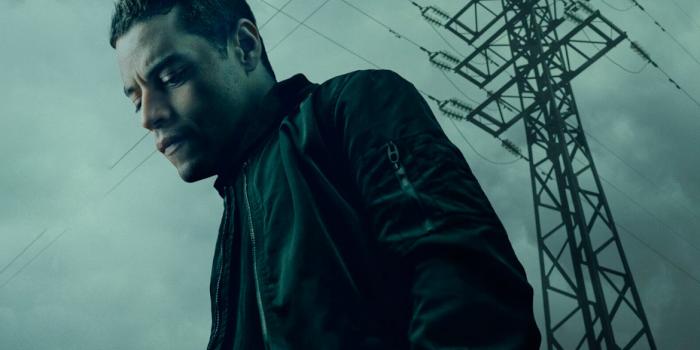
Blackout — Apple — Spotify — Google — Academy Award winner Rami Malek stars in this apocalyptic thriller as a small-town radio DJ fighting to protect his family and community after the power grid goes down nationwide, upending modern civilization.
LifeAfter/The Message — Apple — Spotify — Google — The Message and its sequel, LifeAfter, take listeners on journeys to the limits of technology. n The Message, an alien transmission from decades ago becomes an urgent puzzle with life or death consequences. In LifeAfter, Ross, a low level employee at the FBI, spends his days conversing online with his wife Charlie – who died eight months ago. But the technology behind this digital resurrection leads Ross down a dangerous path that threatens his job, his own life, and maybe even the world. Winner of the Cannes Gold Lion.
Homecoming — Apple — Spotify — Google — Homecoming centers on a caseworker at an experimental facility, her ambitious supervisor, and a soldier eager to rejoin civilian life — presented in an enigmatic collage of telephone calls, therapy sessions, and overheard conversations. Starring Catherine Keener, Oscar Isaac, David Schwimmer, David Cross, Amy Sedaris, Michael Cera, Mercedes Ruehl, Alia Shawkat, Chris Gethard, and Spike Jonze.
Limetown — Apple — Spotify — Google — Web Site — The premise: Ten years ago, over three hundred men, women and children disappeared from a small town in Tennessee, never to be heard from again. In this podcast, American Public Radio reporter Lia Haddock asks the question once more, “What happened to the people of Limetown?”
Motherhacker — Apple — Spotify — Google — Web Site — The plot: Bridget’s life is a series of dropped calls. With a gift for gab, an ex-husband in rehab, and down to her last dollar, Bridget’s life takes a desperate turn when she starts vishing over the phone for a shady identity theft ring in order to support her family.
Passenger List — Apple — Spotify — Google — Web Site — Atlantic Flight 702 has disappeared mid-flight between London and New York with 256 passengers on board. Kaitlin Le (Kelly Marie Tran), a college student whose twin brother vanished with the flight, is determined to uncover the truth.
Sandra — Apple — Spotify — Web Site — Co-stars Kristen Wiig, Alia Shawkat, and Ethan Hawke. Here’s the plot: Helen’s always dreamed of ditching her hometown, so when she lands a job at the company that makes Sandra, everyone’s favorite A.I., she figures it’s the next-best thing. But working behind the curtain isn’t quite the escape from reality that Helen expected.
The Angel of Vine — Apple — Spotify — Google — Web Site — A present day journalist uncovers the audio tapes of a 1950s private eye who cracked the greatest unsolved murder mystery Hollywood has ever known… and didn’t tell a soul. Starring Joe Manganiello, Alfred Molina, Constance Zimmer, Alan Tudyk, Camilla Luddington, and more.
The Bright Sessions — Apple — Spotify — Google — Web Site — A science fiction podcast that follows a group of therapy patients. But these are not your typical patients — each has a unique supernatural ability. The show documents their struggles and discoveries as well as the motivations of their mysterious therapist, Dr. Bright.
The Orbiting Human Circus — Apple — Spotify — Google — Discover a wondrously surreal world of magic, music, and mystery. This immersive, cinematic audio spectacle follows the adventures of a lonely, stage-struck janitor who is drawn into the larger-than-life universe of the Orbiting Human Circus, a fantastical, wildly popular radio show broadcast from the top of the Eiffel Tower. WNYC Studios presents a special director’s cut of this joyous, moving break from reality. Starring John Cameron Mitchell, Julian Koster, Tim Robbins, Drew Callander, Susannah Flood, and featuring Mandy Patinkin and Charlie Day.
The Truth — Apple — Spotify — Google — Web Site — The Truth makes movies for your ears. They’re short stories that are sometimes dark, sometimes funny, and always intriguing. Every story is different, but they all take you to unexpected places using only sound. If you’re new, some good starting places are: Silvia’s Blood, That’s Democracy, Moon Graffiti, Tape Delay, or whatever’s most recent. Listening with headphones is encouraged!
The Walk — Apple — Spotify — “Dystopian thriller, The Walk, is a tale of mistaken identity, terrorism, and a life-or-death mission to walk across Scotland. But the format of this story is — unusual. The Walk is an immersive fiction podcast, and the creators want you to listen to it while walking. It begins with a terrorist attack at a train station; you are the protagonist, known only as Walker, and the police think you’re a member of a shadowy terror group called The Burn.” “Author Naomi Alderman, whose latest novel was a bestseller called The Power, is the creator of The Walk.”
We’re Alive — Apple — Spotify — Google — An award-wining audio drama, originally released in podcast form. Its story follows a large group of survivors of a zombie apocalypse in downtown Los Angeles, California.
Wolf 359 — Apple — Spotify — Google — A science fiction podcast created by Gabriel Urbina. Following in the tradition of Golden Age radio dramas, Wolf 359 tells the story of a dysfunctional space station crew orbiting the star Wolf 359 on a deep space survey mission.
These podcasts can be found in the new collection, The 150 Best Podcasts to Enrich Your Mind.
Related Content:
Pandemic Literature: A Meta-List of the Books You Should Read in Coronavirus Quarantine
How Can Boccaccio’s 14th Century Decameron Help Us Live Through COVID-19?
1,000 Free Audio Books: Download Great Books for Free
Josh Jones is a writer and musician based in Durham, NC. Follow him at @jdmagness
Read More...Support Us
We're hoping to rely on loyal readers, rather than erratic ads. Please click the Donate button and support Open Culture. You can use Paypal, Venmo, Patreon, even Crypto! We thank you!

About Us

Open Culture scours the web for the best educational media. We find the free courses and audio books you need, the language lessons & educational videos you want, and plenty of enlightenment in between.
Advertise With Us

FREE UPDATES!
GET OUR DAILY EMAIL
Get the best cultural and educational resources on the web curated for you in a daily email. We never spam. Unsubscribe at any time.
FOLLOW ON SOCIAL MEDIA

Open Culture editor Dan Colman scours the web for the best educational media. He finds the free courses and audio books you need, the language lessons & movies you want, and plenty of enlightenment in between.
Advertise With Us

