Soundtrack Composer Craig Wedren (Zoey’s Playlist, Glow, Shrill) Joins Pretty Much Pop: A Culture Podcast #41 on TV Musicals

Craig was the front-man of the brainy punk band Shudder to Think from the mid-’80s through the ’90s and has created music for many TV shows and films. He joins your hosts Mark Linsenmayer, Erica Spyres, and Brian Hirt due to his involvement with the current NBC musical dramedy Zoey’s Extraordinary Playlist, which along with Glee, Crazy Ex-Girlfriend, Nashville, Rise, etc. represents a new era of musicals as mainstream TV.
Why are shows like this being created at this point in our cultural history? These shows all use some narrative explanation for why there’s singing (i.e. the songs are diagetic) instead of just having the characters sing as in a classic musical or a film like The Greatest Showman or La La Land. Most of these also make heavy use of cover tunes and/or parodies in a way that stage musicals usually don’t. And of course there’s often a heavy use of autotune and more star-based casting than is the norm for stage productions.
Some articles to provide an overview of the topic:
- “The TV Musical: How Singing on the Small Screen Became So Popular” by Christine Laskodi
- “On TV’s New Musicals, Every Episode Is Opening Night” by Alexis Solosky
- “For the Love of God, Stop Making Mediocre Musical TV Shows” by Alex Zaragoza
Note that Craig doesn’t create the actual songs that the cast members sing for Zoey’s, just the interstitial music, but he’s written heaps of songs and is in a great position to talk with us about everything from Cop Rock to Mama Mia. We also touch on musical episodes in Community and Buffy the Vampire Slayer, Bohemian Rhapsody, karaoke in film, Adam Schlesinger, Stop Making Sense (also see David Byrne’s mobile band on Colbert) and a weird Netflix lip-sync drama called Soundtrack,
Listen to Craig talk about his own tunes on Nakedly Examined Music and watch his daily Sabbath Sessions at facebook.com/craigwedrenmusic or on YouTube. Hear the song he wrote for School of Rock.
Learn more at prettymuchpop.com. This episode includes bonus discussion that you can only hear by supporting the podcast at patreon.com/prettymuchpop. This podcast is part of the Partially Examined Life podcast network.
Pretty Much Pop: A Culture Podcast is the first podcast curated by Open Culture. Browse all Pretty Much Pop posts or start with the first episode.
Read More...Scenes of Ezra Pound Wandering Through Venice and Reading from His Famous Pisan Cantos (1967)
Ezra Pound is a problem for Modernist literary studies in the same way Martin Heidegger is for Continental philosophy: it’s impossible to deny the overwhelming influence of either figure—and impossible to deny that both were devoted anti-Semitic fascists from at least the 1930s to the end of their days. Heidegger kept his views mostly hidden in his “Black Notebooks.” Pound, on the other hand, became an enthusiastic mouthpiece. He publicly idolized Benito Mussolini, signed letters with “Heil Hitler,” and broadcast paranoid anti-Semitic hate speech on Italian radio in over a hundred propaganda pieces for the Axis powers during the war.
Pound was to be sentenced for treason in 1945 but was saved by an insanity defense promoted by Ernest Hemingway (who convinced himself Pound must have been insane to say such things.) After a stay in St. Elizabeth’s, Pound recanted, but privately he never changed. If he were a lesser poet, critics and readers might assure themselves they’d never read the likes of him today. But not only is he inseparable from literary history as an influential editor and booster (without Pound, no Eliot’s The Waste Land), but he is rightly recognized as one of the most gifted poets of the 20th century.
“Is it wrong to love a fascist?” asked Ash Sarkar in a take on the Pound problem that lists him among many “problematic faves, along with The Simpsons and Vybz Kartel.” The “vituperative” anti-Semitism of Pound’s later years finds its way into his later Cantos—the massive, unfinished, eclectic, erudite, and deeply obscure series of epic poems he worked on from 1915 to 1962. “Canto XLV,” notes Sarkar, “one of his many attacks on financiers, is suffused with antisemitic language and imagery.”
Canto XVI contains what Mark Ford calls “a characteristic specimen of Pound’s mimicry,” which Mussolini found “entertaining” during their first and only meeting. (“It’s my idea of how a Continental Jew would speak English,” Pound supposedly told Il Duce.) Such moments of racist mockery alternate in the Pisan Cantos—published in 1948 and written during the war—with elegies, economic and political theories, and archaic lines in which many readers hear echoes of blood and soil mythology. We may hear such an echo in Canto LXXXI, from which Pound reads above, over footage of him wandering around Venice.
Allen Ginsberg described Canto LXXXI as “a collage of Pound’s prison mental gossip (thinking to himself in prison, notating down… little nostalgic recollections of pre-World War I.)” There are, however, gestures toward more recent events. He refers to the “friends of Franco” in one line, for example, and Hélène Aji identifies Pound’s reference to Thomas Jefferson as an allusion to Mussolini. How did Pound himself square his nationalism with his cosmopolitan modernism? Literary scholar David Barnes speculates:
The writer would have seen no conflict here. Pound could easily switch from his Hitlerian fantasies to a recommendation of the kind of artists (Joyce, Marinetti) that Führer would have classed as “degenerate.” In his mind, the sharp lines of modernism seem to have been equated or even interchangeable with the totalitarian politics of Nazi Fascism.
Except it wasn’t Nazi Fascism that Pound mostly hawked—though he enthusiastically recommended Mein Kampf. It was the Italian original. Mussolini did not share Hitler’s extreme antipathy for modern artists. He too saw modernism and fascism as interchangeable, as did the many Italian artists he coopted as propagandists. Pound was not especially unique in such circumstances.
It’s not clear when this film footage was shot, but the reading was recorded in Spoleto, Italy during the summer of 1967. You can listen to the full recording above, and hear another version, and dozens more recordings of Pound, at Penn Sound.
Related Content:
Read Ezra Pound’s List of 23 “Don’ts” For Writing Poetry (1913)
Rare Ezra Pound Recordings Now Online
Josh Jones is a writer and musician based in Durham, NC. Follow him at @jdmagness
Read More...Metallica Is Putting Free Concerts Online: 6 Now Streaming, with More to Come
So, you pull up to the Metallica show and double check to make sure you have everything you need. Cash? Check. Change of clothes for when you stumble back to the car exhausted and sweaty? Check. Earplugs? …. Where are the damn earplugs?
Oh man. You forgot the ear plugs.
Anyone got an extra pair of ear plugs? You’re boned. What to do? You’re gonna need your ears for the next few days for your summer camp gig. Those kids are loud enough without tinnitus.
You consider, for a split second, ditching your ticket and calling a cab. But c’mon. Screw your hearing, this is 1991, you’re in Muskegon, Michigan, and The Black Album just came out. You’re gonna miss the show? No way, man.
Ah, but it’s not 1991, you’re (probably) not in Muskegon, Michigan, and you’re staying home because there’s a deadly virus going around the world. The good news is you can still catch the show.
Watch it at the top, from the comfort of your cozy nest. More good news? You don’t need those earplugs anymore. Turn it way down low and let “Enter Sandman” lull you to sleep.
When you wake up, travel back to last June, to the lovely Slane Castle, to see Metallica play Meath, Ireland, just above. Dime the volume knob until your neighbors complain. Put on your headphones and blast it till your ears bleed and you pass out. There’s more where that came from.
“Metallica may be staying home due to the coronavirus but that doesn’t mean they aren’t here to rock your face off,” Billboard reported last month. “The band, who announced on Monday (March 23) that they have been forced to postpone a scheduled South American spring tour…. Just launched a new weekly concert series called Metallica Mondays.”
This announcement being several weeks ago, there are now several concerts posted on the band’s YouTube channel—six at this moment, including a 2009 gig in Copenhagen, Denmark, one of many places where Metallica’s loud, fast (till The Black Album), death-obsessed thrash metal traveled and transformed into even louder, faster, more death-obsessed metal subgenres.
Maybe you were at one of these shows? If so, relive the glory. If you’ve never seen the band live, know that this is but a pale imitation, as are all filmed concerts, whether you stream them on your smartphone or your 85” TV. But if you want to know what it was like for that kid in Muskegon who forgot his ear plugs, try that headphone trick. Then head over to Metallica’s YouTube channel on Monday for the next show.
Related Content:
Metallica’s “Enter Sandman” Sung in the Style of David Bowie
Josh Jones is a writer and musician based in Durham, NC. Follow him at @jdmagness
Read More...Mark Knopfler Plays a Poignant, Overdriven Version of “The Last Post,” Remembering the Many Lives Lost in World War I
World War I symbolism gets lost on Americans. Our historical memories are short and selective, and the War has “largely vanished from view,” as historian Geoffrey Wawro writes at Time magazine. But in Europe, of course, where some armies suffered ten times the casualties as U.S. troops, and where millions of civilian died and towns were bombed into oblivion, the memory of the Great War is very much alive.
In Ypres, Belgium, the War has been memorialized every day since 1928 (with the exception of four years of German occupation during WWII) by the Last Post Association, a devoted company of buglers who play the military song at the Menin Gate memorial every evening to commemorate the British dead at the Battle of Ypres. As of this writing, they’ve held their 31,748th ceremony.
In Britain itself, and around the world, the tune has a long history as a symbol, like the poppy, of Remembrance Day. Just like Taps in the U.S., the Last Post is “a bugle call,” writes the Last Post Association, “played in the British Army (and in the armies of many other lands) to mark the end of the day’s labours and the onset of the night’s rest…. It has come to represent a final farewell to the fallen at the end of their earthly labours and at the onset of their eternal rest.”
Robert Graves summed up the song’s association with death in his 1918 poem, “The Last Post”:
The bugler sent a call of high romance—
“Lights out! Lights out!” to the deserted square.
On the thin brazen notes he threw a prayer,
“God, if it’s this for me next time in France…
O spare the phantom bugle as I lie
Dead in the gas and smoke and roar of guns,
Dead in a row with the other broken ones
Lying so stiff and still under the sky,
Jolly young Fusiliers too good to die.”
I imagine Mark Knopfler, a lover of poetry, might be familiar with Graves’ verse. In his own rendition of the Last Post, above, Knopfler commemorates 17,000 Northumberland Fusiliers killed in the War, who came from his home region and suffered more casualties than any other regiment. Recorded on Remembrance Day, November 8, 2018, the 100th anniversary of the War’s end, Knopfler’s version is both restrained and fiercely overdriven, recalling Hendrix’s “Star-Spangled Banner” in some of its flashier moments of vibrato. Rather than one of his usual iconic guitars, he plays a custom instrument that howls like a keening bugle.
The recording was part of a project in which musicians around the world played the ceremonial call on a variety of instruments. For comparison with Knopfler’s creative interpretation, see a straightforward rendition played above by a member of the Australian Royal Military College Band. The bugle call reminds us of the war dead we may have forgotten, and the millions killed by starvation and influenza after the armistice. And perhaps it also reminds us of the importance of collective mourning for the dead in our own extraordinary historical moment.
Related Content:
Guitar Stories: Mark Knopfler on the Six Guitars That Shaped His Career
Mark Knopfler Gives a Short Masterclass on His Favorite Guitars & Guitar Sounds
The Great War: Video Series Will Document How WWI Unfolded, Week-by-Week, for the Next 4 Years
Josh Jones is a writer and musician based in Durham, NC. Follow him at @jdmagness
Read More...How to Paint Water Lilies Like Monet in 14 Minutes
Some of us are using this period of self-isolation to make sourdough.
Others are learning to play an instrument or initiating a daily yoga practice.
For those considering taking up painting, David Dunlop’s Emmy-Award winning PBS series Landscapes Through Time offers an excellent alternative (or supplement) to the well-established joys of cult figure Bob Ross, the eternal king of television art instruction.
Like Ross, Dunlop has a mellow onscreen temperament that pairs beautifully with the enchanting setting of Claude Monet’s famous water garden, above.
(Those who’ve visited Monet’s house and garden at Giverny will envy him his tourist-free access to the site. Even those with no intention of picking up a brush should find it restorative to spend time gazing at the same lovely view that Dunlop, like Monet before him, looks at through a deliberately Impressionistic squint.)
He packs a lot of art appreciation into 14 easily digested minutes, touching on art history, brush technique, composition, use of light, and, in particular, color theory.
When the museums reopen, you may find this crash course has enhanced your enjoyment, especially as pertains to canvases by Monet and his fellow Impressionists.
For those pursuing the hands-on oil painting experience, Dunlop provides a supply list of colors, all readily available:
Cobalt Blue
Cadmium Yellow
Alizarin Crimson
Ultramarine
Brilliant Rose
Emerald Green
Hooker’s Green
Titanium White
His brushes and paper appear to be garden variety, and his approach, like Ross’, is fast and loose.
Those who favor a less brazen approach may feel more at home with his watercolor painting demonstration in Cezanne’s Mont Sainte-Victoire in Provence, France, below.
There are more excerpts and instruction on Dunlop’s YouTube channel. For those wishing to take it to the next level, Dunlop is teaching a series of interactive studio demonstration classes via Zoom. Register here.
Related Content:
Rare 1915 Film Shows Claude Monet at Work in His Famous Garden at Giverny
Bob Ross’ Christmas Special: Celebrate, Relax, Nod Off
Ayun Halliday is an author, illustrator, theater maker and Chief Primatologist of the East Village Inky zine. Her art in isolation has taken the form of a hastily assembled tribute to the classic 60s social line dance, The Madison. Follow her @AyunHalliday.
Read More...A Vintage Advertising Film Intelligently Satirizes the Selling of the American Dream: Watch The Your Name Here Story (1960)
When did the United States of America attain peak earnestness? It had to have happened sometime in the long 1950s, beginning with victory in the Second World War and ending with the cultural shifts of the early 60s. Though individual Americans back then might express discontent and even cynicism about the nation, U.S. mass culture kept the dial set to triumphant optimism. And in midcentury America there was no cultural force quite as mass as advertising, which broadcast its messages in not just the media of print, radio, television, and billboard, but film as well. This golden age of American earnestness coincides with the golden age of the Calvin Company, once the country’s dominant maker of advertising, educational, and industrial films.
Founded in Kansas City in 1931, the Calvin Company capitalized early on the advertising potential of 16-millimeter film. At first considered suitable only for “home movies,” the format turned out to be ideal for sales pitches, corporate training sessions, and classroom screenings. Calvin’s client list soon grew to include General Mills, Goodyear, Monsanto, Westinghouse, and Encyclopedia Britannica, as well as the Navy, the Air Force, and the Office of Education.
That we can still watch some of the company’s many productions today we owe to the efforts of Rick Prelinger, whose eponymous film archives we’ve previously featured here on Open Culture. At the Internet Archive you can watch such Calvin classics as Coffee Break, Forty Billion Enemies, Fifty Years of Powered Flight, The Bright Young Newcomer, and Enforcing Rules and Procedures.
None have the reputation of The Your Name Here Story, produced by Calvin in 1960 as “the first truly all-purpose film.” While previous jobs were made to order, painstakingly tailored by an ever-expanding staff of filmmakers to the needs the commissioning clients, The Your Name Here Story is completely generic. “From the dawn of human history, a better way of life has been man’s dream,” booms its narrator, launching into an opening whose epic form will be familiar to anyone who’s put off writing a term paper until the night before. After telling the story of civilization — especially American civilization — in a brisk two minutes, the film arrives in high-tech modernity. Alas, “despite the world’s highest living standards, the average American remained vaguely discontent, aware that his goal of a better way of life had still not been fully realized. There was something missing.”
“Gad, it’s ironic,” says a prototypical American husband of the day, lying awake alongside his wife, both of them sleepless with dissatisfaction. “With all our technology and industrial know-how, we still don’t have the one thing that could give us a better way of life.” That “one thing” is anything the company that licenses The Your Name Here Story happens to make, footage of which they can easily insert into the various spaces provided throughout the film. “In countless ways, directly and indirectly, YOUR PRODUCT HERE serves the nation and its citizens,” says the narrator, crediting whatever it may be with playing a vital role in helping them to “achieve success,” “enjoy healthful recreation,” “grow bigger crops,” “strengthen our national defense,” and of course “get real smoking satisfaction.”
Some may now watch most of The Your Name Here Story before catching on to the film’s satirical intent. That owes to the fact that the Calvin Company itself defined the look and feel of the organizational culture of the 1950s, at least as it remains in cultural memory. Originally created as a bit of fun for the “Calvin Workshop,” the company’s annual gathering of industrial film producers and technicians, the film’s spoofs of what Sapiens author Yuval Noah Harari has termed the “military-industrial-scientific complex” almost feel made for audiences of the future. Among the Calvin Company’s surviving films we also find 1956’s A Magic Bond, directed by no less notable a son of Kansas City than Robert Altman. Knowing what we now do of its self-aware corporate culture, does it comes as a surprise that Calvin would have been the training ground for Hollywood’s pre-eminent smart-aleck?
via Aeon
Related Content:
Watch the First Commercial Ever Shown on American TV, 1941
Eisenhower Answers America: The First Political Advertisements on American TV (1952)
Before Mad Men: Familiar and Forgotten Ads from 1950s to 1980s Now Online
A Gallery of Mad Magazine’s Rollicking Fake Advertisements from the 1960s
Sell & Spin: The History of Advertising, Narrated by Dick Cavett (1999)
Download 6600 Free Films from The Prelinger Archives and Use Them However You Like
Based in Seoul, Colin Marshall writes and broadcasts on cities, language, and culture. His projects include the book The Stateless City: a Walk through 21st-Century Los Angeles and the video series The City in Cinema. Follow him on Twitter at @colinmarshall, on Facebook, or on Instagram.
Read More...Rare Grooves on Vinyl from Around the World: Hear Curated Playlists of Arabic, Brazilian, Bollywood, Soviet & Turkish Music
Just as the category of “Foreign Language Film” has serious problems, so too does that of “World Music,” which names so many kinds of music that it names nothing at all. World music “might best be described by what it is not,” noted a 1994 Music Library Association report. “It is not Western art music, neither it is mainstream Western folk or popular music.” The report adds some vague qualifications about “ethnic or foreign elements” then gives away the game: “It is simply not our music, it is their music, music which belongs to someone else.”
Perhaps one can see why the idea is now regarded by some as “outdated and offensive.” As the University of Minnesota’s Timothy Brennan argues in a historical analysis of the term, “world music does not exist” except “as an idea in the mind of journalists, critics, and the buyers of records.”
But to whom can music belong? If Japanese musicians play jazz, are they playing American-owned music? Is it “Japanese jazz” or just jazz? Must it have Japanese instruments for it to be “World Music”?
How these questions get answered can determine whether most listeners ever encounter the recorded output of jazz musicians from Japan, such as that in an excellent thirty-minute sampler from the 1970s that we featured just a few days back. In this mix, DJ Zag Erlat showcases names that “will sound familiar,” wrote Open Culture’s Colin Marshall, “to those of us who’ve spent years digging crates around the world for Japanese jazz on vinyl.” That’s a select group, indeed, and one you may be inspired to join once you’ve heard Erlat’s mix.
The Turkish DJ has further done his part to disambiguate World Music on his YouTube channel My Analog Journal. Here, you’ll find Erlat spinning sets of “Brazilian Grooves,” “Arabic Grooves,” “African Grooves,” “Bollywood Grooves,” and so much more—including a set of Jazz from the USSR in his tenth episode that is quite a revealing listen. Who knew such music existed in the Soviet Union? Well, except for those Soviet jazz crate-diggers.
Now you know too, and you’ll learn a lot more about what the world’s been up to, music-wise. These are also, obviously, very broad categories, and one might reasonably object to them. But it’s a great start for getting to know some classic pop sounds from specific regions in the world. Erlat does get more specific in some sets, as in his Japanese jazz from the 70s. (I’d especially recommend his “Turkish Female Singers from the 70s” mix.)
This is music of the modern world—not “ours” or “theirs”—its basic elements embedded in a global cultural marketplace. “It is 25 years since the concept of world music was created by enthusiasts in a north London pub,” wrote The Guardian’s Ian Birrell in 2012. “Perhaps it made sense then, as a marketing device to promote the sounds of the world that were lost in record shops and on the radio. But not now. Not in this mixed-up, messy and shrunken world.” Perhaps it didn’t make sense then, when artists like Fela Kuti or Os Mutantes made music that was as much “Western” as it was African or South American.
It becomes increasingly impossible to segregate artists from different countries. Genre mashups rule, and the more furiously artists from around the world pick up and put down global styles, the more they attract the positive notice of fans and critics in pop music. But perhaps we’ll continue to refer to indigenous folk traditions as “World Music,” and perhaps that’s what the label has always been meant to describe. In that case, as one writer for the Grammy’s official blog put it, “something tells me that the rest of the world has a different definition.”
Get familiar with several other groovy musics from elsewhere at Erlat’s My Analog Journal.
Related Content:
Josh Jones is a writer and musician based in Durham, NC. Follow him at @jdmagness
Read More...Coursera Makes Courses & Certificates Free During Coronavirus Quarantine: Take Courses in Psychology, Music, Wellness, Professional Development & More Online

Over the past decade or two, developments in the technology of the World Wide Web have made learning at home possible in a way it wasn’t before. Over the past month or two, learning at home has gone from option to necessity, prevented as many of us are from going out to a classroom by the coronavirus pandemic. If you’ve taken courses on the internet before — and especially if you’ve picked them from our selection of 1,500 you can take for free — you’ve no doubt heard of Coursera, one of the major online learning platforms. Now through May 31st, a period during which the number of potential students will surely remain high, Coursera has made more of its classes free for the taking.
“To help our community during this critical time, we’re launching new, free resources, as well as surfacing interesting course collections, community discussions, and expert interviews,” says the official Coursera blog. “While many courses on Coursera are already available for free without a certificate, this promotion enables you to not only access lectures and quizzes, but also to earn a free certificate for courses that offer them.” The blog highlights these collections of courses, describing them as follows:
- Free online courses for mental health and well-being: from de-mystifying mindfulness to understanding the science of happiness, we’ve collected top wellness courses to help you prioritize mental health and well-being during these uncertain times.
- Free online courses for high school students: from calculus to guitar for beginners, we’ve rounded up courses to help high school students everywhere keep learning.
- Free online courses for college students: from preparing for an interview to learning data science, we’ve collected courses to make it easier to keep learning.
- Free online courses for career development: from creative problem solving to personal branding, we identified courses to help you build important career skills.
- Free online courses for building your cloud technology career: from machine learning to cloud computing, we’ve curated a set of courses to help you grow your career in an increasingly digital world.
- Free online courses for understanding public health: from the science behind COVID-19 to communicating during global emergencies, we’re making popular public health courses completely free.
- Free online courses in Spanish: from wellness to professional development, we’re making popular Spanish-language courses available for free.
The post also includes the following instructions for how to redeem a free course:
- First, click the link to visit a promotion page.
- From the promotion page, click to visit a specific course and wait for the page to fully load. Once loaded, you will see a promotion banner at the top of the page. If you don’t see the banner, please refresh the page.
- Next, click the “Enroll for free” button.
- Select “Purchase Course.” Note that with the promotion applied, there will be a message in parentheses that says “Your promotion will automatically be applied at checkout.”
- At checkout, your purchase total will read “$0.”
- Complete check out and start learning!
Among Coursera’s current free offerings you’ll find a host of courses including “Getting Started with Music Theory” from Michigan State University, “Social Psychology” from Wesleyan University, and “Cloud Computing Basics” from LearnQuest. You’re as likely to come across subject areas into which you’ve long been meaning to get deeper as practical education pertinent to the times we now live in. Take “Sit Less, Get Active” from the University of Edinburgh, or “Science Matters: Let’s Talk About COVID-19” from Imperial College London, a virus-related course of the kind we’ve previously featured here on Open Culture. The University of California, San Diego’s “Converting Challenges into Opportunities” is also not without its relevance, to the future as well as the present. After all, the coronavirus will hardly be the last challenge in which we’ll need to find our own opportunities.
Related Content:
1,700 Free Online Courses from Top Universities.
Free Courses on the Coronavirus: What You Need to Know About the Emerging Pandemic
Dyson Creates 44 Free Engineering & Science Challenges for Kids Quarantined During COVID-19
Based in Seoul, Colin Marshall writes and broadcasts on cities, language, and culture. His projects include the book The Stateless City: a Walk through 21st-Century Los Angeles and the video series The City in Cinema. Follow him on Twitter at @colinmarshall, on Facebook, or on Instagram.
Read More...How Can Boccaccio’s 14th Century Decameron Help Us Live Through COVID-19?
I remember reading selections of Giovanni Boccaccio’s Decameron in my early high school years—and I remember reading them as light, bawdy tales about aristocrats in gardens. We were briefly introduced to the frame narrative, set amidst the 1348 outbreak of plague in Florence, which killed off half the city’s population. But the Black Death seemed almost mythological in scope—a phantom on the periphery. As Albert Camus writes in The Plague, a book also appearing on bestseller and recommended reading lists everywhere: “a dead man has no substance unless one has actually seen him dead, a hundred million corpses broadcast through history are no more than a puff of smoke.”
I don’t recall reading how Florentines “dropped dead in open streets, both by day and by night, whilst a great many others, though dying in their own houses, drew their neighbors’ attention to the fact more by the smell of their rotting corpses.” The picture Boccaccio paints is so incredibly bleak, one is amazed we’ve come to “see the Decameron as a collection of entertaining stories to keep next to your bed,” as Andre Spicer writes at New Statesman. “This scourge had implanted so great a terror in the hearts of men and women that brothers abandoned brothers,” Boccaccio writes, “uncles their nephews, sisters their brothers… fathers and mothers refused to nurse and assist their children.”
This is unimaginable, or so we thought, having never lived through any kind of plague ourselves. Made up of tales swapped by ten friends who escape Florence for a country villa to wait out the epidemic, telling 100 stories between them to pass the time in quarantine, the Decameron, if it has left schools since my time, will surely return with significant emphasis on what was previously given as background. Of course, Italians are revisiting with much renewed interest these tales “of life lessons and folly, of tragedy and happiness, of virtue and vice,” as the blog Tuscan Trends notes.
Read by actors from the Oranona Theatre, with musical accompaniment, a live production of the stories has been going on for a decade. But only now does it constitute a trend, offered as “entertainment for Italians who are confined to their homes escaping a plague seven centuries after Boccaccio wrote his masterpiece of early Italian prose.” (Hear these performances in Italian at the Oranona Facebook page here.) What does this story cycle communicate across 700 years?
“Over the centuries, during other outbreaks of epidemic illness,” says Professor Martin Marafioti in the video above, “the work has become relevant, over and over and over again.” The book offers what Marafioti calls “narrative prophylaxis,” a medicine prescribed by Italian theologian Nicolas of Burgo, another of the many literary voices in Italy’s “canon of contagion.” In a plague advice book, Burgo warns against “fear, anger, sadness, excessive anguish, heavy thoughts and similar things. And equally one should take care to be joyful, to be happy, to listen to lullabies, stories and melodies.”
This advice may be well and good for those who can decamp to well-provisioned houses for two weeks (or months). As Massimo Riva, chair of Brown University’s Italian Studies Department, says in a recent interview, in answer to a question about Boccaccio’s relevance:
I would point to the ethical dilemma the ten young protagonists face in their decision to (temporarily) abandon the city. This decision can be interpreted in two different and somewhat opposite ways: as an escape from the common destiny of those who can afford a luxurious shelter (similar to the doomsday bunkers that very rich people build for themselves today); and as the utopian desire to rebuild together a better, more ethical and harmoniously natural way of life, out of the ruins of the old world.
These two options need not be mutually exclusive, but they might very well rebuild the old exclusions in the new world. More positively, Spicer writes, in some TED-like language that might seem anachronistic in discussions of a 14th century text: Boccaccio “understood the importance of what we now call ‘wellbeing’”; he had “faith in the curative power of stories,” a fact “supported by dozens of studies”; and he “understood the crucial role of what we now call social networks in public health crises.”
I don’t remember any of that in the Boccaccio I read in high school. But I’m starting to see some of it now as I revisit these 700-year-old stories, dipping in and out as time allows and finding in them what Spicer calls the critical “importance of connection when we are socially isolated,” whether in comfortable vacation homes, cramped city apartments, or even more confining circumstances. We need stories to help us figure who we are when everything comes apart. And we need people who will listen to us tell ours. Read and download the full text of the Decameron here.
Related Content:
Download Classic Works of Plague Fiction: From Daniel Defoe & Mary Shelley, to Edgar Allan Poe
Pandemic Literature: A Meta-List of the Books You Should Read in Coronavirus Quarantine
Josh Jones is a writer and musician based in Durham, NC. Follow him at @jdmagness
Read More...Japanese Artist Has Drawn Every Meal He’s Eaten for 32 Years: Behold the Delicious Illustrations of Itsuo Kobayashi
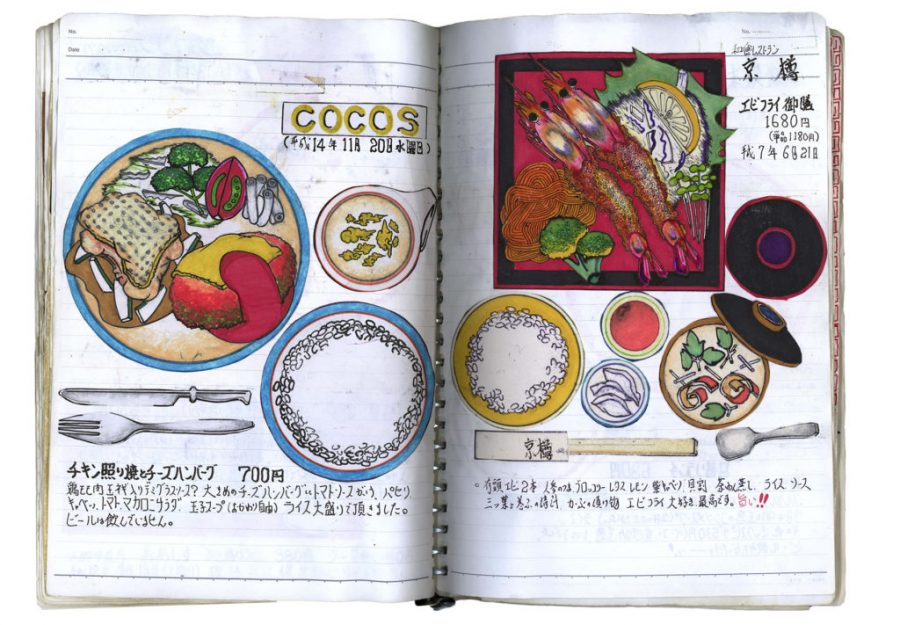
Since the 1980s, Itsuo Kobayashi has drawn a picture of every single meal he eats. However notable we find this practice now, it would surely have struck us as downright eccentric back then. Kobayashi began drawing his food before the arrival of inexpensive digital cameras and cellphones, and well before the smartphone combined the two into the single package we now keep close at hand. We all know people who take camera-phone pictures of their meals, some of them with the regularity and solemnity of prayer, but how many of them could produce lifelike renderings of the food placed before them with only pen and paper?
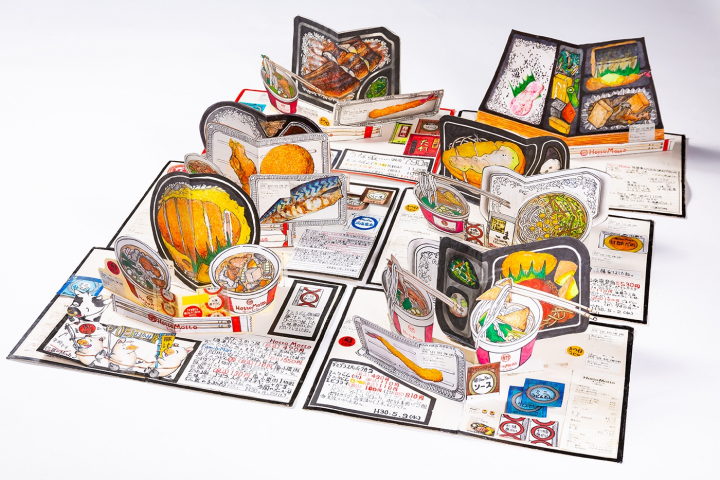
“The Japanese outsider artist and professional cook, born in 1962, first began keeping food diaries as a teenager,” Artnet’s Sarah Cascone writes of Kobayashi. “In his 20s, he began adding illustrations of the dishes he made at work, and those he ate while dining out.” When, at the age of 46, a “debilitating neurological disorder made it difficult for him to walk, leaving him largely confined to his home,” Kobayashi began to focus on his food diaries even more intensely.
His subjects are now mostly “food deliveries — sometimes from restaurants, sometimes from his mother. And though his day-to-day existence rarely varies, he’s been pushing his practice in a new direction, creating a new series of pop-up paintings.”

After 32 years of making increasingly detailed and realistic overhead drawings of his every meal — including such information as names, prices, flavor notes, and faithfully replicated restaurant logos — Kobayashi’s work has caught the attention of the American art world. The Fukuyama-based gallery Kushino Terrace “gave Kobayashi his US debut in January, at New York’s Outsider Art Fair,” Cascone writes. “His works sell for between $500 and $3,000.” That makes for quite a step up in prestige from his old job cooking at a soba restaurant, though his copious experience with that dish shows whenever it appears in his diary.

But then, after decade upon decade of daily practice, everything Kobayashi draws looks good enough to eat, from bowls of ramen to plates of curry to bento boxes filled with all manner of delights from land and sea. Though hardly fancy, especially by the advanced standards of Japanese food culture, these are the kind of meals you want to savor, the ones to which you feel you should pay appreciative attention rather than just scarfing down. Or at least they look that way under Kobayashi’s gaze, which even the most ardent 21st-century food-photographing hobbyist must envy. Many of us wish to eat more consciously, and the work of this cook-turned-artist shows us how: put down the phone, and pick up the sketchbook.

via Artnet
Related Content:
Wagashi: Peruse a Digitized, Centuries-Old Catalogue of Traditional Japanese Candies
Cookpad, the Largest Recipe Site in Japan, Launches New Site in English
How to Make Sushi: Free Video Lessons from a Master Sushi Chef
The Proper Way to Eat Ramen: A Meditation from the Classic Japanese Comedy Tampopo (1985)
Based in Seoul, Colin Marshall writes and broadcasts on cities, language, and culture. His projects include the book The Stateless City: a Walk through 21st-Century Los Angeles and the video series The City in Cinema. Follow him on Twitter at @colinmarshall or on Facebook.
Read More...Support Us
We're hoping to rely on loyal readers, rather than erratic ads. Please click the Donate button and support Open Culture. You can use Paypal, Venmo, Patreon, even Crypto! We thank you!

About Us

Open Culture scours the web for the best educational media. We find the free courses and audio books you need, the language lessons & educational videos you want, and plenty of enlightenment in between.
Advertise With Us

FREE UPDATES!
GET OUR DAILY EMAIL
Get the best cultural and educational resources on the web curated for you in a daily email. We never spam. Unsubscribe at any time.
FOLLOW ON SOCIAL MEDIA

Open Culture editor Dan Colman scours the web for the best educational media. He finds the free courses and audio books you need, the language lessons & movies you want, and plenty of enlightenment in between.
Advertise With Us

