Hear the Great Mixtapes Richard Linklater Created to Psych Up the Actors in Dazed and Confused and Everybody Wants Some!!
Richard Linklater’s films have become increasingly sophisticated as the 90s indie breakout writer-director has grown into his auteurhood. From the loose stoner vérité of Slackers (watch it online) to the loose but heady animation of Waking Life to the painstakingly meticulous “model of cinematic realism” of Boyhood, Linklater has a uniquely American vision and the undeniable talent to realize it in full.
But mostly when I think of Linklater, I think—excuse my language—of cock rock.
I think of Dazed and Confused’s super senior Wooderson, leaning against a muscle car, drawling “alright, alright, alright,” and cranking Aerosmith. I think of wild-eyed Jack Black in School of Rock, strapping a Gibson Flying V on an uptight, sweater-vested youth and teaching him Black Sabbath’s “Iron Man” riff. And now, I think of a gang of short shorts-wearing college baseball dudes in the “campus bromance” Everybody Wants Some!!, singing along (above) to Sugar Hill Gang’s “Rapper’s Delight”…. wait…
So, okay, it ain’t all cock rock. But Linklater’s films are often so dude-centric, and so informed by popular music of certain eras, that he titled two of his most personal—Dazed and Confused and its recent “spiritual sequel”—after anthems from the two most archetypically cock rock bands, Led Zeppelin and Van Halen.
Where Dazed and Confused’s high school milieu more or less stayed anchored in 70s hard rock, Everybody Wants Some!!—like its comparatively adventurous college jocks—takes several musical detours from beer-and-babes 80s clichés. The film’s soundtrack, for example, includes “deep cuts” from Brian Eno, obscure local Texas punk rock band The Big Boys, and L.A.-based 80s New Wave/R&B band The Busboys.
It’s true, then, that the songs choices on Everybody Wants Some!!, which you can hear almost in their entirely (sans a few) above, are fairly diverse, genre-wise, compared to the cock-rock-heavy list of songs from Dazed and Confused (further up). And when it comes to Linklater’s musical inspirations for both films, we see that difference as well.
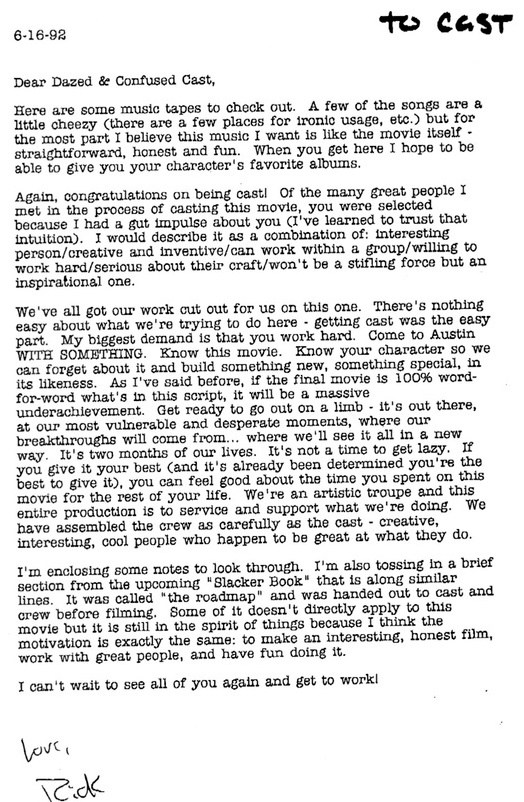
As the Criterion Collection blog documents—bringing us the 1992 letter above (read it here) from Linklater to his cast—the director put together “a thoughtful series of mixtapes to get his cast into the mind-set” of Dazed and Confused. And Criterion put together the Spotify playlist below of the songs Linklater gave his actors. As you’ll see, it’s mostly balls-to-the-wall hard rock, with some obligatory 70s disco and a few cuts from Lou Reed, David Bowie, and Elton John. In his accompanying letter, Linklater admits “a few of the songs are a little cheezy,” but also notes “there are a few places for ironic usage.” For the most part, he says, “this music… is like the movie itself—straightforward, honest and fun.”
When it came time to begin shooting Everybody Wants Some!! (get the official soundtrack here), Linklater again used the same method to get his cast in the mood, circulating the songs in the playlist below (though probably not on cassettes). Here we get a much more diverse, comprehensive musical summary of the decade in question, with Michael Jackson sitting next to Elvis Costello, Pat Benatar and Dire Straits next to Pink Floyd, Sister Sledge, Queen, and Chaka Khan.
It’s an interesting transition that may—musically—signal the move from teenage fandom to the more curious, adventurous listening habits of early adulthood. College, after all, is not only where young Americans of the modern era discover new sexual and chemical pleasures, but also where they acquire new musical tastes. And in the 80s especially, the boundaries of pop music expanded.
“That’s just how it felt to me to be a young person at that time. It was cool to be into everything,” Linklater commented to Cornelia Rowe at Yahoo: “There was a lot of newness in the era. You didn’t really appreciate it at the time – it’s like, there are all these new bands! There’s this new wave, punk, party, R&B – there’s a thing called rap music from New York!”
The athlete bros in Linklater’s latest, very male-oriented piece of cinematic nostalgia “at once embody and upend the stereotype of the shallow, sexually entitled jock,” writes A.O. Scott in his review. Roaming far afield of their comfort zones, they “have a good time wherever they are.” That’s pretty much guaranteed, I think, with the finely-curated 80s gems in these playlists as their soundtrack.
via the Criterion Collection
Related Content:
Watch Free Online: Richard Linklater’s Slacker, the Classic Gen‑X Indie Film
Josh Jones is a writer and musician based in Durham, NC. Follow him at @jdmagness
Read More...Watch UC Berkeley’s Free “Edible Education 101” Lecture Course, Featuring Michael Pollan, Alice Waters and Other Sustainable Food Superstars

Dinner at Berkeley’s famed Chez Panisse shows up on a lot of foodie’s bucket lists. Its founder, Alice Waters, has been promoting the importance of eating organically and locally for nearly half a century.
With the Edible Schoolyard Project, she found a way to share these beliefs in true hands-on fashion, by involving thousands of children and teens in kitchens and gardens across the country.
We will all benefit from this revolution, though I can’t help but envy the kids at its epicenter. Back when Waters was pioneering California cuisine, I was suffering under my school lunchroom’s mandatory “courtesy bite” policy. The remembered aroma of Salisbury steak and instant mashed potatoes still activates my gag reflex.
The University of California’s Edible Education 101 course has been continuing the Edible Schoolyard’s work at the collegiate level since 2011. It’s a glorious antidote to the culinary traumas experienced by earlier generations. UC Berkeley students can take Edible Education 101 for credit. The public is welcome to sit in on lectures featuring a pantheon of sustainable food superstars, including Waters, author Michael Pollan of The Omnivore’s Dilemma, above, and course leader Mark Bittman (you know him from The New York Times and his new startup The Purple Carrot).
Fortunately for those of us whose bucket list splurge at Chez Panisse requires such additional expenses as plane tickets and hotel rooms, many of the lectures are also viewable online.
The range of topics make clear that edible education is not simply a matter of learning to choose a locally grown portobello over a Big Mac. Transportation, technology, marketing, and pubic policy all factor into the goal of making healthy, equitably farmed food available to all at an a non-Chez Panisse price.
A complete playlist of 2015’s Edible Education 101 lectures is here, or stream them right above. A list of 2016’s topics and guest lecturers is here. The Edible Education lectures will be added to our collection, 1,700 Free Online Courses from Top Universities.
Related Content:
Michael Pollan Presents an Edible Education, A Free Online Course From UC Berkeley
Ayun Halliday is an author, illustrator, and Chief Primatologist of the East Village Inky zine. Follow her @AyunHalliday
Read More...“Forbidden Images,” a Compilation of Scandalous Scenes from the Early Days of Cinema (NSFW in 1926)
Last night I caught a screening of Park Chan-wook’s new movie The Handmaiden, whose daringly frank love scenes — by the standards of mainstream cinema, at least — have already drawn no small amount of international notoriety. That goes especially for a once censorship-heavy country like South Korea, where The Handmaiden came from and where I saw it. But it also comes just as one more push of the envelope in the process that has been broadening the range of “acceptable” imagery for high-profile productions ever since the birth of the medium. You can get a sense of just how much it has accomplished by watching “Forbidden Images,” the four-minute compilation just above.
“I made this film for the 2007 edition of the 72 Hour Film Fest in Frederick, MD,” writes its uploader, “These scenes come from a reel of 35mm nitrate that was discovered in the projection booth of an old movie theater in Pennsylvania. The projectionist spliced together this reel of banned, censored scenes to meet local moral standards or for late night, ‘personal’ screenings.” And what does this distillation of pure cinematic scandal show us? Bathing beauties, jubilating flappers, fainting damsels, whirling lady dervishes, skirts flying in the wind, and a whole lot of feet, most of them still shod — a far cry from what most of us, absent very specific desires indeed, would consider forms of titillation today.
Yet at the time, “Forbidden Images” tells us, filmmakers and theater owners had to cut out these shots lest they face arrest. But what films did they have to cut them out of? The video’s commenters on Youtube have identified scenes from Fritz Lang’s Metropolis and Greta Garbo in The Temptress, and a 1926 picture called The Black White Sheep. We may laugh at what people in the silent era considered unshowable, but this compilation presents us with the unavoidable question: “Will our current forms of censorship and moral standards appear just as ridiculous to future audiences?” After all, we can always push the envelope a little further — and thus far, we always have.
Related Content:
Watch After the Ball, the 1897 “Adult” Film by Pioneering Director Georges Méliès (Almost NSFW)
Metropolis: Watch a Restored Version of Fritz Lang’s Masterpiece (1927)
Watch Jean Genet’s Only Film, the Censored A Song of Love (1950)
Based in Seoul, Colin Marshall writes and broadcasts on cities, language, and style. He’s at work on a book about Los Angeles, A Los Angeles Primer, the video series The City in Cinema, the crowdfunded journalism project Where Is the City of the Future?, and the Los Angeles Review of Books’ Korea Blog. Follow him on Twitter at @colinmarshall or on Facebook.
Read More...Martin Scorsese Sends a Sweet Video to the Young Creator a Kubrick/Scorsese Mashup
If you’re a veteran reader of Open Culture, you may remember a 2010 video tribute called “Kubrick vs Scorsese.” To make the video, Leandro Copperfield, a young cinephile living in Rio de Janeiro, spent 25 days re-watching 35 films, selecting more than 500 scenes, and then editing them into an homage to his two favorite directors. Watch it here.
No doubt, it must have come as a surprise when, six years later, Copperfield received a video from Scorsese himself, praising the montage Leandro made so long ago. Again, if you’re an old-timer here, you’ll know that this isn’t the first time Scorsese has shown kindness to younger artists. In 2014, we recounted the story of Colin Levy, a teenage filmmaker who met with Scorsese, and came away with a list of 39 Foreign Films Essential for a Young Filmmaker. Props to Marty for being a good mentor and teacher too.
If you would like to support the mission of Open Culture, consider making a donation to our site. It’s hard to rely 100% on ads, and your contributions will help us continue providing the best free cultural and educational materials to learners everywhere. You can contribute through PayPal, Patreon, and Venmo (@openculture). Thanks!
Related Content:
Martin Scorsese Creates a List of 39 Essential Foreign Films for a Young Filmmaker
Martin Scorsese Plays Vincent Van Gogh in a Short, Surreal Film by Akira Kurosawa
Martin Scorsese Makes a List of 85 Films Every Aspiring Filmmaker Needs to See
Read More...The Books on Young Alan Turing’s Reading List: From Lewis Carroll to Modern Chromatics
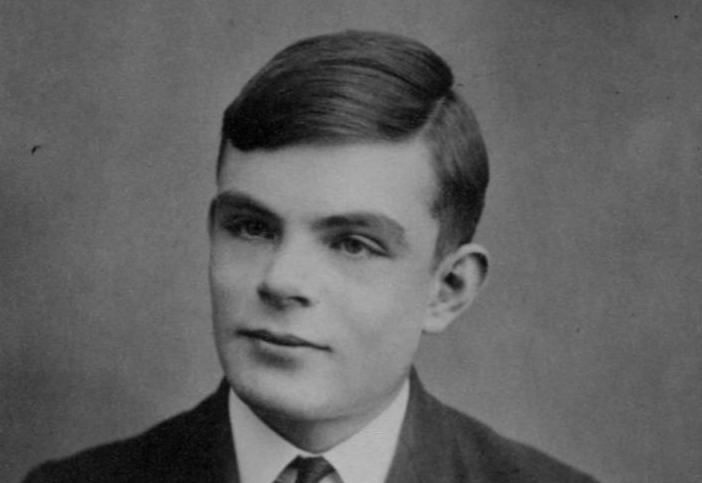
Image via Wikimedia Commons
We now regard Alan Turing, the troubled and ultimately persecuted cryptanalyst (and, intellectually, much more besides)—who cracked the code of the German Enigma machine in World War II—as one of the great minds of history. His life and work have drawn a good deal of serious examination since his early death in 1954, and recently his legacy has even given rise to popular portrayals such as that by Benedict Cumberbatch in the film The Imitation Game. So what, more and more of us have started to wonder, forms a mind like Turing’s in the first place?
A few years ago, mathematics writer Alex Bellos received, from “an old friend who teaches at Sherborne, the school Turing attended between 1928 and 1930,” some “new information about the computer pioneer and codebreaker’s school years” in the form of “the list of books Turing took out from the school library while he was a pupil.” Bellos lists them as follows:
- Illusions
- Journal of the Chemical Society, vols. 95, 96, 97
- Lead
- Modern Electric Theory
- Money
- Isotopes by Frederick William Aston
- Mathematical Recreations and Essays by W. W. Rouse Ball
- Alice’s Adventures in Wonderland, Game of Logic and Through The Looking Glass by Lewis Carroll.
- The Common Sense of the Exact Sciences by William Kingdon Clifford
- Space, Time and Gravitation and The Nature of the Physical World by Sir Arthur Stanley Eddington.
- Sidelights on Relativity by Albert Einstein
- The Escaping Club by A. J. Evans
- Contributions to Mental Philosophy by Immanuel Hermann Fichte, translated and edited by J.D. Morell
- The New Physics by Arthur Haas
- Supply and Demand by Hubert D. Henderson
- The Stars in their Courses by Sir James Hopwood Jeans
- Atoms and Rays and Phases of Modern Science by Sir Oliver Lodge.
- Matter and Motion by James Clerk Maxwell
- The Theory of Heat by Thomas Preston
- A Selection of Photographs of Stars, Star-Clusters & Nebulae, together with information concerning the instruments & the methods employed in the pursuit of celestial photography by Isaac Roberts
- Modern Chromatics, with applications to art and industry by Ogden Nicholas Rood
- Celestial Objects for Common Telescopes by Thomas William Webb
- The Recent Development of Physical Science by William Cecil Dampier Whetham
- Science and The Modern World by Alfred North Whitehead
- Sound Waves and their Uses by Alexander Wood
“As you can see, and as you might expect,” writes Bellos, “heavy on the sciences. The AJ Evans, a memoir about the author’s escape from imprisonment in the First World War, is the only non-scientific book.” He also notes that “the physics books he took out all look very serious, but the maths ones are lighthearted: the Lewis Carroll and the Rouse Ball, which for decades was the classic text in recreational maths problems.” Sherborne archivist Rachel Hassall, who provided Bellos with the list, also told him that “the book chosen by Turing for his school prize was a copy of the Rouse Ball. Even teenage geniuses like to have fun.”
If you, too, would like to do a bit of the reading of a genius — or, depending on how quantitatively your own mind works, just have some fun — you can download for free most of these books the young Turing checked out of the school library. Programmer and writer John Graham-Cumming originally found and organized all the links to the texts on his blog; you can follow them there or from the list in this post. And if you know any youngsters in whom you see the potential to achieve history’s next Turing-level accomplishment, send a few e‑books their way. Why read Harry Potter, after all, when you can read A Selection of Photographs of Stars, Star-Clusters & Nebulae, together with information concerning the instruments & the methods employed in the pursuit of celestial photography?
Related Content:
The Enigma Machine: How Alan Turing Helped Break the Unbreakable Nazi Code
Based in Seoul, Colin Marshall writes and broadcasts on cities, language, and style. He’s at work on a book about Los Angeles, A Los Angeles Primer, the video series The City in Cinema, the crowdfunded journalism project Where Is the City of the Future?, and the Los Angeles Review of Books’ Korea Blog. Follow him on Twitter at @colinmarshall or on Facebook.
Read More...The Instrument Benjamin Franklin Invented, the Glass Armonica, Plays Tchaikovsky’s “Dance of the Sugar Plum Fairy”
Must we ever see another portly, bespectacled re-enactor dragging a kite with key attached to represent the ingenuity of rakish founding father and avatar of cash wealth, Benjamin Franklin? Why, when he invented so many wondrous things—including those bifocal specs—should we only memorialize him for this silly (but very scientific) stunt? Though it may be a true story, unlike Washington and his cherry tree, the familiarity of the image breeds a certain indifference to the man behind it. I’m not suggesting that we remember him for, say, his invention of the catheter, though that’s quite a useful thing. Or for his invention, according to How Stuff Works, of “American Celebrity”—surely no friend to humanity these two hundred-plus years hence.
But maybe swim fins, eh? That’s a pretty neat invention. Imagine your fifth-grader in bald cap and ruffled shirt, plodding across the school stage in a pair of flippers. Or maybe the odometer? Or those reachy, grabby things at the grocery store that pull items down from high shelves? Boring. How about the Glass Armonica? The what? The glass armonica, I say, or—as Franklin originally called it—the “glassychord.” What is it? Well, Franklin, inspired by a concert by Royal Academy colleague Edmund Delaval on a set of water tuned wineglasses, decided to improve upon the instrument. An amateur musician himself, writes William Zeitler as Glassarmonica.com, Franklin left the concert “determined to invent and build ‘a more convenient’ arrangement.”
Thus, after two years of experimentation, “Franklin debuted his glass armonica,” which How Stuff Works describes as “a collection of different-sized glass bowls arranged on a rotating shaft. By spinning the shaft with a foot pedal and running wetted fingers over the rotating bowls, Franklin found he could coax out chords and melodies that Delaval could only dream of.” You needn’t use your imagination. Just watch the video above to see a Franklin re-enactor play a beauteous rendition of Tchaikovsky’s “Dance of the Sugar Plum Fairy” on a glass armonica. Lovely, no? Surely we wouldn’t expect children to pull this off in the school play, but they could mime along to a recording. (Don’t start yelling about revisionist history just yet. We can still tell the kite and key story, too. Just watch these adorable children tell it in this video.)
Franklin premiered the invention in 1762, though he didn’t play it himself but enlisted London musician Marianne Davis. It was an instant hit, “particularly in Germany,” Zeitler writes, where “Mozart was introduced to it by Dr. Franz Mesmer, who used it to ‘mesmerize’ his patients, and later Mozart wrote two works for it (a solo armonica piece, and a larger quintet for armonica, flute, oboe, viola and cello).” Above, hear Mozart’s Rondo for Glass Armonica and Quartet, performed by Thomas Bloch. Impressed? It gets better: “Beethoven also wrote a little piece for armonica and narrator (!), and many of their colleagues of the day composed for it as well—some 200 pieces for armonica… survive from that era.”
What happened? Tastes changed, put simply, and the glass armonica fell out of fashion. That, and the lack of amplification meant it was drowned out in increasingly larger ensembles. I propose we bring it back, maybe in a hip Ben Franklin Broadway musical. Who’s with me?
Learn much more about this fascinating instrument, and see several more video demonstrations, at Glassarmonica.com.
Related Content:
Ben Franklin’s List of 200 Synonyms for “Drunk”: “Moon-Ey’d,” “Hammerish,” “Stew’d” & More (1737)
Josh Jones is a writer and musician based in Durham, NC. Follow him at @jdmagness
Read More...Virginia Woolf Watches The Cabinet of Dr. Caligari & Writes “The Cinema,” a Seminal Attempt to Understand the Power of Movies (1926)
“A shadow shaped like a tadpole suddenly appeared at one corner of the screen,” recalls Virginia Woolf. “It swelled to an immense size, quivered, bulged, and sank back again into nonentity. For a moment it seemed to embody some monstrous diseased imagination of the lunatic’s brain. For a moment it seemed as if thought could be conveyed by shape more effectively than by words. The monstrous quivering tadpole seemed to be fear itself, and not the statement ‘I am afraid.’ ” She witnessed this at a screening of the silent German Expressionist horror film The Cabinet of Dr. Caligari (which you can watch for yourself above), and in it glimpsed the future of cinema itself.
Woolf elaborates on this glimpse in her essay “The Cinema,” first published in a 1926 issue of the journal The Nation and Athenaeum. (The British Library has a scan from the publication here.) “People say that the savage no longer exists in us, that we are at the fag-end of civilization, that everything has been said already, and that it is too late to be ambitious,” she begins. “But these philosophers have presumably forgotten the movies.” She goes on, in this short piece, to come to grips with this new artistic medium, to articulate her experience of it (as “the eye licks it up all instantaneously”) as well as its potential and then-current limitations, such as an over-reliance on literary material.
“The alliance is unnatural,” the author of Mrs. Dalloway (filmed in 1997, and two years later more imaginatively used as the basis for Michael Cunningham’s novel The Hours, turned into cinema itself in 2002) declares about the adaptation of novels into movies. “Eye and brain are torn asunder ruthlessly as they try vainly to work in couples. The eye says ‘Here is Anna Karenina.’ A voluptuous lady in black velvet wearing pearls comes before us. But the brain says, ‘That is no more Anna Karenina than it is Queen Victoria.’ ” She complains, as New Yorker film critic Richard Brody puts it, “that moviemakers, instead of relying on the inherent properties of cinema, harness the making of images to storytelling by way of literature,” presumably failing to understand that “the cinema’s distinctive power involves creating a new kind of visual experience.”
“It is only when we give up trying to connect the pictures with the book,” writes Woolf, “that we guess from some accidental scene — like the gardener mowing the lawn — what the cinema might do if left to its own devices.” Ninety years later, many cinephiles still dream of that gardener mowing the lawn, awaiting the day that cinema gets left to its own devices to fulfill the vast creative and artistic promise only occasionally explored by the filmmakers. Woolf likens them to a “savage tribe” who, “instead of finding two bars of iron to play with, had found scattering the seashore fiddles, flutes, saxophones, trumpets, grand pianos by Erard and Bechstein, and had begun with incredible energy, but without knowing a note of music, to hammer and thump upon them all at the same time.” Cinema developed rapidly in the day of Dr. Caligari, and has developed in certain ways since, but its greatest expressions lie ahead — an observation as true now as when Woolf, with slight disappointment but nevertheless great expectation, first made it. You can read here seminal essay, “The Cinema,” here.
Related Content:
Watch The Cabinet of Dr. Caligari, the Influential German Expressionist Film (1920)
Virginia Woolf Offers Gentle Advice on “How One Should Read a Book”
An Animated Introduction to Virginia Woolf
Based in Seoul, Colin Marshall writes and broadcasts on cities, language, and style. He’s at work on a book about Los Angeles, A Los Angeles Primer, the video series The City in Cinema, the crowdfunded journalism project Where Is the City of the Future?, and the Los Angeles Review of Books’ Korea Blog. Follow him on Twitter at @colinmarshall or on Facebook.
Read More...The Battle to Finish a PhD: World War I Soldier Completes His Dissertation in the Trenches (1916)
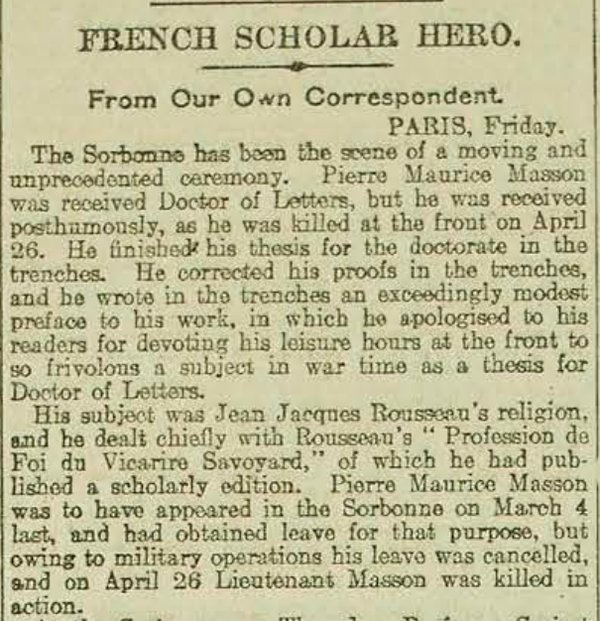
Connie Ruzich, a WWI poetry blogger, recently highlighted on Twitter a historic newspaper clipping that will put the travails of academe into perspective. Getting a Ph.D. is always hard. But hard is relative.
Case in point…
100 years ago, Pierre Maurice Masson, a young scholar, found himself fighting in north-eastern France. Drafted in 1914, Masson rose through the military ranks, moving from sergeant, to sub-lieutenant, to lieutenant. Meanwhile, in the discomfort of the trenches, he continued working on his doctoral thesis–a long dissertation on the religious training of Jean-Jacques Rousseau. By the spring of 1916, he had completed the text, corrected the proofs, and drafted an introduction (of course, that comes last). Finally, he announced to friends, “The monster is ready!” And he sought a leave of absence to return to the Sorbonne to receive his doctorate.
Alas, that didn’t happen. The newspaper clip above tells the rest of the poignant story.
You can read Masson’s posthumously published thesis, La formation religieuse de Rousseau, free online.
If you would like to support the mission of Open Culture, consider making a donation to our site. It’s hard to rely 100% on ads, and your contributions will help us continue providing the best free cultural and educational materials to learners everywhere. You can contribute through PayPal, Patreon, and Venmo (@openculture). Thanks!
Related Content:
The Illustrated Guide to a Ph.D.
Serial Entrepreneur Damon Horowitz Says “Quit Your Tech Job and Get a Ph.D. in the Humanities”
Read More...How to Spot Bullshit: A Primer by Princeton Philosopher Harry Frankfurt
We live in an age of truthiness. Comedian Stephen Colbert coined the word to describe the Bush administration’s tendency to fudge the facts in its favor.
Ten years after the American Dialect Society named it Word of the Year, former president Bush’s calendar is packed with such leisure activities as golf and painting portraits of world leaders, but “truthiness” remains on active duty.
It’s particularly germane in this election year, though politicians are far from its only practitioners.
Take global warming. NASA makes a pretty rock solid case for both its existence and our role in it:
97 percent or more of actively publishing climate scientists agree: Climate-warming trends over the past century are extremely likely due to human activities. In addition, most of the leading scientific organizations worldwide have issued public statements endorsing this position.
In view of such numbers, its understandable that a suburban Joe with a freezer full of factory-farmed beef and multiple SUVs in his garage would cling to the position that global warming is a lie. It’s his last resort, really.
But such self-rationalizations are not truth. They are truthiness.
Or to use the old-fashioned word favored by philosopher Harry Frankfurt, above: bullshit!
Frankfurt–a philosopher at Princeton and the author of On Bullshit–allows that bullshit artists are often charming, or at their very least, colorful. They have to be. Achieving their ends involves engaging others long enough to persuade them that they know what they’re talking about, when in fact, that’s the opposite of the truth.
Speaking of opposites, Frankfurt maintains that bullshit is a different beast from an out-and-out lie. The liar makes a specific attempt to conceal the truth by swapping it out for a lie.
The bullshit artist’s approach is far more vague. It’s about creating a general impression.
There are times when I admit to welcoming this sort of manure. As a maker of low budget theater, your honest opinion of any show I have Little Red Hen’ed into existence is the last thing I want to hear upon emerging from the cramped dressing room, unless you truly loved it.
I’d also encourage you to choose your words carefully when dashing a child’s dreams.
But when it comes to matters of public policy, and the public good, yes, transparency is best.
It’s interesting to me that filmmakers James Nee and Christian Britten transformed a portion of their learned subject’s thoughts into voiceover narration for a lightning fast stock footage montage. It’s diverting and funny, featuring such ominous characters as Nosferatu, Bill Clinton, Charlie Chaplin’s Great Dictator, and Donald Trump, but isn’t it also the sort of misdirection sleight of hand at which true bullshitters excel?
Frankfurt expands upon his thoughts on bullshit in his aptly titled bestselling book, On Bullshit and its followup On Truth.
Related Content:
Noam Chomsky Schools 9/11 Truther; Explains the Science of Making Credible Claims
Stephen Colbert Explains How The Colbert Report Is Made in a New Podcast
Ayun Halliday is an author, illustrator, and Chief Primatologist of the East Village Inky zine. Follow her @AyunHalliday
Read More...Noam Chomsky on Whether the Rise of Trump Resembles the Rise of Fascism in 1930s Germany
No matter where you are in the world, you must by now be well-acquainted with the political chaos in the United States. No one can confidently predict what’s going to happen next. A certain privileged few still find the situation amusing; a certain few have found a tremendous opportunity to increase profit and standing, embracing the madness by embracing Donald Trump, the celebrity real estate mogul some on the right have dubbed their “Great White Hope.”
A column last week by the far-right nationalist Pat Buchanan— whom Trump once denounced as a “Hitler-Lover”—ran with the idea, expressing the paranoiac fantasies of thousands of white supremacists who have rallied behind the Republican nominee. Rhetoric like Buchanan’s and David Duke’s—another supporter Trump once disavowed (then famously didn’t, then eventually did again)—has demolished the “Overton window,” we hear. America’s racist table talk is now a major party platform: the proverbial crank uncle who immiserates Christmas dinner with wild conspiracy theories now airs grievances 24 hours a day on cable news, unbound by “political correctness” or standards of accuracy of any kind.
Granted, a majority of the electorate is hardly thrilled by the likely alternative to Trump, but as even conservative author P.J. O’Rourke quipped in his backhanded endorsement of Hillary Clinton, “She’s wrong about absolutely everything, but she’s wrong within normal parameters.” There’s nothing “normal” about Donald Trump’s candidacy. Its freakishness enthralls his adoring fans. But the millions of Americans who aren’t among them have legitimate cause for alarm.
Comparisons to Hitler and Mussolini may have worn out their usefulness in elections past—frivolous as they often were—but the Trump campaign’s overt demagoguery, vicious misogyny, racism, violent speech, actual violence, complete disregard for truth, threats to free speech, and simplistic, macho cult of personality have prompted plausible shouts of fascism from every corner.
Former Republican Massachusetts governor (and recently rejected Libertarian vice-presidential candidate) William Weld equated Trump’s immigration plan with Kristallnacht, an analogy, writes Peter Baker in The New York Times that is “not a lonely one.” (“There is nobody less of a fascist than Donald Trump,” the candidate retorted.) Likewise, conservative columnist Robert Kagan recently penned a Times op-ed denouncing Trump as a fascist, a position, he writes, without a “coherent ideology” except its nationalist attacks on racial and religious others and belief in “the strongman, the leader (Il Duce, Der Führer), in whom could be entrusted the fate of the nation.”
On the liberal left, figures like former labor secretary Robert Reich and actor and Democratic Party organizer George Clooney have made the charge, as well as columnists in the New Republic and elsewhere. In the video above from Democracy Now, Mexican president Enrique Pena Nieto compares Trump to Hitler, and Columbia University’s Robert Paxton—who has written articles and a book on his theory of fascism—discusses the possibility of Trump-as-fascist.
At the top of the post, Noam Chomsky (MIT professor and author of the new book, Who Rules the World?) weighs in, with his analysis of the “generalized rage” of “mainly working class, middle class, and poor white males” and their “traditional families” coalescing around Trump. (Anyone who objects to Chomsky’s characterization of Trump as a circus clown should take a moment to revisit his reality show career and performance in the WWE ring, not to mention those debates.)
In Chomsky’s assessment, we need only look to U.S. history to find the kind of “strong” racialized nativism Trump espouses, from Benjamin Franklin’s aversion to German and Swedish immigrants, who were “not pure Anglo-Saxons like us,” to later parties like the 19th century Know Nothings. Perhaps, as John Cassidy wrote in The New Yorker last year, that’s what Trump represents.
The history of nativism, Chomsky goes on, “continues into the 20th century. There’s a myth of Anglo-Saxonism. We’re pure Anglo-Saxons. (If you look around, it’s a joke.)” Now, there’s “the picture of us being overwhelmed by Muslims and Mexicans and the Chinese. Somehow, they’ve taken our country away.” This notion (which people like David Duke call “white genocide”) is
Based on something objective. The white population is pretty soon going to become a minority (whatever ‘white’ means)…. The response to this is generalized anger at everything. So every time Trump makes a nasty comment about whoever, his popularity goes up. Because it’s based on hate, you know. Hate and fear. And it’s unfortunately kind of reminiscent of something unpleasant: Germany, not many years ago.
Chomsky discusses Germany’s plummet from its cultural and political heights in the 20s—when Hitler received 3% of the vote—to the decay of the 30s, when the Nazis rose to power. Though the situations are “not identical,” they are similar enough, he says, to warrant concern. Likewise, the economic destruction of Greece, says Chomsky may (and indeed has) lead to the rise of a fascist party, a phenomenon we’ve witnessed all over Europe.
The fall of the Weimar Republic has a complicated history whose general outlines most of us know well enough. Germany’s defeat in WWI and the punitive, post-Treaty of Versailles’ reparations that contributed to hyperinflation and total economic collapse do not parallel the current state of affairs in the U.S.—anxious and agitated as the country may be. But Hitler’s rise to power is instructive. Initially dismissed as a clown, he struggled for political power for many years, and his party barely managed to hold a majority in the Reichstag in the early 30s. The historical question of why few—in Germany or in the U.S.—took Hitler seriously as a threat has become a commonplace. (Partly answered by the amount of tacit support both there and here.)
Hitler’s struggle for dominance truly catalyzed when he allied with the country’s conservatives (and Christians), who made him Chancellor. Thus began his program of Gleichschaltung—“synchronization” or “bringing into line”—during which all former opposition was made to fully endorse his plans. In similar fashion, Trump has fought for political relevance on the right for years, using xenophobic bigotry as his primary weapon. It worked. Now that he has taken over the Republican Party—and the religious right—we’ve seen nearly all of Trump’s opponents on the right, from politicians to media figures, completely fold under and make fawning shows of support. Even some Bernie Sanders supporters have found ways to justify supporting Trump.
But Trump is “not Hitler,” as his wife Melania claimed in his defense after his supporters swarmed journalist Julia Ioffe with grotesque anti-Semitic attacks. Although he has an obvious affinity for white nationalists and neo-Nazis (see his activity on social media and elsewhere) and perhaps a fondness for Hitler’s speeches, the comparison has serious drawbacks. Trump is something else—something perhaps more farcical and bumbling, but maybe just as dangerous given the forces he has unified and elevated domestically, and the dangers of such an unstable, petty, vindictive person taking over the world’s largest military, and nuclear arsenal.
Perhaps he’s just a tasteless, cynical con-man entertainer using hate as another means of self-advancement. He has non-white and Jewish supporters!, his voters claim. He holds “corrupt and liberal New York values”! say conservative detractors. These objections ring hollow given all Trump has said and done in recent years. His campaign, and the response it has drawn, looks enough like those of previous far-right racist leaders that calling Trump a fascist doesn’t seem far-fetched at all. That should seriously alarm any honest person who isn’t a far-right xenophobic nationalist.
Related Content:
Noam Chomsky Defines What It Means to Be a Truly Educated Person
Noam Chomsky Slams Žižek and Lacan: Empty ‘Posturing’
How to Spot Bullshit: A Primer by Princeton Philosopher Harry Frankfurt
Rare 1940 Audio: Thomas Mann Explains the Nazis’ Ulterior Motive for Spreading Anti-Semitism
Josh Jones is a writer and musician based in Durham, NC. Follow him at @jdmagness
Read More...Support Us
We're hoping to rely on loyal readers, rather than erratic ads. Please click the Donate button and support Open Culture. You can use Paypal, Venmo, Patreon, even Crypto! We thank you!

About Us

Open Culture scours the web for the best educational media. We find the free courses and audio books you need, the language lessons & educational videos you want, and plenty of enlightenment in between.
Advertise With Us

FREE UPDATES!
GET OUR DAILY EMAIL
Get the best cultural and educational resources on the web curated for you in a daily email. We never spam. Unsubscribe at any time.
FOLLOW ON SOCIAL MEDIA

Open Culture editor Dan Colman scours the web for the best educational media. He finds the free courses and audio books you need, the language lessons & movies you want, and plenty of enlightenment in between.
Advertise With Us


