When James Joyce & Marcel Proust Met in 1922, and Totally Bored Each Other
When we invoke the names of famous artists of the past, we refer to their most hallowed work—Orson Welles simultaneously means Citizen Kane, for example, or War of the Worlds, and H.G. Wells means The Time Machine or… War of the Words. It happens that when these two artists got together in 1940, they found that their worlds, which had already met in Welles’ notorious broadcast, had quite a lot to say to each other, genially trading stories, ideas, and mutual admiration.
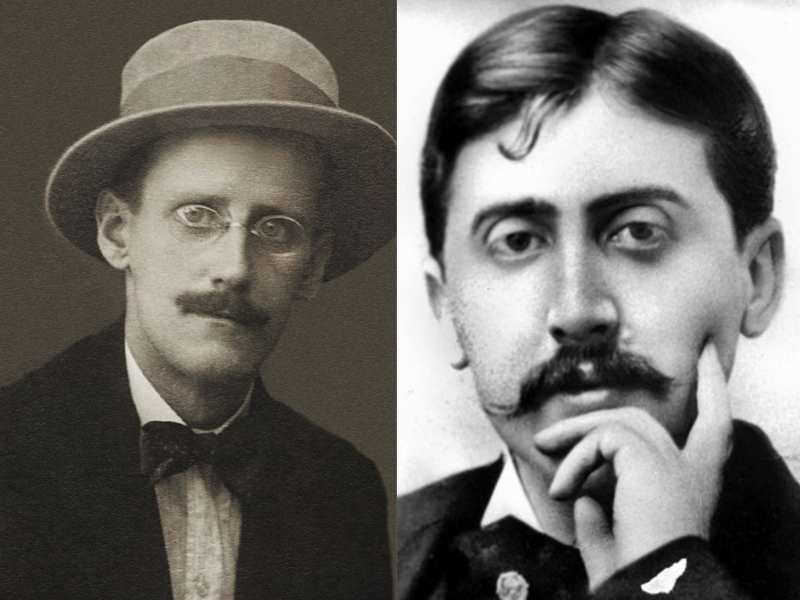
Another historic meeting between two artists we might consider kindred, James Joyce of Ulysses fame and Marcel Proust of In Search of Lost Time, did not produce such a rich exchange. As Irish critic Arthur Power remarked, “Here are the two greatest literary figures of our time meeting and they ask each other if they like truffles.”
That, at least, is one account of the occasion in May of 1922, near the end of Proust’s life. The meeting took place at a party for Igor Stravinsky and Sergei Diaghilev at the Majestic Hotel. Though both novelists propelled their greatest work forward by extrapolating from their favorite subject, themselves, the selves in their work are expansive and vast, taking in whole cities, nations, and social worlds. Both were voracious readers with incredible memories (as we certainly know of Proust) and an intuitive grasp of the cultural mechanisms of modernity. Such serious conversations the two of them might have.…
But one attendee, William Carlos Williams, paints a much more comic picture.….
Joyce, writes Ben Jackson at the London Review of Books, “arrived drunk and poorly dressed; Proust, draped in furs, opened the door.” Then, writes Williams, the two men sat in chairs side by side, while “partisans” waited for “the wits to sparkle and flash.” Instead, they kvetched in the sports-and-weather small talk of two elderly men meeting in a doctor’s waiting room, or two Samuel Beckett characters, beset by petty complaints of ultimate importance.
Joyce said, “I’ve headaches every day. My eyes are terrible.”
Proust replied, “My poor stomach. What am I going to do? It’s killing me. In fact, I must leave at once.”
“I’m in the same situation,’ replied Joyce. ‘If I can find someone to take me by the arm. Goodbye!”
“Charmé,” said Proust. “Oh, my stomach, my stomach.”
Ford Madox Ford confirms the account, but the party’s host, novelist Sydney Schiff denied it, reports Joyce’s most respected biographer Richard Ellmann. Ellmann doesn’t seem to favor one version or another, but he does give us Joyce’s own version, multiply attested. The Ulysses author remembered that their “talk consisted solely of the word ‘No.’ Proust asked me if I knew the duc du so-and-so. I said, ‘No.’” Proust was asked if he’d read Ulysses, and likewise replied in the negative. “The situation,” Joyce remembered, “was impossible.” Other guests remembered the meeting similarly.
In yet another version, we see the aftermath of their conference—in a story that resembles many an end-of-the-night-gone-sour scenario. Sydney Schiff’s wife Violet recalled Joyce drunkenly inviting himself into a taxi with the two of them and Proust, and promptly opening the window. “Knowing Proust’s deadly fear of drafts,” writes a Proust site, Violet “immediately closed the window.” When the cab arrived at Proust’s apartment, the French novelist “urged the Irishman to let the taxi take him home,” then “fled to his apartment.”
The many conflicting renditions all seem to agree on one thing: the meeting was a wash. Nonetheless, one author recently published what purports to be an entire book on the subject. Even he concludes “no one can say for certain exactly what they said to each other.” It’s tempting to think things might have gone otherwise, had they met earlier or in different circumstances, given Joyce’s tendency to get too drunk and Proust’s ill health and aversion to, well, company. The New Inquiry cites a remark Joyce made to Samuel Beckett about Proust: “If we had been allowed to meet and have a talk somewhere….”
Although it’s said that both writers confessed to not having read the other, Jackson notes that when Joyce “did admit to passing his eyes over a few pages he declared that he did not see ‘any special talent.’” He also confessed to some envy of Proust’s comfortable circumstances. Proust, who died six months later, left no mention of their meeting.
Related Content:
The Historic Meeting Between Dickens and Dostoevsky Revealed as a Great Literary Hoax
Edward Said Recalls His Depressing Meeting With Sartre, de Beauvoir & Foucault (1979)
Josh Jones is a writer and musician based in Durham, NC. Follow him at @jdmagness
Read More...Watch What Happens When 100 Metronomes Perform György Ligeti’s Controversial Poème Symphonique
A loose association of mid-20th century artists including at times John Cage, Yoko Ono, and Joseph Bueys, the Fluxus group produced a lot of strange performative work and anti-art stunts influenced by similar provocations from earlier Dada artists. The movement’s “patron saint,” Martha Schwendener writes at The New York Times, was Marcel Duchamp, whose “idea of art (or life) as a game in which the artist reconfigures the rules is central to Fluxus.” Also central was Duchamp’s concept of the “ready-made”—everyday objects turned into objets d’art by means part ritual and part prank.
We can think of the piece above in both registers. György Ligeti’s Poème symphonique, a composition involving 100 metronomes and ten operators, fit right in with Fluxus during Ligeti’s brief association with them.
Written in 1962—and yes, it has a written score—Ligeti’s piece “owes much of its success to its presentation as a ridiculous spectacle,” writes composer Jason Charney, who has made a digital recreation. Ligeti provides specific instructions for the performance.
The work is performed by 10 players under the leadership of a conductor … Each player operates 10 metronomes … The metronomes must be brought onto the stage with a completely run-down clockwork … the players wind up the metronomes … at a sign from the conductor, all the metronomes are set in motion by the players.
These are followed almost to the letter in the video at the top of the page, with the added bonus of holding the performance in a Gothic church. What does it sound like? A cacophonous racket. A waterfall of typewriters. And yet, believe it or not, something interesting does happen after a while; you become attuned to its internal logic. Patterns emerge and disappear in the reverberation from the church walls: A wave of robot applause, then soothing white noise, then a movement or two of a factory symphony.…
“The score,” notes Matt Jolly, who shot the video, “calls for a long silence and then up to an hour of ticking. We decided to shorten this considerably. The metronomes are supposed be fully wound but we had to limit that to 13 turns on average.” The ingenuity of Ligeti’s piece far surpasses that of any mere prank, as does the logistical and material demand. The composer fully acknowledged this, providing specifics as to how performers might go about securing their “instruments,” hard to come by in such large quantity even in 1962. (Mechanical metronomes are now all but obsolete.) Charney quotes from Ligeti’s helpful suggestions, which include enlisting the services of an “executive council of a city, one or more of the music schools, one or more businesses, one or more private persons….”
I doubt he meant any of this seriously. Dutch Television canceled a planned 1963 broadcast of Poème symphonique from an early performance in the Netherlands. The event included speeches by local politicians and an audience who had no idea what to expect. As you might imagine, they did not react favorably. Like the earlier anti-art Ligeti’s idea draws from, he explicitly framed the composition as “a special sort of critique,” whose score is “admittedly rather ironic” and in which he rants vaguely against “all ideologies” and “radicalism and petit-bourgeois attitudes” alike. How seriously he means this is also anyone’s guess. And yet, prank or art, people continue to perform the piece, as in the even shorter rendition above, which goes even further in removing the human element by designing a machine to start all the metronomes simultaneously.
Related Content:
Hear the Radical Musical Compositions of Marcel Duchamp (1912–1915)
Hear the Experimental Music of the Dada Movement: Avant-Garde Sounds from a Century Ago
The Music of Avant-Garde Composer John Cage Now Available in a Free Online Archive
Josh Jones is a writer and musician based in Durham, NC. Follow him at @jdmagness
Read More...Book Readers Live Longer Lives, According to New Study from Yale University
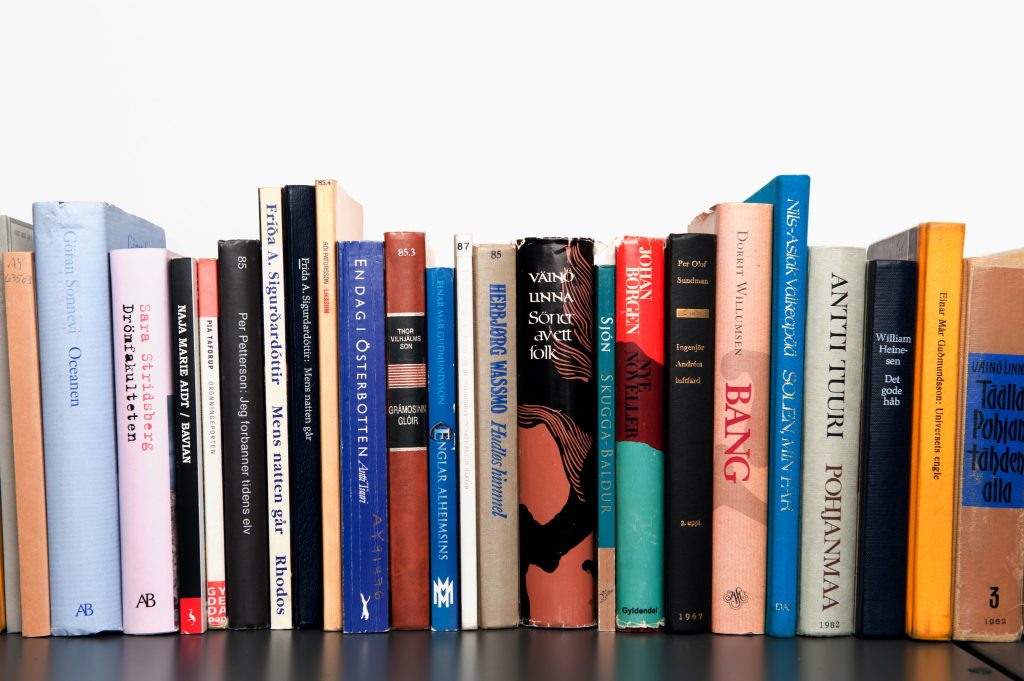
Image by Johannes Jansson, via Wikimedia Commons
What are the keys to longevity? If you ask Dan Buettner, the author of The Blue Zones: Lessons for Living Longer From the People Who’ve Lived the Longest, he’d list nine key factors. They range from slow down and don’t stress out, to have a clear purpose in life, to eat mainly plant based foods and put family first. Nowhere on his list, however, does he suggest sitting down and reading good books.
And yet a new study by researchers at Yale University’s School of Public Health indicates that people who read books (but not so much magazines and newspapers) live two years longer, on average, than those who don’t read at all. Becca R. Levy, a professor of epidemiology at Yale, is quoted in The New York Times as saying, “People who report as little as a half-hour a day of book reading had a significant survival advantage over those who did not read.” “And the survival advantage remained after adjusting for wealth, education, cognitive ability and many other variables.” Precisely how book reading contributes to increased longevity is not spelled out. You can read the abstract for the new study here.
If you would like to support the mission of Open Culture, consider making a donation to our site. It’s hard to rely 100% on ads, and your contributions will help us continue providing the best free cultural and educational materials to learners everywhere. You can contribute through PayPal, Patreon, and Venmo (@openculture). Thanks!
Related Content:
How to Live to Be 100 and Beyond: 9 Diet & Lifestyle Tips
Read More...If Coffee Commercials Told the Unvarnished Truth
A new comedy video from Cracked makes a fair point: there’s a lot of bullshit that goes into the marketing of coffee nowadays. Slap the words “organic” and “fair trade” on the product, and everyone feels pretty good about keeping their caffeine addictions going. Several years ago, Slovenian theorist Slavoj Žižek took a closer look at this phenomenon and drew some interesting conclusions about how, within contemporary capitalism, companies like Starbucks have reworked Max Weber’s Protestant Ethic, and found new ways to square our economic and spiritual lives. Starbucks has made it, Žižek notes, so that when we enter their stores, we’re not just buying coffee and being consumers. Rather, we’re buying fair trade and eco-friendly coffee, participating in charitable work, and leaving with a sense of redemption. The animated video is worth a look.
And lest you think marketing coffee has always been a sunny affair, let me turn your attention to this post in our archive: Men In Commercials Being Jerks About Coffee: A Mashup of 1950s & 1960s TV Ads.
Related Content
“The Virtues of Coffee” Explained in 1690 Ad: The Cure for Lethargy, Scurvy, Dropsy, Gout & More
Philosophers Drinking Coffee: The Excessive Habits of Kant, Voltaire & Kierkegaard
The Birth of London’s 1950s Bohemian Coffee Bars Documented in a Vintage 1959 Newsreel
Good Capitalist Karma: Zizek Animated
Read More...Browse & Stream Jeff Buckley’s Entire Record Collection on a New Interactive Web Site
Jeff Buckley released just one studio album, Grace, before the emerging star died unexpectedly in May, 1997, drowning while swimming in the waters flowing from the Mississippi River. He was only 30 years old.
Given his painfully short discography, fans will delight in the newly-dropped album, You and I, which features, among other things, previously-unreleased Buckley covers of songs originally recorded by Bob Dylan (“Just Like a Woman”); Sly & the Family Stone (“Everyday People”); Led Zeppelin (“Night Flight”) and more. The album is now streaming on Spotify.
Starved for some more Buckley music? Then you’ll also want to check out this new interactive website which lets you browse/stream every album in Buckley’s varied vinyl record collection. Miles Davis, Billie Holiday, Siouxsie and the Banshees, Van Morrison, the Stones, Dylan, Bowie, Coltrane and The Clash–they’re all part of the collection. The video above shows you how to take full advantage of the new site. Enjoy.
If you would like to support the mission of Open Culture, consider making a donation to our site. It’s hard to rely 100% on ads, and your contributions will help us continue providing the best free cultural and educational materials to learners everywhere. You can contribute through PayPal, Patreon, and Venmo (@openculture). Thanks!
Read More...How Did Hannibal Cross the Alps?: A Short Free Course

Over on iTunes, you can find a short course (8 lectures in total) on the age-old mystery: How did Hannibal and his elephants cross the Alps during the Second Punic War? The course was presented by archeologist Patrick Hunt in the Continuing Studies program at Stanford University, back in 2007. Here’s the description for the course:
Hannibal is a name that evoked fear among the ancient Romans for decades. His courage, cunning and intrepid march across the dangerous Alps in 218 BCE with his army and war elephants make for some of the most exciting passages found in ancient historical texts written by Polybius, Livy, and Appian. And they continue to inspire historians and archaeologists today. The mystery of his exact route is still a topic of debate, one that has consumed Patrick Hunt (Director of Stanford’s Alpine Archaeology Project) for more than a decade. This course examines Hannibal’s childhood and his young soldierly exploits in Spain. Then it follows him over the Pyrenees and into Gaul, the Alps, Italy, and beyond, examining his victories over the Romans, his brilliance as a military strategist, and his legacy after the Punic Wars. Along the way, students will learn about archaeologists’ efforts to retrace Hannibal’s journey through the Alps and the cutting-edge methods that they are using. Hunt has been on foot over every major Alpine pass and has now determined the most probable sites where archaeological evidence can be found to help solve the mystery.
This course on the great military leader will be added to our collection, 1,700 Free Online Courses from Top Universities as well as our specialized list of courses on Ancient history, literary and philosophy.
If you live in the San Francisco Bay Are, you’ll definitely want to check out the courses offered by Stanford Continuing Studies (where I also happen to work). The program also regularly offers online courses, for students living anywhere on this planet.
If you would like to support the mission of Open Culture, consider making a donation to our site. It’s hard to rely 100% on ads, and your contributions will help us continue providing the best free cultural and educational materials to learners everywhere. You can contribute through PayPal, Patreon, and Venmo (@openculture). Thanks!
Read More...The Philosophy of Bill Murray: The Intellectual Foundations of His Comedic Persona
“Bill Murray is a national, no, an international, no an intergalactic treasure,” said Jim Jarmusch, who directed him in Coffee and Cigarettes and Broken Flowers, when the actor won this year’s Mark Twain Prize for American Humor. But what, exactly, do we find so compelling about the guy? I launched into my own quest to find out after seeing his performance in Rushmore (regarded by most Murray scholars as a revelation of depth at which he’d only hinted between wisecracks before), watching every movie he ever appeared in. Similarly rigorous research must have gone into this new video on the philosophy of Bill Murray.
“Since replacing Chevy Chase on Saturday Night Live in 1977,” says narrator Jared Bauer, “Bill Murray has embodied a very particular type of comedy that can best be described as ‘ironic and cooly distant.’ ” Bauer references a New York Times article on Murray’s ascendance to “secular sainthood” which describes him as having had “such a long film career that, in the public mind, there are multiple Bill Murrays. The Bill Murray of Stripes and Ghostbusters is an anti-authoritarian goofball: the kind of smart-aleck who leads a company of soldiers in a coordinated dance routine before a visiting general, or responds to the possible destruction of New York City by saying, ‘Human sacrifice, dogs and cats living together, mass hysteria!’ ”
That memorable line makes it into “The Philosophy of Bill Murray,” as do many others, all of which spring from the actor’s signature persona, which “stands slightly at a distance from everything, enabling him to maintain a dryly humorous commentary about what’s going on around him.” Bauer places this in a tradition of American comedy “dating back at least to the vaudeville days” and continuing through to Groucho Marx’s habitual breakage of the fourth wall. He even connects it to 15th-century Japanese playwright-philosopher Zeami Motokiyo and, in some sense his 20th-century continuation, Bertolt Brecht.
But what influence best explains Murray’s distinctive onscreen and increasingly performance art-like offscreen behavior today? Maybe that of his onetime teacher, the Greco-Armenian Sufi mystic G.I. Gurdjieff, who, as Murray’s Ghostbusters co-star Harold Ramis put it, “used to act really irrationally to his students, almost as if trying to teach them object lessons.” He taught what he called “the fourth way of enlightenment,” or — more fittingly in Murray’s case — “the way of the sly man,” who can “find the truth in everyday life” by remaining simultaneously aware of both the outside world and his inner one while not getting caught up in either. The sly man thus exists between, and uses, “the world, the self, and the self that is observing everything.”
Bauer sums up Murray’s uniqueness thus: “He turns the usual style of American comedic irony against itself, or against himself,” leading us to “identify not with Bill Murray’s character, but with Bill Murray, who distances himself from the stakes of the narrative.” But whether playing a character, playing himself, or something between the two, Murray seems as if he knows something we don’t about the stakes of life itself. “I’d like to be more consistently here,” he once said to Charlie Rose, who’d asked what he wants that he doesn’t already have. “Really in it, really alive. I’d like to just be more here all the time, and I’d like to see what I could get done, what I could do, if I was able to not get distracted, to not change channels in my mind and body.” A universal human longing, perhaps, but one Murray, the ultimate sly man, has come to tap more deeply into than any performer around.
Related Content:
Listen to Bill Murray Lead a Guided Mediation on How It Feels to Be Bill Murray
An Animated Bill Murray on the Advantages & Disadvantages of Fame
Bill Murray Reads Poetry at a Construction Site
Bill Murray Reads Great Poetry by Billy Collins, Cole Porter, and Sarah Manguso
Bill Murray Gives a Delightful Dramatic Reading of Twain’s Huckleberry Finn (1996)
Bill Murray Sings the Poetry of Bob Dylan: Shelter From the Storm
Watch Bill Murray Perform a Satirical Anti-Technology Rant (1982)
Based in Seoul, Colin Marshall writes and broadcasts on cities and culture. He’s at work on a book about Los Angeles, A Los Angeles Primer, the video series The City in Cinema, the crowdfunded journalism project Where Is the City of the Future?, and the Los Angeles Review of Books’ Korea Blog. Follow him on Twitter at @colinmarshall or on Facebook.
Read More...Hear Anaïs Nin Read From Her Celebrated Diary: A 60-Minute Vintage Recording (1966)

Image by George Leite, via Wikimedia Commons
At one time, writer Anaïs Nin’s reputation largely rested on her passionate, long-term love affair with novelist Henry Miller, whom she also financially supported while he wrote his best-known novels and became, writes Sady Doyle, a “darling of the avant-garde.” Nin herself was a marginalized, “unfashionable” writer, whose “frank portrayals of illegal abortions, extramarital affairs and incest” brought such critical opprobrium down on her that “by 1954, Nin believed the entire publishing industry saw her as a joke.” She had good reason to think so.
Miller’s notoriously censored books won him cult literary status, and inspired the Beats, Norman Mailer, Philip Roth, and many more hedonistic male writers seeking to turn their lives into art. Nin’s equally explicit work was met, she lamented, “with indifference, with insults.” Critics either ignored her novels, several of them self-published, or dismissed them as vulgar, artless, and worse. One headline, Doyle notes, called Nin “a monster of self-centeredness whose artistic pretentions now seem grotesque.”
All of that changed when Nin published the first volume of her diary in 1966. Thereafter, she achieved global fame as a feminist icon, and the next ten years saw the publication of an additional six volumes of her journals, then several more excerpts after her death in 1977. Most notably, Henry and June appeared in 1986 (subsequently made into a film by Philip Kaufman), a book which—in conjunction with the publication of her and Miller’s letters the following year—further added to the mythology of the two passionately erotic writers.
Nin had kept her diaries religiously since age 11, and has become known as “modernity’s most prolific and perceptive diarist,” writes Maria Popova, a distinction that has led to a tremendous resurgence in pop culture popularity in our time, when well-crafted self-revelation is de rigeur for artists, activists, online personalities, and aspirants of all kinds. Henry Miller is now “a marginalized and largely forgotten American writer” (or so claims his biographer Arthur Hoyle), and Nin has become a “patron saint of social media,” writes Doyle, a “proto-Lena-Dunham.” Pithy quotations from her diaries—properly credited or not—constantly circulate on Tumblr, Facebook, and Twitter.
A new generation just discovering Anaïs Nin can access her work in any number of ways—from hip, meme-heavy Tumblr accounts like Fuck Yeah Anais Nin to more formal online venues like the Anais Nin Blog, which aggregates biographies, podcasts, scholarship, bibliographies, controversies, and anything else one might want to know about the author. Anaïs Nin fans can also hear the author herself read from her famous diary in the audio here. At the top of the post, hear Nin’s reading, recorded in ’66, the year of the first volume’s publication. The complete recording runs about 60 minutes.
After the acclaim of Nin’s diaries, and the celebrity she enjoyed in her last decade, her reputation once again suffered, posthumously, as biographers and critics savaged her life and work in moralistic torrents of what would today be called “slut-shaming.” But Nin is now once again rightly revered as a writer fully dedicated to the art, no matter the reception or the audience. The astonishing stream of words that flowed from her, recording every detail of her experiences, “seems nothing less than phenomenal,” wrote Noel Young of Nin’s nonstop letter writing. When it came to the detailed, insightful, and acutely philosophical recording of her life, “the act of writing may have even surpassed the act of living.”
Related Content:
Simone de Beauvoir Explains “Why I’m a Feminist” in a Rare TV Interview (1975)
Henry Miller Makes a List of “The 100 Books That Influenced Me Most”
Josh Jones is a writer and musician based in Durham, NC. Follow him at @jdmagness
Read More...Free: Hear 24 Hours of Noam Chomsky’s Lectures & Talks on the Powers That Subvert Our Democracies
Noam Chomsky is optimistic. Yes, the world seems to teeter on the brink of… well, name your dystopian scenario, but Noam Chomsky is optimistic. The same Chomsky who, for decades, has sought to show the myriad ways our most revered institutions are largely sham operations behind which powerful elites conduct secret wars, propaganda campaigns, environmental destruction, and concerted efforts to defraud the people and disable democratic processes… well, he tells us, in a recent interview with James Resnick, that we too “can be very optimistic. Things like this have happened before and they’ve been overcome.”
By “things like this,” the renowned linguist and anarchist political philosopher specifically means astounding levels of wealth inequality and the ascendency, once again, of far-right extremism in Europe and the U.S., a phenomenon he first observed in the years prior to World War II. Chomsky began his career of social and political critique in 1938 at the age of 10, “writing articles for the school newspaper on the rise of fascism in Europe and the threats to the world as I saw them.”
He went on to completely revolutionize the field of linguistics, an achievement that, stunningly, can seem secondary to his political writing and activism, given the sheer number of his books, essays, interviews, and speeches critical of state power, war, and media manipulation over the past several decades. (Some of his books you can read free online here.) I suppose if Chomsky weren’t something of an optimist, he would have given up a long time ago. He tells Resnik what keeps him going:
The things I consider inspiring is seeing people struggling: poor suffering people, with limited resources, struggling to really achieve anything. Some of them are very inspiring. For example, a remote very poor village in southern Colombia organizing to try to prevent a Canadian gold-mining operation from destroying their water supply and the environment; meanwhile, fending off para-military and military violence and so on. That kind of thing which you see all over the world is very inspiring.
Are you inspired? Maybe it depends on how many of these grassroots struggles you’ve witnessed. The worldwide, ground-level resistance Chomsky describes—and refers to again and again in his political work—is largely hidden from us, by a mass media that sees no dollar value in it, or perhaps obscures it for more sinister reasons. As Chomsky has argued since the sixties—most comprehensively in his 1988 Manufacturing Consent with Edward S. Herman—the campaigns of war and economic depredation conducted by the West against minorities, indigenous people, and small nations around the world mostly occur with the consent of Western people: a consent manufactured by a massive propaganda operation called the Free Press.
His position should not sound especially controversial to anyone who has paid the least bit of attention in the last few years. The seeming collusion of respected news organizations like The Washington Post and The New York Times in the push for the second Iraq War led to well over a decade of post-hoc introspection by journalists. Recent months have seen those same organs—for perhaps more baldly profit-seeking motives—provide a couple of billion dollars-worth of free PR for Donald Trump, a candidate who has on multiple occasions threatened to retaliate against the press for any criticism, and who recently revoked the Post’s credentials to cover his events. (A recent Harvard study concluded that during this protracted, ugly primary season, “the press became [Trump’s] dependable if unwitting ally.”)
As in these examples, the role of the British press in spreading fear and misinformation prior to this month’s Brexit vote has become its own significant story. We constantly see the press turning in agonized circles, trying to come to grips with its complicity in pushing various agendas. Whether or not mainstream media organizations take direct orders from government bodies or economic elites, they accede to the interests of the powerful all the same, and they wield enormous influence over a voting public who depend upon them for information. The situation presents a serious problem for the health of a functioning democracy, which itself depends upon an informed and educated electorate.
But as Chomsky has often argued—drawing as always on primary sources and directly quoting the West’s most influential political philosophers, policy architects, and business leaders—elites since the 17th and 18th centuries have intentionally thwarted the ability of the public to make informed decisions, and have shut the populace out of the most important decision-making processes. As he wrote in his 1999 critique of Neoliberalism, Profit Over People, “the general population must be excluded entirely from the economic arena, where what happens in the society is largely determined. Here the public is to have no role, according to prevailing democratic theory.”
Chomsky follows this line of reasoning in his talk “When Elites Fail,” at the top of the post, delivered as the keynote address for the Ecoconvergence Conference in Portland, Oregon in 2009. You can also hear this talk, along with 19 others, in the Spotify playlist just above—a total of 24 hours of Chomskyan social, political, and economic analysis, delivered by the man himself in his calm, measured, understated way. (If you need Spotify’s free software, download it here.) Chomsky addresses “The Tyranny of Corporations,” the “U.S. Media as Propaganda System,” “Politics and Language,” “Iraq: The Forever War,” and more—levying criticisms against the systems of power, whether Republican, Democratic, or international, that doggedly seek to increase their domains and, in the approving words of James Madison, to “protect the minority of the opulent against the majority.”
Related Content:
Noam Chomsky on Whether the Rise of Trump Resembles the Rise of Fascism in 1930s Germany
Clash of the Titans: Noam Chomsky & Michel Foucault Debate Human Nature & Power on Dutch TV, 1971
Read 9 Free Books By Noam Chomsky Online
Josh Jones is a writer and musician based in Durham, NC. Follow him at @jdmagness
Read More...Johnny Rotten Becomes a DJ and Plays Songs from His Record Collection, 1977
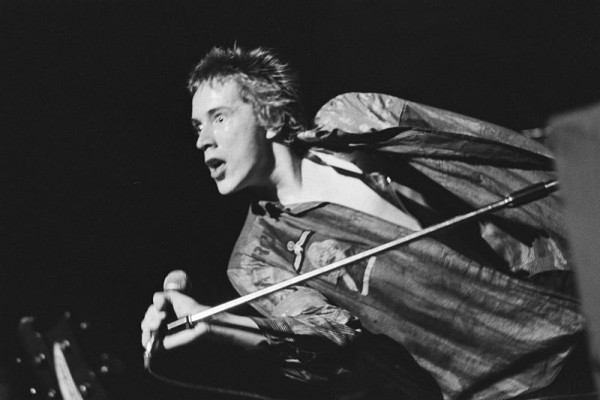
Image via Wikimedia Commons
One of the initial impressions of the British punks–and one that impresario Malcolm McLaren tried to cultivate–was that they were dangerous, unschooled yobs creating rock music from primordial materials. That’s why McLaren was unhappy about John Lydon aka Johnny Rotten’s appearance on Capital Radio’s Tommy Vance Show in the middle of the summer of punk, 1977.
“Anarchy in the U.K.” and “God Save the Queen” had already been released as singles. The Pistols had made their infamous appearance on Bill Grundy’s chat show, where goaded into doing something outrageous, they swore a bit and the British press melted down in paroxysms of panic. They had been dropped by both EMI and A&M, and had finished recording the bulk of Never Mind the Bollocks the month before. The band was in limbo.
DJ Tommy Vance was sixteen years older than Lydon, but Capital Radio was an independent station and offered an alternative to the BBC, which only a few months earlier banned outright “God Save the Queen” from the airwaves and refused to award it a number one single spot, even though the single had earned it, saleswise.
Lydon was asked to bring in records from his own collection and talk about them, and, in doing so, demonstrated that he wasn’t a thug, but an eclectic young music fan with broad tastes. He liked a lot of reggae (Peter Tosh, Makka Bees, Dr. Alimantado) and dub, and says he grew up with it. It also explains the dub heavy outings he’d soon do with Public Image Ltd. And he chooses tracks by singer-songwriters like Tim Buckley, Kevin Coyne, and Neil Young; John Cale, Lou Reed, and Nico; and art rock like Can, a band introduced to him by Sid Vicious.
He’s still abrupt, insulting and dismissive when he needs to be. He calls David Bowie a “real bad drag queen,” doesn’t think much of the Rolling Stones or most ‘60s bands (“terrible scratching sound” he says), and says most of his contemporary punk bands are “stagnant” and predictable. But it wouldn’t be Johnny Rotten any other way, would it?
When asked about his record collection, Lydon says it’s quite big:
I ain’t got a record player at the moment, so I have to pass them around, because music’s for listening to, not to store away in a bloody cupboard. Yeah, I love my music.
You can listen to the broadcast here:
And here’s the full track listing:
Tim Buckley – Sweet Surrender
The Creation – Life Is Just Beginning
David Bowie – Rebel Rebel
Unknown Irish Folk Music / Jig
Augustus Pablo – King Tubby Meets The Rockers Uptown
Gary Glitter – Doing Alright With The Boys
Fred Locks – Walls
Vivian Jackson and the Prophets – Fire in a Kingston
Culture – I’m Not Ashamed
Dr Alimantado & The Rebels – Born For A Purpose
Bobby Byrd – Back From The Dead
Neil Young – Revolution Blues
Lou Reed – Men Of Good Fortune
Kevin Coyne – Eastbourne Ladies
Peter Hammill – The Institute Of Mental Health, Burning
Peter Hammill – Nobody’s Business
Makka Bees – Nation Fiddler / Fire!
Captain Beefheart – The Blimp
Nico – Janitor Of Lunacy
Ken Boothe – Is It Because I’m Black
John Cale – Legs Larry At Television Centre
Third Ear Band – Fleance
Can – Halleluhwah
Peter Tosh – Legalise It
via That Eric Alper/WFMU
Related content:
The Sex Pistols’ 1976 Manchester “Gig That Changed the World,” and the Day the Punk Era Began
Never Mind the Bollocks, Here’s … John Lydon in a Butter Commercial?
Ted Mills is a freelance writer on the arts who currently hosts the FunkZone Podcast. You can also follow him on Twitter at @tedmills, read his other arts writing at tedmills.com and/or watch his films here.
Read More...Support Us
We're hoping to rely on loyal readers, rather than erratic ads. Please click the Donate button and support Open Culture. You can use Paypal, Venmo, Patreon, even Crypto! We thank you!

About Us

Open Culture scours the web for the best educational media. We find the free courses and audio books you need, the language lessons & educational videos you want, and plenty of enlightenment in between.
Advertise With Us

FREE UPDATES!
GET OUR DAILY EMAIL
Get the best cultural and educational resources on the web curated for you in a daily email. We never spam. Unsubscribe at any time.
FOLLOW ON SOCIAL MEDIA

Open Culture editor Dan Colman scours the web for the best educational media. He finds the free courses and audio books you need, the language lessons & movies you want, and plenty of enlightenment in between.
Advertise With Us


