21 Artists Give “Advice to the Young:” Vital Lessons from Laurie Anderson, David Byrne, Umberto Eco, Patti Smith & More
Never meet your idols, they say. It can put a cramp in your appreciation of their work. There are always exceptions, but maybe Bill Murray proves the rule. On the other hand, you should always learn from your idols. There’s a reason you admire them, after all. Find out what it is and what they have to teach you. In the series we feature here, Advice to the Young, many an idol of many an aspiring artist and musician offers some broad, existential advice—ways to absorb a little of their process.
Laurie Anderson, above, tells us to “be loose.” Widen our boundaries, “make it vague,” because “there are so many forces that are trying to push us in certain directions, and they’re traps…. Don’t be caught in that trap of definition. It’s a corporate trap…. Be flexible.” Good advice, if you’re as eclectic and loose as Laurie Anderson, or if you seek artistic liberation ahead of sales. “I became an artist because I want to be free,” she says.
Just above, Daniel Lanois, superstar slide guitarist and producer of Bob Dylan, Neil Young, U2, Peter Gabriel, and Emmylou Harris, tells us what he learned from working with Brian Eno. His advice is impressionistic, alluding to the importance of atmosphere and environment, as one might expect. It’s about appreciating the process, he suggests. He does get concrete about a difficulty nearly every artist faces: “if you have a financial limitation, that might be okay. You don’t have to have everything that the other people have. I think a financial limitation or a technological limitation may free up the imagination.” In an age of home studios, that’s always welcome news.
David Byrne has always told it straight, in his cultural criticism and songwriting, and in his segment, above, he steers hopeful musicians and artists away from the dream of Jay Z‑level fame. “Often the artists who are very successful that way” he says, “they don’t have much flexibility. In achieving success, they lose a little bit of their creative freedom. They have to keep making the same thing over and over again.” Byrne’s advice solidly underlines Anderson’s. If you want creative freedom, be prepared to fly under the radar and make much less money than the stars. Ending on a starkly realist note, Byrne admits that in any case, you’ll probably need a day job: “it’s very, very hard to make money in the music business.”
Novelist Umberto Eco also brings us down to earth in his interview, saying “not to think you are inspired,” then slyly dropping a cliché: “genius is 10% inspiration and 90% perspiration.” The old wisdom is truest, I suppose. He also urges writers to take their time with a book. “I cannot understand those novelists who publish a book every year. They lose this pleasure of spending six, seven, eight years to tell a story.” Eco’s advice: rise through the ranks, “go step by step, don’t pretend immediately to receive the Nobel prize, because that kills a literary career.”
Patti Smith, comfortably addressing an audience from an outdoor stage, urges them to “just keep doing your work” whether anyone’s listening, reading, etc. To those people who criticize her success as selling out her punk rock roots, Smith says, to laughs, “fuck you.” She then transmits some advice she received from William S. Burroughs: “build a good name. Keep your name clean. Don’t’ make compromises, don’t worry about making a lot of money or being successful; be concerned with doing good work.”
Easy perhaps for Burroughs the adding machine-heir to say, but good advice nonetheless, and consistent with what each artist above tells us: do it your way, don’t get pigeonholed, work with what you have, don’t worry about success or money, keep your expectations realistic.
You can watch more interviews with Marina Abramović, Wim Wenders, Jonas Mekas, and many more on this Advice to the Young playlist assembled by The Louisiana Channel. All 21 talks in the series can be viewed below:
Related Content:
Ray Bradbury Gives 12 Pieces of Writing Advice to Young Authors (2001)
John Cleese’s Advice to Young Artists: “Steal Anything You Think Is Really Good”
Ursula Le Guin Gives Insightful Writing Advice in Her Free Online Workshop
Akira Kurosawa’s Advice to Aspiring Filmmakers: Write, Write, Write and Read
Josh Jones is a writer and musician based in Durham, NC. Follow him at @jdmagness
Read More...Anthony Burgess Names the 99 Best Novels in English Between 1939 & 1983: Orwell, Nabokov, Huxley & More
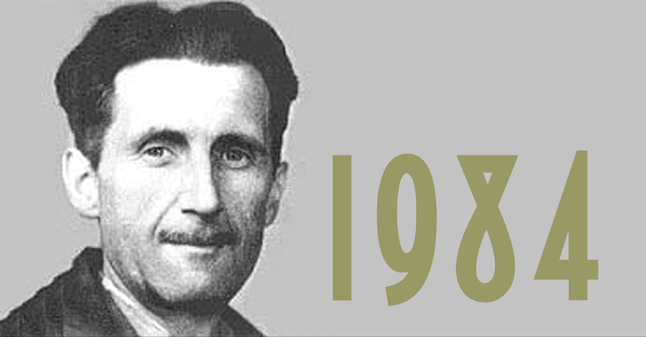
Image via Wikimedia Commons
In 1983, Anthony Burgess took up a commission from a Nigerian publishing company and, in two weeks, delivered to them the manuscript for Ninety-Nine Novels: The Best in English since 1939 — A Personal Choice. Published the following year, the book delivers exactly what its title, subtitle, and sub-subtitle promises: the finest novels English-language writers produced between the years 1939 and 1983, according to the preferences of the writer of more than a few novels himself, including A Clockwork Orange, Earthly Powers, and 1985.
Burgess wrote that last one, so its own title may suggest, as a tribute to George Orwell’s 1984, one of those 99 novels. “Nineteen eighty four has arrived, but George Orwell’s glum prophecy has not been fulfilled,” Burgess declared in a New York Times piece published as that year began. Yet “for 35 years a mere novel, an artifact meant primarily for diversion, has been scaring the pants off us all. Evidently the novel is a powerful literary form which is capable of reaching out into the real world and modifying it. It is a form which even the nonliterary had better take seriously.”
Prolific in his literary consumption as well as production, Burgess got plenty of practice taking the novel seriously in his capacity as a book reviewer. “It was clear that certain novels had to be reviewed whether I wished to review them or not,” he writes. “A new Graham Greene or Evelyn Waugh — this was the known brand-name which would grant an expected satisfaction. But the unknown had to be considered as well. After all, both Greene and Waugh produced first novels. V. S. Naipaul’s first novel went totally unreviewed.” Greene appears among the 99 for The Power and the Glory and The Heart of the Matter, Waugh for Brideshead Revisited and Sword of Honor, and Naipaul for A Bend in the River.
What makes these novels, and Burgess’ other 93 picks, so good? “The primary substance I have considered in making my selection is human character,” meaning that their authors have created “human beings whom we accept as living creatures filled with complexities and armed with free will” — and who thus, to a great extent, shape the story independently of authorial intention. “At best there will be a compromise between the narrative line you have dreamed up and the course of action preferred by the characters,” writes Burgess, as if addressing his colleagues in the enterprise of presenting “the preoccupations of real human beings through invented ones.”
You can see Burgess’ full list of 99 novels below, which includes such other favorite writers here at Open Culture as J.G. Ballard, Aldous Huxley (who scores three hits), James Joyce, and Vladimir Nabokov, all of whom, beyond their duty to character, “have managed language well, have clarified the motivations of action, and have sometimes expanded the bounds of imagination. And they entertain or divert, which means to turn our faces away from the repetitive patterns of daily life and look at humanity and the world with a new interest and even joy.” Only one question remains: why exactly 99? “The reader can decide on his own 100th,” Burgess replies. “He may even choose one of my own novels.”
Note: you can purchase online used copies of Ninety-Nine Novels: The Best in English since 1939 — A Personal Choice. It runs about 160 pages. Now here’s the basic list.
Achebe, Chinua — A Man of the People — (1966)
Aldiss, Brian — Life in the West (1980)
Amis, Kingsley — Lucky Jim (1954)
Amis, Kingsley — The Anti-Death League (1966)
Baldwin, James — Another Country (1962)
Ballard, J.G. — The Unlimited Dream Company (1979)
Barth, John — Giles Goat-Boy (1966)
Bellow, Saul — The Victim (1947)
Bellow, Saul — Humboldt’s Gift (1975)
Bowen, Elizabeth — The Heat of the Day (1949)
Bradbury, Malcolm — The History Man (1975)
Braine, John — Room at the Top (1957)
Cary, Joyce — The Horse’s Mouth (1944)
Chandler, Raymond — The Long Goodbye (1953)
Compton-Burnett, Ivy — The Mighty and Their Fall (1961)
Cooper, William — Scenes from Provincial Life (1950)
Davies, Robertson — The Rebel Angels (1982)
Deighton, Len — Bomber (1970)
Durrell, Lawrence — The Alexandria Quartet (1957)
Ellison, Ralph — Invisible Man (1952)
Faulkner, William — The Mansion (1959)
Fleming, Ian — Goldfinger (1959)
Fowles, John — The French Lieutenant’s Woman (1969)
Frayn, Michael — Sweet Dreams (1973)
Golding, William — The Spire (1964)
Gordimer, Nadine — The Late Bourgeois World (1966)
Gray, Alasdair — Lanark (1981)
Green, Henry — Party Going (1939)
Greene, Graham — The Power and the Glory (1940)
Greene, Graham — The Heart of the Matter (1948)
Harris, Wilson — Heartland (1964)
Hartley, L.P. — Facial Justice (1960)
Heller, Joseph — Catch-22 (1961)
Hemingway, Ernest — For Whom the Bell Tolls (1940)
Hemingway, Ernest — Old Man and the Sea (1952)
Hoban, Russell — Riddley Walker (1980)
Hughes, Richard — The Fox in the Attic (1961)
Huxley, Aldous — After Many a Summer (1939)
Huxley, Aldous — Ape and Essence (1948)
Huxley, Aldous — Island (1962)
Isherwood, Christopher — A Single Man (1964)
Johnson, Pamela Hansford — An Error of Judgement (1962)
Jong, Erica — How to Save Your Own Life (1977)
Joyce, James — Finnegans Wake (1939)
Lessing, Doris — The Golden Notebook (1962)
Lodge, David — How Far Can You Go? (1980)
Lowry, Malcolm — Under the Volcano (1947)
MacInnes, Colin — The London Novels (1957)
Mailer, Norman — The Naked and the Dead (1948)
Mailer, Norman — Ancient Evenings (1983)
Malamud, Bernard - The Assistant (1957)
Malamud, Bernard — Dubin’s Lives (1979)
Manning, Olivia — The Balkans Trilogy (1960)
Maugham, Somerset — The Razor’s Edge (1944)
McCarthy, Mary — The Groves of Academe (1952)
Moore, Brian — The Doctor’s Wife (1976)
Murdoch, Iris — The Bell (1958)
Nabokov, Vladimir — Pale Fire (1962)
Nabokov, Vladimir — The Defence (1964)
Naipaul, V.S. — A Bend in the River (1979)
Narayan, R.K. — The Vendor of Sweets (1967)
Nye, Robert — Falstaff (1976)
O’Brien, Flann — At Swim-Two-Birds (1939)
O’Connor, Flannery — Wise Blood (1952)
O’Hara, John — The Lockwood Concern (1965)
Orwell, George — Nineteen Eighty-Four (1949)
Peake, Mervyn — Titus Groan (1946)
Percy, Walker — The Last Gentleman (1966)
Plunkett, James — Farewell Companions (1977)
Powell, Anthony — A Dance to the Music of Time (1951)
Priestley, J.B. — The Image Men (1968)
Pynchon, Thomas — Gravity’s Rainbow (1973)
Richler, Mordecai — Cocksure (1968)
Roberts, Keith — Pavane (1968)
Roth, Phillip — Portnoy’s Complaint (1969)
Salinger, J.D. — The Catcher in the Rye (1951)
Sansom, William — The Body (1949)
Schulberg, Budd — The Disenchanted (1950)
Scott, Paul — Staying On (1977)
Shute, Nevil — No Highway (1948)
Sillitoe, Alan — Saturday Night and Sunday Morning (1958)
Snow, C.P. - Strangers and Brothers (1940)
Spark, Muriel — The Girls of Slender Means (1963)
Spark, Muriel — The Mandelbaum Gate (1965)
Styron, William — Sophie’s Choice (1979)
Theroux, Alexander — Darconville’s Cat (1981)
Theroux, Paul — The Mosquito Coast (1981)
Toole, John Kennedy — A Confederacy of Dunces (1980)
Updike, John — The Coup (1978)
Vidal, Gore — Creation (1981)
Warner, Rex — The Aerodrome (1941)
Waugh, Evelyn — Brideshead Revisited (1945)
Waugh, Evelyn — Sword of Honor (1952)
White, T.H. — The Once and Future King (1958)
White, Patrick — Riders in the Chariot (1961)
Williamson, Henry — A Chronicle of Ancient Sunlight (1951)
Wilson, Angus — The Old Men at the Zoo (1961)
Wilson, Angus — Late Call (1964)
Wouk, Herman — The Caine Mutiny (1951)
Related Content:
Anthony Burgess’ Lost Introduction to Joyce’s Dubliners Now Online
Vladimir Nabokov Names the Greatest (and Most Overrated) Novels of the 20th Century
The 100 Best Novels: A Literary Critic Creates a List in 1898
Based in Seoul, Colin Marshall writes and broadcasts on cities and culture. He’s at work on a book about Los Angeles, A Los Angeles Primer, the video series The City in Cinema, the crowdfunded journalism project Where Is the City of the Future?, and the Los Angeles Review of Books’ Korea Blog. Follow him on Twitter at @colinmarshall or on Facebook.
Read More...How the Coen Brothers Storyboarded Blood Simple Down to a Tee (1984)
Seldom, in the films of the Joel and Ethan Coen, do characters’ schemes go according to plan. You can watch it happen all across their filmography: the baby theft in Raising Arizona, the own-wife kidnapping and ransom in Fargo, the casino-vault tunnel heist in The Ladykillers, the Communist conversion of a screen idol in Hail, Caesar! But they’ve earned their enormous cinematic reputation not just for their themes, but for the precision with which they construct movies around them; it sometimes seems that the more dissolute the characters and ultimately disastrous the plot they fall into, the more carefully-made the picture.
This pattern began in 1984 with their first feature, the Texas neo-noir Blood Simple. Despite its relatively small-scale production (especially by the standards of their period piece-heavy recent work), it showcases every element their fans love: the sense of place, the sharp dialogue, the fascination with “low” life, the dark humor, the attention to detail.
No wonder, then, that it has now arrived in the Criterion Collection, in an edition which includes supplementary materials like the comparison between the storyboard and finished scene above, featuring commentary from the Coens Joel and Ethan both, as well as director of photography Barry Sonnenfeld and actor Frances McDormand.
“There are directors who are completely comfortable extemporizing on the set, and others who are not,” say Joel and Ethan, trading off observations. “Some directors want to throw everything up in the air and just see where it lands; that’s really how they work, fundamentally, and get great results. We’re kind of the… other end of the spectrum. We’re more comfortable if we have a plan, even if we stray quite a distance from that plan while we’re shooting.” They seem not to have strayed at all in the particular scene in this video, but their filmography boasts more than enough vitality to rule out the possibility of complete, control-freakish rigidity. All of it shows us how the best-laid plans of mice and men go awry — but only because the Coen Brothers lay even better plans first.
via No Film School
Related Content:
Watch the Coen Brothers’ TV Commercials: Swiss Cigarettes, Gap Jeans, Taxes & Clean Coal
Tuileries: A Short, Slightly Twisted Film by Joel and Ethan Coen
World Cinema: Joel and Ethan Coen’s Playful Homage to Cinema History
Based in Seoul, Colin Marshall writes and broadcasts on cities and culture. He’s at work on a book about Los Angeles, A Los Angeles Primer, the video series The City in Cinema, the crowdfunded journalism project Where Is the City of the Future?, and the Los Angeles Review of Books’ Korea Blog. Follow him on Twitter at @colinmarshall or on Facebook.
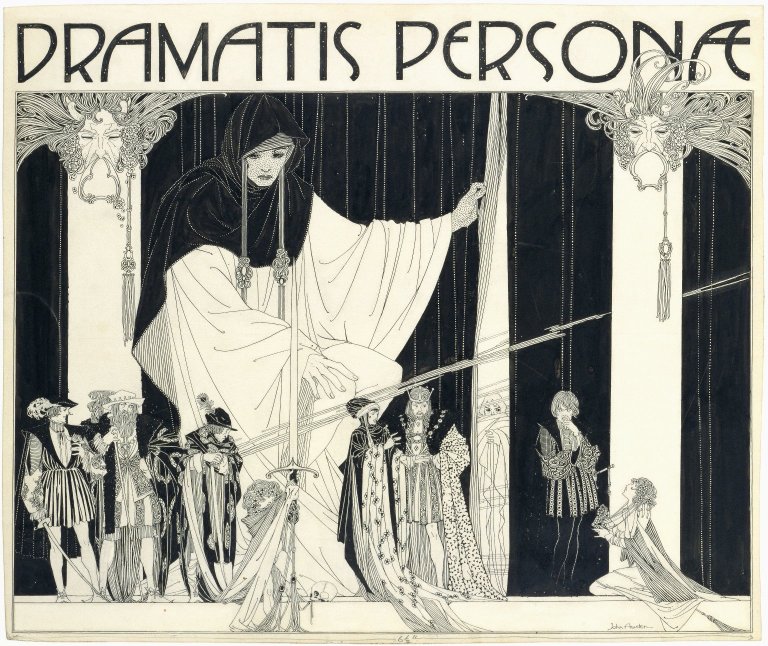
Read More...John Austen’s Haunting Illustrations of Shakespeare’s Hamlet: A Masterpiece of the Aesthetic Movement (1922)
We’ve popularly come to think of the Victorian era as one in which a prudish, sentimental conservatism ruled with imperial force over the arts and culture. But that broad picture ignores the strong countercurrent of weird eroticism in the work of aesthetes like Dante Rossetti, Oscar Wilde, and Aubrey Beardsley.
Beardsley’s elegant, bawdy illustrations of Wilde’s erotic play Salome scandalized British society, as did the play itself. His penchant for occult subjects and a wickedly sensuous style resonated well into the 20th century. Salome was a highlight of the Aesthetic movement,” writes the Met, “and an early manifestation of Art Nouveau in England.” By the 1920s, Beardsley was perhaps one of the most influential of literary illustrators.
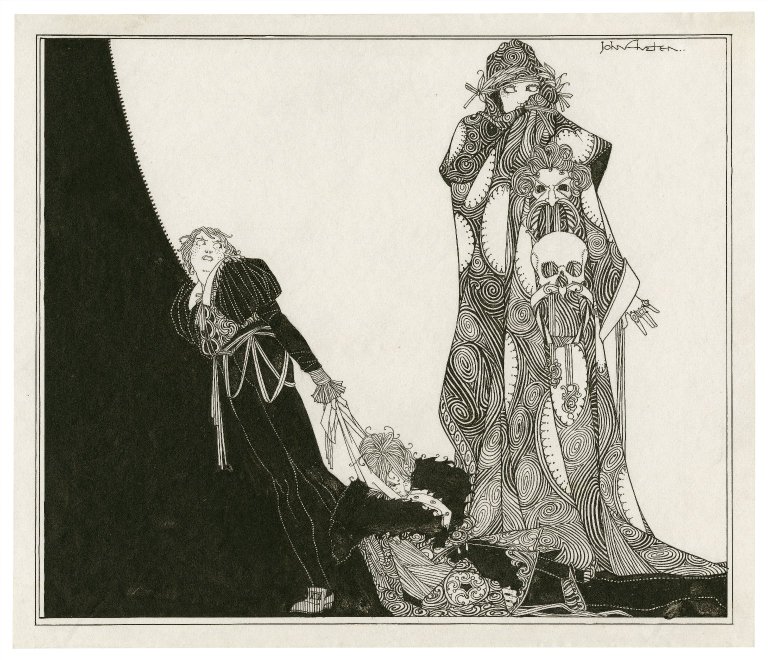
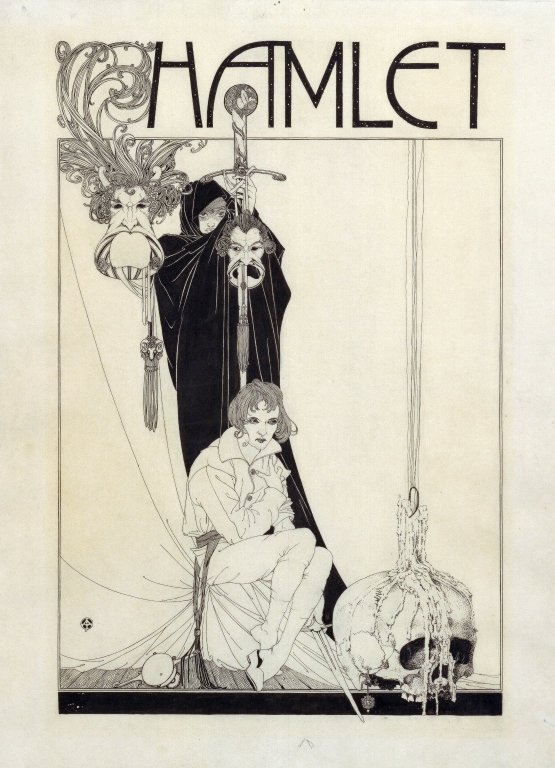
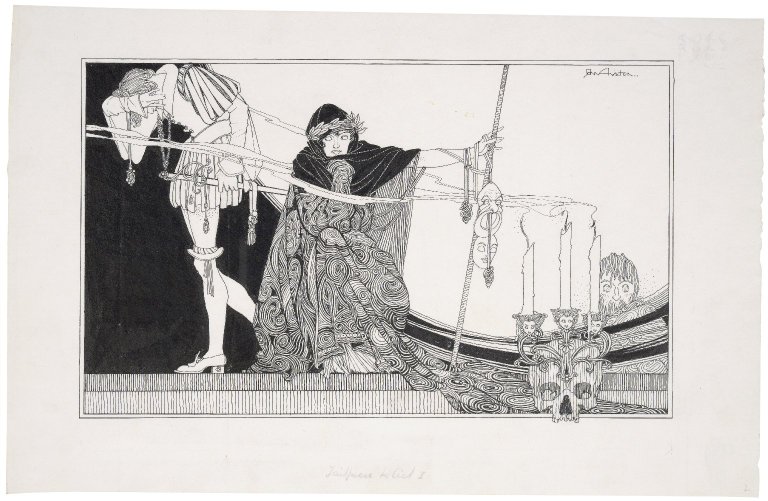
Irish artist Harry Clarke took directly from Beardsley in work like his richly-detailed 1926 edition of Goethe’s Faust. And in 1922, British artist John Austen modernized Hamlet by drawing on Clarke’s earlier work, as well as, quite clearly, on Beardsley. As artist John Coulthart remarks, “If you’re going to borrow a style then you may as well take from the best.” Like Beardsley’s Salome and Clarke’s Faust, Austen’s Hamlet “is often rated as his chef d’oeuvre, and with good reason, he manages to lend some visual splendor to a play whose concerns are a lot more introspective than the usual illustration standards of The Tempest and A Midsummer Night’s Dream” (just as T.S. Eliot had critically argued two years earlier).
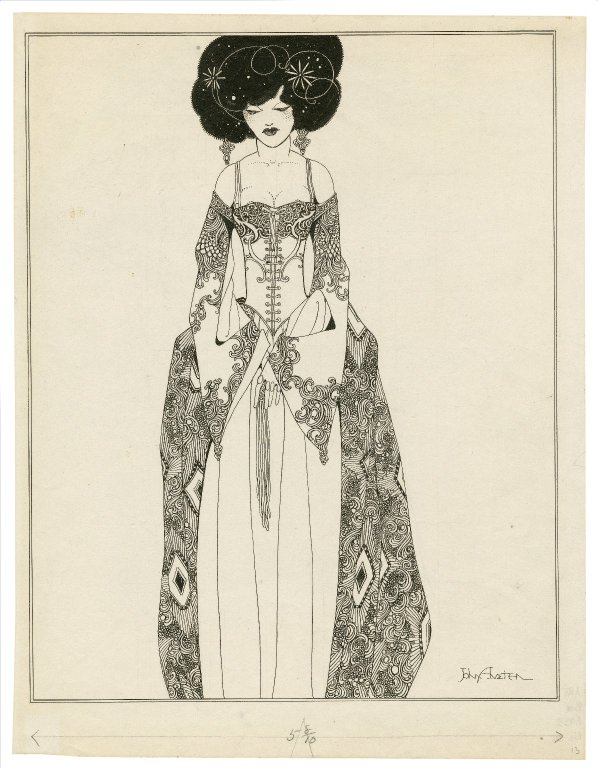
Published by Dover’s Calla Editions (and recently back in print), Austen’s illustrated Hamlet takes the fine, spare lines of Beardsley—well represented in his Poe edition—and clothes them, so to speak, with Clarke’s “manga faces, spiny fingers and swathes of black.” Each of the three artists has a different take on the macabre: Beardsley’s subtle symbolism giving way to Clarke’s surrealism and the heavy iconography in Austen’s Hamlet, permeated by the play’s archetypal images of “masks, swords and skulls.” Austen would soon leave behind the influence of both artists, adopting a much blockier style for literary illustrations later in the decade. In many ways, he represents a bridge between the elegant Art Nouveau aesthetics of Beardsley and the modernism of Art Deco, by way of Clarke’s unique gothic style.
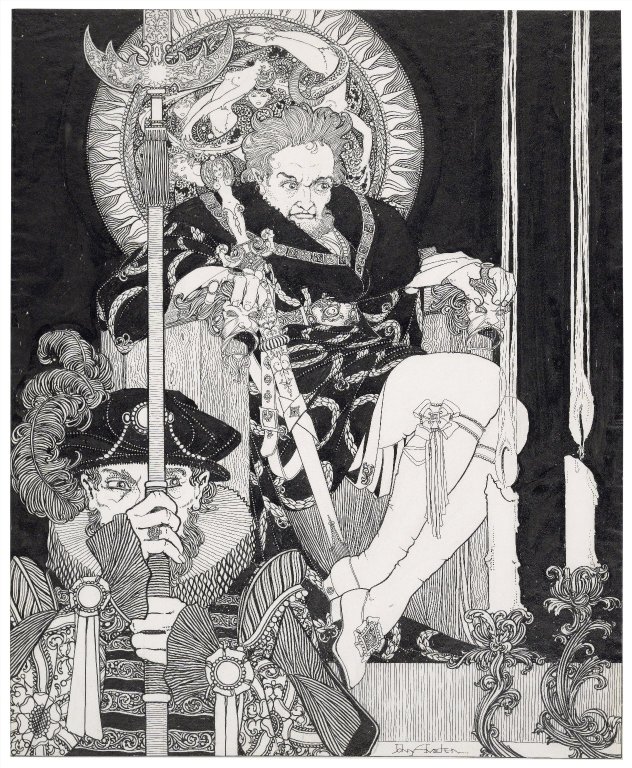
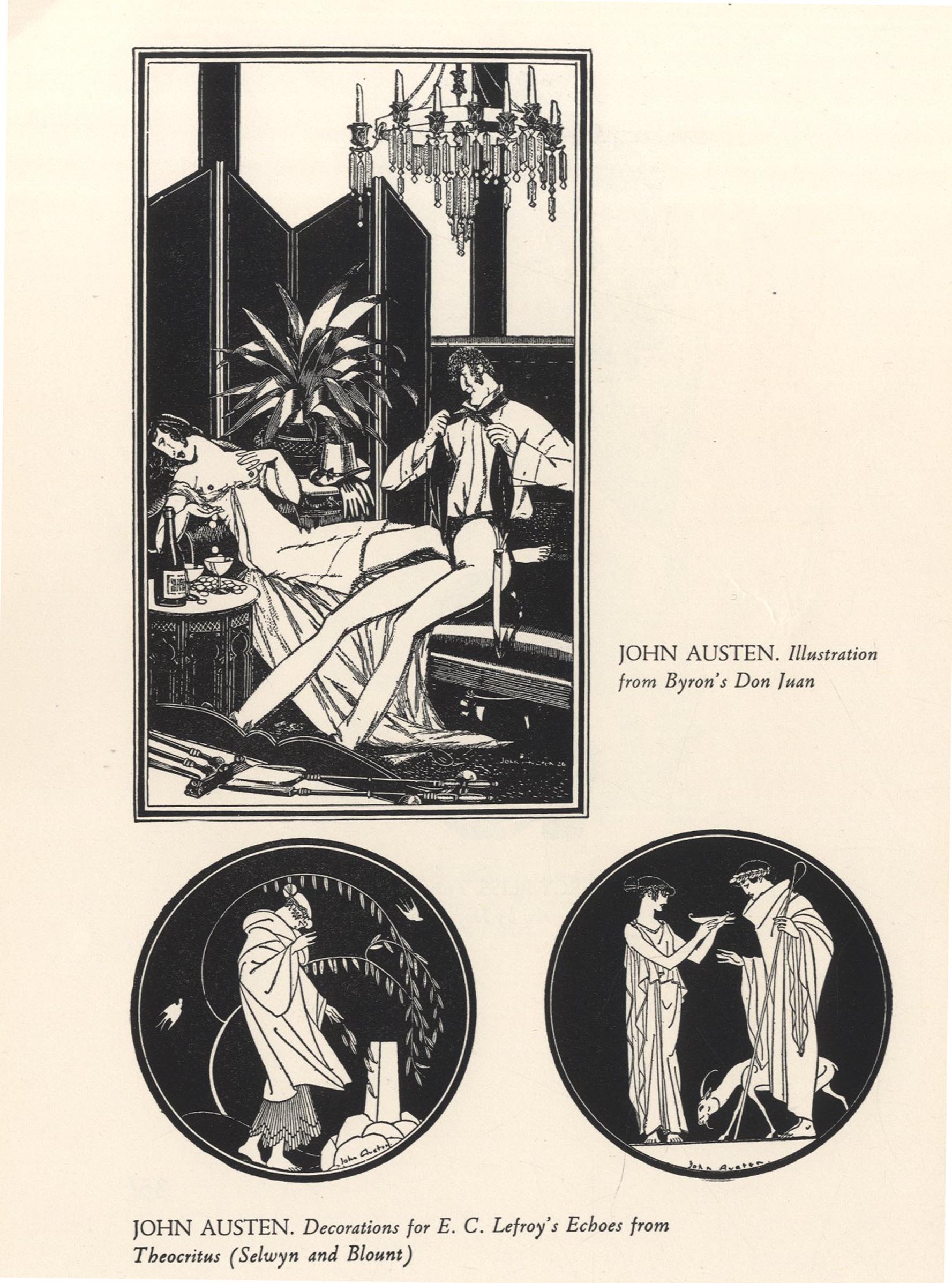
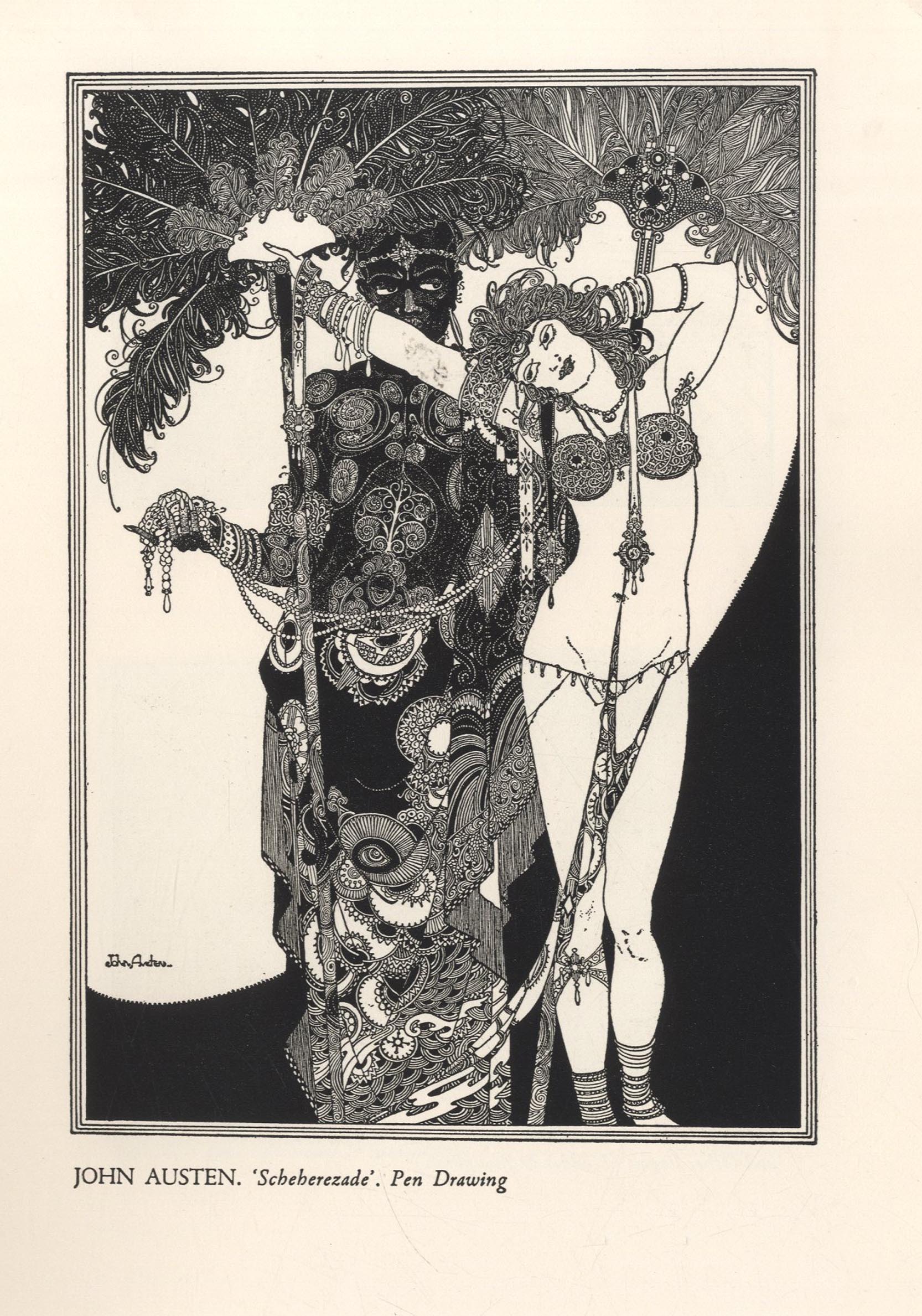
You can view and download all of the Austen illustrations online: The Folger Shakespeare Library hosts all 121 original drawings in high resolution scans, each of which is downloadable in resolutions up to 3072px. Coulthart excerpts several of these images at his blog {feuilleton}. And at fulltable.com, you can see the Austen illustrations in context with the play’s text in high resolution scans. There, you’ll also find more modernist illustrations Austen contributed to editions of Tristram Shandy, Byron’s Don Juan and E.C. Lefroy’s Echoes from Theocritus, and a 1937 instructional book on pen and ink drawing. In at least one other instance, however, Austen retained the stylized, Symbolist Clarke and Beardsley approach—an erotic pen drawing of Sheherezade that pays full homage to Beardsley’s sensual Salome illustrations.
Related Content:
Harry Clarke’s 1926 Illustrations of Goethe’s Faust: Art That Inspired the Psychedelic 60s
Aubrey Beardsley’s Macabre Illustrations of Edgar Allan Poe’s Short Stories (1894)
Josh Jones is a writer and musician based in Durham, NC. Follow him at @jdmagness
Read More...Watch Akira Kurosawa & Francis Ford Coppola in Japanese Whiskey Ads from 1979: The Inspiration for Lost in Translation
Francis Ford Coppola wasn’t the first or last Western celebrity to hawk booze in a Japanese commercial, but if you’re looking for the seed that sprouted into the funniest scene in his daughter Sophia’s Lost in Translation, here are the series of five ads in all their glory, in which the director shares a glass with one of his idols, Akira Kurosawa.
The year is 1979, and Coppola is deep in post-production for Apocalypse Now. While he is struggling with reels and reels from a troubled production, Akira Kurosawa, despite his stature in the world of cinema, is struggling with finances. His two films of the 1970s, Dodeskaden and Dersu Uzala, had been flops, despite some critical acclaim. At some point he had been so despondent wondering if he’d ever direct again, he had attempted suicide and was a heavy drinker.
But George Lucas and Coppola, learning of the director’s sad condition, convinced 20th Century Fox to put up the money for Kagemusha: The Shadow Warrior, Kurosawa’s return to the samurai films of his classic period. At the same time, Coppola agreed to be in a commercial for Suntory Whiskey alongside Kurosawa–who had shot some ads for them in 1976–just to get the director some more money. (Kurosawa’s fee was $30,000. And Coppola didn’t drink.)
For Suntory, the oldest distilling company in Japan, this meeting of East and West was a metaphor for their desire to break into the Western whiskey market. Using American celebrities like Sammy Davis Jr. established authenticity in the mind of the Japanese consumer, but this was a new level of prestige.
The series of ads above also show glimpses of Kurosawa in the midst of filming Kagemusha, shooting epic battles featuring samurai on horseback. The voice over is unsurprisingly (for this sophisticated market) pretentious:
“The world’s gaze is fixed on these two men right now as on nobody else. There’s no stronger friendship than that between these two men.” (The impact of that translation, you could say, is lost.)
Unlike Bill Murray’s character in Sophia Coppola’s film, Francis Ford Coppola really didn’t have to do much except show up, but no doubt the experience was re-told many times to his daughter over the years. And after the comeback of Kagemusha, Kurosawa went on to direct one of his best films, the King Lear-inspired Ran.
We’ll raise a glass to that.
Related Content:
The Best Japanese Commercial Ever? James Brown Sells Miso Soup
David Lynch Directs a Mini-Season of Twin Peaks in the Form of Japanese Coffee Commercials
Ted Mills is a freelance writer on the arts who currently hosts the artist interview-based FunkZone Podcast. You can also follow him on Twitter at @tedmills, read his other arts writing at tedmills.com and/or watch his films here.
Read More...What Makes Vertigo the Best Film of All Time? Four Video Essays (and Martin Scorsese) Explain
Vertigo is the greatest motion picture of all time. Or so say the results of the latest round of respected film magazine Sight & Sound’s long-running critics poll, in which Alfred Hitchcock’s James Stewart- and Kim Novak- (and San Francisco-) starring psychological thriller unseated Citizen Kane from the top spot. For half a century, Orson Welles’ directorial debut seemed like it would forever occupy the head of the cinematic table, its status disputed only by the unimpressed modern viewers who, having attended a revival screening or happened across it on television, complain that they don’t understand all the critical fuss. The new champion has given them a different question to ask: what makes Vertigo so great, anyway?
Like Citizen Kane in 1941, Vertigo flopped at the box office in 1958, but Hitchcock’s film drew more negative reviews, its critics sounding baffled, dismissive, or both. Even Welles reportedly disliked it, and Hitchcock kept it out of circulation himself between 1973 and his death in 1980, a period when cinephiles — and cinephile-filmmakers, such as a certain well-known Vertigo enthusiast called Martin Scorsese — regarded it as a sacred document. Only in 1984 did Vertigo re-emerge, by which point it badly needed an extensive audiovisual restoration. It received just that in 1996, speeding up its ascent to acclaim, in progress at least since it first appeared on the Sight & Sound poll, in eighth place, in 1982.
“Why, after watching Vertigo more than, say, 30 times, are we confident that there are things to discover in it — that some aspects remain ambiguous and uncertain, unfathomably complex, even if we scrutinize every look, every cut, every movement of the camera?” asks critic Miguel Marías in an essay on the film at Sight & Sound. He lists many reasons, and many more exist than that. But nobody can appreciate a work with so many purely cinematic strengths without actually watching it, which perhaps makes the video essay a better form for examining the power of what we have come to recognize as Hitchcock’s masterpiece.
“Only one film had been capable of portraying impossible memory — insane memory,” says the narrator of Chris Marker’s essay film Sans Soleil: “Alfred Hitchcock’s Vertigo.” B. Kite and Alexander Points-Zollo’s three-part “Vertigo Variations” at the Museum of the Moving Image uses Marker’s interpretation, as well as many others, to see from as many angles as possible Hitchcock’s “impossible object: a gimcrack plot studded with strange gaps that nonetheless rides a pulse of peculiar necessity, a field of association that simultaneously expands and contracts like its famous trick shot, a ghost story whose spirits linger even after having been apparently explained away, and a study of obsession that becomes an obsessive object in its own right.”
The popular explainer known as the Nerdwriter looks at how Hitchcock blocks a scene by breaking down the visit by Stewart’s traumatized, retired police detective protagonist to the office of a former college classmate turned shipbuilding magnate. The conversation they have sets the story in motion, and Hitchcock took the placement of his actors and his camera in each and every shot as seriously as he took every other aspect of the film. Color, for instance: another video essayist, working under the banner of Society of Geeks, identifies Hitchcock’s use of rich Technicolor as a mechanism to heighten the emotions, with, as critic Jim Emerson writes it, “red suggesting Scottie’s fear/caution/hesitancy when it comes to romance, and its opposite green, suggesting the Edenic bliss (and/or watery oblivion) of his infatuation.” Ava Burke isolates another of Hitchcock’s visual devices in use: the mirroring that fills the viewing experience with visual echoes both faint and loud.
When he got to work on Vertigo, Hitchcock had already made more than forty films in just over three decades as a filmmaker. Though often labeled a “master of suspense” during his lifetime, he instinctively learned and deeply internalized a vast range of filmmaking techniques that film scholars, as well as his successors in filmmaking, continue to take apart, scrutinize, and put back together again. This most re-watchable of his pictures (and one that, according to several of the critics and video essayists here, transforms utterly upon the second viewing) makes use of the full spectrum of Hitchcock’s mastery as well as the full spectrum of his fixations. Whether or not you consider it the greatest motion picture of all time, if you love the art of cinema, you by definition love Vertigo.
Related Content:
22 Free Hitchcock Movies Online
Alfred Hitchcock’s Seven-Minute Editing Master Class
Watch 25 Alfred Hitchcock Trailers, Exciting Films in Their Own Right
Martin Scorsese Reveals His 12 Favorite Movies (and Writes a New Essay on Film Preservation)
The 10 Greatest Films of All Time According to 846 Film Critics
Based in Seoul, Colin Marshall writes and broadcasts on cities and culture. He’s at work on a book about Los Angeles, A Los Angeles Primer, the video series The City in Cinema, the crowdfunded journalism project Where Is the City of the Future?, and the Los Angeles Review of Books’ Korea Blog. Follow him on Twitter at @colinmarshall or on Facebook.
Read More...Watch Nirvana Perform “Smells Like Teen Spirit,” Just Days After the Release of Nevermind (1991)
It’s hard to imagine a time when Nirvana’s “Smells Like Teen Spirit” didn’t belong to all of us. One day it didn’t exist. And then one day it did, and for so many of us who heard that churning opening chord, that was it. Maybe it took one listen, or five, but it was clear this song was going to mean something. And as the autumn of 1991 wore on, it would take on the weight of many things—expectations of a new generation, a new decade, the end of hair metal, the beginning of grunge, the return of rock, or just as correctly, rock’s last gasp.
The song was released to radio stations in August, issued as a single on September 10, 1991, and then officially released on September 24, 1991. But “Smells Like Teen Spirit” really broke a month later, when MTV premiered it on 120 Minutes. Then the band watched as it became a daytime MTV hit, then a hit on every rock radio playlist, from “modern rock” to “college rock” and all the marketing divisions in between.
The above video shows the band playing the song before any of this happened, just two days after the release of Nevermind. As Jason Kottke said on his site when he posted this, “There’s a freight train bearing down on those boys and they don’t even know it.”
The performance comes from a gig at The Moon in New Haven, Connecticut (see it all above), the band playing on a small stage, with such a low ceiling that bassist Krist Novoselic looks like he’s going to bang his head on the ceiling. The audience is one huge mosh pit, all male, it seems, and you can smell the sweat and stale beer through the screen. Did the crowd know they were seeing a band on the cusp? Is it too much to read into that yelp from the audience, during the second quiet passage, that they’re witnessing a finely constructed hit, the kind of loud-soft dynamic that would be copied and echoed through the nineties.
By April of the following year the song would be so popular Weird Al Yankovic would have made his parody version (one of his best). And soon Kurt Cobain would be swallowed by fame, seeing only a few ways out of his predicament. But here they are for a brief moment in time, perhaps thinking that there would be more clubs like The Moon, just a bit bigger, maybe just a bit smaller, on the horizon.
Related Content:
Nirvana’s Last Concert: Audio/ Video Recorded on March 1, 1994
Kurt Cobain’s Home Demos: Early Versions of Nirvana Hits, and Never-Released Songs
Nirvana Plays in a Radio Shack, the Day After Recording its First Demo Tape (1988)
Ted Mills is a freelance writer on the arts who currently hosts the FunkZone Podcast. You can also follow him on Twitter at @tedmills, read his other arts writing at tedmills.com and/or watch his films here.
Read More...Watch M.C. Escher Make His Final Artistic Creation (1971)
I first encountered the world of Maurits Cornelis Escher where many others do: in school. A poster of his 22-foot-long Metamorphosis III hung along the walls of my fourth-grade classroom, where I spent many an idle minute or ten staring at its intricate geometry through which squares became birds, birds became lizards, lizards became fish, and it all somehow arrived at the cliff-like edge of a three-dimensional chessboard. It came as the last of a trilogy of woodcuts Escher made between 1937 and 1968, and a journey through its 1940 predecessor Metamorphosis II ends the 1971 documentary above, M.C. Escher: Adventures in Perception.
Escher himself seemingly had no happy classroom memories. “I hated school,” the narrator quotes him as saying. “The only class I liked at all was art. That doesn’t mean I was any good at it.” Though his work has no doubt inspired many youngsters to take up drawing, woodcutting, and printmaking themselves, it’s surely driven even more of them into mathematics.
Obsessed with perspective, geometry, and pattern (Escher described tessellation as “a real mania to which I have become addicted”), his images have, by the count of mathematician and Escher scholar Doris Schattschneider, led so far to eleven separate strands of mathematical and scientific research.
The twenty-minute Adventures in Perception, originally commissioned by the Netherlands’ Ministry of Foreign Affairs, offers in its first half a meditation on the mesmerizing, often impossible world Escher had created with his art to date. Its second half captures Escher in the last years of his life, still at work in his Laren, North Holland studio. It even shows him printing one of the three titular serpents, threaded through a set of elaborately interlocking circles, of his very last print Snakes. He never actually finished Snakes, whose patterns would have continued on to the effect of infinity, and even says here of his officially complete works that none succeed, “because it’s the dream I tried for that can’t be realized.” But those unrealized dreams have kept the rest of us dreaming, and thinking, ever since.
Adventures in Perception will be added to our collection of Free Documentaries, a subset of our list, 4,000+ Free Movies Online: Great Classics, Indies, Noir, Westerns, Documentaries & More.
Related Content:
Metamorphose: 1999 Documentary Reveals the Life and Work of Artist M.C. Escher
Inspirations: A Short Film Celebrating the Mathematical Art of M.C. Escher
M.C. Escher’s Perpetual Motion Waterfall Brought to Life: Real or Sleight of Hand?
Back to Bed: A New Video Game Inspired by the Surreal Artwork of Escher, Dali & Magritte
David Bowie Sings in a Wonderful M.C. Escher-Inspired Set in Jim Henson’s Labyrinth
Based in Seoul, Colin Marshall writes and broadcasts on cities and culture. He’s at work on a book about Los Angeles, A Los Angeles Primer, the video series The City in Cinema, the crowdfunded journalism project Where Is the City of the Future?, and the Los Angeles Review of Books’ Korea Blog. Follow him on Twitter at @colinmarshall or on Facebook.
Read More...Nakedly Examined Music Podcast Explores Songwriting with Cracker, King Crimson, Cutting Crew, Jill Sobule & More
I’m Mark Linsenmayer, the host of The Partially Examined Life Philosophy Podcast, and I’d like to introduce you to a new-in-2016 interview series called Nakedly Examined Music (iTunes — Facebook — RSS) that features great songwriters talking about their motivations and techniques regarding specific songs.
In episode one, for instance, indie rock icon and activist for artist rights David Lowery deconstructed the lyrics for his story songs “All Her Favorite Fruit” (Camper Van Beethoven, 1989) and “I Sold the Arabs the Moon” (from his 2011 solo album), contrasting these with the nonsense song that launched his career, “Take the Skinheads Bowling.”
The songs discussed are played in full, and the idea is to get a sense of the artist’s approach in very specific terms, and how this has changed over time. In episode 15, Craig Wedren shows us his development from writing heavy (“post-hardcore”), dissonant music in the 90s with Shudder to Think, to creating disco synthscapes with his early 00’s band Baby, to now composing music for soundtracks like Netflix’s “Wet Hot American Summer: First Day of Camp.”
The emphasis in a given interview depends on the artist: Guitar virtuoso Gary Lucas (Captain Beefheart, Jeff Buckley) eschews music theory, so the focus is more on the ideology of creation, whereas tap-guitar wizard Trey Gunn (King Crimson, David Sylvian) instructs us in combining time signatures and soloing in modes. The interviews both teach us how to listen to and appreciate music by showing us what to focus on, and also serve to instruct songwriters real and vicarious about decisions that go into a choice of chord or lyric or instrumentation.
What kind of music can you expect to hear? Officially, anything that has thought behind it, but I’m starting with my experience as musician (see www.marklint.com) and music lover growing up in the 80s and 90s listening to popular, indie, folk, punk, and progressive rock. There hare been some movement into soul (Episode 16 features the great Narada Michael Walden, who produced Whitney Houston among many others), electronica (Gareth Mitchell), country (Beth Kille), and future episodes will venture into classical, hip-hop, and world music. More typical, however (i.e. more akin to my own writing), are figures like 90s sweetheart and political activist Jill Sobule, cow-punk pioneer Jon Langford (Mekons), grunge-peddler turned symphonist Jonathan Donahue (Mercury Rev), NPR darling Chad Clark (Beauty Pill), and 80s Cutting Crew front-man Nick Eede. One of the episodes next to be released will feature Bill Bruford (Yes, King Crimson, Earthworks).
Listen to Jill Sobule in episode 18:
In one of the most interesting interviews (episode 3), major league music video director–and member of 70s supergroup 10cc and 80s duo Godley & Creme–Kevin Godley takes us from 70s prog excess (and getting to record jazz legend Sarah Vaughan) into the New Wave and out of music altogether, only to rediscover it post-retirement.
This is not about getting behind the scenes with your favorite stars or any other hype of that sort, but about talking with smart people to figure out the language of music, the motivations behind creation, and the techniques available for self-expression. In the course of these discussions, we get into changing trends in making a living in music (or not!), new music technologies, and, of course, philosophical issues.
Mark Linsenmayer is a writer and musician in Madison, WI. His Partially Examined Life Philosophy Podcast has been downloaded more than 15 million times. Learn more about Nakedly Examined Music at www.nakedlyexaminedmusic.com, subscribe via iTunes, or follow on Facebook.
Read More...Penn Jillette Makes the Philosophical & Pragmatic Case for Libertarianism
For an anarchist like Noam Chomsky, libertarianism as it’s understood in the U.S. is a corruption of the term. Throughout their political history, Chomsky argues, “real” Libertarians have been anti-Capitalist—and he includes under this heading such classical liberals as Adam Smith and Thomas Jefferson, as well as modern anarcho-socialists like himself. Modern U.S. Libertarians like Ron and Rand Paul, Milton Friedman, and Robert Nozick have all meant something very different by the term, and certainly haven’t agreed on what that is. So what exactly is Libertarianism?
Given popular misconceptions—and some less than stellar public relations moments—one perhaps gets a clearest idea of what American Libertarianism is by reading about what it isn’t, as in this essay from one of its most contrarian theorists, Murray Rothbard. Or we can spend a few minutes with that voluble comedic magician Penn Jillette, a well-known face of Libertarian and atheist thought for many years. Jillette’s thesis in his eighteen-minute Big Think video above comes down to this: “we think you should take as little from other people by force as possible and you should be able to do whatever you think is right.” Libertarianism, Jillette elaborates, “is the strongest sense of ‘please, do what you want, try not to hurt me.”
The concept he refers to is one Isaiah Berlin wrote of as “negative liberty,” or the principle of noninterference, a staple of all Libertarian thought. The heavy stress on individual rights has come in for critique as naïve, but as Rothbard notes, “no individualist denies that people are influencing each other all the time.” Libertarian thinkers have wrestled with the conflict (if not contradiction) between maximal individual freedom and freedom from harm. Robert Nozick, for example, extended his discussion beyond our responsibilities to each other to a moral case study of our duties toward animals. Responsibility stands as a key term in Jillette’s articulation of Libertarianism—a sine qua non of a Libertarian society.
But is there such a thing as a functioning Libertarian society? Or does Jillette describe an unrealizable utopia that depends not only on most people acting responsibly, but also on most people acting rationally? As he himself says, “Libertarianism is taking a right on money, your first left on sex, and looking for utopia straight ahead.” This language aside, he doesn’t seem to operate under the illusion that people always make the best choices for themselves or their families. As part of his argument, however, he admits he isn’t qualified or desirous to make those choices for other people when he can often barely discern the right course of action for himself. As it generally does, this course of reasoning brings us to the problem of taxation in Libertarian thought.
Jillette’s appeal seems commonsensical and pragmatic, and after his general pitch, he launches into a critique of corporate capitalism that could come right out of a Chomsky talk—in some small part, that is. Jillette believes that, absent most government interference, we would have such a thing as a “true free market” in which everyone could compete fairly and without coercion. This is a position even Nozick softened on many years after his classic Anarchy, State, and Utopia, calling it “seriously inadequate” and admitting that many democratic institutions Libertarians want to abolish preserve “our equal human dignity, our autonomy and powers of self-direction.”
Whatever we make of Jillette’s laissez faire ideology, his critiques of government speak to Libertarians on either side of the economics divide. He makes an incisive case against Clinton, then tears into Trump’s willingness to “give easy answers.” Holding up career politicians Bernie Sanders and Gary Johnson as “paragons” may seem a bit much, given Jillette’s forceful argument for a healthy and thoroughgoing mistrust of government. As he says in the earlier Big Think interview above, “part of the joy and the wonder and the brilliance of the ideas of the United States of America that whoever’s in power is questioned and beat up.”
He does not, of course, mean that last part in any literal sense. While Libertarianism has perhaps been tarred by association with an increasingly violent right, it would be a mistake to lump Jillette in with certain political opportunists who at one time or another have used the term to describe themselves. His commitment to anti-war and drug legalization policies is unwavering, and he makes a strong, well-reasoned case for his politics. It’s one worth hearing out whether you agree or not in the end.
Related Content:
Noam Chomsky on Whether the Rise of Trump Resembles the Rise of Fascism in 1930s Germany
Josh Jones is a writer and musician based in Durham, NC. Follow him at @jdmagness
Read More...Support Us
We're hoping to rely on loyal readers, rather than erratic ads. Please click the Donate button and support Open Culture. You can use Paypal, Venmo, Patreon, even Crypto! We thank you!

About Us

Open Culture scours the web for the best educational media. We find the free courses and audio books you need, the language lessons & educational videos you want, and plenty of enlightenment in between.
Advertise With Us

FREE UPDATES!
GET OUR DAILY EMAIL
Get the best cultural and educational resources on the web curated for you in a daily email. We never spam. Unsubscribe at any time.
FOLLOW ON SOCIAL MEDIA

Open Culture editor Dan Colman scours the web for the best educational media. He finds the free courses and audio books you need, the language lessons & movies you want, and plenty of enlightenment in between.
Advertise With Us