Every Filmed and Televised Performance by Joy Division (1978–79)
Brian Eno once said of the Velvet Underground that their first album sold only 30,000 copies, but everyone who bought one started a band. Joy Division’s debut Unknown Pleasures sold only 20,000 copies in its initial period of release, but the T‑shirt emblazoned with its cover art — an image of radio waves emanating from a pulsar taken from an astronomy encyclopedia — has long since constituted a commercial-semiotic empire unto itself. That speaks to the vast subcultural influence of the band, despite their only having been active from 1976 to 1980. When we speak of the genre of post-punk, we speak, in large part, of Joy Division and the artists they influenced.
Less than a year after the 1979 release of Unknown Pleasures, Joy Division’s lead singer Ian Curtis committed suicide. The band had already recorded Closer, their second and last album (at least before the subsequent, more successful reformation as New Order). Scant though it may be, their studio discography has only drawn more and more critical acclaim over the decades.
Still, fans who weren’t around to witness the rise of Joy Division first-hand will suspect they’ve missed out on something essential. “Live, Joy Division were heavy,” remembers band historian Jon Savage. “Performers — and David Bowie is a good example – know exactly what to give and what to withhold, but Ian Curtis didn’t have that stagecraft. He just came on and gave everything.”
That sort of intensity, Savage adds, is “not infinitely reproducible”; even at the time, it seems that those who witnessed Joy Division in concert understood that their peculiarly compelling energy was driving toward some kind of final combustion. You can get a taste of it in the collection of the group’s every televised performance, originally aired on BBC2 and Granada TV in 1978 and 1979, at the top of the post; just above, we have a 70-minute compilation of all their filmed live shows. Much of it consists of footage shot over two nights at the Apollo Theatre in 1979, which the uploader describes as of poor quality — but “according to people who were there, the gig’s quality was poor in person too.” As much as generations of fans have done to mythologize the band’s brief existence over the past 45 years, here is evidence that even Joy Division had an off night once in a while.
Related content:
The History of Rock n Roll in 10 Songs: A List Created by Legendary Rock Critic Greil Marcus
Radiohead Covers The Smiths & New Order (2007)
Hear a 9‑Hour Tribute to John Peel: A Collection of His Best “Peel Sessions”
An Animated History of Goth
Based in Seoul, Colin Marshall writes and broadcasts on cities, language, and culture. His projects include the Substack newsletter Books on Cities and the book The Stateless City: a Walk through 21st-Century Los Angeles. Follow him on the social network formerly known as Twitter at @colinmarshall.
Read More...An Introduction to Moebius, the Comic Artist Who Influenced Blade Runner and Miyazaki
The work of the comic artist Jean Giraud, better known as Moebius (or, more stylishly, Mœbius), has often appeared on Open Culture over the years, but even if you’ve never seen it here, you know it. Granted, you may never have read a page of it, to say nothing of an entire graphic novel’s worth, but even so, you’ve absorbed it indirectly through generations of international popular culture. If you enjoy Blade Runner, Akira, the manga and anime of Hayao Miyazaki, and even the Star Wars movies, you must, on some level, enjoy Moebius, so deeply did his comic art shape the look and feel of those major works, to say nothing of all it has inspired at further remove.
The new video above by Youtuber matttt goes in depth on the biographical, cultural, and psychological force that shaped the artist’s vision on the page, whose sheer imaginative force and persistently strange sublimity looked like nothing else in comics when he hit his stride in the nineteen-seventies. It helped that he was French, and thus an inheritor of the grand Francophone tradition of the bande dessinée, an art form taken much more seriously than comic strips and books in America. Belgian comics like Spirou and Tintin caught his attention early on, and time spent as a teenager amid the vast desert landscapes of Mexico instilled him with a taste for spiritual grandeur.
An apprenticeship under the Belgian comic artist Joseph “Jijé” Gillain, whom he idolized, helped Giraud — who had not yet become Moebius — to refine his style. His creation of the Jean Paul Belmondo-looking cowboy Blueberry in the early nineteen-sixties produced what turned out to be his most lucrative franchise. But it wasn’t until his encounter with taboo-breaking American “underground” comics that flourished later in that decade, and especially the work of Robert Crumb, that he found it within himself to let loose, exploring technological, mythological, and psychosexual realms hitherto unknown in his medium.
It was with the launch of the comics-anthology magazine Métal Hurlant in 1974, later repackaged in the United States as Heavy Metal, that Moebius’ work found its way to a much wider public. Notable readers included William Gibson, Ridley Scott, Luc Besson, George Lucas, Alejandro Jodorowsky, and the Wachowskis: some imitated Moebius, and others hired him. Through the Japanese edition of Starlog magazine in the late seventies, his art re-shaped the aesthetics of mangaka like Akira creator Katsuhiro Otomo and Studio Ghibli co-founder Hayao Miyazaki. Moebius himself later took on Otomo as one of his own influences, and in tribute to Miyazaki, named his daughter Nausicaa. For Jean Giraud, inspiration wasn’t a one-way street; it was more like a Möbius strip.
Related content:
Watch Groundbreaking Comic Artist Mœbius Draw His Characters in Real Time
Mœbius & Jodorowsky’s Sci-Fi Masterpiece The Incal Brought to Life in a Tantalizing Animation
Watch Moebius and Miyazaki, Two of the Most Imaginative Artists, in Conversation (2004)
Moebius Gives 18 Wisdom-Filled Tips to Aspiring Artists
Based in Seoul, Colin Marshall writes and broadcasts on cities, language, and culture. His projects include the Substack newsletter Books on Cities and the book The Stateless City: a Walk through 21st-Century Los Angeles. Follow him on the social network formerly known as Twitter at @colinmarshall.
Read More...Hermann Rorschach’s Original Rorschach Test: What Do You See? (1921)
There is a well-known scene in Woody Allen’s Take The Money And Run (1969) when Virgil Starkwell (Allen) takes a psychological test to join the Navy, but is thwarted by his lascivious unconscious. The psychological measure that proves to be Starkwell’s undoing—rejected, he turns to a life of crime—is the Rorschach inkblot test, devised a century ago by Carl Jung’s compatriot and fellow psychologist, Hermann Rorschach. Although Rorschach would die young, at 37, his namesake remains embedded in our perception of psychology, alongside Freud’s couch and Pavlov’s dog.
Hermann Rorschach’s father was an art teacher, and encouraged his son to express himself. Whether the young Rorschach had innate artistic leanings, or had begun to listen to his father more closely after the death of his mother at age 12, is uncertain. What is known, however, is that Hermann became so fascinated with making pictures out of inkblots—a Swiss game known under the delightful designation of Klecksography—that his schoolmates gave him the nickname of Klecks.
Although he struggled to choose between art and science as a career, Rorschach, on the counsel of eminent German biologist and ardent Darwin supporter Ernst Haeckel, chose medicine, specializing in psychology. Still, he never abandoned art.
Even before the young Rorschach began to study psychology, the medical profession had flirted with imagery association. In 1857, a German doctor named Justinus Kerner published a book of poetry, with each poem inspired by an accompanying inkblot. Alfred Binet, the father of intelligence testing, also tinkered with inkblots at the outset of the 20th century, seeing them as a potential measure of creativity. While the claim that Rorschach was familiar with these particular inkblots rests on conjecture, we know that he was familiar with the work of Szymon Hens, an early psychologist who explored his patients’ fantasies using inkblots, as well as Carl Jung’s practice of having his patients engage in word-association.
After noticing that schizophrenic patients associated vastly different things with inkblots than other patients, Rorschach, following some experimentation, created the first version of the inkblot test as a measure of schizophrenia in 1921. The test, however, only came to be used as a form of personality assessment when Samuel Beck and Bruno Klopfer expanded its original scope in the late 1930s. Since then, psychologists have frequently used the various aspects of people’s responses (e.g., inkblot focus area) to make judgment calls about broad personality traits. Ironically, Rorschach himself had been skeptical about the inkblots’ value in assessing personality.
In honor of Rorschach’s birthday (he was born on this day in 1884), we’ve highlighted his original images below, as well as some of the most popular responses. If you see something else in these images, feel free to let us know in the comments section below. The images, we should note, are in the public domain, and otherwise readily viewable on Wikipedia. And, according to Wikimedia Commons, the images are in the public domain.
Image 1: Bat, butterfly, moth
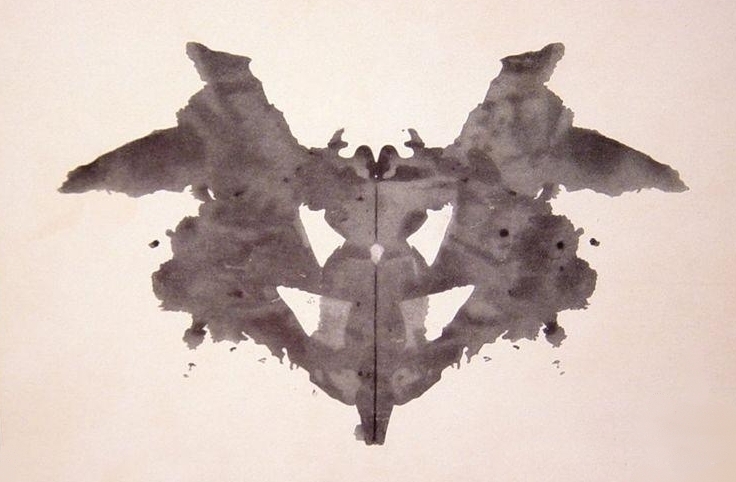
Image 2: Two humans
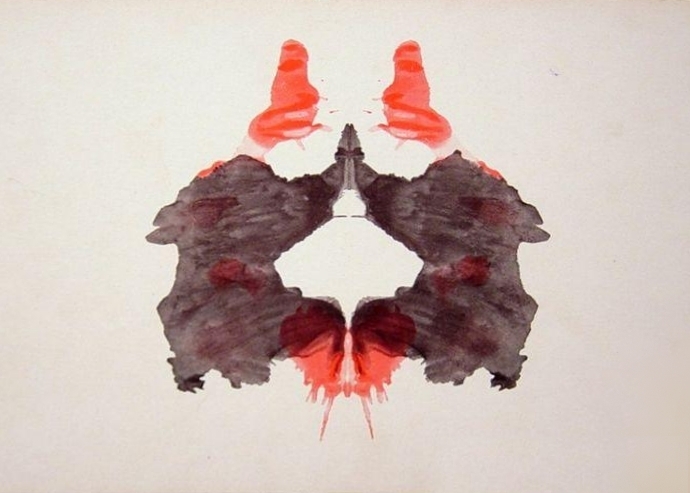
Image 3: Two humans
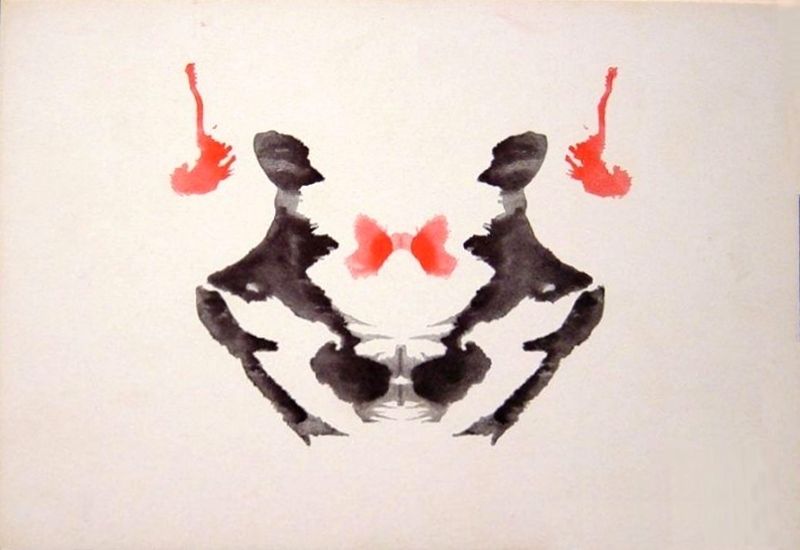
Image 4: Animal hide, skin, rug
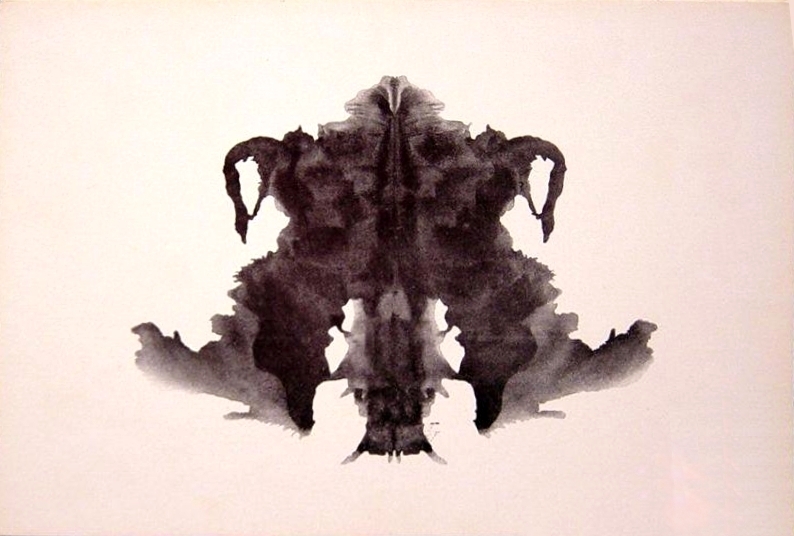
Image 5: Bat, butterfly, moth

Image 6: Animal hide, skin, rug

Image 7: Human heads or faces

Image 8: Animal; not cat or dog

Image 9: Human
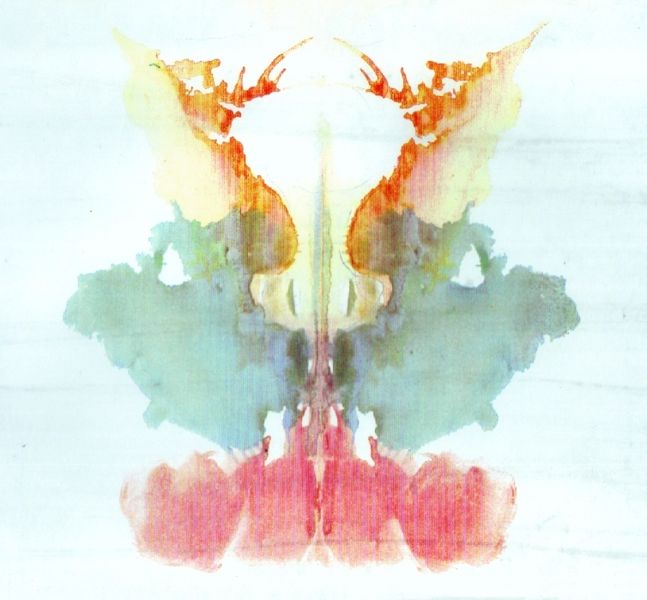
Image 10: Crab, lobster, spider,
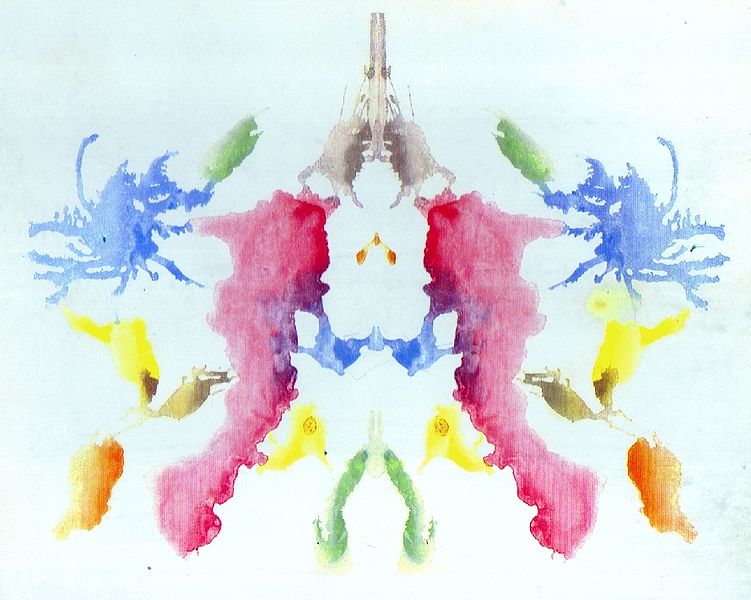
Happen to see an elephant and a men’s glee club engaged in unmentionable acts? Don’t fret—you’ve likely projected nothing intelligible. The test has long been out of date, and is deemed neither reliable nor valid in the vast majority of cases (although an updated version exists, it suffers from similar methodological flaws). Virgil Starkwell, it seems, would have made a fine Navy officer.
Ilia Blinderman is a Montreal-based culture writer. Follow him at@iliablinderman
Read More...Albert Einstein Gives a Speech Praising Immigrants’ Contributions to America (1939)
There have been many times in American history when celebrations of the country’s multi-ethnic, ever-changing demography served as powerful counterweights to narrow, exclusionary, nationalisms. In 1855, for example, the publication of Brooklyn native Walt Whitman’s Song of Myself offered a “passionate embrace of equality,” writes Kathleen Kennedy Townsend, “the soul of democracy.” We can contrast the vibrancy and dynamism of Whitman’s vision with the violent nativism of the anti-immigrant Know-Nothings, who reached their peak in the 1850s. The movement was founded by two other New Yorkers, gang leader William “Bill the Butcher” Poole and writer Thomas R. Whitney, who asked in one of his political tracts, “What is equality but stagnation?”
Almost 100 years later, we see another nationalist movement taking hold, not only in Europe, but in the States. Before the U.S. entered World War II, its views on National Socialist Germany were decidedly ambivalent, with glowing portraits of its leader published throughout the 30s, and a sizable Nazi presence in the U.S. From 1934 to 1939, for example, German groups in the U.S. organized massive rallies in Madison Square Garden. Additionally, the German-American Bund promoted the Nazi Party throughout the U.S. with 70 different local chapters. These organizations held Nazi family and summer camps in New Jersey, Wisconsin, Pennsylvania…. “There were forced marches in the middle of the night to bonfires,” says historian Arnie Bernstein, “where the kids would sing the Nazi national anthem and shout ‘Sieg Heil.’”
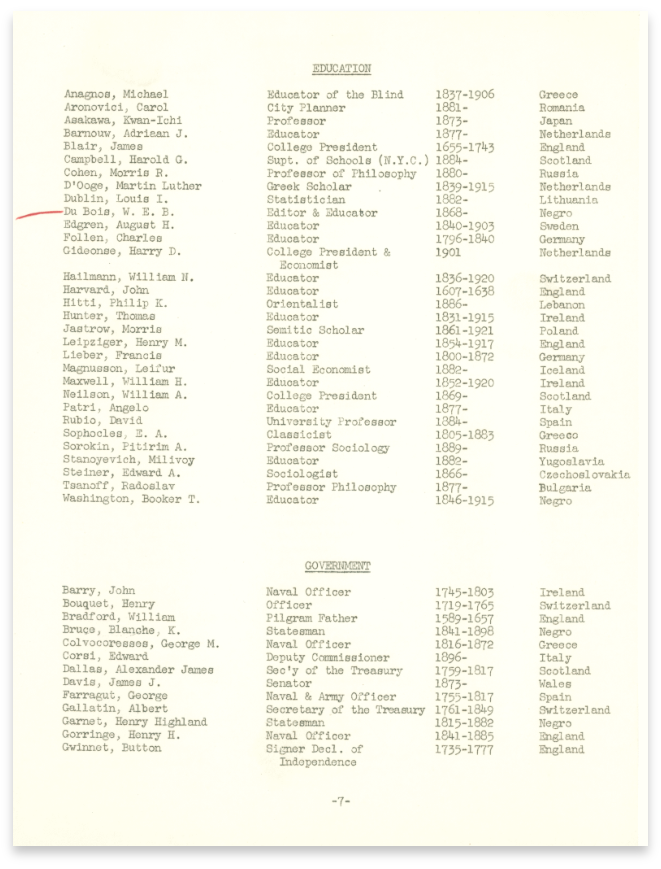
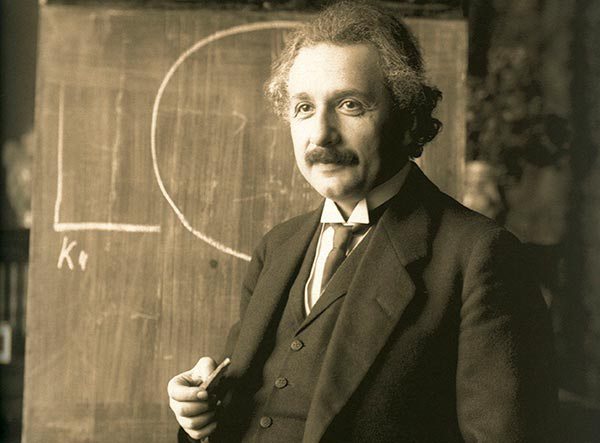
Needless to say, these scenes made a number of minority groups and immigrants particularly nervous, especially Jews who had just escaped from Europe. One such immigrant, physicist Albert Einstein, had made the U.S. his permanent home in 1933 when he accepted a position at Princeton after living as a refugee in England. He would go on to become a forceful advocate for equality in the U.S., speaking out against the racial caste system of segregation. In 1940, Einstein gave a little-known speech at the New York World’s Fair to inaugurate an exhibit that paid “homage to the diversity of the U.S. population.” On the display, called the “Wall of Fame,” were inscribed “the names and professions of hundreds of the nation’s most notable ‘immigrants, Negroes and American Indians.’” (See the first page of the typed list above, and the full list here.)
Einstein’s speech comes to us via Speeches of Note, a sibling of two favorite sites of ours, Letters of Note and Lists of Note. Below, you can read the full transcript of the speech, in which Einstein—having adopted the country as it had adopted him—-declaims, “these, too, belong to us, and we are glad and grateful to acknowledge the debt that the community owes them.”
It is a fine and high-minded idea, also in the best sense a proud one, to erect at the World’s Fair a wall of fame to immigrants and Negroes of distinction.
The significance of the gesture is this: it says: These, too, belong to us, and we are glad and grateful to acknowledge the debt that the community owes them. And focusing on these particular contributors, Negroes and immigrants, shows that the community feels a special need to show regard and affection for those who are often regarded as step-children of the nation—for why else this combination?
If, then, I am to speak on the occasion, it can only be to say something on behalf of these step-children. As for the immigrants, they are the only ones to whom it can be accounted a merit to be Americans. For they have had to take trouble for their citizenship, whereas it has cost the majority nothing at all to be born in the land of civic freedom.
As for the Negroes, the country has still a heavy debt to discharge for all the troubles and disabilities it has laid on the Negro’s shoulders, for all that his fellow-citizens have done and to some extent still are doing to him. To the Negro and his wonderful songs and choirs, we are indebted for the finest contribution in the realm of art which America has so far given to the world. And this great gift we owe, not to those whose names are engraved on this “Wall of Fame,” but to the children of the people, blossoming namelessly as the lilies of the field.
In a way, the same is true of the immigrants. They have contributed in their way to the flowering of the community, and their individual striving and suffering have remained unknown.
One more thing I would say with regard to immigration generally: There exists on the subject a fatal miscomprehension. Unemployment is not decreased by restricting immigration. For unemployment depends on faulty distribution of work among those capable of work. Immigration increases consumption as much as it does demand on labor. Immigration strengthens not only the internal economy of a sparsely populated country, but also its defensive power.
The Wall of Fame arose out of a high-minded ideal; it is calculated to stimulate just and magnanimous thoughts and feelings. May it work to that effect.
The speech is remarkable for its egalitarianism. The exhibit works more or less as a “who’s who” of notable personalities—all of them men. Of course, Einstein himself was one of the most notable immigrants of the age. And yet, his ethos is Whitmanian, celebrating the multitudes of laborers and artists “blossoming namelessly” and those who have “remained unknown.” The country, Einstein suggests, could not possibly be itself without its diversity of people and cultures. That same year, Einstein would pass his citizenship test, and explain in a radio broadcast, “Why I am an American.”
Note: An earlier version of this post appeared on our site in 2017.
Related Content:
Albert Einstein Expresses His Admiration for Mahatma Gandhi, in Letter and Audio
Josh Jones is a writer and musician based in Durham, NC.
Read More...What an 85-Year-Long Harvard Study Says Is the Real Key to Happiness
We’ve long used the French word milieu in English, but not with quite the same range of meanings it has back in France. For example, French society (and especially the members of its older generations) explicitly recognizes the value of a milieu in the sense of the collected friends, acquaintances, and relations with whom one has regular and frequent contact. Keeping a good milieu is a key task for living a good life. Robert Waldinger doesn’t use the word in the new hour-long Big Think video above, but then, he comes from a different cultural background: he’s American, for one, a Harvard psychiatrist, and he also happens to be a Zen Buddhist priest. But he would surely agree wholeheartedly about the importance of the milieu to human happiness.
As the fourth director of the long-term Harvard Study of Adult Development, which has been keeping an eye on the well-being of its subjects for more than 85 years now, Waldinger knows something about happiness. Early in the video, he cites findings that half of it is “a kind of biological set point,” 10 percent is “based on our current life circumstances,” and the remaining 40 percent is under our control. The single most important factor in the variability of our happiness, he explains, is our relationships. To take the measure of that aspect of our own lives, we should ask ourselves these questions: “Do I have enough connection in my life?” “Do I have relationships that are warm and supportive?” “What am I getting from relationships?”
There are, of course, good relationships and bad relationships, those that fill you with energy and those that drain you of energy. To a great extent, Waldinger says, good relationships can be cultivated, and even bad relationships can be modified or approached in an advantageous way. What makes learning to do so important is that a lack of relationships — that is, loneliness — can take as much of a physical toll as obesity or heavy smoking. Alas, since television made its way into the home after the Second World War, we’ve lived with a rapidly and ceaselessly multiplying array of forces that make it difficult to form and maintain relationships; at this point, we’re so “constantly distracted by our wonderful screens” that we have trouble paying attention to even the people we think we love. This is where Zen comes in.
Attention, as one of Waldinger’s own teachers in that tradition put it, is “the most basic form of love,” and meditation has always been a reliable way to cultivate it. Such a practice reveals our own minds to be “messy and chaotic,” and from that realization, it’s not far to the understanding that “everybody’s minds are messy and chaotic.” Attaining a clear view of our own questionable impulses and irritating deficiencies helps us to accept those same qualities in others. “We can sometimes imagine that other people have it all figured out, and we’re the only one who has ups and downs in our life,” says Waldinger, but the truth is that “everybody has ups and downs. We never figure it out, ultimately.” The fleeting nature of satisfaction constitutes just one facet of the impermanence Zen requires us to accept. Nothing lasts forever: certainly not our lives, nor those of the members of our milieu, so if we want to enjoy them, we’d better start paying attention to them while we still can.
Related content:
What Are the Keys to Happiness? Lessons from a 75-Year-Long Harvard Study
A 6‑Step Guide to Zen Buddhism, Presented by Psychiatrist-Zen Master Robert Waldinger
All You Need is Love: The Keys to Happiness Revealed by a 75-Year Harvard Study
How Much Money Do You Need to Be Happy? A New Study Gives Us Some Exact Figures
How Loneliness Is Killing Us: A Primer from Harvard Psychiatrist & Zen Priest Robert Waldinger
Based in Seoul, Colin Marshall writes and broadcasts on cities, language, and culture. His projects include the Substack newsletter Books on Cities and the book The Stateless City: a Walk through 21st-Century Los Angeles. Follow him on the social network formerly known as Twitter at @colinmarshall.
Read More...Behold an Anatomically Correct Replica of the Human Brain, Knitted by a Psychiatrist
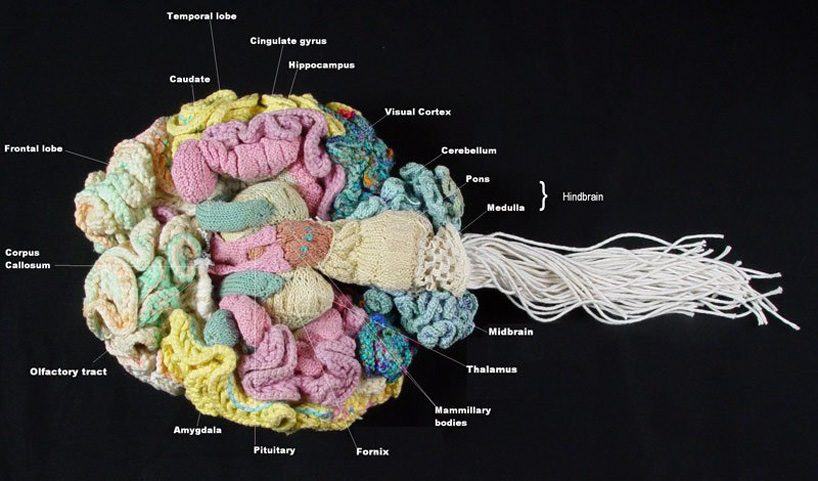
Our brains dictate our every move.
They’re the ones who spur us to study hard, so we can make something of ourselves, in order to better our communities.
They name our babies, choose our clothes, decide what we’re hungry for.
They make and break laws, organize protests, fritter away hours on social media, and give us the green light to binge watch a bunch of dumb shows when we could be reading War and Peace.
They also plant the seeds for Fitzcarraldo-like creative endeavors that take over our lives and generate little to no income.
We may describe such endeavors as a labor of love, into which we’ve poured our entire heart and soul, but think for a second.
Who’s really responsible here?
The heart, that muscular fist-sized Valentine, content to just pump-pump-pump its way through life, lub-dub, lub-dub, from cradle to grave?
Or the brain, a crafty Iago of an organ, possessor of billions of neurons, complex, contradictory, a mystery we’re far from unraveling?
Psychiatrist Dr. Karen Norberg’s brain has steered her to study such heavy duty subjects as the daycare effect, the rise in youth suicide, and the risk of prescribing selective serotonin reuptake inhibitors as a treatment for depression.
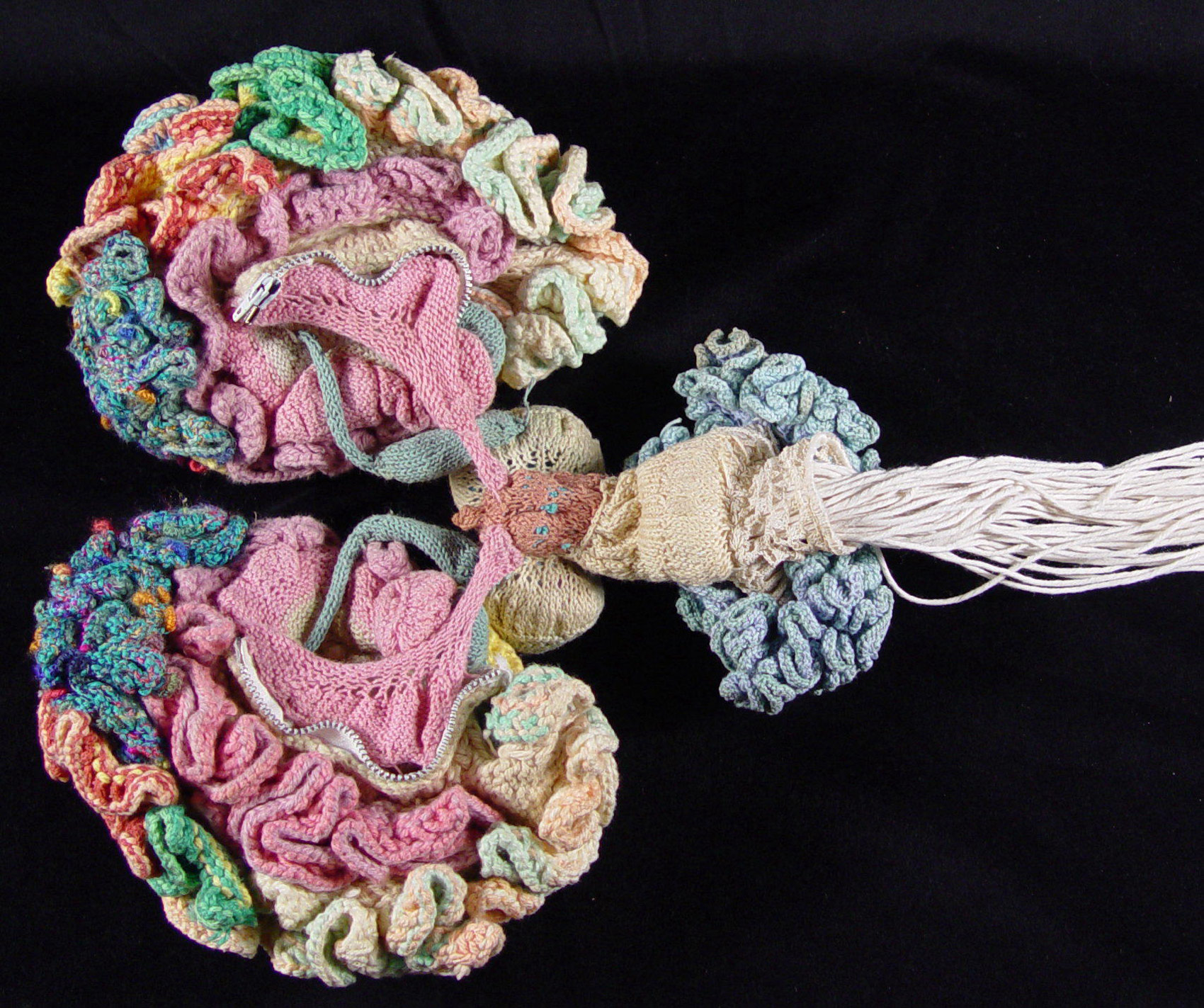
On a lighter note, it also told her to devote nine months to knitting an anatomically correct replica of the human brain.
(Twelve, if you count three months of research before casting on.)
How did her brain convince her to embark on this madcap assignment?
Easy. It arranged for her to be in the middle of a more prosaic knitting project, then goosed her into noticing how the ruffles of that project resembled the wrinkles of the cerebral cortex.
Coincidence?
Not likely. Especially when one of the cerebral cortex’s most important duties is decision making.
As she explained in an interview with The Telegraph, brain development is not unlike the growth of a knitted piece:
You can see very naturally how the ‘rippling’ effect of the cerebral cortex emerges from properties that probably have to do with nerve cell growth. In the case of knitting, the effect is created by increasing the number of stitches in each row.
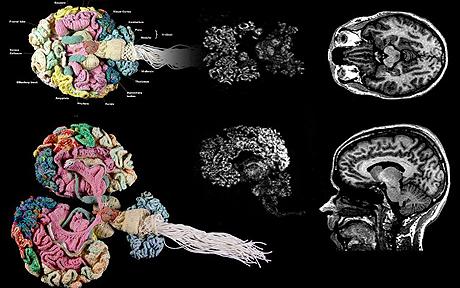
Dr. Norberg—who, yes, has on occasion referred to her project as a labor of love—told Scientific American that such a massive crafty undertaking appealed to her sense of humor because “it seemed so ridiculous and would be an enormously complicated, absurdly ambitious thing to do.”
That’s the point at which many people’s brains would give them permission to stop, but Dr. Norberg and her brain persisted, pushing past the hypothetical, creating colorful individual structures that were eventually sewn into two cuddly hemispheres that can be joined with a zipper.
(She also let slip that her brain—by which she means the knitted one, though the observation certainly holds true for the one in her head—is female, due to its robust corpus callosum, the “tough body” whose millions of fibers promote communication and connection.)
Note: An earlier version of this post appeared on our site in 2019.
Related Content:
The Human Brain: A Free Online Course from MIT
Ayun Halliday is an author, illustrator, theater maker.
Read More...A Massive Choir Sings “Paranoid” to Honor Ozzy Osbourne
In Toronto, 7,000 singers participated in Choir Choir Choir’s tribute to Ozzy Osbourne, all taking part in a giant sing-along of “Paranoid.” The first single on Black Sabbath’s second album (1970), “Paranoid” reached #4 in the UK market and put Sabbath on the map. The song also became an early heavy metal classic. Watch Sabbath perform the song live in 1970 here; or watch them perform it for the very last time on July 5, 2025 here. Then enjoy the Choir Choir Choir tribute above.
If you would like to support the mission of Open Culture, consider making a donation to our site. It’s hard to rely 100% on ads, and your contributions will help us continue providing the best free cultural and educational materials to learners everywhere. You can contribute through PayPal, Patreon, and Venmo (@openculture). Thanks!
Related Content
Watch David Byrne Lead a Massive Choir in Singing David Bowie’s “Heroes”
Watch The Nine Lives of Ozzy Osbourne: A Free Documentary on the Heavy Metal Pioneer (RIP)
Ozzy Osbourne’s Guitarist Zakk Wylde Plays Black Sabbath on a Hello Kitty Guitar
Kids Orchestra Plays Ozzy Osbourne’s “Crazy Train” and Zeppelin’s “Kashmir”
Patti Smith Sings “People Have the Power” with a Choir of 250 Fellow Singers
Read More...Hear the Long-Lost Chants of English Monks, Revived for the First Time in 500 Years
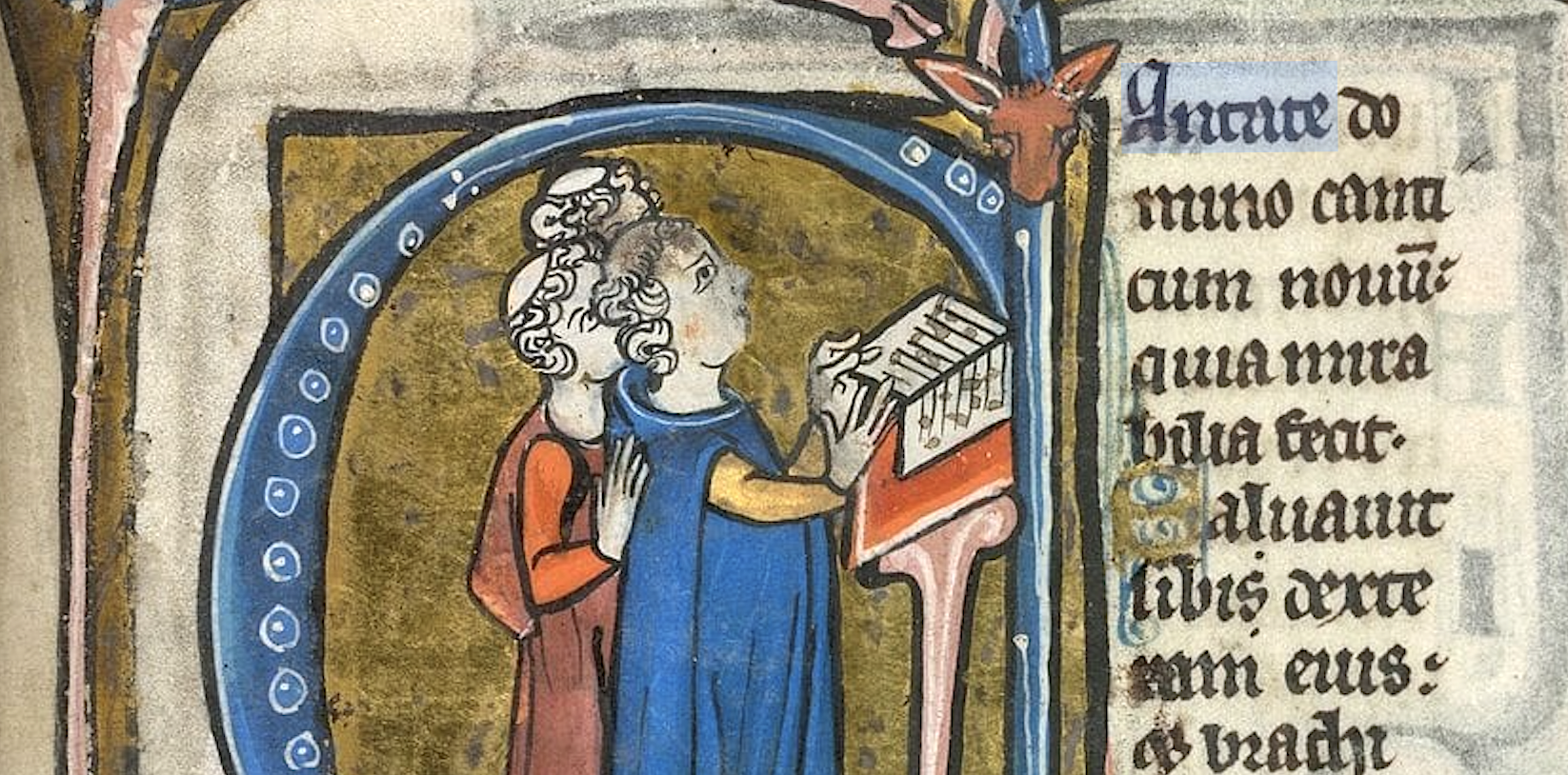
Listening to music, especially live music, can be a religious experience. These days, most of us say that figuratively, but for medieval monks, it was the literal truth. Every aspect of life in a monastery was meant to get you that much closer to God, but especially the times when everyone came together and sang. For English monks accustomed to that way of life, it would have come as quite a shock, to say the very least, when Henry VIII ordered the dissolution of the monasteries between the mid fifteen-thirties and the early fifteen-forties. Not only were the inhabitants of those refuges sent packing, their sacred music was cast to the wind.
Nearly half a millennium later, that music is still being recovered. As reported by the Guardian’s Steven Morris, University of Exeter historian James Clark found the latest example while researching the still-standing Buckland Abbey in Devon for the National Trust.
“Only one book — rather boringly setting out the customs the monks followed — was known to exist, held in the British Library.” But lo and behold, a few leaves of parchment stuck in the back happened to contain pieces of early sixteenth-century music, or rather chant, with both text and notation, a vanishingly rare sort of artifact of medieval monastic life.
Just this month, for the first time in almost five centuries, the music from the “Buckland book” resonated within the walls of Buckland Abbey once again. You can hear a clip from the University of Exeter chapel choir’s performance just above, which may or may not get across the grimness of the original work. “The themes are heavy — the threats from disease and crop failures, not to mention powerful rulers — but the polyphonic style is bright and joyful, a contrast to the sort of mournful chants most associated with monks,” writes Morris. For listeners here in the twenty-first century, these compositions offer the additional transcendental dimension of aesthetic time travel. The only way their rediscovery could be more fortuitous is if it had happened in time to benefit from the nineteen-nineties Gregorian-chant boom.
Related content:
See the Guidonian Hand, the Medieval System for Reading Music, Get Brought Back to Life
The Medieval Ban Against the “Devil’s Tritone”: Debunking a Great Myth in Music Theory
A Beatboxing Buddhist Monk Creates Music for Meditation
Based in Seoul, Colin Marshall writes and broadcasts on cities, language, and culture. His projects include the Substack newsletter Books on Cities and the book The Stateless City: a Walk through 21st-Century Los Angeles. Follow him on the social network formerly known as Twitter at @colinmarshall.
Read More...Why Knights Fought Snails in Medieval Illuminated Manuscripts
The snail may leave a trail of slime behind him, but a little slime will do a man no harm… whilst if you dance with dragons, you must expect to burn.
- George R. R. Martin, The Mystery Knight
As any Game of Thrones fan knows, being a knight has its downsides. It isn’t all power, glory, advantageous marriages and gifts ranging from castles to bags of gold.
Sometimes you have to fight a truly formidable opponent.
We’re not talking about bunnies here, though there’s plenty of documentation to suggest medieval rabbits were tough customers.
As Vox Almanac’s Phil Edwards explains, above, the many snails littering the margins of 13th-century manuscripts were also fearsome foes.
Boars, lions, and bears we can understand, but … snails? Why?
Theories abound.
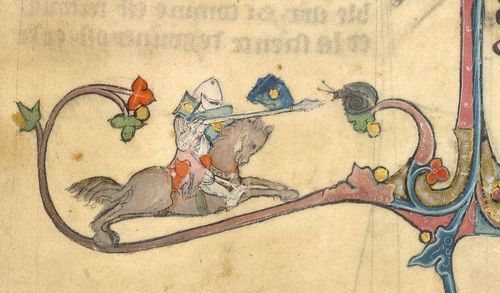
Detail from Brunetto Latini’s Li Livres dou Tresor
Edwards favors the one in medievalist Lilian M. C. Randall’s 1962 essay “The Snail in Gothic Marginal Warfare.”
Randall, who found some 70 instances of man-on-snail combat in 29 manuscripts dating from the late 1200s to early 1300s, believed that the tiny mollusks were stand ins for the Germanic Lombards who invaded Italy in the 8th century.
After Charlemagne trounced the Lombards in 772, declaring himself King of Lombardy, the vanquished turned to usury and pawnbroking, earning the enmity of the rest of the populace, even those who required their services.
Their profession conferred power of a sort, the kind that tends to get one labelled cowardly, greedy, malicious … and easy to put down.
Which rather begs the question why the knights going toe-to- …uh, facing off against them in the margins of these illuminated manuscripts look so damn intimidated.
(Conversely why was Rex Harrison’s Dr. Dolittle so unafraid of the Giant Pink Sea Snail?)
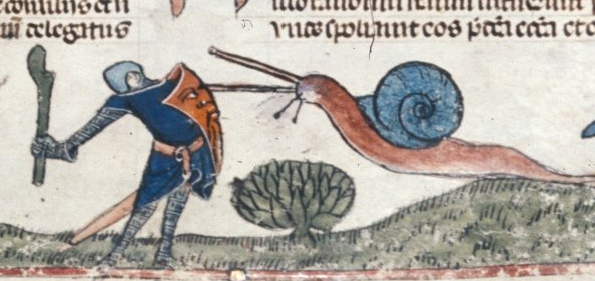
Detail from from MS. Royal 10 IV E (aka the Smithfield Decretals)
Let us remember that the doodles in medieval marginalia are editorial cartoons wrapped in enigmas, much as today’s memes would seem, 800 years from now. Whatever point—or joke—the scribe was making, it’s been obscured by the mists of time.
And these things have a way of evolving. The snail vs. knight motif disappeared in the 14th-century, only to resurface toward the end of the 15th, when any existing significance would very likely have been tailored to fit the times.
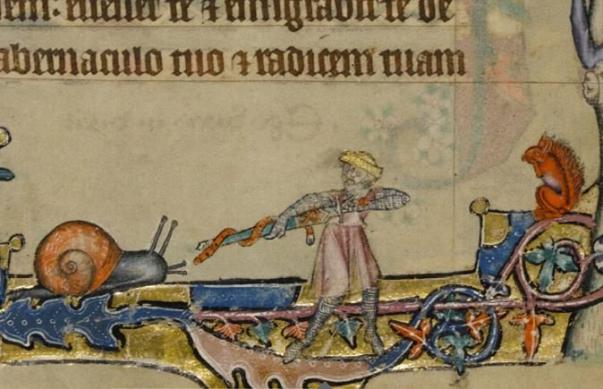
Detail from The Macclesfield Psalter
Other theories that scholars, art historians, bloggers, and armchair medievalists have floated with regard to the symbolism of these rough and ready snails haunting the margins:
The Resurrection
The high clergy, shrinking from problems of the church
The slowness of time
The insulation of the ruling class
The aristocracy’s oppression of the poor
A critique of social climbers
Female sexuality (isn’t everything?)
Virtuous humility, as opposed to knightly pride
The snail’s reign of terror in the garden (not so symbolic, perhaps…)
A practical-minded Reddit commenter offers the following commentary:
I like to imagine a monk drawing out his fantastical daydreams, the snail being his nemesis, leaving unsightly trails across the page and him building up in his head this great victory wherein he vanquishes them forever, never again to be plagued by the beastly buggers while creating his masterpieces.
Readers, any other ideas?
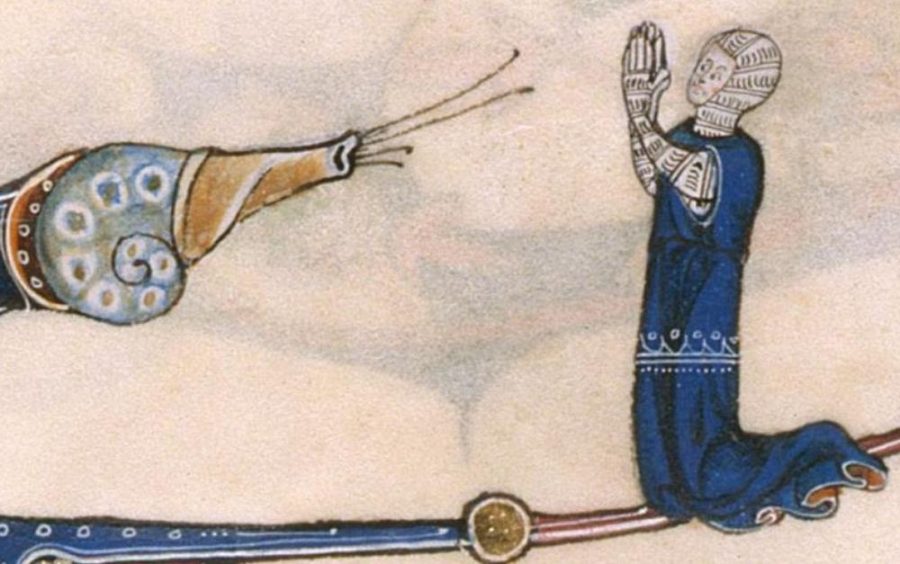
Detail from The Gorleston Psalter
Note: An earlier version of this post appeared on our site in 2019.
Related Content:
A Rabbit Rides a Chariot Pulled by Geese in an Ancient Roman Mosaic (2nd century AD)
Ayun Halliday is an author, illustrator, theater maker in New York City.
Read More...The Spinal Tap Sequel Arrives Next Month: Watch the Trailer and a Scene with Elton John & Paul McCartney
This Is Spinal Tap came out more than 40 years ago. At the time, says director Rob Reiner in a recent interview at San Diego Comic-Con, “nobody got it. I mean, they thought I’d made a movie about a real band that wasn’t very good, and why wouldn’t I make a movie about the Beatles or the Rolling Stones?” Indeed, stories circulated of people in the music industry (including the late Ozzy Osbourne) not realizing it was supposed to be a comedy, so close was its satire to their actual professional lives. Eventually, “the real word started creeping in”: the fictional band “played Glastonbury, they played Royal Albert Hall and Wembley Stadium.” Real-life rock and pop musicians also became fans of the film. “Every time I see it,” Reiner quotes Sting as saying, “I don’t know whether to laugh or cry.”
The boundaries between Spinal Tap’s world and the real one have remained porous enough that the production of the film’s upcoming sequel Spinal Tap II: The End Continues has involved a great many celebrities playing themselves, or at least versions thereof.
Take, for example, the newly released version of “Stonehenge,” whose music video features not just Elton John, but — to the delight of some fans, and perhaps the disappointment of others — a correctly scaled stage prop. The song will be included on the album of The End Continues, scheduled for release along with the film on September 12th, whose thirteen tracks bring in guest stars like Paul McCartney, Garth Brooks, and Trisha Yearwood.
It’s been about fifteen years since the last Spinal Tap album, a factor the sequel incorporates into its premise. “We created this whole idea that there’s bad blood, they’re not speaking to each other,” says Reiner, “but they now are forced together because of a contract” dictating that they must give one last performance, a prospect suddenly made viable when their song “Big Bottom” goes viral. As unrecognizable as both pop culture in general and the music industry in particular have become over the past four decades, Reiner assures us that David St. Hubbins, Nigel Tufnel, and Derek Smalls “have not grown emotionally, musically, or artistically. They are stuck in that heavy-metal world.” In a Hollywood movie, such a flagrant lack of character development would constitute a violation of storytelling laws; in rock, it’s unflinching realism.
Related content:
Ian Rubbish (aka Fred Armisen) Interviews the Clash in Spinal Tap-Inspired Mockumentary
The Spinal Tap Stonehenge Debacle
Watch The Nine Lives of Ozzy Osbourne: A Free Documentary on the Heavy Metal Pioneer (RIP)
Based in Seoul, Colin Marshall writes and broadcasts on cities, language, and culture. His projects include the Substack newsletter Books on Cities and the book The Stateless City: a Walk through 21st-Century Los Angeles. Follow him on the social network formerly known as Twitter at @colinmarshall.
Read More...Support Us
We're hoping to rely on loyal readers, rather than erratic ads. Please click the Donate button and support Open Culture. You can use Paypal, Venmo, Patreon, even Crypto! We thank you!

About Us

Open Culture scours the web for the best educational media. We find the free courses and audio books you need, the language lessons & educational videos you want, and plenty of enlightenment in between.
Advertise With Us

FREE UPDATES!
GET OUR DAILY EMAIL
Get the best cultural and educational resources on the web curated for you in a daily email. We never spam. Unsubscribe at any time.
FOLLOW ON SOCIAL MEDIA

Open Culture editor Dan Colman scours the web for the best educational media. He finds the free courses and audio books you need, the language lessons & movies you want, and plenty of enlightenment in between.
Advertise With Us


