Hear the Pieces Mozart Composed When He Was Only 5 Years Old
A preternaturally talented, precocious child, barely out of toddlerhood, in powdered wig and knee-breeches, capering around the great houses of 18th century Europe between virtuoso performances on the harpsichord. A young boy who can play any piece anyone puts in front of him, and compose symphonies extemporaneously with ease…. Few scenes better capture the mythos of the child prodigy than those reported from the childhood of Wolfgang Amadeus Mozart.
If Milos Forman’s Amadeus is any reliable guide to his character, if not his history, Mozart may never have lost his boyish charm and exuberance, but his musical ability seemed to mature exponentially as he composed hundreds of sonatas, quartets, concertos, and operas, ending with the Requiem, an astonishing piece of work by any measure, despite remaining unfinished in the year of his death, 1791, at the age of 35.
While those feverish scenes of Requiem’s composition in Forman’s film may be tenuously attached to the truth, the stories of Mozart the preschool and boyhood genius are well attested. Not only did he play with unbelievable skill for “emperors and empresses in the courts of Europe,” but “by the time he was six he had composed dozens of remarkable pieces for the keyboard as well as for other instruments,” notes Willard Palmer in an introduction to Mozart’s most popular works. “His first efforts at composition began when he was only four years old.”
He composed several short pieces the following year, and you can hear them all performed above. At the Morgan Library’s site you can also see a scanned manuscript image of four of those compositions, written in Mozart’s father’s hand. Leopold Mozart—the driving stage-parental force, as we know, behind Wolfgang’s childhood career as a touring marvel—notated these first attempts, crediting them to “Wolfgangerl,” in what is known as the Nannerl Notebook, from the nickname of Mozart’s older sister, Maria Anna.
Leopold, Kapellmeister of the Salzburg court orchestra, recognized not only Wolfgang’s musical talents, but also those of Nannerl, and he devoted his time to overseeing both his children’s training. For sadly obvious reasons, the elder Mozart did not continue to perform, and the notebook named for her does not contain any of her compositions, only Leopold’s exercises for the children and her brother’s first original work. In addition to Mozart’s earliest pieces, it may also contain music composed by him at 7 or 8 years old—more extensive works that might, says Mozarteum researcher Ulrich Leisinger, bridge the short, simple first pieces and his first major compositions.
Nonetheless, we have dozens of Mozart’s compositions throughout his childhood and teenage years. Several of those earlier pieces come from the so-called London Notebook, a sketchbook kept during Mozart’s time in England between 1764–65. Here, writes Elena Abend, we find him “extending his musical themes compared to his earlier compositions.” And yet the music “almost always has a playfulness about it.” It’s a quality that never left Mozart’s work, excluding the awesome Requiem, of course, but then this final masterwork was completed by other composers, none of them with Mozart’s lightness of spirit, which we can trace all the way back to that first piece, “a courtly little composition.” Writes Abend, “gracefulness is essential in performing the piece.”
Note: An earlier version of this post appeared on our site in 2017.
Related Content:
Watch the First Performance of a Mozart Composition That Had Been Lost for Centuries
Hear the Evolution of Mozart’s Music, Composed from Ages 5 to 35
Mozart’s Diary Where He Composed His Final Masterpieces Is Now Digitized and Available Online
Josh Jones is a writer and musician based in Durham, NC. Follow him at @jdmagness
Read More...
Curious Alice — The 1971 Anti-Drug Movie Based on Alice in Wonderland That Oddly Made Drugs Look Like Fun
The Reagan presidency was probably the golden age of anti-drug messaging. America’s school kids were told that a brain was like an egg and drugs were like a frying pan. The First Lady told America’s school kids simply to “Just Say No.” The message was stupefyingly simple. Drugs, like Communism and taxes, are bad.
During the early 1970s, however, that anti-drug message was much more confused. Take for example Curious Alice, a visually stunning, deeply odd movie about the perils of drug abuse that makes the stuff look like a lot of fun. Created by the National Institute of Mental Health in 1971, the film shows young Alice reading Lewis Carroll’s Alice in Wonderland in a sunny dappled meadow before nodding off.
She soon finds herself plunging down the rabbit hole and in a wonderland … of drugs. The King of Hearts is hawking heroin. The Mad Hatter is tripping on LSD. The hookah-smoking Caterpillar is stoned out of his gourd. The Dormouse is in a barbiturate-induced stupor and the March Hare, who looks like the Trix Bunny’s ne’er-do-well brother, is a fidgeting tweaker. “You oughta have some pep pills! Uppers!” he exclaims. “Amphetamines! Speed! You feel super good.”
The movie was reportedly intended for eight-year-olds. While it’s unlikely that your average third grader is going to absorb Alice’s moralizing about acid, they will almost certainly respond to the film’s trippy, Monty Pythonesque animation. The animators clearly had a blast making this movie, but their efforts didn’t exactly translate into an effective message. After the movie came out, the National Coordinating Council on Drug Education slammed the movie, calling it confusing and counterproductive. As an adult, however, the movie is a lot of fun. So check it out above.
Note: An earlier version of this post appeared on our site in 2014.
Related Content:
The First-Ever Film Version of Lewis Carroll’s Tale, Alice in Wonderland (1903)
Artist Draws Nine Portraits on LSD During 1950s Research Experiment
Jonathan Crow is a writer and filmmaker whose work has appeared in Yahoo!, The Hollywood Reporter, and other publications.
Read More...The Invisible Horror of The Shining: How Music Makes Stanley Kubrick’s Iconic Film Even More Terrifying
Inexplicable as it may sound to readers of this site, there are movie-lovers who claim not to enjoy the work of Stanley Kubrick. But even his most steadfast non-appreciators have to hand it to him for The Shining, his 1980 Stephen King adaptation widely considered one of the scariest — quite possibly the scariest – film ever made. The visual reasons for its effectiveness well beyond the core audience of Kubrick enthusiasts are many, and they’ve been much scrutinized by twenty-first-century video essayists. But as explained in the Kaptain Kristian video above, a significant portion of the horror of The Shining is invisible. That is, we don’t see it, but hear it; or rather, what we hear greatly intensifies what we see.
One technique powerfully employed in the film has the incongruous name of “Mickey Mousing.” Named after the manner in which classic cartoons were scored in tight synchrony with the movements of their characters, it had fallen into disuse by the nineteen-seventies, when a subtler cinematic style prevailed.
For The Shining, Kubrick and musical editor Gordon Stainforth chose to revive it, assembling scenes to pieces of music like Béla Bartók’s “Music for Strings, Percussion and Celesta” so as to heighten not just shock moments, but also to deepen the sense of dread that pervades the movie from its opening moments. So tight does the correspondence feel between The Shining’s music and its characters’ actions that it comes as a surprise that most of the film was shot without what we hear on the soundtrack playing on the set; some scenes weren’t even intended to have music at all before editing.
Stainforth has said that the overall idea was to use “music as fate”: for example, the “big chords” that accompany the title cards announcing the day of the week, which portend “a doomsday of judgment coming ever closer.” When next you watch The Shining, pay attention to the cues, and notice just how closely they’re associated in your memory with — and how much more frightening they’re made by — their accompanying images: Jack dancing through the ballroom filled with jazz-age ghosts, Danny turning a corner and seeing the pallid twins, the blood flowing out of the elevator, Wendy locking eyes with the man in the bear suit. But then, I suspect that last one would be scary no matter what was on the soundtrack.
Related Content:
How Stanley Kubrick Adapted Stephen King’s The Shining into a Cinematic Masterpiece
Stanley Kubrick’s Annotated Copy of Stephen King’s The Shining
The Classical Music in Stanley Kubrick’s Films: Listen to a Free Four-Hour Playlist
Based in Seoul, Colin Marshall writes and broadcasts on cities, language, and culture. His projects include the Substack newsletter Books on Cities and the book The Stateless City: a Walk through 21st-Century Los Angeles. Follow him on the social network formerly known as Twitter at @colinmarshall.
Read More...Watch Animated Sheet Music for Miles Davis’ “So What,” Coltrane’s “Giant Steps,” and Charlie Parker’s “Confirmation”
Miles Davis’ Kind of Blue changed jazz. It changed music, period. So I take it very seriously. But when I see the animated sheet music of the first cut, “So What,” I can’t help but think of Charles Schulz’s Peanuts cartoons, and their Vince Guaraldi compositions. I mean no offense to Miles. His modal jazz swings, and it’s fun, as fun to listen to as it is to watch in rising and falling arpeggios. The YouTube uploader, Dan Cohen, gives us this on his channel Animated Sheet Music, with apologies to Jimmy Cobb for the lack of drum notation.
Also from Cohen’s channel, we have Charlie Parker’s music animated. Never one to keep up with his admin, Parker left his estate unable to recuperate royalties from compositions like “Confirmation” (above).
Nonetheless, everyone knows it’s Bird’s tune, and to see it animated above is to see Parker dance a very different step than Miles’ post-bop cool, one filled with complex melodic paragraphs instead of chordal phrases.
And above, we have John Coltrane’s massive “Giant Steps,” with its rapid-fire bursts of quarter notes, interrupted by half-note asides. Coltrane’s iconic 1960 composition displays what Ira Gitler called in a 1958 Downbeat piece, “sheets of sound.” Gitler has said the image he had in his head was of “bolts of cloth undulating as they unfurled,” but he might just as well have thought of sheets of rain, so multitudinous and heavy is Coltrane’s melodic attack.
See Cohen’s Animated Sheet Music channel for two more Charlie Parker pieces, “Au Privave” and “Bloomdido.”
If you would like to support the mission of Open Culture, consider making a donation to our site. It’s hard to rely 100% on ads, and your contributions will help us continue providing the best free cultural and educational materials to learners everywhere. You can contribute through PayPal, Patreon, and Venmo (@openculture). Thanks!
Note: An earlier version of this post appeared on our site in 2013.
Related Content:
Behold John Coltrane’s Handwritten Outline for His Masterpiece A Love Supreme
Josh Jones is a writer and musician based in Durham, NC. Follow him at @jdmagness
Read More...“The Vertue of the COFFEE Drink”: An Ad for London’s First Cafe Printed Circa 1652
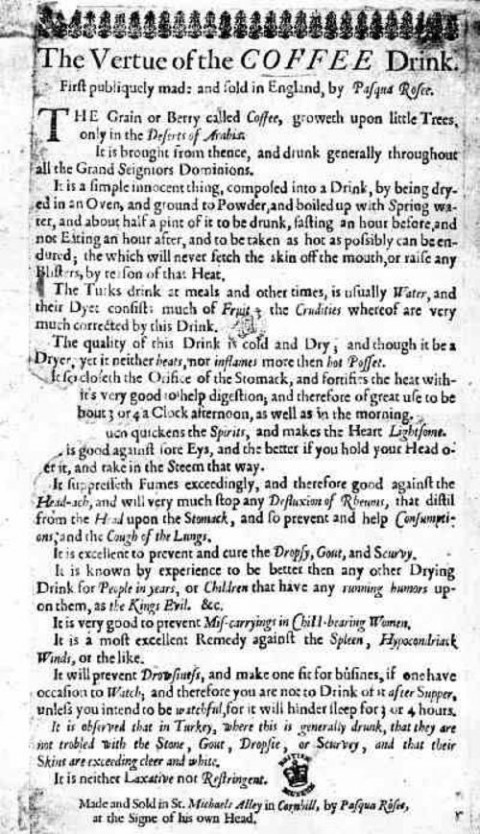
The story of coffee goes back to the 13th century, when it came out of Ethiopia, then spread to Egypt and Yemen. It reached the Middle East, Turkey, and Persia during the 16th century, and then Europe during the early 17th, though not without controversy. In Venice, some called it the ‘bitter invention of Satan,’ but the Pope, upon tasting it, gave it his blessing. By 1652, the first café in London had opened its doors on St. Michael’s Alley, bringing coffee to England—all thanks to a Sicilian immigrant, Pasqua Rosée.
Today, the British Museum houses a handbill that may well be the first advertisement for coffee in England. It proves remarkable for a couple of reasons. First, the ad introduced Brits to what’s now a staple of the Western diet, and eventually they’d bring it to North America. And, what’s more, you can see another instance of the adage that the more things change, the more they stay the same. Advertising is advertising. Then, as now, beverages were sold on their taste and health properties. And, of course, you were encouraged to consume the product not once, but twice a day. You can find a transcription of the text below.
Text:
THE Grain or Berry called Coffee, groweth upon little Trees, only in the Deserts of Arabia.
It is brought from thence, and drunk generally throughout all the Grand Seigniors Dominions.
It is a simple innocent thing, composed into a drink, by being dryed in an Oven, and ground to Powder, and boiled up with Spring water, and about half a pint of it to be drunk, fasting an hour before and not Eating an hour after, and to be taken as hot as possibly can be endured; the which will never fetch the skin off the mouth, or raise any Blisters, by reason of that Heat.
The Turks drink at meals and other times, is usually Water, and their Dyet consists much of Fruit, the Crudities whereof are very much corrected by this Drink.
The quality of this Drink is cold and Dry; and though it be a Dryer, yet it neither heats, nor inflames more than hot Posset.
It forcloseth the Orifice of the Stomack, and fortifies the heat with- [missing text] its very good to help digestion, and therefore of great use to be [missing text] bout 3 or 4 a Clock afternoon, as well as in the morning.
[missing text] quickens the Spirits, and makes the Heart Lightsome.
[missing text]is good against sore Eys, and the better if you hold your Head o’er it, and take in the Steem that way.
It supresseth Fumes exceedingly, and therefore good against the Head-ach, and will very much stop any Defluxion of Rheumas, that distil from the Head upon the Stomach, and so prevent and help Consumptionsand the Cough of the Lungs.
It is very good to prevent Mis-carryings in Child-bearing Women.
It will prevent Drowsiness, and make one fit for Busines, if one have occasion to Watch, and therefore you are not to drink of it after Supper, unless you intend to be watchful, for it will hinder sleep for 3 or 4 hours.
It is observed that in Turkey, where this is generally drunk, that they are not troubled with the Stone, Gout, Dropsie, or Scurvy, and that their Skins are exceeding cleer and white.
It is neither Laxative nor Restringent.
Made and Sold in St. Michaels Alley in Cornhill, by Pasqua Rosee, at the Signe of his own Head.
Note: An earlier version of this post appeared on our site in 2012.
Related Content
“The Virtues of Coffee” Explained in 1690 Ad: The Cure for Lethargy, Scurvy, Dropsy, Gout & More
The Birth of Espresso: The Story Behind the Coffee Shots That Fuel Modern Life
How Humanity Got Hooked on Coffee: An Animated History
Elementary School Kids Sing David Bowie’s “Space Oddity” & Other Rock Hits: A Cult Classic Recorded in 1976
In 1976 and 1977 an inspired music teacher in the small school district of Langley Township, British Columbia, a suburb of Vancouver, recorded his elementary school students singing popular songs in a school gym. Two vinyl records were produced over the two years, and families were invited to pay $7 for a copy. The recordings were largely forgotten — just another personal memento stored away in a few homes in Western Canada — until a record collector stumbled across a copy in a thrift store in 2000.
Enthralled by what he heard, the collector sent a sample to a disc jockey at WFMU, an eclectic, listener-supported radio station in New Jersey. The station began playing some of the songs over the airwaves. Listeners were touched by the haunting, ethereal quality of the performances. In 2001, a small record company released a compilation called The Langley Township Music Project: Innocence & Despair.
The record became an underground hit. The Washington Post called it “an album that seems to capture nothing less than the sound of falling in love with music.” Spin said the album “seems to sum up all the reasons music is holy.” And Dwight Gamer of The New York Times wrote that the music was “magic: a kind of celestial pep rally.” Listeners were moved by the ingenuousness of the young voices, the strange authenticity of performances by children too young to understand all of the adult themes in the lyrics. As Hans Fenger, the music teacher who made the recordings, writes in the liner notes:
The kids had a grasp of what they liked: emotion, drama, and making music as a group. Whether the results were good, bad, in tune or out was no big deal — they had élan. This was not the way music was traditionally taught. But then I never liked conventional “children’s music,” which is condescending and ignores the reality of children’s lives, which can be dark and scary. These children hated “cute.” They cherished songs that evoked loneliness and sadness.
You can learn the story of Fenger’s extraordinary music project in the 2002 VH1 documentary above, which includes interviews and a reunion with some of the students. And listen below for a few samples of that touching quality of loneliness and sadness Fenger and others have been talking about.
David Bowie’s ‘Space Oddity’:
One of the most widely praised songs from Innocence & Despair is the 1976 recording of David Bowie’s “Space Oddity.” In a 2001 interview with Mike Appelstein for Scram magazine, Fenger explained the sound effects in the recording. “When I first taught ‘Space Oddity,’ ” he said, “the first part I taught after the song was the kids counting down. They loved that: they’d go ‘TEN!’ They couldn’t say it loud enough; the countdown in the song was the big winner. But as soon as they got to zero, nothing happened. So I brought this old steel guitar. Well, one of the little guys whose name I’ve forgot, I put him on this thing and said, ‘Now listen, when they get to zero, you’re the rocket. So make a lot of noise on this. He’s fooling around with this steel guitar, and I didn’t even think of this, but he intuitively took out a Coke bottle from his lunch and started doing this (imitates a bottle running up and down the fretboard). I just cranked up the volume and turned down the master volume so it was really distorted. And that was the ‘Space Oddity’ sound effect.”
The Beach Boys’ ‘In My Room’:
The children recorded “In My Room” by the Beach Boys in 1977. Fenger told Appelstein it was the ultimate children’s song. “It’s the perfect introspective song for a nine-year-old,” he said, “just as ‘Dust in the Wind’ is the perfect philosophy song for a nine-year-old. Adults may think it’s dumb, but for a child, it’s a very heavy, profound thought. To think that there is nothing, and it’s expressed in such a simple way.”
The Eagles’ ‘Desperado’:
Several of the recordings feature soloists. A young girl named Sheila Behman sang the Eagles’ “Desperado” in 1977. “With ‘Desperado,’ ” said Fenger, “you can see it as a cowboy romantic story, but that’s not the way Sheila heard it. She couldn’t articulate metaphorically what the song was about, but in that sense, I think it was purer because it was unaffected. It’s not as if the kids were trying to be somebody else. They were just trying to be who they were, and they’re doing this music and falling in love with it.”
Note: An earlier version of this post appeared on our site in 2013.
Related Content
David Bowie Urges Kids to READ in a 1987 Poster Sponsored by the American Library Association
When David Bowie Launched His Own Internet Service Provider: The Rise and Fall of BowieNet (1998)
How David Bowie Used William S. Burroughs’ Cut-Up Method to Write His Unforgettable Lyrics
Read More...Tibetan Musical Notation Is Beautiful
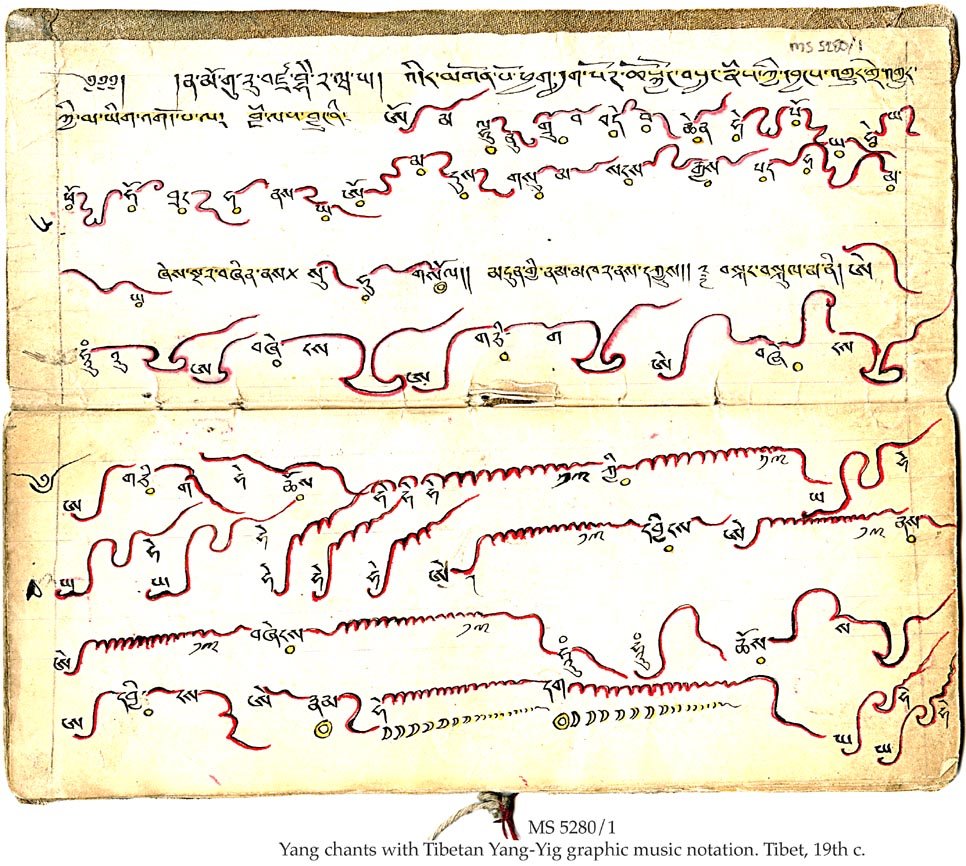
Religions take the cast and hue of the cultures in which they find root. This was certainly true in Tibet when Buddhism arrived in the 7th century. It transformed and was transformed by the native religion of Bon. Of the many creative practices that arose from this synthesis, Tibetan Buddhist music ranks very highly in importance.
As in sacred music in the West, Tibetan music has complex systems of musical notation and a long history of written religious song. “A vital component of Tibetan Buddhist experience,” explains Google Arts & Cultures Buddhist Digital Resource Center, “musical notation allows for the transference of sacred sound and ceremony across generations. A means to memorize sacred text, express devotion, ward off feral spirits, and invoke deities.”

Some of these features may be alien to secular Western Buddhists focused on mindfulness and silent meditation, but to varying degrees, Tibetan schools place considerable value on the aesthetic experience of extra-human realms. As University of Tulsa musicologist John Powell writes, “the use of sacred sound” in Tibetan Buddhism, a “Mantrayana” tradition, acts “as a formula for the transformation of human consciousness.”
Tibetan musical notations, Google points out, “symbolically represent the melodies, rhythm patterns, and instrumental arrangements. In harmony with chanting, visualizations, and hand gestures, [Tibetan] music crucially guides ritual performance.” It is characterized not only by its integration of ritual dance, but also by a large collection of ritual instruments—including the long, Swiss-like horns suited to a mountain environment—and unique forms of polyphonic overtone singing.
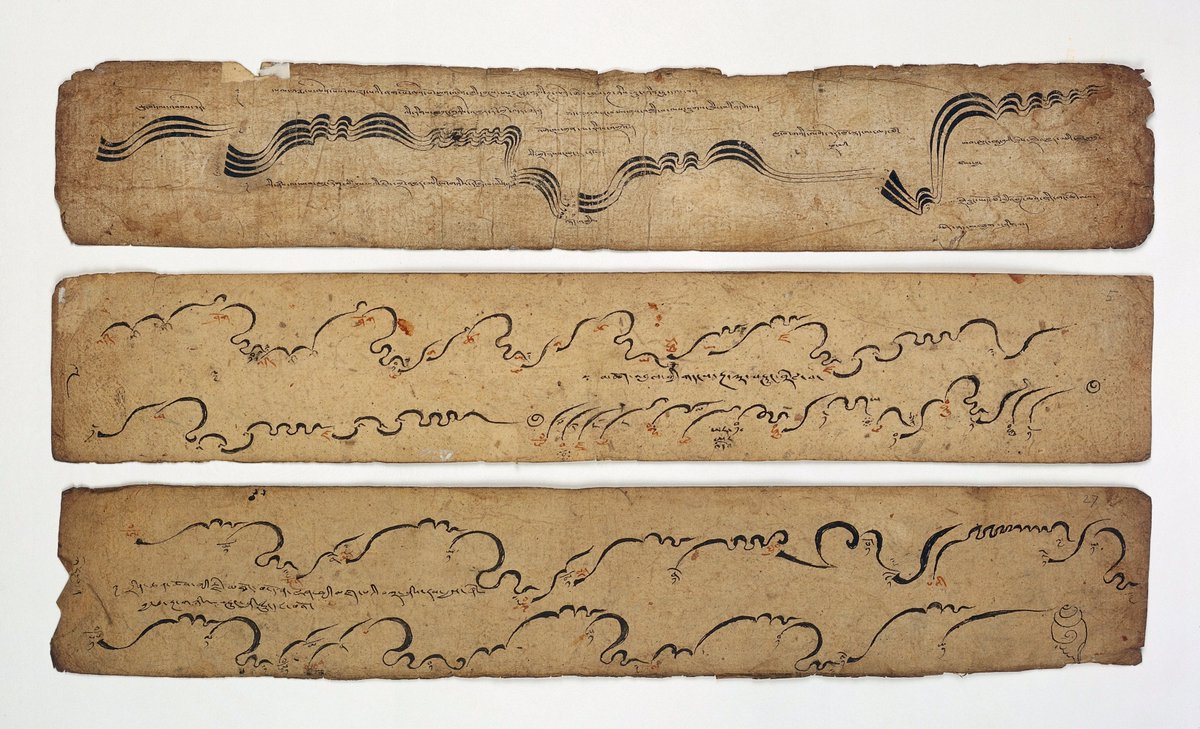
The examples of musical notation you see here came from the appropriately-named Twitter account Musical Notation is Beautiful and typeface designer and researcher Jo De Baerdemaeker. At the top is a 19th century manuscript belonging to the “Yang” tradition, “the most highly involved and regarded chant tradition in Tibetan music,” notes the Schoyen Collection, “and the only one to rely on a system of notation (Yang-Yig).”

The curved lines represent “smoothly effected rises and falls in intonation.” The notation also “frequently contains detailed instructions concerning in what spirit the music should be sung (e.g. flowing like a river, light like bird song) and the smallest modifications to be made to the voice in the utterance of a vowel.” The Yang-Yig goes all the way back to the 6th century, predating Tibetan Buddhism, and “does not record neither the rhythmic pattern nor duration of notes.” Other kinds of music have their own types of notation, such as that in the piece above for voice, drums, trumpets, horns, and cymbals.
Though they articulate and elaborate on religious ideas from India, Tibet’s musical traditions are entirely its own. “It is essential to rethink the entire concept of melody and rhythm” to understand Tibetan Buddhist chant, writes Powell in a detailed overview of Tibetan music’s vocal and instrumental qualities. “Many outside Tibetan culture are accustomed to think of melody as a sequence of rising or falling pitches,” he says. “In Tibetan Tantric chanting, however, the melodic content occurs in terms of vowel modification and the careful contouring of tones.” Hear an example of traditional Tibetan Buddhist chant just above, and learn more about Tibetan musical notation at Google Arts & Culture.
Note: An earlier version of this post appeared on our site in 2019.
Related Content:
Breathtakingly-Detailed Tibetan Book Printed 40 Years Before the Gutenberg Bible
The World’s Largest Collection of Tibetan Buddhist Literature Now Online
Free Online Course: Robert Thurman’s Introduction to Tibetan Buddhism (Recorded at Columbia U)
Leonard Cohen Narrates Film on The Tibetan Book of the Dead, Featuring the Dalai Lama (1994)
Josh Jones is a writer and musician based in Durham, NC. Follow him at @jdmagness
Read More...A Grad Student Asks Carl Sagan If He Believes in God (1994)
?si=yeo1Xsu2ZLuCpQbC
Most scientists are prepared to answer questions about their research from other members of their field; rather fewer have equipped themselves to answer questions from the general public about what Douglas Adams called life, the universe, and everything. Carl Sagan was one of that minority, an expert “science communicator” before science communication was recognized as a field unto itself. In popular books and television productions, most notably Cosmos and its accompanying series Cosmos: A Personal Voyage, he put himself out there in the mass media as an enthusiastic guide to all that was known about the realms beyond our planet. More than a few members of his audience might well have asked themselves where does God fit into all this.
One such person actually put that question to Sagan, at a Q&A session after the latter’s 1994 “lost lecture” at Cornell, titled “The Age of Exploration.” The questioner, a graduate student, asks, “Is there any type of God to you? Like, is there a purpose, given that we’re just sitting on this speck in the middle of this sea of stars?”
In response to this difficult line of inquiry, Sagan opens a more difficult one: “What do you mean when you use the word God?” The student takes another tack, asking, “Given all these demotions” — defined by Sagan himself as the continual humbling of humanity’s self-image in light of new scientific discoveries — “why don’t we just blow ourselves up?” Sagan comes back with yet another question: “If we do blow ourselves up, does that disprove the existence of God?” The student admits that he guesses it does not.
The question eventually gets Sagan considering how “the word ‘God’ covers an enormous range of different ideas.” That range “runs from an outsized, light-skinned male with a long white beard, sitting in a throne in the sky, busily tallying the fall of every sparrow,” for whose existence Sagan knows of no evidence, to “the kind of God that Einstein or Spinoza talked about, which is very close to the sum total of the laws of the universe,” and as such, whose existence even Sagan would have to acknowledge. There’s also “the deist God that many of the founding fathers of this country believed in,” who’s held to have created the universe and then removed himself from the scene. With such a broad range of possible definitions, the concept of God itself becomes useless except as “social lubrication,” a means of seeming to “agree with someone else with whom you do not agree.” Terms of that malleable kind do have their advantages, if not to the scientific mind.
Related content:
Carl Sagan, Stephen Hawking & Arthur C. Clarke Discuss God, the Universe, and Everything Else
150 Renowned Secular Academics & 20 Christian Thinkers Talking About the Existence of God
Bertrand Russell on the Existence of God & the Afterlife (1959)
Bertrand Russell and F.C. Copleston Debate the Existence of God, 1948
What Is Religion Actually For?: Isaac Asimov and Ray Bradbury Weigh In
Based in Seoul, Colin Marshall writes and broadcasts on cities, language, and culture. His projects include the Substack newsletter Books on Cities and the book The Stateless City: a Walk through 21st-Century Los Angeles. Follow him on the social network formerly known as Twitter at @colinmarshall.
Read More...How Jackson Pollock Redefined Modern Art: An Introduction
In his lifetime, Jackson Pollock had only one successful art show. It took place at the Betty Parsons Gallery in New York in November 1949, and afterward, his fellow abstract expressionist Willem de Kooning declared that “Jackson has finally broken the ice.” Perhaps, according to Louis Menand’s book The Free World: Art and Thought in the Cold War, he meant that “Pollock was the first American abstractionist to break into the mainstream art world, or he might have meant that Pollock had broken through a stylistic logjam that American painters felt blocked by.” Whatever its intent, de Kooning’s remark annoyed art critic and major Pollock advocate Clement Greenberg, who “thought that it reduced Pollock to a transitional figure.”
It wasn’t necessarily a reduction: as Menand sees it, “all figures are transitional. Not every figure, however, is a hinge, someone who represents a moment when one mode of practice swings over to another.” Pollock was such a hinge, as, in his way, was Greenberg: “After Pollock, people painted differently. After Greenberg, people thought about painting differently.”
When they made their mark, “there was no going back.” Gallerist-YouTuber James Payne examines the nature of that mark in the new Great Art Explained video above, the first of a multi-part series on Pollock’s art and the figures that made its cultural impact possible. Even more important than Greenberg, in Payne’s telling, is Pollock’s fellow artist — and, in time, wife — Lee Krasner, whose own work he also gives its due.
We also see the paintings of American regionalist Thomas Hart Benton, Pollock’s teacher; Mexican muralist David Alfaro Siqueiros, in whose workshop Pollock participated; and even Pablo Picasso, who exerted subtle but detectable influences of his own on Pollock’s work. Other, non-artistic sources of inspiration Payne explores include the psychological theory of Carl Gustav Jung, with whose school of therapy Pollock engaged in the late nineteen-thirties and early forties. It was in those sessions that he produced the “psychoanalytic drawings,” one of several categories of Pollock’s work that will surprise those who know him only through his large-canvas, wholly abstract drip paintings. Each represents one stage of a complex evolutionary process: Pollock may have been the ideal artist for the new, post-war American world, but he hardly came fully formed out of Wyoming.
Related content:
Watch Portrait of an Artist: Jackson Pollock, the 1987 Documentary Narrated by Melvyn Bragg
The MoMA Teaches You How to Paint Like Pollock, Rothko, de Kooning & Other Abstract Painters
Based in Seoul, Colin Marshall writes and broadcasts on cities, language, and culture. His projects include the Substack newsletter Books on Cities and the book The Stateless City: a Walk through 21st-Century Los Angeles. Follow him on the social network formerly known as Twitter at @colinmarshall.
Read More...The History of the World in One Beautiful, 5‑Foot-Long Chart (1931)
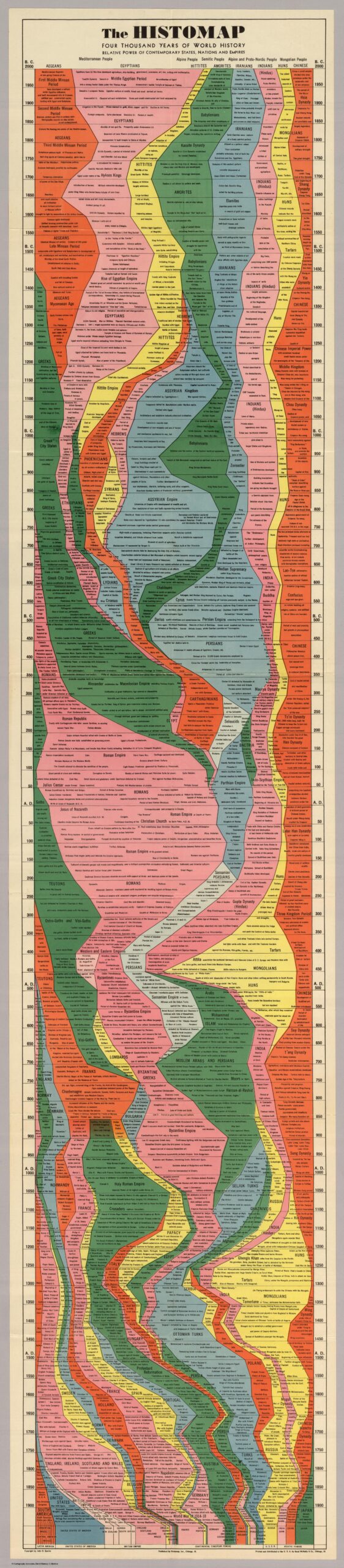
In the image above, we see an impressive pre-internet macro-infographic called a “Histomap.” Its creator John B. Sparks (who later created “histomaps” of religion and evolution) published the graphic in 1931 with Rand McNally. The five-foot-long chart—purportedly covering 4,000 years of “world” history—is, in fact, an example of an early illustration trend called the “outline,” of which Rebecca Onion at Slate writes: “large subjects (the history of the world! every school of philosophy! all of modern physics!) were distilled into a form comprehensible to the most uneducated layman.” Here we have the full description of most every political chart, graph, or animation in U.S.A. Today, most Internet news sites, and, of course, The Onion.
The similarity here isn’t simply one of form. The “outline” functioned in much the same way that simplified animations do—condensing heavy, contentious theoretical freight trains and ideological baggage. Rebecca Onion describes the chart as an artifact very much of its time, presenting a version of history prominent in the U.S. between the wars. Onion writes:
The chart emphasizes domination, using color to show how the power of various “peoples” (a quasi-racial understanding of the nature of human groups, quite popular at the time) evolved throughout history.
Sparks’ map, however, remains an interesting document because of its seeming disinterestedness. While the focus on racialism and imperial conquest may seem to place Sparks in company with populist “scientific” racists of the period like Lothrop Stoddard (whom Tom Buchanan quotes in Fitzgerald’s Gatsby), it would also seem that his design has much in common with early Enlightenment figures whose conception of time was not necessarily linear. Following classical models, thinkers like Thomas Hobbes tended to divide historical epochs into rising and falling actions of various people groups, rather than the gradual ascent of one race over all others towards an end of history. For example, poet Abraham Cowley writes a compressed “universal history” in his 1656 poem “To Mr. Hobs,” moving from Aristotle (the “Stagirite”) to the poem’s subject Thomas Hobbes. The movement is progressive, yet the historical representatives of each civilization receive some equal weight and similar emphasis.
Long did the mighty Stagirite retain
The universal Intellectual reign,
Saw his own Countreys short-liv’ed Leopard slain;
The stronger Roman-Eagle did out-fly,
Oftner renewed his Age, and saw that Dy.
Mecha it self, in spight of Mahumet possest,
And chas’ed by a wild Deluge from the East,
His Monarchy new planted in the West.
But as in time each great imperial race
Degenerates, and gives some new one place:
The period of Cowley recognized theories of racial, cultural, and natural supremacy, but such qualities, as in Sparks’ map, were the product of a long line of succession from equally powerful and noteworthy empires and groups to others, not a social evolution in which a superior race naturally arose. Rand McNally advertised the chart as presenting “the march of civilization, from the mud huts of the ancients thru the monarchistic glamour of the middle ages to the living panorama of life in present day America.” While the blurb is filled with pseudoscientific colonialist talking points, the chart itself has the dated, yet strikingly egalitarian arrangement of information that—like much of the illustration in National Geographic—sought to accommodate the best consensus models of the times, displaying, but not proselytizing, its biases.
Note: An earlier version of this post appeared on our site in 2013.
Related Content:
180,000 Years of Religion Charted on a “Histomap” in 1943
10 Million Years of Evolution Visualized in an Elegant, 5‑Foot Long Infographic from 1931
The History of the World in One Video: Every Year from 200,000 BCE to Today
Josh Jones is a writer and musician based in Durham, NC. Follow him at @jdmagness
Read More...Support Us
We're hoping to rely on loyal readers, rather than erratic ads. Please click the Donate button and support Open Culture. You can use Paypal, Venmo, Patreon, even Crypto! We thank you!

About Us

Open Culture scours the web for the best educational media. We find the free courses and audio books you need, the language lessons & educational videos you want, and plenty of enlightenment in between.
Advertise With Us

FREE UPDATES!
GET OUR DAILY EMAIL
Get the best cultural and educational resources on the web curated for you in a daily email. We never spam. Unsubscribe at any time.
FOLLOW ON SOCIAL MEDIA

Open Culture editor Dan Colman scours the web for the best educational media. He finds the free courses and audio books you need, the language lessons & movies you want, and plenty of enlightenment in between.
Advertise With Us

