The Dylatov Pass Incident: Has One of the Biggest Soviet Mysteries Been Solved?
Most of us would go out of our way not to set foot anywhere near a place the local natives refer to as “Dead Mountain.” That didn’t stop the Dyatlov Hiking Group, who set out on a sixteen-day skiing expedition across the northern Urals in late January of 1959. Experienced and intrepid, those ten young Soviet ski hikers had what it took to make the journey, at least if nothing went terribly wrong. A bout of sciatica forced one member of the group to turn back early, which turned out to be lucky for him. About a month later, the irradiated bodies of his nine comrades were discovered scattered in different areas of Dead Mountain some distance from their campsite, with various traumatic injuries and in various states of undress.
Something had indeed gone terribly wrong, but nobody could figure out what. For decades, the fate of the Dyatlov Hiking Group inspired countless explanations ranging widely in plausibility. Some theorized a freak weather phenomenon; others some kind of toxic airborne event; others still, the actions of American spies or even a yeti.
“In a place where information has been as tightly controlled as in the former Soviet Union, mistrust of official narratives is natural, and nothing in the record can explain why people would leave a tent undressed, in near-suicidal fashion,” writes the New Yorker’s Douglas Preston. Only in the late twenty-tens, when the Dyatlov Group Memorial Foundation got the case reopened, did investigators assess the contradictory evidence while making new measurements and conducting new experiments.
The probable causes were narrowed down to those explained by experts in the Vox video above: a severe blizzard and a slab of ice that must have shifted and crushed the tent. Densely packed by the wind, that massive, heavy slab would have “prevented them from retrieving their boots or warm clothing and forced them to cut their way out of the downslope side of the tent,” proceeding to the closest natural shelter from the avalanche they believed was coming. But no avalanche came, and they couldn’t find their way back to their camp in the darkness. “Had they been less experienced, they might have remained near the tent, dug it out, and survived,” writes Preston. “The skiers’ expertise doomed them.” Not everyone accepts this theory, but then, the idea that knowledge can kill might be more frightening than even the most abominable snowman.
Related content:
The Denali Experiment: A Test of Human Limits
The Curious Death of Vincent van Gogh
The Gruesome Dollhouse Death Scenes That Reinvented Murder Investigations
Based in Seoul, Colin Marshall writes and broadcasts on cities, language, and culture. His projects include the Substack newsletter Books on Cities and the book The Stateless City: a Walk through 21st-Century Los Angeles. Follow him on the social network formerly known as Twitter at @colinmarshall.
Read More...1980s Metalhead Kids Are Alright: Scientific Study Shows That They Became Well-Adjusted Adults
In the 1980s, The Parents Music Resource Center (PMRC), an organization co-founded by Tipper Gore and the wives of several other Washington power brokers, launched a political campaign against pop music, hoping to put warning labels on records that promoted Sex, Violence, Drug and Alcohol Use. Along the way, the PMRC issued “the Filthy Fifteen,” a list of 15 particularly objectionable songs. Hits by Madonna, Prince and Cyndi Lauper made the list. But the list really took aim at heavy metal bands from the 80s — namely, Judas Priest, Mötley Crüe, Twisted Sister, W.A.S.P., Def Leppard, Black Sabbath, and Venom. (Interesting footnote: the Soviets separately created a list of blackballed rock bands, and it looked pretty much the same.)
Above, you can watch Twisted Sister’s Dee Snider appear before Congress in 1985 and accuse the PMRC of misinterpreting his band’s lyrics and waging a false war against metal music. The evidence 40 years later suggests that Snider perhaps had a point.
A study by psychology researchers at Humboldt State, Ohio State, UC Riverside and UT Austin “examined 1980s heavy metal groupies, musicians, and fans at middle age” — 377 participants in total — and found that, although metal enthusiasts certainly lived riskier lives as kids, they were nonetheless “significantly happier in their youth and better adjusted currently than either middle-aged or current college-age youth comparison groups.” This left the researchers to contemplate one possible conclusion: “participation in fringe style cultures may enhance identity development in troubled youth.” Not to mention that heavy metal lyrics don’t easily turn kids into damaged goods.
You can read the report, Three Decades Later: The Life Experiences and Mid-Life Functioning of 1980s Heavy Metal Groupies here. And, right above, listen to an interview with one of the researchers, Tasha Howe, a former headbanger herself, who spoke yesterday with Michael Krasny on KQED radio in San Francisco.
Note: An earlier version of this post appeared on our site in July 2015.
If you would like to support the mission of Open Culture, consider making a donation to our site. It’s hard to rely 100% on ads, and your contributions will help us continue providing the best free cultural and educational materials to learners everywhere. You can contribute through PayPal, Patreon, and Venmo (@openculture). Thanks!
Related Content:
A Bluegrass Version of Metallica’s Heavy Metal Hit, “Enter Sandman”
Read More...The PhD Theses of Richard Feynman, Marie Curie, Albert Einstein & Others, Explained with Illustrations
Raise your children with a love of science, and there’s a decent chance they’ll grow up wanting to be like Richard Feynman, Marie Curie, Albert Einstein, or any number of other famous scientists from history. Luckily for them, they won’t yet have learned that the pursuit of such a career will almost certainly entail grinding out a PhD thesis. But it’s also lucky for you that they consequently won’t ask you to explain the subjects of their idols’ theses. Maybe you tell them about quantum electrodynamics, radiation, and even the theory of relativity, but what can you recall of “The Principle of Least Action in Quantum Mechanics,” “Research on Radioactive Substances,” or “Eine neue Bestimmung der Moleküldimensionen”?
Perhaps “recall” isn’t quite the word. But if you want to get a handle on these papers, which constitute important parts of the foundation of the research that would ultimately make their authors famous, you could do much worse than beginning with the explanations of science YouTuber Toby Hendy. In recent years, while building up an ever-larger audience with her channel Tibees, she’s occasionally reached into the archives and pulled out a notable scientist’s PhD thesis.
We’ve assembled all of her videos in that series into the playlist above, which also includes Hendy explanations of theses written by figures not primarily known to the public for their research: Carl Sagan and Neil DeGrasse Tyson, and Brian Cox (the physicist, not the Succession star), whose media work has inspired generations of fans to go into science.
Though a young woman, Hendy has mastered old-school teaching techniques, such as drawing on a transparency placed on an overhead projector, that may trigger Proustian memories of science class, at least in those of us of a certain age. With her calmness and clarity (not to mention her willingness to admit when she herself struggles with the material) she’d surely have ranked among any of our favorite teachers, and if you introduce her channel to your kids, she’ll probably become one of theirs. Whether they go on to earn a science PhD is, of course, down to their own inclination and efforts. Like so many young people these days, they may ultimately come away with a stronger desire to become a YouTuber — which, after all, is what Hendy quit her own PhD to do.
Related content:
John Nash’s Super Short PhD Thesis: 26 Pages & Two Citations
Queen Guitarist Brian May Is Also an Astrophysicist: Read His PhD Thesis Online
Albert Einstein’s Grades: A Fascinating Look at His Report Cards
This Is What an 1869 MIT Entrance Exam Looks Like: Could You Have Passed the Test?
Based in Seoul, Colin Marshall writes and broadcasts on cities, language, and culture. His projects include the Substack newsletter Books on Cities and the book The Stateless City: a Walk through 21st-Century Los Angeles. Follow him on the social network formerly known as Twitter at @colinmarshall.
Read More...George Orwell’s Rules for Making the Perfect Cup of Tea: A Short Animation
Several years back, Colin Marshall highlighted George Orwell’s essay, “A Nice Cup of Tea,” which first ran in the Evening Standard on January 12, 1946. In that article, Orwell weighed in on a subject the English take seriously–how to make the perfect cup of tea. (According to Orwell, “tea is one of the mainstays of civilization.”) And he proceeded to offer 11 rules for making that perfect cup. Above, Luís Sá condenses Orwell’s suggestions into a short animation, made with kinetic typography. Below, you can read the first three of Orwell’s 11 rules, and find the remaining eight here.
- First of all, one should use Indian or Ceylonese tea. China tea has virtues which are not to be despised nowadays — it is economical, and one can drink it without milk — but there is not much stimulation in it.…
- Secondly, tea should be made in small quantities — that is, in a teapot.… The teapot should be made of china or earthenware. Silver or Britanniaware teapots produce inferior tea and enamel pots are worse.…
- Thirdly, the pot should be warmed beforehand. This is better done by placing it on the hob than by the usual method of swilling it out with hot water.
Enjoy!
If you would like to support the mission of Open Culture, consider making a donation to our site. It’s hard to rely 100% on ads, and your contributions will help us continue providing the best free cultural and educational materials to learners everywhere. You can contribute through PayPal, Patreon, and Venmo (@openculture). Thanks!
Related Content:
George Orwell and Christopher Hitchens’ Ironclad Rules for Making a Good Cup of Tea
An Animated History of Tea
10 Golden Rules for Making the Perfect Cup of Tea (1941)
“The Virtues of Coffee” Explained in 1690 Ad: The Cure for Lethargy, Scurvy, Dropsy, Gout & More
Read More...The 1924 Soviet Chess Match Where The Chess Pieces Were Real Soldiers and Horses
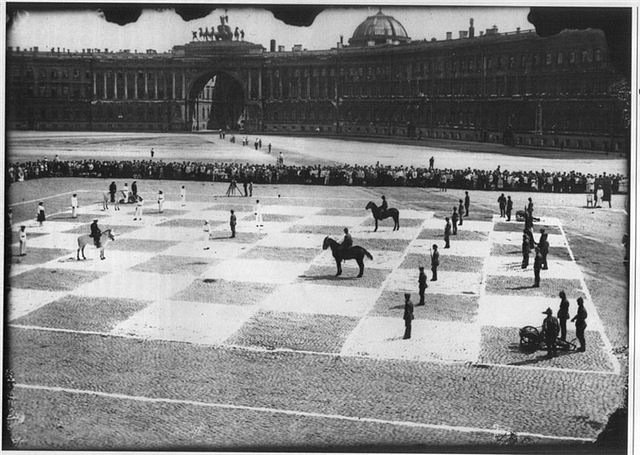
Let’s time travel back to Leningrad (aka St. Petersburg) in 1924. That’s when an unconventional chess match was played by Peter Romanovsky and Ilya Rabinovich, two chess masters of the day.
Apparently, they called in their moves over the telephone. And then real-life chess pieces—in the form of human beings and horses—were moved across a huge chessboard covering Palace Square. Members of the Soviet Union’s Red Army served as the black pieces; members of the Soviet navy were the white pieces. 8,000 onlookers watched the action unfold.
According to this online forum for chess enthusiasts, the 5‑hour match “was an annual event, designed to promote chess in the USSR.” The first such match was held in Smolensk in 1921, followed by matches in Kerch in 1922, Omsk in 1923 and then St. Petersburg in 1924. You can catch a glimpse of the match in the footage below.
?si=OaFBnWMUJ9YrqtwD
If you would like to support the mission of Open Culture, consider making a donation to our site. It’s hard to rely 100% on ads, and your contributions will help us continue providing the best free cultural and educational materials to learners everywhere. You can contribute through PayPal, Patreon, and Venmo (@openculture). Thanks!
Related Content:
A Free 700-Page Chess Manual Explains 1,000 Chess Tactics in Straightforward English
A Famous Chess Match from 1910 Reenacted with Claymation
A Brief History of Chess: An Animated Introduction to the 1,500-Year-Old Game
Read More...How to Evade Taxes in Ancient Rome: A 1,900-Year-Old Papyrus Reveals an Ancient Tax Evasion Scheme
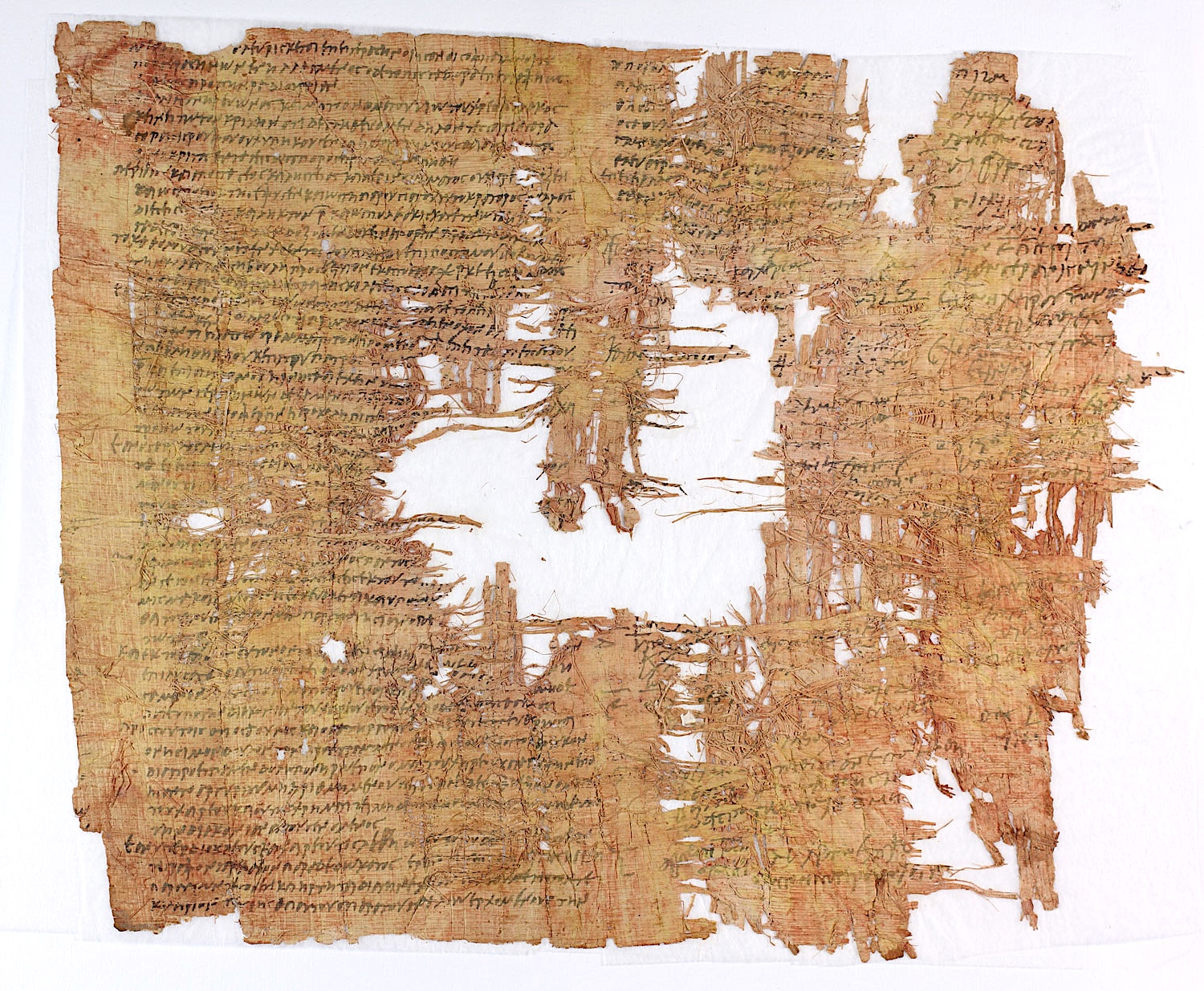
It was surely not a coincidence that the New York Times published its story on the trial of a certain Gadalias and Saulos this past Monday, April 14th. The defendants, as their names suggest, did not live in modernity: the papyrus documenting their legal troubles dates to the reign of Hadrian, around 130 AD. These men were charged, writes the Times’ Franz Lidz, with “the falsification of documents and the illicit sale and manumission, or freeing, of slaves — all to avoid paying duties in the far-flung Roman provinces of Judea and Arabia, a region roughly corresponding to present-day Israel and Jordan.”
In other words, Gadalias and Saulos were accused of tax evasion, a subject always on the mind of Americans under the shadow of their tax-return due date, April 15th. While the prospect of an IRS audit keeps more than a few of them awake at night, ancient Roman law went, predictably, quite a bit harsher.
“Penalties ranged from heavy fines and permanent exile to hard labor in the salt mines and, in the worst case, damnatio ad bestias, a public execution in which the condemned were devoured by wild animals,” writes Lidz. Such a fate presumably wouldn’t have been out of the question for those convicted of a crime of these proportions.
The long-misclassified document of this case was only properly deciphered, and even understood to have been written in ancient Greek, after its rediscovery in 2014. “A team of scholars was assembled to conduct a detailed physical examination and cross-reference names and locations with other historical sources,” which resulted in this paper published this past January. For any scholar of Roman law, such an opportunity to get into the minds of both that civilization’s judges and its criminals could hardly be passed up. Even out on the edge of the empire, prosecutors turn out to have employed “deft rhetorical strategies worthy of Cicero and Quintilian and displayed an excellent command of Roman legal terms and concepts in Greek.” This will no doubt get today’s law students speculating: specifically, about the existence of an ancient ChatGPT.
via NYTimes
Related content:
Donald Duck Wants You to Pay Your Taxes (1943)
Based in Seoul, Colin Marshall writes and broadcasts on cities, language, and culture. His projects include the Substack newsletter Books on Cities and the book The Stateless City: a Walk through 21st-Century Los Angeles. Follow him on the social network formerly known as Twitter at @colinmarshall.
Read More...Hear the World’s Oldest Known Song, “Hurrian Hymn No. 6” Written 3,400 Years Ago
Do you like old timey music?
Splendid.
You can’t get more old timey than Hurrian Hymn No. 6, which was discovered on a clay tablet in the ancient Syrian port city of Ugarit in the 1950s, and is over 3400 years old.
Actually, you can — a similar tablet, which references a hymn glorifying Lipit-Ishtar, the 5th king of the First Dynasty of Isin (in what is now Iraq), is older by some 600 years. But as CMUSE reports, it “contains little more than tuning instructions for the lyre.”
Hurrian Hymn No. 6 offers meatier content, and unlike five other tablets discovered in the same location, is sufficiently well preserved to allow archaeologists, and others, to take a crack at reconstructing its song, though it was by no means easy.
University of California emeritus professor of Assyriology, Anne Kilmer spent 15 years researching the tablet, before transcribing it into modern musical notation in 1972.
Hers is one of several interpretations YouTuber Hochelaga samples in the above video.
While the original tablet gives specific details on how the musician should place their fingers on the lyre, other elements, like tuning or how long notes should be held, are absent, giving modern arrangers some room for creativity.
Below archaeomusicologist Richard Dumbrill explains his interpretation from 1998, in which vocalist Lara Jokhader assumes the part of a young woman privately appealing to the goddess Nikkal to make her fertile:
Here’s a particularly lovely classical guitar spin, courtesy of Syrian musicologist Raoul Vitale and composer Feras Rada…
And a haunting piano version, by Syrian-American composer Malek Jandali, founder of Pianos for Peace:
And who can resist a chance to hear Hurrian Hymn No. 6 on a replica of an ancient lyre by “new ancestral” composer Michael Levy, who considers it his musical mission to “open a portal to a time that has been all but forgotten:”
I dream to rekindle the very spirit of our ancient ancestors. To capture, for just a few moments, a time when people imagined the fabric of the universe was woven from harmonies and notes. To luxuriate in a gentler time when the fragility of life was truly appreciated and its every action was performed in the almighty sense of awe felt for the ancient gods.
Samurai Guitarist Steve Onotera channels the mystery of antiquity too, by combining Dr. Dumbrill’s melody with Dr. Kilmer’s, trying and discarding a number of approaches — synthwave, lo-fi hip hop, reggae dub (“an absolute disaster”) — before deciding it was best rendered as a solo for his Fender electric.
Amaranth Publishing has several MIDI files of Hurrian Hymn No. 6, including Dr. Kilmer’s, that you can download for free here.
Open them in the music notation software program of your choice, and should it please the goddess, perhaps yours will be the next interpretation of Hurrian Hymn No. 6 to be featured here on Open Culture…
Note: An earlier version of this post appeared on our site in 2022.
Related Content
What Ancient Greek Music Sounded Like: Hear a Reconstruction That is ‘100% Accurate’
The Evolution of Music: 40,000 Years of Music History Covered in 8 Minutes
A Modern Drummer Plays a Rock Gong, a Percussion Instrument from Prehistoric Times
- Ayun Halliday is the Chief Primatologist of the East Village Inky zine and author, most recently, of Creative, Not Famous: The Small Potato Manifesto. Follow her @AyunHalliday.
Read More...When Charlie Chaplin First Spoke Onscreen: How His Famous Great Dictator Speech Came About
Charlie Chaplin came up in vaudeville, but it was silent film that made him the most famous man in the world. His mastery of that form primed him to feel a degree of skepticism about sound when it came along: in 1931, he called the silent picture “a universal means of expression,” whereas the talkies, as they were then known, “necessarily have a limited field.” Nevertheless, he was too astute a reader of public tastes to believe he could stay silent forever, though he only began to speak onscreen on his own terms — literally, in the case of Modern Times. In that celebrated film, his iconic character the Tramp sings a song, but does so in an unintelligible hash of cod French and Italian, and yet still somehow gets his meaning across, just as he had in all his silent movies before.
That scene appears in the CinemaStix video essay above on “the moment the most famous silent comedian opens his mouth,” which comes not in Modern Times but The Great Dictator, Chaplin’s 1940 send-up of the then-ascendant Adolf Hitler. In it, Chaplin plays two roles: the narrow-mustachioed Hitler parody Adenoid Hynkel who “speaks” in a tonally and rhythmically convincing ersatz German, and a Tramp-like Jewish Barber interned by Hynkel’s regime whose only lines come at the film’s very end.
Dressed as the dictator in order to escape the camp, the Barber suddenly finds himself giving a speech at a victory parade. When he speaks, he famously does so in Chaplin’s natural voice, expressing sentiments that sound like Chaplin’s own: inveighing against “machine men with machine minds,” making a plea for liberty, brotherhood, and goodwill toward men.
Though it may have been Chaplin’s biggest box-office hit, The Great Dictator isn’t his most critically acclaimed picture. When it was made, the United States had yet to enter the war, and the full nature of what the Nazis were doing in Europe hadn’t yet come to light. This film’s relationship with actual historical events thus feels uneasy, as if Chaplin himself wasn’t sure how light or heavy a tone to strike. Even his climactic speech was only created as a replacement for an intended final dance sequence, though he did work at it, writing and revising over a period of months. It’s more than a little ironic that The Great Dictator is mainly remembered for a scene in which a comic genius to whom words were nothing as against image and movement forgoes all the techniques that made him a star — and indeed, forgoes comedy itself.
Related content:
Charlie Chaplin Finds Comedy Even in the Brutality of WWI: A Scene from Shoulder Arms (1918)
Discover the Cinematic & Comedic Genius of Charlie Chaplin with 60+ Free Movies Online
Based in Seoul, Colin Marshall writes and broadcasts on cities, language, and culture. His projects include the Substack newsletter Books on Cities and the book The Stateless City: a Walk through 21st-Century Los Angeles. Follow him on the social network formerly known as Twitter at @colinmarshall.
Read More...Where The Simpsons Began: Discover the Original Shorts That Appeared on The Tracey Ullman Show (1987–1989)
When it first went on air in the late nineteen-eighties, Fox had to prove itself capable of playing in a televisual league with the likes of NBC, CBS, and ABC. To that end, it began building its prime-time lineup with two original programs more thematically and aesthetically daring than anything on those staid networks: the sitcom Married… with Children and the sketch comedy series The Tracey Ullman Show. Before and after commercial breaks, the latter treated its early viewers to a series of irreverent animated shorts created by an acclaimed cartoonist and featuring the vocal talents of Dan Castellaneta, Julie Kavner, and Nancy Cartwright. I speak, of course, of Dr. N!Godatu.
On an alternate timeline, perhaps the personal and professional adventures of that near-unflappable psychotherapist were spun off into their own hit series that broke every record for prime-time animation and is now in its 36th season.
Here in our reality, however, that’s been the destiny of The Simpsons, which also began as The Tracey Ullman Show’s bumper entertainment. Dr. N!Godatu vanished after a few weeks, never to be seen again, but the Simpson family remained for two full years, making their final short-from appearance in May of 1989. Seven months later, The Simpsons made its Christmas-special debut — an event that, if you don’t remember watching, I can’t count you as a member of my generation.
Not that, given my young age, I’d ever actually seen The Tracey Ullman Show at the time. But the hard promotional push leading up to that first real Simpsons offered glimpses into an animated world that looked and felt completely novel. (Having grown accustomed over generations to the show’s aesthetic, we easily forget how bizarre its yellow-skinned, universally overbite-afflicted characters once looked.) Many who tuned in wouldn’t have been aware that that look and feel hadn’t been created out of whole cloth, but rather had emerged through the evolutionary process you can witness in the 48 original Simpsons shorts collected in the Youtube playlist at the top of the post (and the hour-long consolidated video here).
To even a casual Simpsons viewer, everything in these shorts will seem at once familiar and “off” in myriad ways. The design of the characters looks both harsher and looser than it would later become, and certain of their voices, especially Castellaneta’s Walter Matthau-esque Homer, have yet to reflect the personalities they would later develop. The conventionally “cartoony” animation also distorts bodies and faces in ways that have long since been prohibited by the show’s official style guidelines. Even so, there are occasional jokes and even haunting moments of the kind we know from the first couple of seasons, if nothing in particular to foreshadow The Simpsons’ nineteen-nineties golden age — or the three decades’ worth of episodes that have followed it.
Related content:
27 Movies References in The Simpsons Put Side-by-Side with the Movie Scenes They Paid Tribute To
Before The Simpsons, Matt Groening Illustrated a “Student’s Guide” for Apple Computers (1989)
The Simpsons Reimagined as a Russian Art Film
Based in Seoul, Colin Marshall writes and broadcasts on cities, language, and culture. His projects include the Substack newsletter Books on Cities and the book The Stateless City: a Walk through 21st-Century Los Angeles. Follow him on the social network formerly known as Twitter at @colinmarshall.
Read More...Hear the Jazz-Funk Musical Adaptation of Dune by David Matthews (1977)
Even if you’ve never read Frank Herbert’s Dune, you may well have encountered its adaptations to a variety of other media: comic books, video games, board games, television series, and of course films, David Lynch’s 1984 version and Denis Villeneuve’s two-parter earlier this decade. But before any of those came Dune, the jazz-funk album by keyboardist and bandleader David Matthews. Released in 1977 on the popular jazz label CTI Records, it devotes its entire first side to a 20-minute suite ostensibly inspired by Herbert’s novel, consisting of the pieces “Arrakis,” “Sandworms,” “Song of the Bene Gesserit,” and “Muad’dib.”
You’ll notice that the typography on the cover of Matthews’ Dune seems awfully reminiscent of Star Wars, a film that had come out the very same year. It’s not exactly false advertising, since the album closes with versions of both Star Wars’ main theme and Princess Leia’s theme, supplemented by the theme from Douglas Trumbull’s Silent Running and even David Bowie’s “Space Oddity.” According to jazz historian Doug Payne, the concept was the idea of CTI founder Creed Taylor.
Taylor had originally hired Matthews as CTI’s chief arranger, the latter’s years of experience as James Brown’s musical director having promised the potential to imbue the label’s releases with disco appeal. In addition to Matthews on the keyboards, Dune also features heavy-hitting session players from the late-seventies jazz world like Randy Brecker, Steve Gadd, Grover Washington, Jr., Hiram Bullock, and David Sanborn. Fans of obscurantist hip-hop may also recognize Matthews’ “Space Oddity” cover as a sample source for MF DOOM’s “Rapp Snitch Knishes.”
Much like Bob James, his fellow mastermind of disco-inflected jazz, Matthews has created a body of work that lives on a hip-hop goldmine: his other samplers include Method Man, Redman, and The Notorious B.I.G. But it was in Japan that he found his most enthusiastic listenership. After leaving CTI in 1978, Payne writes, “Matthews went onto record a slew of records for mostly Japanese labels under a variety of guises including Japan’s number one selling jazz group, the Manhattan Jazz Quintet.” If you visit Japan, you may well hear Matthews’ music playing in a local jazz bar.
Related Content:
How Hans Zimmer Created the Otherworldly Soundtrack for Dune
Hear Brian Eno’s Contribution to the Soundtrack of David Lynch’s Dune (1984)
Space Jazz, a Sonic Sci-Fi Opera by L. Ron Hubbard, Featuring Chick Corea (1983)
Great Mixtapes of 1970s Japanese Jazz: 4 Hours of Funky, Groovy, Fusion‑y Music
Based in Seoul, Colin Marshall writes and broadcasts on cities, language, and culture. His projects include the Substack newsletter Books on Cities and the book The Stateless City: a Walk through 21st-Century Los Angeles. Follow him on the social network formerly known as Twitter at @colinmarshall.
Read More...Support Us
We're hoping to rely on loyal readers, rather than erratic ads. Please click the Donate button and support Open Culture. You can use Paypal, Venmo, Patreon, even Crypto! We thank you!

About Us

Open Culture scours the web for the best educational media. We find the free courses and audio books you need, the language lessons & educational videos you want, and plenty of enlightenment in between.
Advertise With Us

FREE UPDATES!
GET OUR DAILY EMAIL
Get the best cultural and educational resources on the web curated for you in a daily email. We never spam. Unsubscribe at any time.
FOLLOW ON SOCIAL MEDIA

Open Culture editor Dan Colman scours the web for the best educational media. He finds the free courses and audio books you need, the language lessons & movies you want, and plenty of enlightenment in between.
Advertise With Us

