Watch the Historic First Episode of Saturday Night Live with Host George Carlin (1975)
50 years of Saturday Night Live. It all started here with this first episode, aired on October 11, 1975. George Carlin hosted the show. Billy Preston and Janis Ian served up the music. Jim Henson staged an elaborate puppet show. And “the Not Ready for Prime Time Players” (Belushi, Aykroyd, Gilda, Jane, Chevy, Garrett, Laraine and the rest) provided the comedy, performing the first of 10,000 sketches that have since aired over SNL’s long history. SNL added the complete episode to its YouTube channel, and you can now watch how it all began. Enjoy!
Related Content
When William S. Burroughs Appeared on Saturday Night Live: His First TV Appearance (1981)
Saturday Night Live’s Very First Sketch: Watch John Belushi Launch SNL in October, 1975
5 Musical Guests Banned From Saturday Night Live: From Elvis Costello to Frank Zappa
David Bowie and Klaus Nomi’s Hypnotic Performance on SNL (1979)
Read More...
Jane Austen Used Pins to Edit Her Manuscripts: Before the Word Processor & White-Out
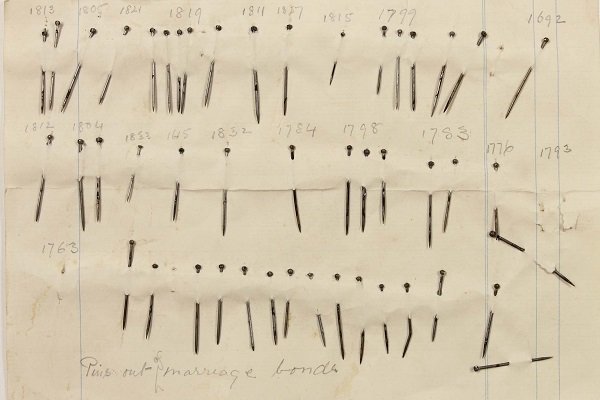
Before the word processor, before White-Out, before Post-It Notes, there were straight pins. Or, at least that’s what Jane Austen used to make edits in one of her rare manuscripts. In 2011, Oxford’s Bodleian Library acquired the manuscript of Austen’s abandoned novel, The Watsons. In announcing the acquisition, the Bodleian wrote:
The Watsons is Jane Austen’s first extant draft of a novel in process of development and one of the earliest examples of an English novel to survive in its formative state. Only seven manuscripts of fiction by Austen are known to survive. The Watsons manuscript is extensively revised and corrected throughout, with crossings out and interlinear additions.
Janeausten.ac.uk (the website where Austen’s manuscripts have been digitized) takes a deeper dive into the curious quality of The Watsons manuscript, noting:
The manuscript is written and corrected throughout in brown iron-gall ink. The pages are filled in a neat, even hand with signs of concurrent writing, erasure, and revision, interrupted by occasional passages of heavy interlinear correction.… The manuscript is without chapter divisions, though not without informal division by wider spacing and ruled lines. The full pages suggest that Jane Austen did not anticipate a protracted process of redrafting. With no calculated blank spaces and no obvious way of incorporating large revision or expansion she had to find other strategies – the three patches, small pieces of paper, each of which was filled closely and neatly with the new material, attached with straight pins to the precise spot where erased material was to be covered or where an insertion was required to expand the text.
According to Christopher Fletcher, Keeper of Special Collections at the Bodleian Library, this prickly method of editing wasn’t exactly new. Archivists at the library can trace pins being used as editing tools back to 1617.
You can find The Watsons online here:
- The Watsons, Morgan Library & Museum, New York — Facsimile
- The Watsons, Bodleian Library, Oxford — Facsimile
Note: An earlier version of this post appeared on our site in August, 2014.
If you would like to support the mission of Open Culture, consider making a donation to our site. It’s hard to rely 100% on ads, and your contributions will help us continue providing the best free cultural and educational materials to learners everywhere. You can contribute through PayPal, Patreon, and Venmo (@openculture). Thanks!
Related Content:
How Jane Austen Changed Fiction Forever
Take a Virtual Tour of Jane Austen’s Library
Jane Austen’s Music Collection, Now Digitized and Available Online
Read More...Watch 10 Great German Expressionist Films: Nosferatu, The Cabinet of Dr. Caligari & More
In 1913, Germany, flush with a new nation’s patriotic zeal, looked like it might become the dominant nation of Europe and a real rival to that global superpower Great Britain. Then it hit the buzzsaw of World War I. After the German government collapsed in 1918 from the economic and emotional toll of a half-decade of senseless carnage, the Allies forced it to accept draconian terms for surrender. The entire German culture was sent reeling, searching for answers to what happened and why.
German Expressionism came about to articulate these lacerating questions roiling in the nation’s collective unconscious. The first such film was The Cabinet of Dr. Caligari (1920), about a malevolent traveling magician who has his servant do his murderous bidding in the dark of the night. The storyline is all about the Freudian terror of hidden subconscious drives, but what really makes the movie memorable is its completely unhinged look. Marked by stylized acting, deep shadows painted onto the walls, and sets filled with twisted architectural impossibilities — there might not be a single right angle in the film – Caligari’s look perfectly meshes with the narrator’s demented state of mind.
Subsequent German Expressionist movies retreated from the extreme aesthetics of Caligari but were still filled with a mood of violence, frustration and unease. F. W. Murnau’s brilliantly depressing The Last Laugh (1924) is about a proud doorman at a high-end hotel who is unceremoniously stripped of his position and demoted to a lowly bathroom attendant. When he hands over his uniform, his posture collapses as if the jacket were his exoskeleton. You don’t need to be a semiotician to figure out that the doorman’s loss of status parallels Germany’s. Fritz Lang’s M (1931), a landmark of early sound film, is the first serial killer movie ever made. But what starts out as a police procedural turns into something even more unsettling when a gang of distinctly Nazi-like criminals decide to mete out some justice of their own.
German Expressionism ended in 1933 when the Nazis came to power. They weren’t interested in asking uncomfortable questions and viewed such dark tales of cinematic angst as unpatriotic. Instead, they preferred bright, cheerful tales of Aryan youths climbing mountains. By that time, the movement’s most talented directors — Fritz Lang and F.W. Murnau — had fled to America. And it was in America where German Expressionism found its biggest impact. Its stark lighting, grotesque shadows and bleak worldview would go on to profoundly influence film noir in the late 1940s after another horrific, disillusioning war. See our collection of Free Noir Films here.
You can watch 10 German Expressionist movies – including Caligari, Last Laugh and M — for free below.
- Nosferatu — Free — German Expressionist horror film directed by F. W. Murnau. An unauthorized adaptation of Bram Stoker’s Dracula. (1922)
- The Student of Prague — Free — A classic of German expressionist film. German writer Hanns Heinz Ewers and Danish director Stellan Rye bring to life a 19th-century horror story. Some call it the first indie film. (1913)
- Nerves — Free — Directed by Robert Reinert, Nerves tells of “the political disputes of an ultraconservative factory owner Herr Roloff and Teacher John, who feels a compulsive but secret love for Roloff’s sister, a left-wing radical.” (1919)
- The Cabinet of Dr. Caligari — Free — This silent film directed by Robert Wiene is considered one of the most influential German Expressionist films and perhaps one of the greatest horror movies of all time. (1920)
- Metropolis — Free — Fritz Lang’s fable of good and evil fighting it out in a futuristic urban dystopia. An important classic. (1927)
- The Golem: How He Came Into the World — Free — A follow-up to Paul Wegener’s earlier film, “The Golem,” about a monstrous creature brought to life by a learned rabbi to protect the Jews from persecution in medieval Prague. Based on the classic folk tale, and co-directed by Carl Boese. (1920)
- The Golem: How He Came Into the World — Free — The same film as the one listed immediately above, but this one has a score created by Pixies frontman Black Francis. (2008)
- The Last Laugh - Free — F.W. Murnau’s classic chamber drama about a hotel doorman who falls on hard times. A masterpiece of the silent era, the story is told almost entirely in pictures. (1924)
- Faust — Free - German expressionist filmmaker F.W. Murnau directs a film version of Goethe’s classic tale. This was Murnau’s last German movie. (1926)
- Sunrise: A Song of Two Humans — Free — Made by the German expressionist director F.W. Murnau. Voted in 2012, the 5th greatest film of all time. (1927)
- M — Free — Classic film directed by Fritz Lang, with Peter Lorre. About the search for a child murderer in Berlin. (1931)
For more classic films, peruse our larger collection, 4,000+ Free Movies Online: Great Classics, Indies, Noir, Westerns, Documentaries & More.
Note: An earlier version of this post appeared on our site in December, 2014.
If you would like to support the mission of Open Culture, consider making a donation to our site. It’s hard to rely 100% on ads, and your contributions will help us continue providing the best free cultural and educational materials to learners everywhere. You can contribute through PayPal, Patreon, and Venmo (@openculture). Thanks!
Related Content:
How German Expressionism Influenced Tim Burton: A Video Essay
When the Nazis Declared War on Expressionist Art (1937)
Jonathan Crow is a writer and filmmaker whose work has appeared in Yahoo!, The Hollywood Reporter, and other publications.
Read More...Warner Bros. Lets You Watch 31 Films Free Online: David Byrne’s True Stories, Christopher Guest’s Waiting for Guffman, Michel Gondry’s The Science of Sleep & More
It’s Friday, which means that tonight, many of us will sit down to watch a movie with our family, our friends, our significant other, or — for some cinephiles, best of all — by ourselves. If you haven’t yet lined up any home-cinematic experience in particular, consider taking a look at this playlist of 31 feature films just made available to stream by Warner Bros. You’ll know the name of that august Hollywood studio, of course, but did you know that it put out True Stories, the musical plunge into tabloid America directed by Talking Heads’ David Byrne? Or Waiting for Guffman, the first improvised movie by Christopher Guest and his troupe of crack comedic players like Eugene Levy, Fred Willard, Catherine O’Hara, and Parker Posey?
That may already strike many Open Culture readers as the makings of a fine double feature, though some may prefer to watch the early work of another kind of auteur: Michel Gondry’s The Science of Sleep, say, or Richard Linklater’s SubUrbia (a stage-play adaptation that could well be paired with Sidney Lumet’s Deathtrap).
If you’re in more of a mood for critically acclaimed historical drama, you have your pick of The Wind and the Lion, Mutiny on the Bounty, The Year of Living Dangerously, The Mission, and Michael Collins. And if you’d been meaning to get around to such nineteen-eighties literary adaptations as The Bonfire of the Vanities or The Accidental Tourist, well, your chance has finally come.
“It’s a fairly wild selection,” The Verge’s Jess Weatherbed writes of this playlist, pointing out its “dreadful flops like 2000’s Dungeons & Dragons movie, Bobcat Goldthwait’s Hot to Trot (1988), and Eddie Murphy’s The Adventures of Pluto Nash (2002).”
But if you’re just looking to have some fun, there’s no reason you couldn’t fire up the likes of Mr. Nice Guy, Jackie Chan’s first English-language picture. Should that prove too refined, Warner Bros. has also generously made available American Ninja V — a non-canonical entry in that series, we should note, starring not original American Ninja Michael Dudikoff, but direct-to-video martial-arts icon David Bradley. On Friday night, after all, any viewing goes.
Related content:
4,000+ Free Movies Online: Great Classics, Indies, Noir, Westerns, Documentaries & More
365 Free Movies Streaming on YouTube
How to Watch Hundreds of Free Movies on YouTube
Based in Seoul, Colin Marshall writes and broadcasts on cities, language, and culture. His projects include the Substack newsletter Books on Cities and the book The Stateless City: a Walk through 21st-Century Los Angeles. Follow him on the social network formerly known as Twitter at @colinmarshall.
Read More...Behold Harry Clarke’s Hallucinatory Illustrations for Edgar Allan Poe’s Story Collection, Tales of Mystery and Imagination (1923)
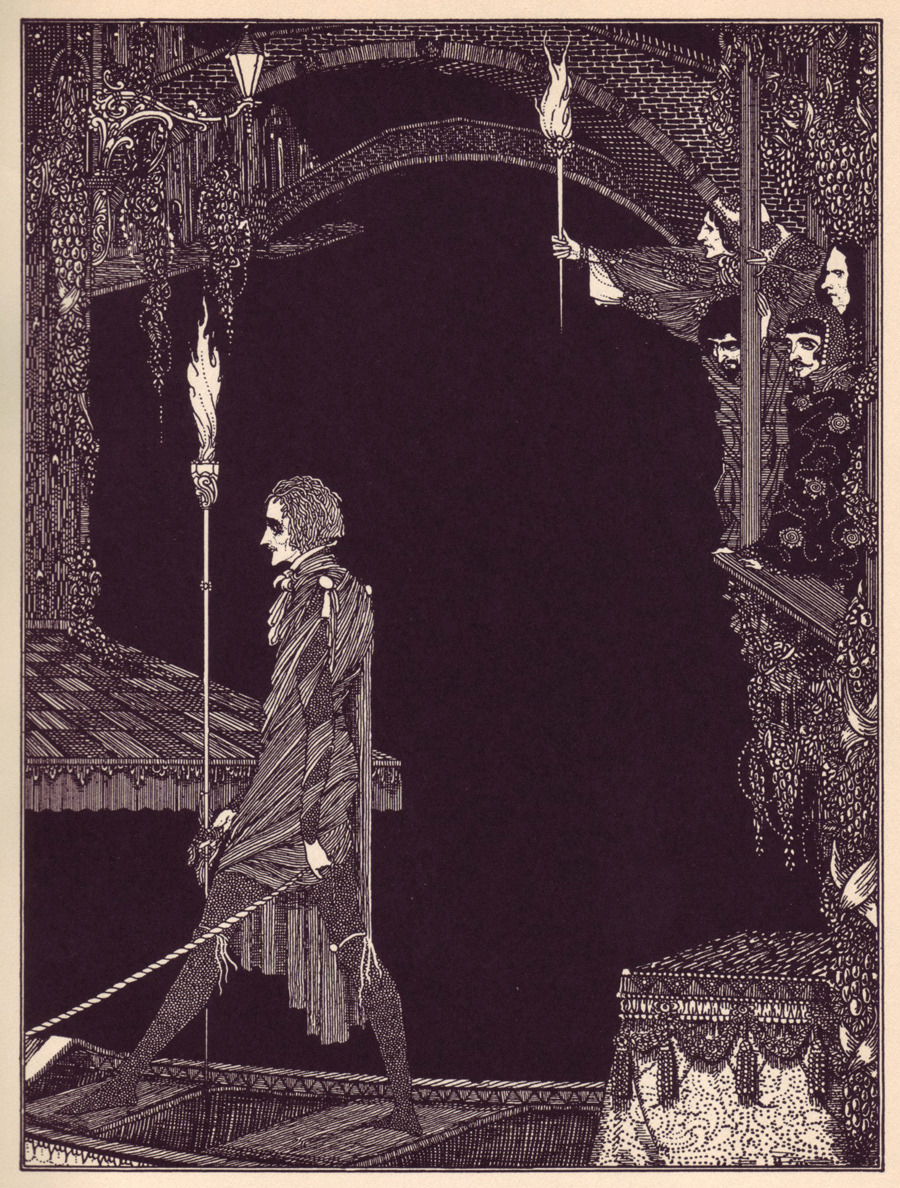
As you’ve probably noticed if you’re a regular reader of this site, we’re big fans of book illustration, particularly that from the form’s golden age—the late 18th and 19th century—before photography took over as the dominant visual medium. But while photographs largely supplanted illustrations in textbooks, magazines, and newspapers over the course of the 20th century, works of fiction, which had been routinely published in lavishly illustrated editions, suddenly became the featureless banks of words we know today. Though image-heavy graphic novels and comic books have thrived in recent decades, the illustrated literary text is a rarity indeed.
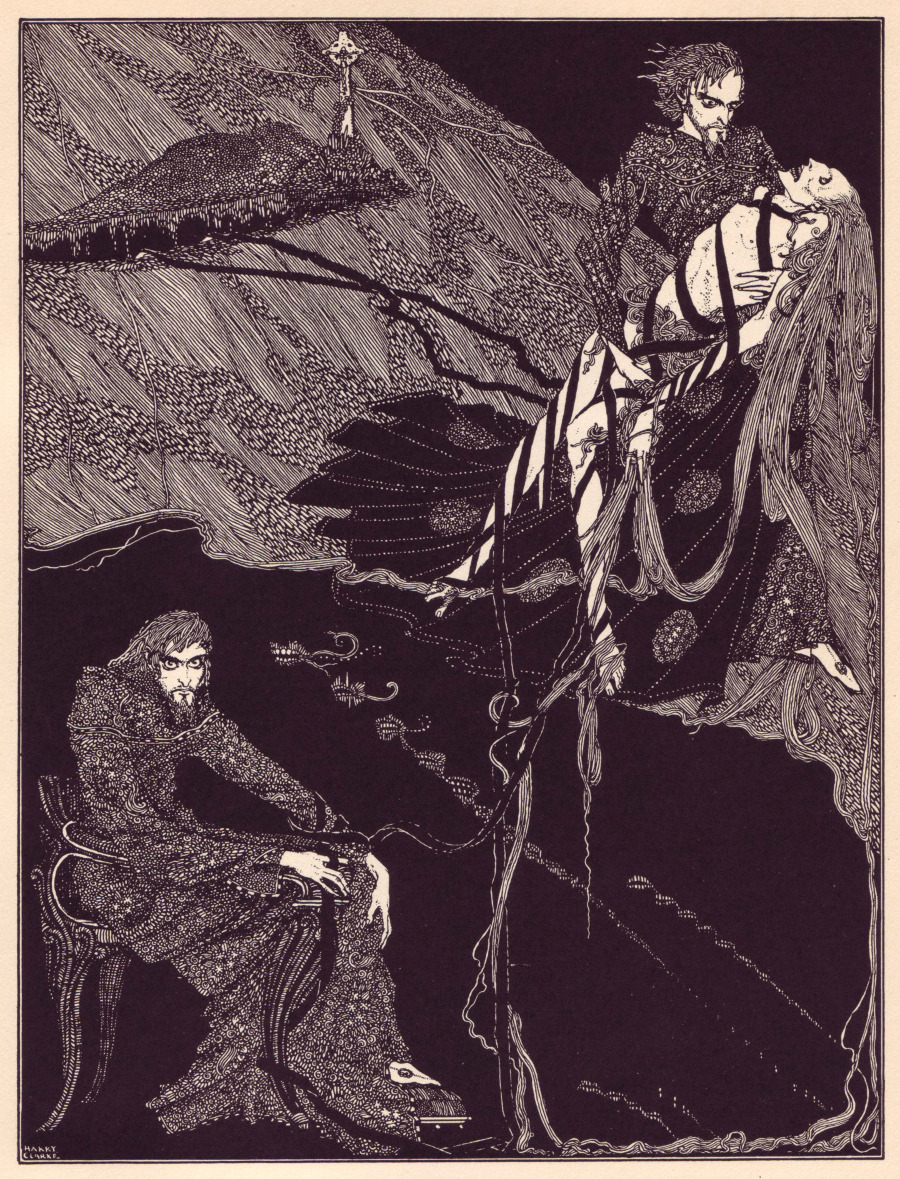
Why did this change come about? “I really don’t know,” writes Christopher Howse at The Telegraph, but he points out that the era of illustrated fiction for grown-ups ended “after the death of the big Victorian novelists,” like Dickens and Trollope. Before adult picture-books went out of style, several now-famous artists made careers as book illustrators. When we think of the big names from the period, we think of Aubrey Beardsley and Gustave Doré, both of whom we’ve covered heavily here. We tend not to think of Irish artist Harry Clarke—a relative latecomer—but we should. Of the many incredible illustrations from famous works of literature we’ve featured here, my favorite might be Clarke’s 1926 illustrations of Goethe’s Faust.
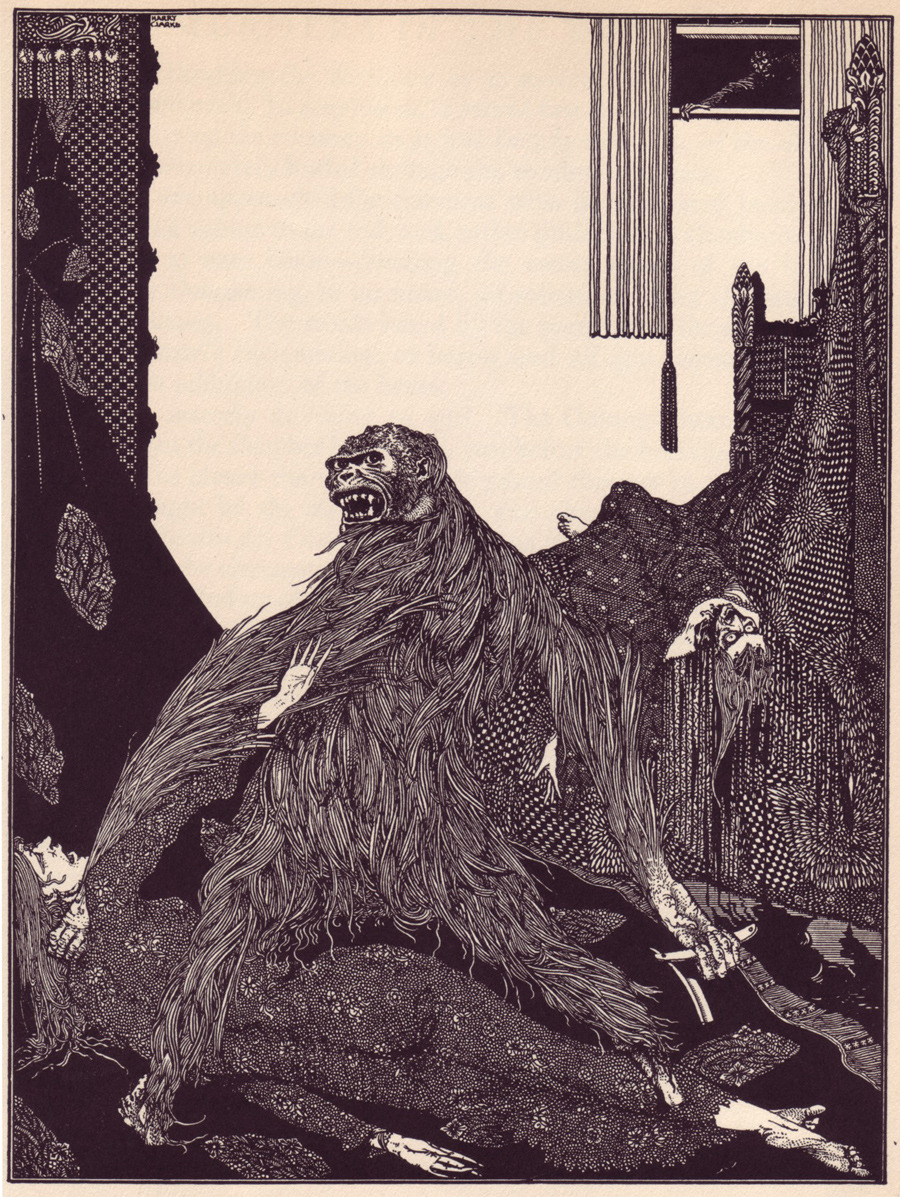
So out-there are some of his illustrations, so delightfully nightmarish and weird, one is tempted to fall back on that rather sophomoric explanation for art we find disturbing: maybe he was on drugs! Not that he’d need them to conjure up many of the images he did. His source material is bizarre enough (maybe Goethe was on drugs!). In any case, we can definitely call Clarke’s work hallucinatory, and that goes for his earlier, 1923 illustrations of Edgar Allan Poe’s Tales of Mystery and Imagination as well, of which you can see a few choice examples here.
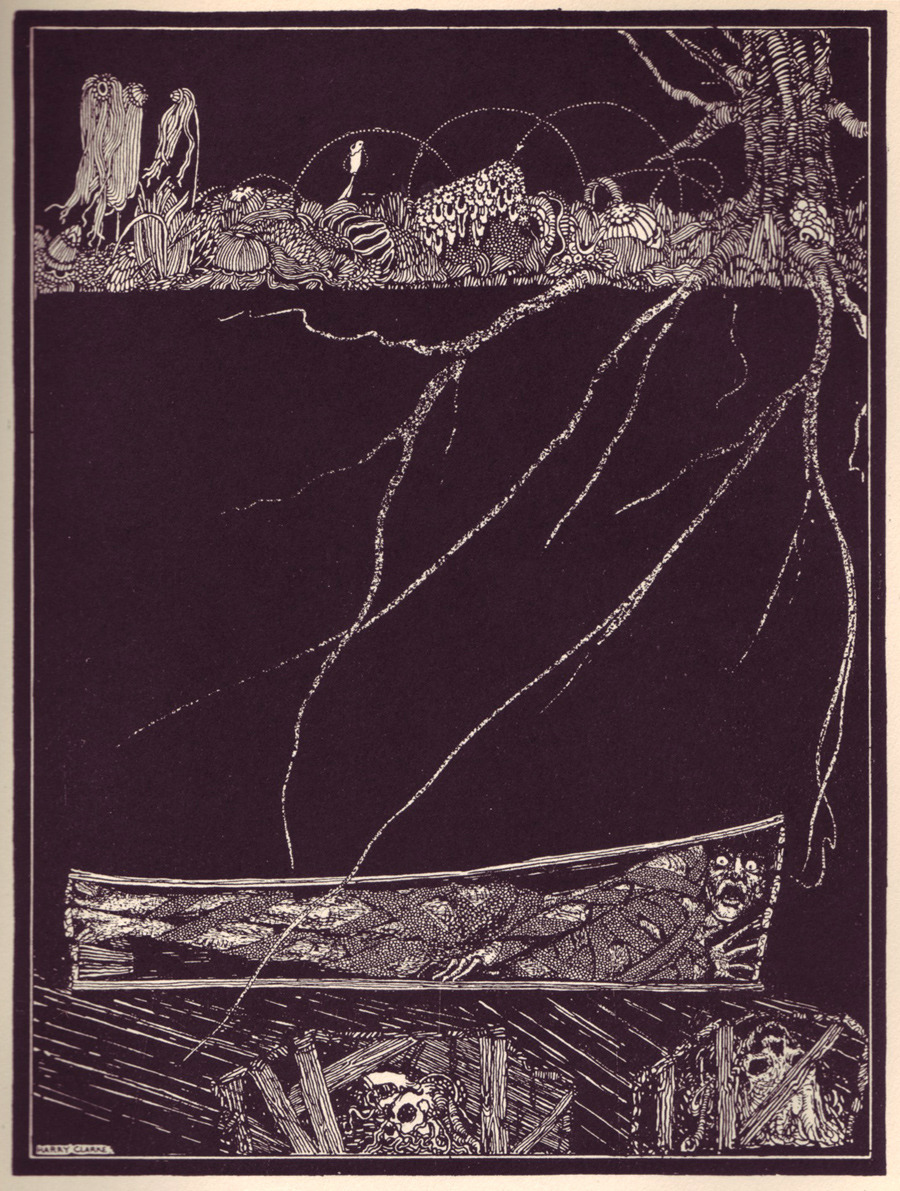
Dublin-born Clarke worked as a stained-glass artist as well as an illustrator, and drew his inspiration from the earlier art nouveau aesthetic of Beardsley and others, adding his own rococo flourishes to the elongated forms and decorative patterns favored by those artists. His glowering figures—including one who looks quite a bit like Poe himself, at the top—suit the feverish intensity of Poe’s world to perfection. And like Poe, Clarke’s art generally thrived in a seductively dark underworld filled with ghouls and fiends. Both of these proto-goths died young, Poe under mysterious circumstances at age 40, Clarke of tuberculosis at 42.
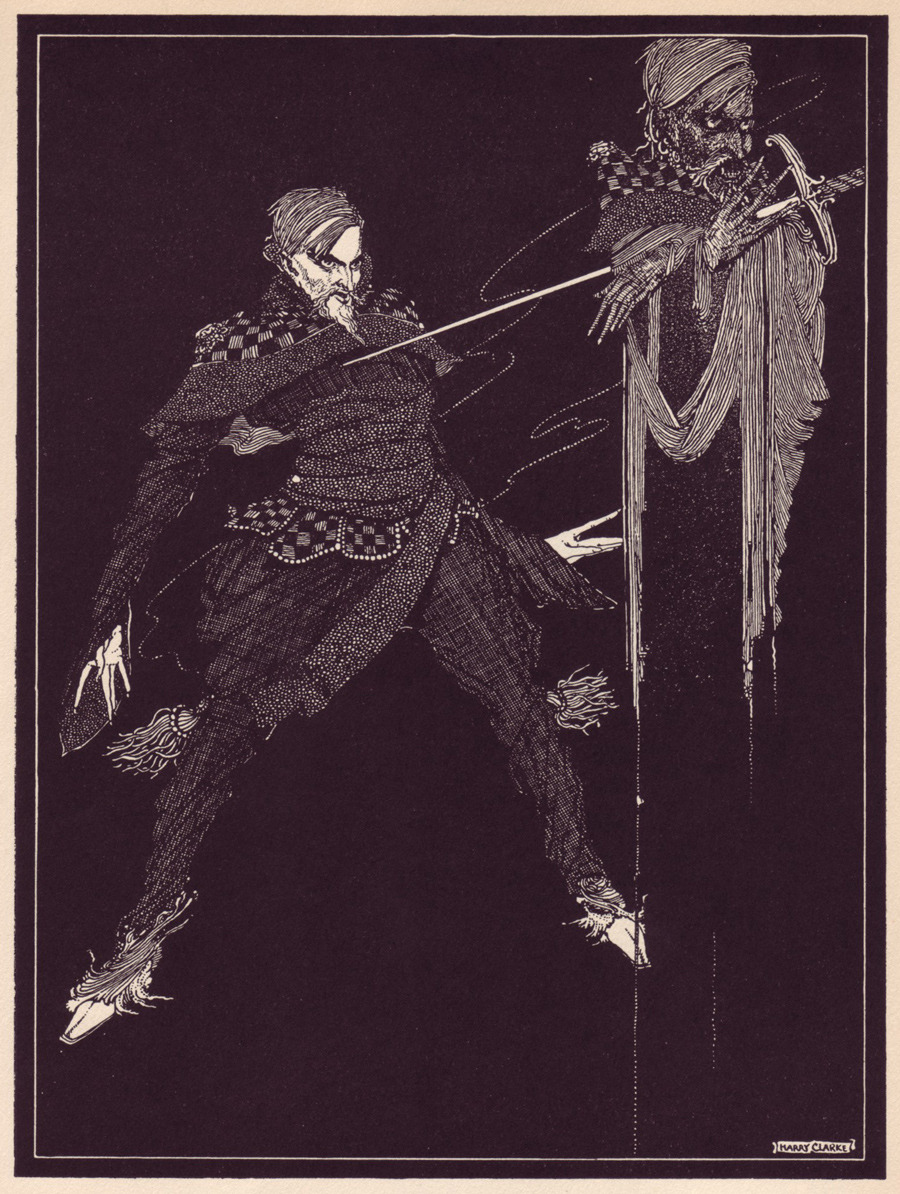
Clarke’s illustrated edition of Poe contained 8 full-color plates and 24 black and white illustrations. The Irish artist also notably illustrated editions of the fairy tales of Hans Christian Andersen and Charles Perrault, with images that—as you might imagine—are likely to terrify some sensitive children. You can purchase your own edition of the Clarke-illustrated Poe here, re-released in 2008 by Calla Press. And to see all 24 of Clarke’s black and white plates, head over to 50 Watts.
Note: An earlier version of this post appeared on our site in 2016.
Related Content:
Gustave Doré’s Macabre Illustrations of Edgar Allan Poe’s “The Raven” (1884)
Aubrey Beardsley’s Macabre Illustrations of Edgar Allan Poe’s Short Stories (1894)
Harry Clarke’s 1926 Illustrations of Goethe’s Faust: Art That Inspired the Psychedelic 60s
Josh Jones is a writer and musician based in Durham, NC. Follow him at @jdmagness
Read More...Jean-Luc Godard Shoots Marianne Faithfull (RIP) Singing “As Tears Go By” in 1966
Note: Yesterday, Marianne Faithfull passed away at age 78. In her memory, we’re bringing back a favorite from deep in our archive. It originally appeared on our site in June 2012.
When you want to learn a thing or two about Jean-Luc Godard, you turn to New Yorker film critic Richard Brody. I do, anyway, since the man wrote the book on Godard: namely, Everything is Cinema: The Working Life of Jean-Luc Godard. He followed up our post on Godard’s film of Jefferson Airplane’s 1968 rooftop concert with a tweet linking us to a clip from Godard’s feature Made in U.S.A
That film came out in 1966, two years before the immortal Airplane show but well into Godard’s first major burst of daring creativity, which began with 1959’s Breathless and lasted at least until Sympathy for the Devil, his 1968 documentary on — or, anyway, including — the Rolling Stones. Brody pointed specifically to the clip above, a brief scene where Marianne Faithfull sings “As Tears Go By,” a hit, in separate recordings, for both Faithfull and the Stones.
Brody notes how these two minutes of a cappella performance from the 19-year-old Faithfull depict the “styles of the day.” For a long time since that day, alas, we American filmgoers hadn’t had a chance to fully experience Made in U.S.A. Godard based its script on Donald E. Westlake’s novel The Jugger but never bothered to secure adaptation rights, and the film drifted in legal limbo until 2009. But today, with that red tape cut, crisp new prints circulate freely around the United States. Keep an eye on your local revival house’s listings so you won’t miss your chance to witness Faithfull’s café performance, and other such Godardian moments, in their theatrical glory. The cinephilically intrepid Brody, of course, found a way to see it, after a fashion, nearly thirty years before its legitimate American release: “The Mudd Club (the White Street night spot and music venue) got hold of a 16-mm. print and showed it — with the projector in the room — to a crowd of heavy smokers. It was like watching a movie outdoors in London by night, or as if through the shrouding mists of time.”
If you would like to support the mission of Open Culture, consider making a donation to our site. It’s hard to rely 100% on ads, and your contributions will help us continue providing the best free cultural and educational materials to learners everywhere. You can contribute through PayPal, Patreon, and Venmo (@openculture). Thanks!
Related Content:
Watch David Bowie & Marianne Faithfull Rehearse and Sing Sonny & Cher’s “I Got You Babe” (1973)
Colin Marshall hosts and produces Notebook on Cities and Culture. Follow him on Twitter at @colinmarshall.
Read More...Explore a Digitized Edition of the Voynich Manuscript, “the World’s Most Mysterious Book”
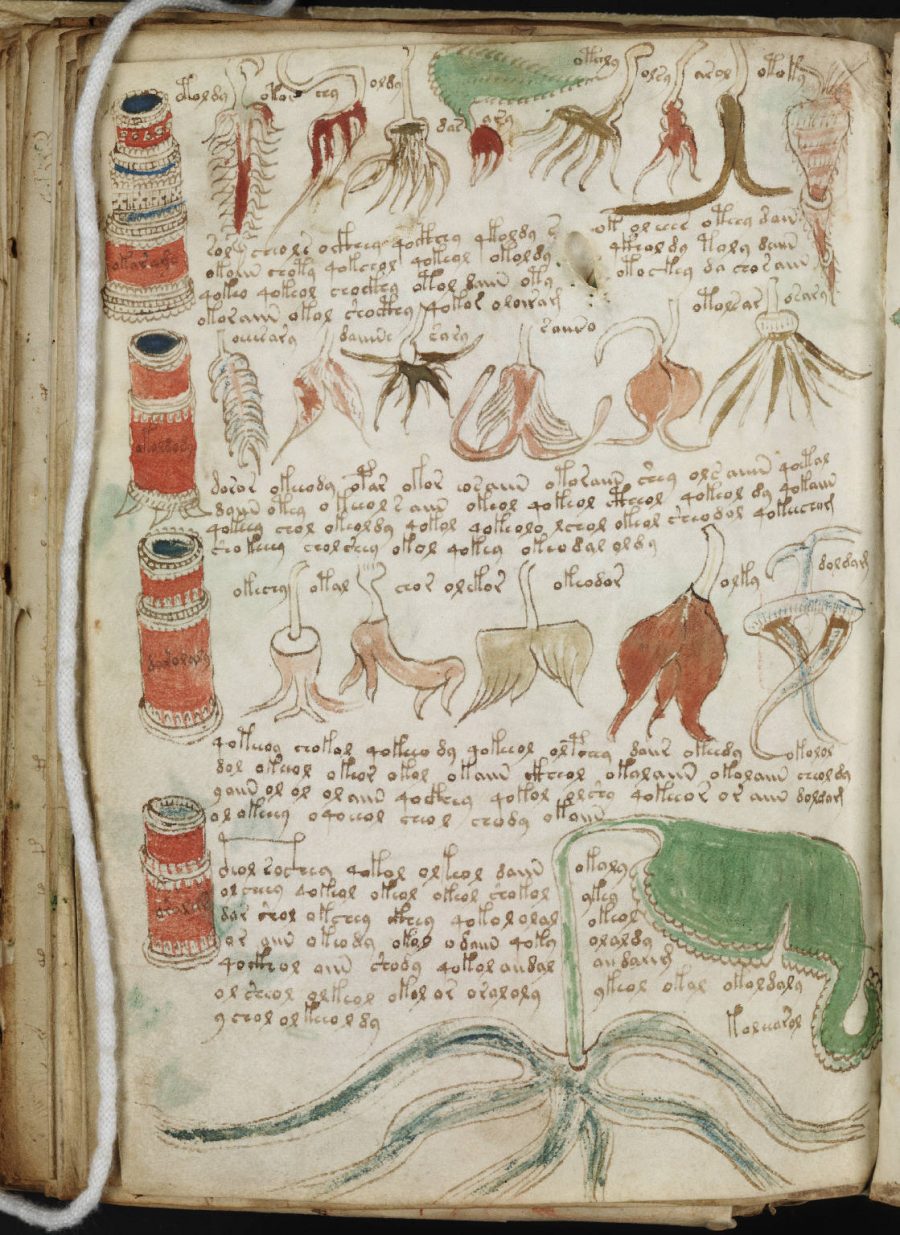
A 600-year-old manuscript—written in a script no one has ever decoded, filled with cryptic illustrations, its origins remaining to this day a mystery…. It’s not as satisfying a plot, say, of a National Treasure or Dan Brown thriller, certainly not as action-packed as pick-your-Indiana Jones…. The Voynich Manuscript, named for the antiquarian who rediscovered it in 1912, has a much more hermetic nature, somewhat like the work of Henry Darger; it presents us with an inscrutably alien world, pieced together from hybridized motifs drawn from its contemporary surroundings.
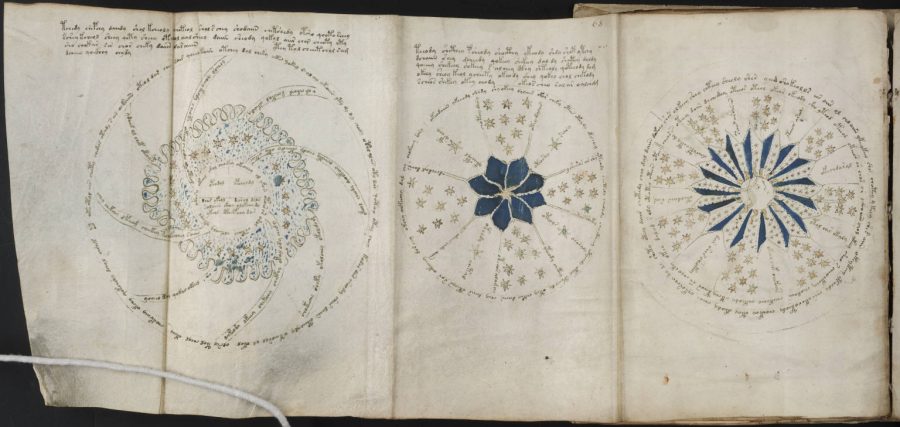
The Voynich Manuscript is unique for having made up its own alphabet while also seeming to be in conversation with other familiar works of the period, such that it resembles an uncanny doppelganger of many a medieval text.
A comparatively long book at 234 pages, it roughly divides into seven sections, any of which might be found on the shelves of your average 1400s European reader—a fairly small and rarefied group. “Over time, Voynich enthusiasts have given each section a conventional name” for its dominant imagery: “botanical, astronomical, cosmological, zodiac, biological, pharmaceutical, and recipes.”
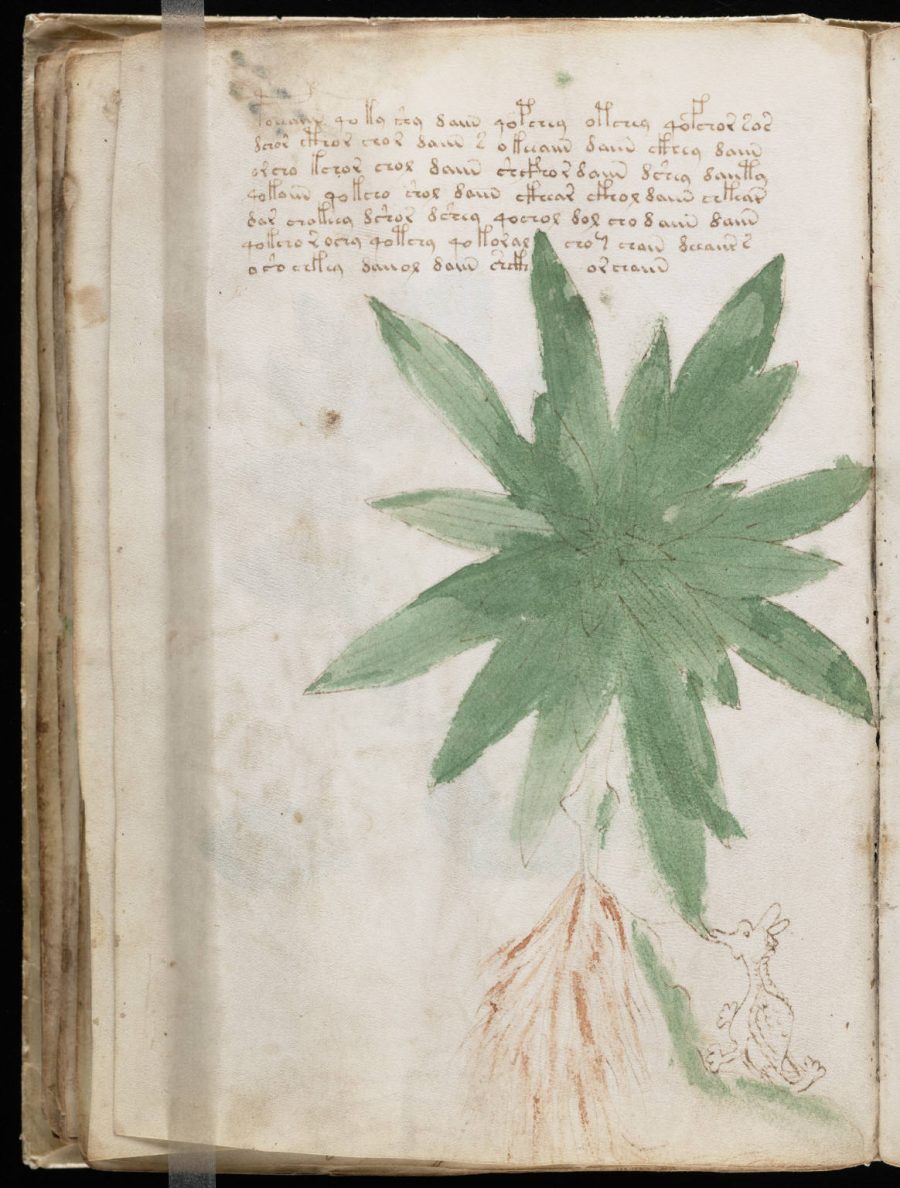
Scholars can only speculate about these categories. The manuscript’s origins and intent have baffled cryptologists since at least the 17th century, when, notes Vox, “an alchemist described it as ‘a certain riddle of the Sphinx.’” We can presume, “judging by its illustrations,” writes Reed Johnson at The New Yorker, that Voynich is “a compendium of knowledge related to the natural world.” But its “illustrations range from the fanciful (legions of heavy-headed flowers that bear no relation to any earthly variety) to the bizarre (naked and possibly pregnant women, frolicking in what look like amusement-park waterslides from the fifteenth century).”
The manuscript’s “botanical drawings are no less strange: the plants appear to be chimerical, combining incompatible parts from different species, even different kingdoms.” These drawings led scholar Nicholas Gibbs to compare it to the Trotula, a Medieval compilation that “specializes in the diseases and complaints of women,” as he wrote in a Times Literary Supplement article. It turns out, according to several Medieval manuscript experts who have studied the Voynich, that Gibbs’ proposed decoding may not actually solve the puzzle.
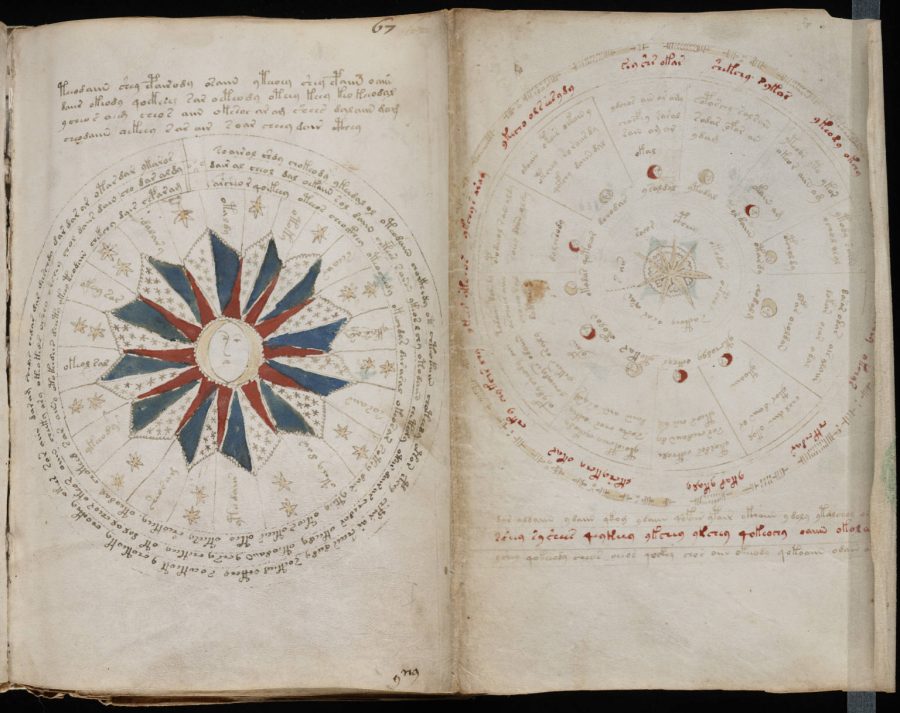
The degree of doubt should be enough to keep us in suspense, and therein lies the Voynich Manuscript’s enduring appeal—it is a black box, about which we might always ask, as Sarah Zhang does, “What could be so scandalous, so dangerous, or so important to be written in such an uncrackable cipher?” Wilfred Voynich himself asked the same question in 1912, believing the manuscript to be “a work of exceptional importance… the text must be unraveled and the history of the manuscript must be traced.” Though “not an especially glamorous physical object,” Zhang observes, it has nonetheless taken on the aura of a powerful occult charm.
But maybe it’s complete gibberish, a high-concept practical joke concocted by 15th century scribes to troll us in the future, knowing we’d fill in the space of not-knowing with the most fantastically strange speculations. This is a proposition Stephen Bax, another contender for a Voynich solution, finds hardly credible. “Why on earth would anyone waste their time creating a hoax of this kind?,” he asks. Maybe it’s a relic from an insular community of magicians who left no other trace of themselves. Surely in the last 300 years every possible theory has been suggested, discarded, then picked up again.
Should you care to take a crack at sleuthing out the Voynich mystery—or just to browse through it for curiosity’s sake—you can find the manuscript scanned at Yale’s Beinecke Rare Book & Manuscript Library, which houses the vellum original. Or flip through the Internet Archive’s digital version above. Another privately-run site contains a history and description of the manuscript and annotations on the illustrations and the script, along with several possible transcriptions of its symbols proposed by scholars. Good luck!
Note: An earlier version of this post appeared on our site in 2017.
Related Content:
1,000-Year-Old Illustrated Guide to the Medicinal Use of Plants Now Digitized & Put Online
An Introduction to the Codex Seraphinianus, the Strangest Book Ever Published
Josh Jones is a writer and musician based in Durham, NC. Follow him at @jdmagness
Read More...Mahatma Gandhi’s List of the Seven Social Sins; or Tips on How to Avoid Living the Bad Life

Image via Wikimedia Commons
In 590 AD, Pope Gregory I unveiled a list of the Seven Deadly Sins – lust, gluttony, greed, sloth, wrath, envy and pride – as a way to keep the flock from straying into the thorny fields of ungodliness. These days, though, for all but the most devout, Pope Gregory’s list seems less like a means to moral behavior than a description of cable TV programming.
So instead, let’s look to one of the saints of the 20th century–Mahatma Gandhi. On October 22, 1925, Gandhi published a list he called the Seven Social Sins in his weekly newspaper Young India.
- Politics without principles.
- Wealth without work.
- Pleasure without conscience.
- Knowledge without character.
- Commerce without morality.
- Science without humanity.
- Worship without sacrifice.
The list sprang from a correspondence that Gandhi had with someone only identified as a “fair friend.” He published the list without commentary save for the following line: “Naturally, the friend does not want the readers to know these things merely through the intellect but to know them through the heart so as to avoid them.”
Unlike the Catholic Church’s list, Gandhi’s list is expressly focused on the conduct of the individual in society. Gandhi preached non-violence and interdependence and every single one of these sins are examples of selfishness winning out over the common good.
It’s also a list that, if fully absorbed, will make the folks over at the US Chamber of Commerce and Ayn Rand Institute itch. After all, “Wealth without work,” is a pretty accurate description of America’s 1%. (Investments ain’t work. Ask Thomas Piketty.) “Commerce without morality” sounds a lot like every single oil company out there and “knowledge without character” describes half the hacks on cable news. “Politics without principles” describes the other half.
In 1947, Gandhi gave his fifth grandson, Arun Gandhi, a slip of paper with this same list on it, saying that it contained “the seven blunders that human society commits, and that cause all the violence.” The next day, Arun returned to his home in South Africa. Three months later, Gandhi was shot to death by a Hindu extremist.
Note: An earlier version of this post appeared on our site in 2014.
Related Content:
Albert Einstein Expresses His Admiration for Mahatma Gandhi, in Letter and Audio
Isaac Newton Creates a List of His 57 Sins (Circa 1662)
Mahatma Gandhi Talks (in First Recorded Video)
When Mahatma Gandhi Met Charlie Chaplin (1931)
Hear Gandhi’s Famous Speech on the Existence of God (1931)
Jonathan Crow is a writer and filmmaker whose work has appeared in Yahoo!, The Hollywood Reporter, and other publications,
Read More...10,000+ Free Online Certificates & Badges: A Resource for Lifelong Learners

For those looking to boost their skills or explore new fields without breaking the bank, Class Central has done the heavy lifting. Known as a search engine for online courses, Class Central has compiled what might be the largest collection of free online certificates and badges available anywhere. From tech giants like Google and Microsoft to elite universities like Harvard and Stanford, this list covers a diverse range of subjects and skill sets.
There was a time when the world’s top universities used to offer free certificates for completing online courses. While most of those certificates are no longer free, many of the courses themselves remain open to learners, covering topics like Computer Science, Literature, and Business.
Certificates can serve as both motivation and proof of achievement for completing online courses. While platforms like Coursera and edX have moved toward paid certifications, a surprising number of free options remain — if you know where to look. Thankfully, Class Central’s guide makes it easy to find these opportunities.
What’s Included in the Guide?
The article organizes free certificate offerings by providers, including:
- Google: Over 1,000 free certificates and badges in topics like digital marketing, Android development, and AI.
- Harvard: Free certificates for their popular CS50 series and other online courses.
- Stanford Medicine: Medical courses offering free certificates and CME credit.
- LinkedIn Learning: 110+ hours of free certifications in business, technology, and design.
- Semrush Academy: 90+ courses with free certificates focused on marketing and SEO.
- CodeSignal: 700+ free skill certifications to validate coding, technical abilities, and soft skills.
If you’re ready to explore the full list of free courses and certifications, head over to Class Central’s detailed guide: Massive List of Thousands of Free Certificates and Badges. It’s a treasure trove for anyone looking to learn something new, enhance their resume, or simply satisfy their curiosity — all for free!
Read More...
Everything You Need to Know About Saturday Night Live: A Deep Dive into Every Season of the Iconic Comedy Show
Saturday Night Live began its 50th season last fall, around the same time as the premiere of Jason Reitman’s film Saturday Night, which dramatizes the program’s 1975 debut. All of this has put fans into something of a retrospective mood, especially if they happen to have been tuning in since the very beginning. For others, SNL is a show they haven’t been watching all that long, used to watch, or watched at one time and have started watching again. With its ever-changing cast, writers, sketch concepts, and overall comedic sensibility, it’s never remained the same for too long at a stretch, and though many viewers have their favorite seasons, few grasp the full sweep of its history as a television institution.
Now, anyone can get a sense of SNL in its entirety with Everything You NEED to Know About Saturday Night Live, a YouTube series that, true to its title, recounts the show’s most notable performers, characters, innovations, troubles, and moments planned or otherwise (often the latter, given the nature of the broadcast). Each season gets its own episode, starting with the first, whose Not Ready for Prime Time Players included such young up-and-comers as Dan Aykroyd, John Belushi, Chevy Chase, and Gilda Radner.
As that list of names would imply, this “hip comedy variety program for baby boomers that dared to stay up late” soon became a veritable force of era-defining funnymen and funnywomen. Then as now, SNL tends to send its breakout stars to Hollywood, albeit with varying results.
That contributes to the constant churn that has brought onto the show’s roster such household-names-to-be as Bill Murray, Eddie Murphy, Billy Crystal, Adam Sandler, and Tina Fey, while also featuring non-cast-members like Penn and Teller or guest hosts like Steve Martin, whose appearances greatly raised their own profiles. To watch through these encapsulations, which as of this writing have reached season nineteen (1993–94), is to take a journey through American popular culture itself. Creator Lorne Michaels’ recently declared lack of intent to step down any time soon bolsters SNL’s aura of unstoppabilty, built up over five decades of influential personalities, still-quoted gags, and instantly recognizable characters — if also the occasional uncooperative host, chemistry-free cast, or accidentally uttered bit of profanity. But what’s the fun of doing half a century of live TV if it goes without a hitch?
Follow Everything You NEED to Know About Saturday Night Live here.
Related content:
Saturday Night Live’s Very First Sketch: Watch John Belushi Launch SNL in October, 1975
Classic Punk Rock Sketches from Saturday Night Live, Courtesy of Fred Armisen
Based in Seoul, Colin Marshall writes and broadcasts on cities, language, and culture. His projects include the Substack newsletter Books on Cities and the book The Stateless City: a Walk through 21st-Century Los Angeles. Follow him on the social network formerly known as Twitter at @colinmarshall.
Read More...Support Us
We're hoping to rely on loyal readers, rather than erratic ads. Please click the Donate button and support Open Culture. You can use Paypal, Venmo, Patreon, even Crypto! We thank you!

About Us

Open Culture scours the web for the best educational media. We find the free courses and audio books you need, the language lessons & educational videos you want, and plenty of enlightenment in between.
Advertise With Us

FREE UPDATES!
GET OUR DAILY EMAIL
Get the best cultural and educational resources on the web curated for you in a daily email. We never spam. Unsubscribe at any time.
FOLLOW ON SOCIAL MEDIA

Open Culture editor Dan Colman scours the web for the best educational media. He finds the free courses and audio books you need, the language lessons & movies you want, and plenty of enlightenment in between.
Advertise With Us


