Nirvana Before They Were Nirvana: Watch Their 1988 Performance Recorded in a Radio Shack
Here’s a strange home video of Nirvana when they were unknown, playing inside a Radio Shack in the band’s hometown of Aberdeen, Washington. The video was recorded on the evening of January 24, 1988, after the store had closed. In those days the group went by the name of Ted Ed Fred.
Only the day before, the band had recorded its first demo tape at a studio in Seattle. Guitarist and singer Kurt Cobain asked his new friend Eric Harter, who managed the Radio Shack, to videotape the band playing “Paper Cuts,” one of 10 songs from the demo. Along with Cobain, the video features Nirvana co-founder Krist Novoselic on bass and Dale Crover of the Melvins on drums.
The video below includes footage of Harter talking about the Radio Shack video and giving a copy of the tape to Cobain’s grieving widow Courtney Love, who is shown with her friend Kat Bjelland of Babes in Toyland. At one point, Harter mentions a “Ted Ed Fred” concert at the Community World Theater in Tacoma. To see a full video of that show, which was staged the night before the Radio Shack taping (and only hours after the demo session), click here.
Note: An earlier version of this post appeared on our site in 2013.
If you would like to support the mission of Open Culture, consider making a donation to our site. It’s hard to rely 100% on ads, and your contributions will help us continue providing the best free cultural and educational materials to learners everywhere. You can contribute through PayPal, Patreon, and Venmo (@openculture). Thanks!
Related Content:
The First Live Performance of ‘Smells Like Teen Spirit’ (1991)
Nirvana’s “Come As You Are” Played By Musicians Around the World
Kurt Cobain’s Isolated Vocal Track From ‘Smells Like Teen Spirit’
Nirvana’s Home Videos: An Intimate Look at the Band’s Life in 1988
Patti Smith’s Cover of Nirvana’s “Smells Like Teen Spirit” Strips the Song Down to its Heart
Read More...Compare the “It Ain’t Me Babe” Scene from A Complete Unknown to the Real Bob Dylan & Joan Baez Performance at the Newport Folk Festival
A Complete Unknown, the new movie about Bob Dylan’s rise in the folk-music scene of the early nineteen-sixties and subsequent electrified break with it, has been praised for not taking excessive liberties, at least by the standards of popular music biopics. Its conversion of a real chapter of cultural history has entailed various conflations, compressions, and rearrangements, but you’d expect that from a Hollywood director like James Mangold. What many viewers’ judgment will come down to is less historical veracity than whether they believe Timothée Chalamet as the young Bob Dylan — or rather, as the young Bob Dylan they’ve always imagined.
Still, much depends on the rest of the cast, who portray a host of major folk- and folk-adjacent figures including Pete Seeger, Woody Guthrie, Johnny Cash, Alan Lomax, and the late Peter Yarrow. No performance apart from Chalamet’s has received as much attention as Monica Barbaro’s Joan Baez. In those characters’ key scene together they take the stage at the 1964 Newport Folk Festival and sing “It Ain’t Me Babe,” a Dylan song that Baez also recorded. Their rendition conveys the depth of their romantic and artistic connection not just to the audience, but also to Dylan’s girlfriend, played by Elle Fanning, watching just offstage.
“That idea of the secret is really what I needed to drive the scene,” says Mangold, using the language of his trade, in the Variety video at the top of the post. “Ultimately, I’ve got to get it to where Elle is driven away by whatever she’s seen on stage. But it wouldn’t have worked as well if Chalamet and Barbaro hadn’t nailed the performance, just one of many in the film shot 100 percent live. If you’d like to compare them to the real thing, have a look at the footage of Dylan and Baez singing “It Ain’t Me Babe” at the actual 1964 Newport Folk Festival just above. After that, you may want to go back to the previous year’s festival and watch their performance of “With God on Our Side” — and, while you’re at it, listen to Dylan’s entire catalog all over again.
Related content
Joan Baez Live in 1965: Full Concert
Bob Dylan’s Historic Newport Folk Festival Performances, 1963–1965
Watch Joan Baez Endearingly Imitate Bob Dylan (1972)
A Massive 55-Hour Chronological Playlist of Bob Dylan Songs: Stream 763 Tracks
Based in Seoul, Colin Marshall writes and broadcasts on cities, language, and culture. His projects include the Substack newsletter Books on Cities and the book The Stateless City: a Walk through 21st-Century Los Angeles. Follow him on the social network formerly known as Twitter at @colinmarshall.
Read More...Radio Caroline, the Pirate Radio Ship That Rocked the British Music World (1965)
Nowadays musicians can reach hundreds, thousands, sometimes millions of listeners with a few, usually free, online services and a minimal grasp of technology. That’s not to say there aren’t still economic barriers aplenty for the struggling artist, but true independence is not an impossible prospect.
In the 1950s and 60s, on the other hand, as popular music attained newfound commercial value, musicians found themselves completely beholden to record companies and radio stations in order to have their music heard by nearly anyone. And those entities schemed together to promote certain recordings and ignore or marginalize others. Payola, in a word, ruled the day.
In the UK, a different but no less impregnable order presented itself to the aspiring obscurity. Rather than corporate interests and well-bribed DJs, the BBC and British government, writes the Modesto Radio Museum, “were increasingly hostile toward any competition for their radio monopoly.” (After WWII, the British Broadcasting Service maintained a monopoly on radio, and later television, broadcasting in the UK.) Enter the pirates.
While the phrase now denotes a class of freebooters who work from their terminals, the original music pirates actually took to the seas. The first, Radio Mercur, “established by a group of Danish businessmen” in 1958, “transmitted from a small ship anchored off Copenhagen, Denmark.” Mercur inspired Radio Nord in 1960, anchored off the Swedish Coast, then the Dutch Radio Veronica that same year.
Then, in 1962, Irish manager Ronan O’Rahilly met Australian businessman Allan Crawford. O’Rahilly had previously attempted to launch the career of musician Georgie Fame, but to no avail. Record companies wouldn’t record him, and when O’Rahilly funded an album, the BBC refused to play it—he wasn’t on their favored labels, EMI and Decca. So O’Rahilly and Crawford conspired to create their own pirate station, Radio Caroline (named after the daughter of John F. Kennedy).
They purchased their first ship, the MV Mi Amigo, in 1963, then set about securing funds and rigging up the vessel with two 10 Kilowatt AM transmitters and a 13-ton, 165 foot antenna mast. Broadcasting from 6am to 6pm daily, Radio Caroline managed to break the BBC monopoly (and launch Georgie Fame to… well actual, chart-topping fame). In 1965, a British Pathé film crew visited the ship, noting in their narration that “for over a year,” Radio Caroline had “given pop music to something like 20 million listeners,” changing British pop culture “with the connivance of almost every teenager in Southeast England.”
The station kicked off their first broadcast, which you can hear above, on Easter Sunday, March 1964, with the announcement, “This is Radio Caroline on 199, your all day music station.” The very first tune they played was the Rolling Stones’ cover of Buddy Holly’s “Not Fade Away” (one of the band’s first major hits). In the mid-60s pirate radio, particularly Radio Caroline, helped break a number of bands, introducing eager young listeners to The Who’s first four singles, for example. (The band returned the favor by attempting to give 1967’s The Who Sell Out the raw sound and feel of a pirate radio broadcast.)
Learn more about Radio Caroline’s long and storied existence in the documentary segment further up, Part 6 of DMC World’s comprehensive The History of DJ. The Modesto Radio Museum’s thorough, multipart essay series, complete with photographs, offers a rich history, as does Ray Clark’s book, Radio Caroline: The True Story of the Boat that Rocked. “The world’s most famous offshore radio station,” is still on the air today (even though the original ship sank in 1980) or rather, on the web, with streaming programs and “gadgets and widgets” for Android devices, iPhones, iPads, and browsers.
It’s something of an irony that they’ve ended up just one of hundreds of online streaming stations vying for listeners’ attention, but it’s safe to say that without their exploits in the 60s and beyond, pop music as we know it—with all its legal and not-so-legal means of dissemination—may never have spread and evolved into the myriad forms we now take for granted.
Note: An earlier version of this post appeared on our site in 2016.
Related Content:
How to Listen to the Radio: The BBC’s 1930 Manual for Using a New Technology
“Joe Strummer’s London Calling”: All 8 Episodes of Strummer’s UK Radio Show Free Online
Jimi Hendrix Wreaks Havoc on the Lulu Show, Gets Banned From BBC (1969)
Josh Jones is a writer and musician based in Durham, NC. Follow him at @jdmagness
Read More...The Complete History of the Music Video: From the 1890s to Today
If you want to understand the history of music videos, you must consider a lot of things that are not obviously music videos. The Buggles’ “Video Killed the Radio Star,” the first selection of MTV’s inaugural broadcast, must surely count as a music video — but then, it was produced a couple years earlier for the much different context of the British chart program Top of the Pops, much like Queen’s proto music video for “Bohemian Rhapsody” from 1975. But is Bob Dylan’s much-parodied card-dropping “performance” of “Subterranean Homesick Blues” from a decade earlier, shot for D. A. Pennebaker’s Dont Look Back, a music video? What about A Hard Day’s Night, the Beatles’ exuberantly narrative-light film from the year before?
All of these come up in the new history of the music video from YouTube channel Polyphonic above, which compiles into an over three-hour-long viewing experience all the episodes of its series on the subject. In its long historical view, the music video didn’t begin with the Fab Four, and not even with their epoch-making appearance on The Ed Sullivan Show.
One can trace it farther back, past Scopitone film jukeboxes (included in “the canon of Camp” by Susan Sontag in her famous essay); past Disney’s Fantasia (essentially eight animated classical music videos strung together); past even The Jazz Singer, the first feature-length musical “talkie,” which in 1927 put a definitive end to the era of silent film.
Perhaps the earliest identifiable predecessor of the music video is “The Little Lost Child,” which in 1894 was exhibited as an “illustrated song.” Its delivery of a narrative through projected still images accompanied by live piano was like nothing its audiences had experienced before, with an emotional power greater than the sum of its visual and musical parts. This was a brand new technology, and indeed, like any cultural history, that of the music video is also a technological history, one advanced by film, broadcast television, cable television, and in our time, internet streaming, which stayed the form’s looming prospect of pop-cultural irrelevance. Now, in the twenty-twenties, we must ask ourselves this: when TikTok users post themselves dancing, zooming in on pancakes, or skateboarding while drinking Ocean Spray, is it a music video?
Related content:
The 50 Greatest Music Videos of All Time, Ranked by AV Club
Michel Gondry’s Finest Music Videos for Björk, Radiohead & More: The Last of the Music Video Gods
Watch the First Two Hours of MTV’s Inaugural Broadcast (August 1, 1981)
David Bowie Releases 36 Music Videos of His Classic Songs from the 1970s and 1980s
Jim Jarmusch’s Anti-MTV Music Videos for Talking Heads, Neil Young, Tom Waits & Big Audio Dynamite
David Lynch’s Music Videos: Nine Inch Nails, Moby, Chris Isaak & More
Based in Seoul, Colin Marshall writes and broadcasts on cities, language, and culture. His projects include the Substack newsletter Books on Cities and the book The Stateless City: a Walk through 21st-Century Los Angeles. Follow him on the social network formerly known as Twitter at @colinmarshall.
Read More...When Christmas Was Legally Banned for 22 Years by the Puritans in Colonial Massachusetts
Complaints about the commercial-age corruption of Christmas miss one critical fact: as a mass public celebration, the holiday is a rather recent invention. Whether we credit Charles Dickens, Bing Crosby, or Frank Capra—men not opposed to marketing—we must reckon with Christmas as a product of modernity. That includes the sacred ideas about family, piety, and gratitude we attach to the season.
The Puritans of the Massachusetts Bay Colony “despised Christmas,” notes Boing Boing. They associated it with debauchery: heavy drinking, gluttony, riots, “rowdiness and sinful behavior.” Not only that, but they “saw it as a false holiday with stronger ties to paganism than Christianity,” writes Rebecca Beatrice Brooks at the History of Massachusetts blog, and “they were correct, according to the book The Battle for Christmas.”
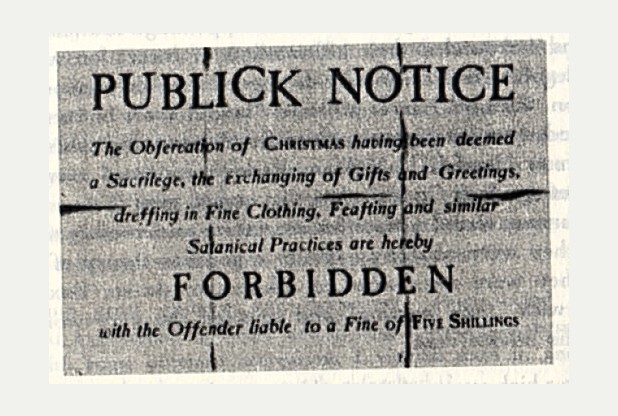
The History Dose video above informs us that in 1659, “the General Court of Massachusetts made it illegal to celebrate Christmas.” Feasting, or even taking off work on December 25th would result in a fine of five shillings. It seems extreme, but the holiday had a carnivalesque reputation at the time. Not only were revelers, at the end of a long year’s work, eager to enjoy the spoils of their labor, but their caroling might even turn into a kind of violent trick-or-treating.
“On some occasions the carolers would become rowdy and invade wealthy homes demanding food and drink,” Brooks writes. They “would vandalize the home if the owner refused.” The Puritans’ authoritarian streak, and respect for the sanctity of private property, made canceling Christmas the only seemingly logical thing to do, with a ban lasting 22 years. In any case, explicit ban or no, spurning Christmas was common practice for two hundred years of New England’s colonial history.
In the end, for all its supposed intrusions into the snow globe of Christmas purism, “we can partially thank commercialization for sustaining the domestic brand of Christmas we have today”—the brand, that is, that ensures we can’t stop talking about, reading about, and hearing about Christmas, whatever our beliefs, in the several weeks leading up to December 25th.
If you would like to support the mission of Open Culture, consider making a donation to our site. It’s hard to rely 100% on ads, and your contributions will help us continue providing the best free cultural and educational materials to learners everywhere. You can contribute through PayPal, Patreon, and Venmo (@openculture). Thanks!
Related Content:
Behold! The Very First Christmas Card (1843)
John Waters’ Hand-Made, Oddball Christmas Cards: 1964-Present
Watch Björk, Age 11, Read a Christmas Nativity Story on an Icelandic TV Special (1976)
Langston Hughes’ Homemade Christmas Cards From 1950
Josh Jones is a writer and musician based in Durham, NC. Follow him at @jdmagness.
Read More...Unlock AI’s Potential in Your Work and Daily Life: Take a Popular Course from Google
Generative AI is rapidly becoming an essential tool for streamlining work and solving complex challenges. However, knowing how to use GenAI effectively isn’t always obvious. That’s where Google Prompting Essentials comes in. This course will teach you to write clear and specific instructions—known as prompts—for AI. Once you can prompt well, you can unlock generative AI’s potential more fully.
Launched in April, Google Prompting Essentials has become the most popular GenAI course offered on Coursera. The course itself is divided into four modules. First, “Start Writing Prompts Like a Pro” will teach you a 5‑step method for crafting effective prompts. (Watch the video from Module 1 above, and more videos here.) With the second module, “Design Prompts for Everyday Work Tasks,” you will learn how to use AI to draft emails, brainstorm ideas, and summarize documents. The third module, “Speed Up Data Analysis and Presentation Building,” teaches techniques for uncovering insights in data, visualizing results, and preparing presentations. The final module, “Use AI as a Creative or Expert Partner,” explores advanced techniques such as prompt chaining and multimodal prompting. Plus, you will “create a personalized AI agent to role-play conversations and provide expert feedback.”
Offered on the Coursera platform, Google Prompting Essentials costs $49. Once you complete the course, you will receive a certificate from Google to share with your network and employer. Better yet, you will understand how to make GenAI a more useful tool in your life and work. Enroll here.
Note: Open Culture has a partnership with Coursera. If readers enroll in certain Coursera courses and programs, it helps support Open Culture.
Read More...The BBC Creates Step-by-Step Instructions for Knitting the Iconic Dr. Who Scarf: A Document from the Early 1980s
When Jon Pertwee reincarnated into Tom Baker in 1974, the Fourth Doctor of the popular sci-fi show Doctor Who ditched the foppish look of velvet jackets and frilly shirts, and went for the “Romantic adventurer” style, with floppy felt hat, long overcoats and, most iconically, his multicolored scarf.
Fan legend has it that costume designer James Acheson picked up a load of multi-color wool and asked knitter Begonia Pope to create a scarf, and Pope, perhaps mishearing, used *all* the wool, resulting in a scarf that ran 12 feet long. The mistake was perfect, and suddenly many UK grandmothers were being asked by their grandchildren to recreate their hero’s look.
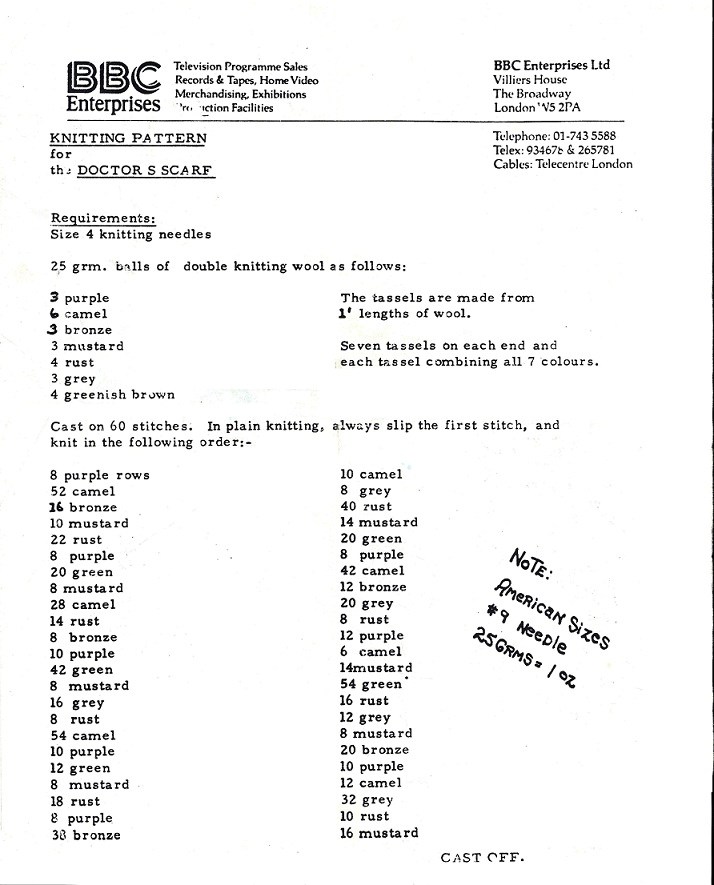
The above memo isn’t dated, but comes from sometime in the early ‘80s when the BBC sent detailed instructions to a fan’s mother on making the scarf. (Click here, then click again, to view the document in a larger format.) The colors include camel, rust, bronze, mustard, grey, green and purple and should be knitted with size four needles (that’s #9 US size). The requests must have come regularly, because a similar memo is reprinted from many years later to another fan’s family.
The original scarf only lasted a few episodes, then was altered, replaced, and subtly changed as the show went on. There were stunt scarves for stand-ins.
Come Season 18, costume designer June Hudson rethought the entire costume and streamlined the colors to three: rust, wine, and purple, to match the Doctor’s more swashbuckling look. It also became the longest scarf of the series, some 20 feet.
The following year, the Doctor reincarnated again into a cricket-jumper and striped trouser-wearing young blonde man. The Scarf Years were over.
For a very in-depth look at the scarves, including Pantone color references and wool brands, there is nothing better than DoctorWhoScarf.com. So, get knitting, Who-vians!
Related Content:
How Doctor Who First Started as a Family Educational TV Program (1963)
The Fascinating Story of How Delia Derbyshire Created the Original Doctor Who Theme
Ted Mills is a freelance writer on the arts who currently hosts the FunkZone Podcast. You can also follow him on Twitter at @tedmills, read his other arts writing at tedmills.com and/or watch his films here.
Read More...Édouard Manet Illustrates Edgar Allan Poe’s The Raven, in a French Edition Translated by Stephane Mallarmé (1875)
Edgar Allan Poe achieved almost instant fame during his lifetime after the publication of The Raven (1845), but he never felt that he received the recognition he deserved. In some respects, he was right. He was, after all, paid only nine dollars for the poem, and he struggled before and after its publication to make a living from his writing.
Poe was one of the first American writers to do so without independent means. His work largely met with mixed reviews and he was fired from job after job, partly because of his drinking. After his death, however, Poe’s influence dominated emerging modernist movements like that of the decadent poetry of Charles Baudelaire (who called Poe his “twin soul”) and his symbolist disciple Stéphane Mallarmé.
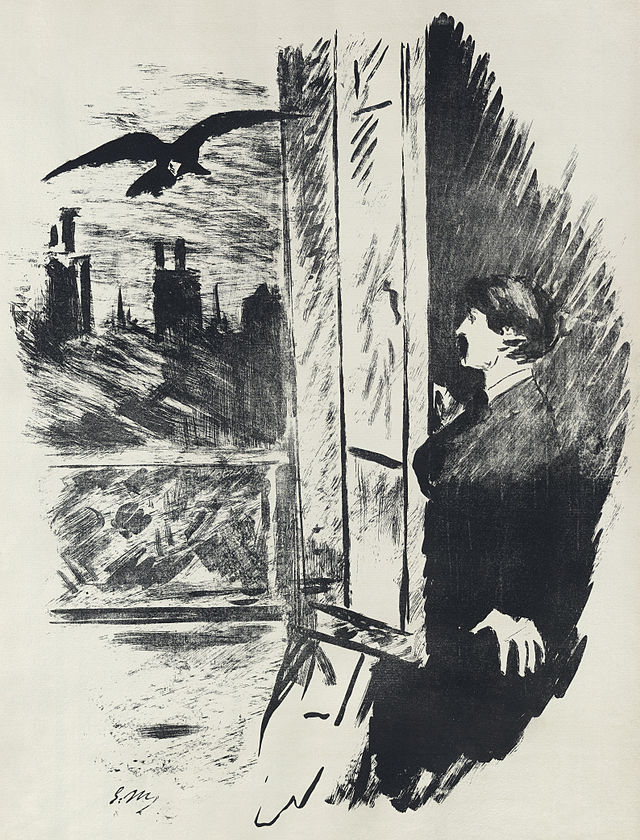
Mallarmé would write of Poe, “His century appalled at never having heard / That in this voice triumphant death had sung its hymn.” To bring that hymn of death, the raven’s cry of “Nevermore,” to French readers, he made a translation of The Raven, Le Corbeau, in 1875 at age 33.
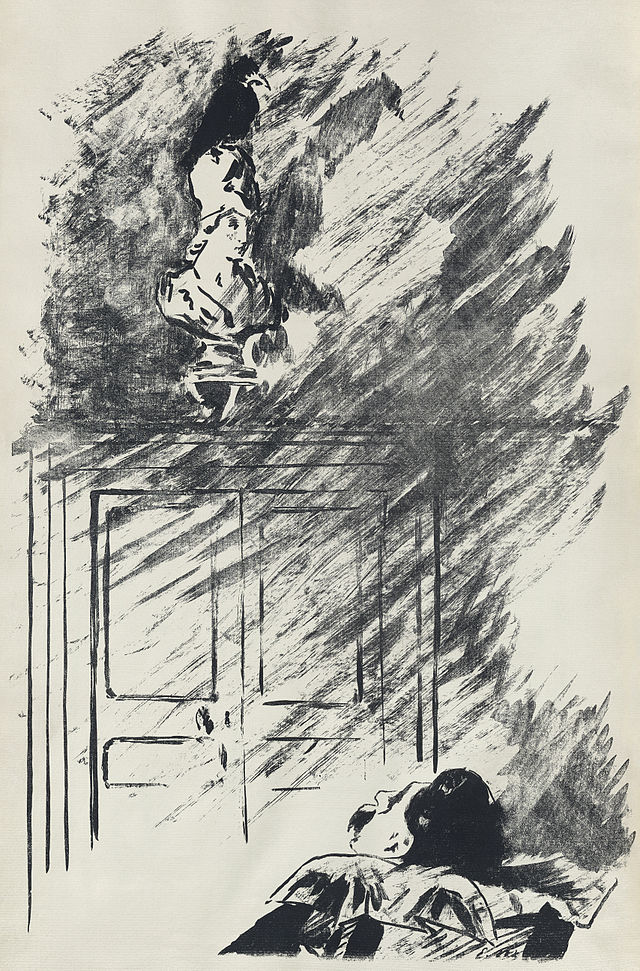
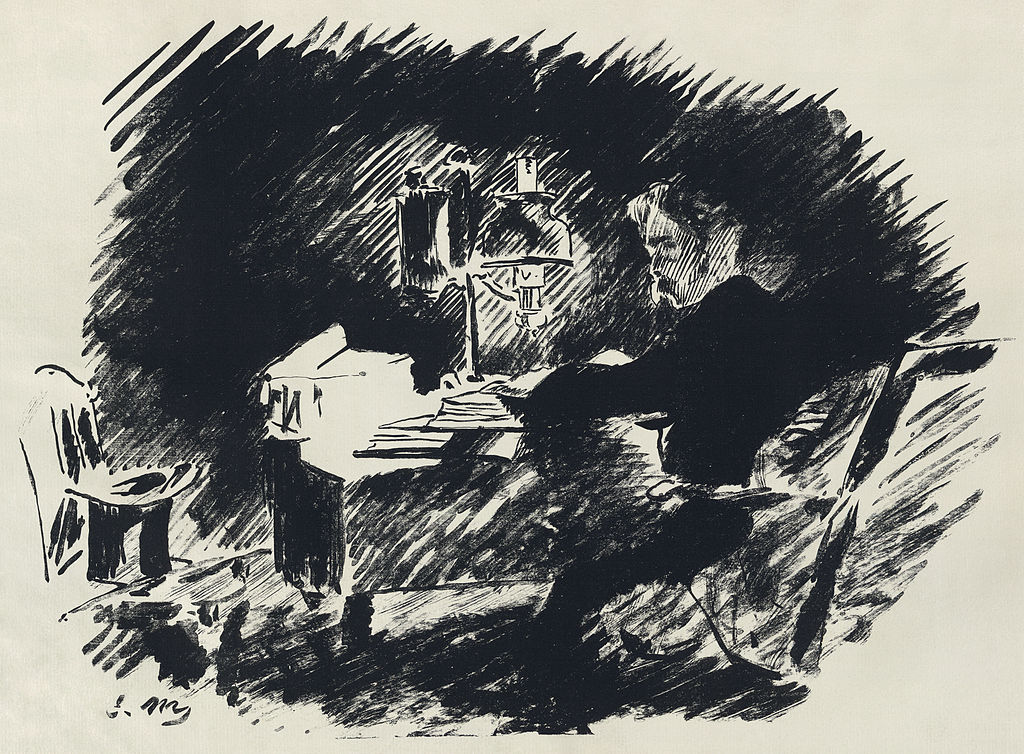
Poe also had a tremendous influence on the visual arts in France. Illustrating the text was none other than Édouard Manet, the painter credited with the genesis of impressionism. The resulting engravings, rendered in dark, heavy smudges, give us the poem’s unnamed, bereaved speaker as the young Mallarmé, unmistakable with his pushbroom mustache.
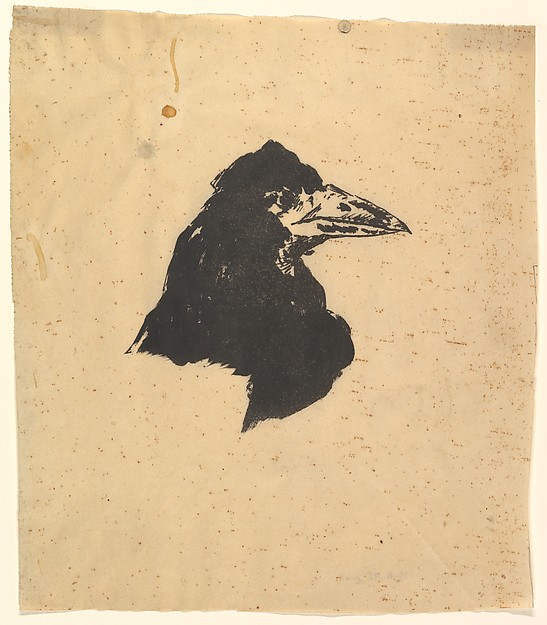
Sadly, the New York Public Library tells us, “the publication was not a commercial success.” (See Manet’s design for a poster and the book cover at the top of the post.)
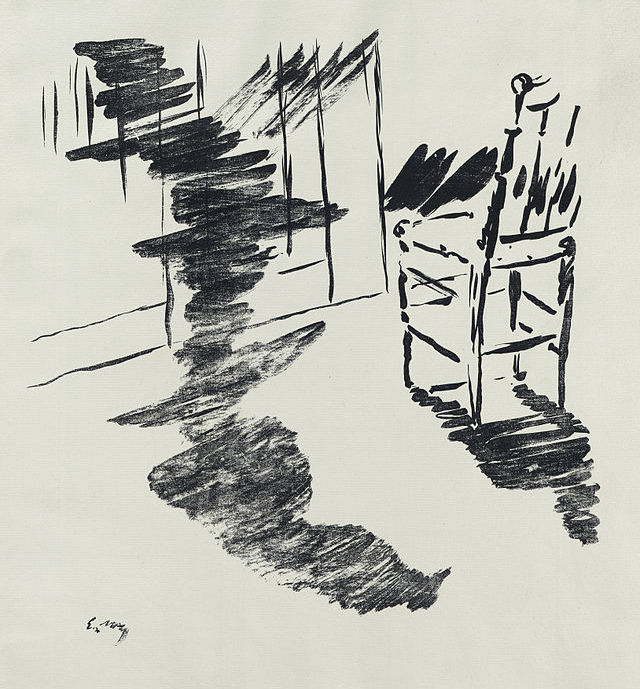
The book also illustrates the reciprocal relationship between Poe and French art and literature. Chris Semtner, curator of a Richmond, Virginia exhibit on this mutual influence, remarks that Poe “read Voltaire among other French authors”—such as Alexandre Dumas—“in college” and found them highly influential. Likewise, Poe left his mark not only on Baudelaire, Mallarmé, and Manet, but also Paul Gauguin, Odilon Redon, and Henri Matisse.
You can read Le Corbeau here in a dual language edition, with all the original illustrations. View and download high-res scans of the engravings here. And just above, listen to The Raven read aloud in Mallarmé’s French, courtesy of the Internet Archive.
Related Content:
Gustave Doré’s Splendid Illustrations of Edgar Allan Poe’s “The Raven” (1884)
Aubrey Beardsley’s Macabre Illustrations of Edgar Allan Poe’s Short Stories (1894)
Harry Clarke’s Hallucinatory Illustrations for Edgar Allan Poe’s Stories (1923)
Josh Jones is a writer and musician based in Durham, NC. Follow him at @jdmagness
Read More...
How Designing Buildings Upside-Down Revolutionized Architecture, Making Possible St. Paul’s Cathedral, Sagrada Família & More
For 142 years now, Sagrada Família has been growing toward the sky. Or at least that’s what it seems to be doing, as its ongoing construction realizes ever more fully a host of forms that look and feel not quite of this earth. It makes a kind of sense to learn that, in designing the cathedral that would remain a work in progress nearly a century after his death, Antoni Gaudí built a model upside-down, making use of gravity in the opposite way to which we normally think of it as acting on a building. But as architecture YouTuber Stewart Hicks explains in the video above, Gaudí was hardly the first to use that technique.
Take St. Paul’s Cathedral, which Christopher Wren decided to make the tallest building in London in 1685. It included what would be the highest dome ever built, at 365 feet off the ground. “For a traditional dome design to reach this height, it would have to span an opening that’s 160 feet or 49 meters wide, but this made it much too heavy for the walls below,” says Hicks. “Existing techniques for building this just couldn’t work.” Enter scientist-engineer Robert Hooke, who’d already been figuring out ways to model forces like this by hanging chains from the ceiling.
“Hooke’s genius was that he realized that the chain in his experiments was calculating the perfect shape for it to remain in tension, since that’s all it can do.” He explained domes as, physically, “the exact opposite of the chains. His famous line was, ‘As hangs the flexile line, so but inverted will stand the rigid arch.’ ” In other words, “if you flip the shape of Hooke’s chain experiments upside down, the forces flip, and this shape is the perfect compression system.” Hence the distinctively elongated-looking shape of the dome on the completed St. Paul’s Cathedral, a departure from all architectural precedent.
The shape upon which Wren and Hooke settled turned out to be very similar to what architecture now knows as a catenary curve, a concept important indeed to Gaudí, who was “famously enamored with what some call organic forms.” He made detailed models to guide the construction of his projects, but after those he’d left behind for Sagrada Família were destroyed by anarchists in 1936, the builders had nothing to go on. Only in 1979 did the young architect Mark Burry “imagine the models upside-down,” which brought about a new understanding of the building’s complex, landscape-like forms. It was a similar physical insight that made possible such dramatic mid-century buildings as Annibale Vitellozzi and Pier Nervi’s Palazzetto dello Sport and Eero Saarinen’s TWA Flight Center: pure Space Age, but rooted in the Enlightenment.
Related content:
How This Chicago Skyscraper Barely Touches the Ground
Based in Seoul, Colin Marshall writes and broadcasts on cities, language, and culture. His projects include the Substack newsletter Books on Cities and the book The Stateless City: a Walk through 21st-Century Los Angeles. Follow him on Twitter at @colinmarshall or on Facebook.
Read More...
Built to Last: How Ancient Roman Bridges Can Still Withstand the Weight of Modern Cars & Trucks
A foreign traveler road-tripping across Europe might well feel a wave of trepidation before driving a fully loaded modern automobile over a more than 2,000-year-old bridge. But it might also be balanced out by the understanding that such a structure has, by definition, stood the test of time — and, for those with a grasp of the history of engineering, that its ancient designers would have ensured its capacity to bear a load far heavier than any that would have crossed it in reality. With no scientific means of modeling stresses, as classical-history Youtuber Garrett Ryan explains in the new Told in Stone video above, they just had to build it tough.
Key to that toughness were arches, “made of heavy blocks laid over a falsework frame until the keystone was slotted into place.” From the late first century, stonework was supplemented or replaced by brick and Roman concrete, a substance much-featured here on Open Culture.
We’ve also covered the Roman bridges you can still cross today: Spain’s Puente de Alcántara (from the Arabic al-qanţarah, meaning “arch”), for example, which, though crossed by a quarter-million vehicles every year, “shows no signs of failing”; or France’s Pont des Marchands, which “has supported a neighborhood of multi-story shops and houses since the Middle Ages.”
But the arches of the nearly 1,000 wholly or partially surviving Roman bridges haven’t done all the work by geometry alone. “The load-bearing capacity of a bridge depended both on the solidity of its abutments and the strength — ‘shearing point’ — of its voussoirs,” or the stones of its arches between the keystone at the top and the springers at the bottom. “Since Roman builders carved voussoirs from the strongest readily available stone, their bridges tended to be impressively solid.” You wouldn’t want to run a freight train across the Puente de Alcántara, but 40-ton trucks are no problem — to say nothing of a car filled with luggage, a few kids, and even a dog or two.
Related content:
The Roman Roads and Bridges You Can Still Travel Today
The Mystery Finally Solved: Why Has Roman Concrete Been So Durable?
The Roads of Ancient Rome Visualized in the Style of Modern Subway Maps
Roman Architecture: A Free Online Course from Yale
Based in Seoul, Colin Marshall writes and broadcasts on cities, language, and culture. His projects include the Substack newsletter Books on Cities and the book The Stateless City: a Walk through 21st-Century Los Angeles. Follow him on Twitter at @colinmarshall or on Facebook.
Read More...Support Us
We're hoping to rely on loyal readers, rather than erratic ads. Please click the Donate button and support Open Culture. You can use Paypal, Venmo, Patreon, even Crypto! We thank you!

About Us

Open Culture scours the web for the best educational media. We find the free courses and audio books you need, the language lessons & educational videos you want, and plenty of enlightenment in between.
Advertise With Us

FREE UPDATES!
GET OUR DAILY EMAIL
Get the best cultural and educational resources on the web curated for you in a daily email. We never spam. Unsubscribe at any time.
FOLLOW ON SOCIAL MEDIA

Open Culture editor Dan Colman scours the web for the best educational media. He finds the free courses and audio books you need, the language lessons & movies you want, and plenty of enlightenment in between.
Advertise With Us


