The Amazing Recording History of The Beatles’ “Here Comes the Sun”
The most streamed Beatles song isn’t “She Loves You,” “Hey Jude,” or “All You Need Is Love.” It isn’t even “Yesterday.” If you were about to guess “Something,” you’re on the right track, at least as far as the source album and songwriter. In fact, it’s George Harrison’s other signature song “Here Comes the Sun,” which has racked up 1,433,830,334 Spotify streams as of this writing, nearly a million more than “In My Life” right below it. The You Can’t Unhear This video above breaks down what makes “Here Comes the Sun” stand out even amid the formidable Beatles catalog, from its conception through its recording process.
Though it comes off as a simple song — whose inviting quality may well have something to do with its outsized popularity — “Here Comes the Sun” turns out to be the result of a technically complex and unconventional process fairly characteristic of the late Beatles. Starting with a melody crafted while playing an acoustic guitar in Eric Clapton’s garden (having recused himself from yet another business meeting), Harrison enriched it with such techniques as running his guitar through a revolving Leslie speaker meant for an organ and having his hulking Moog synthesizer transported to Abbey Road so he could add a layer of electronic sublimity.
At this point in the life of the Beatles, everyone involved could surely feel that the band’s end was near. Regardless, none of the Fab Four was quite working in isolation, and indeed, the “Here Comes the Sun” sessions — which, of course, ended up on Abbey Road, the final album they recorded — represent some of their last work as a unit. It’s not surprising that such a context would produce, say, John Lennon’s grimly descending “I Want You (She’s So Heavy),” which ends side one; what startles no matter how many times you hear it is the gentle optimism with which Harrison’s side two opens immediately thereafter, especially if you’re not turning an LP over in between.
Even in isolation, “Here Comes the Sun” has made such a cultural impact that Carl Sagan lobbied for its inclusion on the Voyager “Golden Records,” which were launched into outer space with the intent to give other forms of intelligent life a glimpse of human civilization. The Beatles also liked the idea, but they didn’t own the necessary rights; those belonged to the label EMI, who in the recollection of Sagan’s widow Ann Druyan demanded a prohibitive fee for the song’s use. Had it been included, perhaps it could’ve ended up the first intergalactic hit song — one enjoyed in the orbit of another sun entirely.
Related content:
The Beatles Release the First Ever Video for “Here Comes the Sun”
Hear The Beatles’ “Here Comes the Sun” With a Re-Discovered George Harrison Solo
Flashmob Performs The Beatles’ “Here Comes the Sun” in Madrid Unemployment Office
Watch George Harrison’s Final Interview and Performance (1997)
Based in Seoul, Colin Marshall writes and broadcasts on cities, language, and culture. His projects include the Substack newsletter Books on Cities and the book The Stateless City: a Walk through 21st-Century Los Angeles. Follow him on Twitter at @colinmarshall or on Facebook.
Read More...
David Bowie’s Fashionable Mug Shot From His 1976 Marijuana Bust
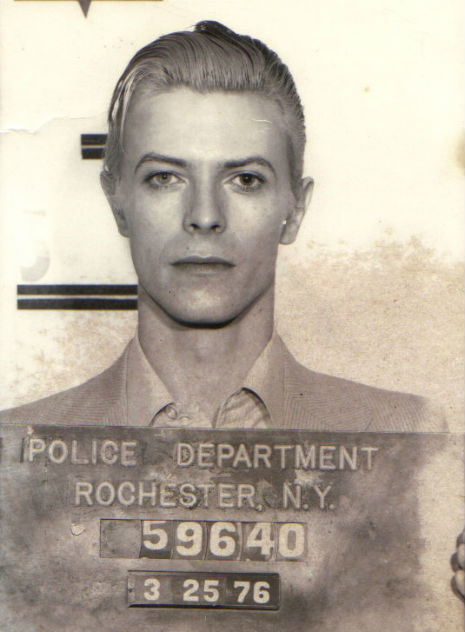
David Bowie always managed to look cool, even when he was being booked for a felony.
In early 1976, Bowie was on his “Isolar” tour, performing as the Thin White Duke, a persona he would describe as “a very Aryan fascist type — a would-be romantic with no emotions at all.” Bowie invited his friend and sometime creative collaborator Iggy Pop to travel with him.
In the early morning hours of March 21, after a concert at the Community War Memorial arena in Rochester, New York, four local vice squad detectives and a state police investigator searched Bowie’s three-room suite at the Americana Rochester Hotel. According to reports in the Rochester Democrat and Chronicle, the cops found 182 grams (a little over 6.4 ounces) of marijuana there. Bowie and three others — Pop, a bodyguard named Dwain Voughns, and a young Rochester woman named Chiwah Soo — were charged with fifth-degree criminal possession of marijuana, a class C felony, punishable by up to 15 years in prison.
Bowie and Pop were booked under their real names, David Jones and James Osterberg Jr. The group spent the rest of the night in the Monroe County Jail and were released at about 7 a.m. on $2,000 bond each. They were supposed to be arraigned the next day, but Bowie left town to go to his next concert in Springfield, Massachusetts. His lawyer appeared and asked for the court’s indulgence, explaining the heavy penalties for breaking concert engagements. He promised the judge that Bowie would appear the following morning, March 23.
Bowie showed up for his arraignment looking dapper in his Thin White Duke clothing. It was then that his mug shot was taken — so we’ll never actually know what Bowie looked like when he was unexpectedly dragged into jail at 3 a.m. The police escorted the rock star in and out of the courtroom mostly through back corridors, shielding him from a crowd of fans who showed up at the courthouse. Reporter John Stewart describes the scene in the next day’s Democrat and Chronicle:
Bowie and his group ignored reporters’ shouted questions and fans’ yells as he walked in — except for one teenager who got his autograph as he stepped off the escalator.
His biggest greeting was the screams of about a half-dozen suspected prostitutes awaiting arraignment in the rear of the corridor outside the courtroom.
Asked for a plea by City Court Judge Alphonse Cassetti to the charge of fifth-degree criminal possession of a controlled substance, Bowie said, “not guilty, sir.” The court used his real name — David Jones.
He stood demurely in front of the bench with his attorneys. He wore a gray three-piece leisure suit and a pale brown shirt. He was holding a matching hat. His two companions were arraigned on the same charge.
The defense lawyer told the judge that Bowie and the others had never been arrested before. The judge allowed them to remain free on bond until a grand jury convened. Bowie and his entourage went on with their tour, and the grand jury eventually decided not to indict anyone. The incident was largely forgotten until an auction house employee named Gary Hess stumbled on Bowie’s mug shot while sorting through the estate of a retired Rochester police officer. Hess rescued the photo from the trash bin, according to an article in Rochester Subway, and in late 2007 his brother sold it on eBay for $2,700.
Related Content:
The Thin White Duke: A Close Study of David Bowie’s Darkest Character
John Coltrane’s Naval Reserve Enlistment Mugshot (1945)
Read More...David Bowie’s 100 Must Read Books

Image by Avro, via Wikimedia Commons
In 2013, the curators of the touring museum exhibit “David Bowie Is” released a list of David Bowie’s 100 favorite reads, providing us with deeper insights into his literary tastes. Covering fiction and non-fiction, the list spans six decades, moving from Richard Wright’s memoir Black Boy (1945) to Susan Jacoby’s The Age of American Unreason (2008). As we once noted in another post, “his list shows a lot of love to American writers, from … Truman Capote to … Hubert Selby, Jr., Saul Bellow, Junot Díaz, Jack Kerouac and many more. He’s also very fond of fellow Brits George Orwell, Ian McEwan, and Julian Barnes and loves Mishima and Bulgakov.” You can read the full list below, and, if you choose, also explore a related book from 2019–Bowie’s Bookshelf: The Hundred Books That Changed David Bowie’s Life.
- Interviews With Francis Bacon by David Sylvester
- Billy Liar by Keith Waterhouse
- Room At The Top by John Braine
- On Having No Head by Douglass Harding
- Kafka Was The Rage by Anatole Broyard
- A Clockwork Orange by Anthony Burgess
- City Of Night by John Rechy
- The Brief Wondrous Life Of Oscar Wao by Junot Diaz
- Madame Bovary by Gustave Flaubert
- Iliad by Homer
- As I Lay Dying by William Faulkner
- Tadanori Yokoo by Tadanori Yokoo
- Berlin Alexanderplatz by Alfred Döblin
- Inside The Whale And Other Essays by George Orwell
- Mr. Norris Changes Trains by Christopher Isherwood
- Halls Dictionary Of Subjects And Symbols In Art by James A. Hall
- David Bomberg by Richard Cork
- Blast by Wyndham Lewis
- Passing by Nella Larson
- Beyond The Brillo Box by Arthur C. Danto
- The Origin Of Consciousness In The Breakdown Of The Bicameral Mind by Julian Jaynes
- In Bluebeard’s Castle by George Steiner
- Hawksmoor by Peter Ackroyd
- The Divided Self by R. D. Laing
- The Stranger by Albert Camus
- Infants Of The Spring by Wallace Thurman
- The Quest For Christa T by Christa Wolf
- The Songlines by Bruce Chatwin
- Nights At The Circus by Angela Carter
- The Master And Margarita by Mikhail Bulgakov
- The Prime Of Miss Jean Brodie by Muriel Spark
- Lolita by Vladimir Nabokov
- Herzog by Saul Bellow
- Puckoon by Spike Milligan
- Black Boy by Richard Wright
- The Great Gatsby by F. Scott Fitzgerald
- The Sailor Who Fell From Grace With The Sea by Yukio Mishima
- Darkness At Noon by Arthur Koestler
- The Waste Land by T.S. Elliot
- McTeague by Frank Norris
- Money by Martin Amis
- The Outsider by Colin Wilson
- Strange People by Frank Edwards
- English Journey by J.B. Priestley
- A Confederacy Of Dunces by John Kennedy Toole
- The Day Of The Locust by Nathanael West
- 1984 by George Orwell
- The Life And Times Of Little Richard by Charles White
- Awopbopaloobop Alopbamboom: The Golden Age of Rock by Nik Cohn
- Mystery Train by Greil Marcus
- Beano (comic, ’50s)
- Raw (comic, ’80s)
- White Noise by Don DeLillo
- Sweet Soul Music: Rhythm And Blues And The Southern Dream Of Freedom by Peter Guralnick
- Silence: Lectures And Writing by John Cage
- Writers At Work: The Paris Review Interviews edited by Malcolm Cowley
- The Sound Of The City: The Rise Of Rock And Roll by Charlie Gillette
- Octobriana And The Russian Underground by Peter Sadecky
- The Street by Ann Petry
- Wonder Boys by Michael Chabon
- Last Exit To Brooklyn By Hubert Selby, Jr.
- A People’s History Of The United States by Howard Zinn
- The Age Of American Unreason by Susan Jacoby
- Metropolitan Life by Fran Lebowitz
- The Coast Of Utopia by Tom Stoppard
- The Bridge by Hart Crane
- All The Emperor’s Horses by David Kidd
- Fingersmith by Sarah Waters
- Earthly Powers by Anthony Burgess
- The 42nd Parallel by John Dos Passos
- Tales Of Beatnik Glory by Ed Saunders
- The Bird Artist by Howard Norman
- Nowhere To Run The Story Of Soul Music by Gerri Hirshey
- Before The Deluge by Otto Friedrich
- Sexual Personae: Art And Decadence From Nefertiti To Emily Dickinson by Camille Paglia
- The American Way Of Death by Jessica Mitford
- In Cold Blood by Truman Capote
- Lady Chatterly’s Lover by D.H. Lawrence
- Teenage by Jon Savage
- Vile Bodies by Evelyn Waugh
- The Hidden Persuaders by Vance Packard
- The Fire Next Time by James Baldwin
- Viz (comic, early ’80s)
- Private Eye (satirical magazine, ’60s – ’80s)
- Selected Poems by Frank O’Hara
- The Trial Of Henry Kissinger by Christopher Hitchens
- Flaubert’s Parrot by Julian Barnes
- Maldoror by Comte de Lautréamont
- On The Road by Jack Kerouac
- Mr. Wilson’s Cabinet of Wonder by Lawrence Weschler
- Zanoni by Edward Bulwer-Lytton
- Transcendental Magic, Its Doctrine and Ritual by Eliphas Lévi
- The Gnostic Gospels by Elaine Pagels
- The Leopard by Giuseppe Di Lampedusa
- Inferno by Dante Alighieri
- A Grave For A Dolphin by Alberto Denti di Pirajno
- The Insult by Rupert Thomson
- In Between The Sheets by Ian McEwan
- A People’s Tragedy by Orlando Figes
- Journey Into The Whirlwind by Eugenia Ginzburg
If you would like to support the mission of Open Culture, consider making a donation to our site. It’s hard to rely 100% on ads, and your contributions will help us continue providing the best free cultural and educational materials to learners everywhere. You can contribute through PayPal, Patreon, and Venmo (@openculture). Thanks!
Related Content:
Bowie’s Bookshelf: A New Essay Collection on The 100 Books That Changed David Bowie’s Life
Brian Eno Creates a List of 20 Books That Could Rebuild Civilization
Hayao Miyazaki Selects His 50 Favorite Children’s Books
Read More...13 Experimental Animations of Osamu Tezuka, “the Godfather of Manga” (1964–1987)
If you enjoy modern Japanese animation, you can no doubt name several masterpieces of the form off the top of your head, whether acclaimed series like Neon Genesis Evangelion and Cowboy Bebop to the work of cinema auteurs like Satoshi Kon and Hayao Miyazaki. What may cross your mind less readily is how much these and other anime productions owe to Astro Boy, or as it was known in Japan, Tetsuwan Atomu (“Mighty Atom”). First conceived on the page by artist Osamu Tezuka, remembered today as “the Godfather of Manga” (i.e., Japanese comics), it became an animated television series in 1962, a production overseen — and fatefully under-budgeted — by Tezuka himself.
“It was a stupidly low number,” Tezuka later wrote in his autobiography of the per-episode figure he quoted to his reluctant sponsors. Yet despite the manifold production stresses it caused, it forced — like any severe limitation — a good deal of creativity.
In time, writes Matt Alt in Pure Invention: How Japan Made the Modern World, “the beloved hallmarks of Japanese animated fare — the striking of theatrical poses, the lingering freeze-frames, the limited ranges of motion — evolved from desperate cost-saving workarounds into factors that distinguish anime from content produced in other lands.”
When they were first publicly screened in November of 1962, the first episodes of Astro Boy were accompanied by a lesser-known Tezuka project: Tales from a Certain Street Corner (ある街角の物語), a 40-minute film crafted with an “anti-Disney” aesthetic. At Nishikata Film Review, Cathy Munroe Hotes describes this as “the first of Tezuka’s jikken animation – or experimental works – which Tezuka made for artistic rather than commercial purposes. Although the animation does employ some unusual techniques such as a POV shot of a plane tree seed flying to the ground, it is not ‘experimental’ in the usual sense of the word.”
The term better suits some of the other works included in the playlist at the top of the post, which collects clips of a variety of Tezuka’s experimental and quasi-experimental animations produced between the mid-nineteen-sixties and the late eighties (many of which can easily be seen in full on Youtube), which collectively exhibit both imaginative power and a sense of humor. “Memory” (めもりい), from 1964, mixes traditional animation with Monty Python-style cutouts to depict the yearnings of a postwar salaryman. The omnibus Pictures at an Exhibition (展覧会の絵), made a couple of years later, satirizes modern society in ten different ways, each scored with a movement of the eponymous Mussorgsky piece.
By the last years of Tezuka’s life, the style of his animation seems to have evolved in several directions at once. “Jumping” (ジャンピング) from 1984, imagines what it would be like to jump ever-more-superhuman heights from a first-person perspective; “Push” (プッシュ), from 1987, uses a more conventionally cartoonish aesthetic to render a post-apocalyptic world dominated by vending machines. That same year, Tezuka — a descendant of famed samurai Hanzō Hattori — also released “Muramasa” (村正), a nuclear-annihilation allegory about a haunted sword. The threat posed to Earth by man was also the major theme of Legend of the Forest (森の伝説), left unfinished by the time of Tezuka’s death in 1989 but later picked up by his son Makoto: just one of the countless animators, Japanese and otherwise, working under the Godfather’s influence today.
Related content:
Watch the First Episode of Osamu Tezuka’s Astro Boy, Of Which Stanley Kubrick Became a Big Fan
Jim Henson Creates an Experimental Animation Explaining How We Get Ideas (1966)
Watch the Oldest Japanese Anime Film, Jun’ichi Kōuchi’s The Dull Sword (1917)
The Origins of Anime: Watch Early Japanese Animations (1917 to 1931)
Watch Fantasmagorie, the World’s First Animated Cartoon (1908)
Based in Seoul, Colin Marshall writes and broadcasts on cities, language, and culture. His projects include the Substack newsletter Books on Cities and the book The Stateless City: a Walk through 21st-Century Los Angeles. Follow him on Twitter at @colinmarshall or on Facebook.
Read More...The Enchanting Opera Performances of Klaus Nomi
After making one of the grandest entrances in music history on the stages of East Village clubs, the BBC’s The Old Grey Whistle Test, and Saturday Night Live, theatrical German new wave space alien Klaus Nomi died alone in 1983, a victim of the “first beachhead of the AIDS epidemic.” The disease frightened Nomi’s friends away—no one knew anything about what was then called “gay cancer” but that it was deadly. Soon afterward, the immensely talented singer’s reputation declined. Writer Rupert Smith pronounced Nomi “largely forgotten” in a 1994 issue of Attitude magazine, and made a case for renewed attention. “Nomi,” wrote Smith, “remains rock music’s queerest exponent, who outshone the many acts following in his wake.”
But Nomi has since received his due, in a moment of revival that has extended over several years, thanks in part to many of those later acts. In his own day, wrote LD Beghtol at The Village Voice, “the underground punk-opera singer was mostly unknown beyond his small circle of friends and fans.” Nomi was “queer in multiple senses of the word and stood well apart from his fellow East Village bohos.
And he possessed an undeniable gift, a voice that surged up from a husky Weimar croon into the falsetto stratosphere. Operatic countertenors, though, were hopelessly déclassé. His professional options were few.” It’s also the case that Nomi’s opera experience wouldn’t have taken him very far. “As young Klaus Sperber,” writes Smith, “he had worked front-of-house at the Berlin Opera in the late Sixties, and would entertain colleagues with his renditions of the great arias as they swept up after performances.”
But with or without the résumé, Nomi had the voice—one audiences could hardly believe came from the strange, diminutive cabaret character with heavy makeup and tri-cornered receding hairline. At the top of the post, see Nomi’s 1978 debut at New Wave Vaudeville, a four-night revue at Irving Plaza. “Nomi,” Smith tells us, “was a smash.” Skip ahead to 2:14 to see Nomi’s musical director Kristian Hoffman introduce his performance of “Mon cœur s’ouvre à ta voix” (“My heart opens to your voice”) from Camille Saint-Saëns’ 1877 opera Samson et Dalila. After every subsequent performance, Hoffman says, the cabaret’s MC had to assure audiences that Nomi’s voice was “not an electrical recording.”
Nomi’s voice and presence attracted the attention of stars like David Bowie, who hired him as a backup singer for that SNL appearance in 1979 after he appeared on the cult New York public access show TV Party. Glenn O’Brien’s introduction of Nomi as “one of the finest pastry chefs in New York,” above, is only partly tongue in cheek; that was indeed the singer’s day job. But in character, he wielded his otherworldly falsetto like a raygun. “Every song,” writes Pitchfork in an appreciation, “included dramatic multiple shifts in octave, where Klaus would rise to extreme highs and lows, handling both effortlessly. He would jerk his hands into karate chops with each changing note, widening his eyes every time he skirted into higher octaves.”
Nomi’s brand of opera-infused synth-pop and retro-futurist, shiny-suited cabaret act—the “Klaus Nomi Show” as it was called—brought him notoriety in the New York art scene during his lifetime, and has since made him a star, decades after his tragic death. As gratifying as that may be for longtime fans of Nomi’s work, we should also remember that Nomi’s devotion to opera was no mere gimmick, but a lifelong passion and undeniable talent. As we noted in an earlier post, in Nomi’s last performance before his death—in a small 1982 European tour—he sang the aria “Cold Genius” from Henry Purcell’s 1691 opera King Arthur or, The British Worthy, a performance, wrote Matthias Rascher, that was “certainly one of the most memorable in operatic history.” Perhaps we might call it one of the most memorable moments in pop music history as well.
Related Content:
Klaus Nomi: Watch the Final, Brilliant Performance of a Dying Man
David Bowie and Klaus Nomi’s Hypnotic Performance on SNL (1979)
Klaus Nomi’s Ad for Jägermeister (Circa 1980)
Josh Jones is a writer and musician based in Durham, NC. Follow him at @jdmagness
Read More...How an Ancient Roman Shipwreck Could Explain the Universe
In a 1956 New Statesman piece, the British scientist-novelist C. P. Snow first sounded the alarm about the increasingly chasm-like divide between what he called the “scientific” and “traditional” cultures. We would today refer to them as the sciences and the humanities, while still wringing our hands over the inability of each side to learn from (or even coherently communicate with) the other. Nevertheless, recent history provides the occasional heartening example of sciences-humanities collaboration, few of them as dramatic as the story told in the SciShow video above, “An Ancient Roman Shipwreck May Explain the Universe.”
The shipwreck in question occurred two millennia ago, off the western coast of Sardinia. Having set sail from the mining center of Cartegena, Spain, it was carrying more than 30 metric tons of lead, processed into a thousand ingots. An important metal in the ancient Roman Empire, lead was used to make pipes (like the ones installed in aqueducts), water tanks, roofs, and weapons of war. While our civilization has grown justifiably wary of putting water through lead pipes (and has at its command much stronger metals in any case), it still has plenty of use for the stuff, especially in shields against X‑rays and other forms of activity.
No matter how little contact you have with the scientific culture, you can surely appreciate how researchers in need of radioactivity shields must have felt when this lead ingot-filled shipwreck was discovered in 1988. Having spent a couple thousand years at the bottom of the ocean, the Roman lead aboard had lost most of its radioactivity, making it ideal for use in the shield of the Cryogenic Underground Observatory for Rare Events (CUORE) at the Gran Sasso National Laboratory in Italy. Engineered for research into the mass of neutrinos, subatomic particles long thought to have no mass at all, CUORE held out the promise of data that could lead to insights into the origin of the universe.
Ultimately, the physicists and archaeologists struck a deal, allowing the former to melt down the least-well preserved ingots from the shipwreck (after first removing the historically valuable inscriptions from its manufacturer) and use it to shield the highly sensitive CUORE from outside radiation. The design worked, but as of last year, none of the experiments have produced conclusive results about the role of neutrinos in the emergence of life, the universe, and everything. Probing that question further will be a job for CUORE’s successor CUPID (CUORE Upgrade with Particle Identification), scheduled to come online later this year. Though C. P. Snow never lived to see these projects, he surely wouldn’t be surprised that, to find convergence between the sciences and the humanities, you’ve got to dive deep.
Related content:
See the Well-Preserved Wreckage of Ernest Shackleton’s Ship Endurance Found in Antarctica
“The Value of Culture” Revealed in a New BBC Radio Series by Melvyn Bragg
Based in Seoul, Colin Marshall writes and broadcasts on cities, language, and culture. His projects include the Substack newsletter Books on Cities and the book The Stateless City: a Walk through 21st-Century Los Angeles. Follow him on Twitter at @colinmarshall or on Facebook.
Read More...Jimi Hendrix Arrives in London in 1966, Asks to Get Onstage with Cream, and Blows Eric Clapton Away: “You Never Told Me He Was That F‑ing Good”
Jimi Hendrix arrived on the London scene like a ton of bricks in 1966, smashing every British blues guitarist to pieces the instant they saw him play. As vocalist Terry Reid tells it, when Hendrix played his first showcase at the Bag O’Nails, arranged by Animals’ bassist Chas Chandler, “there were guitar players weeping. They had to mop the floor up. He was piling it on, solo after solo. I could see everyone’s fillings falling out. When he finished, it was silence. Nobody knew what to do. Everybody was dumbstruck, completely in shock.”
He only exaggerates a little, by all accounts, and when Reid says “everybody,” he means everybody: Keith Richards, Mick Jagger, Brian Jones, Jeff Beck, Paul McCartney, The Who, Eric Burdon, John Mayall, and maybe Jimmy Page, though he denies it. Mayall recalls, “the buzz was out before Jimi had even been seen here, so people were anticipating his performance, and he more than lived up to what we were expecting.” In fact, even before this legendary event sent nearly every star classic rock guitarist back to the woodshed, Jimi had arrived unannounced at the Regent Street Polytechnic, and asked to sit in and jam with Cream, where he proceeded to dethrone the reigning British guitar god, Eric Clapton.
Nobody knew who he was, but “in those days anybody could get up with anybody,” Clapton says in a recent interview, “if you were convincing enough that you could play. He got up and blew everyone’s mind.” As Hendrix biographer Charles Cross tells it, “no one had ever asked to jam” with Cream before. “Most would have been too intimidated by their reputation as the best band in Britain.” To hear the story as it’s told in the clip above from the BBC documentary Seven Ages of Rock, no one else would have ever dared to get onstage with Eric Clapton. Clapton, as the famed graffiti in London announced, was God. “It was a very brave person who would do that,” says Jack Bruce.
Actually, it was Chandler who asked the band, and who also tried to prepare Clapton. Jimi got onstage, plugged into Bruce’s bass amp, and played a version of Howlin’ Wolf’s “Killin’ Floor.” Everyone was “completely gobsmacked,” Clapton writes in his autobiography. “I remember thinking that here was a force to be reckoned with. It scared me, because he was clearly going to be a huge star, and just as we are finding our own speed, here was the real thing.” Fear, envy, awe… all reasonable emotions when standing next to Jimi Hendrix as he tears through “Killin’ Floor” three times faster than anyone else played it (as you can see him play it in Stockholm above)—while doing the splits, lying on the floor, playing with his teeth and behind his head…
“It was amazing,” writes Clapton, “and it was musically great, too, not just pyrotechnics.” There’s no telling how Jimi might have remembered the event had he lived to write his memoirs, but he would have been pretty modest, as was his way. No one else who saw him felt any need to hold back. “It must have been difficult for Eric to handle,” says Bruce, “because [Eric] was ‘God,’” and this unknown person comes along, and burns.” He puts it slightly differently at the top: “Eric was a guitar player. Jimi was some sort of force of nature.”
Rock journalist Keith Altham has yet a third account, as Ed Vulliamy writes at The Guardian. He remembers “Chandler going backstage after Clapton left in the middle of the song ‘which he had yet to master himself’; Clapton was furiously puffing on a cigarette and telling Chas: ‘You never told me he was that fucking good.’” Who knows if Hendrix knew Clapton had struggled with “Killin’ Floor” and decided not to try it live. But as blues guitarist Stephen Dale Petit notes, “when Chas invited Jimi to London, Jimi did not ask about money or contracts. He asked if Chas would introduce him to Beck and Clapton.”
He had come to meet, and blow away, his rock heroes. “Two weeks after The Bag O’Nails,” writes Classic Rock’s Johnny Black, “when Cream appeared at The Marquee Club, Clapton was sporting a frizzy perm and he left his guitar feeding back against the amp, just as he’d seen Jimi do.”
Related Content:
Jimi Hendrix Unplugged: Two Great Recordings of Hendrix Playing Acoustic Guitar
23-Year-Old Eric Clapton Demonstrates the Elements of His Guitar Sound (1968)
Jimi Hendrix Opens for The Monkees on a 1967 Tour; Then Flips Off the Crowd and Quits
Jimi Hendrix’s Final Interview Animated (1970)
Josh Jones is a writer and musician based in Durham, NC. Follow him at @jdmagness
Read More...An Architect Breaks Down the 5 Most Common Styles of College Campus
Every now and again on social media, the observation circulates that Americans look back so fondly on their college years because never again do they get to live in a well-designed walkable community. The organization of college campuses does much to shape that experience, but so do the buildings themselves. “People often say that college is the best four years of your life,” says architect Michael Wyetzner in the new Architectural Digest video above, “but it was also likely that it was some of the best architecture you’ve been around as well.” He goes on to identify, explain, and contextualize the five building styles most commonly seen on American college campuses: colonial, Collegiate Gothic, modernism, brutalism, and postmodernism.
For examples of colonial campus architecture, look no further than the Ivy League, only one of whose schools was built after the Declaration of Independence — whose author, Thomas Jefferson, later designed the University of Virginia, drawing much inspiration (if not always first-hand) from ancient Greece and Rome. “Ironically, after the US declared independence, newer schools wanted to look older,” says Wyetzner, a desire that spawned the enduring Collegiate Gothic style. Constructed out of masonry and brick, its earliest buildings tend to pick and choose features of genuine Gothic architecture while mixing and matching them with the design languages of other times and places. More recent examples have been strenuously faithful by comparison, incorporating gargoyles and all.
When they arise, architectural styles tend to align themselves with the old or the new, and it was the latter that overtook college campuses after the Second World War. Take the Illinois Institute of Technology, which was designed whole by no less a Bauhaus-credentialed modernist than Ludwig Mies van der Rohe. Modular, flat-roofed, and built with plenty of exposed brick, glass, and steel, its buildings proved influential enough that “nearly every high school in the United States that was built in the fifties and sixties” was designed in more or less the same way — albeit without the early utopian modernist spirit, which by that point had devolved into an industrial emphasis on “rationalism, functionality, and hygiene.”
After modernism came brutalism, the style of the least-beloved buildings on many a campus today. Coined by Le Corbusier, the style’s name comes from béton brut, or raw concrete, vast quantities of which were used to shape its hulking and, depending on how you feel about them, either dreary or awe-inspiring structures. The aesthetically promiscuous postmodernist buildings that began appearing in the sixties and multiplied in the seventies and eighties were more playful and historically aware — or all too playful and historically aware, as their detractors would put it. If you think back to your own college days, you can probably remember spending time in, or around, at least one example of each of these styles, because large US college campuses have, over time, become rich anthologies of architectural history. Would that most Americans could say the same about the places they live after graduation.
Related content:
Why People Hate Brutalist Buildings on American College Campuses
Architect Breaks Down Five of the Most Iconic New York City Apartments
An Architect Breaks Down the Design of New York City Subway Stations, from the Oldest to Newest
What Is Postmodern Architecture?: An Introduction in Three Videos
Based in Seoul, Colin Marshall writes and broadcasts on cities, language, and culture. His projects include the Substack newsletter Books on Cities and the book The Stateless City: a Walk through 21st-Century Los Angeles. Follow him on Twitter at @colinmarshall or on Facebook.
Ancient Egyptian Pyramids May Have Been Built with Water: A New Study Explore the Use of Hydraulic Lifts

Image by Charles Sharp, via Wikimedia Commons
The compelling but less-than-straightforward question of how the ancient Egyptians built the pyramids has inspired all manner of theory and speculation, grounded to varying degrees in physical reality. Sheer manpower must have played a large part, and it’s certainly not beyond the realm of possibility that various simple machines were involved. But in certain cases, could the machines have been less simple than we imagine today? Such is the proposal advanced in a paper recently published in PLOS ONE, “On the Possible Use of Hydraulic Force to Assist with Building the Step Pyramid of Saqqara.”
“The Step Pyramid was built around 2680 BCE, part of a funerary complex for the Third Dynasty pharaoh Djoser,” writes Ars Technica’s Jennifer Ouellette. “It’s located in the Saqqara necropolis and was the first pyramid to be built, almost a ‘proto-pyramid’ that originally stood some 205 feet high,” as against the more widely known Great Pyramid of Giza, which reached 481 feet.
According to the paper’s first author Xavier Landreau, head of the French research institute Paleotechnic, his team’s intensive research on “the watersheds to the west of the Saqqara plateau” led to “the discovery of “structures they believe constituted a dam, a water treatment facility, and a possible internal hydraulic lift system within the pyramid,” which could have been used to move heavy limestone.
Not every Egypt expert is convinced. As the University of Cambridge’s Judith Bunbury puts it to Ouellette, “there is evidence that Egyptians used other kinds of hydraulic technologies around that time, but there is no evidence of any kind of hydraulic lift system.” At Smithsonian.com, Will Sullivan rounds up other skeptical reactions, including that of University of Toronto archaeologist Oren Siegel, who “tells Science News that the proposed dam could not have held enough water from occasional rain to maintain a hydraulic system.” Clearly, the view of the Step Pyramid taken by Landreau and his researchers will require more concrete support, as it were, before being accepted into the mainstream. But it’s still a good deal more plausible than, say, the somehow persistent notion that members of an advanced spacefaring civilization came to give the ancient Egyptians a hand.
Related content:
How Did They Build the Great Pyramid of Giza?: An Animated Introduction
What the Great Pyramids of Giza Originally Looked Like
Based in Seoul, Colin Marshall writes and broadcasts on cities, language, and culture. His projects include the Substack newsletter Books on Cities and the book The Stateless City: a Walk through 21st-Century Los Angeles. Follow him on Twitter at @colinmarshall or on Facebook.
Read More...David Bowie Predicts the Good & Bad of the Internet in 1999: “We’re on the Cusp of Something Exhilarating and Terrifying”
“We’re on the cusp of something exhilarating and terrifying.”
The year is 1999 and David Bowie, in shaggy hair and groovy glasses, has seen the future and it is the Internet.
In this short but fascinating interview with BBC’s stalwart and withering interrogator cum interviewer Jeremy Paxman, Bowie offers a forecast of the decades to come, and gets most of it right, if not all. Paxman dolefully plays devil’s advocate, although I suspect he did really see the Net as a “tool”– simply a repackaging of an existing medium.
“It’s an alien life form that just landed,” Bowie counters.
Bowie, who had set up his own bowie.net as a private ISP the previous year, begins by saying that if he had started his career in 1999, he would not have been a musician, but a “fan collecting records.”
It sounded provocative at the time, but Bowie makes a point here that has taken on more credence in recent years–that the revolutionary status of rock in the ‘60s and ‘70s was tied to its rarity, that the inability to readily hear music gave it power and currency. Rock is now “a career opportunity,” he says, and the Internet now has the allure that rock once did.
What Bowie might not have seen is how quickly that allure would wear off. The Internet no longer has a mystery to it. It’s closer to a public utility, oddly a point that Bowie makes later when talking about the invention of the telephone.
Bowie also approved of the demystification between the artist and audience that the Internet was providing. In his final decade, however, he would seek out anonymity and privacy, dropping his final two albums suddenly without fanfare and refusing all interviews. He also didn’t foresee the kind of trolling that sends celebrities and artists off of social media.
Paxman sees the fragmentation of the Internet as a problem; Bowie sees it as a plus.
“The potential of what the Internet is going to do to society, both good and bad, is unimaginable.”
There’s a lot more to unpack in this segment, and let your differing viewpoints be known in the comments. It’s what Bowie would have wanted.
Related Content:
David Bowie on Why It’s Crazy to Make Art–and We Do It Anyway (1998)
How David Bowie Used William S. Burroughs’ Cut-Up Method to Write His Unforgettable Lyrics
Ted Mills is a freelance writer on the arts who currently hosts the artist interview-based FunkZone Podcast. You can also follow him on Twitter at @tedmills, read his other arts writing at tedmills.com and/or watch his films here.
Read More...Support Us
We're hoping to rely on loyal readers, rather than erratic ads. Please click the Donate button and support Open Culture. You can use Paypal, Venmo, Patreon, even Crypto! We thank you!

About Us

Open Culture scours the web for the best educational media. We find the free courses and audio books you need, the language lessons & educational videos you want, and plenty of enlightenment in between.
Advertise With Us

FREE UPDATES!
GET OUR DAILY EMAIL
Get the best cultural and educational resources on the web curated for you in a daily email. We never spam. Unsubscribe at any time.
FOLLOW ON SOCIAL MEDIA

Open Culture editor Dan Colman scours the web for the best educational media. He finds the free courses and audio books you need, the language lessons & movies you want, and plenty of enlightenment in between.
Advertise With Us


