Jimi Hendrix Opens for The Monkees on a 1967 Tour; Then Flips Off the Crowd and Quits
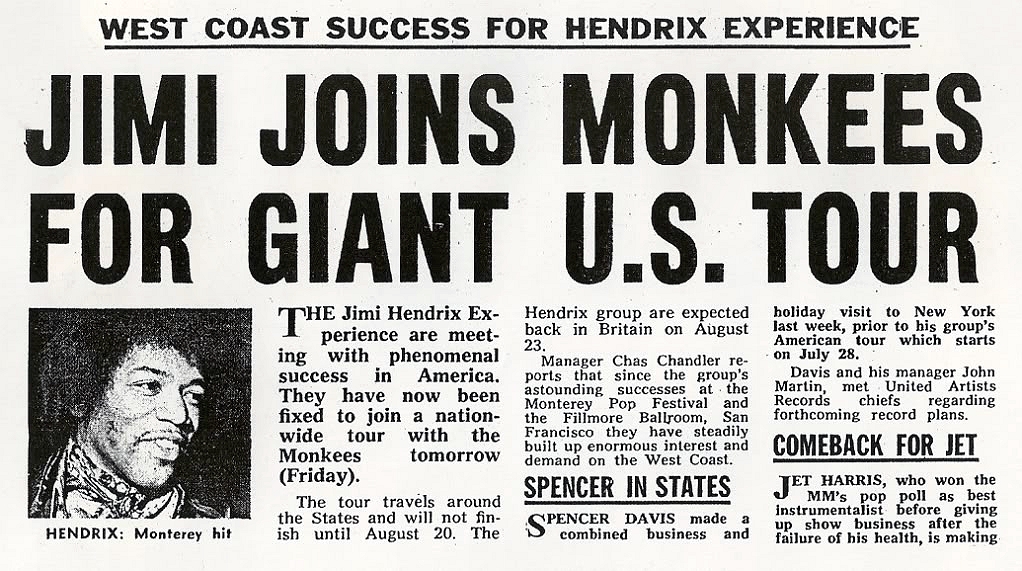
It’s easy to dismiss The Monkees. Critics and listeners have been doing it since the sixties, although the band has also come in for its share of reappraisals, particularly for their psych-rock album Head. (That’s the soundtrack from the 1968 Jack Nicholson-directed art film of the same name: “One of the weirdest and best rock movies ever made.”) But whatever you think of The Monkees’ music, you have to admit: they had one of the most extraordinary careers of any band in rock and roll.
They began in 1965 as a troupe of actors in a sitcom that Monkee Micky Dolenz described as being about “an imaginary band… that wanted to be The Beatles,” but “was never successful.” In a very short time, the four members—Dolenz, Peter Tork, Davy Jones, and Michael Nesmith—had mastered their instruments and learned to write their own original songs.
It seemed that almost overnight, they’d gone from lip-syncing boy band comedians to genuine pop stars. (Dolenz describes it as “the equivalent of Leonard Nimoy really becoming a Vulcan.”)
In the summer of 1967, “at the height of Monkeemania,” The Monkees Almanac informs us, the band embarked on a 28-city tour through the United States and England, opening at the Hollywood Bowl just five days after their TV show collected two Primetime Emmy Awards. The oddest thing about the tour: for eight dates, Jimi Hendrix opened for the band with his newly formed Experience, “one of the strangest pairings in rock and roll history.” But at the time, writes Mental Floss, “the pairing actually made a little bit of sense for both acts.” The Monkees wanted credibility, and Hendrix needed a U.S. audience.
He was already a huge star in England, but, despite blowing the crowd away at the Monterey Pop Festival that spring, Hendrix was mostly an unknown quantity to U.S. music buyers. But Dolenz had seen him play in New York and was suitably impressed. When he suggested Hendrix for the tour, the Experience’s manager Mike Jeffery jumped at the chance, thinking he could leverage The Monkees’ huge crowds to break Hendrix in the States. Hendrix himself expressed much less enthusiasm, having called The Monkees’ music “dishwater” in a Melody Maker interview.
So how did it go? Not well, as you might imagine—certainly not the “West Coast Success” the headline at the top of the post trumpets. Monkees fans—mostly young kids dragging along parental chaperons—had no idea what to make of Hendrix. “Jimi would amble out onto the stage, fire up the amps and break into ‘Purple Haze,’ ” wrote Dolenz in his autobiography, “and the kids in the audience would instantly drown him out with, ‘We Want Davy!!’ God, it was embarrassing.” Although Peter Tork especially among The Monkees’ members was overjoyed to have Hendrix on the tour, he later recalled the pairing as a singularly bad idea: “This is screaming, scaring-your-daddy music compared with The Monkees. It didn’t cross anybody’s mind that it wasn’t gonna fly. And there’s poor Jimi, and the kids go, ‘We want The Monkees, we want The Monkees.’ ”
You can see Tork describe the ill-fated match-up in a hilariously dated MTV clip above. Despite his reservations, Hendrix got on very well with The Monkees. Not so much with their obnoxious fans. “The Jimi Hendrix Experience played just eight of the 29 scheduled tour dates,” writes Mental Floss, “and then on July 16, 1967, Jimi flipped the Forest Hills, Queens, New York, audience off, threw down his guitar and walked away from Monkeemania.” (History.com gives the date as July 17.) No great loss for either band. A couple of months later, Melody Maker presented Hendrix with a “World’s Top Musician” award, and his music hit the U.S. mainstream as well. And The Monkees finished the tour and went on to make Head, the film and album, which, depending on whom you ask, either ruined their rock cred or defined it forever.
Related Content:
Jimi Hendrix Unplugged: Two Great Recordings of Hendrix Playing Acoustic Guitar
How the 1968 Psychedelic Film Head Destroyed the Monkees & Became a Cult Classic
Watch Frank Zappa Play Michael Nesmith (RIP) on The Monkees–and Vice Versa (1967)
How Science Fiction Formed Jimi Hendrix
Josh Jones is a writer and musician based in Durham, NC. Follow him at @jdmagness
Read More...How Rome Began: The History As Told by Ancient Historians
Much attention has been paid to the fall of the Roman Empire, by everyone from august historians like Edward Gibbon to modern-day observers wringing their hands over the fate of the United States of America. But as every Rome enthusiast knows, that long collapse constitutes just one chapter — or rather, a series of chapters at the very least — of a story with much more to it. And as with any story, nobody can hope to understand how it ends unless they understand how it begins: hence the new Voices of the Past video above, “How Did Rome Begin?”
If you’re at all familiar with Roman mythology (or if you, like me, played Centurion: Defender of Rome growing up), you’ll have seen the image of the twins brothers Romulus and Remus being nursed by a giant she-wolf, la Lupa Capitolina, on the banks of the Tiber river. According to one version of events, Rome was founded by Romulus on April 21st in 753 BCE, after he killed Remus and named the Eternal City-to-be after himself.
What relationship this dramatic tale has to historical events is a matter of scholarly interest, but Voices of the Past’s investigation has a wider scope, beginning four and a half centuries earlier with the fall of Troy as told by Homer, one of the many sources cited along the video’s two-hour historical journey.
To make vivid the conditions under which Rome arose, the video closely examines the ruins of the ancient world while quoting the words of historians who lived under the actual Roman Empire, like Livy and Dionysius of Halicarnassus. While they may come with certain embellishments, and even fabrications, these texts together offer a coherent narrative of Rome’s rise, which in this video stretches to eight turbulent centuries. Its final chapter opens in 387 BC, with the storm of Rome’s sack by the Gauls quickly gathering. For Roman citizens at the time, it would have seemed that their long-established city had met its end. Little did they know, it still had — if not an eternity — centuries and centuries still to go.
Related content:
Hear an Ancient Chinese Historian Describe The Roman Empire (and Other Voices of the Past)
The History of Ancient Rome in 20 Quick Minutes: A Primer Narrated by Brian Cox
Based in Seoul, Colin Marshall writes and broadcasts on cities, language, and culture. His projects include the Substack newsletter Books on Cities and the book The Stateless City: a Walk through 21st-Century Los Angeles. Follow him on Twitter at @colinmarshall or on Facebook.
Read More...Honoré de Balzac Writes About “The Pleasures and Pains of Coffee,” and His Epic Coffee Addiction
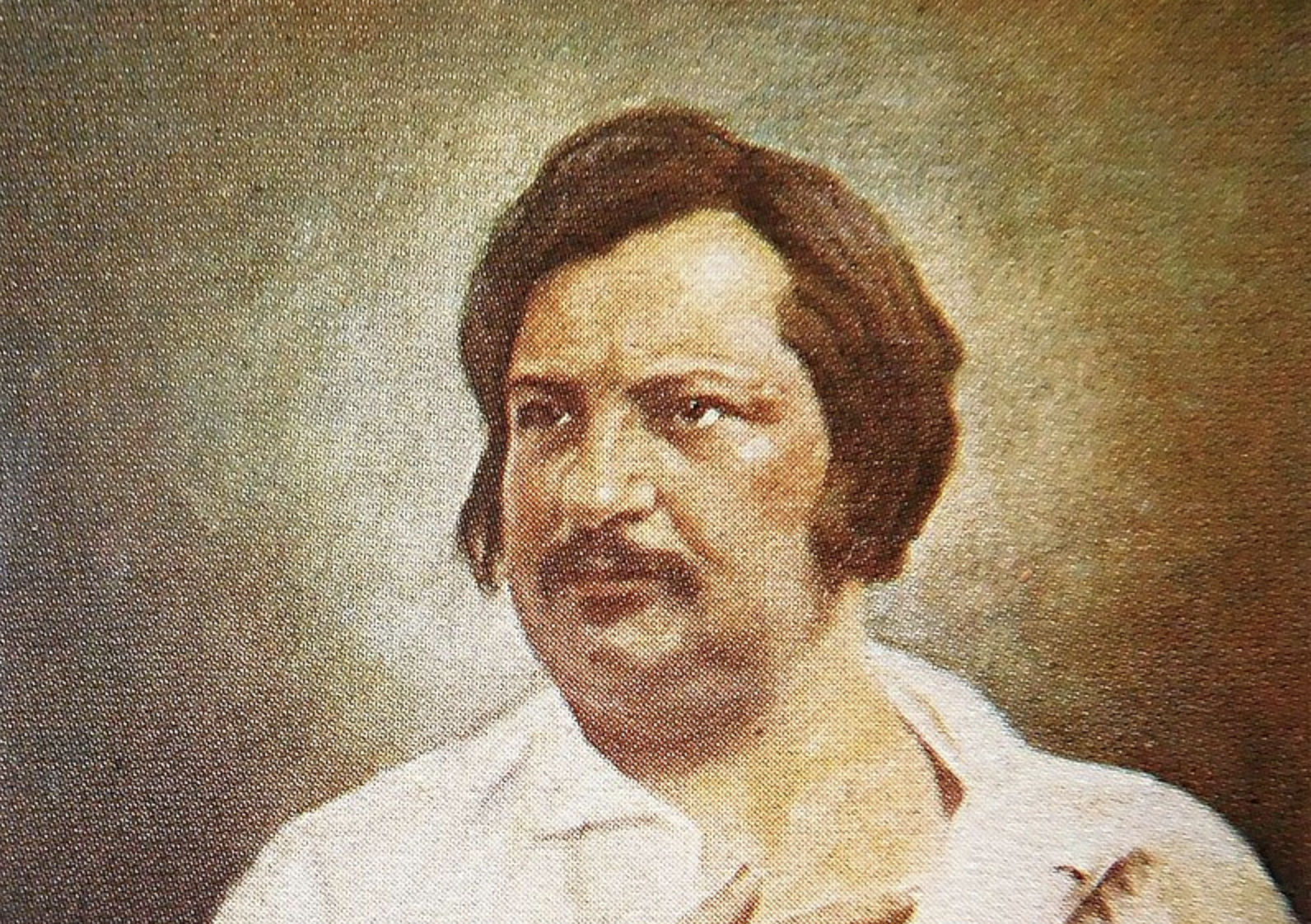
174 years after his death, Honoré de Balzac remains an extremely modern-sounding wag. Were he alive today, he’d no doubt be pounding out his provocative observations in a coffice, a café whose free wifi, lenient staff, and abundant electrical outlets make it a magnet for writers.
One has a hunch Starbucks would not suffice…
Judging by his humorous essay, “The Pleasures and Pains of Coffee,” Balzac would seek out a place that stays open past midnight, and the strongest, most arcane brewing methods. The Bucket of Black Snakes was his Green Fairy. He was that most cunning of addicts, sometimes imbibing up to 50 cups of coffee a day, carefully husbanding his binges, knowing just when to pull back from the edge in order to prolong his vice.
Coffee — he called it a “great power in [his] life” — made possible a grueling writing schedule that had him going to bed at six, rising at 1am to work until eight in the morning, then grabbing forty winks before putting in another seven hours.
It takes more than a couple of cappuccinos to maintain that kind of pace. Whenever a reasonable human dose failed to stimulate, Balzac would begin eating coffee powder on an empty stomach, a “horrible, rather brutal method” that he recommended “only to men of excessive vigor, men with thick black hair and skin covered with liver spots, men with big square hands and legs shaped like bowling pins.”
Apparently it got the job done. He cranked out eighty-five novels in twenty years and died at 51. The cause? Too much work and caffeine, they like to say. Other speculated causes of death include hypertension, atherosclerosis, and even syphilis.
Above, watch actor Paul Giamatti play Balzac all hopped up on coffee. And here you can behold The Coffee Pot That Fueled Honoré de Balzac’s Coffee Addiction.
Related Content:
Paul Giamatti Plays Honoré de Balzac, Hopped Up on 50 Coffees Per Day
Philosophers Drinking Coffee: The Excessive Habits of Kant, Voltaire & Kierkegaard
“The Virtues of Coffee” Explained in 1690 Ad: The Cure for Lethargy, Scurvy, Dropsy, Gout & More
Ayun Halliday hasn’t touched the stuff for two whole weeks. Follow her @AyunHallliday
Read More...Andy Warhol Hosts Frank Zappa on His Cable TV Show, and Later Recalls, “I Hated Him More Than Ever” After the Show
Had Andy Warhol lived to see the internet–especially social networking–he would have loved it, though it may not have loved him. Though Warhol did see the very beginnings of the PC revolution, and made computer art near the end of his life on a Commodore Amiga 1000, he was mostly enamored, unsurprisingly, of TV. “I love television,” he once remarked, “It is the medium I’d most like to shine in. I’m really jealous of everybody who’s got their own show on television. I want a show of my own.”
Warhol realized his dream in 1979, though in a venue that may not have lived up to his fantasies: a New York public-access channel called Manhattan Cable, “which showed local sports matches and agreed to sell 30-minute slots to Warhol for around $75 a pop,” notes The Telegraph. Warhol made a total of 42 episodes of his odd interview show. The pop art impresario “wasn’t exactly a natural… when it came to the delicate art of chat-show hosting,” but “he didn’t let that stop him.” By 1983, one might have thought he’d have gotten the hang of it, yet he seems especially awkward when cranky prog genius Frank Zappa appeared on his show that year.
Luckily for Warhol, he is joined by Zappa fan Richard Berlin, who serves as a buffer between the two superstars. (Berlin is probably the son of William Randolph Hearst’s handpicked successor, whose daughter, Brigid, was one of Warhol’s film stars.) At least in the excerpt above, Berlin does all of the work while Warhol looks on, seemingly stupefied. But the truth is that Warhol hated Zappa, and after the interview, he wrote in his Diaries, “I hated Zappa even more than when it started.” Part of what the show’s ostensible host found so objectionable was Zappa’s egomaniacal personality. Though Warhol, like Zappa, controlled his own small independent empire, in temperament, the two couldn’t have been more different.
But there was also some personal history between them that went back to the earliest days of the Velvet Underground. “I remember,” Warhol goes on, “when he was so mean to us when the Mothers of Invention played with the Velvet Underground—I think both at the trip, in L.A., and at the Fillmore in San Francisco. I hated him then and I still don’t like him.” Zappa wasn’t simply rude, however; at a 1967 show in New York, he turned his talent for ridicule into what Kaleidoscope magazine writer Chris Darrow called “one of the greatest pieces of rock’n roll theater that I have ever seen.”
The opening night was very crowded and Zappa and members of the Mothers of Invention showed up to show their support. (…) Nico’s delivery of her material was very flat, deadpan, and expressionless, and she played as though all of her songs were dirges. She seemed as though she was trying to resurrect the ennui and decadence of Weimar, pre-Hitler Germany. Her icy, Nordic image also added to the detachment of her delivery. (…) The audience was on her side, as she was in her element and the Warhol contingent was very prominent that night. However, what happened next is what sticks in my mind the most from that night. In between sets, Frank Zappa got up from his seat and walked up on the stage and sat behind the keyboard of Nico’s B‑3 organ. He proceeded to place his hands indiscriminately on the keyboard in a total, atonal fashion and screamed at the top of his lungs, doing a caricature of Nico’s set, the one he had just seen. The words to his impromptu song were the names of vegetables like broccoli, cabbage, asparagus… This “song” kept going for about a minute or so and then suddenly stopped. He walked off the stage and the show moved on.
What Warhol took personally may have just been the irrepressible outgrowth of Zappa’s disdain for virtually everything, which he expresses to Berlin in the interview. Original Mothers of Invention drummer Jimmy Carl Black speculated that he may have hated the Velvet Underground because “they were junkies and Frank just couldn’t tolerate any kind of drugs.” The two bands were also, briefly, competitors at MGM.
But perhaps Zappa just couldn’t tolerate anyone else taking the spotlight, especially a talented female performer. Warhol remembers Zappa’s response to a compliment about his daughter, Moon. “Listen,” he supposedly told Warhol, “I created her. I invented her.… She’s nothing. It’s all me.” In contrast to the “peculiar” reply, Warhol writes “if it were my daughter I would be saying ‘Gee, she’s so smart,’ but he’s taking all the credit.” Zappa may have been a musical genius with a special entrepreneurial flair and incisive critical wit, but the “sexist autocrat… with a scabrous attitude,” as Carlo Wolff describes him, “was not a likeable man.” Certainly the mild-mannered Warhol didn’t think so.
Related Content:
Andy Warhol Digitally Paints Debbie Harry with the Amiga 1000 Computer (1985)
Frank Zappa’s 1980s Appearances on The David Letterman Show
When Andy Warhol Guest-Starred on The Love Boat (1985)
Josh Jones is a writer and musician based in Durham, NC. Follow him at @jdmagness
Read More...How Sci-Fi Writers Isaac Asimov & Robert Heinlein Contributed to the War Effort During World War II
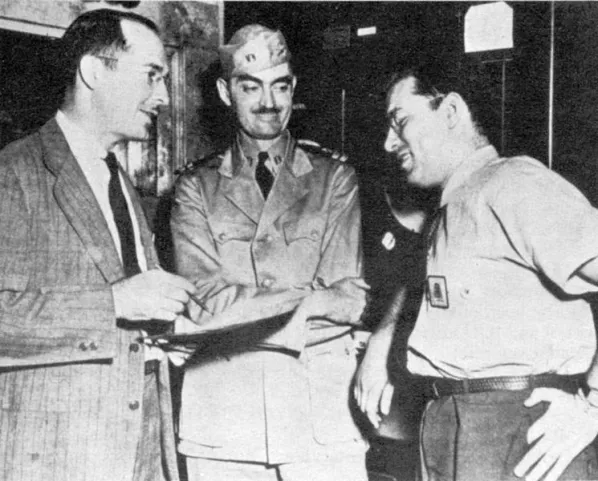
Robert Heinlein, Isaac Asimov and L. Sprague De Camp at the Navy Yard in 1944
Robert Heinlein was born in 1907, which put him on the mature side by the time of the United States’ entry into World War II. Isaac Asimov, his younger colleague in science fiction, was born in 1920 (or thereabouts), and thus of prime fighting age. But in the event, they made most of their contribution to the war effort in the same place, the Naval Aviation Experimental Station in Philadelphia. By 1942, Heinlein had become the preeminent sci-fi writer in America, and the 22-year-old Asimov, a graduate student in chemistry at Columbia, had already made a name for himself in the field. It was Heinlein, who’d signed on to run a materials testing laboratory at the Yard, who brought Asimov into the military-research fold.
Having once been a Navy officer, discharged due to tuberculosis, Heinlein jumped at the chance to serve his country once again. During World War II, writes John Redford at A Niche in the Library of Babel, “his most direct contribution was in discussions of how to merge data from sonar, radar, and visual sightings with his friend Cal Laning, who captained a destroyer in the Pacific and was later a rear admiral. Laning used those ideas to good effect in the Battle of Leyte Gulf in 1944, the largest naval battle ever fought.” Asimov “was mainly involved in testing materials,” including those used to make “dye markers for airmen downed at sea. These were tubes of fluorescent chemicals that would form a big green patch on the water around the guy in his life jacket. The patch could be seen by searching aircraft.”
Asimov scholars should note that a test of those dye markers counts as one of just two occasions in his life that the aerophobic writer ever dared to fly. That may well have been the most harrowing of either his or Heinlein’s wartime experiences, they were both involved in the suitably speculative “Kamikaze Group,” which was meant to work on “invisibility, death rays, force fields, weather control” — or so Paul Malmont tells it in his novel The Astounding, the Amazing, and the Unknown. You can read a less heightened account of Heinlein and Asimov’s war in Astounding, Alec Nevala-Lee’s history of American science fiction.
Their time together in Philadephia wasn’t long. “As the war ended, Asimov was drafted into the Army, where he spent nine months before he was able to leave, where he returned to his studies and writing,” according to Andrew Liptak at Kirkus Reviews. “Heinlein contemplated returning to writing full time, as a viable career, rather than as a side exercise.” When he left the Naval Aviation Experimental Station, “he resumed writing and working on placing stories in magazines.” In the decades thereafter, Heinlein’s work took on an increasingly militaristic sensibility, and Asimov’s became more and more concerned with the enterprise of human civilization broadly speaking. But pinning down the influence of their war on their work is an exercise best left to the sci-fi scholars.
Related content:
Sci-Fi Icon Robert Heinlein Lists 5 Essential Rules for Making a Living as a Writer
Isaac Asimov Recalls the Golden Age of Science Fiction (1937–1950)
Sci-Fi Writer Robert Heinlein Imagines the Year 2000 in 1949, and Gets it Mostly Wrong
X Minus One: Hear Classic Sci-Fi Radio Stories from Asimov, Heinlein, Bradbury & Dick
The Encyclopedia of Science Fiction: 17,500 Entries on All Things Sci-Fi Are Now Free Online
Read Hundreds of Free Sci-Fi Stories from Asimov, Lovecraft, Bradbury, Dick, Clarke & More
Based in Seoul, Colin Marshall writes and broadcasts on cities, language, and culture. His projects include the Substack newsletter Books on Cities and the book The Stateless City: a Walk through 21st-Century Los Angeles. Follow him on Twitter at @colinmarshall or on Facebook.
Read More...Oh My God! Winston Churchill Received the First Ever Letter Containing “O.M.G.” (1917)
Winston Churchill is one of those preposterously outsized historical figures who seemed to be in the middle of every major event. Even before, as Prime Minister, he steeled the resolve of his people and faced down the Third Reich juggernaut; even before he loudly warned of the Nazi menace before it was polite to do so; even before he was pilloried in the press for the disastrous Gallipoli invasion during WWI, Churchill was a famous and controversial figure. As a young cavalry officer, he left his post in India to report on the bloody colonial campaign in the Swat Valley in present-day Pakistan. His hugely popular articles pushed the military slang word “sniper” into popular use. During the second Boer War, Churchill was not only captured at gunpoint by future South African prime minister Louis Botha but he managed to successfully escape from his POW camp. And after being pushed out of the government following Gallipoli, he returned to the military as a Lieutenant Colonel and commanded a battalion of troops in France. He also won a Nobel Prize for Literature in 1953 and was, as we’ve recently seen, a pretty good painter too.
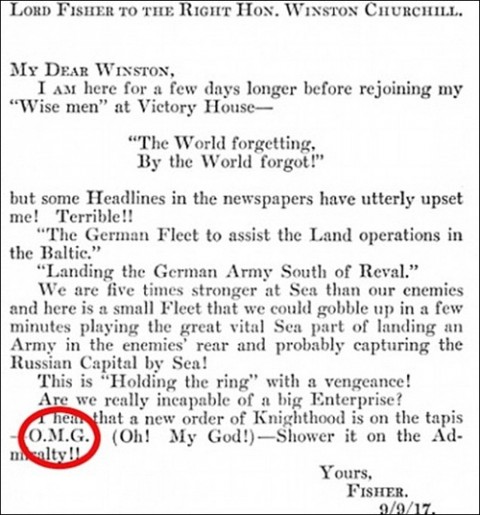
Add to this one more triumph: he unwittingly had a hand in shaping the speech patterns of teenaged girls some 50–60 years after his death. Churchill was the recipient of a missive containing the first ever usage of the oft-texted acronym “O.M.G.”. According to the Oxford English Dictionary, O.M.G.’s origins can be traced back to a letter to Churchill from Admiral John Arbuthnot Fisher, sent on September 9, 1917. After complaining about the state of affairs of the Navy during the war, Fisher closes with the following lame joke: “I hear that a new order of Knighthood is on the tapis – O.M.G. (Oh! My God!) – Shower it on the Admiralty!!”
Churchill’s relationship with Fisher was complex. While he was the First Lord of the Admiralty, Churchill brought Fisher out of retirement in 1911 to head the royal navy. Their relationship went south in 1915 following the failure of the Dardanelles campaign. Churchill was still roundly blamed mostly because of Fisher’s loud, public protestations. (In fact, had the naval officers pushed through the Dardanelles to Constantinople, as Churchill commanded, the war would have likely ended years earlier than it did.) Yet, much to his wife’s dismay, Churchill remained cordial enough with Fisher to exchange friendly notes.
The first online usage of O.M.G., by the way, came on a usenet forum about soap operas in 1994. Churchill does not appear to be connected to that instance.
Related Content:
What Happens When Mortals Try to Drink Winston Churchill’s Daily Intake of Alcohol
Winston Churchill Goes Backward Down a Water Slide & Loses His Trunks (1934)
Jonathan Crow: You can follow him at @jonccrow.
Read More...Philip K. Dick Theorizes The Matrix in 1977, Declares That We Live in “A Computer-Programmed Reality”
In 1963, Philip K. Dick won the coveted Hugo Award for his novel The Man in the High Castle, beating out such sci-fi luminaries as Marion Zimmer Bradley and Arthur C. Clarke. Of the novel, The Guardian writes, “Nothing in the book is as it seems. Most characters are not what they say they are, most objects are fake.” The plot—an alternate history in which the Axis Powers have won World War II—turns on a popular but contraband novel called The Grasshopper Lies Heavy. Written by the titular character, the book describes the world of an Allied victory, and—in the vein of his worlds-within-worlds thematic—Dick’s novel suggests that this book-within-a-book may in fact describe the “real” world of the novel, or one glimpsed through the novel’s reality as at least highly possible.
The Man in the High Castle may be Dick’s most straightforwardly compelling illustration of the experience of alternate realities, but it is only one among very many. In an interview Dick gave while at the high profile Metz science fiction conference in France in 1977, he said that like David Hume’s description of the “intuitive type of person,” he lived “in terms of possibilities rather than in terms of actualities.” Dick also tells a parable of an ancient, complicated, and temperamental automated record player called the “Capard,” which reverted to varying states of destructive chaos. “This Capard,” Dick says, “epitomized an inscrutable ultra-sophisticated universe which was in the habit of doing unexpected things.”
In the interview, Dick roams over so many of his personal theories about what these “unexpected things” signify that it’s difficult to keep track. However, at that same conference, he delivered a talk titled “If You Find This World Bad, You Should See Some of the Others” (in edited form above), that settles on one particular theory—that the universe is a highly-advanced computer simulation. (The talk has circulated on the internet as “Did Philip K. Dick disclose the real Matrix in 1977?”).
The subject of this speech is a topic which has been discovered recently, and which may not exist all. I may be talking about something that does not exist. Therefore I’m free to say everything and nothing. I in my stories and novels sometimes write about counterfeit worlds. Semi-real worlds as well as deranged private worlds, inhabited often by just one person…. At no time did I have a theoretical or conscious explanation for my preoccupation with these pluriform pseudo-worlds, but now I think I understand. What I was sensing was the manifold of partially actualized realities lying tangent to what evidently is the most actualized one—the one that the majority of us, by consensus gentium, agree on.
Dick goes on to describe the visionary, mystical experiences he had in 1974 after dental surgery, which he chronicled in his extensive journal entries (published in abridged form as The Exegesis of Philip K. Dick) and in works like VALIS and The Divine Invasion. As a result of his visions, Dick came to believe that “some of my fictional works were in a literal sense true,” citing in particular The Man in the High Castle and Flow My Tears, The Policeman Said, a 1974 novel about the U.S. as a police state—both novels written, he says, “based on fragmentary, residual memories of such a horrid slave state world.” He claims to remember not past lives but a “different, very different, present life.”
Finally, Dick makes his Matrix point, and makes it very clearly: “we are living in a computer-programmed reality, and the only clue we have to it is when some variable is changed, and some alteration in our reality occurs.” These alterations feel just like déjà vu, says Dick, a sensation that proves that “a variable has been changed” (by whom—note the passive voice—he does not say) and “an alternative world branched off.”
Dick, who had the capacity for a very oblique kind of humor, assures his audience several times that he is deadly serious. (The looks on many of their faces betray incredulity at the very least.) And yet, maybe Dick’s crazy hypothesis has been validated after all, and not simply by the success of the PKD-esque The Matrix and the ubiquity of Matrix analogies. For several years now, theoretical physicists and philosophers have entertained the theory that we do in fact live in a computer-generated simulation and, what’s more, that “we may even be able to detect it.”
Related Content:
Robert Crumb Illustrates Philip K. Dick’s Infamous, Hallucinatory Meeting with God (1974)
The Simulation Theory Explained In Three Animated Videos
Josh Jones is a writer and musician based in Durham, NC. Follow him at @jdmagness
Read More...A Playlist of the 3,300 Best Films & Documentaries on Youtube, Including Works by Hitchcock, Kubrick, Errol Morris & Other Auteurs
?si=yCx1pqpcATHND90L
Once upon a time, the most convenient means of discovering movies was cable television. This held especially true for those of us who happened to be adolescents on a break from school, ready and willing morning, midday, or night to sit through the commercial-laden likes of Corvette Summer, Transylvania 6–5000, BMX Bandits, or Freejack. Click on any of those links, and you can watch the relevant picture free on Youtube; click on the link to this playlist, and you’ll find 3,000 of the best films now available on that platform (the exact number may vary depending on your region of the world), as curated by Learnoutloud.com.
?si=rXFzge1fowoHfHxR
Not all these movies belong in the cheap-thrills bin. You’ll also find the work of celebrated auteurs like Alfred Hitchcock (The Man Who Knew Too Much, The 39 Steps), Stanley Kubrick (Fear and Desire, Barry Lyndon), Akira Kurosawa (Dersu Uzala, Dreams), and Woody Allen (Mighty Aphrodite, Cassandra’s Dream).
Then here are the documentaries, gathered here on their own playlist, including Errol Morris’ Gates of Heaven and The Thin Blue Line and Werner Herzog’s The Great Ecstasy of Woodcarver Steiner and Lessons of Darkness. You can even find related pictures across genres: consider following Lost in La Mancha, which documents Terry Gilliam’s thwarted efforts to make The Man Who Killed Don Quixote, with The Man Who Killed Don Quixote.
?si=iEzCzwxZXCYcw8Up
“Almost all of these movies are free with ads,” writes Learnoutloud.com’s David Bischke, though YouTube Premium subscribers will be able to watch ad-free. “Like any streaming service, the rights to these movies change frequently, especially on YouTube’s official Movies and TV channel. So if you see a movie you really want to watch, then check it out soon!” If you’ve been meaning to get into Raise the Red Lantern and To Live by director Zhang Yimou, to learn about artists and musicians like Jackson Pollock and Glenn Gould, or to behold a young Arnold Schwarzenegger’s early appearances in Pumping Iron and Hercules in New York, now’s the time. And with Vice Versa and Dream a Little Dream currently available, why not revisit the subgenre of the eighties body-switch comedy while you’re at it?
P.S. In case you’re wondering about the legality of the films, the Learnoutloud site notes: To make the playlist, “the movies had to be legally free on YouTube either from YouTube’s official Movies and TV channel, from a YouTube channel legally distributing the movie, or from a movie on YouTube that is in the public domain.” Just thought you might want to know…
Related content:
4,000+ Free Movies Online: Great Classics, Indies, Noir, Westerns, Documentaries & More
Watch More Than 400 Classic Korean Films Free Online Thanks to the Korean Film Archive
Download 6600 Free Films from The Prelinger Archives and Use Them However You Like
Based in Seoul, Colin Marshall writes and broadcasts on cities, language, and culture. His projects include the Substack newsletter Books on Cities, the book The Stateless City: a Walk through 21st-Century Los Angeles and the video series The City in Cinema. Follow him on Twitter at @colinmarshall or on Facebook.
Read More...A New Analysis of Beethoven’s DNA Reveals That Lead Poisoning Could Have Caused His Deafness
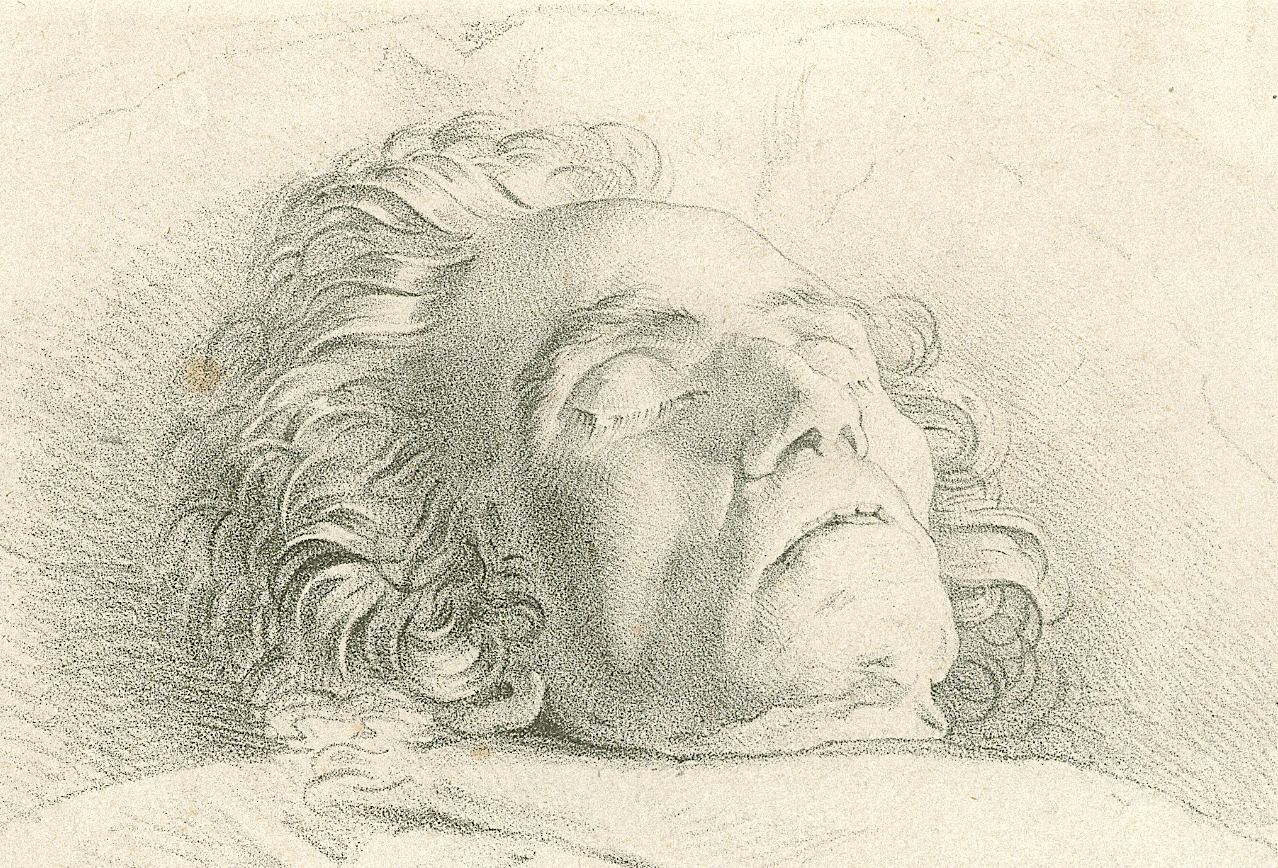
Despite the intense scrutiny paid to the life and work of Ludwig van Beethoven for a couple of centuries now, the revered composer still has certain mysteries about him. Some of them he surely never intended to clarify, like the identity of “Immortal Beloved”; others he explicitly requested be made public, like the cause of his death. The trouble is that, for generation after generation, nobody could quite figure out what that cause was. But recent genetic analysis of his hair, which we first featured last year here on Open Culture, has shed new light on the matter of what killed Beethoven — or rather, what increasingly ailed him up until he died at the age of 56.
This effort “began a few years ago, when researchers realized that DNA analysis had advanced enough to justify an examination of hair said to have been clipped from Beethoven’s head by anguished fans as he lay dying,” writes the New York Times’ Gina Kolata.
With the genuine samples separated from the frauds, a test for heavy metals revealed that “one of Beethoven’s locks had 258 micrograms of lead per gram of hair and the other had 380 micrograms”: 64 times and 95 times the normal amount, respectively. Chronic lead poisoning, possibly caused by Beethoven’s habit of drinking cheap wine sweetened with “lead sugar,” could have caused the “unrelenting abdominal cramps, flatulence and diarrhea” that plagued him in his lifetime.
It could also have hastened the deafness that had become nearly complete by age thirty. “Over the years, Beethoven consulted many doctors, trying treatment after treatment for his ailments and his deafness, but found no relief,” Kolata writes. “At one point, he was using ointments and taking 75 medicines, many of which most likely contained lead.” Alas, the true danger of lead poisoning, a condition that had been acknowledged since antiquity, wouldn’t be taken seriously until the late nineteenth century. According to the research so far, even this degree of lead exposure wouldn’t have been fatal by itself. But with a bit less of it, would Beethoven have completed his tenth symphony, or even continued on to an eleventh? Add that to the still-growing list of unanswerable questions about him.
Related content:
The Secrets of Beethoven’s Fifth, the World’s Most Famous Symphony
The Math Behind Beethoven’s Music
Read Beethoven’s Lengthy Love Letter to His Mysterious “Immortal Beloved” (1812)
Based in Seoul, Colin Marshall writes and broadcasts on cities, language, and culture. His projects include the Substack newsletter Books on Cities, the book The Stateless City: a Walk through 21st-Century Los Angeles and the video series The City in Cinema. Follow him on Twitter at @colinmarshall or on Facebook.
Read More...The First Recording of Allen Ginsberg Reading “Howl” (1956)

Image by Michiel Hendryckx, via Wikimedia Commons
Occasionally I slip into an ivory tower mentality in which the idea of a banned book seems quaint—associated with silly scandals over the tame sex scenes in James Joyce or D.H. Lawrence. After all, I think, we live in an age when bestseller lists are topped (no pun) by tawdry fan fiction like Fifty Shades of Grey. Nothing’s sacred. But this notion is a massive blind spot on my part; the whole awareness-raising mission of the annual Banned Books Week seeks to dispel such complacency. Books are challenged, suppressed, and banned all the time in public schools and libraries, even if we’ve moved past outright government censorship of the publishing industry.
It’s also easy to forget that Allen Ginsberg’s generation-defining poem “Howl” was once almost a casualty of censorship. The most likely successor to Walt Whitman’s vision, Ginsberg’s oracular utterances did not sit well with U.S. Customs, who in 1957 tried to seize every copy of the British second printing. When that failed, police arrested the poem’s publisher, Lawrence Ferlinghetti, and he and Ginsberg’s “Howl” were put on trial for obscenity. Apparently, phrases like “cock and endless balls” did not sit well with the authorities. But the court vindicated them all.
The story of Howl’s publication begins in 1955, when 29-year-old Ginsberg read part of the poem at the Six Gallery, where Ferlinghetti—owner of San Francisco’s City Lights bookstore—sat in attendance. Deciding that Ginsberg’s epic lament “knocked the sides out of things,” Ferlinghetti offered to publish “Howl” and brought out the first edition in 1956. Prior to this reading, “Howl” existed in the form of an earlier poem called “Dream Record, 1955,” which poet Kenneth Rexroth told Ginsberg sounded “too formal… like you’re wearing Columbia University Brooks Brothers ties.” Ginsberg’s rewrite jettisoned the ivy league decorum.
Unfortunately, no audio exists of that first reading, but above you can hear the first recorded reading of “Howl,” from February, 1956 at Portland’s Reed College. The recording sat dormant in Reed’s archives for over fifty years until scholar John Suiter rediscovered it in 2008. In it, Ginsberg reads his great prophetic work, not with the cadences of a street preacher or jazzman—both of which he had in his repertoire—but in an almost robotic monotone with an undertone of manic urgency. Ginsberg’s reading, before an intimate group of students in a dormitory lounge, took place only just before the first printing of the poem in the City Lights edition.
Note: This post originally appeared on our site in 2013. Over the years, the audio originally featured in the post, along with many of the links, went dead. So we gave everything a refresh and brought it back.
If you would like to support the mission of Open Culture, consider making a donation to our site. It’s hard to rely 100% on ads, and your contributions will help us continue providing the best free cultural and educational materials to learners everywhere. You can contribute through PayPal, Patreon, and Venmo (@openculture). Thanks!
Related Content:
Allen Ginsberg Recordings Brought to the Digital Age. Listen to Eight Full Tracks for Free
James Franco Reads a Dreamily Animated Version of Allen Ginsberg’s Epic Poem ‘Howl’
2,000+ Cassettes from the Allen Ginsberg Audio Collection Now Streaming Online
13 Lectures from Allen Ginsberg’s “History of Poetry” Course (1975)
Josh Jones is a writer and musician based in Washington, DC. Follow him at @jdmagness
Read More...Support Us
We're hoping to rely on loyal readers, rather than erratic ads. Please click the Donate button and support Open Culture. You can use Paypal, Venmo, Patreon, even Crypto! We thank you!

About Us

Open Culture scours the web for the best educational media. We find the free courses and audio books you need, the language lessons & educational videos you want, and plenty of enlightenment in between.
Advertise With Us

FREE UPDATES!
GET OUR DAILY EMAIL
Get the best cultural and educational resources on the web curated for you in a daily email. We never spam. Unsubscribe at any time.
FOLLOW ON SOCIAL MEDIA

Open Culture editor Dan Colman scours the web for the best educational media. He finds the free courses and audio books you need, the language lessons & movies you want, and plenty of enlightenment in between.
Advertise With Us


