Salvador Dalí’s Surreal Jewelry Designs: From Throbbing Heart Necklaces to Medusa Brooches
Upon hearing the name of Salvador Dalí, even a total layman in the art world is bound to get visions of melting clocks. Surprisingly, for an artist who showed so much self-marketing savvy, Dalí never brought an actual timepiece in that distinctively, even canonically surreal shape to market. But that hardly stopped Cartier from putting out the Crash, whose distorted shape may have always brought The Persistence of Memory to mind, but whose name hints at the inspiration of a watch smashed up in a car wreck. The Crash came out in swinging-sixties London at its very height, by which time Dalí himself had been designing real jewelry for more than a quarter century.
?si=v8xd7w6Tr3ZQzIIq
You can see a few of Dalí’s jewels in the 1960 British Pathé clip at the top of the post. Unsurprisingly, they occupy a realm apart from, or at least orthogonal to, that of conventional jewelry. Some of them move: Living Flower, for instance, which “opens to reveal stamen and petals paved with diamonds. The mechanism is embedded in malachite from the Congo, which to Dalí represents the unknown, latent forces, while the gold and diamond flowers, known beauty and creativity.”
Angel Cross, by contrast, embodies “the hypoxiological concept of existence — whatever that means.” Certainly, Dalí never claimed to play to the sensibility of the British, though some of them might go in for The Royal Heart, with its “pulsating rubies representing our queen, heart beating constantly for her people, while the nugget gold symbolizes the people sheltering and protecting their ruler.”
The segment’s outtakes feature more footage of these pieces, giving us a longer look at works like The Eye of Time, embedded with a small clock signed by Dalí, and the “leaf-veined hands” he described as “reaching out to the future.” Other of his vivid jewelry designs include the Medusa brooch, completed with a nest of ruby-eyed gold snakes, and a construction that literalizes — and, at the same time, surrealizes — the expression “ruby lips and teeth like pearls.” Realized in collaboration with the well-regarded jewelers Carlos Alemany, Eric Ertman, and Henryk Kaston, and often inspired by his wife and muse Gala, they may be overshadowed by Dalí’s paintings and drawings, but haute couture does pay them occasional homage. What else — indeed, who else — could have inspired the throbbing heart-shaped rhinestone necklace seen on Schiaparelli’s models last summer at Paris Fashion Week?
via Messy Nessy
Related content:
Salvador Dalí’s Surreal Cutlery Set from 1957
The Tarot Card Deck Designed by Salvador Dalí
When Salvador Dalí Created a Surrealist Funhouse at New York World’s Fair (1939)
Captivating Collaboration: Artist Hubert Duprat Uses Insects to Create Golden Sculptures
Based in Seoul, Colin Marshall writes and broadcasts on cities, language, and culture. His projects include the Substack newsletter Books on Cities and the book The Stateless City: a Walk through 21st-Century Los Angeles. Follow him on the social network formerly known as Twitter at @colinmarshall.
Read More...Why Coffee Makes You Go #2
James Hoffmann, the author of The World Atlas of Coffee and the creator of a coffee-centric YouTube channel, can tell you many things about coffee—from how to roast coffee, to the tools and techniques needed to make espresso, to the ultimate French Press technique. Then he can also get into more tangentially related questions, like why coffee makes you drop the proverbial deuce. Above, Mr. Hoffmann takes you on a short scientific journey through the human body, exploring the effects of coffee on digestion, gut bacteria, and our nervous system. We’ll provide no spoilers or gory details here.
Related Content
How Humanity Got Hooked on Coffee: An Animated History
“The Virtues of Coffee” Explained in 1690 Ad: The Cure for Lethargy, Scurvy, Dropsy, Gout & More
The Birth of Espresso: The Story Behind the Coffee Shots That Fuel Modern Life
Read More...Watch Winsor McCay’s The Sinking of the Lusitania, the First Major Animated Propaganda Film (1918)
You might know Winsor McCay (1867? ‑1934) for the gorgeously surreal Little Nemo comic strip or for his early animated short Gertie the Dinosaur (1914). But did you know that he also created some of the earliest examples of animated propaganda ever?
On May 7, 1915, the RMS Lusitania was just off the coast of Ireland, heading towards its destination of Liverpool, when a German U‑boat attacked the ship without warning. Eighteen minutes after two torpedoes slammed into the ship, it was under water. 1,198 died. The furor over the incident eventually led to the United States entering WWI.
At the time of the sinking, McCay was employed by William Randolph Hearst as an editorial cartoonist. Though McCay was incensed by the attack, Hearst was an isolationist and demanded that he draw anti-war cartoons. This grated on the artist more and more until finally he decided to follow up on his hugely successful Gertie the Dinosaur by making The Sinking of the Lusitania (1918), which you can see above.
The movie took two years of painstaking effort to make and consisted of over 25,000 drawings—all done by hand and most done by McCay himself during his free time after work.
Compared to other animation done around this time, the film is both stark and serious, lending it the air of a documentary. The piece, which isn’t much shorter than the actual time it took for the Lusitania to sink, gives a blow-by-blow account of the attack. Though the incident is depicted largely from afar, as if from a camera on another ship, McCay doesn’t shy away from showing some really gut-wrenching moments of the tragedy up close. At one point, there is a shot of a desperate mother trying to keep her baby above the waves. At another point, dozens of people are seen bobbing in the choppy seas like driftwood.
And, just in case you haven’t quite grasped the thrust of the film, McCay includes some intertitles, which are, even by the standards of war propaganda, pretty heavy-handed.
The babe that clung to his mother’s breast cried out to the world – TO AVENGE the most violent cruelty that was ever perpetrated upon an unsuspecting and innocent people.
And
The man who fired the shot was decorated for it by the Kaiser! – AND YET THEY TELL US NOT TO HATE THE HUN.
The curious thing about the movie, considering its subject matter, is how beautiful it is. Just look at the stylized lines of the ocean, the baroque arabesques of the smoke coming off the ship’s smokestacks, the elegant use of negative space. Each and every cel of the movie is worthy of getting framed. How many war propaganda movies can you say that about?
You can find The Sinking of the Lusitania in the Animation section of our collection of Free Movies Online: Great Classics, Indies, Noir, Westerns.
Note: An earlier version of this post appeared on our site in 2014.
Related Content:
Watch the Sinking of the Lusitania Animated in Real Time (1915)
Watch Dziga Vertov’s Soviet Toys: The First Soviet Animated Movie Ever (1924)
Jonathan Crow is a writer and filmmaker whose work has appeared in Yahoo!, The Hollywood Reporter, and other publications.
Read More...AC/DC Plays a Short Gig at CBGB in 1977: Hear Metal Being Played on Punk’s Hallowed Grounds
Punk rock and heavy metal were two genres that evolved over the ‘70s, but seemed to run parallel to each other, despite sharing common fashion, sounds, and attitudes. But then there are moments in history, where everybody plays together in the same sandbox. For example, the above remastered audio, which captures the Australian band AC/DC on their first American tour, playing New York’s CBGB, synonymous now with punk and new wave music.
The date is August 24, 1977, and AC/DC were on a cross-country trip that had taken in both club dates and arenas, where they supported—yes, hard to believe, I know—REO Speedwagon. Their album Let There Be Rock had just dropped in June. The band would be in the States until the winter.
This CBGB gig finds them on the same bill as Talking Heads and the Dead Boys, according to a poster from the time. And while there’s no video for this show, you can find a few photos that document the concert here. You can feel the muggy New York summer in these photos, but also the excitement of an unforgettable gig.
At 15 minutes, the set is short, but still three minutes longer than the Ramones’ first set at the same club three years earlier. That’s pretty metal, man.
Note: An earlier version of this post appeared on our site in 2016.
Related Content:
Listen to Patti Smith’s Glorious Three Hour Farewell to CBGB’s on Its Final Night
The Talking Heads Play CBGB, the New York Club That Shaped Their Sound (1975)
Watch an Episode of TV-CBGB, the First Rock ‘n’ Roll Sitcom Ever Aired on Cable TV (1981)
Ted Mills is a freelance writer on the arts.
Read More...Dozens of M.C. Escher Prints Have Been Digitized & Put Online by the Boston Public Library
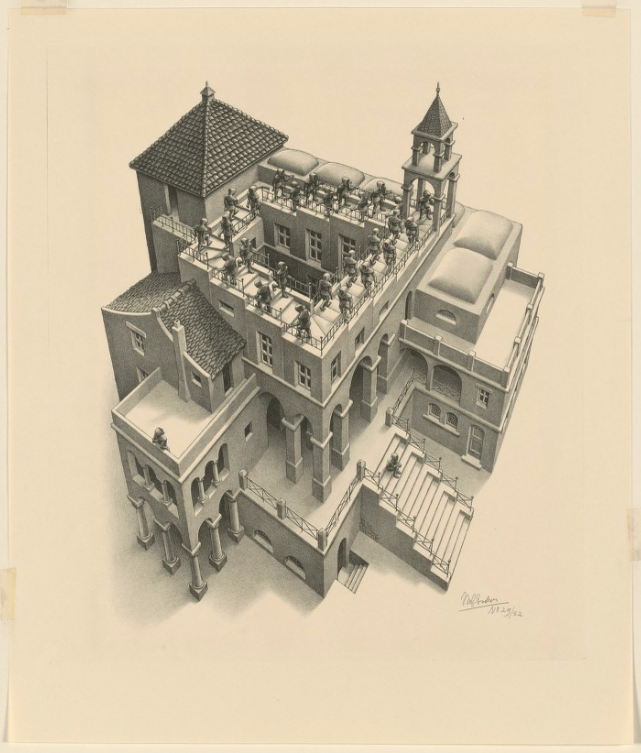
In addition to the iconic scene in Jim Henson’s Labyrinth, or appearances in animated TV shows and video games, M.C. Escher’s work has adorned the covers of albums like Mott the Hoople’s 1969 debut and the speculative fiction of Italo Calvino and Jorge Luis Borges. A big hit with hippies and 1960s college students, writes Heavy Music Artwork, his mind-bending prints became associated with “questioning accepted views of normal experience and testing the limits of perception with hallucinogenic drugs.” While he appreciated his cult following, Escher “did not encourage their mystical interpretations of his images.” Replying to one enthusiastic fan of his print Reptiles, who claimed to see in it an image of reincarnation, Escher replied, “Madame, if that’s the way you see it, so be it.”
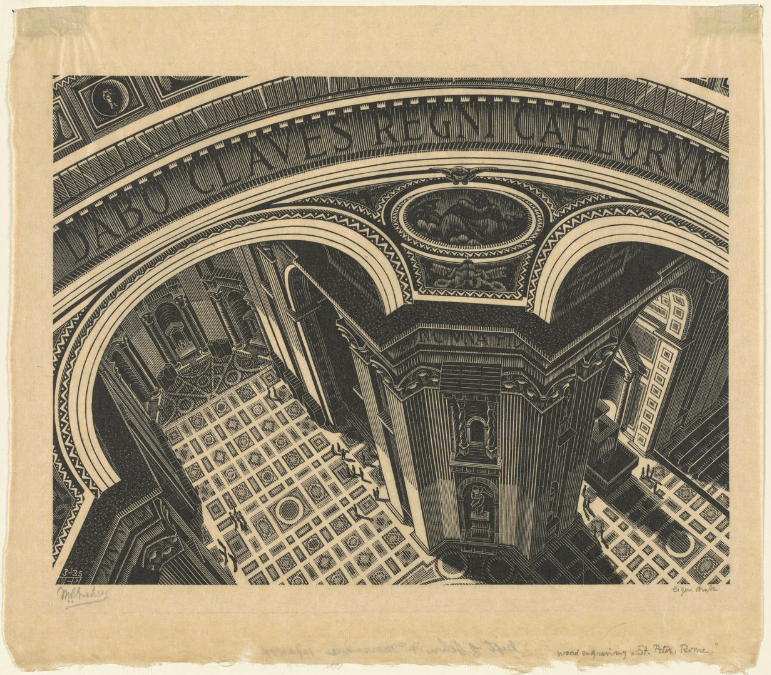
Rather than illustrate higher states of consciousness or metaphysical entities, Bruno Ernst writes in The Magic Mirror of M.C. Escher, the artist intended to create practical, “pictorial representation of intellectual understanding.” Illustrations, that is, of philosophical and scientific thought experiments. The son of a civil engineer, Escher began his studies in architecture before moving to drawing and printmaking.
The challenge of creating built environments—even seemingly impossible ones—always seemed to occupy his mind. Along with themes from the natural world, a high percentage of his works center on buildings—inspired by formative early years in Rome and his admiration for Islamic art and Spanish architecture.
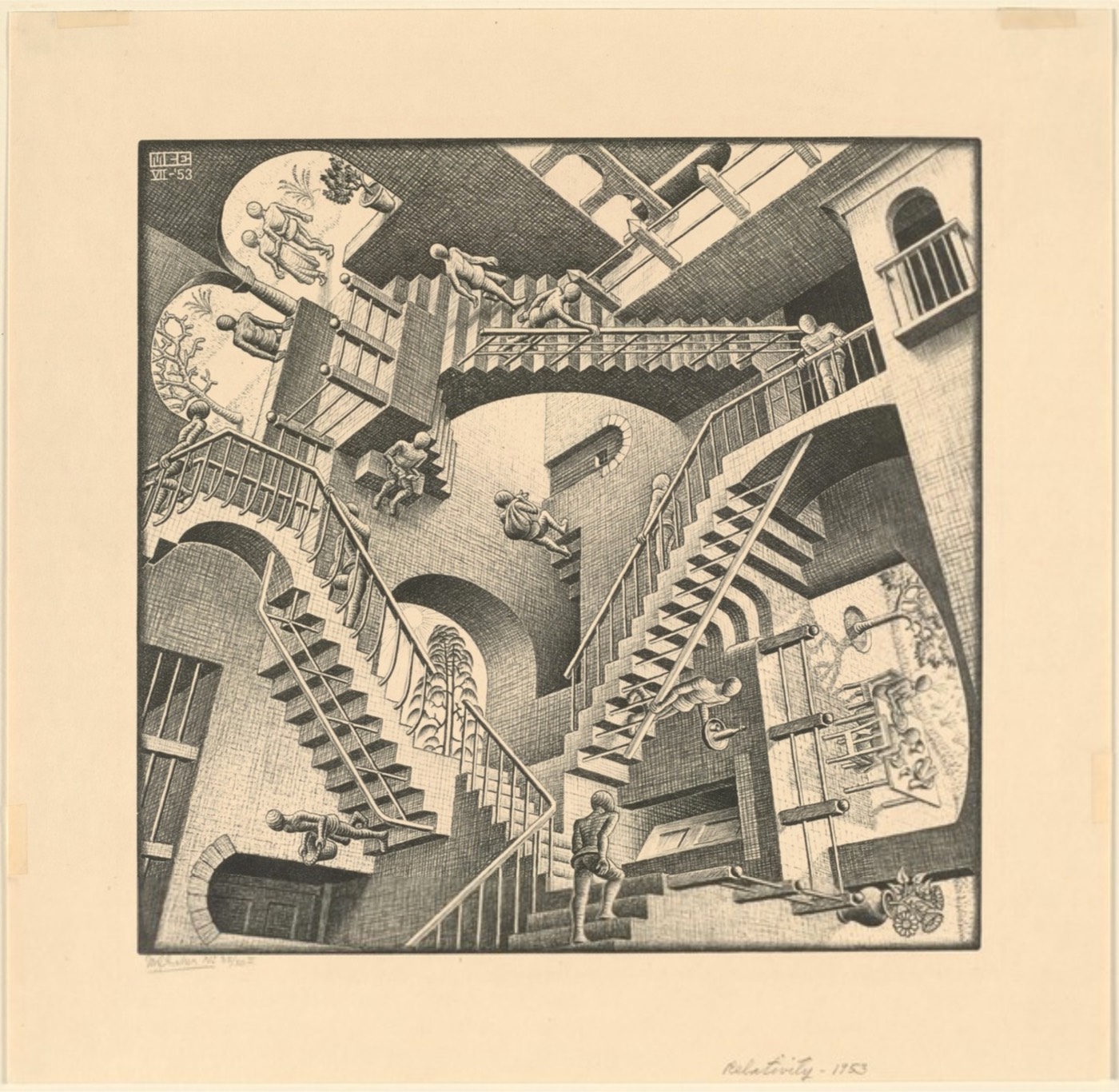
In the 50s and 60s Escher’s art piqued the interest of academics and mathematicians, an audience he found more congenial to his vision. He corresponded with scientists and incorporated their ideas into his work, meanwhile claiming to be “absolutely innocent of training or knowledge in the exact sciences.” In the 50s, Escher “dazzled” the likes of mathematicians like Roger Penrose and HSM Coxeter. In turn, notes Maev Kennedy, he “was inspired by Penrose’s perspectival triangle and Coxeter’s work on crystal symmetry.”
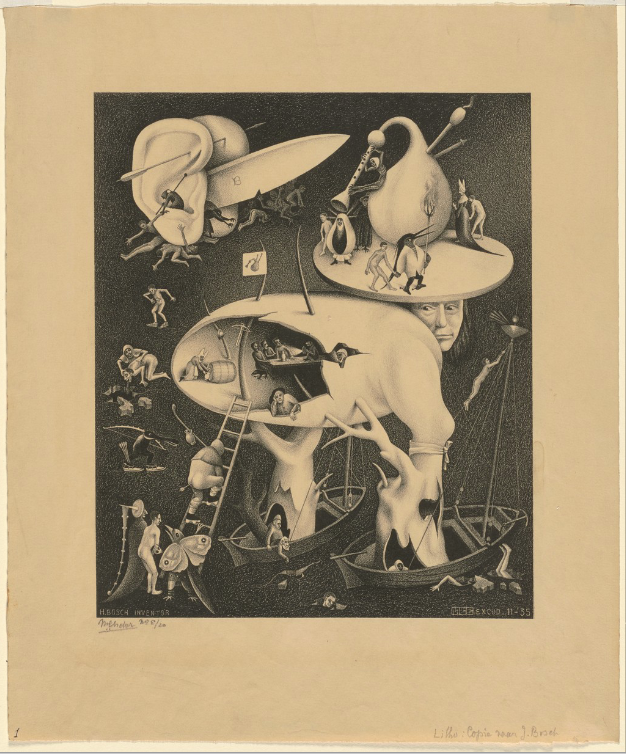
For all the excitement he created among mathematicians, it took a bit longer for Escher to get noticed in the art world. When Penrose’s uncle showed Escher’s version of the perspectival triangle to Picasso, “Picasso had heard of the British mathematician but not of the Dutch artist.” Escher’s fame spread outside of the sciences in part through the interests of the counterculture. He may have shrugged off mystical and psychedelic readings of his prints, but he had an innate penchant for the marvelously weird (see his copy of a scene, for example, from Hieronymus Bosch, above, or his surreal print Gravity, below).
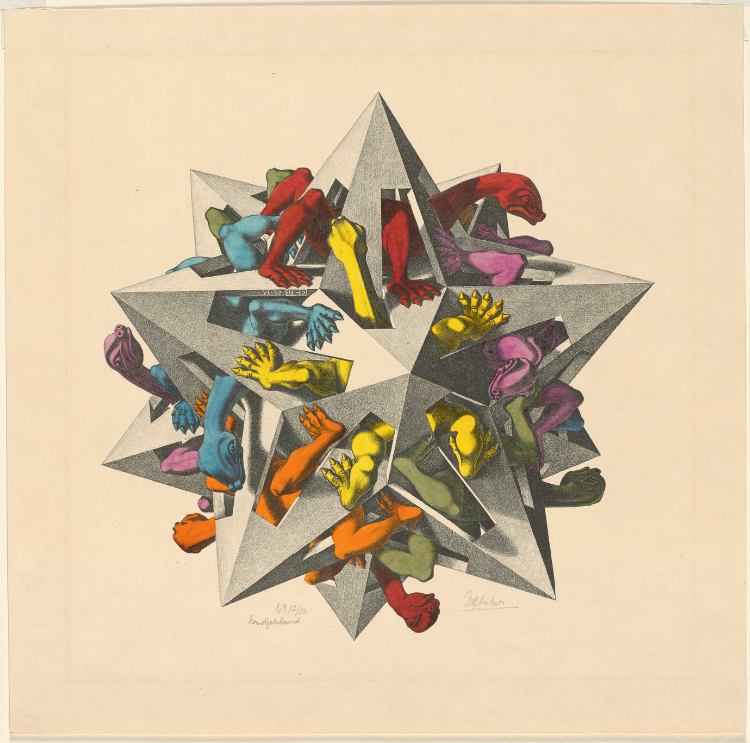
See the prints pictured here and a few dozen more digitized in high resolution at Digital Commonwealth, courtesy of Boston Public Library, who scanned their Escher collection and made it available to the public. Zoom into the fine details of prints like Inside Saint Peter’s, further up—a finely rendered but otherwise not-especially-Escher-like work—and the labyrinthine Ascending and Descending at the top. Whether—as Harvard Library curator John Overholt confesses—you’re a “nerd who loves M.C. Escher” for his mathematical mind, an artist with a mystical bent who loves him for his hallucinatory qualities, or some measure of both, you’ll find exactly the Escher you’re looking for in this digital gallery.
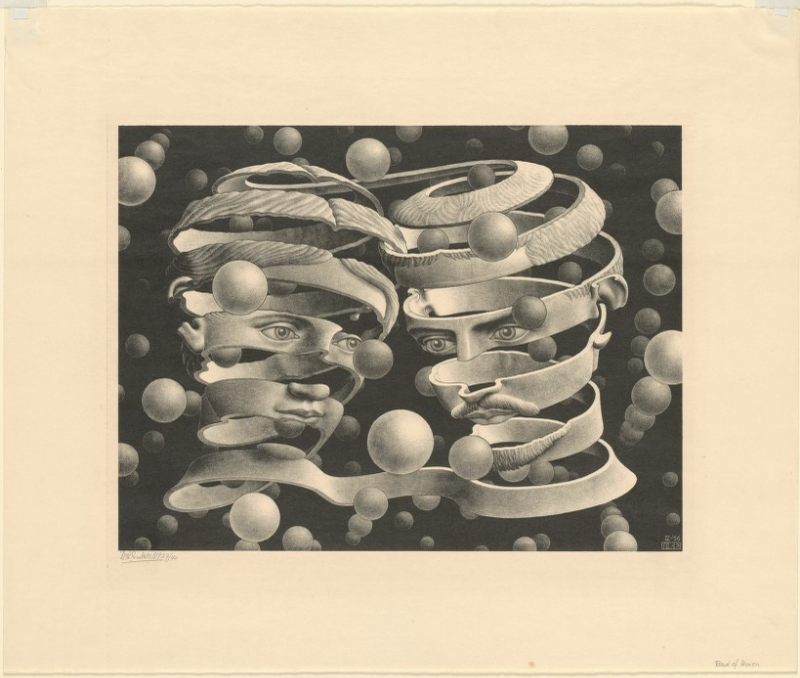
Note: An earlier version of this post appeared on our site in 2018.
Related Content:
M.C. Escher Cover Art for Great Books by Italo Calvino, George Orwell & Jorge Luis Borges
Josh Jones is a writer and musician based in Durham, NC.
Read More...Celebrate Halloween with Michael Jackson’s Horrifically Entertaining “Thriller” Music Video—and a Behind-the-Scenes Documentary
Michael Jackson’s Thriller is the best-selling album of all time, and not by a particularly slim margin. The most recent figures have it registered at 51.3 million copies, as against the 31.2 million notched by the runner up, AC/DC’s Back in Black. But it would surely be a closer call without the title song’s celebrated music video, thirteen John Landis-directed minutes full of not just singing and dancing, but also classic-style Hollywood monsters, some of them doing that singing and dancing themselves. Halloween night is, of course, the best time to revisit Michael Jackson’s Thriller, as it’s officially titled. This year, why not chase it with the behind-the-scenes documentary below, Making Michael Jackson’s Thriller?
Younger fans may not know that “Thriller” wasn’t even released as a single until November of 1983: about a year after the album itself, which had already spun off six songs, including enormous hits like “Billie Jean” and “Beat It.” In fact, Jackson’s unprecedented vision for the album had been that every song could be a hit, with no filler in between.
The higher-ups at Epic Records felt that its popularity, however sensational to that point, had just about run its course. That made them unwilling, at first, to put out “Thriller” on its own, as did the song’s campy scary-movie lyrics, sound effects, and “rap” by none other than Vincent Price, the embodiment of old-Hollywood horror. (This sort of thing wasn’t without precedent: with his siblings, Jackson had created a similar spooky atmosphere in “This Place Hotel,” from 1980.)
Still, at that point in his rise to the kind of fame no cultural figure may ever know again, Jackson understood much that the old guard didn’t. He knew that “Thriller” could succeed, not just as a song on the radio, but a multimedia cultural phenomenon. It would, of course, need a music video, but not one that merely met the (still fairly lax) standards of MTV. Impressed by the horror, comedy, and visual effects of John Landis’ An American Werewolf in London, Jackson called up Landis and asked him to direct what he’d been envisioning for “Thriller” at feature-film production values. The $500,000 budget came from television networks like MTV and Showtime, officially for broadcasting rights to Making Michael Jackson’s Thriller.
The documentary captures various aspects of the video’s creation, from casting to choreography to shooting to makeup, that last being an especially painstaking process overseen by industry master Rick Baker. Whatever the rigors of the production, Jackson displays undisguised enjoyment of it all in this footage, perhaps foreseeing that it would culminate in the kind of expression that could come from no other artist. Though an intensely collaborative effort, Michael Jackson’s Thriller is true to its name in ultimately being the product of a single, guiding performative sensibility, somehow both universally appealing and highly idiosyncratic at the same time. Jackson’s insistence on calling his music videos “short films” may have been regarded as a typical eccentricity, but never was the label more appropriate than when he brought back the old-school monster movie one last, funky time.
Related content:
Where Zombies Come From: A Video Essay on the Origin of the Horrifying, Satirical Monsters
Based in Seoul, Colin Marshall writes and broadcasts on cities, language, and culture. His projects include the Substack newsletter Books on Cities and the book The Stateless City: a Walk through 21st-Century Los Angeles. Follow him on the social network formerly known as Twitter at @colinmarshall.
Read More...The Mystery of Edgar Allan Poe’s Death: 19 Theories on What Caused the Poet’s Demise
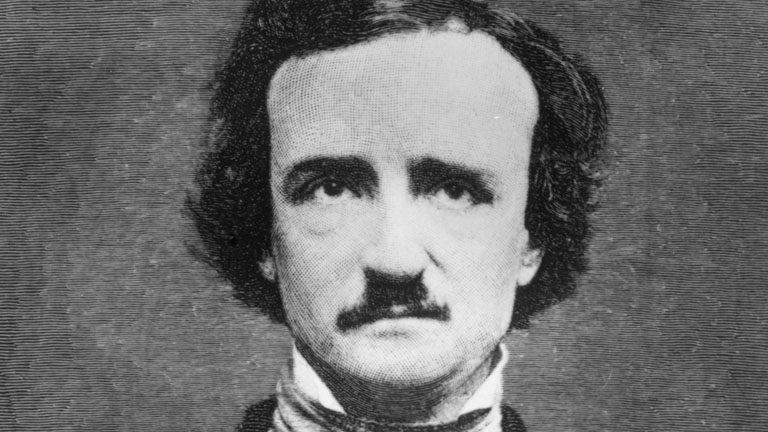
One of my very first acts as a new New Yorker many years ago was to make the journey across three boroughs to Woodlawn Cemetery in the Bronx. My purpose: a pilgrimage to Herman Melville’s grave. I came not to worship a hero, exactly, but—as Fordham University English professor Angela O’Donnell writes—“to see a friend.” Professor O’Donnell goes on: “It might seem presumptuous to regard a celebrated 19th-century novelist so familiarly, but reading a great writer across the decades is a means of conducting conversation with him and, inevitably, leads to intimacy.” I fully share the sentiment.
I promised Melville I would visit regularly but, alas, the pleasures and travails of life in the big city kept me away, and I never returned. No such petty distraction kept away a friend-across-the-ages of another 19th-century American author.
“For decades,” writes the Baltimore Sun, “Edgar Allan Poe’s birthday was marked by a mysterious visitor to his gravesite in Baltimore. Beginning in the 1930s, the ‘Poe Toaster’ placed three roses at the grave every Jan. 19 and opened a bottle of cognac, only to disappear into the night.” The identity of the original “Poe Toaster”—who may have been succeeded by his son—remains a tantalizing mystery. As does the mystery of how Edgar Allan Poe died.
Most of you have probably heard some version of the story. On October 3, 1849, a compositor for the Baltimore Sun, Joseph Walker, found Poe lying in a gutter. The poet had departed Richmond, VA on September 27, bound for Philadelphia “where he was to edit a volume of poetry for Mrs. St. Leon Loud,” the Poe Museum tells us. Instead, he ended up in Baltimore, “semiconscious and dressed in cheap, ill-fitting clothes so unlike Poe’s usual mode of dress that many believe that Poe’s own clothing had been stolen.” He never became lucid enough to explain where he had been or what happened to him: “The father of the detective story has left us with a real-life mystery which Poe scholars, medical professionals, and others have been trying to solve for over 150 years.”
Most people assume that Poe drank himself to death. The rumor was partly spread by Poe’s friend, editor Joseph Snodgrass, whom the poet had asked for in his semi-lucid state. Snodgrass was “a staunch temperance advocate” and had reason to recruit the writer posthumously into his campaign against drink, despite the fact that Poe had been sober for six months prior to his death and had refused alcohol on his deathbed. Poe’s attending physician, John Moran, dismissed the binge drinking theory, but that did not help clear up the mystery. Moran’s “accounts vary so widely,” writes Biography.com, “that they are not generally considered reliable.”
So what happened? Doctors at the University of Maryland Medical Center theorize that Poe may have contracted rabies from one of his own pets—likely a cat. This diagnosis accounts for the delirium and other reported symptoms, though “no one can say conclusively,” admits the Center’s Dr. Michael Benitez, “since there was no autopsy after his death.” As with any mystery, the frustrating lack of evidence has sparked endless speculation. The Poe Museum offers the following list of possible cause of death, with dates and sources, including the rabies and alcohol (both overimbibing and withdrawal) theories:
- Beating (1857) The United States Magazine Vol.II (1857): 268.
- Epilepsy (1875) Scribner’s Monthly Vo1. 10 (1875): 691.
- Dipsomania (1921) Robertson, John W. Edgar A. Poe A Study. Brough, 1921: 134, 379.
- Heart (1926) Allan, Hervey. Israfel. Doubleday, 1926: Chapt. XXVII, 670.
- Toxic Disorder (1970) Studia Philo1ogica Vol. 16 (1970): 41–42.
- Hypoglycemia (1979) Artes Literatus (1979) Vol. 5: 7–19.
- Diabetes (1977) Sinclair, David. Edgar Allan Poe. Roman & Litt1efield, 1977: 151–152.
- Alcohol Dehydrogenase (1984) Arno Karlen. Napo1eon’s Glands. Little Brown, 1984: 92.
- Porphryia (1989) JAMA Feb. 10, 1989: 863–864.
- Delerium Tremens (1992) Meyers, Jeffrey. Edgar A1lan Poe. Charles Scribner, 1992: 255.
- Rabies (1996) Maryland Medical Journal Sept. 1996: 765–769.
- Heart (1997) Scientific Sleuthing Review Summer 1997: 1–4.
- Murder (1998) Walsh, John E., Midnight Dreary. Rutgers Univ. Press, 1998: 119–120.
- Epilepsy (1999) Archives of Neurology June 1999: 646, 740.
- Carbon Monoxide Poisoning (1999) Albert Donnay
The Smithsonian adds to this list the possible causes of brain tumor, heavy metal poisoning, and the flu. They also briefly describe the most popular theory: that Poe died as a result of a practice called “cooping.”
A site called The Medical Bag expands on the cooping theory, a favorite of “the vast majority of Poe biographies.” The term refers to “a practice in the United States during the 19th century by which innocent people were coerced into voting, often several times, for a particular candidate in an election.” Oftentimes, these people were snatched unawares off the streets, “kept in a room, called the coop” and “given alcohol or drugs in order for them to follow orders. If they refused to cooperate, they would be beaten or even killed.” One darkly comic detail: victims were often forced to change clothes and were even “forced to wear wigs, fake beards, and mustaches as disguises so voting officials at polling stations wouldn’t recognize them.”
This theory is highly plausible. Poe was, after all, found “on the street on Election Day,” and “the place where he was found, Ryan’s Fourth Ward Polls, was both a bar and a place for voting.” Add to this the notoriously violent and corrupt nature of Baltimore elections at the time, and you have a scenario in which the author may very well have been kidnapped, drugged, and beaten to death in a voter fraud scheme. Ultimately, however, we will likely never know for certain what killed Edgar Allan Poe. Perhaps the “Poe Toaster” was attempting all those years to get the story from the source as he communed with his dead 19th century friend year after year. But if that mysterious stranger knows the truth, he ain’t talking either.
Note: An earlier version of this post appeared on our site in 2015.
Related Content:
7 Tips from Edgar Allan Poe on How to Write Vivid Stories and Poems
Josh Jones is a writer and musician based in Durham, NC.
Read More...The 100 Greatest Novels of All Time, According to 750,000 Readers in the UK (2003)
In the eighteenth century, the readers of Europe went mad for epistolary novels. France had, to name the most sensational examples, Montesquieu’s Lettres persanes, Rousseau’s Julie, and Laclos’ Les Liaisons dangereuses; Germany, Goethe’s Die Leiden des jungen Werther and Hölderlin’s Hyperion. The English proved especially insatiable when it came to long-form stories composed entirely out of letters: soon after its publication in 1740, Samuel Richardson’s Pamela — by some reckonings, the first real English novel — grew into an all-encompassing cultural phenomenon, which Richardson himself outdid eight years later with Clarissa. Alas, when the BBC surveyed the public two and three-quarter centuries later to determine the most beloved novel in the U.K., neither of those books even made the top 100.
With the possible exceptions of Bram Stoker’s Dracula (#104) and Mary Shelley’s Frankenstein (#171) — two works of nineteenth-century horror that make use of a variety of textual forms, letters included — the rankings produced by “The Big Read” included practically no epistolary novels. (Nor did eighteenth-century works of any other kind make the cut.) What happened to the literary genre that had once caused such a national craze? For one thing, Jane Austen happened: novels like Pride and Prejudice, Emma, and Persuasion revealed just how rich a story could become when its narration breaks away from the pen of any character in particular, gaining the ability to know more about them than they know about themselves. Not for nothing did all three of those books perform well on The Big Read the better part of 200 years after they came out; Pride and Prejudice even came in at number two.
The top spot was taken by J. R. R. Tolkien’s Lord of the Rings trilogy: an understandable outcome, given not just its ambition but also its massive and enduring popularity and influence. Still, one does wonder if Peter Jackson’s blockbuster film adaptations, released in the years leading up to the poll, might have had something to do with it. Similar suspicions adhere to the likes of Captain Corelli’s Mandolin (#19), American Psycho (#185), The Beach (#103), and Bridget Jones’s Diary (#75), all of which provided the basis for major motion pictures around the turn of the millennium. Umberto Eco’s The Name of the Rose, one of a scattering of translated novels to make the list, also got the Hollywood treatment, but it’s worth remembering that the book itself sold so well that its English translator could use his royalties to build an addition to his Tuscan villa called the “Eco Chamber.”
Apart from Austen, the other novelists with multiple books on The Big Read’s top 100 include Stephen King, who also has three; Thomas Hardy, with four; and Charles Dickens, with seven. Those are, in any case, some of the novelists for adults. The abiding British appreciation for children’s literature shows in the high rankings of Roald Dahl, who secured a great many votes with even lesser works like The Twits and Danny, the Champion of the World; J. K. Rowling, who would have benefited from the height of Harry Potter mania in any case; and the prolific Dame Jacqueline Wilson, whose fourteen novels on the list place her second only to Sir Terry Pratchett’s fifteen. It could be that his comic-fantasy sensibility, saturated with both the outlandish and the mundane, resonated uniquely with the British psyche. Or, as Pratchett himself says in the BBC’s Big Read television broadcast, “it could just be that I’m quite popular.”
In total, more than 750,000 readers participated in the Big Read poll. Find readers’ top 100 books below:
Related content:
800 Free eBooks for iPad, Kindle & Other Devices
The 10 Greatest Books Ever, According to 125 Top Authors (Download Them for Free)
The 100 Best Novels: A Literary Critic Creates a List in 1898
Based in Seoul, Colin Marshall writes and broadcasts on cities, language, and culture. His projects include the Substack newsletter Books on Cities and the book The Stateless City: a Walk through 21st-Century Los Angeles. Follow him on the social network formerly known as Twitter at @colinmarshall.
Read More...The First Electric Guitar: Behold the 1931 “Frying Pan”

The names Leo Fender and Les Paul will be forever associated with the explosion of the electric guitar into popular culture. And rightly so. Without engineer Fender and musician and studio wiz Paul’s timeless designs, it’s hard to imagine what the most iconic instruments of decades of popular music would look like.
They just might look like frying pans.
Though Fender and Paul (and the Gibson company) get all the glory, it’s two men named George who should rightly get much of the credit for inventing the electric guitar. The first, naval officer George Breed, has a status vis-à-vis the electric guitar similar to Leonardo da Vinci’s to the helicopter.
In 1890, Breed submitted a patent for a one-of-a-kind design, utilizing the two basic elements that would eventually make their way into Stratocasters and Les Pauls—a magnetic pickup and wire strings. Unfortunately for Breed, his design also included some very impractical circuitry and required battery operation, “resulting in a small but extremely heavy guitar with an unconventional playing technique,” writes the International Repertory of Music Literature, “that produced an exceptionally unusual and unguitarlike, continuously sustained sound.”
Like a Renaissance flying machine, the design went nowhere. That is, until George Beauchamp, a “musician and tinkerer” from Texas, came up with a design for an electric guitar pickup that worked beautifully. The first “Frying Pan Hawaiian” lap steel guitar, whose schematic you can see at the top of the post, “now sits in a case in a museum,” writes Andre Millard in his history of the electric guitar, “looking every inch the historic artifact but not much like a guitar.” Gizmodo quotes guitar historian Richard Smith, who discusses the need in the 20s and 30s for an electric guitar to be heard over the rhythm instruments in jazz and in Beauchamp’s preferred style, Hawaiian music, “where… the guitar was the melody instrument. So the real push to make the guitar electric came from the Hawaiian musicians.”
Beauchamp developed the guitar after he was fired as general manager of the National String Instrument Corporation. Needing a new project, he and another National employee, Paul Barth, began experimenting with Breed’s ideas. After building a working pickup, they called on another National employee, writes Rickenbacker.com, “to make a wooden neck and body for it. In several hours, carving with small hand tools, a rasp, and a file, the first fully electric guitar took form.” (An earlier electro-acoustic guitar—the Stromberg Electro—contributed to amplifier technology but its awkward pickup design didn’t catch on.)
Needing capital, manufacturing, and distribution, Beauchamp contracted with toolmaker Adolph Rickenbacker, who mass produced the Frying Pan as “The Rickenbacher A‑22″ under the company name “Electro String.” (The company became Rickenbacker Guitars after its owner sold it in the 50s.) Although the novelty of the instrument and its cost during the Great Depression inhibited sales, Beauchamp and Rickenbacker still produced several versions of the Frying Pan, with cast aluminum bodies rather than wood. (See an early model here.) Soon, the Frying Pan became integrated into live jazz bands (see it at the 3:34 mark above in a 1936 Adolph Zukor short film) and recordings.
How does the Frying Pan sound? Astonishingly good, as you can hear for yourself in the demonstration videos above. Although Rickenbacker and other guitar makers moved on to installing pickups in so-called “Spanish” guitars—hollow-bodied jazz boxes with their familiar f‑holes—the Frying Pan lap steel continues to have a particular mystique in guitar history, and was manufactured and sold into the early 1950s.
The next leap forward in electric guitar design? After the Frying Pan came Les Paul’s first fully solidbody electric: The Log.
Learn More about the invention of the electric guitar in the short Smithsonian video just above.
Note: An earlier version of this post appeared on our site in 2013.
Related Content:
The History of the Electric Guitar Solo: A Seven-Part Series
Oxford Scientist Explains the Physics of Playing Electric Guitar Solos
Josh Jones is a writer and musician based in Durham, NC. Follow him at @jdmagness
Read More...Hear What the Language Spoken by Our Ancestors 6,000 Years Ago Might Have Sounded Like
As scholars of ancient texts well know, the reconstruction of lost sources can be a matter of some controversy. In the ancient Hebrew and less ancient Christian Biblical texts, for example, critics find the remnants of many previous texts, seemingly stitched together by occasionally careless editors. Those source texts exist nowhere in any physical form, complete or otherwise. They must be inferred from the traces they have left behind—signatures of diction and syntax, stylistic and thematic preoccupations….
So it is with the study of ancient languages, but since oral cultures far predate written ones, the search for linguistic ancestors can take us back to the very origins of human culture, to times unremembered and unrecorded by anyone, and only dimly glimpsed through scant archaeological evidence and observable aural similarities between vastly different languages. So it was with the theoretical development of Indo-European as a language family, a slow process that took several centuries to coalesce into the modern linguistic tree we now know.
The observation that Sanskrit and ancient European languages like Greek and Latin have significant similarities was first recorded by a Jesuit missionary to Goa, Thomas Stephens, in the sixteenth century, but little was made of it until around 100 years later. A great leap forward came in the mid-nineteenth century when German linguist August Schleicher, under the influence of Hegel, published his Compendium of the Comparative Grammar of the Indo-European Languages. There, Schleicher made an extensive attempt at reconstructing the common ancestor of all Indo-European languages, “Proto-Indo-European,” or PIE, for short, thought to have originated somewhere in Eastern Europe, though this supposition is speculative.
To provide an example of what the language might have been like, Schleicher made up a fable called “The Sheep and the Horses” as a “sonic experiment.” The story has been used ever since, “periodically updated,” writes Eric Powell at Archaeology, “to reflect the most current understanding of how this extinct language would have sounded when it was spoken some 6,000 years ago.” Having no access to any texts written in Proto-Indo-European (which may or may not have existed) nor, of course, to any speakers of the language, linguists disagree a good deal on what it should sound like; “no single version can be considered definitive.”
And yet, since Schleicher’s time, the theory has been considerably refined. At the top of the post, you can hear one such refinement based on work by UCLA professor H. Craig Melchert and read by linguist Andrew Byrd. See a translation of Schleicher’s story, “The Sheep and the Horses” below:
A sheep that had no wool saw horses, one of them pulling a heavy wagon, one carrying a big load, and one carrying a man quickly. The sheep said to the horses: “My heart pains me, seeing a man driving horses.” The horses said: “Listen, sheep, our hearts pain us when we see this: a man, the master, makes the wool of the sheep into a warm garment for himself. And the sheep has no wool.” Having heard this, the sheep fled into the plain.
Byrd also reads another story in hypothetical Proto-Indo-European, “The King and the God,” using “pronunciation informed by the latest insights into PIE.”
See Powell’s article at Archaeology for the written transcriptions of both Schleicher’s and Melchert/Byrd’s versions of PIE, and see his article here to learn about the archeological evidence for the Bronze Age speakers of this theoretical linguistic common ancestor.
Note: An earlier version of this post appeared on our site in 2017.
Related Content:
Listen to The Epic of Gilgamesh Being Read in its Original Ancient Language, Akkadian
Hear Homer’s Iliad Read in the Original Ancient Greek
Hear What Homer’s Odyssey Sounded Like When Sung in the Original Ancient Greek
Was There a First Human Language?: Theories from the Enlightenment Through Noam Chomsky
What Ancient Greek Music Sounded Like: Listen to a Reconstruction That’s “100% Accurate”
Josh Jones is a writer and musician based in Durham, NC. Follow him at @jdmagness
Read More...Support Us
We're hoping to rely on loyal readers, rather than erratic ads. Please click the Donate button and support Open Culture. You can use Paypal, Venmo, Patreon, even Crypto! We thank you!

About Us

Open Culture scours the web for the best educational media. We find the free courses and audio books you need, the language lessons & educational videos you want, and plenty of enlightenment in between.
Advertise With Us

FREE UPDATES!
GET OUR DAILY EMAIL
Get the best cultural and educational resources on the web curated for you in a daily email. We never spam. Unsubscribe at any time.
FOLLOW ON SOCIAL MEDIA

Open Culture editor Dan Colman scours the web for the best educational media. He finds the free courses and audio books you need, the language lessons & movies you want, and plenty of enlightenment in between.
Advertise With Us


