Charles Bamforth is the Anheuser-Busch Endowed Professor of Malting and Brewing Sciences at UC Davis, which means he knows a few things about making beer. He can get into some nitty-gritty topics, like the enzymology of the brewing process, foam stability, and the psychophysics of beer perception. But that’s not what he’s doing here. In the clip above, the “Pope of Foam,” as Bamforth is otherwise known, gives you a quick overview of the beer-making process, describing everything from grinding the malt, to boiling the wort, to bottling with glass versus cans. Finally, the Pope gives you a hot tip: how to pick the freshest pint when you’re at a pub.
Musically, Tom Waits has come a long way since the 1970s. Absorbing a range of influences, Waits has reinvented himself several times over to become one of the most influential writers and performers of our time.
Along the way he has also made his mark as a character actor. But “parallel career” would be the wrong phrase to describe Waits’s film and television work, for his music and acting have always intersected. Never was this more apparent than in the 1970s, when Waits cultivated the persona of a down-and-out barfly with the soul of a Beat poet.
That early phase of Waits’s career is preserved in this highly theatrical 54-minute television performance. It was recorded on December 5, 1978 at the University of Texas for a March 24, 1979 broadcast of Austin City Limits. The program was later released onDVD as Burma Shave. Waits is joined by Herbert Hardesty on trumpet and tenor saxophone, Arthur Richards on guitar, Greg Cohen on bass, and Big John Thomassie on drums. Here’s the set list:
Doctor, what does it mean if you dream of creating a font of Freud’s handwriting?
This is exactly what German typographer Harald Geisler has in mind, and, in the spirit of self-actualization, he’s funding the project on Kickstarter. His charisma is such that he’s already raised over eight times the original $1500 goal that will allow him to travel to Vienna, where he will create the typeface in a borrowed apartment within walking distance from Freud’s former home at Berggasse 19. That address is now home to the Sigmund Freud Museum, where the romantically-minded Geisler plans to visit the hard copies of the eight letters from which his alphabet will be assembled.
Don’t let the project’s fully-in-the-black status keep you from visiting its fundraising page. In addition to being an inadvertent tutorial on the elements of a top-notch Kickstarter campaign, it also provides some interesting information with regard to penmanship, font creation, and the difference between Kurrent, the German-style script Freud learned as a schoolboy, and the Latin-style cursive that was standard among his North American patients.
Geisler says it cracks him up to imagine someone jotting a note to his or her shrink in Freud’s handwriting. Perhaps those of us not currently under the care of a psychiatry professional could use it to write our mothers.
Drones over America –they’re a high tech assault on American constitutional rights, and they deserve to be met with a modern form of dissent, something more than a cranky op-ed in the pages of The New York Times. In this case, animated satire feels just about right. Enter Drew Christie, who created a satirical “Op-Doc” for the Times that mocks plans to use drones to police America. Christie hails from Seattle, whose police force recently announced it would adopt an aerial drone program. When the plan was later scuttled, K.G.B. agents everywhere were very upset. Who could blame them, seeing that we were so close to achieving our brave new world?
If Mr. K.G.B. feels a little too severe, then why not have a little fun with Mr. Blasty? He’s adorable, a barrel of laughs, but he pulls no punches. “While you’re all suddenly wondering about me and my drone friends blowing you to bits in Bowling Green, I’ve been busy abroad for years killing thousands!…” “Don’t worry, they’re usually just foreigners though. But whether they’re foreigners or citizens– first comes firepower [blam], then comes legalese! And if the legalese doesn’t work, there’s always “state secrets” where nobody knows nothin’–.” The more the administrations the change, the more they stay the same.
You may struggle to find two more iconoclastic countercultural figures than William S. Burroughs and Frank Zappa. The well-known names conceal often less well-known and at times inaccessible or downright infuriating work and personalities. Despite their sometimes too-easy association with the movements they helped birth, neither Burroughs nor Zappa fits comfortably with free-wheeling Beat sensibilities or flowery California hippie culture. They were both simply too contrary, cultivated or, at times, too weird and antisocial for that.
But these confounding tendencies make both artists perennially interesting. Despite their differences—in medium, age, and background—both share at least two significant traits: a wry, blasphemous sense of humor and descent from families integral to U.S. technocratic supremacy: Burroughs the grandson of the inventor of the adding machine and Zappa the son of a chemist and mathematician who helped make chemical weapons. Maybe it’s historical irony that the Burroughs and Zappa families produced such errant offspring, maybe it’s a dialectical inevitability. But it’s certainly fitting that the two come together in the audio above, where Zappa reads a particularly funny and profane passage from Burroughs’ most famous novel Naked Lunch.
The occasion of this reading was the Nova Convention in 1978, three days and nights of readings, panel discussions, film screenings, and performances that, The New York Times wrote at the time, “sought to grapple with some of the implications of the writing” of Burroughs. In addition to Burroughs and Zappa, the convention featured such notable countercultural names as Terry Southern, Patti Smith, Philip Glass, Brion Gysin, John Cage, Timothy Leary, and Robert Anton Wilson. A good bit of the happening (including the audio above) was recorded for posterity and released as a double-LP by Giorno Poetry Systems.
Last week we featured studio-executive notes on Blade Runner. “This movie gets worse every screening,” they said. “Deadly dull,” they said. “More tits,” they said. These remarks now offer something in the way of irony and entertainment, but they only give even the most avid Blade Runner enthusiast so much to think about. For a more interesting reaction, and certainly a more articulate one, we should turn to Philip K. Dick, the prolific writer of psychologically inventive science fiction whose Do Androids Dream of Electric Sheep? provided Blade Runner’s source material. Dick, alas, would not live to see the film open in theaters, much less ascend to the top of the canon of sci-fi cinema decades later, but he did get a good look, before moving on to other realms, at the script and some of the footage. With just those, he managed to outguess everyone — audiences, critics, and especially studio executives — about the film’s fate.
“This indeed is not science fiction,” Dick wrote in a letter available on his official site. “It is not fantasy; it is exactly what [star] Harrison [Ford] said: futurism. The impact of Blade Runner is simply going to be overwhelming, both on the public and on creative people — and, I believe, on science fiction as a field. [ … ] Nothing we have done, individually or collectively, matches Blade Runner. This is not escapism; it is super realism, so gritty and detailed and authentic and goddam convincing that, well, after the segment I found my normal present-day ‘reality’ pallid by comparison.” 32 years on, many of us frequent Blade Runner-watchers feel just the same way, and Dick wrote that after catching nothing more than a segment about the picture on the news. “It was my own interior world,” he later told interview John Boonstra. “They caught it perfectly.” And, at this point, all of our interior worlds look a little more Blade Runner-esque.
H/T to Marianne for the lead on the PKD letter.
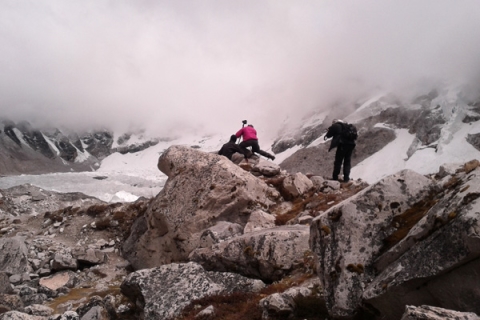
What’s surprising about Everest Base Camp is the color. It’s a flinty, gray place littered with shards of Himalayan sandstone and shale. Here and there appears a vivid green pool of alpine water. And then there’s the red, blue and green prayer flags hung by Himalayans to blow blessings in the wind.
Google Street View’s latest project, the World’s Highest Peaks, takes us to Everest and two other mountains included in the Seven Summits—the highest mountains on each of the seven continents.
Teams of mountaineers toted digital cameras on treks to the top of each mountain and integrated their images into Google maps so we can trek along with them from the comfort of our laptops, iPhones or Android devices. Like Google Street View’s Ocean gallery, the mountain images bring us to places we may never see with our own eyes.
It’s easy to imagine the dry, cold climate at Camp Colera, where hikers wait for the weather to permit a climb of Aconagua, the highest mountain in the Andes. The views of Tanzania from Arrow Glacier are breathtaking. Hikers camp here before making the treacherous ascent to Uhuru—the “rooftop of Africa” and the summit of Mt. Kilimanjaro.
One of the things Google does really well is create galleries of images that are the kind we might take ourselves, not filtered-lens professional shots that belong on calendars. We see mountaineers resting and hanging out at the frosty Casa de Piedra, on the way up to Aconagua, hikers picnicking at Lemosho Glades as they switch from jeep to foot on the climb up Kilimanjaro, and the weird, abandoned diesel barrels that serve as shelter for folks climbing Mount Elbrus in Russia.
As usual, Google lets us in on the process of collecting all these images with a fun blog written by the photographers.
Which best describes your museum-going experience? Inspiration and spiritual refreshment? Or a soul crushing attempt to fight your way past the hoards there for the latest blockbuster exhibit, with a too-heavy bag and a whining, foot sore companion in tow?
Wouldn’t it be wonderful to lose yourself in contemplation of a single work? What about that giant one at the top of the Metropolitan Museum of Art’s Grand Staircase? For every visitor who pauses to take it in, another thousand stream by with hardly a glance.
The above commentary by curator of Italian paintings, Xavier Salomon, may well turn Giovanni Battista Tiepolo’s The Triumph of Marius into one of the Met’s hottest attractions. It’s often difficult for the average museum-goer to understand what the deal is in one of these densely populated, 19th century oils. Salomon supplies the needed historical context—general Gaius Marius parading captive Numidian king Jugurtha through the streets upon his triumphal return to Rome.
Things get even more interesting when he translates the Latin inscription at the top of the canvas: “The Roman people behold Jugurtha laden with chains.” In other words, you can forgo the hero worship of the title and concentrate on the bad guy. This, Salomon speculates, is what the artist had in mind when swathing Jugurtha in that eye-catching red cape. Jugurtha may be the loser, but his refusal to be humbled before the crowd is winsome.
As is 82nd and 5th, an online series that aims to celebrate 100 transformative works of art from the museum’s collection before year’s end. In addition to Salomon’s compelling thoughts on The Triumph of Marius, some pleasures thus far include Melanie Holcomb, Associate Curator of Medieval Art and The Cloisters, geeking out over illustrated manuscript pages and fashion and costume curator Andrew Bolton recalling his first encounter with one of designer Alexander McQueen’s most extreme garments. Each video is supplemented with a tab for further exploration. You can also find the talks collected on YouTube.
Brilliantly conceived and executed, these commentaries provide virtual museum-goers with a highly personal tour, and can only but enrich the experience of anyone lucky enough to visit in the flesh.
Thelonious Monk’s personality was as quirky and original as his piano playing. An elusive, insular figure, Monk was nevertheless persuaded in late 1967 to allow a camera crew to follow him around over an extended period of time for a West German television documentary. The film, Monk (shown above in its entirety), is a fascinating up-close look at one of the giants of Jazz.
The 55-minute movie was shot by the American filmmakers Michael and Christian Blackwood for the networks NDR (North German Broadcasting) and WDR (West German Broadcasting). The Blackwood brothers had unprecedented access to Monk over a six-month period in late 1967 and early 1968, as he and his quartet performed and recorded in New York, Atlanta and Europe. The quartet includes Charlie Rouse on tenor saxophone, Larry Gales on bass and Ben Riley on drums. Although there are a few brief passages of untranslated German narration, the film is basically a cinéma vérité piece on Monk (who speaks English) and his remarkable music.
The Blackwood brothers’ footage, which Stephen Holden of The New York Times called “some of the most valuable jazz sequences ever shot,” later became the nucleus of a longer 1988 documentary produced by Clint Eastwood. You can watch that film and learn more about it in our 2011 post, “Thelonious Monk: Straight No Chaser.”
The story above—from our old friend James Grime of Numberphile and Cambridge University—has all the makings of weirdo Americana: bad amateur science, commercial ventures based upon the same, and a state legislature eager to embrace it all. In 1897, an amateur mathematician named Edwin Goodwin believed he’d solved an ancient problem ruled insoluble fifteen years earlier. He thought that he had squared the circle and could reasonably copyright Pi as 3.2. Yes, that’s right, after his “discovery,” Goodwin, a native of Indiana, decided to copyright his proof so that anyone using it outside of the state would have to pay him royalties.
But kindly, in a gesture of nativist goodwill (or political opportunism), Goodwin decided he would let his home state of Indiana use his proof for free for educational purposes. In fact, he said as much when he introduced a bill to the Indiana House of Representatives to rule his proof correct and grant him sole proprietorship. And, as sometimes happens in stories like this, the bill passed, unanimously, and the legislators were impressed. But one man wasn’t. By sheer chance, a professor of mathematics happened to be in attendance. While he declined to meet mathematics hero Edwin Goodwin, he did take it upon himself to warn the Indiana Senate of what was coming its way. Luckily for the state’s schoolchildren, the Senate threw the bill out, but not before a half-hour spent mocking its silliness.
But is the idea of squaring a circle ridiculous? Dr. Grime cites one Indian mathematician who proposed a somewhat feasible solution. And what exactly does it mean to “square a circle”? If you don’t know (and I don’t), you’ll have to wait till next time on Numberphile, when Grime and his team promise to explain it to us rubes.
We're hoping to rely on loyal readers, rather than erratic ads. Please click the Donate button and support Open Culture. You can use Paypal, Venmo, Patreon, even Crypto! We thank you!
Open Culture scours the web for the best educational media. We find the free courses and audio books you need, the language lessons & educational videos you want, and plenty of enlightenment in between.