If you would like to support the mission of Open Culture, consider making a donation to our site. It’s hard to rely 100% on ads, and your contributions will help us continue providing the best free cultural and educational materials to learners everywhere. You can contribute through PayPal, Patreon, and Venmo (@openculture). Thanks!
Over the years, when Roman Polanski was asked to name the film he was happiest with, his answer was surprising: The Fearless Vampire Killers.
The film was a commercial and critical flop when it was released in 1967, and Polanski was furious when MGM chopped 20 minutes out of the movie and changed the title from Dance of the Vampires to the farcical The Fearless Vampire Killers, or Pardon Me, But Your Teeth Are In My Neck. A reviewer for The New York Times pronounced the film “as dismal and dead as a blood-drained corpse.”
But as the years went by, Polanski professed a fondness for it. “The film reminds me of the happiest time of my life,” he told Le Nouvel Observateur in 1984. “It’s Proust’s Madeleine to the power of a thousand. All my memories come flooding back in one shot.” Polanski fell in with actress Sharon Tate while filming on a soundstage in England and on location in the Italian Alps.
Polanski also liked the film because it was unpretentious. He told Cahiers du Cinéma in 1969, “As a filmmaker who wants to show something interesting or new cinematically speaking, I made Cul-de-sac. But for those people who want to go to the cinema for two hours and have a good time, I made The Fearless Vampire Killers.”
Some viewers have protested that the film is not especially funny or scary. Polanski said his intention was to create a kind of cinematic fairy tale, a fantasy adventure. “I wanted to tell a romantic story that was funny and frightening at the same time,” he told Positif in 1969. “These are the things we like to see when we’re children. We go to the funfair, sit in the ghost train, and hope to be frightened. When we laugh or get goose-pimples at the same time it’s a pleasant feeling because we know there’s no real danger.”
The film tells the story of the eccentric Professor Abronsius (Jack McGowran) and his young apprentice Alfred (Polanski) as they venture into Transylvania in search of vampires. They arrive at an isolated Jewish inn, where a hapless proprietor (Alfie Bass) has trouble keeping tabs on his beautiful daughter (Tate).
“In the film there’s an Eastern European culture which was desolated by the Germans and that’s been killed off for good thanks to Polish Stalinism,” Polanski told Positif. “It’s the kind of thing that you can see in the work of figures like Chagall and Isaac Babel, and also in certain Polish paintings. This culture, which never reappeared after the war, is part of my childhood memories. There just aren’t any traditional Jews in Poland any more.”
There are some beautiful, dreamlike moments in The Fearless Vampire Killers. The opening scene, in which the protagonists are pursued by a pack of wild dogs, evokes the sort of childhood nightmare in which we find ourselves unable to call out for help. In another scene, a hunchback uses a coffin as a sled, gliding over the curving hills like a surreal Norelco Santa.
The Fearless Vampire Killers is good fun as long as you follow the director’s lead and don’t take it too seriously. This version (which has been added to our collection of Free Movies) runs one hour and 43 minutes. The American theatrical release ran one hour and 28 minutes, so it appears that most of the missing footage has been restored. Make some popcorn, turn down the lights and enjoy the film!
Warner Brothers’ animation department did several cartoons based on this concept over 50 years ago that packed much more energy and humor into a very few minutes worth of dazzling animation.
The reader was also good enough to point us to one such early cartoon, which we’re featuring today. (See above.)
Released in 1946, the Looney Tunes cartoon Book Revuestarts with a scene that may look familiar if you watched Jonze’s film: It’s midnight. The bookstore is closed. The lights are off. No creatures are stirring, not even … Scratch that, the books are stirring. They’re coming to life. And the hormones are running high, a little too high. You can watch the rest, but we’ll leave you with this tidbit. In 1994, Book Revue was voted one of the 50 greatest cartoons of all time by a group of 1,000 animation professionals. We thank Mike for sending this our way.
For good measure, let’s also rewind the clock to 1938, when Merrie Melodies released Have You Got Any Castles?It may well be the original books-come-to-life cartoon. We start again at midnight, and the book covers do their thing. Dr. Jekyll and Mr. Hyde, Fu Manchu, The Phantom of the Opera, and Frankenstein make an appearance, along with other famous literary characters. When TBS re-released this cartoon decades later, several characters from this original film (Bill “Bojangles” Robinson from The 39 Steps, and Cab Calloway singing “I’ve Got Swing For Sale”) were edited out because of the indelicate way that African-Americans were caricatured here. Talent these 1930s animators had. But also their blindspots too.…
Arizona State University has launched a new contest called 10,000 Solutions open to anyone over 18, anywhere in the world, and it offers a $10,000 prize. Entries can take on one of the eight greatest challenges facing the world, like sustainability and the future of education. What makes the contest unusual is that participants are encouraged to collaborate and build on one another’s solutions. ASU wants to create an open solutions bank that others can use to generate new ideas, and some students at ASU have already met up in person to talk over things they shared on the site. The school is promoting 10,000 Solutions as an experiment in collaborative invention and the National Science Foundation is funding a team of ASU researchers to study the contest and see how ideas are shared and developed.
The contest is off to a strong start, getting some high-profile entries like this one from Dan Ariely.
While many of the solutions share questions or ideas at the brainstorming stage, some groups are using the platform to promote working prototypes. This group of ASU student engineers is working on a low-cost smartboard technology based on the Wii that could be set up anywhere you can run a projector.
ASU hopes 10,000 Solutions will bring some fresh energy to problems that often seem overwhelming. If you have a minute to spare and a bright idea for making the world a better place, why not share it?
Ed Finn is an occasional contributor to Open Culture. He recently started working at Arizona State University in University Initiatives, an office focused on developing new projects and thinking big about the future of public university education. 10,000 Solutions is a project his team is helping to launch this year.
This month marks the 50th anniversary of Catch-22, Joseph Heller’s exuberantly surreal comedy about the insanity of war. The novel grew out of Heller’s experiences as an Air Force bombardier in Europe during World War II. Surprisingly, the author’s own attitude toward the war bore little resemblance to the views of his immortal protagonist, John Yossarian.
“I have no complaints about my service at all,” Heller told Allan Gregg of Canadian public broadcasting in an interview (see above) recorded not long before the author’s death in 1999. “If anything, it was beneficial to me in a number of ways.” Catch-22, he says, was a response to what transpired during the novel’s 15-year gestation: the cold war, the McCarthy hearings–“the hypocrisy, the bullying that was going on in America.”
As E.L. Doctorow told a reporter the day after Heller’s death, “When ‘Catch-22’ came out, people were saying, ‘Well, World War II wasn’t like this.’ But when we got tangled up in Vietnam, it became a sort of text for the consciousness of that time.” The novel went on to sell more than 10 million copies, and its title, as The New York Times wrote in Heller’s obituary, “became a universal metaphor not only for the insanity of war but also for the madness of life itself.”
In the story, Yossarian strives to get himself grounded from future missions, only to come up against the genius of bureaucratic logic:
There was only one catch and that was Catch-22, which specified that a concern for one’s safety in the face of dangers that were real and immediate was the process of a rational mind. Orr was crazy and could be grounded. All he had to do was ask; and as soon as he did, he would no longer be crazy and would have to fly more missions. Orr would be crazy to fly more missions and sane if he didn’t, but if he were sane he had to fly them. If he flew them he was crazy and didn’t have to; but if he didn’t want to he was sane and had to. Yossarian was moved very deeply by the absolute simplicity of this clause of Catch-22 and let out a respectful whistle.
Heller went on to write six more novels, three plays, two memoirs and a collection of short stories, but none were as successful as his debut novel. In later years when Heller was asked why he hadn’t written another book like Catch-22, his stock response was: “Who has?”
60,000 peer-reviewed papers, including the first peer-reviewed scientific research journal in the world, are now available free online. The Royal Society has opened its historical archives to the public. Among the cool stuff you’ll find here: Issac Newton’s first published research paper and Ben Franklin’s write-up about that famous kite experiment. Good luck getting anything accomplished today. Or ever again. —
Several weeks back, we featured Ladies and Gentlemen… Mr. Leonard Cohen, the 1965 film that documented the life and times of the young poet who hadn’t yet started his legendary songwriting career. Now comes a little postscript. Speaking last Friday at the Prince of Asturias Awards, Mr. Cohen recalls the defining little moment when he shifted towards music and songwriting. He calls it the moment that explains “How I Got My Song,” and it’s all bound up with Spain and tragedy. The 11-minute talk is filled with humility and gratitude in equal parts. You can find a transcript here. H/T Metafilter
Apple has posted on its web site the celebration of Steve Jobs’ life that it held last Wednesday. And, at least for me, one of the more poignant moments comes when Norah Jones takes the stage (around the 23 minute mark) and sings a moving version of Bob Dylan’s Forever Young (29 minute mark).
Jobs always had a special affection for Dylan’s songwriting. According to Walter Isaacson’s new biography, Jobs and Steve Wozniak bonded over Dylan’s music as young men. “The two of us would go tramping through San Jose and Berkeley and ask about Dylan bootlegs and collect them,” Wozniak recalled. “We’d buy brochures of Dylan lyrics and stay up late interpreting them. Dylan’s words struck chords of creative thinking.”
Later, when Jobs created the famous “Think Different” ad, he made sure that Dylan was among the 17 rebels featured in it. (Watch the never-aired commercial narrated by Jobs himself here.) Apple also helped underwrite the production of Martin Scorsese’s Bob Dylan documentary, No Direction Home. And, even down to his last days, Jobs’ personal iPod was packed with iconic music from the 60s — the Beatles, the Stones and, of course, Bob Dylan too. Enjoy, and for good measure, we’re adding a song from Coldplay’s performance, which comes later in the celebration.
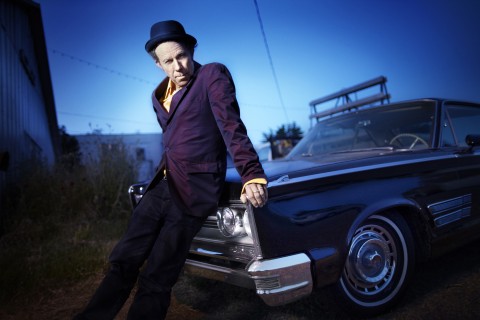
This week Tom Waits released his first studio album in seven years, and it doesn’t disappoint. Bad As Me, writes Will Hermes in a four-star Rolling Stone review, may be Waits’ most broadly emotional album to date: “Certainly it’s his most sharply focused record since the game-changing tag team Swordfishtrombones and Rain Dogs decades ago.” You can judge for yourself: For a limited time, National Public Radio is offering a sneak preview of the complete album.
Bad As Me is more accessible than many of Waits’ albums. As his long-time session guitarist Marc Ribot told The New York Times, “On this record it was less, ‘O.K. let’s be super rigorous and create music completely without precedent,’ and more just ‘Let’s rock the house.’ ” The title track is a good example. It’s a rollicking blues stomp, with Waits channeling the ghost of Screamin’ Jay Hawkins as he shouts:
You’re the head on the spear You’re the nail on the cross You’re the fly in my beer You’re the key that got lost You’re the letter from Jesus on the bathroom wall You’re mother superior in only a bra You’re the same kind of bad as me
On a more serious note, Waits sings of America’s infantile politics, its military and economic quagmires, and the general breakdown of discourse in the melancholy “Talking At The Same Time”:
A tiny boy sat and he played in the sand He made a sword from a stick And a gun from his hand Well we bailed out the millionaires They’ve got the fruit We’ve got the rind And everybody’s talking at the same time
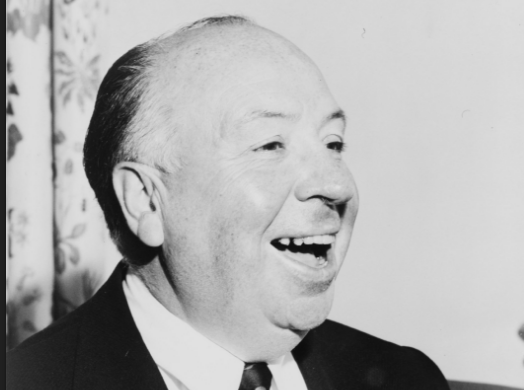
Close the doors. Shut the blinds. Turn out the lights. Make that room dark. Get ready for Alfred Hitchcock Presents Ghost Stories for Young People. Originally recorded in 1962, the album features 11 ghost stories introduced by Hitchcock himself and then read by actor John Allen. If you were a kid during the early 60s, this may bring back some very good memories. The recording is available on YouTube and Spotify, embedded below. (Download Spotify’s software for free here.)
Here’s a playlist of the tracks:
The Haunted And The Haunters (The Pirate’s Curse)
This past weekend, Pete Seeger marched through the streets of Manhattan with the Occupy Wall Street movement. He was a spritely 92. It was the latest in a lifetime of political engagement by Seeger, dating all the way back to his youthful support of the Spanish Civil War. Today we bring you a film of Seeger when he was only 27 years old: To Hear Your Banjo Play. Released in 1946, To Hear Your Banjo Play is an engaging 16-minute introduction to American folk music, written and narrated by Alan Lomax and featuring rare performances by Woody Guthrie, Baldwin Hawes, Sonny Terry, Brownee McGhee, Texas Gladden and Margot Mayo’s American Square Dance Group. To Hear Your Banjo Play is included in our collection, 4,000+ Free Movies Online: Great Classics, Indies, Noir, Westerns, Documentaries & More.
If you would like to support the mission of Open Culture, consider making a donation to our site. It’s hard to rely 100% on ads, and your contributions will help us continue providing the best free cultural and educational materials to learners everywhere. You can contribute through PayPal, Patreon, and Venmo (@openculture). Thanks!
We're hoping to rely on loyal readers, rather than erratic ads. Please click the Donate button and support Open Culture. You can use Paypal, Venmo, Patreon, even Crypto! We thank you!
Open Culture scours the web for the best educational media. We find the free courses and audio books you need, the language lessons & educational videos you want, and plenty of enlightenment in between.