So Consequence of Soundhas posted a list of The 100 Best One-Hit Wonder Songs, and before we dive in, we should point out that they’ve really tried to do their best in the face of history. I’m sure there are those out there who have been outraged some way or another at the arbitrary nature of the “one-hit wonder” designation over the years. I know I have thrown a fit to see Madness’ “Our House” called a one-hit-wonder in the States without mentioning their 30 or so Top 40 hits in the UK.
If American chart success is a judge, the CoS writers says, Beck would be a one-hit-wonder along with Radiohead. No, what we’re really gunning for are artists who really only have one bona fide hit to their name, and afterwards pretty much disappeared into the ether.
The Vapors’ “Turning Japanese” is definitely one of those. Released in a flood of new wave/post-punk fervor, it’s a catchy earworm that would both define the band and then entrap them. They never had another hit and ironically had chosen this as their second single, worried that they might become a one-hit-wonder. Whoops!
And while the ‘70s and ‘80s are seen as the height of the one-hit-wonder, the 1990s sure are worth reconsidering. We didn’t know it then, but the music industry was just about to collapse with the arrival of Napster and the Internet, and the rise of electronica brought with it a cornucopia of one-off downtempo/triphop tracks, college-rock/post-grunge anthems, and this single from Toronto’s finest, Len:
(Ah, 1999. Just before the world imploded.)
You can listen to Consequence of Sound’s list on Spotify, if you so choose:
So what happened to the one-hit-wonder? YouTube. Where else can you find novelty hits, parody songs, and pop cultural touchstones these days? The major labels certainly aren’t releasing them. That might be good for users, but it’s gonna be hell for pop historians attempting to assemble a comparable list in the future.
Ted Mills is a freelance writer on the arts who currently hosts the artist interview-based FunkZone Podcast and is the producer of KCRW’s Curious Coast. You can also follow him on Twitter at @tedmills, read his other arts writing at tedmills.com and/or watch his films here.
A series of videos has been going around showing Zakk Wylde, former guitarist for Ozzy Osbourne, playing classic rock and metal songs on diminutive Hello Kitty guitars. They’re funny: seeing the burly, bearded legend rock out on a kid’s guitar; but they’re also pretty impressive, when he wrings real grit and feeling from these unlikely instruments.
I imagine it won’t be long before we’ll see a similar stunt with someone like Moby, for example, ripping out danceable grooves on the Blipblox, a kids’ toy that is also a fully-functioning synthesizer (“actually, it’s both”!).
While the Blipblox may look like one of thousands of noisy console-like toddler toys, it’s one that won’t tempt parents to do what many parents do (be honest)—pull out the batteries and hide them where they can’t ever be found.
Apologies to Hello Kitty guitars, but by comparison with most instruments made for kids, the Blipblox is seriously sophisticated. “What sets this apart from other toys,” writes Mixmag, “is that it uses ‘a proprietary algorithm that synthesizes completely unique waveforms’ allowing users to create their own soundwave. The features include one low pass filter, two envelope generators, eight oscillator modulation schemes, two LFOs and MIDI, plus more.”
If those specs sound like an alien language to you, they won’t make any more sense to your 3‑year-old, and they don’t need to. “The blipblox was made to have fun without fully understanding how it works,” says the toy synthesizer’s creator in an introductory video above. Turn it on and start hitting buttons, twisting dials, and pushing the two joystick-like controllers back and forth, and beats, bleeps, bloops, blurps, and other synth‑y sounds spill out, at various tempos and pitches.
As kids (or parents who hijack the device) gain more control, they can start refining their technique and create original compositions, as you can see happening in the “studio sessions” video above. Then they can output their sounds to mom and dad’s home studio, or wherever—Blipblox is ready, as its Indiegogo campaign promises, for “a pro studio setup.” Or just lots of entertaining goofing around.
The Blipblox is a brilliant invention and has already won a 2018 award for “Best Teaching Tool for Pre-School Students” and made an appearance at the very grown-up 2018 NAMM (National Association of Music Merchants) convention—see below. Priced at $159, the Blipblox ships this summer. Sign up at Indiegogo for “early bird perks.”
What is the role of the writer in times of political turmoil? Professional athletes get told to “shut up and play” when they speak out—as if they had no vested interest in current events or a constitutional right to speak. But it is generally assumed that writers have a central part to play in public discourse, even when they don’t explicitly write about politics. When writers make controversial statements, it sounds a little ridiculous to tell them to “shut up and write.”
On one view, “it is the responsibility of intellectuals to speak the truth and to expose lies,” as Noam Chomsky declares in “The Responsibility of Intellectuals.” Chomsky deplores those who comfortably accept the consensus and deliberately disseminate untruths out of a “failure of skepticism” and blind belief in the purity of their motives. Faced with obvious lies, outrages, and oppression, “intellectuals”— journalists, academics, artists, even clergy—should “follow the path of integrity, wherever it may lead.”
One such intellectual, George Orwell, is often held up across the political spectrum as a paradigm of intellectual integrity. Orwell, as you might expect, had his own thoughts on what he called “the position of the writer in an age of State control.” He expressed his view in a 1948 essay titled “Writers and the Leviathan.” He accords with Chomsky in most respects, yet in the end does not endorse the view that the political responsibilities of writers are greater than anyone else. Yet Orwell also expresses similar wariness about writers becoming cardboard propagandists, and losing their creative, critical, and ethical integrity.
Orwell begins his argument by claiming that writers bear some responsibility for creating the culture that nurtures politics. “WHAT KIND of State rules over us,” he writes, “must depend partly on the prevailing intellectual atmosphere: meaning, in this context, partly on the attitude of writers and artists themselves.” Moreover, he suggests, it is unrealistic to expect writers, or anyone for that matter, not to have strong political opinions. The “special problem of totalitarianism” infects everything, even literature, making “a purely aesthetic attitude,” like that of Oscar Wilde, “impossible.”
This is a political age. War, Fascism, concentration camps, rubber truncheons, atomic bombs, etc are what we daily think about, and therefore to a great extent what we write about, even when we do not name them openly. We cannot help this. When you are on a sinking ship,
your thoughts will be about sinking ships.
Seventy years after Orwell’s essay, we live in no less a “political age,” burdened by daily thoughts of all the above, plus the deadly effects of climate change and other ills Orwell could not foresee.
We also see our age reflected in Orwell’s description of the “orthodoxies and ‘party lines’” that plague the writer. “A modern literary intellectual,” he writes, “lives and writes in constant dread—not, indeed, of public opinion in the wider sense, but of public opinion within his own group…. At any given moment there is a dominant orthodoxy, to offend against which needs a thick skin and sometimes means cutting one’s income in half for years on end.”
But integrity requires unorthodox thinking. Orwell goes on to analyze a number of “unresolved contradictions” on the left that make a wholesale, uncritical embrace of its political orthodoxy tantamount to “mental dishonesty.” He takes pains to note that this phenomenon is inherent to every political ideology: “acceptance of ANY political discipline seems to be incompatible with literary integrity.” Here is a dilemma. Ignoring politics is irresponsible and impossible. But so is committing to a party line.
Well, then what? Do we have to conclude that it is the duty of every writer to “keep out of politics”? Certainly not! In any case, as I have said already, no thinking person can or does genuinely keep out of politics, in an age like the present one. I only suggest that we should draw a sharper distinction than we do at present between our political and our literary loyalties, and should recognise that a willingness to DO certain distasteful but necessary things does not carry with it any obligation to swallow the beliefs that usually go with them. When a writer engages in politics he should do so as a citizen, as a human being, but not AS A WRITER. I do not think that he has the right, merely on the score of his sensibilities, to shirk the ordinary dirty work of politics. Just as much as anyone else, he should be prepared to deliver lectures in draughty halls, to chalk pavements, to canvass voters, to distribute leaflets, even to fight in civil wars if it seems necessary. But whatever else he does in the service of his party, he should never write for it. He should make it clear that his writing is a thing apart. And he should be able to act co-operatively while, if he chooses, completely rejecting the official ideology. He should never turn back from a train of thought because it may lead to a heresy, and he should not mind very much if his unorthodoxy is smelt out, as it probably will be.
It might be objected that Orwell himself wrote an awful lot about politics from a definite point of view (which he defined in “Why I Write” as “against totalitarianism and for democratic socialism”). He even cited “political purpose” as one of four reasons that serious writers have for writing. But before accusing him of hypocrisy, we must read on for more nuance. “There is no reason,” he says, that a writer “should not write in the most crudely political way, if he wishes to. Only he should do so as an individual, an outsider, at the most an unwelcome guerilla on the flank of a regular army.” (His position is reminiscent of James Baldwin’s, a political writer who “excoriated the protest novel.”) And if the writer finds some of that army’s positions untenable, “then the remedy is not to falsify one’s impulses, but to remain silent.”
Orwell’s essay characterizes the “almost inevitable nature of the irruption of politics into culture,” argues Enzo Traverso, “Writers were no longer able to shut themselves up in a universe of aesthetic values, sheltered from the conflicts that were tearing apart the old world.” The kind of compartmentalization he recommends might seem cynical, but it represents for him a pragmatic third way between the “ivory tower” and the “party machine,” a way for the writer to act ethically in the world yet retain a “saner self [who] stands aside, records the things that are done and admits their necessity, but refuses to be deceived as to their true nature” and thus become a party mouthpiece, rather than an artist and critical thinker.
Gavin Free and Dan Gruchy, otherwise known as “The Slow Mo Guys,” took a vinyl record and spun it so fast that it shattered into roughly 50,000 pieces–give or take a few. Thanks to a Phantom v2640 camera, you can watch things disintegrate in slow motion, at about 12,500 frames per second. In a previous episode recorded several years ago, Free and Gruchy pushed a CD to its physical limits. You can watch that here.
“Omg wow this is rly cool and unique like I never knew the govermnet was wacthing me.”
So wrote an anonymous internet commenter on a Washington Post article about NSA mobile phone tracking, joking, or just emerging from a bunker somewhere off the grid. Everyone knows the government is watching or might be. Or at least we should since the infamous 2013 revelations about the massive scope of NSA domestic surveillance. Reports of domestic spying first appeared in 2005. In 2009, Alex Kingsbury at U.S. News and World Reportdescribed the Agency as “one of the most secretive fiefdoms inside the American government… probably familiar to most people only as the guys who may or may not be listening to your phone calls and reading your E‑mails as they surveil terrorists.”
As is often the case when government overreach, abuse, or corruption become public knowledge, the question is not whether most Americans know, but whether they care. An often-misused Ben Franklin quote pops up frequently in arguments about a necessary balance between “liberty” and “security.” The latter now seems to inevitably entail extra-constitutional spying (as well as torture, indefinite detention, police militarization and other totally normal government operations).
These days, as often as not, government surveillance takes place by proxy, by way of tech monopolies like AT&T, Amazon, and Google (which the NSA helped create). Maybe, when it comes to the government watching, resistance is futile, as a species of outer space cyborg totalitarians likes to say.
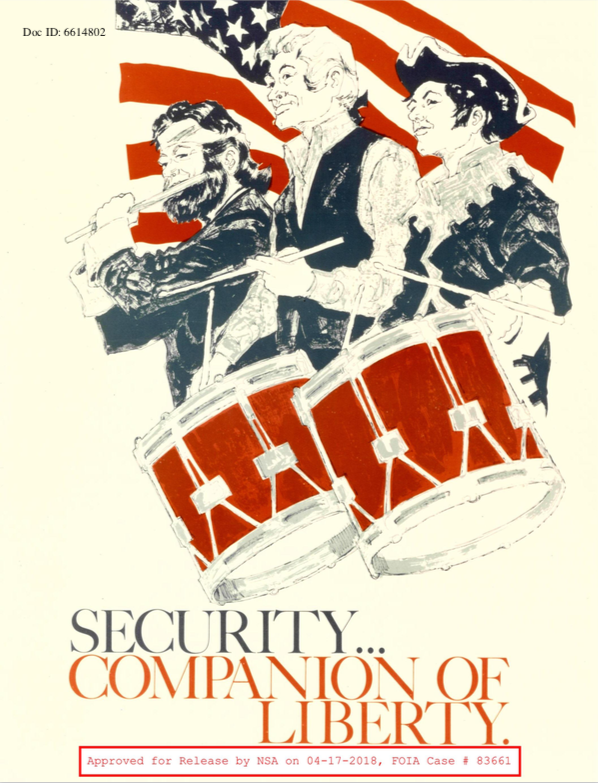
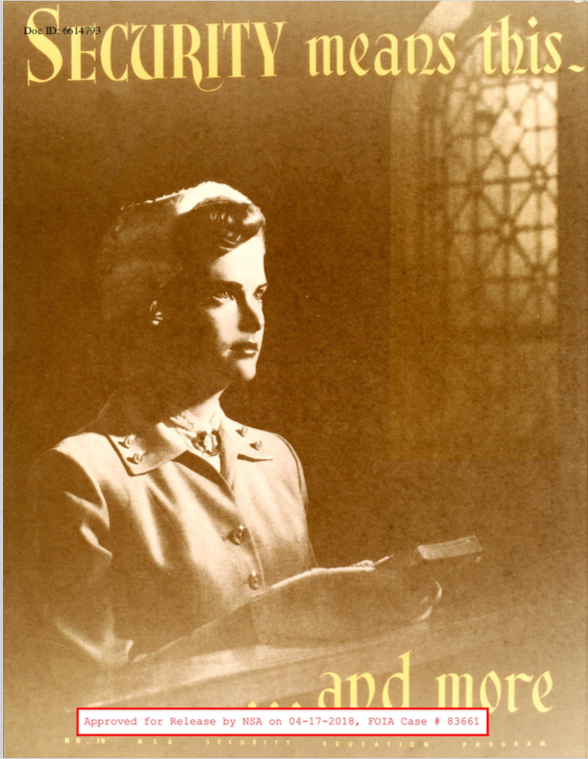
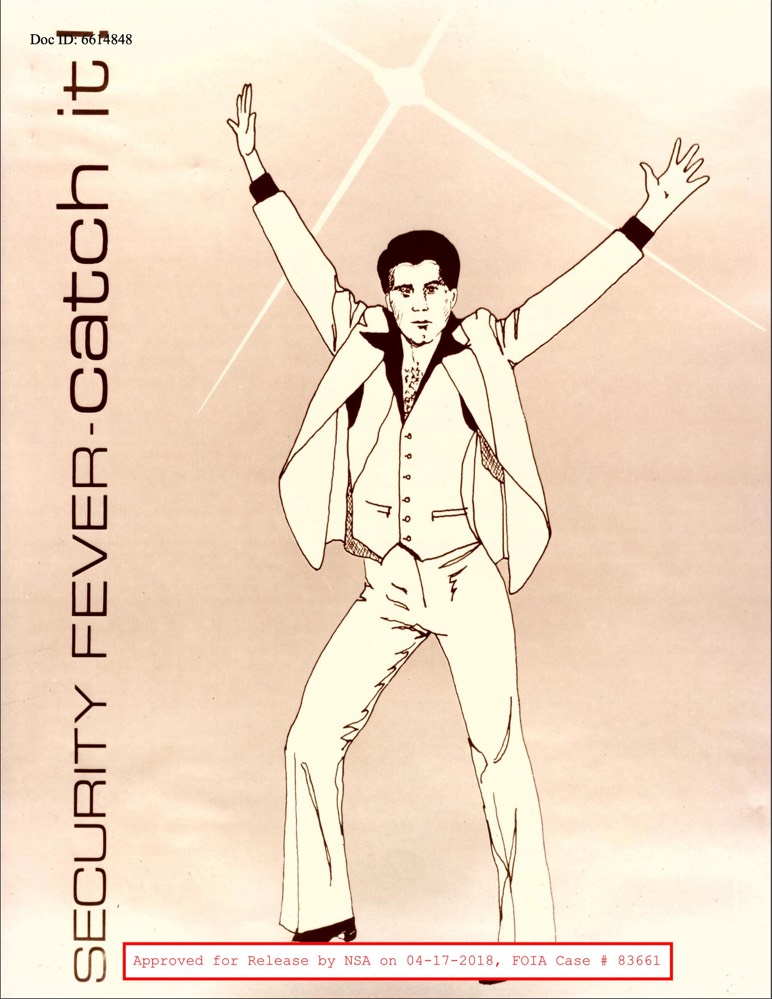
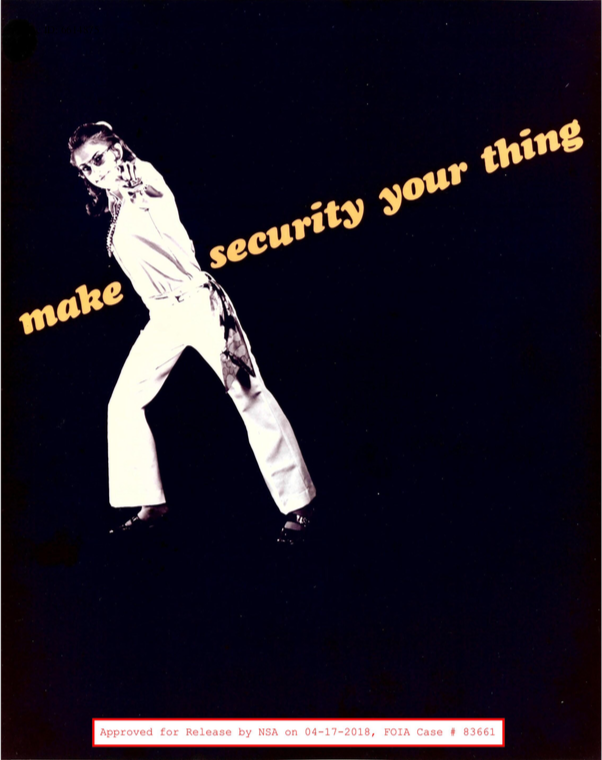
In any case, we might imagine that public debates about civil liberties and privacy are laughable to many a seasoned intelligence agent. A recently declassified trove of propaganda posters aimed at NSA employees, dating from the 50s, 60s, and 70s, shows that in the mind of the Agency, there is no conflict between liberty and security. Without security (or total secrecy), many of these posters suggest, all freedom is lost. They do so in some “super freaky” ways, to quote Jason Kottke, looking like “they were cooked up by Salvador Dali or the Dadaists. Or even Mad Magazine.”
Some of the posters, especially those from the Cold War, look pretty chilling in hindsight, with their theocratic overtones and anti-Communist apocalypticism. Agency employees were to understand that not only might they risk their jobs and clearances if they happened to spill classified info, but that everything they held dear—Christmas, prayer, fishing, freedom of the press—might be destroyed. The posters get progressively groovier as things thawed between the superpowers, and they stop alluding to specific enemies and threats to Christian piety. Still, there’s something a little creepy about an intelligence agency co-opting the Mona Lisa and Saturday Night Fever.
The agency was officially created in 1952 to monitor foreign electronic signals, which at the time meant radio and telephone traffic. The comparatively bronze-age technology available in the decades these posters were printed makes them seem all the more quaint, with their references to carelessly discarded documents and getting too chatty in the car pool. Is the government still warrantlessly spying on Americans? There may have been several recent “inadvertent compliance lapses,” the NSA admits, but surely a secret court and trustworthy Congress will keep everyone honest.
Sigmund Freud died in 1939, and the nearly eight decades since haven’t been kind to his psychoanalytical theories, but in some sense he survives. “For many years, even as writers were discarding the more patently absurd elements of his theory — penis envy, or the death drive — they continued to pay homage to Freud’s unblinking insight into the human condition,” writes the New Yorker’s Louis Menand. He claims that Freud thus evolved, “in the popular imagination, from a scientist into a kind of poet of the mind. And the thing about poets is that they cannot be refuted. No one asks of ‘Paradise Lost’: But is it true? Freud and his concepts, now converted into metaphors, joined the legion of the undead.”
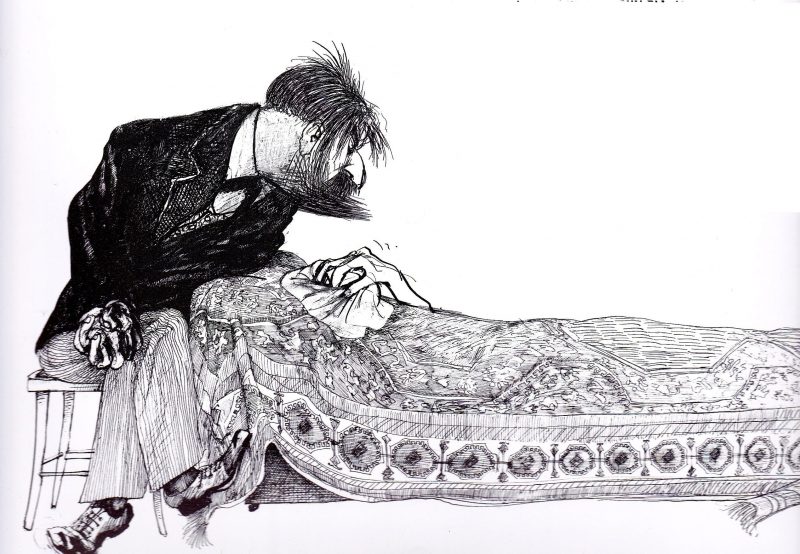
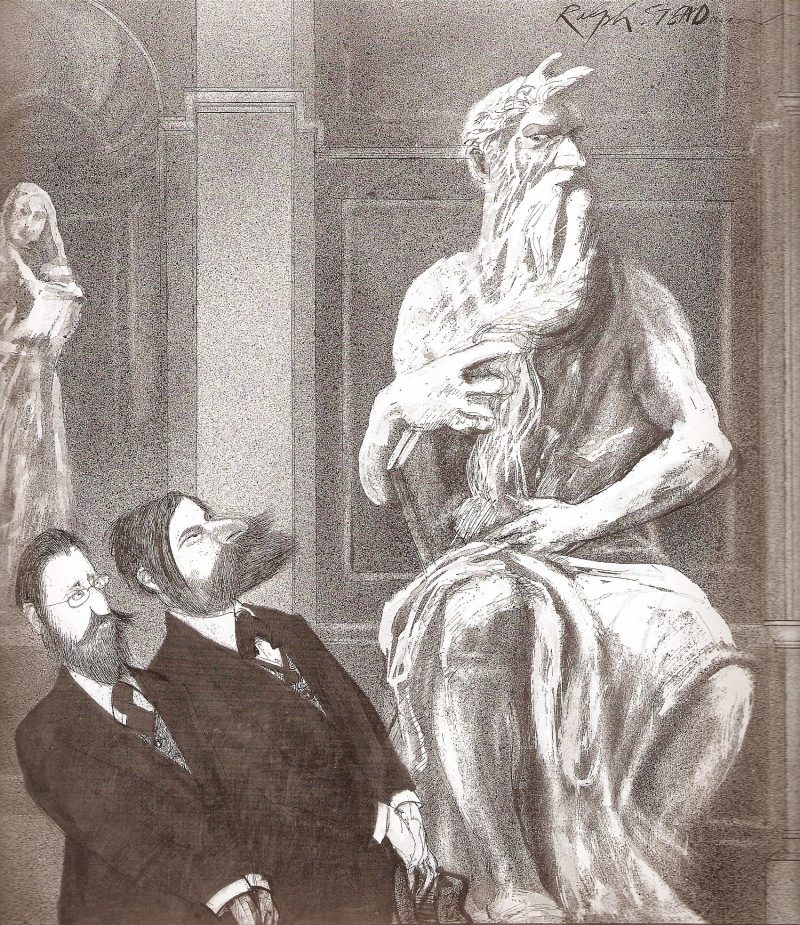
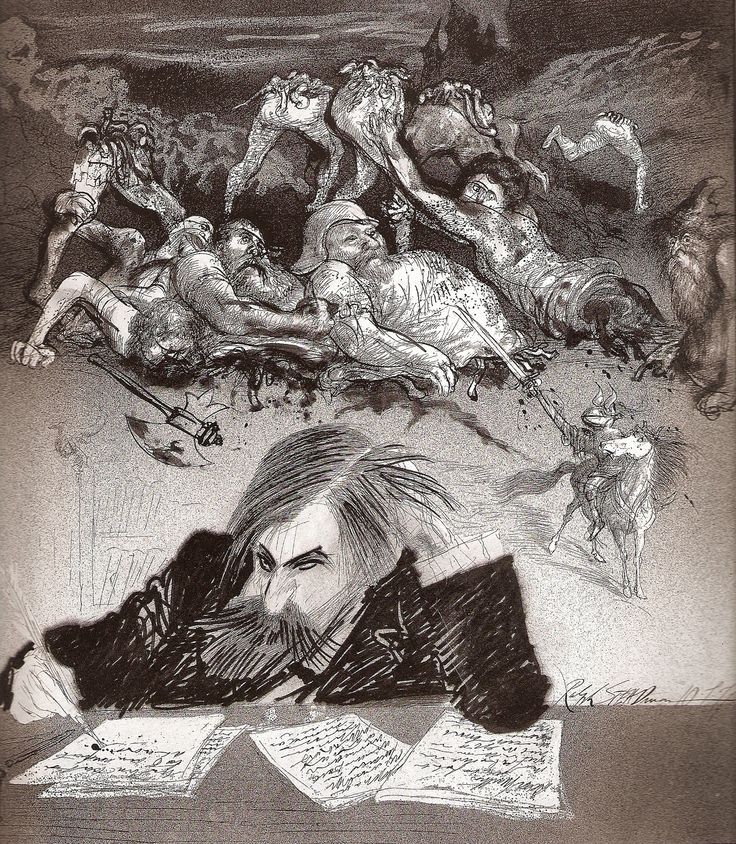
The master of a legion of undead psychological metaphors — who, in the ranks of living illustrators, could be more suited to render such a figure than Ralph Steadman? And how many of us know that he actually did so in 1979, when he produced an “art-biography” of the “Father of Psychoanalysis”?
Sigmund Freud, which has spent long stretches out of print since its first publication, tells the story of Freud’s life, beginning with his childhood in Austria to his death, not long after his emigration in flight from the Nazis, in London. It was there that he met Virginia Woolf, who in her diary describes him as “a screwed up shrunk very old man: with a monkey’s light eyes, paralyzed spasmodic movements, inarticulate: but alert.”
There, again, Freud sounds like one of Steadman’s drawings, sometimes outwardly unappealing but always possessed of an unignorable vitality generated by a solid core of perceptiveness. Earlier chapters of Freud’s life, characterized by intellectual as well as physical vigorousness aided by the 19th-century “miracle drug” of cocaine, also give the illustrator rich material to work with. One can’t help but think of Fear and Loathing in Las Vegas, which forged a permanent cultural link between Steadman’s art and Hunter S. Thompson’s prose. How “true” is the drug-fueled desert odyssey that book recounts? More so, perhaps, than many of Freud’s supposedly scientific discoveries. But as with the work of Freud, so with that of Thompson and Steadman: we return to it not because we want the truth, exactly, but because we can’t turn away from the often grotesque versions of ourselves it shows us.
Based in Seoul, Colin Marshall writes and broadcasts on cities and culture. His projects include the book The Stateless City: a Walk through 21st-Century Los Angeles and the video series The City in Cinema. Follow him on Twitter at @colinmarshall or on Facebook.
More than half a century after his death, Winston Churchill continues to draw both great admiration and great fascination. Interest in the wartime Prime Minister of the United Kingdom has even increased in recent years, as evidenced last year by Joe Wright’s highly praised film Darkest Hour. Starring Gary Oldman as Churchill, it tells the story of his assumption of the office in May 1940 and navigation of the dire global geopolitical situation (including but not limited to the Battle of Dunkirk, also cinematically recreated last year by Christopher Nolan) into which it immediately plunged him.
“We get the greatest hits, out loud,” writes the New Yorker’s Anthony Lane on Oldman’s performance in a piece on why actors love to play Churchill. “We get the blood and the sweat, barked to the House of Commons, and, needless to say, we get the most celebrated speech of all, unleashed on June 4th, when the Prime Minister informed the world that Britain would fight the Germans on the beaches, in the streets, and wherever else they chose to intrude.”
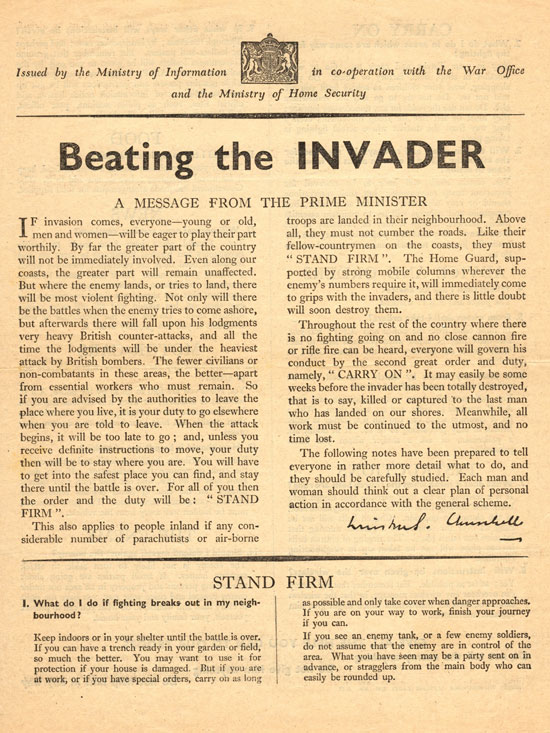
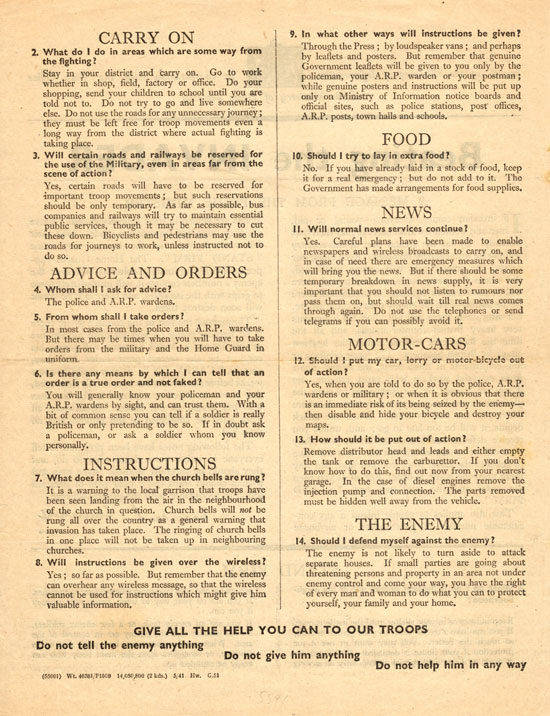
Churchill could issue a compelling communiqué on the subject not just in speech but in writing, and he even prepared one for distribution in the event of a German invasion. Its characteristic title: “Beating the Invader.”
“If invasion comes, everyone – young or old, men and women – will be eager to play their part worthily,” Churchill proclaims in the leaflet, which you can read in full at AbeBooks. “If you are advised by the authorities to leave the place where you live, it is your duty to go elsewhere when you are told to leave. When the attack begins, it will be too late to go; and, unless you receive definite instructions to move, your duty then will be to stay where are. You will have to get into the safest place you can find, and stay there until the battle is over. For all of you then the order and the duty will be: ‘STAND FIRM’.”
Churchill provides more specifics of his expectations in a Q&A section, addressing such concerns as “What do I do if fighting breaks out in my neighbourhood?”, “Is there any means by which I can tell that an order is a true order and not faked?” (“With a bit of common sense you can tell if a soldier is really British or only pretending to be so”), and “Should I defend myself against the enemy?” To that last he assures his reader that “you have the right of every man and woman to do what you can to protect yourself, your family and your home.” Thanks to those who gave their all to win the war, it never came to that. And even now, though Britain faces no apparent danger of imminent invasion, many still govern their conduct in the spirit of Churchill’s “second great order and duty, namely, ‘CARRY ON’.”
If you want to purchase an original copy of the document, find some here.
Based in Seoul, Colin Marshall writes and broadcasts on cities and culture. His projects include the book The Stateless City: a Walk through 21st-Century Los Angeles and the video series The City in Cinema. Follow him on Twitter at @colinmarshall or on Facebook.
When Leon Theremin debuted his strange electronic device on the world stage, it seemed to many people more like a curious toy than a serious musical instrument. The theremin soon became associated with B‑grade sci-fi movies and novelty soundtracks, an association that made Clara Rockmore furious. Determined to achieve respectability for the theremin, she championed it as “a legitimate classical instrument that deserves a place in the pit,” writes Atlas Obscura, “right next to the violins and piano.” Rockmore’s ambitions may have been outsized, but her talent was undeniable. “As serious as anyone has ever been about the theremin… she left behind a number of valuable lessons,” including a book, freely available, in which she dispenses some very practical advice.
But much has changed since her day, including popular methods of instruction and some of the technical design of theremins. Now, aspiring players will likely go looking for video lessons before consulting Rockmore’s guide, which requires that students read music in order to transition from exercises to “easy pieces” by Camille Saint-Saëns and J.S. Bach.
One series of video lessons offered by “thereminist” Thomas Grillo, an earnest instructor in a white shirt and tie, begins with the very basics and works up to more advanced techniques, including possible mods to the device (Grillo plays a Moog-made theremin himself).
Grillo opens with a disclaimer that his short course is “no substitute for professionally done how-to videos on how to play the theremin,” thereby humbly acknowledging the low production values of his series. Nonetheless, I imagine his classes are as good a place to start as any for newcomers to theremin-ing, not a skill one can pick up as readily online as playing the guitar or piano. He clearly knows his stuff. With the look and demeaner of a high school algebra teacher, Grillo patiently explains and demonstrates many techniques and principles, beginning with lesson one above, then continuing in lessons two, three, four, five, six, and seven.
Once you’ve reached an intermediate stage, or if you already find yourself there, you may benefit from the instruction of Carolina Eyck, who has carried on the serious classical work of Clara Rockmore. See her just above perform a stirring rendition of Rachmaninoff’s “Vocalise,” accompanied on piano by Christopher Tarnow, and check out her YouTube channel for more performances and short lessons.
William S. Burroughs was a cultural prism. Through him, the mid-century demi-monde of illicit drug use and marginalized sexualities—of occult beliefs, alternative religions, and bizarre conspiracy theories—was refracted on the page in experimental writing that inspired everyone from his fellow Beats to the punks of later decades to name-your-countercultural-touchstone of the past fifty years or so. There are many such people in history: those who go to the places that most fear to tread and send back reports written in language that alters reality. To quote L. Ron Hubbard, another writer who purported to do just that, “the world needs their William Burroughses.”
And Burroughs, so it appears, needed L. Ron Hubbard, at least for most of the sixties, when the writer became a devout follower of the Church of Scientology. The sci-fi-inspired “new religious movement” that needs no further introduction proved irresistible in 1959 when Burroughs met John and Mary Cooke, two founding members of the church who had been trying to recruit Burroughs’ friend and frequent artistic partner Brion Gysin. “Ultimately,” writes Lee Konstantinou at io9, “it was Burroughs, not Gysin, who explored the Church that L. Ron Hubbard built. Burroughs took Scientology so seriously that he became a ‘Clear’ and almost became an ‘Operating Thetan.’ ”
Burroughs immersed himself without reservation in the practices and principles of Scientology, writing letters to Allen Ginsberg that same year in which he recommends his friend “contact [a] local chapter and find an auditor. They do the job without hypnosis or drugs, simply run the tape back and forth until the trauma is wiped off. It works. I have used the method—partially responsible for recent changes.” No doubt Burroughs had his share of personal trauma to overcome, but he also found Scientology especially conducive to his greater creative project of countering “the Reactive Mind… an ancient instrument of control designed to stultify and limit the potential for action in a constructive or destructive direction.”
The method of “auditing” gave Burroughs a good deal of material to work with in his fiction and filmmaking experiments. He and Gysin included Scientology’s language in a short 1961 film called “Towers Open Fire,” which was, writes Konstantinou, “designed to show the process of control systems breaking down.” Scientology appeared in 1962’s The Ticket That Exploded and again in 1964’s Nova Express. Each novel references the concept of “engrams,” which Burroughs succinctly defines as “traumatic material.” During this hugely productive period, the radically anti-authoritarian Burroughs “associated the group with a range of mind-expanding and mind-freeing practices.”
It’s easy to say Burroughs uncritically partook of a certain sugary beverage. But he clearly made his own idiosyncratic uses of Scientology, incorporating it within the syncretic constellation of references, practices, and cut-up techniques “designed to jam up what he called ‘the Reality Studio,’ aka the everyday, conditioned, mind-controlled reality.” An inevitable turning point came, however, in 1968, as Burroughs journeyed deeper into Scientology’s secret order at the world headquarters in Saint Hill Manor in the UK. There, he reported, he “had to work hard to suppress or rationalize his persistently negative feelings toward L. Ron Hubbard during auditing sessions.”
Burroughs’ dislike of the church’s founder and extreme aversion to “what he considered its Orwellian security protocols” eventuated his break with Scientology, which he undertook gradually and publicly in a series of “bulletins” published during the late sixties in the London magazine Mayfair. Before his “clearing course” with Hubbard, in a 1967 article excerpted and republished as a pamphlet by the church itself, Burroughs praises Scientology and its founder, and claims that “there is nothing secret about Scientology, no talk of initiates, secret doctrines, or hidden knowledge.”
By 1970, he had made an about-face, in a fiercely polemical essay titled “I, William Burroughs, Challenge You, L. Ron Hubbard,” published in the Los Angeles Free Press. While he continues to value some of the benefits of auditing, Burroughs declares the church’s founder “grandiose” and “fascist” and lays out his objections to its initiations, secret doctrines, and hidden knowledge, among other things:
…One does not simply pay the tuitions, obtain the materials and study. Oh no. One must JOIN. One must ‘sign up for the duration of the universe’ (Sea Org members are required to sign a billion-year contract)…. Furthermore whole categories of people are automatically excluded from training and processing and may never see Mr Hubbard’s confidential materials.
Burroughs challenges Hubbard to “show his confidential materials to the astronauts of inner space,” including Gysin, Ginsberg, and Timothy Leary; to the “students of language like Marshall MacLuhan and Noam Chompsky” [sic]; and to “those who have fought for freedom in the streets: Eldridge Cleaver, Stokely Carmichael, Abe Hoffman, Dick Gregory…. If he has what he says he has, the results should be cataclysmic.”
The debate continued in the pages of Mayfair when Hubbard published a lengthy and blandly genial reply to Burroughs’ challenge, in an article that also contained, in an inset, a brief rebuttal from Burroughs. The debate will surely be of interest to students of the strange history of Scientology, and it should most certainly be followed by lovers of Burroughs’ work. In the process of embracing, then rejecting, the controlling movement, he compellingly articulates a need for “unimaginable extensions of awareness” to deal with the trauma of living on what he calls the “sinking ship” of planet Earth.
Is there a design geek lurking among your fine feathered friends?
Some chickadee or finch who values clean lines over the fripperies of the gilded cage?
Or perhaps you’re a bird lover who’s loathe to junk up your mid-century modernist view by hanging a folksy miniature saltbox from a branch outside the kitchen window.…
California-based cabinetmaker Douglas Barnhard’s Bauhaus birdhouses offer a minimalist solution.
No word on the interiors, but the exteriors are gorgeous, with additional inspiration coming from the likes of Frank Lloyd Wright and Joseph Eichler.
Barnhard, who studied architecture briefly, repurposes walnut, bamboo, teak, and mahogany in his designs, which extend to dog beds, breadboxes, and planters.
His birdhouses feature living walls and green roofs planted with succulents.
Is it wishful thinking to believe it’s only a matter of time ’til tiny wetsuits and empty Fosters and Pacificos start festooning the rails?
Browse Barnhard’s birdhouses here and follow him on Instagram to get a peek at custom orders, many for customers residing in the sorts of homes he recreates for the birds.
Ayun Halliday is an author, illustrator, theater maker and Chief Primatologist of the East Village Inky zine. Her solo show Nurse!, in which one of Shakespeare’s best loved female characters hits the lecture circuit to set the record straight premieres in June at The Tank in New York City. Follow her @AyunHalliday.
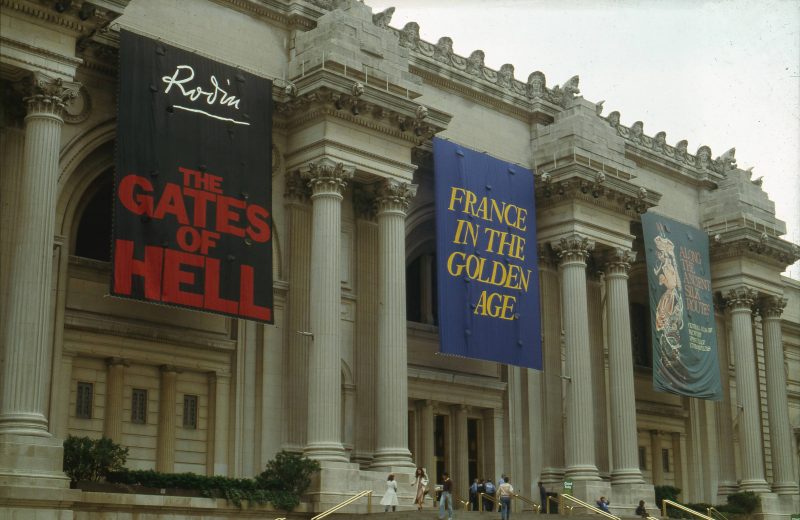
If you’ve lived in or visited New York City, you must know the laughable futility of trying to “do the Met” in a day, or even a weekend. Not only is the museum enormous, but its permanent collections demand to be studied in detail, an activity one cannot rush through with any satisfaction. If you’re headed there for a special exhibit, be especially disciplined—make a beeline and do not stop to linger over elaborate Edo-period samurai armor or austere Shaker-made furniture.
I thought I’d learned my lesson after many years of residence in the city. When I returned last summer for a visit, family in tow, I vowed to head straight for the Rei Kawakubo exhibit, listing all other priorities beneath it. More fool me.
Immediate overwhelm overtook as we entered, on a weekend, in a crush of tourist noise. After hours spent admiring sarcophagi, neoclassical paintings, etc., etc., we had to nix the exhibit and push our way into Central Park for fresh air and recuperative ice cream.
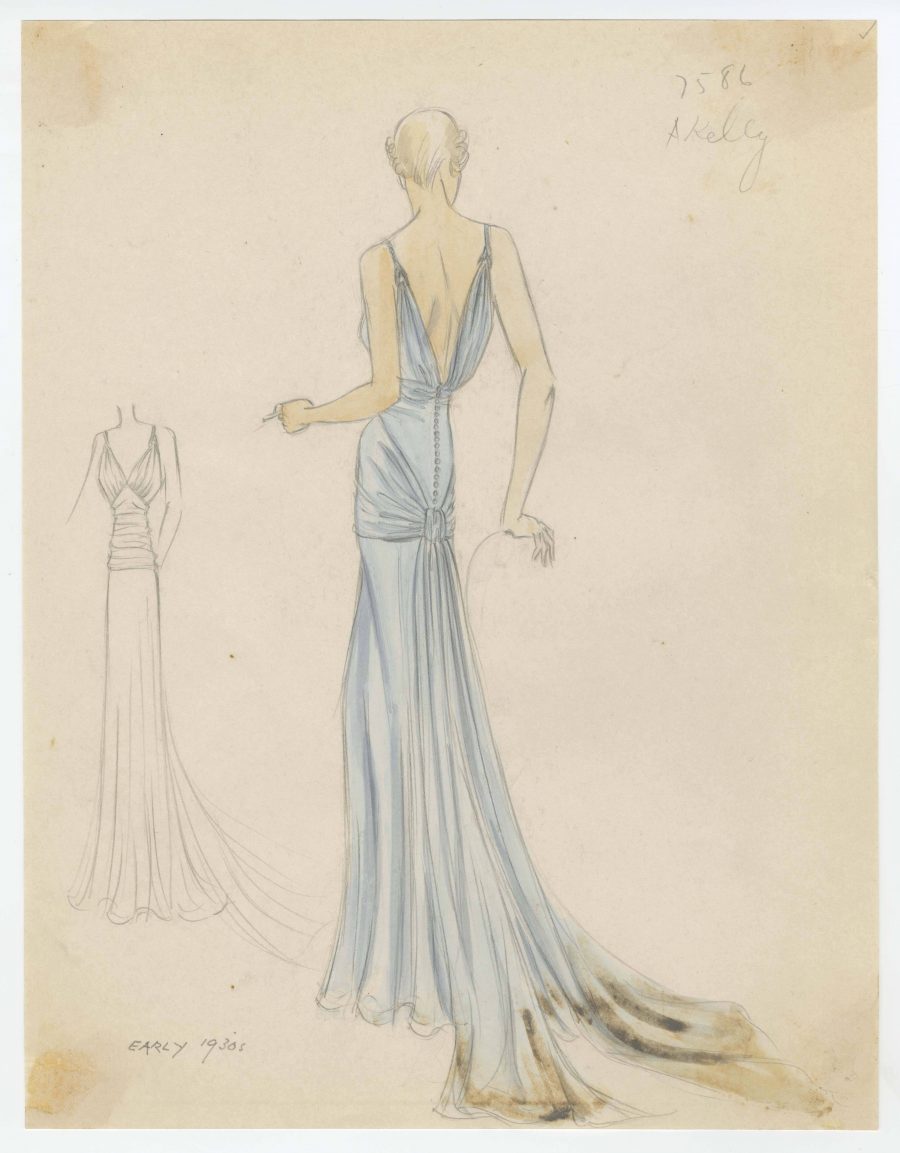
Does an exhibition checklist, with photographs and descriptions of every piece on display, make up for missing the Kawakubo in person? Not exactly, but at least I can linger over it, virtually, in solitude and at my leisure. If you value this experience, cannot make it to the Met, or want to see several hundred past exhibitions from the comfort of your home, you can do so easily thanks to the wealth of catalogs the Met has uploaded to its Digital Collections.
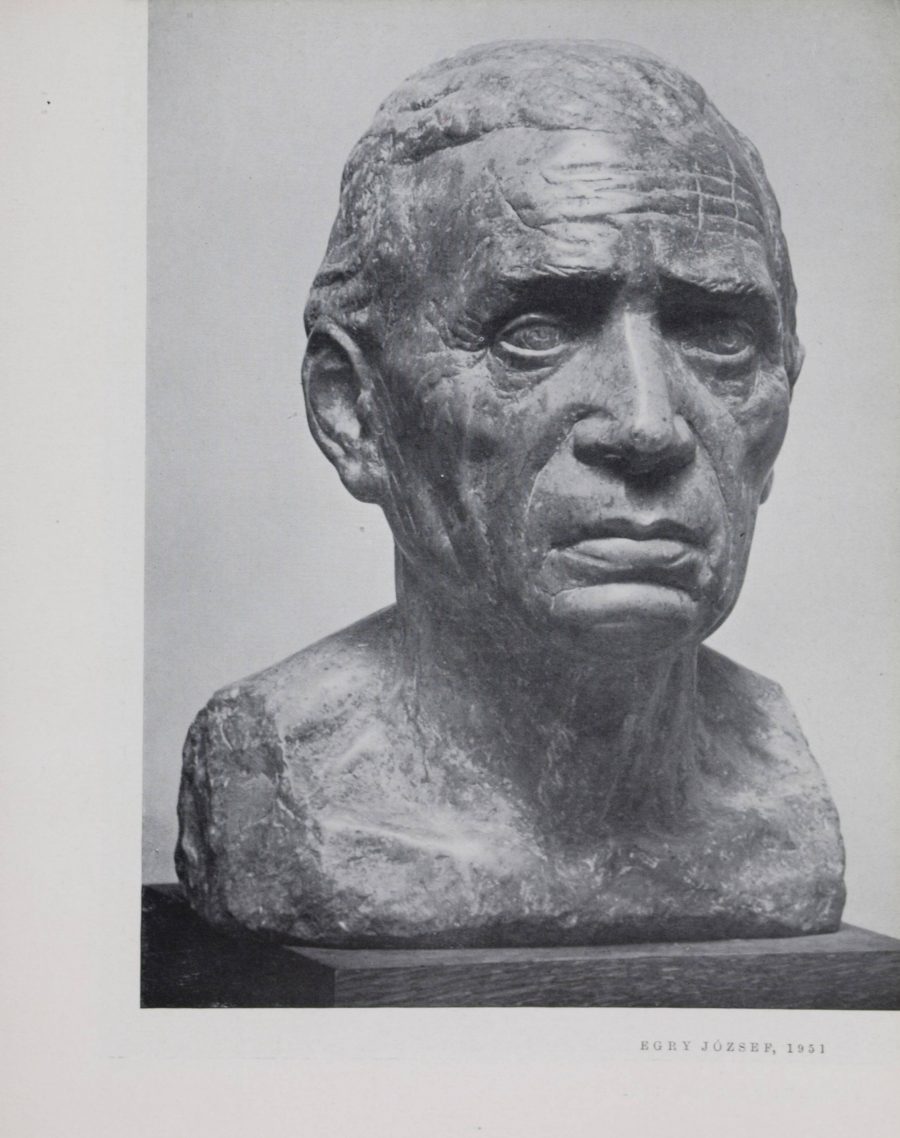
These catalogs document special exhibits not only at the New York landmark, but also at galleries around the world from the past 100 years or so. In a recent blog post, the Met points to one such scanned catalog—out of almost a hundred from the Hungarian Gallery Nemzeti Szalon—from a 1957 exhibition of sculptor Miklós Borsos. The text is in Hungarian, but the artwork (further up), in detailed black and white photographs, speaks a universal visual language.
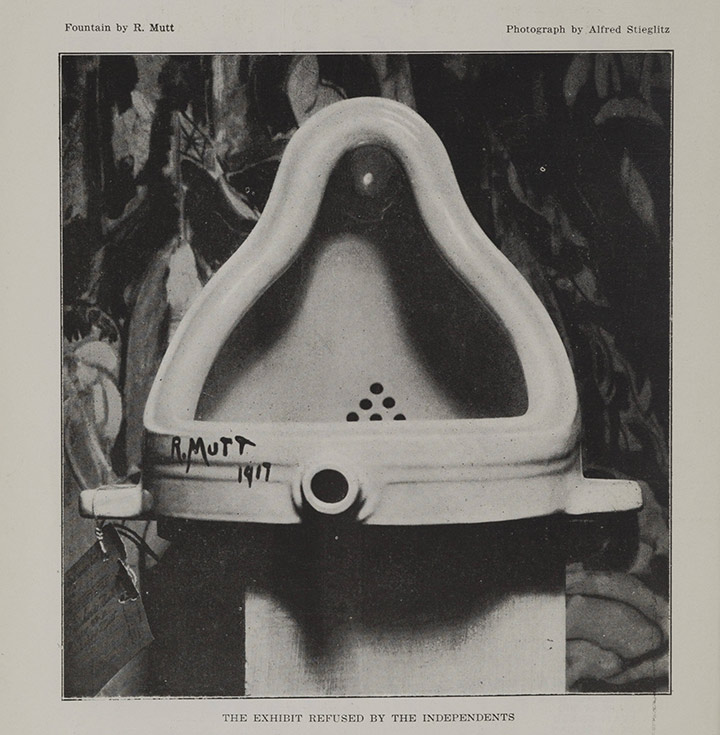
These catalogs join the thousands of books—50,000 titles in all—at the Met’s Digital Collections. There, you’ll find collections such as Rare Books Published in Imperial and Early Soviet Russia, with unusual treasures like the book Churches of Uglich, a survey of one Russian town’s churches, with photos, from the 1880s. “Interested in Dada?” asks the Met, and who isn’t? The museum has just added a 1917 issue of journal The Blind Man, edited by Marcel Duchamp and containing Alfred Stieglitz’s photograph of Duchamp’s found art prank Fountain.
If you’re headed to the Met to see one of these special exhibits, take my advice and don’t get distracted once you’re inside. But if you want to access a range of the museum’s cultural treasures from afar, you can’t do any better than browsing its Digital Collections, where you’re also likely to get lost for hours, maybe days.
We're hoping to rely on loyal readers, rather than erratic ads. Please click the Donate button and support Open Culture. You can use Paypal, Venmo, Patreon, even Crypto! We thank you!
Open Culture scours the web for the best educational media. We find the free courses and audio books you need, the language lessons & educational videos you want, and plenty of enlightenment in between.