Long before the tumultuous marriage to Diego Rivera and the mortifications of the flesh occasioned by a horrific bus accident, and longer still before the avalanche of Frida-centric kitsch and tchotchkes and the Julie Taymor biopic starring Salma Hayek, there was a cherubic little girl named Magdalena Carmen Frieda Kahlo y Calderón.
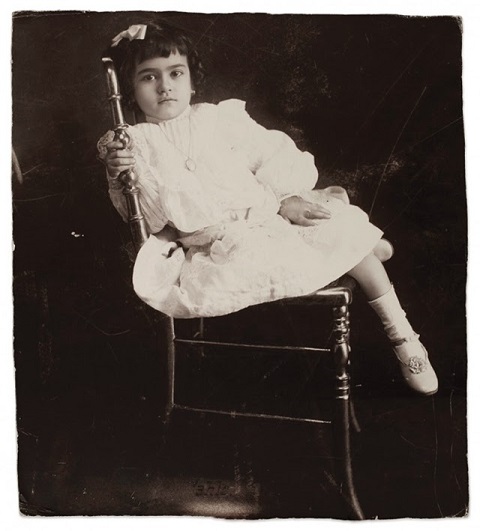
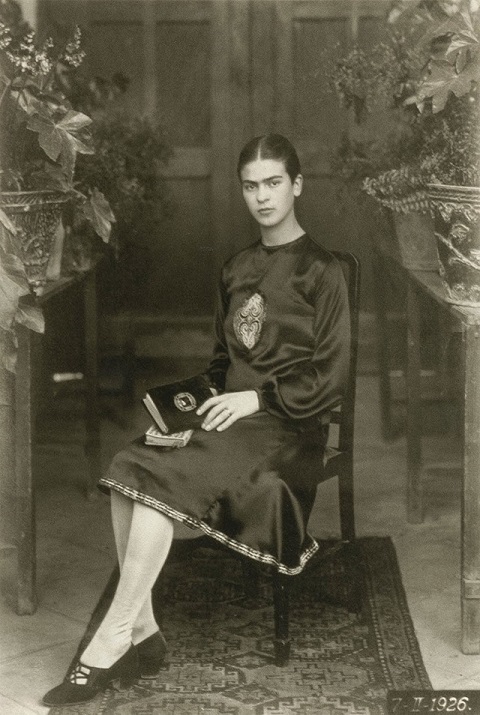
Witness these photos of young Magdalena Carmen Frieda, taken by her Hungarian Jewish father, Guillermo, over a period of twenty years.
The 2‑year-old Frida is merry, chubby, and barely recognizable.
The piercing gaze starts coming into focus around age 5. Kid looks like an artist already!
The famous eyebrows have filled in by 12, when she faces the camera in a sailor suit and giant hair bow.
The 18-year-old pre-med student adopting an unsmiling pose in 1926—the year of the accident—is unapologetic, intense, and unmistakably Frida Kahlo.
Visit Vintage Everyday for more of Guillermo Kahlo’s images of his second-to-last daughter.
You might think that a movie about information from 1953 couldn’t possibly be relevant in the age of iPhone apps and the Internet but you’d be wrong. A Communications Primer, directed by that power couple of design Charles and Ray Eames, might refer to some hopelessly quaint technology – computer punch cards, for instance – but the underlying ideas are as current as anything you’re likely to see at a TED talk. You can watch it above.
In fact, the film made for IBM was the result of the first ever multi-media presentations that Charles Eames developed for the University of Georgia and UCLA. Using slides, music, narration and film, Eames broke down some elemental aspects of communications for the audience. Central to the film is an input/output diagram that was laid out by Claude Shannon, the father of information theory, in his 1949 book, The Mathematical Theory of Communication. As the perhaps overly soothing narrator intones, any message is transmitted by a signal through a channel to its receiver. While in the channel, the signal is altered and degraded by noise. The key to effective communication is to reduce “noise” (construed broadly) that interferes with the message and to generally simplify things.
The issue of signal vs noise is probably more relevant now in this age of perpetual distraction than it was during the Eisenhower administration. Every email, text message or Buzzfeed article seen individually is clearly a signal. Yet for someone trying to work, say on an article about a short film by Charles and Ray Eames, they are definitely noise.
The Eames use the terms “signal,” “noise,” and “communication” quite broadly. Not only do they use these terms to describe, say, a radio broadcast or a message being relayed by Morse code but also the creation of architecture, design and even visual art.
The source of a painting is the mind and experience of the painter. Message? His concept of a particular painting. Transmitter? His talent and technique. Signal? The painting itself. Receiver? All the eyes and nervous systems and previous conditioning of those who see the painting. Destination? Their minds, their emotions, their experience. Now in this case, the noise that tends to disrupt the signal can take many forms. It can be the quality of the light. The color of the light. The prejudices of the viewer. The idiosyncrasies of the painter.
Of course, a painting — or a poem, or a film by Andrei Tarkovsky — is a different kind of signal than an email. It’s message is multilayered and multivalent. And while a generation of cultural theorists would no doubt chafe at Eames’s reductive, Modernist view of art, it is still interesting to think of a painting in the same manner as smoke signals.
The film’s narrator continues:
But besides noise, there are other factors that can keep information from reaching its destination in tact. The background and conditioning of the receiving apparatus may so differ from that of the transmitter that it may be impossible for the receiver to pick up the signal without distortion.
That’s about as good a description of cable new pundits as I’ve ever seen.
Jonathan Crow is a Los Angeles-based writer and filmmaker whose work has appeared in Yahoo!, The Hollywood Reporter, and other publications. You can follow him at @jonccrow. And check out his blog Veeptopus, featuring lots of pictures of vice presidents with octopuses on their heads. The Veeptopus store is here.
In “Epic Pooh,” a lengthy, cantankerous essay on J.R.R. Tolkien’s Lord of the Rings that savages the trilogy’s nostalgic, middle-class ideology, fantasy maven Michael Moorcock takes a long quotation from a 1969 review by Clyde S. Kilby as his epigraph. Articulating just the view Moorcock rails against, Kilby writes,
For a century at least the world has been increasingly demythologized. But such a condition is apparently alien to the real nature of men. Now comes a writer such as John Ronald Reuel Tolkien and, as remythologizer, strangely warms our souls.
We may uncritically enjoy Tolkien as “redolent of timelessness,” as does Kilby, or see in his work—as does the skeptical Moorcock—a reactionary sentimentalism, “the prose of the nursery-room… meant to soothe and console….”
In either case, the effect is achieved: whatever else we make of The Lord of the Rings—Orthodox allegory, anti-modern polemic, environmentalist fable, etc.—it is also, without a doubt, possessed of a strange power to soothe, to envelop, to transport readers to a plane where all human action (or hobbit, elf, or dwarf) is amplified a hundredfold and given immeasurable significance. In this respect, his work may be compared to the ancient epics that inspired it, though some may think it heretical to say so.
Tolkien fans couldn’t care less. As his biographer at the Tolkien Society observes, “he has regularly been condemned by the Eng. Lit. establishment, with honourable exceptions, but loved by literally millions of readers worldwide.” While hardly a representative of the “establishment,” Moorcock echoes their critical judgments. I am sympathetic to some of them. But then I pick up the books, or watch the sweeping Peter Jackson adaptations, and my suspicions drop away. I can become again the thirteen-year-old reader who spent hours fully immersed in the grandeur, heroism, humor and dread of Middle Earth. This respite from the frequent, harried confusion and fatigue of adulthood is most welcome, even if, in the end, it is found in what Moorcock calls “comforting lies.” But perhaps that’s what we want from epic fantasy, after all, Moorcock’s high literary seriousness notwithstanding.
And as for myself, at least, the full immersion in Tolkien’s world goes double when I hear the author himself read his work. We’ve featured many selections of Tolkien reading in the past—from The Fellowship of the Ring (in Elvish!), The Two Towers, and Rings precursor The Hobbit. Above, you can hear many of these readings and much more, compiled by University of Edinburgh researcher Sean Williams for his podcast Voice on Record (Part 1 at the top, Part 2 above). Along the way, Williams offers much helpful context and reads the liner notes from the original LPs from which these recordings come. And yes, Tolkien does, indeed, lapse into nursery rhyme, in “The Man in the Moon Came Down Too Soon” (or “There is an Inn,” at 10:30 in Part 1), a poem from The Hobbit. In his voice, it is delightful to hear.
Back in 2011, Adam Mansbach and Ricardo Cortés published the mock children’s book, Go the F**k to Sleep. And it gained national attention when pirated PDF copies circulated on the internet, and a reading by Werner Herzog made the rounds on YouTube, both of which turned the book into a #1 bestseller on Amazon. Now, three years later, Mansbach is back with a sequel, You Have to F–king Eat. The print edition went on sale today, and, even better, the audio edition, narrated by Breaking Bad star Bryan Cranston, can be downloaded for free over at Audible.com. The irreverent, 4‑minute NSFW reading will remain free through 12/12/14. You can hear a sample above.
Americans say that they love creativity but in fact they don’t. As Jessica Oliennotes in Slate, thinking outside the box tends to freak people out. Studies show that teachers favor dull but dutiful students over creative ones. In the corporate world, suggestions made by creative workers routinely get ignored by their superiors. As art critic Dave Hickey succinctly notes, “Everybody hates it when something’s really great.”
This is probably as good a way as any to understand Orson Welles’s stunted career. Here was a man of such genius that he radically transformed just about every creative medium he touched. His 1937 production of Julius Caesar, set in contemporary Fascist Italy, was the toast of Broadway. His notorious radio adaptation of War of the Worlds was so effective in creating a sense of unfolding calamity that it caused an actual public panic. And his masterpiece Citizen Kane was so original that it perplexed audiences when it came out. Now, of course, Kane is widely considered one of the best movies ever made. In spite of Welles’s terrific natural talents – he made Kane at age 25 – he consistently found himself shut down by the powers that be. The studio butchered Welles’s follow up movie The Magnificent Ambersons, and he struggled with studios and financiers for artistic control of just about every movie since.
In the 1950s, Welles tried to transform another medium – television. As Dangerous Minds recently unearthed, Welles made a pilot for The Orson Welles Show in 1956, an anthology series backed by Lucille Ball’s production company Desilu. The series was never picked up ostensibly because it was (and still is) nothing like what you’ve ever seen on TV. Welles incorporated noirish lighting, rear projection, photo stills, in-camera set changes and a host of other techniques borrowed from radio and the stage. Though the network dashed all hope of a series, NBC ultimately did air the pilot episode — “The Fountain of Youth” — on its Colgate Theater in 1958.
The story itself is a deliciously ironic fable adapted from a short story by John Collier. Dressed in a tuxedo and with a perpetual wry smirk on his face, Welles narrates. (Welles also wrote, directed, set designed the show along with arranging its music.) The less said about the story, the better, but it involves a self-obsessed actress, an equally narcissistic tennis star and an embittered scientist who claims to have discovered the secret to eternal youth. Watch it above and think about the fascinating road TV could have traveled.
Jonathan Crow is a Los Angeles-based writer and filmmaker whose work has appeared in Yahoo!, The Hollywood Reporter, and other publications. You can follow him at @jonccrow. And check out his blog Veeptopus, featuring lots of pictures of vice presidents with octopuses on their heads. The Veeptopus store is here.
Worry not, students of thought, for Adamson has continued these past few years, still regularly and gaplessly, to provide “the ideas and lives of the major philosophers as well as the lesser-known figures of the tradition.” Just this past weekend, he put up a twenty-minute episode on the Carolingian Renaissance. If you haven’t kept up with the show since we last posted about it, you’ve got a great deal of intellectually rich catching up to do. You will find more than 100 new podcasts, featuring short talks on Latin Platonism, Aristotelian philosophy’s “Baghdad school,” philosophy’s reign in Spain, Illuminationism, and women scholars and Islam. If you’ve wanted to learn the entire history philosophy in the most convenient possible manner, now’s the time to jump aboard. If you planned on waiting until Adamson gets to, say, Derrida, I fear you’ll have a bit of a daunting backlog on your hands — not to mention your ears and brain.
Note: This article was first published in November, 2014. As of February, 2016, there are 247 episodes in this series. The title of the post has been updated to reflect that.
You thought video games were a waste of time? Well, think again. These 8‑bit video games can teach you philosophy. Plato, Descartes, Nietzsche, Derrida and the rest. Created by Napkin Note Productions, 8‑Bit Philosophy attempts to “communicate even the most complex of philosophical concepts in a fun, easy-to-understand way.”
The most recent episode explores the philosophy of Jacques Derrida using scenes from the 1987 beat’ em up video game, Double Dragon. Does that game ring a bell? It didn’t for me either. Until I googled it and suddenly remembered wasting countless hours and quarters on it, almost three decades ago. It’s all coming back to me now.
Try to imagine a world without The Ramones. Just close your eyes and try…. Okay, maybe you can do it, but I can’t. Poof! Several dozen scuzzy punk bands that played the soundtrack to my adolescence suddenly vanish. The Queens, NY band’s bratty take on 50s girl group pop and doo wop—played at double and triple speeds, harmonies chanted more than sung—saved rock and roll from its bloated, delusional self. They made dumb music for smart people, and if they tended toward self-parody in their later years, including the sad spectacle of Dee Dee’s abortive rap career, they can and should be forgiven.
In a disdainful swipe at seventies progressive rock, critic Robert Christgau once attributed to Chuck Berry the words “beware of middlebrows bearing electric guitars.” Catty, but it’s true that when budgets swelled and the music business boomed, rock went full-on MOR; The Ramones provided the perfect antidote. With songs like “Now I Wanna Sniff Some Glue” and “I Don’t Wanna Be Learned/I Don’t Wanna Be Tamed” they proclaimed themselves defiant lowbrows and proud of it. Both tunes show up on their first demo record, above (at 10:40 and 18:22), a gloriously fuzzy, lo-fi affair featuring a few cuts that didn’t appear on their self-titled 1976 debut.
Recorded in 1975—and some perhaps as early as ’74—these recordings capture the band at their most raw and unmediated. The blog Ramones: Humming a Sickening Tune has an excellent breakdown of each demo song, and sums up this precious artifact nicely: “[The early demo recordings] offer a fascinating alternative insight into how the eventual debut album might have otherwise sounded. Their dense, primal sound reveals the surprising amount of dilution that the first record’s somewhat conceptual mix wrought upon the quartet’s fundamental power.”
The increasing professionalization of the Ramones, and their gradual transition to almost-pop, has served to obscure the truly hypnotic, pounding, buzzsaw drone they made as complete amateur unknowns. Dare I say I like their early work better? If only because they made a sound every lo-fi DIY band from my youth, including my own high school garage outfit, strove mightily to emulate, whether they could actually play their instruments or not. None of this praise is meant to diminish the brilliance of Ramones, which cannot be called a traditional studio rock record by any stretch. Recorded for Sire Records in seven days on a $6,400 budget, the band’s first album is as lean and scrappy as major label product gets. But the demos above show us that they could do just as well, maybe better, with almost nothing but their instruments and sui generis genius. Or as blogger BuncombeShinola puts it: “crunchy and charged, these recordings make the six grand spent on The Ramones seem like a dubious extravagance.” Indeed.
Songs you can hear above include:
1. 53rd & 3rd Demo
2. I Wanna Be Your Boyfriend Demo
3. Judy Is A Punk Demo
4. Now I Wanna Sniff Some Glue Demo
5. I Can’t Be Demo
6. I Don’t Wanna Be Learned I Don’t Wanna Be Tamed Demo
7. You Should Never Open That Door Demo
You may have heard that podcasting has a renaissance going on. As a podcaster since the beginning stages of the medium — and one slightly surprised to find that the medium has now reached ten years of age — I can only welcome the news, though I never knew podcasting had gone into a dark age. New York Magazine’s Kevin Roose tells the story of the appearance of Apple’s iPod, followed by a flowering of “podcasts about politics, sports, literature, comedy,” “podcasts that sounded like NPR, and ones that sounded like Rush Limbaugh,” some that “lacked polish,” but most possessed of “a kind of energy to them that suited their audiences well.” But then, “sometime around 2009 or 2010, the podcast scene seemed to wither. The stalwarts (This American Life, Radiolab) stayed around at the top of the iTunes charts, but there wasn’t much else happening. Download numbers fell. Interest waned.” But ah, in this year of our Pod 2014, things have changed: “Today, a very different problem exists: There are too many great podcasts to keep up with.”
Roose, and hundreds upon hundreds of other people on the internet, recommends first and foremostSerial(iTunes — RSS — Soundcloud), “the true-crime drama hosted by This American Life producer Sarah Koenig,” a show sometimes credited with reviving podcasting itself. The New Yorker’s Sarah Larson calls it “the podcast we’ve been waiting for” in a piece giving a look into the reasons behind its success. Roos also gives special mention to another new show involving a name you might recognize from the This American Life orbit: Alex Blumberg’s StartUp(iTunes — RSS), a running document of the creator’s attempt to launch a podcasting business, the kind of venture that sounds less quixotic all the time. And Roose also names a personal favorite of mine, the well-known podcast about architecture and design — but Really, About Life Itself — 99% Invisible(iTunes — RSS).
If you feel like getting into this podcast renaissance, or if you’ve spent years as a podcast listener and just need some new material in your rotation, you could do much worse than starting with the three shows above. To add to that list, I can suggest no podcast more suited to the interests of Open Culture readers than In Our Time (iTunes — RSS), the long-running BBC Radio 4 program about the history of ideas wherein veteran broadcaster Melvyn Bragg interviews groups of Oxbridge experts on subjects like nuclear fusion, the Haitian revolution, Rudyard Kipling, the Battle of Talas, and the female pharaoh Hatshepsut — just in the past month. Personally, I so enjoy In Our Time that I went to interview Melvyn Bragg on my own podcast Notebook on Cities and Culture earlier this year.
Interviews and comedy have proven two of the most durable forms of content in podcasting, and anyone who hasn’t dipped into comedian Marc Maron’s in-depth and introspective interview show WTF (iTunes — RSS) — not that many haven’t at this point — has missed out on a sterling example of the kind of listening experiences podcasting, and only podcasting, has made possible. (You might consider also listening to my interview with Maron on The Los Angeles Review of Books podcast.) And while not necessarily comedy, I can’t imagine Open Culture readers not getting a laugh, and all other kinds of intellectual stimulation besides, out of the podcasting of Benjamen Walker. Walker, formerly the host of Too Much Information on the beloved independent radio station WFMU, recently launched a new show called Benjamen Walker’s Theory of Everything(iTunes — Soundcloud), a show of personal stories that explores all things to which those stories connect.
True, one complaint about podcasting in its early years held that the shows podcasters made went too personal — the old charge of “two or three guys sitting in basement talking about nothing” — but now that this decade-old medium has found more mature forms, the personal has become its art and its craft. I never hesitate to promote XO(iTunes — RSS), a show by Keith McNally, a podcast auteur whom I believe has done more to master the creative personal-story podcast than almost anybody, and he began doing it earlier. (As with Bragg, I went to his hometown of Toronto to interview him too.) But enough about my favorite podcasts; which ones do you tirelessly champion? Make your recommendations, and we’ll round them up in a post soon.
After retiring for personal reasons from prog-rock giants Genesis, Peter Gabriel went on to record a total of four solo records entitled Peter Gabriel, distinguished from each other by references to their cover art (“Car,” “Scratch,” “Melt”) and an alternate title insisted upon by his label (“Security”). This intensive focus on the eponymous perhaps bespeaks of ego, perhaps humility. It also maybe signifies the deceptively straightforward presentation Gabriel would offer the world—shorn of the makeup and costumes of his Genesis days, he might appear to have become another earnest, balladeering singer/songwriter. (See our post on classic Gabriel-era Genesis from yesterday.) Yet that first, 1977, solo outing was as imaginative, baroque, and gleefully experimental as his previous work. His expansive musical vocabulary gave the first Peter Gabriel what Stereogum calls “a purposefully eclectic, anything-flies approach to songcraft” that sometimes worked, sometimes didn’t.
Some of the unevenness of the first solo album is due to what Gabriel himself felt was overproduction on the part of Bob Ezrin, particularly on the song “Here Comes the Flood.” He would thereafter perform this song solo on piano—re-recording it thus in 1990. At the top of the post, you can hear him play it as the opener for his first ever solo show at the Capitol Theatre in Passaic, New Jersey.
The March 5, 1977 concert kicked off the tour for the first Peter Gabriel, for which he assembled an all-star band, some of whom had featured on the album, including King Crimson guitarist Robert Fripp (appearing under the name “Dusty Rhodes” and apparently playing offstage behind the curtain). After “Here Comes the Flood” is “On the Air,” and just above, hear the weird, wobbly “Moribund the Burgermeister” from that night. Below, in four parts, hear the remaining songs in the set (see the full setlist here). Over the audio in each Youtube clip, see montages of still images—some presumably from the tour, some of album and promo artwork.
While Gabriel may have ditched the flamboyant onstage personae, he never abandoned his visual flair, as we know from those groundbreaking music videos. Witness the artistic pedigree on display in the cover art of Peter Gabriel (Car)—a photograph by Throbbing Gristle member and artist Peter “Sleazy” Christopherson of Gabriel slumped in a car owned by famed album cover designer Storm Thorgerson.
But the new Peter Gabriel, the solo artist, had—as he put it in the first album’s big single “Solsbury Hill”—“walked right out of the machinery” of Genesis’ excessive presentation. That song, still one of his most memorable, has been covered by everyone from Lou Reed to Erasure. Speaking to his strength as a songwriter, the tune with perhaps the broadest appeal is also one of his most personal—purportedly about his decision to leave Genesis. Hear it live in Part 5 below.
Though he may have left behind the band that made him famous, he still pays tribute to them in his first solo concert’s finale. At the close of the set, below, he ends with a Genesis song, “Back in N.Y.C.,” from the last, double concept album he recorded with them. It doesn’t feel out of place at all, proving perhaps that, even without the makeup—as Allmusic writes—Peter Gabriel was “undeniably the work of the same man behind The Lamb Lies Down on Broadway.”
If you’re of a certain vintage—let’s just say old enough to bore millennials to death with nostalgic rants about how MTV used to play music videos, man—then you will remember Peter Gabriel’s visually stunning “Sledgehammer” video from his award-winning 1986 album So. You will have had your heartstrings tugged by his “In Your Eyes” and its pitch-perfect appropriation in Cameron Crowe’s Say Anything. And you will know—though maybe not as well as Patrick Bateman—the sounds and images of Phil Collins’ “In the Air Tonight.” This music may not have aged as well as those of us who grew up hearing it (or vice versa), but it left an indelible impression on a generation and defined 80s pop culture as much as Michael Jackson or The Bangles.
But if you are of a slightly earlier vintage, you will remember these fine musicians for an entirely different reason. Before the catchy dance-pop silliness of “Sussudio” and “Big Time,” there was the arty, high-seriousness of Genesis, as fronted in its heyday by Gabriel, with Collins pounding the drums. Though the band persisted well into the 80s and 90s after Gabriel’s 1975 departure, melding funk, soul, and pop in innovative ways as Collins took the lead, die-hard Genesis fans swear by its classic configuration, with its surreal concept albums and stage shows rivaling Wall-era Pink Floyd or Bowie’s Stardust phase. If you’re none too keen on later Genesis, the slick synth-rock hit machine, and if the aforementioned flamboyant productions are your cup of English prog-rock tea, then we have a treat for you.
Just above is a fully restored concert film of a 1973 performance at England’s Shepperton Studios, “perhaps,” writes Dangerous Minds, “the single best representation of Peter Gabriel-era Genesis on film.” Though the concert precedes the band’s Gabriel-era swan song—double concept album, The Lamb Lies Down on Broadway—it does showcase the strongest material from their two previous records, Foxtrot and the truly excellent Selling England by the Pound. Prominently on display are the eccentricities that sharply divided critics and enamored fans: the odd time-signatures and abrupt tempo changes, virtuosic musicianship, literate, esoteric lyrics, and Gabriel’s theatrical makeup and costuming. The effect of it all is sometimes a bit like Rush in a production of Godspell, and while This is Spinal Tap took a lot of the air out of this sort of thing three decades ago, the film remains an impressive document even if the performances are hard to take entirely seriously at times. See below for a full tracklist:
“Watcher of the Skies” (8:04)
“Dancing with the Moonlit Knight” (9:02)
“I Know What I Like” (5:46)
“The Musical Box” (11:39)
“Supper’s Ready” (23:59)
The story of the film’s restoration is intriguing in its own right. The Shepperton footage was rescued by a small group who pooled resources to buy it in a New York estate sale. Since then, Youtube uploader King Lerch and his confreres have upgraded the original restoration to the HD version you see above.
We're hoping to rely on loyal readers, rather than erratic ads. Please click the Donate button and support Open Culture. You can use Paypal, Venmo, Patreon, even Crypto! We thank you!
Open Culture scours the web for the best educational media. We find the free courses and audio books you need, the language lessons & educational videos you want, and plenty of enlightenment in between.