Singing a piece of music for the first time while reading the notes from a sheet is hard, and requires complete control of one’s vocals. Today, the most popular ways of teaching this skill to musicians are based on the solfège method, where notes on a scale are matched to particular syllables: your standard do, re, mi, fa, so la, si. Students practice singing different combinations of these syllables, using varying rhythms and intervals, and eventually cement their knowledge of that particular scale. The method is, surprisingly, almost a millenium old, with the first European use of this mnemonic technique dating back to the middle ages.
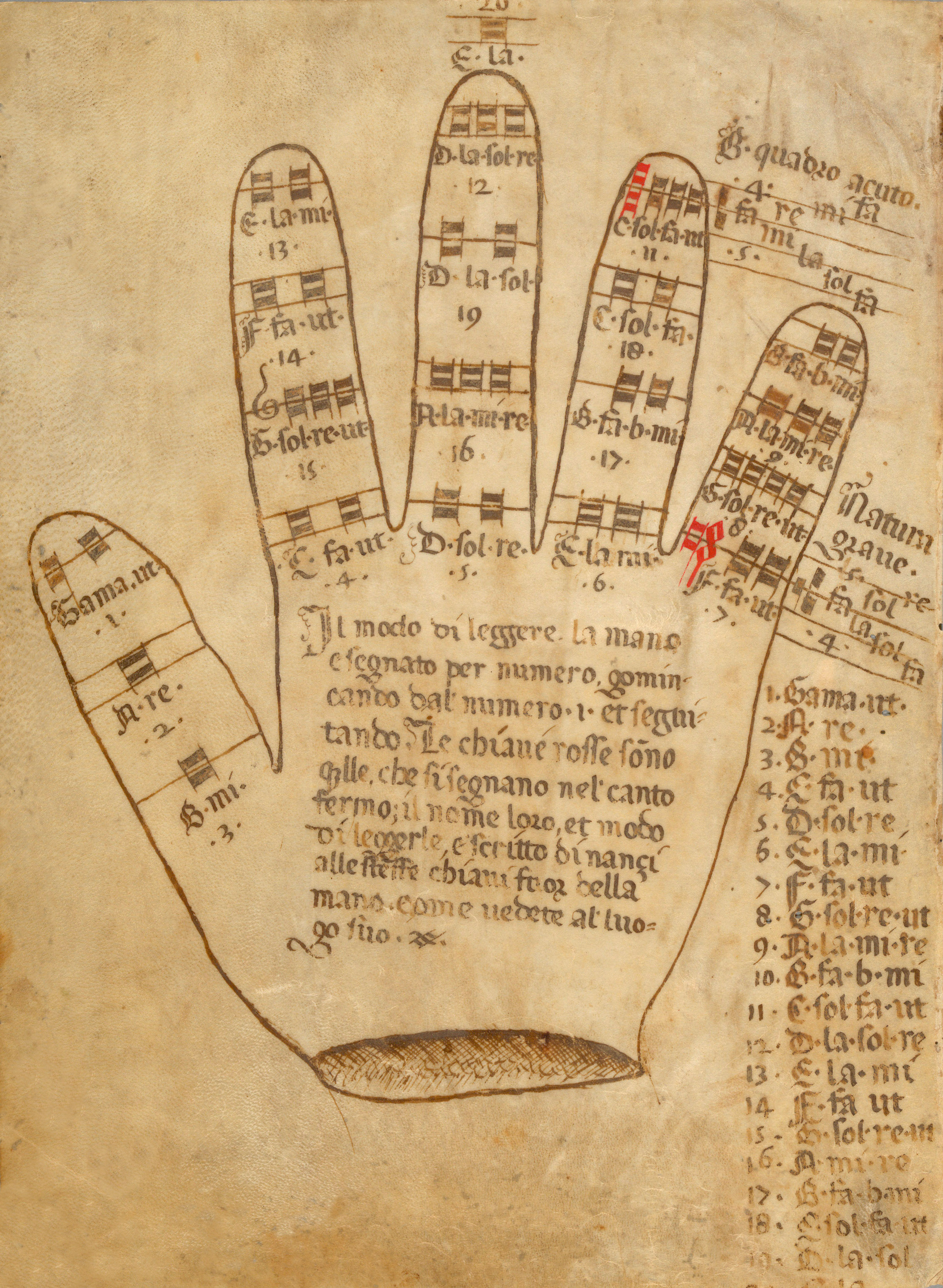
In the 11th century, a monk known as Guido of Arezzo, began to use the “Guidonian hand” as way to teach medieval music singers his hexachord, or six-note scales. Arezzo, who had also devised the modern musical notation system, had noticed that singers struggled to remember the various Gregorian chants that the monastic orders performed in the monasteries.
To help their memorization, Guido decided to take the first syllable in each line of the well known hymn Ut Queant Laxis, and created a hexachord, or six note scale, that singers familiar with the hymn already knew: ut, re, mi, fa, sol, la. The hand, shown above, was a map of the musical notes in this hexachord system, with each note associated with a particular joint. In all, the Guidonian hand ranges almost three octaves. Although it had fallen out of use for the past few centuries, the Guidonian hand seems to be making a comeback. Here’s a video of the method in action, forwarded our way by Anton Hecht, an Open Culture reader:
I love the concept, but can’t help feel that using the Guidonian hand during a performance makes you look a little like a first grader struggling with basic arithmetic.
For more information on the Guidonian hand, check out this writeup of a 2011 Stanford symposium, and watch another demonstration video, here.
They say Seinfeld was about nothing. But the clip above puts that sense of nothingness into perspective. Running six plus minutes, the montage assembled by LJ Frezza presents “A supercut of empty shots. A New York without people.” Essentially moments of pure nothingness. When you’re done, you can graduate to some more existentialist ideas — some fun, some substantive — in our archive.
Born in Philadelphia, Brenner started out a documentary filmmaker, but eventually launched a career as a comedian. His big break came on January 8, 1971 when Johnny Carson let him do nine minutes of standup on The Tonight Show. Carson apparently liked Brenner’s observational comedy routine. In years to come, Brenner made a record-setting 157 appearances on Johnny’s show, sometimes as a comedy act, sometimes as a substitute host. Above you can watch the very first of those funny appearances.
After the infant Herzog survived a bombing that covered him in rubble, his mother, understandably fearing for her children’s safety, fled to the mountains. The remoteness of his upbringing sheltered him in some ways (“I did not even know that cinema existed until I was 11”) and not, in others. (“At age four, I was in possession of a functioning submachine gun and my brother had a hand grenade.”)
When he says that hunger was a prevailing theme, I dare you to disagree.
Dire predictions, and yet he fills me with cheer every time he opens his mouth. I swear it’s not just that marvelous, much imitated voice. It’s also a comfort to know we’ve got a prolific artist remaining at his outpost from a sense of duty, gloomy yet stout as a child in his belief that an ecstasy of truth lies within human grasp.
In 2012, the Los Angeles County Museum of Art (LACMA) unveiled a sprawling, exhaustive exhibit on Stanley Kubrick. And it had just about everything you might want on the great director. Early photographs he took for Look magazine in the 1940s? Check. The blood soaked dresses of those creepy twins from The Shining? You got it! Sketches, notes and documents about Napoleon, the greatest movie he never made? They had a whole room for that. For those cinephiles who worship at Kubrick’s altar, LACMA’s exhibit was akin to a visit to the Vatican. There were more holy relics there than you could shake a monolith at—oh, and they had one of those there too.
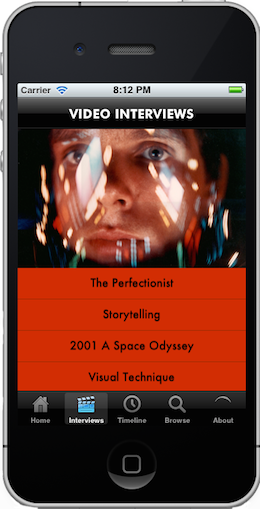
The exhibit wrapped up in June 2013. If you missed it and you are jonesing for more Kubrick memorabilia, take heart — LACMA designed an app in conjunction with the exhibit for the iPhone, iPad and Android and you can download it right now. For free. The app is about as sprawling as the exhibit (and it will take a bit of time to download) but it features hand drawn notes from Kubrick, behind-the-scenes pictures from all of his movies, and interviews with the director, plus ones with the likes of Elvis Mitchell, Christopher Nolan and Douglas Trumbull.
The only thing that the app and the exhibit didn’t cover is the ever-growing number of insane conspiracy theories surrounding his work. Want something about how The Shining is really about a faked moon landing or how Eyes Wide Shut is really about the Illuminati? Look somewhere else.
Jonathan Crow is a Los Angeles-based writer and filmmaker whose work has appeared in Yahoo!, The Hollywood Reporter, and other publications. You can follow him at @jonccrow.
David Bowie and Cher: the combination sounds so incongruous, but then you think about it and realize the two could hardly have more in common. Two singers of the same generation, close indeed in age but both (whether through their sensibilities or through various cosmetic technologies) perpetually youthful; both performers of not exactly rock and not exactly pop, but some oscillating form between that they’ve made wholly their own; both masters of the distinctively flamboyant and theatrical; both given to sometimes radical changes of image throughout the course of their careers; and both immediately identifiable by just one name. The only vast difference comes in their performance schedules: Bowie, despite releasing an acclaimed album The Next Day last year, seems to have quit playing live shows in the mid-2000s, while Cher’s continuing tours grow only more lavish.
Long before this current stage of Bowie and Cher’s lives as musical icons, the two came together on an episode of the latter’s short-lived solo (i.e., without ex-husband Sonny Bono, with whom she’d hosted The Sonny & Cher Show) television variety show, simply titled Cher. On the broadcast of November 23, 1975, Bowie and Cher sang “Young Americans,” at the top, “Can You Hear Me,” just above, and bits of other songs besides.
Watch these clips not just for the performances, and not just for the outfits — costumes, really, especially when you consider Cher’s even then-famous variety of artificial hairstyles — but for the video effects, which by modern standards look like something out of a late-night public-access cable program. An especially trippy set of visuals accompanies Bowie’s solo moment on the episode below, singing about the one quality that perhaps unites he and Cher more than any other: “Fame.” And lots of it.
Since Vivian Kubrick was in grade school, she worked as a collaborator with her famous filmmaker father. She had cameos in a number of his movies including 2001: A Space Odyssey and Barry Lyndon. She shot the behind-the-scenes documentary about the making of The Shining at the age of 24. And she composed the score for Full Metal Jacket under the pseudonym of Abigail Mead. Kubrick seemed to groom his daughter to be his cinematic heir. And then in the late 90s, that all stopped. She cut off all contact with her family.
Kubrick’s family was initially cagey about what happened to her, saying simply that she was living in LA. But then in 2010, Kubrick’s stepdaughter Katharina opened up. “We weren’t lying, we were just being economical with the truth,” she told The Daily Beast. “Because if you say, ‘My sister has become a Scientologist,’ where do you go from that?”
The Church of Scientology’s policy of disconnection is one of its most controversial practices. It’s not clear if Vivian formerly disconnected with her family but she did reportedly attend her father’s funeral in 1999 with a Scientologist minder. When her sister Anya died of cancer in 2009, she did not attend that funeral even though they were, by all accounts, inseparable growing up.
The rift between Kubrick and his daughter became final when he asked her to score Eyes Wide Shut and she refused, as “They had a huge fight. He was very unhappy,” recalled Kubrick’s wife and Vivian’s mother. “He wrote her a 40-page letter trying to win her back. He begged her endlessly to come home from California. I’m glad he didn’t live to see what happened.”
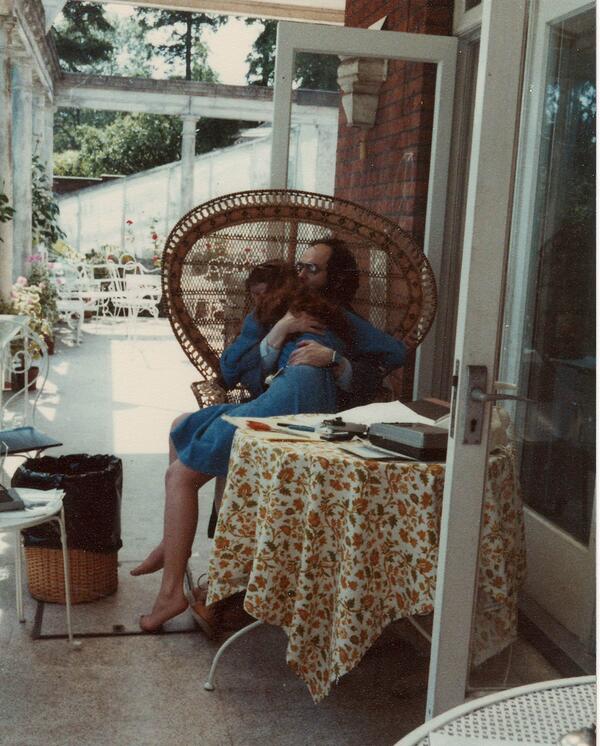
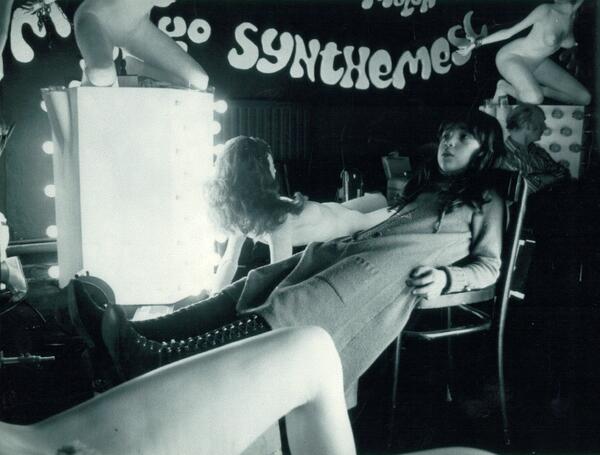
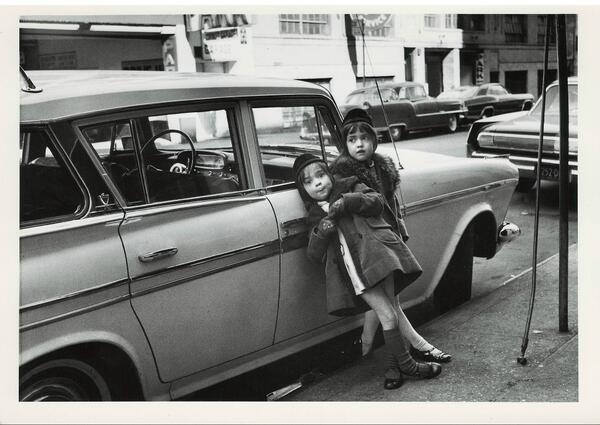
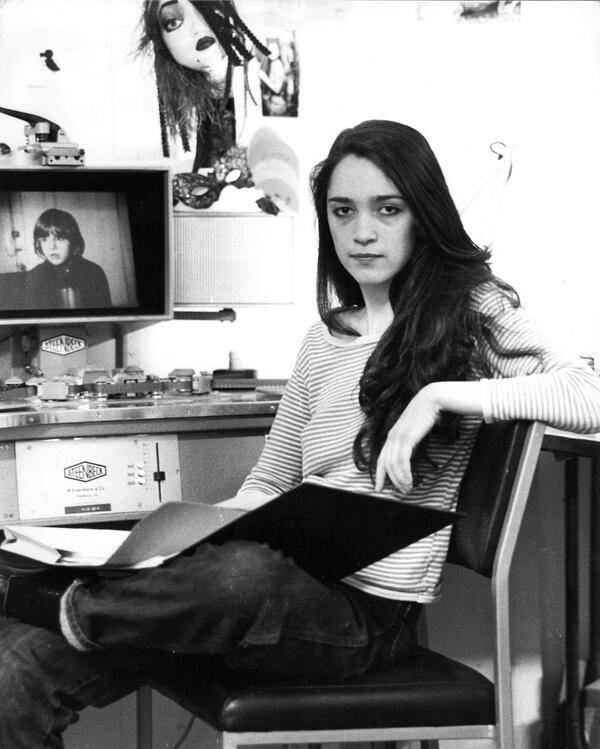
Recently on her Twitter feed, Vivian posted a series of photos of herself on the set of her father’s movies. One picture shows an eight-year old Vivian clutching a baby chimp used on 2001. Another shows her hanging out on the milk bar set of A Clockwork Orange. “I helped cut out those Styrofoam letters on the wall,” she writes. Another picture shows Vivian sitting before a 16mm Steenbeck, editing her documentary on The Shining. And, most poignantly, one of her picture’s shows Vivian and Kubrick embracing on a deck chair.
“In Memory of my Dad,” she writes. “Who I loved with all my heart and soul… Dad and Me on the back veranda of Abbots Mead.”
Jonathan Crow is a Los Angeles-based writer and filmmaker whose work has appeared in Yahoo!, The Hollywood Reporter, and other publications. You can follow him at @jonccrow.
We live in a golden age of television, not just because technology lets us watch shows whenever we like, however we like — thus freeing shows from the tedious need to repeat past events every episode, or worse, to forego the idea of an overarching story entirely — but because technology provides us so many ways to talk about the shows as well. When else, for example, could a critic like Matt Zoller Seitz make the kind of thoughtful video essays he does for so wide an audience? He doesn’t even labor under the obligation to write only about current programs, and you can see the fruits of that freedom in his new video essay above. “A Lie Agreed Upon,” produced for the tenth anniversary of the debut of HBO’s Deadwood, examines the still-resonant neo-Western series created by television auteur David Milch, its genesis, its artistic accomplishments, and what it still has to say about society. “If you’ve read my work,” writes Zoller-Seitz on his blog at RogerEbert.com, “you know I never miss an opportunity to work Deadwood into the conversation, as a legitimate point of comparison with other shows or films or because I just love talking about it.”
Zoller-Seitz channels this critical compulsion into “a stand-alone, nearly half-hour-long piece, co-produced with HitFix, that looks at the show’s style and major themes, as well as its roots in different genres, including the Western and the gangster picture.” On that page, you can even read the essay’s annotated script, which gives you a look at the thought behind this short but rich exegesis on “one of the greatest dramas in American television history,” a show that, though originally conceived for an ancient Roman setting, flawlessly made the transition to a story of “the founding of civilization” in post-Civil War South Dakota. Going from “lewd farce” to “comedy of manners” to “political drama,” Deadwood holds fast to the theme of the basic truths, real or imagined, around which society coheres. After running down the series’ rough-and-tumble cast of characters, most of them addicted to one primitive Old West drug or another — booze, laudanum, hope — Zoller-Seitz paraphrases Milch’s own thoughts on the subject: “A community’s collective agreement on certain principles can be yet another kind of intoxicant — perhaps the most powerful one of all.”
Walt Whitman’s Leaves of Grass often makes its way into the hands of oversized American characters of, shall we say, uncertain repute. We learned, for example, under scandalous circumstances, of Bill Clinton’s admiration for the book, and we’ll never forget the role it played in the rise and fall of similarly alliteratively named, power-mad Walter White.
Another fictional mastermind—Sideshow Bob—quotes gleefully from Leaves of Grass in a recent Simpsons episode. And perhaps the most outré character of them all—the florid speech of the rogue and pimp Al Swearengen in HBO’s Deadwood—derives in part from the “barbaric yawp” Whitman describes as his native tongue in the poem from which the book’s title comes, “Song of Myself.”
One of the many reasons this particular poem from Leaves of Grass captures the imagination of outlaw intellectuals (and narcissists) may be Whitman’s invention of a new American poetic idiom for the eloquent assertion of stridently defiant personal identities. (As Ezra Pound put it, Whitman “broke the new wood.”) The Guardian placed “Song of Myself” at the top of a 10 best American poems list for the “peerless self-performance” of the poem’s hypnotic cadences. Who better to interpret those lines than another self-invented American contrarian, Orson Welles?
During some difficult times in the fifties—in part due to Welles’ IRS trouble—the great actor/director/multi-media impresario found work on radio plays in England, including The Lives of Harry Lime (based on his character in The Third Man) and The Adventures of Sherlock Holmes (as Moriarty). In 1953, the BBC contracted with Welles to record an hour of readings from “Song of Myself.” BBC 3 broadcast the session, and it later saw release as an LP, now sadly out of print. Fortunately, however, much of this recording has been digitally preserved. At the top, hear Welles read section VI of the poem, and directly above, hear him read the heretical section XLVIII. The Mickle Street Review, an online journal of Whitman studies, hosts a small part of Side 1 and, it appears, all of Side 2 of the record, below. The text of the poem was too long for a full treatment, and Welles, it seems, abridged and adapted some of the work himself. His reading was apparently very well received by the UK press.
Side 1:
Side 2:
While the BBC commissioned the recordings—and Welles no doubt needed the money—he already had an affinity for Whitman. In the same year he completely re-invented American film with Citizen Kane, he also began broadcasting the Orson Welles Show on CBS Radio, on which he and his guests gave dramatic readings from drama, poetry, and fiction. Welles produced 19 episodes, though only 8 have survived. One of the lost episodes, from December 1, 1941, featured Welles reading from Leaves of Grass. As further evidence, we have this photograph of Welles reading Gay Wilson Allen’s The Solitary Singer, a critical biography of the poet.
What draws Welles, and restless personalities like him, to Whitman, and especially to Leaves of Grass? One answer lies in Whitman’s own life. Early on, PBS’s American Experience tells us, Whitman staked out “radical positions… putting him in near constant opposition to society’s prevailing sentiments.” He never moderated his views or his voice, though faced with charges of blasphemy, obscenity, bad writing, and various other public vices at the time. Whitman’s steadfast commitment to his political and artistic vision brought him worldwide acclaim, as well as censure, in his lifetime. A particularly scathing 1882 Atlantic review of the second printing of Leaves of Grass catalogues Whitman’s literary abuses and concludes that “the book cannot attain to any very wide influence.” Despite this terribly wrongheaded prediction, the reviewer at least recognizes Whitman’s “generous aspiration,” a quality held in common by all of Whitman’s admirers, be they heroes, villains, or just average people responding to the poet’s raw self-assertion and capacious, grandiose, and particularly American, form of longing.
In high school, my physics teacher taught the class by having us listen to his long, monotonous lectures. After I realized that I couldn’t digest his verbal lessons, I stopped listening. Instead, I picked up a textbook and never looked back. I can only imagine how much better off I would have been had I taken a physics class like Brian Greene’s special relativity course on World Science U.
We featured Greene’s work two years ago, when the Columbia University physicist and mathematician launched his impressive PBS series, The Fabric of The Cosmos. Now, Greene and other scientists have created a new education platform called World Science U, and it promises to offer rich, rigorous and engaging courses in the sciences — for free. As Greene explains above, the free courses offered by World Science U take abstract concepts and represent them graphically, using a slew of interactive activities and real-world scenarios. Students receive immediate performance feedback on the problem sets they complete, and have access to a large number of video lectures. Theory is illustrated by way of intuitive animations, and exercises are paired with video solutions that take students through the ideal way to derive the answer.
Although later classes will tackle general relativity, quantum mechanics, and other subjects, World Science U has only two full courses available at present. The first is Greene’s brief conceptual class on special relativity that lasts 2–3 weeks, called Space, Time, and Einstein. There’s also a more advanced, university level course on the same topic called Special Relativity, which lasts about 10 weeks. Interested? We’ll let Greene himself tell you a little more about them in the video below.
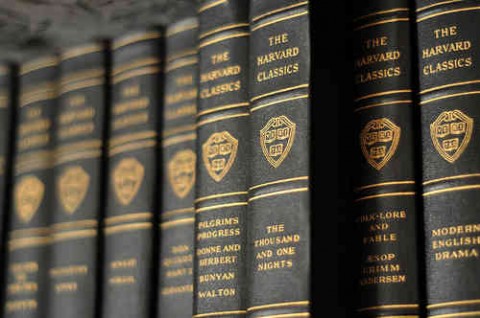
Every revolutionary age produces its own kind of nostalgia. Faced with the enormous social and economic upheavals at the nineteenth century’s end, learned Victorians like Walter Pater, John Ruskin, and Matthew Arnold looked to High Church models and played the bishops of Western culture, with a monkish devotion to preserving and transmitting old texts and traditions and turning back to simpler ways of life. It was in 1909, the nadir of this milieu, before the advent of modernism and world war, that The Harvard Classics took shape. Compiled by Harvard’s president Charles W. Eliot and called at first Dr. Eliot’s Five Foot Shelf, the compendium of literature, philosophy, and the sciences, writes Adam Kirsch in Harvard Magazine, served as a “monument from a more humane and confident time” (or so its upper classes believed), and a “time capsule…. In 50 volumes.”
What does the massive collection preserve? For one thing, writes Kirsch, it’s “a record of what President Eliot’s America, and his Harvard, thought best in their own heritage.” Eliot’s intentions for his work differed somewhat from those of his English peers. Rather than simply curating for posterity “the best that has been thought and said” (in the words of Matthew Arnold), Eliot meant his anthology as a “portable university”—a pragmatic set of tools, to be sure, and also, of course, a product. He suggested that the full set of texts might be divided into a set of six courses on such conservative themes as “The History of Civilization” and “Religion and Philosophy,” and yet, writes Kirsch, “in a more profound sense, the lesson taught by the Harvard Classics is ‘Progress.’” “Eliot’s [1910] introduction expresses complete faith in the ‘intermittent and irregular progress from barbarism to civilization.’”
In its expert synergy of moral uplift and marketing, The Harvard Classics (find links to download them as free ebooks below) belong as much to Mark Twain’s bourgeois gilded age as to the pseudo-aristocratic age of Victoria—two sides of the same ocean, one might say.
The idea for the collection didn’t initially come from Eliot, but from two editors at the publisher P.F. Collier, who intended “a commercial enterprise from the beginning” after reading a speech Eliot gave to a group of workers in which he “declared that a five-foot shelf of books could provide”
a good substitute for a liberal education in youth to anyone who would read them with devotion, even if he could spare but fifteen minutes a day for reading.
Collier asked Eliot to “pick the titles” and they would publish them as a series. The books appealed to the upwardly mobile and those hungry for knowledge and an education denied them, but the cost would still have been prohibitive to many. Over a hundred years, and several cultural-evolutionary steps later, and anyone with an internet connection can read all of the 51-volume set online. In a previous post, we summarized the number of ways to get your hands on Charles W. Eliot’s anthology:
You can still buy an old set off of eBay for $399 [now $299.99]. But, just as easily, you can head to the Internet Archiveand Project Gutenberg, which have centralized links to every text included in The Harvard Classics (Wealth of Nations, Origin of Species, Plutarch’s Lives, the list goes on below). Please note that the previous two links won’t give you access to the actual annotated Harvard Classics texts edited by Eliot himself. But if you want just that, you can always click here and get digital scans of the true Harvard Classics.
In addition to these options, Bartleby has digital texts of the entire collection of what they call “the most comprehensive and well-researched anthology of all time.” But wait, there’s more! Much more, in fact, since Eliot and his assistant William A. Neilson compiled an additional twenty volumes called the “Shelf of Fiction.” Read those twenty volumes—at fifteen minutes a day—starting with Henry Fielding and ending with Norwegian novelist Alexander Kielland at Bartleby.
What may strike modern readers of Eliot’s collection are precisely the “blind spots in Victorian notions of culture and progress” that it represents. For example, those three harbingers of doom for Victorian certitude—Marx, Nietzsche, and Freud—are nowhere to be seen. Omissions like this are quite telling, but, as Kirsch writes, we might not look at Eliot’s achievement as a relic of a naively optimistic age, but rather as “an inspiring testimony to his faith in the possibility of democratic education without the loss of high standards.” This was, and still remains, a noble ideal, if one that—like the utopian dreams of the Victorians—can sometimes seem frustratingly unattainable (or culturally imperialist). But the widespread availability of free online humanities certainly brings us closer than Eliot’s time could ever come.
We're hoping to rely on loyal readers, rather than erratic ads. Please click the Donate button and support Open Culture. You can use Paypal, Venmo, Patreon, even Crypto! We thank you!
Open Culture scours the web for the best educational media. We find the free courses and audio books you need, the language lessons & educational videos you want, and plenty of enlightenment in between.
 In 2012, the