Worth a quick mention: Dr. Pardis Sabeti, a media-savvy computational geneticist at Harvard, has teamed up with the Annenberg Foundation, to create a new introduction to statistics. In 32 nicely-produced videos, Against All Odds: Inside Statistics guides “viewers through the wide range of statistical applications used by scientists, business owners, and even Shakespeare scholars, in their work and daily lives.” It’s all about “real people working on real problems.”
The series starts with What Is Statistics?. And then, along the way, the course covers topics like Standard Deviation, Correlation, Samples and Surveys, and more. The clip above comes from the unit called Checking Assumption of Normality. And do note that each video module is complemented by a Student Guide and Faculty Guide specific to the unit.
If you would like to support the mission of Open Culture, consider making a donation to our site. It’s hard to rely 100% on ads, and your contributions will help us continue providing the best free cultural and educational materials to learners everywhere. You can contribute through PayPal, Patreon, and Venmo (@openculture). Thanks!
Last year, Stanford opened a glorious new concert hall. Somewhere during its construction, Steven Sano, a professor in the Music Department, found some extra scraps of Alaskan yellow cedar, the wood used to build the stage floor. He took the wood known “for its resonance and fine grain” to a luthier and came home with two blond-top tenor ukes. They’re on display above. Stanford News has more on the story.
Most of the twentieth century’s notable men of letters — i.e., writers of books, of essays, of reportage — seem also to have, literally, written a great deal of letters. Sometimes their correspondence reflects and shapes their “real” written work; sometimes it appears collected in book form itself. Both hold true in the case of George Orwell, a volume of whose letters, edited by Peter Davison, came out last year. In it we find this missive, also published in full at The Daily Beast, sent in 1944 to one Noel Willmett, who had asked “whether totalitarianism, leader-worship etc. are really on the up-grade” given “that they are not apparently growing in [England] and the USA”:
As to the comparative immunity of Britain and the USA. Whatever the pacifists etc. may say, we have not gone totalitarian yet and this is a very hopeful symptom. I believe very deeply, as I explained in my book The Lion and the Unicorn, in the English people and in their capacity to centralise their economy without destroying freedom in doing so. But one must remember that Britain and the USA haven’t been really tried, they haven’t known defeat or severe suffering, and there are some bad symptoms to balance the good ones. To begin with there is the general indifference to the decay of democracy. Do you realise, for instance, that no one in England under 26 now has a vote and that so far as one can see the great mass of people of that age don’t give a damn for this? Secondly there is the fact that the intellectuals are more totalitarian in outlook than the common people. On the whole the English intelligentsia have opposed Hitler, but only at the price of accepting Stalin. Most of them are perfectly ready for dictatorial methods, secret police, systematic falsification of history etc. so long as they feel that it is on ‘our’ side. Indeed the statement that we haven’t a Fascist movement in England largely means that the young, at this moment, look for their fuhrer elsewhere. One can’t be sure that that won’t change, nor can one be sure that the common people won’t think ten years hence as the intellectuals do now. I hope they won’t, I even trust they won’t, but if so it will be at the cost of a struggle. If one simply proclaims that all is for the best and doesn’t point to the sinister symptoms, one is merely helping to bring totalitarianism nearer.
You also ask, if I think the world tendency is towards Fascism, why do I support the war. It is a choice of evils—I fancy nearly every war is that. I know enough of British imperialism not to like it, but I would support it against Nazism or Japanese imperialism, as the lesser evil. Similarly I would support the USSR against Germany because I think the USSR cannot altogether escape its past and retains enough of the original ideas of the Revolution to make it a more hopeful phenomenon than Nazi Germany. I think, and have thought ever since the war began, in 1936 or thereabouts, that our cause is the better, but we have to keep on making it the better, which involves constant criticism.
Yours sincerely,
Geo. Orwell
Three years later, Orwell would write 1984. Two years after that, it would see publication and go on to generations of attention as perhaps the most eloquent fictional statement against a world reduced to superstates, saturated with “emotional nationalism,” acquiescent to “dictatorial methods, secret police,” and the systematic falsification of history,” and shot through by the willingness to “disbelieve in the existence of objective truth because all the facts have to fit in with the words and prophecies of some infallible fuhrer.” Now that you feel like reading the novel again, or even for the first time, do browse our collection of 1984-related resources, which includes the eBook, the audio book, reviews, and even radio drama and comic book adaptations of Orwell’s work.
If you would like to support the mission of Open Culture, consider making a donation to our site. It’s hard to rely 100% on ads, and your contributions will help us continue providing the best free cultural and educational materials to learners everywhere. You can contribute through PayPal, Patreon, and Venmo (@openculture). Thanks!
In one time-lapse minute, you can watch Bigfoot Barleywine Style Ale, made by Sierra Nevada, turbulently sloshing around, rising and falling, over the course of six days. The clip is set to the music of Edvard Grieg’s Peer Gynt Suite No. 1, Op. 46. Now if you want to put this visual display into a bit of a larger educational context, then we recommend you spend another two minutes watching a short animated video explaining the beer-making process, from start to finish. For the impatient, the fermenting comes at the 1:20 mark.
Isaiah Berlin casts a long shadow over modern political philosophy. Rising to prominence as a British public intellectual in the 1950s alongside thinkers like A.J. Ayer and Hugh Trevor-Roper, Berlin (writes Joshua Chemiss in The Oxonian Review of Books) was at one time a “cold warrior,” his opposition to Soviet Communism the “lynchpin” of his thought. But his longevity and intellectual vitality meant he was much more besides, and he has remained a popular reference, though, as Chemiss points out, Berlin’s reputation took a beating from critics on the left and right after his death in 1997. Born into a prominent Russian-Jewish family, Berlin grew up in middle class stability until the Russian Revolution dismantled the Czarist Russia of his youth and his family relocated to Britain in 1921.
Berlin’s childhood experience of the Bolsheviks was never far from his mind and precipitated his aversion to violence and coercion, he confesses above in a 1992 interview with his biographer Michael Ignatieff (who spent ten years in conversation with Berlin). Originally broadcast on BBC 2, Ignatieff’s interview serves as an introduction to both the man himself and to his past—in lengthy segments that detail Berlin’s history through photographs and narration. Referring to Berlin’s hugely influential categorization of intellectual history, The Hedgehog and the Fox, Ignatieff tells us: “He once wrote, ‘A fox knows many things, but a hedgehog knows one, big thing.’ He was a hedgehog, all his work was a defense of liberty.… All of his writing can be read as a defense of the individual against the violence of the crowd and the dogma of the party line.”
Berlin was enormously prolific, in print as well as in recorded media, and we have access to several of his lectures online. One radio lecture series, Freedom and its Betrayal, examined six thinkers Berlin identified as “anti-liberal.” Perhaps foremost among these was Jean-Jacques Rousseau. In his lecture on Rousseau above (continued here in Parts 2, 3, 4, 5 & 6), Berlin elaborates on his important distinction between types of liberty, a theme he returned to again and again, most famously in a lecture, eventually published as a 57-page pamphlet, called “Two Concepts of Liberty.” Berlin adapted much of the ideas in these lectures from his Political Ideas in the Romantic Age—written between 1950 and 1952 and published posthumously—a text that Berlin called his “torso.”
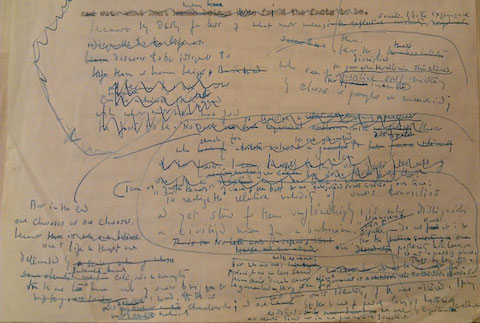
Oxford University hosts an extensive “Isaiah Berlin Virtual Library” that details the composition of “Two Concepts of Liberty,” from its earliest draft stages (above) to its publication history. You can read the full text of the published lecture here and listen to Berlin’s recorded dictation of an early draft below.
In the published version of “Two Concepts of Liberty,” Berlin succinctly sums up his major premise: “To coerce a man is to deprive him of freedom.” Then he goes on:
freedom from what? Almost every moralist in human history has praised freedom. Like happiness and goodness, like nature and reality, the meaning of this term is so porous that there little interpretation that it seems able to resist….[There are] more than two hundred senses.… of this protean word….
Berlin reduces the more than two hundred to two: negative liberty—dealing with the areas of life in which one is free from any interference; and positive liberty—his term for that which interferes in people’s lives for their supposed benefit and protection. Berlin’s conceptions of these two types is anchored in specific geopolitical arrangements and philosophical traditions, as Dwight MacDonald explained in a 1959 review of the published text. He saw Communism as an abuse of positive liberty and wished to enhance so-called negative liberty as much as possible. As such, Berlin is often cited approvingly by politicians and philosophers with more classical, limited understandings of state power, although these may include libertarians as well as liberals, finding common ground in values of ethical pluralism and robust civil liberties, both of which Berlin defended strenuously.
Berlin draws his account of negative liberty from the work of classical liberal political philosophers like John Locke, Adam Smith, and John Stuart Mill. Most of his critique of positive liberty focused on Romanticism and German Idealism, in which he saw the beginnings of totalitarianism (above, hear Berlin’s final 1965 lecture on the “Roots of Romanticism,” continued in Parts 2, 3, 4, 5, 6, & 7). Despite his preoccupation with kinds of freedom, his thought was extraordinarily idiosyncratic, wide-ranging, and diverse. Oxford hopes to soon add the text of much of Berlin’s published work to its Virtual Library. Now, in addition to “Two Concepts of Liberty,” it also houses online text of the essay collection Concepts and Categories. While we await the posting of more Berlin texts, we might attend again to Berlin’s conception of types of freedom, and hear them defined by the philosopher himself in a 1962 interview:
As in the case of words which everyone is in favour of, ‘freedom’ has a very great many senses – some of the world’s worst tyrannies have been undertaken in the name of freedom. Nevertheless, I should say that the word probably has two central senses, at any rate in the West. One is the familiar liberal sense in which freedom means that every man has a life to live and should be given the fullest opportunity of doing so, and that there are only two adequate reasons for controlling men. The first is that there are other goodsbesides freedom, such as, for example, security or peace or culture, or other things which human beings need, which must be given them, apart from the question of whether they want them or not. Secondly, if one man obtains too much, he will deprive other people of their freedom – freedom for the pike means death to the carp – and this is a perfectly adequate reason for curtailing freedom. Still, curtailing freedom isn’t the same as freedom.
The second sense of the word is not so much a matter of allowing people to do what they want as the idea that I want to be governed by myself and not pushed around by other people; and this idea leads one to the supposition that to be free means to be self-governing. To be self-governing means that the source of authority must lie in me – or in us, if we’re talking about a community. And if the source of freedom lies in me, then it’s comparatively unimportant how much control there is, provided the control is exercised bymyself, or my representatives, or my nation, my people, my tribe, my Church, and so forth. Provided that I am governed by people who are sympathetic to me, or understand my interests, I don’t mind how much of my life is pried into, or whether there is a private province which is divided from the public province; and in some modern States – for example the Soviet Union and other States with totalitarian governments – this second view seems to be taken.
Between these two views, I see no possibility of reconciliation.
A true fact about the thesis stage of an advanced degree: Whatever the academic field, whether writing a fifty page bachelor’s or master’s thesis or 250 plus page doctoral dissertation, at some point, you will need to winnow your argument down to an abstract summary of a couple succinct paragraphs. Then, one inevitably finds—when riding elevators with colleagues and mentors, talking to relatives over holiday dinners, justifying one’s existence to friends and acquaintances—that the whole damned thing needs to somehow reduce to one intelligible sentence or two. It’s all anyone has the patience for, honestly, and it saves you the trouble of trying to reconstruct complex arguments for people who won’t understand or care about them and who generally only asked out of politeness anyway.
But how, how, to cram years of research, agony, turmoil, crushing failure and soaring epiphany into bite-sized conversational nuggets without gross oversimplification to the point of tautological absurdity? Can it even be done?! The blog “lol my thesis,” started last year by a Harvard senior studying Human Developmental and Regenerative Biology, suggests that it can, but not without hilarious results. Part of an exploding genre of academic parody (and procrastination) sites, lol my thesis proudly ventures forth in its mission of “summing up years of work in one sentence” with open submissions from current students. Many of the submissions are from the sciences, and many from undergraduate theses, but a fair number also come from humanities and post-graduate studies. Take, for example, the following submission from an MFA Creative Nonfiction student at Emerson College, which directly addresses the intended audience:
“A collection of nonfiction essays, which means they’re written about real people and events, mom. Remember all those times you accused me of not listening to the things you said?”
A passive aggressive example that most of us who’ve been through the process can relate to at some level. Another one that hits home is this, from a Vassar Political Science major, who discovers too late that the argument doesn’t work: “Oops: Turns out self-published poetry didn’t actually affect Indian politics but I’m 60 pages in, so.”
The submissions from the sciences do not disappoint. For example, from a University of Maryland student of Biological Sciences: “We spent thousands of government dollars to create a mouse model for a disease only 32 people in the world have.” And a Science Writing student at M.I.T. gives us this particularly impressive example of brevity: “Wolves + humans, the ultimate frenemies.” Not to be outdone, a Stem Cell Biology student at Harvard offers a grimly terse confessional: “I have killed so many fish.”
The submissions are anonymous, but some good sports have chosen to include links to their theses, endearingly hoping that someone besides their advisor will actually want to read them. Most of the submissions, however, simply combine two qualities every advanced student knows all too well: a well-earned feeling of futility and the mordant wit required to keep going anyway.
Today I am pleased to bring you samplings of a handful of my favorite bands. It so happens they are all mostly-female or female-fronted punk bands. This fact to me seems almost incidental to my enjoyment—these are all fantastic musicians, songwriters, and/or personalities. And yet their commonalities are highly remarkable all the same. Punk introduced aggressive, all-female bands like The Slits and frontwomen like Siouxie Sioux who never had to play vulnerable objects, desperate seductresses, jilted lovers, femme fatales, etc. and yet still manifested their power in their sexuality as well as in their fierce intelligence and fury. In the late ’70s, women strode out in front as leaders in punk scenes in the UK and US, and helped to change the gender politics of rock and roll.
First up, the Runaways, a band best known today for the later careers of guitarists Joan Jett and Lita Ford. The Runaways tend to get unfairly pegged as little more than wards and projects of manager Kim Fowley, but the L.A. band formed organically around Jett and drummer Sandy West in 1975 and succeeded in their own right after splitting with Fowley in 1977. While they did not technically begin as a punk band, they briefly became associated with several New York and London punks, especially due to Jett’s orientation toward glam, garage, and punk. Ford, known for her flashy guitar solos, wanted to go metal (and later did), and the band pulled apart in 1978. The Runaways were so rock n’ roll that they were biggest in Japan, especially their song “Cherry Bomb” from their first, self-titled 1976 album. Watch them play the song above on Japanese TV in ’77.
Next (and my ordering here means nothing, by the way), The Slits. When German-born frontwoman Ari Up (stepdaughter of John Lydon, as it happens) passed away from cancer in 2010, many, many people mourned her death. And many more sent “Slits” trending on all the social networks. It was long past time then for a more public profile of the band, which reformed in 2005 but mostly absent much critical notice. Arising in 1976 from members of a band called Flowers of Romance (later the name of an album and song by Lydon’s Public Image Ltd.), the mostly all-female Slits made a very different sound from the Runaways somewhat formulaic hard rock. Like the Clash, with whom they often played, the Slits evolved from raw street punk to taking reggae ideas and making something new, in their case something weirder, wobblier, and more angular than most anyone else at the time (though later male post-punk bands like Swell Maps and Lydon’s PIL took much from them). See them do “Typical Girls” above in a rare music video, and check out their cover of “Heard it Through the Grapevine.”
Siouxsie Sioux, of Siouxsie and the Banshees, and later the Creatures, began her career in London’s punk scene as a follower of the Sex Pistols. In a scene thronged with inventive kids competing for attention, she stood out. Once she decided to take the stage herself (after an impromptu jam of “The Lord’s Prayer” with guitarist Steve Severin and Sid Vicious on drums) and form her own band, she seemed to Slits guitarist Viv Albertine to have arrived “fully made, fully in control, utterly confident.” Siouxsie was “unlike any female singer before or since,” wrote rock journalist Jon Savage, “commanding yet aloof, entirely modern.” She was also a phenomenal songwriter and, along with The Cure, Bauhaus, and The Damned, gets credit—for better or worse—for the origins of goth rock. See Siouxsie command the stage in 1978 above, doing “Hong Kong Garden.”
I feel I would be most remiss if I did not include Wendy O. Williams. As we seem to endlessly debate the social value of certain female pop stars clumsy attempts to shock us, Williams spent most of the ‘70s onstage topless, sawing guitars in half with chainsaws, and setting cars on fire. Was her band, the Plasmatics, any good? It’s hard to say. They were… uneven. Not much of a singer, Williams and the Plasmatics embraced a more raucous version of the Runaway’s hard rock and eventually moved toward metal. This is not necessarily music you listen to, it’s music you experience, in the sheer amount of barely-controlled chaos Williams and the band conjured onstage. Some of the stunts might look silly in hindsight, but bear in mind, she pushed the boundaries of decorum over thirty years ago with the kind of sexual frankness and power that still makes our culture very nervous. Williams’ antics made her a prime figure for television (like gross-out punk provocateur G.G. Allin, she became something of a novelty act on the talk-show circuit). See her above with the Plasmatics on Solid Gold in 1981, with the added bonus of an interview with the “Madame” puppet (of Wayland Flowers and Madame) after the performance.
I cannot begin to do justice here to the groundswell of excellent female punk bands from the ‘70s and ‘80s (not even to mention the ‘90s), and I can’t overstate their importance. Dr. Helen Reddington, former bassist and singer for ’70s punk band The Chefs, approvingly quotes journalist Caroline Coon, onetime manager of both The Clash and The Slits as saying: “it would be possible to tell the whole story of British punk solely through its female bands and artists” (this is much less the case in U.S. punk history). You might wish to check out the rather crudely made, but interesting documentary She’s a Punk Rocker and the database on punk77.com for more. I haven’t mentioned Patti Smith, but we cover her body of work frequently enough here. Yes, I’ve left off Blondie, and of course X‑Ray Spex, and two more favorites of mine—the sadly underrated but truly awesome Bush Tetras and the obscure, Devo-like Mo-Dettes. The list, as always, could go on, but perhaps some of you have your own favorite female or female-fronted punk bands. If so, add them to the comments, preferably with a link to audio or video.
Click the image above and you’ll enter an interactive/moving graphic that gives you a fairly nice genealogy of rock n roll and the many forms of music it later spawned. The graphic starts you with the blues, appalachian folk, and bluegrass. Eventually you hit the 1950s and the advent of rock. Then you keep traveling through time, reaching the hard rock, glam rock and punk of the 70s; the power metal and emerging grunge of the 80s; the post metal and neo folk of the 90s; and beyond. At any point, you can click the pause button, click on the name of a particular musical genre (eg Gothabilly), and hear a sample of the music. When you’re done, you might want to check out some of the related items below:
Kim Jong-Il (1941–2011), son of North Korea’s despotic Kim Il-sung and a tyrant in his own filial right, had as many titles as he did talents, with honorifics including the Sun of the Nation and the Shining Star of Paektu Mountain. Highfalutin nicknames aside, the younger dictator was a pretty able guy. North Korean sources assert that the Dear Leader once shot a 38 under par with 11 birdies (in his first and only game of golf), and could alter the weather using the power of his mind. Having turned his intellect to academia, Kim wrote 1500 books while studying at university. He also theorized extensively about art, cinema, and opera.
Kim once served as the Movie and Arts Division Director in North Korea’s Propaganda and Agitation Department, and was a renowned cinephile. As befitting a man whose personal video library reportedly housed over 20,000 titles, Kim (or some unfortunate ghostwriters) published numerous lectures and pamphlets on film, some of which are available in the Democratic Republic of Korea’s E‑Library. In his text The Cinema and Directing, for example, Kim shows off his talents for writing stilted academic prose while discussing ideology:
The ideological kernel of a production is the seed which the director and all the other creative workers should bring into flower through their collective efforts and wisdom. It is not only the basis of the interpretation by the individual creative workers, but also the foundation on which they all combine to produce one single cinematic presentation. When all interpretations are conducted on the basis of one seed, they form the components of one cinematic presentation because they are built on the same foundation [et cetera, ad nauseum].
Kim also pontificated on matters of literature. The treatise, entitled Life and Literature, offers the Ever-Victorious, Iron-Willed Commander’s thoughts on the essence of writing:
Literature belongs to the domain of humanics [sic]. The essential characteristic of literature as a humanics [sic] consists of describing real people and serving man… To say that literature portrays people means that it describes people and their lives, people who live, breathe, think and act as they do in real life. That literature serves man means that it solves urgent and important human problems through people and their lives and thus teaches them what life is and influences them to lead an honourable life. It is only through an accurate portrayal of people and their lives that literature can provide proper solutions for valuable human problems, and exert a great influence on people.
The key words here are “people” and “lives.” Got it?
Lest you dismiss these writings as pseudo-intellectual nonsense, it’s important to note that some philosophical interpretation is required. It’s the meanings behind the words, and the things that Kim leaves unsaid, that make up the real meat and potatoes of the piece… Or something.
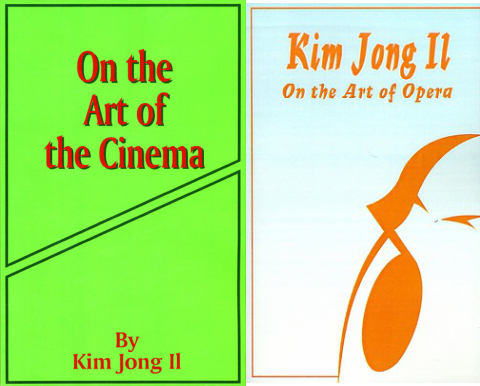
You can find more of Kim Jong-il’s writings (alongside those of his father, Kim Il-sung) at the Democratic Republic of Korea E‑Library. Other titles include On the Art of the Drama and On the Art of Opera, which gets some pretty stellar reviews on Amazon. Take for example: “With over five books published per year in North Korea, it is a challenge to pick a single favorite. However, this book is a standout for North Korean opera connoisseurs and beginners alike.”
Ilia Blinderman is a Montreal-based culture and science writer. Follow him at @iliablinderman.
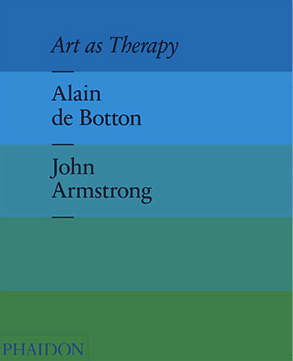
Alain de Botton, pop philosopher, has come out with a new book. Like his others, it’s full of sweeping ideas about an entire mode of human existence. He’s written on religion, sex, success, and happiness, and now he takes on art in Art as Therapy, co-written with art historian and author John Armstrong. Like all of de Botton’s ventures, the new book is sure to polarize. Many people find his work powerful and immediate, many see it as blithe intellectual tourism. To the latter critics, one might reply that de Botton’s approach is somewhat like that of other non-professional philosophers ancient and modern, from Plato to Schopenhauer, who addressed any and every area of life. And yet de Botton is a professional of another kind—he is a professional author, speaker, and self-help guru, and unlike his predecessors, he expressly sells a product. There’s no inherent reason why this should render his philosophy suspect. Yet, to use a favorite descriptor of his, some may find his media savviness vulgar, as Socrates found the so-called “sophists” of his day (a term of abuse that may be generally undeserved then and now).
In the video above—one of de Botton’s “Sunday Sermons” for his School of Life, an organization that more and more resembles his vision of a “religion for atheists”—de Botton lays out the book’s argument in a pretty unconventional way. The intro looks exactly like an evangelical church service, scored by a Robbie Williams song, which de Botton uses as his first example of “art.” It’s a tongue-in-cheek demonstration of de Botton’s claim that “art is our new religion… culture is something that is imminently suited to filling [religion’s] shoes.” Whether all of this large talk, pseudo-religiosity, and Robbie Williams music inspires, bores, or disturbs you is a personal matter, I suppose, but it does prepare one for something very different from a philosophical lecture in any case. This is, in fact, a sermon, replete with literary and theoretical references, tailored to offer answers to Life’s Big Questions.
De Botton first identifies the problem. While the secular gatekeepers of culture pretend to believe in the mollifying spiritual effects of art, “in fact,” he says, “the idea is dead.” Museums are moribund because, for example, they don’t directly address individual’s fear of death. Presumably, his “art as therapy” approach does. The book’s website contains snippets divided into broad categories like “Politics,” “Work,” “Love,” “Anxiety,” “Self,” and “Free Time.” In his sermon, de Botton doesn’t seem to evince any recognition of the field of art therapy, which has been chugging along since the early 20th century, but as he tells Joshua Rothman in an interview for The New Yorker he means the word therapy—“a big, simple, vulgar word”—broadly. Sounding for all like an Anglican theologian, de Botton says of an annunciation altarpiece by Fra Fillippo Lippi:
There’s a sudden tenderness here, which is so far removed from the harshness outside. If I were to put a caption here, it might say: ‘Our world, for all its technological sophistication, is lacking in certain qualities. But this painting is a visitor from another world, where those qualities—tenderness, reverence, and modesty—are very highly valued. Take it as an argument against Fox News and the New York Post. Use it to find the still places in yourself.’
The notion of this piece of art as “an argument” on the same conceptual plane as corporate mass media seems to contradict de Botton’s premise that it’s “from another world.” This cheek-by-jowl referencing of the sacred and profane, high and low, offends the sensibilities of several philosophical thinkers, and may have offended Fra Fillippo Lippi. But perhaps it’s too easy to be cynical about de Botton’s populist approach. If all of his evangelism seems like nothing more than elaborate publicity for his books, he’s certainly made things difficult for himself by founding a school. Whether you find his ideas compelling or not, he proves himself a passionate, if not particularly modest, thinker attempting to grapple with the problems of middle-class Western malaise and existential angst.
We're hoping to rely on loyal readers, rather than erratic ads. Please click the Donate button and support Open Culture. You can use Paypal, Venmo, Patreon, even Crypto! We thank you!
Open Culture scours the web for the best educational media. We find the free courses and audio books you need, the language lessons & educational videos you want, and plenty of enlightenment in between.