Last month, Lawrence Livermore National Laboratory put on YouTube 200 now-declassified videos documenting American nuclear tests conducted between 1945 and 1962. According the Lab, “around 10,000 of these films sat idle, scattered across the country in high-security vaults. Not only were they gathering dust, the film material itself was slowly decomposing, bringing the data they contained to the brink of being lost forever.”
In the first video above, weapon physicist Greg Spriggs discusses how a team of experts salvaged these decomposing films, with the hope that they can “provide better data to the post-testing-era scientists who use computer codes to help certify that the aging U.S. nuclear deterrent remains safe, secure and effective.”
If you click the forward button, the playlist will skip to the next video, the first of 63 nuclear tests. Several of those clips you can watch below:
Operation Hardtack
Operation Plumbbob
Operation Teapot
If you would like to support the mission of Open Culture, consider making a donation to our site. It’s hard to rely 100% on ads, and your contributions will help us continue providing the best free cultural and educational materials to learners everywhere. You can contribute through PayPal, Patreon, and Venmo (@openculture). Thanks!
As the co-founders of Impactstory describe it, Unpaywall is “an extension for Chrome and Firefox that links you to free full-text as you browse research articles. Hit a paywall? No problem: click the green tab and read it free!”
Their FAQ gets into the mechanics a little more, but here’s the gist of how it works: “When you view a paywalled research article, Unpaywall automatically looks for a copy in our index of over 10 million free, legal fulltext PDFs. If we find one, click the green tab to read the article.”
While many science publishers put a paywall in front of scientific articles, it’s often the case that these articles have been published elsewhere in an open format. “More and more funders and universities are requiring authors to upload copies of their papers to [open] repositories. This has created a deep resource of legal open access papers…” And that’s what Unpaywall draws on.
This seems like quite a boon for researchers, journalists, students and policymakers. You can download the Unpaywall extension for Chrome and Firefox, or learn more about the new service at the Unpaywall website.
If you would like to support the mission of Open Culture, consider making a donation to our site. It’s hard to rely 100% on ads, and your contributions will help us continue providing the best free cultural and educational materials to learners everywhere. You can contribute through PayPal, Patreon, and Venmo (@openculture). Thanks!
Uruguayan-French poet Jules Laforgue, one of the young T.S. Eliot’s favorites, published his major work, The Imitation of Our Lady the Moon, in 1886, two years before his untimely death at 27 from tuberculosis. It is “a book of poems,” notes Wuthering Expectations, “about clowns who live on the moon… wear black silk skullcaps and use dandelions as boutonieres.” The Pierrots in his poems, Laforgue once wrote in a letter, “seem to me to have arrived at true wisdom” as they contemplate themselves and their conflicts in the light of the moon’s many faces.
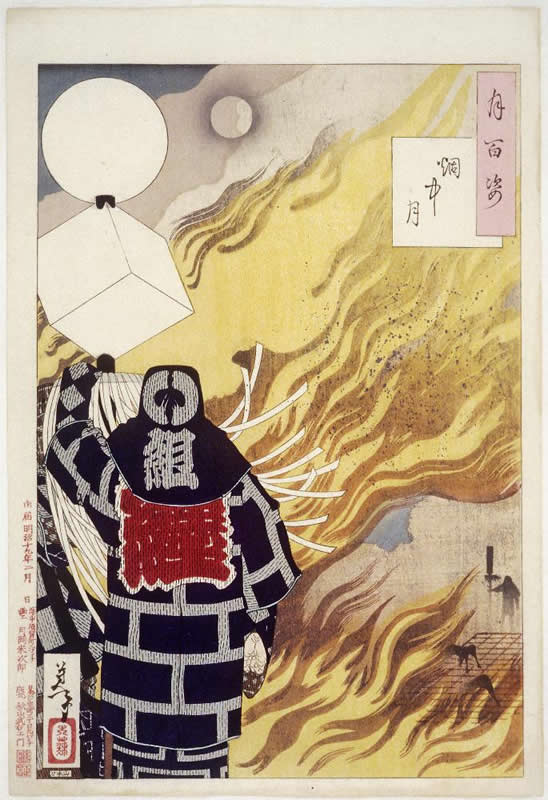
I cannot help but think of Laforgue when I think of another artist who, around the same time, began on the other side of the world what is often considered the greatest work of his career. The artist, Japanese printmaker Tsukioka Yoshitoshi, also stood astride an old world and a rapidly modernizing new one. And his visual ruminations, though lacking Laforgue’s arch comedy, beautifully illustrate the same kind of dreamy contemplation, loneliness, melancholy, and weary resignation. The moon, as Laforgue wrote—a “Cat’s‑eye of bright / Redeeming light”—both comforts and taunts us: “It comes with the force of a body blow / That the Moon is a place one cannot go.”
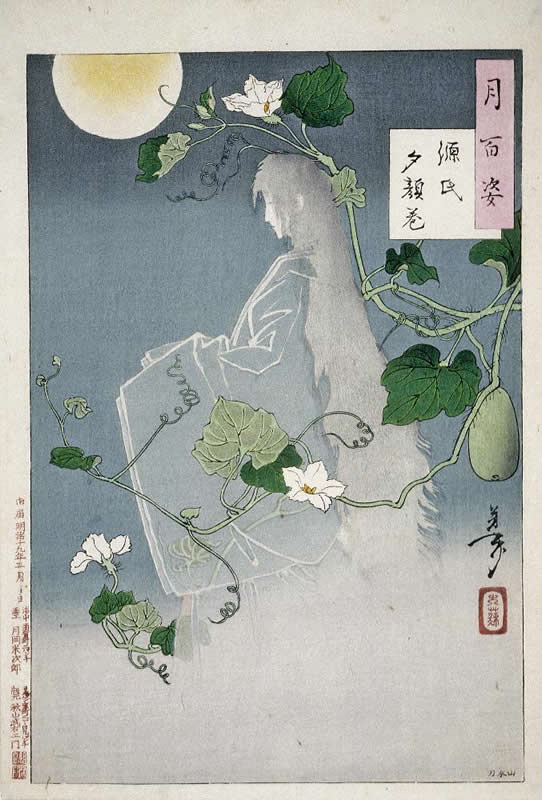
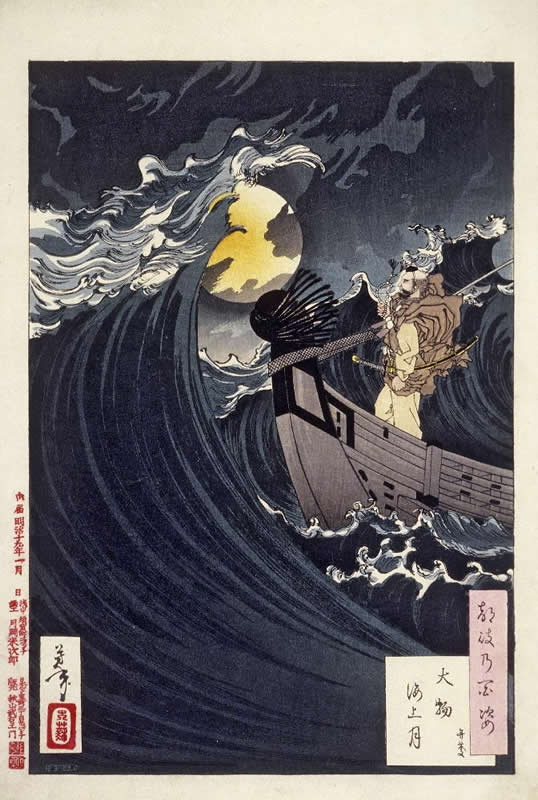
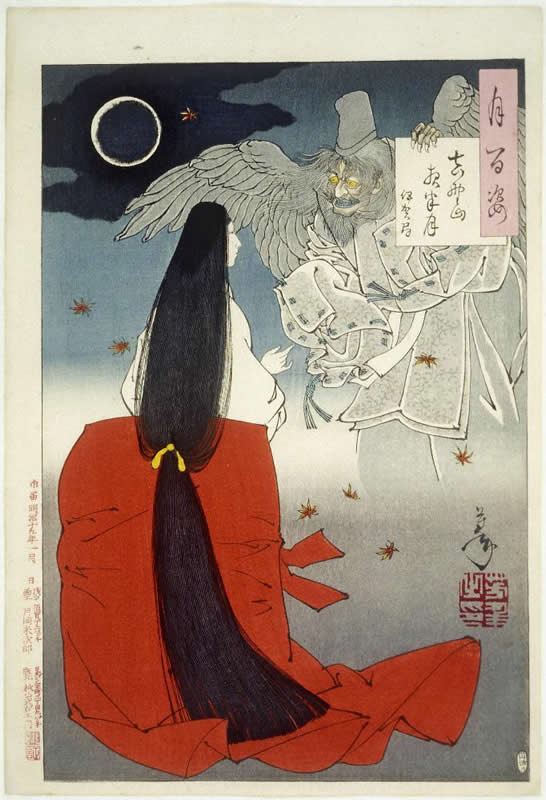
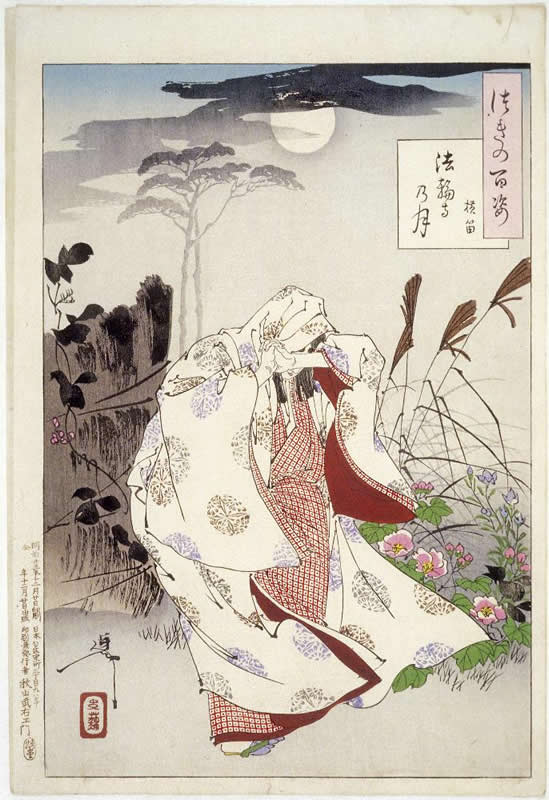
Yoshitoshi’s prints feature a fixation on the moon’s mysteries, and a theatrical device to aid in the contemplation of its meanings: characters from Chinese and Japanese folklore and heroes from novels and plays, all of them staged just after key moments in their stories, in static postures and in silent dialogue with the night. Heavily invested with literary allusions and deeply laden with symbolism, the 100 prints, writes the Fitzwilliam Museum, “conjure a refined poetry to give a new twist to traditional subjects.”
The portraits, mostly solitary, wistful, and brooding, “penetrated deeper into the psychology of his subjects” than previous work in Yoshitoshi’s Ukiyo‑e style, one soon to be altered permanently by Western influences flooding in between the Edo and Meiji periods. Yoshitoshi both incorporated and resisted this influence, using figures from Kabuki and Noh theater to represent traditional Japanese arts, yet introducing techniques “never seen before in Japanese woodblock prints,” writes J. Noel Chiappa, breaking convention by “show[ing] people freely, from all angles,” rather than only in three-quarter view, and by using increased realism and Western perspectives.
Yoshitoshi began publishing these prints in 1885, and they proved hugely popular. People lined up for new additions to the series, which ran until 1892, when the artist died after a long struggle with mental illness. In these last years, he produced his greatest work, which also includes a kabuki-style series based on Japanese and Chinese ghost stories, New Forms of 36 Ghost Stories. “In a Japan that was turning away from its own past,” Chiappa writes, Yoshitoshi, “almost single-handedly managed to push the traditional Japanese woodblock print to a new level, before it effectively died with him.
His tumultuous career, after very successful beginnings, had fallen into disrepair and he had been publishing illustrations for sensationalist newspapers, an erotic portrait series of famous courtesans, and macabre prints of violence and cruelty. These preoccupations become completely stylized and psychologized in his final works, especially in One Hundred Aspects of the Moon, an extraordinary series of prints. View them all, with short descriptions of each subject, here, or at the Ronin Gallery, who provide information on the size and condition of each of its prints and allow viewers to zoom in on every detail. The images have also been publishished in a 2003 book, One Hundred Aspects of the Moon: Japanese Woodblock Prints by Yoshitoshi.
While it certainly helps to understand the literary and cultural context of each print in the series, it is not necessary for an appreciation of their exquisite visual poetry. Perhaps the artist’s memorial poem after his death at age 53 provides us with a master key for viewing his One Hundred Aspects of the Moon.
holding back the night with increasing brilliance the summer moon
Almost all movies tell stories, even the ones that don’t intend to. Put every movie ever made together, and they collectively tell another story: the story of cinema. Of course, not just one “story of cinema” exists to tell: critic Mark Cousins told one to great acclaim a few years ago in the form of his book and documentary series The Story of Film, as Jean-Luc Godard had done earlier in his Histoire(s) du cinéma, whose very title acknowledges the multiplicity of possible narratives in the history of the moving image. Now, with a lighter but no doubt equally strong perspective, comes the latest multipart video journey through it: Crash Course Film History.
“Movies haven’t always looked like they do now,” says host Craig Benzine (better known as the Youtuber WheezyWaiter) in the trailer above. “There was a real long process to figure out what they… were. Were they spectacles? Documentaries? Short films? If so, how short? Long films?
If so, how long? Is black and white better than color? Should sound be the industry standard? And where should we make them?” And even though we’ve now seen over a century of development in cinema, those issues still seem up for grabs — some of them more than ever.
In the first episode, Benzine dives right into his search for the source of the power of movies, “one of the most influential forms of mass communication the world has ever known,” a “universal language that lets us tell stories about our collective hopes and fears, to make sense of the world around us and the people around us.” To do so, he must begin with the invention of film — the actual image-capturing celluloid substance that made cinema possible — and then goes even farther back in time to the very first moving images, “illusions” in their day, and the surprising qualities of human visual perception they exploited.
All this might seem a far cry from the spectacles you’d see at the multiplex today, but Crash Course Film History (which comes from the same folks who gave us A Crash Course in English Literature and A Crash Course in World History) assures us that both of them exist on the same spectrum — the ride along that spectrum being the story of movies. It will last sixteen weeks, after which Crash Course and PBS Digital Studios will continue their collaborative exploration of film with a course on production followed by a course on criticism. Take all three and you’ll no doubt come out impressed not just by the size of the creative space into which film has expanded, but also by how much it has yet to touch.
Note: There are a couple brief not-safe-for-work moments in this film.
Patronizing, ponderous, well-meaning, self-aggrandizing, incoherent… young artists are subjected to a lot of unsolicited advice, and not just from their parents.
But what happens when a young artist actively seeks it out?
Her resultant short film, above, appears to be the work of a deliriously aggro inner child, one with a keen bullshit meter and an anarchic sense of humor.
The pulsating reproductive organs aren’t entirely inappropriate. Listen to Eliasson’s full interview to hear him equate making art with making the world. Now that’s the sort of advice that will put a young artist to work!
Some of the more generous advice:
Build a good name, keep your name clean, don’t make compromises, don’t worry about making a bunch of money or being successful.
Don’t be embarrassed about what excites you.
If you are doing something weird that everybody hates, that might be something worth looking into and worth investigating.
Make your own way in the world. Wrap up warm. Eat properly, sensibly. Don’t smoke and phone your mom.
We love imagining the sort of unfettered advice Shuhman will one day be in a position to dispense.
You can see some of her post graduation illustration work on her Flickr page.
I’ll be honest, for a long time when I thought of Frank Sinatra, I thought of Marilyn Monroe, ratpack films, and the Olive Garden. That is, until I lived for a short time near The Bronx’s Arthur Avenue, the best Little Italy in New York. Sinatra poured from the speakers of Italian eateries and cigar and pastry shops. It dramatically increased the quality of my pleasant associations with his music. Still, I rarely listened very closely. I can’t entirely blame pop culture for turning him into background music—it happens to nearly every major star. But overuse of his voice as accompaniment to olive oil, cigars, and martinis has perhaps made us tune him out too often.
Treating Sinatra as mood music would not have sat well with some of the singers many of us grew up idolizing from a young age, like Paul McCartney and David Bowie, who both found his work formative. McCartney thought so highly of it, he sent Sinatra one of his earliest compositions, an off-kilter lounge crooner called “Suicide” that he wrote at the age of 14. (Hear an unreleased recording below.)
“I thought it was quite a good one,” he remembered, “but apparently [Sinatra] thought I was taking the mickey out of him and he rejected it.”
Bowie, in 1977, wrote what he expressly intended as a parody of Sinatra—“Life on Mars.” But the story is even stranger than that. He specifically tried to “take the mickey” out of Sinatra’s “My Way,” a song credited to Paul Anka that just happens to have first been written, with different lyrics, by Bowie, as “Even a Fool Learns to Love” in 1968 (hear Bowie sing it above). “Life on Mars,” one of the most beautifully melodic songs in all of pop music, with one of Bowie’s best vocal performances, shows how much the Thin White Duke owed to Ole Blue Eyes.
These are just two of hundreds of male singers whose melodies have taken up immortal residence in our brains and who owe a tremendous debt to Frank Sinatra. In addition to his keen melodic sensibility, Sinatra also set a high bar with his technique. In the video at the top of the post from 1965, we see the consummate artist record “It Was a Very Good Year” in the studio, while smoking a cigarette and casually sipping what may be coffee from a paper cup in his other hand.
At one point, he stops and banters with the engineer, asking him to stop for any “P popping,” the explosive sound resulting from singers putting too much force into their “p” sounds and distorting the microphone. Nowadays everyone uses what’s called a “pop filter” to catch these bursts of air, but Sinatra doesn’t have one, or seem to need one. “I don’t thump,” he tells the recording engineer, “I’m a sneaky P popper.” Indeed. One commenter on YouTube pointed out Sinatra’s graceful mic technique:
Notice how he turned his head when he sang “it poured sweet and clear” to avoid the spike on the P. In fact, he backed away from the mic just a bit for that whole last verse because he was singing much stronger for the last statement of the song. Think about it… this was a live studio recording. One take. No overdubs, No added tracks. Just pure talent. The only thing the sound engineers had to do was adjust the eq levels a bit and that’s it. This is what you hear on the album. You’d be hard pressed to find ANYONE who could do that today.
Most vocal performances get recorded in booths, and certainly not in big open rooms with an orchestra and no headphones. Some singers learn to handle a microphone well. Many do not. Audio compression supplies the dynamics, performances get processed digitally and edited together from several takes. Young producers often wonder how people made great sounding records before improvements like pop filters, isolating monitoring systems, or software that allow a nearly infinite number of corrective techniques. The answer: perhaps many of these things aren’t always improvements, but props. As Sinatra shows us in this footage, great sound in the studio came from the professionalism and attentive technique of artists and engineers who got it right at the source.
This weekend, YouTube is live streaming Coachella 2017, which will feature performances by Lady Gaga, Kendrick Lamar, Radiohead, Lorde, Bon Iver, New Order and more.
To watch the shows, you can tune into three channels throughout the weekend, plus a Live 360 channel for select performances. The channels all appear below. And further down the page, you can find the schedule for the entire weekend. Enjoy!
When we think of Stanley Kubrick, we can’t help but think of perfectionism, a quality he brought even to the making of what he called a “ghost film” — a genre for which he seemed to have little respect — with 1980’s The Shining. So much did he want to get his adaptation (or rather, near-total reimagination) of Stephen King’s novel of the haunted Overlook Hotel just right that he actually had the first set of released prints recalled and destroyed because he didn’t think he’d quite nailed the ending: specifically, he wanted to remove just one short scene from it, one which came immediately before the haunting final photograph of the Overlook’s 1921 Fourth of July Ball.
“There was a big length problem with Warner Bros,” said screenwriter Diane Johnson in an interview with Entertainment Weekly’s James Hibberd. “The film was too long and people said it had to be shortened.” The two minutes Kubrick cut from the ending constituted what Hibberd describes as a hospital scene in which “the hotel manager, Ullman (Barry Nelson), visits Wendy and Danny after their ordeal and explains that no supernatural evidence was found to support their claims of what transpired,” not even the frozen body of Jack Nicholson’s crazed Jack Torrance. “Just when the audience begins to question everything they’ve seen, Ullman ominously gives Danny the same ball that was rolled to him from an unseen force outside Room 237.”
“In other words,” said Johnson in an explanation of the scene’s point, “all of this really happened, and the magic events were actual. It was just a little twist. It was easy to jettison.” Roger Ebert, in a 2006 essay on the film, also thought “Kubrick was wise to remove that epilogue,” though for a different reason: “It pulled one rug too many out from under the story. At some level, it is necessary for us to believe the three members of the Torrance family are actually residents in the hotel during that winter, whatever happens or whatever they think happens.” Whether or not you think it should have been left in, we can surely all agree that Kubrick did well to depart from King’s original ending, which had the Overlook explode in a ball of flame, taking Jack with it, as the rest of the family escaped to safety. Sometimes what works on the page just doesn’t work on the screen.
The video above features the screenplay for the deleted original ending of The Shining.
The ‘Sad Clown with the Golden Voice’ has taken to releasing emotionally-freighted covers on select Fridays.
There’s something about a giant sad singing clown that comforts us, let’s us know it’s ok to feel, to show our feelings. It’s a sad and beautiful world, and we’re all in it together, even when we’re totally alone.
So quoth Big Mike Geier, the founder and frontman of the band Kingsized, and the man behind Puddles’ white makeup and rickrack-trimmed clown suit.
Whatever he’s tapped into, it’s real. The New York Times’ Jason Zinnoman, in a slightly skeeved-out think piece on clowns last year, wrote:
What makes him transcend the trope is his vulnerability. When you first see him charging down the aisle, he’s an intimidating figure, but his body is actually not aggressive. It slumps, passively. When he asks for a hug, it looks as if he really needs it. He makes you feel bad for finding him off-putting, and then he belts out a lovely song.
Friday, March 3 found Puddles accompanying himself on a red guitar for “It’s a Heartache,” a hit for Bonnie Tyler and later, Rod Stewart. They both have their strengths, but Puddles is uniquely suited to tap into the heartache of ‘standing in the cold rain, feeling like a clown.”
A previous Friday Feel, Roy Orbison’s “Crying,” was a fan request. (Yes, he’s still taking them.)
February 10’s Friday Feel brought new listeners to a younger artist, Brett Dennen. Puddles praised his “Heaven” as “beautiful and thoughtful song,” confessing that he “barely held it together on this one.” Also see Cheap Trick’s “I Want You to Want Me” down below.
The piece de resistance, wherein the lyrics of Pinball Wizard are sung to the tune of Folsom Prison Blues, is at the top of the page. It’s no great surprise that that one’s gone viral. Puddles is transparent, however, giving credit to the late Gregory Dean Smalley, an Atlanta-based songwriter who died of AIDS in the late 90s:
Back in 1994 or so, I saw (him) perform this mashup at the Star Community Bar. I was floored. Greg was a force of supernatural proportions and he is missed. Many people have done it prior to me doing it. I guess it was always meant to be.
From filmmaker Steve Olpin comes a short documentary (a “documentary poem”) called Earth and Fire, about artist and primitive potter Kelly Magleby. The film follows Kelly as she travels into “the backcountry of Southern Utah with a knife and a buckskin for 10 days to try to learn about Anasazi pottery by doing it the way the Anasazi did it.” On her website, Kelly writes “My desire to make Anasazi pottery started with my interest in primitive and survival skills. I love the fact that you can go into the wild with nothing and get all you need to survive and even flourish from the earth. The idea that you can go out and dig up some ‘dirt’, shape it, paint it and fire it all using only materials found in nature is amazing to me.” On her site, she details her method for making the pottery. Find more info about the Anasazi and their pottery here and here.
If you would like to support the mission of Open Culture, consider making a donation to our site. It’s hard to rely 100% on ads, and your contributions will help us continue providing the best free cultural and educational materials to learners everywhere. You can contribute through PayPal, Patreon, and Venmo (@openculture). Thanks!
One of the greatest challenges for writers and greatest joys for readers of fantasy and science fiction is what we call “world building,” the art of creating cities, countries, continents, planets, galaxies, and whole universes to people with warring factions and nomadic truth seekers. Such writing is the natural offspring of the Medieval travelogue, a genre once taken not as fantasy but fact, when sailors, crusaders, pilgrims, merchants, and mercenaries set out to chart, trade for, and convert, and conquer the world, and returned home with outlandish tales of glittering empires and people with faces in their chests or hopping around on a single foot so big they could use it to shade themselves.
One of the most famous of such chroniclers, Sir John Mandeville, may now be mostly forgotten, but for centuries his Travels was so popular with aspiring navigators and literary men like Shakespeare, Milton, and Keats that “until the Victorian era,” writes Giles Milton, it was he, “not Chaucer, who was known as ‘the father of English prose.’”
Mandeville, like Marco Polo half a century before him, may have been part adventurer, part charlatan, but in any case, both drew their itineraries, as did later navigators like Columbus and Walter Raleigh, from a very long tradition: the making of speculative world maps, which far predates the early Middle Ages of pilgrimage and thirst for Eastern spices and gold.
In the Western tradition, we can trace world mapmaking all the way back to 6th century B.C.E., Pre-Socratic thinker Anaximander, student of Thales, whom Aristotle regarded as the first Greek philosopher. We have no copy of the map, but we have some idea what it might have looked since Herodotus described it in detail, a circular known world sitting atop an earth the shape of a drum. (Anaximander was also an original speculative astronomer.) His map contained two continents, or halves, “Europe” and “Asia”—which included the known countries of North Africa. “Two relatively small strips of land north and south of the Mediterranean Sea,” with ten inhabited regions in total, that illustrate the very early dichotomizing of the world—in this case divided top to bottom rather than west and east.
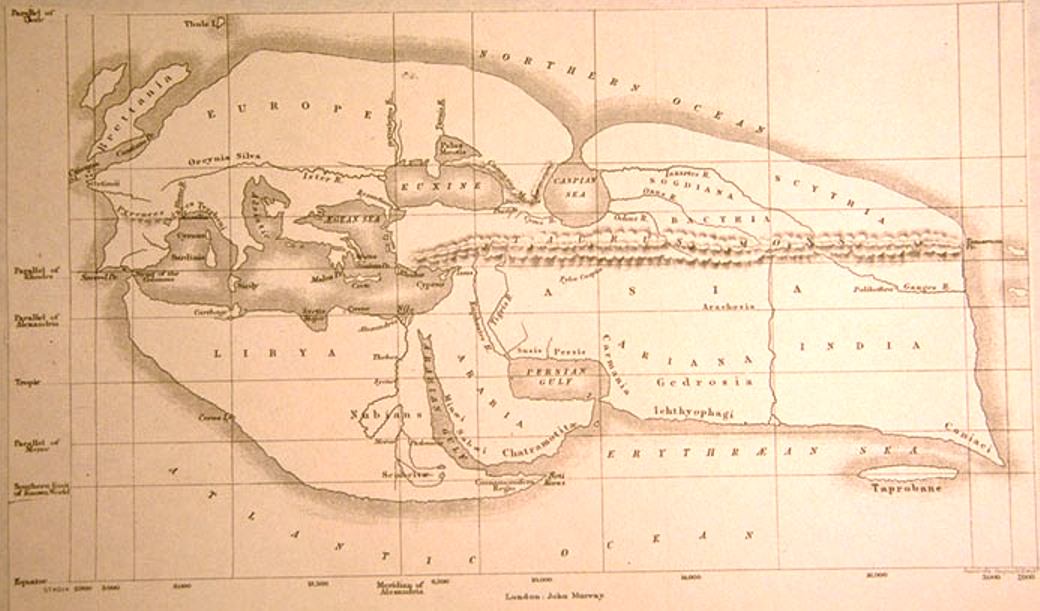
Anaximander may have been the first Greek geographer, but it is the 2nd century B.C.E. that Libyan-Greek scientist and philosopher Eratosthenes who has historically been given the title “Father of Geography” for his three-volume Geography, his discovery that the earth is round, and his accurate calculation of its circumference. Lost to history, Eratosthenes’ Geography has been pieced together from descriptions by Roman authors, as has his map of the world—at the top in a 19th-century reconstruction—showing a contiguous inhabited landmass resembling a lobster claw.
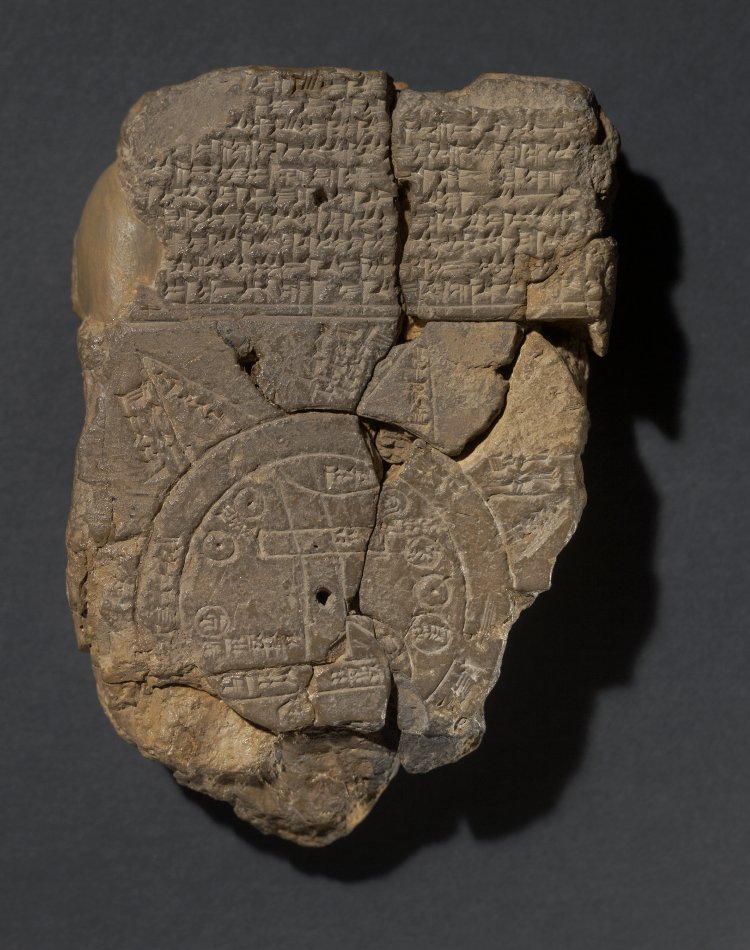
You’ll note that Eratosthenes drew primarily on Anaximander’s description of the world. In turn, his map had a significant influence on later Medieval geographers. A Babylonian world map, inscribed on a clay tablet around the time Anaximander imagined the world (and thought to be the earliest extant example of such a thing), may have influenced European map-making in the age of discovery as well. It depicts a flat, round world, with Babylon at the center (see the British Museum for a detailed translation and commentary of the map’s legend).
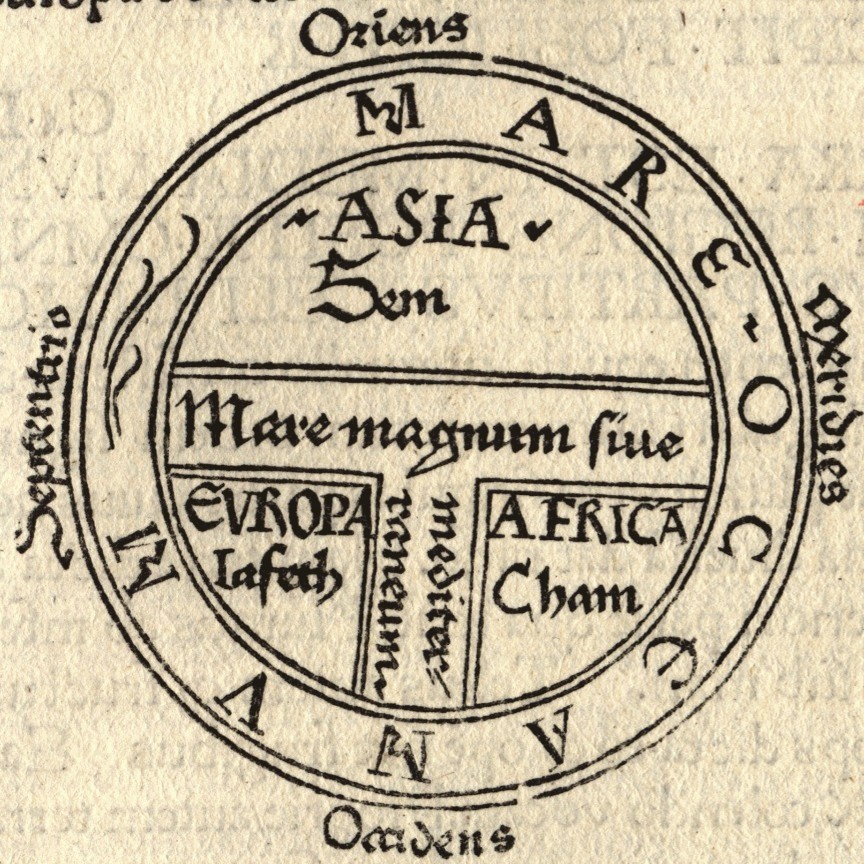
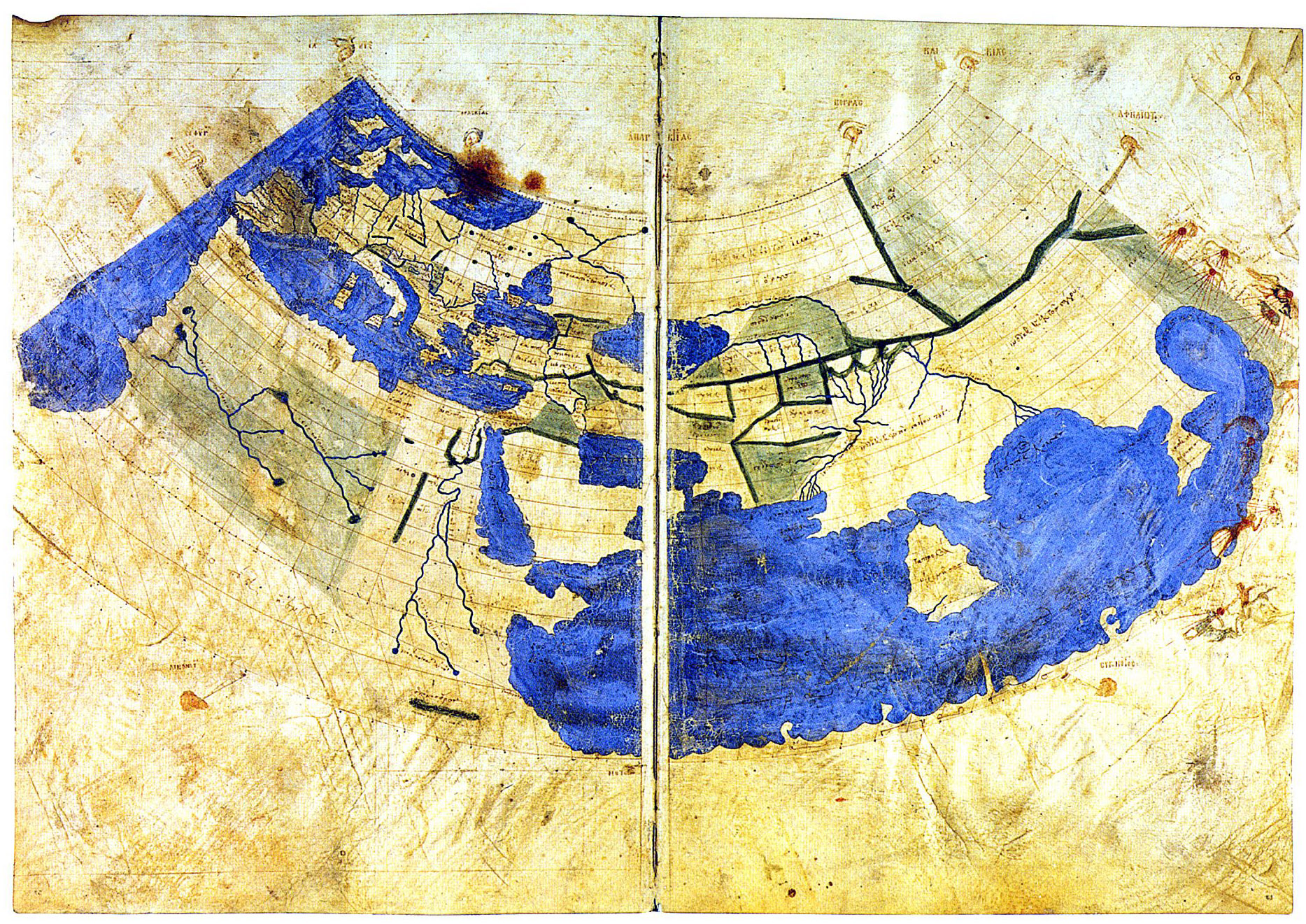
The Babylonian map is said to survive in the similar-looking “T and O map” (third image from top), representing the words orbis terrarium and originating from descriptions in 7th century C.E. Spanish scholar Isadora of Seville’s Etymologiae. The “T” is the Mediterranean and the “O” the ocean. In the version above, a recreation of an 8th century drawing, and every derivation thereafter, we see the three known continents, Asia, Europe, and Africa, with the holy city, Jerusalem, at the center. This map greatly informed early Medieval conceptions of the world, from crusaders to garrulous knights errant like Mandeville, and raconteur merchants like Polo, both of whom made quite an impression on Columbus and Raleigh, as did the circa 1300 map from Constantinople above, the oldest of many drawn from the thousands of coordinates in Roman geographer and astronomer Ptolemy’s Geographia.
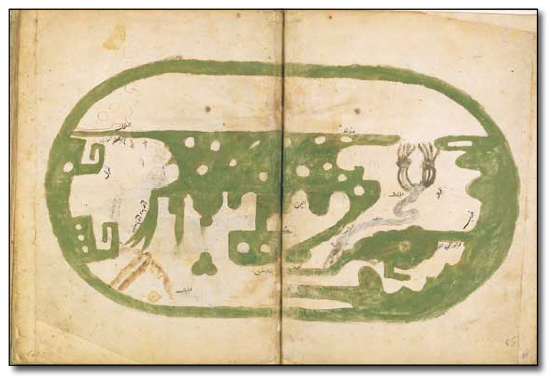
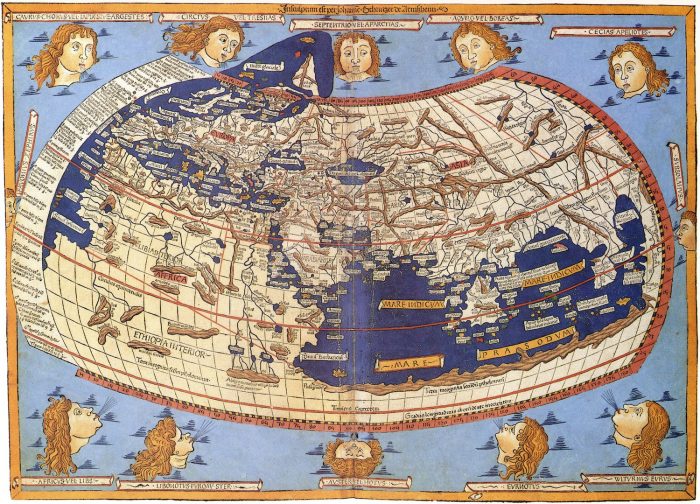
It wouldn’t be until 100 years after the translation of Ptolemy’s text from Greek to Latin in 1407 that his geographical precision became widely known. Until this, “all knowledge of these co-ordinates had been lost in the West,” writes the British Library. This would not be so in the East, however, where world maps like Ibn Hawqal’s, above from 980 C.E., show the influence of Ptolemy, already so long dominant in geography in the Islamic world that it was beginning to wane. Many more world maps survive from 11–12th century Britain, Turkey, and Sicily, from 16th century Korea, and from that wandering age of Columbus and Raleigh, beginning to increasingly resemble the world maps we’re familiar with today. (See a 15th century reconstruction of Ptolemy’s geography below.)
For most of recorded history, knowledge of the world from any one place in it was almost wholly or partly speculative and imaginative, often peopled with monsters and wonders. “All cultures have always believed that the map they valorize is real and true and objective and transparent,” as Jerry Brotton Professor at Queen Mary University of London tells Uri Friedman at The Atlantic. Columbus believed in his speculative maps, even when he ran into islands off the coast of continents charted on none of them. We are still conceptual prisoners—or consumers, users, readers, viewers, audiences—of maps, though we’ve physically plotted every corner of the globe. Perspectives cannot be rendered objective. No gods-eye views exist.
Nonetheless, several culturally formative projections of the world since Ptolemy’s Geography and well before it have changed the whole world, pointing to the power of human imagination and the legendarily imaginative, as well as legendarily brutal, acts of “world building” in real life.
We're hoping to rely on loyal readers, rather than erratic ads. Please click the Donate button and support Open Culture. You can use Paypal, Venmo, Patreon, even Crypto! We thank you!
Open Culture scours the web for the best educational media. We find the free courses and audio books you need, the language lessons & educational videos you want, and plenty of enlightenment in between.