Click the image above and you’ll enter an interactive/moving graphic that gives you a fairly nice genealogy of rock n roll and the many forms of music it later spawned. The graphic starts you with the blues, appalachian folk, and bluegrass. Eventually you hit the 1950s and the advent of rock. Then you keep traveling through time, reaching the hard rock, glam rock and punk of the 70s; the power metal and emerging grunge of the 80s; the post metal and neo folk of the 90s; and beyond. At any point, you can click the pause button, click on the name of a particular musical genre (eg Gothabilly), and hear a sample of the music. When you’re done, you might want to check out some of the related items below:
Kim Jong-Il (1941–2011), son of North Korea’s despotic Kim Il-sung and a tyrant in his own filial right, had as many titles as he did talents, with honorifics including the Sun of the Nation and the Shining Star of Paektu Mountain. Highfalutin nicknames aside, the younger dictator was a pretty able guy. North Korean sources assert that the Dear Leader once shot a 38 under par with 11 birdies (in his first and only game of golf), and could alter the weather using the power of his mind. Having turned his intellect to academia, Kim wrote 1500 books while studying at university. He also theorized extensively about art, cinema, and opera.
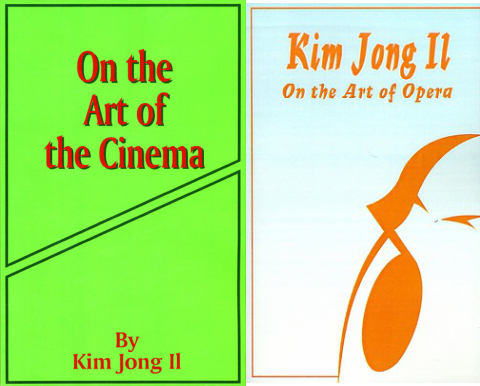
Kim once served as the Movie and Arts Division Director in North Korea’s Propaganda and Agitation Department, and was a renowned cinephile. As befitting a man whose personal video library reportedly housed over 20,000 titles, Kim (or some unfortunate ghostwriters) published numerous lectures and pamphlets on film, some of which are available in the Democratic Republic of Korea’s E‑Library. In his text The Cinema and Directing, for example, Kim shows off his talents for writing stilted academic prose while discussing ideology:
The ideological kernel of a production is the seed which the director and all the other creative workers should bring into flower through their collective efforts and wisdom. It is not only the basis of the interpretation by the individual creative workers, but also the foundation on which they all combine to produce one single cinematic presentation. When all interpretations are conducted on the basis of one seed, they form the components of one cinematic presentation because they are built on the same foundation [et cetera, ad nauseum].
Kim also pontificated on matters of literature. The treatise, entitled Life and Literature, offers the Ever-Victorious, Iron-Willed Commander’s thoughts on the essence of writing:
Literature belongs to the domain of humanics [sic]. The essential characteristic of literature as a humanics [sic] consists of describing real people and serving man… To say that literature portrays people means that it describes people and their lives, people who live, breathe, think and act as they do in real life. That literature serves man means that it solves urgent and important human problems through people and their lives and thus teaches them what life is and influences them to lead an honourable life. It is only through an accurate portrayal of people and their lives that literature can provide proper solutions for valuable human problems, and exert a great influence on people.
The key words here are “people” and “lives.” Got it?
Lest you dismiss these writings as pseudo-intellectual nonsense, it’s important to note that some philosophical interpretation is required. It’s the meanings behind the words, and the things that Kim leaves unsaid, that make up the real meat and potatoes of the piece… Or something.
You can find more of Kim Jong-il’s writings (alongside those of his father, Kim Il-sung) at the Democratic Republic of Korea E‑Library. Other titles include On the Art of the Drama and On the Art of Opera, which gets some pretty stellar reviews on Amazon. Take for example: “With over five books published per year in North Korea, it is a challenge to pick a single favorite. However, this book is a standout for North Korean opera connoisseurs and beginners alike.”
Ilia Blinderman is a Montreal-based culture and science writer. Follow him at @iliablinderman.
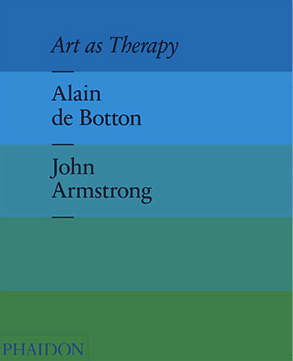
Alain de Botton, pop philosopher, has come out with a new book. Like his others, it’s full of sweeping ideas about an entire mode of human existence. He’s written on religion, sex, success, and happiness, and now he takes on art in Art as Therapy, co-written with art historian and author John Armstrong. Like all of de Botton’s ventures, the new book is sure to polarize. Many people find his work powerful and immediate, many see it as blithe intellectual tourism. To the latter critics, one might reply that de Botton’s approach is somewhat like that of other non-professional philosophers ancient and modern, from Plato to Schopenhauer, who addressed any and every area of life. And yet de Botton is a professional of another kind—he is a professional author, speaker, and self-help guru, and unlike his predecessors, he expressly sells a product. There’s no inherent reason why this should render his philosophy suspect. Yet, to use a favorite descriptor of his, some may find his media savviness vulgar, as Socrates found the so-called “sophists” of his day (a term of abuse that may be generally undeserved then and now).
In the video above—one of de Botton’s “Sunday Sermons” for his School of Life, an organization that more and more resembles his vision of a “religion for atheists”—de Botton lays out the book’s argument in a pretty unconventional way. The intro looks exactly like an evangelical church service, scored by a Robbie Williams song, which de Botton uses as his first example of “art.” It’s a tongue-in-cheek demonstration of de Botton’s claim that “art is our new religion… culture is something that is imminently suited to filling [religion’s] shoes.” Whether all of this large talk, pseudo-religiosity, and Robbie Williams music inspires, bores, or disturbs you is a personal matter, I suppose, but it does prepare one for something very different from a philosophical lecture in any case. This is, in fact, a sermon, replete with literary and theoretical references, tailored to offer answers to Life’s Big Questions.
De Botton first identifies the problem. While the secular gatekeepers of culture pretend to believe in the mollifying spiritual effects of art, “in fact,” he says, “the idea is dead.” Museums are moribund because, for example, they don’t directly address individual’s fear of death. Presumably, his “art as therapy” approach does. The book’s website contains snippets divided into broad categories like “Politics,” “Work,” “Love,” “Anxiety,” “Self,” and “Free Time.” In his sermon, de Botton doesn’t seem to evince any recognition of the field of art therapy, which has been chugging along since the early 20th century, but as he tells Joshua Rothman in an interview for The New Yorker he means the word therapy—“a big, simple, vulgar word”—broadly. Sounding for all like an Anglican theologian, de Botton says of an annunciation altarpiece by Fra Fillippo Lippi:
There’s a sudden tenderness here, which is so far removed from the harshness outside. If I were to put a caption here, it might say: ‘Our world, for all its technological sophistication, is lacking in certain qualities. But this painting is a visitor from another world, where those qualities—tenderness, reverence, and modesty—are very highly valued. Take it as an argument against Fox News and the New York Post. Use it to find the still places in yourself.’
The notion of this piece of art as “an argument” on the same conceptual plane as corporate mass media seems to contradict de Botton’s premise that it’s “from another world.” This cheek-by-jowl referencing of the sacred and profane, high and low, offends the sensibilities of several philosophical thinkers, and may have offended Fra Fillippo Lippi. But perhaps it’s too easy to be cynical about de Botton’s populist approach. If all of his evangelism seems like nothing more than elaborate publicity for his books, he’s certainly made things difficult for himself by founding a school. Whether you find his ideas compelling or not, he proves himself a passionate, if not particularly modest, thinker attempting to grapple with the problems of middle-class Western malaise and existential angst.
TED Talks — they give your “discovery-seeking brain a little hit of dopamine;” make you “feel part of a curious, engaged, enlightened, and tech-savvy tribe;” almost giving you the sensation that you’re attending a “new Harvard.” That was the hype around TED Talks a few years ago. Since then, the buzz around TED has mercifully died down, and the organization has gone on, staging its conferences around the globe. It’s been a while since we’ve featured a TED Talk whose ideas seem worth spreading. But today we have one for you. Intriguingly, it’s called “What’s Wrong with TED Talks?” It was presented by Benjamin Bratton, Associate Professor of Visual Arts at UCSD, at none other than TEDxSanDiego 2013. Bratton makes his case (above) in 11 minutes — well within the 18 allotted minutes — by arguing that TED doesn’t just help popularize ideas. Instead, it changes and cheapens the agenda for science, philosophy and technology in America. He begins to frame the problem by telling a story:
I was at a presentation that a friend, an astrophysicist, gave to a potential donor. I thought the presentation was lucid and compelling.… After the talk the sponsor said to him, “you know what, I’m gonna pass because I just don’t feel inspired …you should be more like Malcolm Gladwell.”
Think about it: an actual scientist who produces actual knowledge should be more like a journalist who recycles fake insights! This is beyond popularization. This is taking something with value and substance and coring it out so that it can be swallowed without chewing. This is not the solution to our most frightening problems – rather this is one of our most frightening problems.
Bratton then concludes, “astrophysics run on the model of American Idol is a recipe for civilizational disaster.” If “our best and brightest waste their time – and the audience’s time – dancing like infomercial hosts,” the cost will be too high, and our most difficult problems won’t get solved.
In watching Bratton’s talk, I found myself agreeing with many things. Sure, TED Talks are often “a combination of epiphany and personal testimony … through which the speaker shares a personal journey of insight and realization, its triumphs and tribulations.” Yes, the talks offer viewers a predictably “vicarious insight, a fleeting moment of wonder, an inkling that maybe it’s all going to work out after all.” Maybe TED Talks sometimes provide nothing more than “middlebrow megachurch infotainment.” But is TED really changing the agenda for scientists, technologists and philosophers? Are scholars actually choosing their intellectual projects based on anything having to do with TED (or TED-inspired ways of thinking)? Is someone at the NIH doling out money based on whether a project will eventually yield 15 good minutes of diversion and entertainment? Short of empirical evidence that actually applies to TED (the anecdote above doesn’t), it feels like Bratton is giving TED way too much credit. Maybe TED matters on YouTube. But let’s get real, its pull largely starts and ends there. You can read a complete transcript of Bratton’s talk here.
The Atlas of the Historical Geography of the United States remains a valuable historical resource today. But, for all of these years, it had one notable shortcoming. Around the time of its first publication, John K. Wright acknowledged that “The ideal historical atlas might well be a collection of motion-picture maps, if these could be displayed on the pages of a book without the paraphernalia of projector, reel, and screen.” The technology that would lend itself to creating motion-picture maps wasn’t available in the 1930s. But it is today. And thanks to the University of Richmond’s Digital Scholarship Lab, we can now view The Atlas of the Historical Geography of the United States in a new digital, sometimes animated format. If you want to see a good example of historical data put into motion, then you might want to check out this map of American Explorations in the West, 1803–1852. (Click here and then click “Animate” at the bottom of the screen.) This map will trace for you the expeditions of Lewis and Clark and many other explorers. Then, if you’re ready to be an explorer yourself, you can start your journey through the digitized atlas by entering the Table of Contents.
In 1982, John Michael Osbourne was playing a show at the Veterans Memorial Auditorium, in Des Moines, Iowa. During the set, a fan tossed a bat onstage. Having drunkenly bitten off a dove’s head some months earlier, Osbourne obeyed his instincts and decapitated the bat in similar fashion. With a single bite, Osbourne, known as Ozzy to his legion fans, had become the most notorious example of metal’s dangerous, ungodly ways.
Those wary of metal’s loud sounds and louder hair will likely be surprised by what they find in the BBC documentary, Heavy Metal (1989), above. Interspersed amidst headbanging performances by Metallica, Motorhead, and Slayer, Heavy Metal includes several entertaining interviews, including an arrestingly sedate Osbourne together with Geezer Butler, Black Sabbath’s bassist and lyricist, who discuss launching their careers in a blues band. How does Osbourne justify the grim, confronting nature of Black Sabbath’s lyrics?
“It’s heavy metal, so you’ve got to put a heavy lyric to it. I suppose writing about the darker forces and about the darker sides of, whatever, fits the music. You would hardly write about a love song to that… kind of heaviness.”
In contrast with their brash, outsized personas, most interviewees are surprisingly demure. Axl Rose’s boasts of Guns N Roses’ musical integrity aside, Black Sabbath, Napalm Death, and Iron Maiden all prove disappointing ambassadors of satan-worship, providing lucid commentary on the state of metal, the differences between its American and English varieties, and codpieces. Iron Maiden’s Bruce Dickinson, whose non-musical pursuits include beer brewing, piloting commercial aircraft, penning novels, and Olympic-level fencing, distinguishes himself as the most thoughtful and engaging of the bunch.
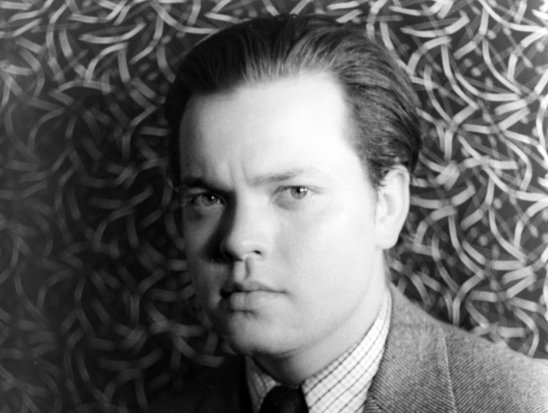
Orson Welles never wrote a proper autobiography, but we have a book that comes close: This is Orson Welles, assembled by critic Jonathan Rosenbaum and filmmaker Peter Bogdanovich (Targets, The Last Picture Show, Paper Moon) out of a series of in-depth recorded conversations between Bogdanovich and Welles. That volume has given the younger filmmaker something of a sub-career as the older one’s Boswell, which has led to a certain degree of ribbing about his willingness to trot out an Orson Welles anecdote for every context. Though I’ve always enjoyed hearing Bogdanovich’s interpretations of Welles, they always get me curious to hear the stories of the life and career of the man who made The War of the Worlds, Citizen Kane, and (my personal favorite) F for Fake straight from, well, the man who made The War of the Worlds, Citizen Kane, and F for Fake. You can do just that at the Internet Archive, which offers nearly four hours of audio of the very interviews that gave This is Orson Welles its source material. (Audio starts at the 12 second mark.)
“I first met Orson Welles toward the end of 1968,” says Bogdanovich in his introduction, “and not long after we began taping our conversations for a book about his career that he hoped would ‘set the record straight.’ We started in his bungalow at the Beverly Hills Hotel, and then resumed a couple of weeks later in Guaymas, Mexico, where Orson was acting in the movie of Catch-22.” Their talks continued in places from New York’s Plaza Hotel and Rome’s Hotel Eden to, for whatever reason, Carefree, Arizona, exploring not just the well-known chapters of Welles’ career, but his experiences with now-overlooked or never-completed projects like most of his countless radio dramas, his early adaptation of Cecil Day-Lewis’ Smiler with a Knife, and his later adaptation of Kafka’s The Trial. Some may accuse Bogdanovich of over-milking his association with Welles, but if I had conversations this fascinating with perhaps the most respected auteur in American film history, I’d probably talk about them all the time too.
For several decades of its history, the Polaroid was called a “Land Camera” after the company’s founder Edwin Land, and the product line included not only consumer devices but also high-end machines like the SX-70, a folding SLR camera introduced in 1972. The SX-70 boasted a host of impressive features that allowed photographers to achieve the effects of non-instant SLRs such as “changes in depth of field, double exposure, fixed-point focusing, and closeup photography.” The SX-70 made a considerable impression on famed husband and wife design team Charles and Ray Eames, so much so that they produced the 11-minute advertisement above describing in detail the SX-70’s highly complex operations. In his introduction, Charles Eames tells us that no less an authority than Alfred Stieglitz “favored any means that might free the photographer’s whole energies so that they could be channeled in the direction of the decision, the picture itself.” Thus, Edwin Land’s inventions are given the imprimatur of the father of fine art photography himself, and in 1972, the SX-70 was Land’s highest achievement to date.
The Polaroid instant camera seems to have come full circle from consumer toy to utilitarian snapshot-maker to artists’ experimental tool to instrument of retro-hipsterism to consumer toy again. But the physical, real-world Polaroid aesthetic almost met its end in 2008 when the company discontinued production of its instant film, prompting the creators of the Impossible Project to “[save] analog instant photography from extinction by releasing various, brand new and unique instant films.” VP Dave Bias demonstrates the project’s device, which allows smartphone photogs to print images on Polaroid-style film. Responding to the massive demands of 21st century détourned nostalgia, Polaroid has introduced new lines of instant cameras, and Fuji is also bridging the Instagram/Polaroid divide with a portable printer this spring. But what the Impossible Project highlights—as the Eames did in ‘72—is just how much the Polaroid became a means of making fine art as well as kitsch, a too often unremarked upon application of the famous instant camera and the visual aesthetics it bequeathed the digital age.
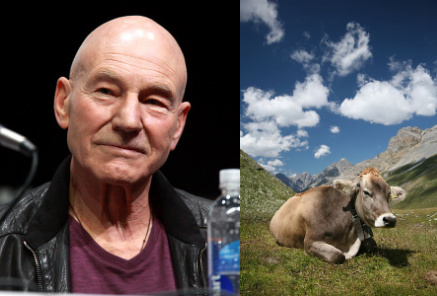
Her question? What do English cows sound like when they moo.
The knighted star does not skimp on his answer, even if, as he repeatedly suggests, one cannot do the subject justice in less than an entire afternoon. The dialects of British cows, like those of their human counterparts, underscore that theirs is a society “dominated by class, social status and location.”
The moo of a cow from West Oxfordshire, home to Prime Minister David Cameron, is quite conservative compared to the lusty bellow of a specimen from West Yorkshire, where Stewart grew up. (The latter is so astonishing, he immediately offers to produce it twice.)
Cockney cows, a breed whose ranks have thinned considerably since Shakespeare’s day, sound like sheep.
As an extra treat, Stewart generously agrees to the host’s request for an American cow, impersonating a Nevada-dweller, a geographic homage to the original questioner as well as his bride, jazz singer Sunny Ozell.
Is there anything this man can’t — or won’t — do?
After reaching the rank of Sergeant during World War I, Alexander Woollcott returned to New York to become a drama critic for the New York Times. Woollcott was a man of large bulk and outsized personality, whose sharp, acerbic wit made him popular with his readers. According to The Ten-Year Lunch, an Oscar-winning documentary about the New York group of writers and journalists known as the Algonquin Round Table, Woollcott’s quick tongue made his bombastic presence nearly unbearable to his friends:
When he returned from the war, Woollcott boasted of his military adventures so often and so loudly that his friends grew tired of listening. He began every sentence with “When I was in the theatre of war…” Irritated by his pomposity, press agent Murdoch Pemberton lured Woollcott [to the Algonquin Hotel] with the promise of an ace pastry chef. The idea was to hold a sort of roast, at which a number of critics and journalists from around town would come and poke fun at him.
For better or worse, the attempt to puncture Woollcott’s ego at the Algonquin Hotel was unsuccessful. Rather than take offence, Woollcott was flattered by the attention, and the various figures in attendance also thoroughly enjoyed themselves. Serendipitously, the legendary luncheons of the Algonquin Round Table were born.
Most of the Table’s members had taken part in the war, to one degree or another: journalist Ruth Hale and her syndicated-columnist husband Heywood Broun had been war correspondents; New Yorker founder Harold Ross had edited the military newspaper Stars & Stripes; acclaimed columnist Franklin Pierce Adams had made Captain. Other members included poet and critic Dorothy Parker, a tragic romantic who had become the city’s most quotable woman. (Parker’s inexhaustible supply of witticisms still feels fresh today: when asked to use the word horticulture in a sentence, Parker replied, “You can lead a whore to culture, but you can’t make her think.”) Parker’s best friend was humorist and essayist Robert Benchley, who had once written an essay exploring Newfoundland fishing rights for his International Law class at Harvard from the unorthodox perspective of the fish. Frequently joining them was Neysa McNein, a sought-after illustrator who hosted the Table’s afternoon gatherings in her studio, where Irving Berlin could occasionally be found playing the piano.
The near-daily meetings at the Algonquin Hotel fostered a close-knit cultural fraternity of New York’s best writers, illustrators, and artists. The group vacationed together at their jointly-owned Vermont island, played games of poker wagering houses and honeymoons, and criticized each other’s work. Whenever a member of the Round Table would make a conceited remark, everyone would immediately rise and bow, honoring their friend’s regal affectations. The only exception to the rule was Woollcott, whose bread and butter pomposity was tolerated by virtue of its regularity.
With its interviews of original Table members, the documentary is a tantalizing look at the lives of the men and women who ruled New York’s cultural milieu during the heyday of the printed word. Equal parts wish for the idyllic past and history of New York’s biggest cultural players, The Ten-Year Lunch leaves one with a pang of oddly potent nostalgia. We can’t recommend it enough.
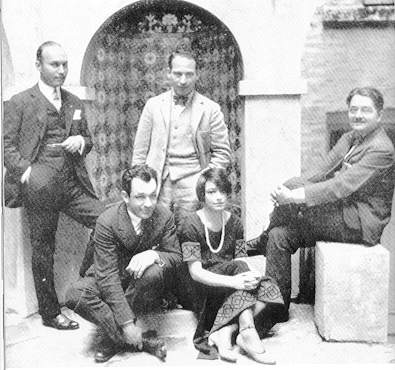
In the image above, see Art Samuels, Charlie MacArthur, Harpo Marx, Dorothy Parker and Alexander Woollcott
Ilia Blinderman is a Montreal-based culture and science writer. Follow him at @iliablinderman.
We're hoping to rely on loyal readers, rather than erratic ads. Please click the Donate button and support Open Culture. You can use Paypal, Venmo, Patreon, even Crypto! We thank you!
Open Culture scours the web for the best educational media. We find the free courses and audio books you need, the language lessons & educational videos you want, and plenty of enlightenment in between.