We know well the role music plays in the work of prolific Japanese novelist Haruki Murakami. We’ve previously featured his passion for jazz, his first love. He began as a jazz club owner in Tokyo, and he has written two collections of essays titled Portrait in Jazz and Portrait in Jazz 2. But Murakami is no less a fan of classical music and rock and roll—all three forms intertwine in his novels and stories, providing recurring motifs, soundtracks, and backdrops. Music is more than thematic; it defines his literary style, as he told listeners on “Murakami Radio,” his stint as a DJ on Tokyo FM.
“Rather than learning storytelling technique from someone,” the novelist explained, “I’ve taken a musical approach, while being very conscious about rhythms, harmony and improvisation.” Perhaps this approach explains the wonderfully evocative quality of his prose.
Reading his books, “you feel sad without knowing why,” writes Charles Finch at The Independent, in a review of Murakami’s latest, Killing Commendatore, “and yet, within that sadness glows a small ember of happiness, because to feel sad is at least to feel honestly.” We could say something similar about the feelings evoked by an aria, a blues, or a Dylan song—music helps us access emotions for which we don’t have ready words.
Murakami translates that “ineffable yearning” into writing. “The obscurely lonely domestic images that run through his novels—rain, swimming, pasta, jazz, a particular sort of warm, impersonal sex—root that yearning in the truth of everyday life.” His newest novel brings in a third art, painting; its protagonist, seeking to reinvent his life and work, comes to discover an important message through a series of magical events. It’s familiar territory for Murakami, but don’t ask him to explain any of it. As he told Sarah Lyall at The New York Times, “I cannot explain anything at all… you just have to accept the form. A book is a metaphor.”
Better to get him talking about music, which he is happy to do, moving smoothly between styles with the same imaginative leaps he makes on the page. Above, some fine soul has put together a playlist (listen to it on Spotify here) for Killing Commendatoreand it is classic Murakami, a collection of music from Sheryl Crow, Puccini, the Modern Jazz Quartet, Mozart, Thelonious Monk, Verdi, Dylan, The Doors, Beethoven, Bruce Springsteen, Roberta Flack, The Beatles, The Beach Boys, and more. How do all of these artists fit together? Like the strange happenings in Murakami’s world, you have to stop trying to make sense of things and just go with it.
“What does it mean to protest suffering, as distinct from acknowledging it?” writes Susan Sontag in Regarding the Pain of Others. Acknowledgment, the recognition of unimaginable pain and loss, is central, it turns out, to healing. Grief expert Alan Wolfelt lists “acknowledging the full reality of the loss” as the first in his “Six Needs of Mourning.” But he also notes what so many in his field are quick to point out about contemporary culture: “Normal thoughts and feelings connected to loss are typically seen as unnecessary and even shameful.”
The important work of grieving gets bypassed not only by our own internalized shame, but by the unhelpful interventions of others. Megan Devine—author of It’s OK That You’re Not OK: Meeting Grief and Loss in a Culture That Doesn’t Understand—explains the central role of acknowledgment, simply being with others in the full scope of their pain, in the short animated video above. Many of us are taught to do anything but, to throw out advice and platitudes instead. (Illustrated here by an animated bunny tossing out rainbows.)
Our motives may not be “nefarious,” she says, but—to use Sontag’s phrase—trying to fix someone’s suffering amounts to a form of protest against it. And it only makes things worse. Devine is a psychotherapist and bereaved person herself. Her book, notes Jane Brody at The New York Times, “grew out of the tragic loss of her beloved partner, who drowned at age 39 while the couple was on vacation.” She speaks not in the jargon of a clinician but in the frank language of a fellow sufferer and survivor.
“You don’t need platitudes,” she writes on her website, “You don’t need cheerleading. You don’t need to be told this all happened for a reason. You certainly don’t need to be told that you needed your pain in order to learn something about life. Some things cannot be fixed. They can only be carried.”
Being with someone in their grief is “a radical act,” says Devine. “In order to really support you, I have to acknowledge that things really are as bad as they feel to you.” Offers of cheer or advice create defensive barriers. Turning toward someone’s suffering gives them what they need the most: “Being heard helps. It’s the best medicine we have. It makes things better, even when they can’t be made right.”
It’s taken for granted that every brand or rising star must establish and maintain a constant presence on various social networks. Indeed, the social media star—an entity famous solely for collecting followers and posting glamorous photos with themed commentary—may seem like a phenomenon that could only exist in the internet age, though writers like J.G. Ballard saw such things coming decades ago.
But before obsessive photography saturated the digital environment, Andy Warhol grasped the medium’s central importance in the documentation of everyday life. It just so happened that his everyday life was filled with celebrity actors, models, artists, and musicians.
Warhol, writes James D. Ellis at Light Stalking, “was the proto-hipster,” a restless moth always on the hunt for a flame. “Much like our contemporary culture, Warhol found it difficult to sit and do nothing. He had to leave his house or Factory and experience his immediate surroundings.”
And he had to photograph every one of those experiences. Warhol used his Polaroids and 35mm the way we use iPhones. A court case in the early nineties once took up the question of whether Warhol’s photographs could be considered fine art, but the artist himself, writes Patina Lee at Widewalls, “was obviously undecided about their value and meaning,” saying “A picture means I know where I was every minute. That’s why I take pictures. It’s a visual diary.”
Warhol, Lee writes, “took his camera with him wherever he went, documenting practically everything, the highest high class and the lowest trash (literally, he took photos of trash cans and of what they contained)…. This inclusiveness is what made his photographic undertakings border between art and mere obsessive collecting, or as people like to cynically notice, consuming the life around him.” His consumption, and photographs of trash, comes to us as treasure, an extensive record of Warhol’s New York in the seventies and eighties.
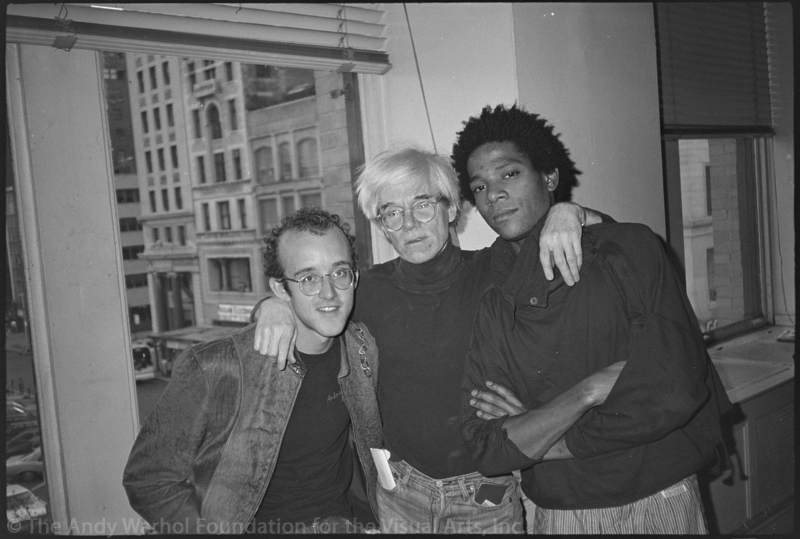
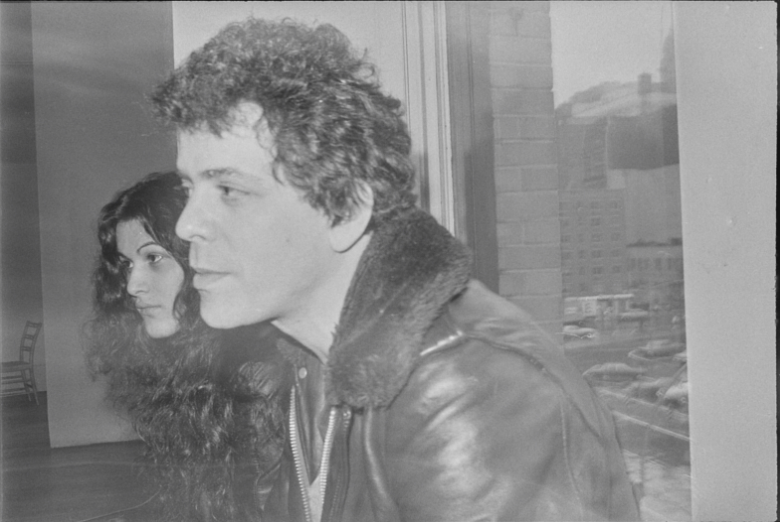
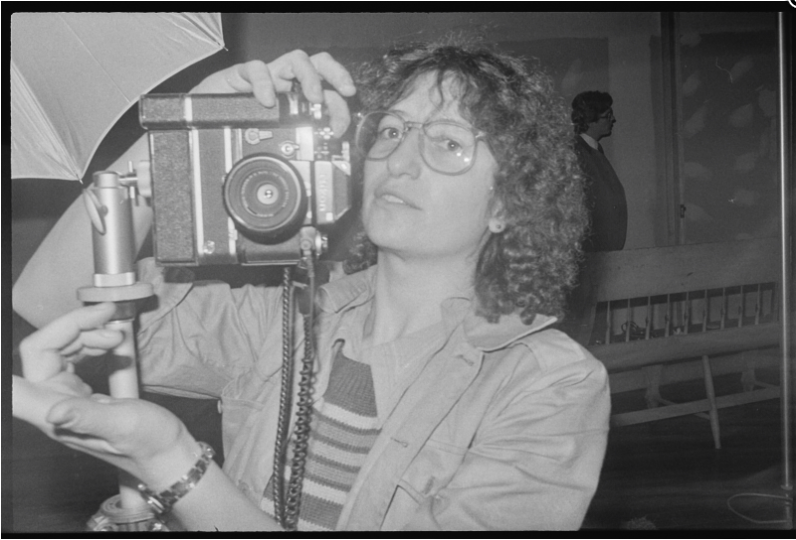
Stanford University’s Cantor Arts Center and Stanford Libraries have collaborated to make their Warhol photo archives available to the public—photos snapped “at discos, dinner parties, flea markets, and wrestling matches. Friends, boyfriends, business associates, socialites, celebrities, and passersby.” This “trove of 3,600 contact sheets featuring 130,000 photographic exposures” documents Warhol’s daily life from 1976 until his death in 1987 and includes candid photos of Jean-Michel Basquiat, Truman Capote, Bianca Jagger, Jimmy Carter, Martha Graham, Keith Haring, Debbie Harry, Grace Jones, Jackie Kennedy, Liza Minelli, Dolly Parton, Elizabeth Taylor, and more.
The archive, writes Sandra Feder for Stanford News, “is the most complete collection of the artist’s black-and-white photography ever made available to the public.” It was acquired by the Cantor in 2014 from the Andy Warhol Foundation for the Visual Arts. Given that these are all contact sheets, navigating the collecting can be a little bewildering. The Cantor has provided a number of tools to help. Click on Contact Sheets here to explore all 3,600+ contact sheets. Click Negatives to see individual frames, like those of Keith Haring, Warhol, and Jean-Michel Basquiat at the top, Lou Reed further up, and Annie Leibovitz above. Or start browsing through pictures organized by theme here.
Dig deep, and you’ll find the oddest things, like Andy Warhol running in Central Park for charity with Grace Jones and photographer Gordon Parks. Whatever Andy did, whoever he happened to do it with—and a stranger cast of characters you will not find—it’s all in this huge photo archive somewhere.
If you would like to support the mission of Open Culture, consider making a donation to our site. It’s hard to rely 100% on ads, and your contributions will help us continue providing the best free cultural and educational materials to learners everywhere. You can contribute through PayPal, Patreon, and Venmo (@openculture). Thanks!
In his native Japan, Haruki Murakami has published not just fiction but all sorts of essays dealing with a variety of subjects, from travel to music to writing itself. One collection of these pieces came out under the title Murakami Radio, a possible inspiration for a broadcast of the same name this past summer on Tokyo FM. For its 55-minute duration, Murakami took the DJ’s seat and spun records (or rather, files from several of his music-filled iPods) from his famously vast personal library, including The Beach Boys’ “Surfin’ USA,” Joey Ramone’s version of “What a Wonderful World,” Eric Burdon and The Animals’ “Sky Pilot,” and Daryl Hall and John Oates’ version of “Love Train.” You can listen to all his selections in the Youtube Playlist above.
“It has been my hobby to collect records and CDs since my childhood, and thanks to that, my house is inundated with such things,” wrote Murakami in a message posted by Tokyo FM. “However, I have often felt a sense of guilt toward the world while listening to such amazing music and having a good time alone. I thought it may be good to share such good times with other people while chatting over a glass of wine or a cup of coffee.”
He also chatted a bit himself between songs, answering listener questions and explaining the relationship between the music he loves and the books he writes. “Rather than learning storytelling technique from someone, I’ve taken a musical approach, while being very conscious about rhythms, harmony and improvisation,” he said on-air. “It’s like writing as I dance, even though I don’t actually dance.”
For many of Murakami’s fans, Murakami Radio (full recordings of which do exist on the internet) marks the first time they’ve ever heard his actual voice, and it turns out to have a thing or two in common with his authorial one: take, for instance, his use of boku, the informal personal pronoun favored by most of his narrators. With the broadcast initially announced as a one-off, it might also have seemed like the last chance to hear Murakami speak, but the official Murakami Radio site recently announced two more editions. The next one, scheduled for October 19th, will deal with not just music but another of Murakami’s passions, running. Anyone who’s read Murakami’s 1979 debut novel Hear the Wind Sing will remember the talkative Saturday-night radio DJ who makes occasional appearances in the text — and may wonder if, nearly 40 years later, Murakami channels him again when he gets behind the microphone himself.
Based in Seoul, Colin Marshall writes and broadcasts on cities, language, and culture. His projects include the book The Stateless City: a Walk through 21st-Century Los Angeles and the video series The City in Cinema. Follow him on Twitter at @colinmarshall or on Facebook.
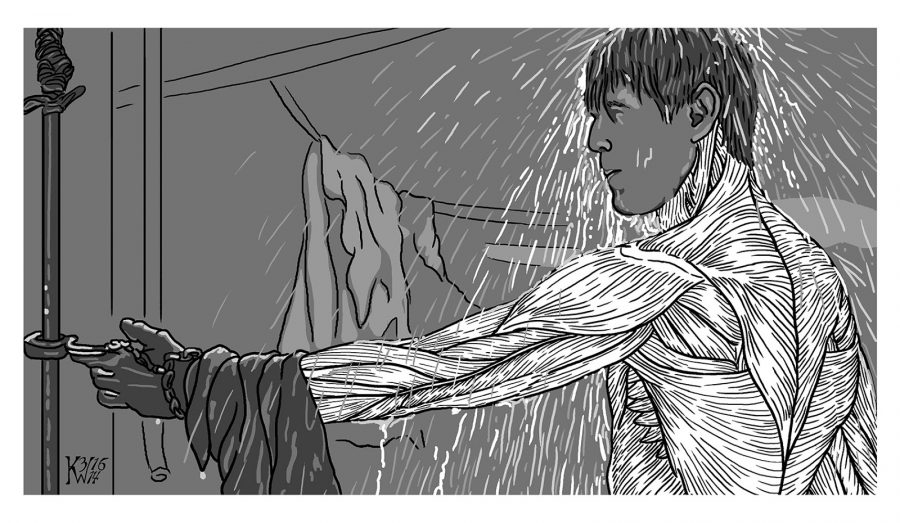
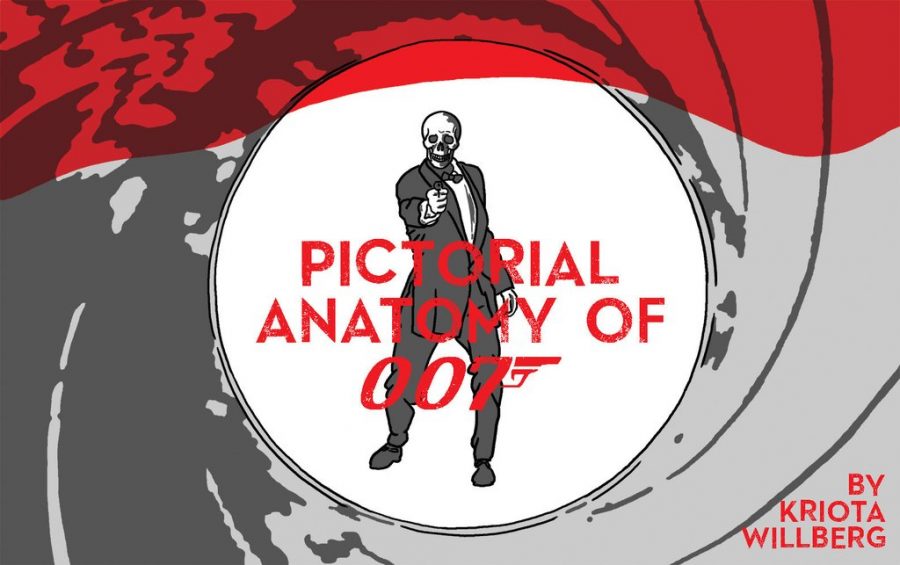
That shower scene is just one iconic moment that Willberg included in her mini-comic, Pictorial Anatomy of 007.
Agent Bond’s sartorial sense is a crucial aspect of his appeal, but Willberg, a Bond fan who’s seen every film in the canon at least five times, digs below that celebrated surface, peeling back skin to expose the structures that lie beneath.
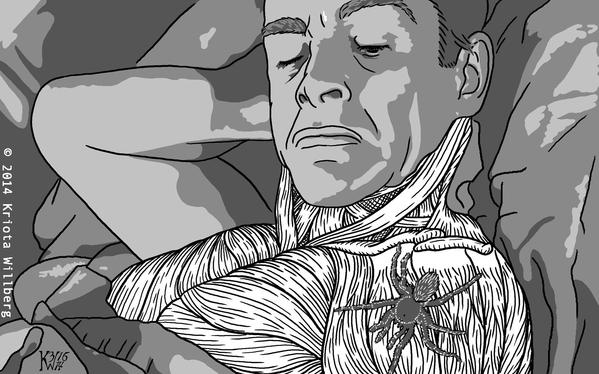
Sean Connery’s Bond exhibits a veteran artist’s model’s stillness waiting for the right time to make his move against Dr. No’s “eight-legged assassin.” Even before Willberg got involved, it was an excellent showcase for his pecs, delta, and sternocleitomastoid muscles.
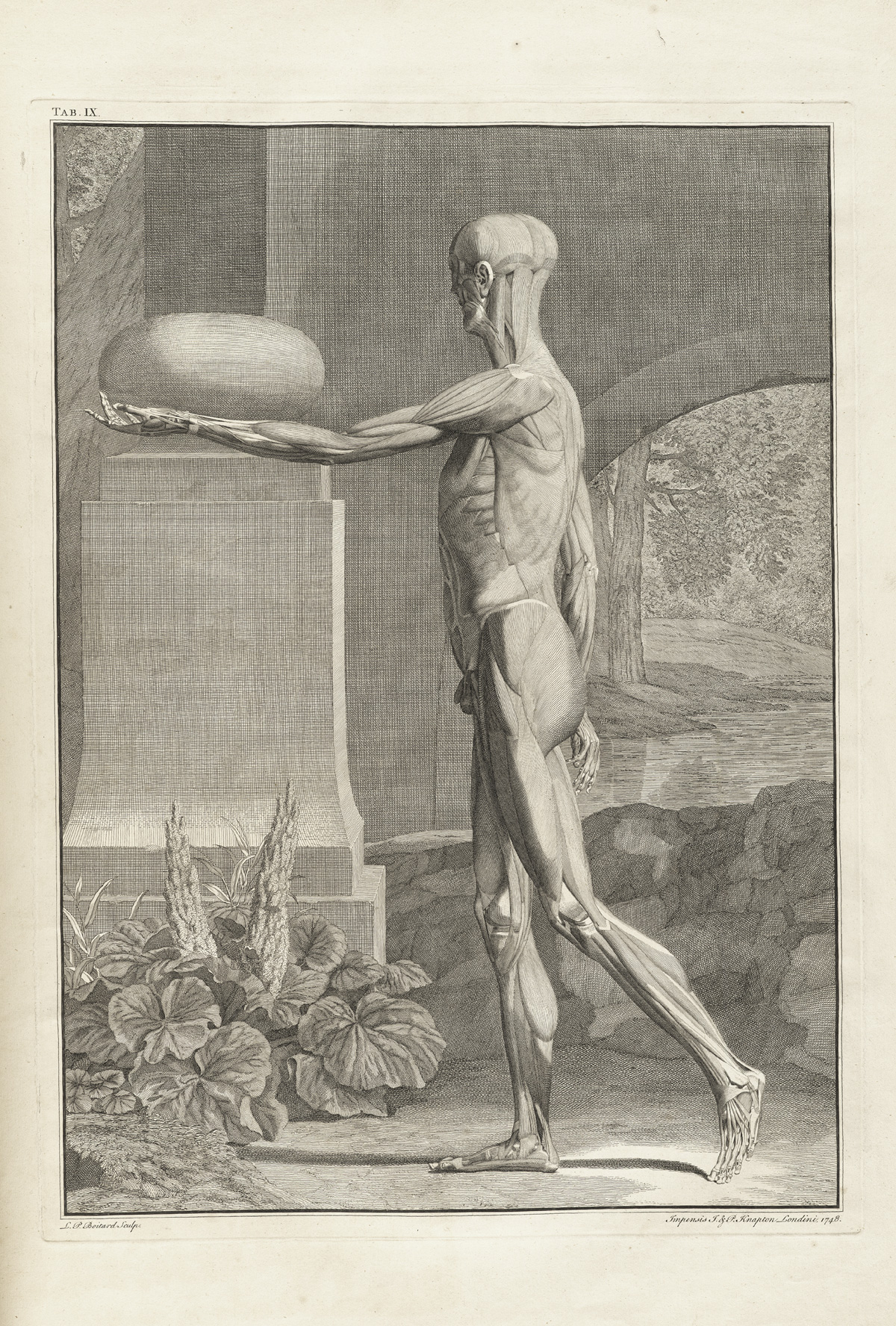
Leaving her flayed Bonds in their cinematic settings are a way of paying tribute to the antique anatomical illustrations Willberg admires for their dynamism:
…sitting in a chair, taking a stroll, holding its skin or organs out of the way so that the reader can get a better look at deeper structures. Some of the cadavers are very flirty. The pictures remind us that we are the organs we see on the page. They do stuff!
I didn’t think they’d have the balls! Sorry! Poor taste but I couldn’t resist. Although Timothy Dalton physically resembled Bond as described in the books, most of the movies make Bond out to be smarter than Fleming wrote him. I think Judy Dench called Daniel Craig, Casino Royale’s Bond, a “blunt instrument” which is pretty much how he’s written. He’s tough and lucky and that’s why he’s survived. Plus the machete fight is great.
Sometimes people get too prissy about the body. I am meat and liver and sausage and so are you. Your body is inescapable while you live. You should get to know it. Think about it in different contexts. It’s fun!
WhenFrom Russia With Love’s Rosa Klebb punches master assassin, Red Grant, in the stomach, she is squishing a living liver through living abdominal muscles.
Listen to an hour-long interview with Comics Alternative in which Willberg discusses her New York Academy of Medicine residency, anatomical research, and the ways in which humor informs her approach here.
Ayun Halliday is an author, illustrator, theater maker and Chief Primatologist of the East Village Inky zine. Her latest script, Fawnbook, is available in a digital edition from Indie Theater Now. Follow her @AyunHalliday.
In “one of the strangest stories in modern film,” Monty Python alumnus and critically-lauded director Terry Gilliam strove for three decades to make his take on Don Quixote, an ordeal that inspired two documentaries and that did not end in triumph even when the film premiered to acclaim at Cannes this year after its long gestation. Just a few weeks afterward, Gilliam lost the rights to the film in a lawsuit with its former producer. Nonetheless, for all of the serious setbacks on the road to its completion, Gilliam’s The Man Who Killed Don Quixote has still mostly fared better than the protagonist of Cervantes’ novel.
But the delusional knight-errant and his much-put-upon squire’s ridiculous and inevitable failures are what constitute the novel’s enduring appeal. Published in two volumes in 1605 and 1615, The Ingenious Nobleman Sir Quixote of La Mancha has become the best-selling novel of all time, and by the accounts of its most illustrious admirers, the matrix of all modern fiction. “The novelist need answer to no one but Cervantes,” says Milan Kundera. Mexican novelist Carlos Fuentes called Don Quixote“the first modern novel, perhaps the most eternal novel ever written and certainly the fountainhead of European and American fiction.”
Such effusive praise for Cervantes is near-universal, but like Gilliam’s film, and the fictional knight’s quest, the Spanish writer’s epic adventure came to him late in life, when he was almost sixty, having “spent most of his life as a struggling poet and playwright,” says Ilan Stavans in the TED-Ed video above. He succeeded after a long, undistinguished career with a book that satirized the chivalric romances which “dominated European culture” at the time.
Cervantes’ brilliant idea—conjuring a character who actually believed these stories—gave us the great parodic epic and, in its second volume, a brilliant work of pre-post-modern metafiction in which the characters Quixote meets have already read about his exploits in the first book. The mad hidalgo Don Quixote, unlike the stock figures in popular romances, actually develops and matures as a character, a unique feature of fiction at the time and one reason Cervantes’ book is called the “first modern novel.”
Other foundational features of the novel include the relationship of Quixote and Sancho Panza, a fictional study in contrasts that may be the origin of so many iconic duos since—from Sherlock Holmes and Dr. Watson to Batman and Robin and the Odd Couple. The novel’s commercial success was immediate and global—again marking it as a product of modernity. Pirated copies circulated where it had been banned in the Americas. Asserting his proprietary rights over the character while also meeting reader demand, he wrote and published volume two to preempt spurious sequels.
The TED-Ed video is part of a “Why you should read X” series trumpeting the value of great works of literature. These efforts will, hopefully, inspire many people to pick up the books of Gabriel Garcia Marquez, Edgar Allan Poe, Virginia Woolf, and more. But ultimately, great works of literature should speak for themselves. Why should you read Don Quixote? Well, yes, because it is the foundation of modern fiction. But the real answer to the question lies between the novel’s covers. Pick up Don Quixote(I like Edith Grossman’s 2003 translation), and find out for yourself.
In addition to his formidable body of work in architecture, design, and theory of the kind the world had never known before, Buckminster Fuller also knew how to promote himself. Sometimes this meant appearing on late-night new-age talk shows, but at its core it meant coming up with ideas that would immediately “read” as revolutionary to anyone who saw them in action. But how to put them before the eyes of someone who hasn’t had the chance to see a geodesic dome, a Dymaxion House and Car, or even a Geodome 4 tent in real life?
The ascent of graphic design in the 20th century, a century Fuller saw begin and lived through most of, provided one promising answer: posters. The ones you see here show off “Fuller’s most famous inventions, with line drawings from his patents superimposed over a photograph of the thing itself,” writes Fast Company’s Katharine Schwab.
“While they look like something Fuller aficionados might have created after the man’s death to celebrate his work, Fuller actually created them in partnership with the gallerist Carl Solway near the end of his career.”
These posters, “striking with their two-layer design, are Fuller’s visual homage to his own genius — and an attempt to bring what he believed were world-changing utopian concepts to the masses.” They’re also now on display at the Edward Cella Art + Architecture in Los Angeles, whose exhibition “R. Buckminster Fuller: Inventions and Models” runs until November 2nd. “Fuller’s objects and prints function not only as models of the mathematical and geometric properties underlying their construction but also as elegant works of art,” says the gallery’s site. “As such, the works represent the hybridity of Fuller’s practice, and his legacy across the fields of art, design, science, and engineering.”
You can see more of Fuller’s posters, which depict and visually explain the structures of such inventions as the geodesic dome and Dymaxion Car, of course, but also lesser-known creations like a “Fly’s Eye” dome covered in bubble windows (individually swappable for solar panels), a submersible for offshore drilling, and a rowboat with a body reduced to two thin “needles,” at Designboom. Edward Cella Art + Architecture has also made the posters available for purchase at $7,000 apiece. That price might seem in contradiction with Fuller’s utopian ideals about universal accessibility through sheer low cost, but then, who could look at these and call them anything but works of art?
Based in Seoul, Colin Marshall writes and broadcasts on cities, language, and culture. His projects include the book The Stateless City: a Walk through 21st-Century Los Angeles and the video series The City in Cinema. Follow him on Twitter at @colinmarshall or on Facebook.
These days Noam Chomsky is probably most famous for his consistent, outspoken criticism of U.S. foreign policy. Yet before the War on Terror and the War on Drugs, Chomsky became internationally famous for proposing a novel solution to an age-old question: what does a baby know?
Platoargued that infants retain memories of past lives and thus come into this world with a grasp of language. John Locke countered that a baby’s mind is a blank slate onto which the world etches its impression. After years of research, Chomsky proposed that newborns have a hard-wired ability to understand grammar. Language acquisition is as elemental to being human as, say, dam building is to a beaver. It’s just what we’re programmed to do. Chomsky’s theories revolutionized the way we understand linguistics and the mind.
A little while ago, film director and music video auteur Michel Gondry interviewed Chomsky and then turned the whole thing into an extended animated documentary called Is the Man Who Is Tall Happy?.
Above is a clip from the film. In his thick French accent, Gondry asks if there is a correlation between language acquisition and early memories. For anyone who’s watched Eternal Sunshine of the Spotless Mind, you know that memory is one of the director’s major obsessions. Over Gondry’s rough-hewn drawings, Chomsky expounds: “Children know quite a lot of a language, much more than you would expect, before they can exhibit that knowledge.” He goes on to talk about new techniques for teaching deaf-blind children and how a day-old infant interprets the world.
As the father of a toddler who is at the cusp of learning to form thoughts in words, I found the clip to be fascinating. Now, if only Chomsky can explain why my son has taken to shouting the word “bacon” over and over and over again.
If you would like to support the mission of Open Culture, consider making a donation to our site. It’s hard to rely 100% on ads, and your contributions will help us continue providing the best free cultural and educational materials to learners everywhere. You can contribute through PayPal, Patreon, and Venmo (@openculture). Thanks!
Note: An earlier version of this post appeared on our site in March 2015.
Jonathan Crow is a Los Angeles-based writer and filmmaker whose work has appeared in Yahoo!, The Hollywood Reporter, and other publications. You can follow him at @jonccrow. And check out his blog Veeptopus, featuring lots of pictures of badgers and even more pictures of vice presidents with octopuses on their heads. The Veeptopus store is here.
Back in the 1990s I’d often run across volumes of the Unuseless Japanese Inventionsseries at bookstores. Each one features about a hundred ostensibly real Japanese devices, photographed and described with a disarming straightforwardness, that mash up other consumer products in outwardly bizarre ways: chopsticks whose attached miniature electric fan cools ramen noodles en route to the mouth; a plastic zebra crossing to unroll and lay across a street at the walker’s convenience; an inverted umbrella attached to a portable tank for rainwater collection on the go. Such things, at once plausible and implausible, turn out to have their own word in the Japanese language: chindōgu (珍道具), or “curious tool.”
“There’s an essence to chindōgu that can’t be ignored,” writes Michael Richey at Tofugu, where you can view an extensive gallery of examples. “They need to be useful, but only just so. Something people could use, but probably won’t because of shame,” a famously powerful force in Japanese society.
They also adhere to a set of principles laid down by Kenji Kawakami, former editor of the country housewife-targeted magazine Mail Order Life, who first revealed chindōguto Japan by showing off his prototypes in the back pages. These tencommandments of chindōgu are as follows:
A Chindōgu Cannot be for Real Use — They must be, from a practical point of view, useless.
A Chindōgu Must Exist — A Chindōgu must be something that you can actually hold, even if you aren’t going to use it.
There must be the Spirit of Anarchy in Every Chindōgu — Chindōgu inventions represent the freedom to be (almost) useless and challenge the historical need for usefulness.
Chindōgu Tools are for Everyday Life — Chindōgu must be useful (or useless) to everyone around the world for everyday life.
Chindōgu are Not for Sale — Chindōgu cannot be sold, as this would go against the spirit of the art form.
Humor is Not the Sole Reason for Creating a Chindōgu — Even if Chindōgu are inherently quirky and hilarious, the main reason they are created is for problem solving.
Chindōgu are Not Propaganda — Chindōgu are, however, innocent and made with good intentions. They should only be created to be used (or not used).
Chindōgu are Never Taboo — Chindōgu must adhere to society’s basic standards.
Chindōgu Cannot be Patented — Chindōgu cannot be copyrighted or patented, and are made to be shared with the rest of the world.
Chindōgu Are Without Prejudice — Everyone should have an equal chance to enjoy every Chindōgu.
These principles resulted in the kind of inventions that drew great fascination and amusement in their home country — you can watch a short Japanese television broadcast showing Kawakami demonstrate a few chindōgu above — but not only there. The Unuseless Japanese Inventions books came out in the West at just the right time, a historical moment that saw Japan’s image shift from that of a fearsome innovator and economic powerhouse to that of an inward-looking but often charming nation of obsessives and eccentrics. Of course such people, so Western thinking went, would come up with fashionable earrings that double as earplugs, a cup holder that slots into a jacket pocket, and shoes with toe-mounted brooms and dustpans.
Kawakami has continued to invent and exhibit chindōgu in recent years, and even now his work remains as analog as ever. “There’s always some process in analog products, and these processes themselves can be their purpose,” he told the Japan Times in a 2001 interview. “If you look at digital products, they all isolate people and leave them in their own small world, depriving them of the joy of communicating with others… I can’t deny that they make life more exciting and convenient, but they also make human relationships more shallow and superficial.” Those wise words look wiser all the time — but then, you’d expect that degree of insight into 21st-century life from the man who may well have invented the selfie stick.
Based in Seoul, Colin Marshall writes and broadcasts on cities, language, and culture. His projects include the book The Stateless City: a Walk through 21st-Century Los Angeles and the video series The City in Cinema. Follow him on Twitter at @colinmarshall or on Facebook.
We should be suspicious when researchers assume their conclusion; when the results of an academic study merely confirm the author’s pre-existing biases. Humans are wired to seek confirmation, a cognitive deficit so deeply engrained that it can be exploited among laypeople and specialists alike. Art historians have been fooled by forgeries, historians by fake manuscripts, and paleontologists by phony fossils. Physicist Steven Weinberg referenced such high-level hoaxes in a 1996 essay in The New York Review of Books, and he placed that year’s academic scandal—known as the “Sokal Hoax”—among them.
The gist of the Sokal affair runs as follows: NYU mathematical physicist Alan Sokal suspected that post-structuralist-influenced cultural studies was jargon-laden, obfuscating BS, and he set out to prove it by authoring his own “postmodernist” text, an article full of misused terminology from quantum physics. He sent it off to the journal Social Text, who published it in their Spring/Summer issue. Sokal then revealed in another journal, Lingua Franca, that the article had been a fraud, “liberally salted with nonsense,” and had only been accepted because “(a) it sounded good and (b) it flattered the editor’s ideological preconceptions.”
Sokal’s hoax, it was roundly claimed, demonstrated that certain fashionable quarters of the academic humanities had deteriorated into babble, signifying nothing more than rigid ideological commitments and a general disregard for the actual meanings of words and concepts. Weinberg wasn’t so sure. At most, perhaps, it showed the editorial failings of Social Text. And while humanists may abuse scientific ideas, Weinberg points out that scientists of the stature of Werner Heisenberg have also been prone to slipshod, quasi-mystical thinking.
But the Sokal hoax did expose to the wider public a tendency among a coterie of academics to indulge in mystifying language, including the misuse of jargon from other fields of study, usually in imitation of French theorists like Jacques Lacan, Julia Kristeva, or Jacques Derrida—whom, it must be said, all wrote in a very different intellectual culture (one that expects, Michel Foucault once admitted, at least “ten percent incomprehensible”). For a good many people in the academic humanities, this wasn’t much of a revelation. (Sokal has since published a more thoroughly critical book with the apt title Beyond the Hoax.)
Part of the problem with his hoax as a serious critique is that it began with its conclusion. Cultural studies are rife with crap arguments, ideology, and incomprehensible nonsense, Sokal believed. And so, when his paper was accepted, he simply rested his case, making no effort to engage charitably with good scholarship while he ridiculed the bad. Which brings us to the current state of the academic humanities, and to a contemporary, Sokal-like attack on them by a trio of writers who rest their case on a slightly broader base of evidence—20 fraudulent articles sent out to various niche cultural studies journals over a year: four published (since retracted), three accepted but not published, seven under review, and six rejected.
The authors—academic philosopher Peter Boghossian and writers Helen Pluckrose and James A. Lindsay—revealed the hoax this week in an article published at the Pluckrose-edited Areo magazine. One needn’t read past the title to understand the authors’ take on cultural studies in general: “Academic Grievance Studies and the Corruption of Scholarship.” While all three hoaxers identify as left-leaning liberals, the broad-brush characterization of whole fields as “grievance studies” reveals a prejudicial degree of contempt that seems unwarranted. In the article, they reveal their motivations and methods, outline the successes of the project, and post the comments of the articles’ referees, along with a video of themselves having a good laugh at the whole thing.
This last bit is unnecessary and obnoxious, but does the new hoax—“Sokal Squared” as it’s been called—genuinely undermine the credibility of cultural studies as a whole? Is it “’hilarious and delightful,’” asks Alexander C. Kafka at The Chronicle of Higher Education, or “an ugly example of dishonesty and bad faith?” Harvard political scientist Yascha Mounk tactfully finds in it a serious case for concern: “Some academic emperors—the ones who supposedly have the most to say about these crucial topics [discrimination, racism, sexism]—have no clothes.”
This is a point worth pursuing, and certain recent scandals should give everyone pause to consider how bullying and groupthink manifest on the academic left at the highest level of prestige. But the great majority of academics are not “emperors” and have very little social or economic power. And Mounk is careful not to overstate the case. He points out how the hoax has unfortunately given welcome “ammunition” to right-wing conservative axe-grinders:
Many conservatives who are deeply hostile to the science of climate change, and who dismiss out of hand the studies that attest to deep injustices in our society, are using Sokal Squared to smear all academics as biased culture warriors. The Federalist, a right-wing news and commentary site, went so far as to spread the apparent ideological bias of a few journals in one particular corner of academia to most professors, the mainstream media, and Democrats on the Senate Judiciary Committee.
The Federalist specializes in irresponsible conspiracy-mongering, the kind of thing that sells ads and wins elections but doesn’t belong in academic debate. The question Mounk doesn’t ask is whether the hoaxers’ own attitudes encourage and share in such hostility, an issue raised by several of their critics. As physicist Sean Carroll wrote on Twitter, “What strikes me about stunts like this is their fundamental meanness. No attempt to intellectually engage with ideas you disagree with; just trolling for the lulz.” McGill University political theorist Jacob T. Levy expressed similar reservations in an interview, notes The New York Times, saying
even some colleagues who are not fans of identity-oriented scholarship are looking at the hoax and saying ‘this is potentially unethical and doesn’t show what they think it is showing.’ Besides, he added, “We all recognized that this kind of thing could also be done in our disciplines if people were willing to dedicate a year to do it.”
Therein lies another problem with Sokal Squared. Hoaxes have been perpetuated by smart, dedicated forgers, con-artists, and pranksters in nearly every field, showing up all sorts of experts as potential dupes. The singling out of cultural studies for particular ridicule—the characterization of studies of race, gender, disability, etc. as “grievance studies”—reveals an aggrieved agenda all its own, one that ignores the serious problems corrupting other disciplines (e.g. industry funding in academic sciences, or the gross overuse of undergraduate students as the main subjects of studies—groups that hardly represent the general population.)
Some, but not all, of the successfully-published hoax papers sound ludicrous and terrible. Some, in fact, do not, as Justin Weinberg shows at Daily Nous, and should not shame the editors who published them. Some of the journals have much higher editorial standards than others. (An early hoax attempt by Boghossian targeted an ill-reputed, pay-to-play publication.) The whole affair may speak to broader failures in academic publishing that go beyond a tiny corner of the humanities. In part, those failures may stem from a general trend toward overworked, underpaid, increasingly precarious scholars whose disciplines, and funding, have been under relentless political attack since at least the 1990s and who must keep grinding out publications, sometimes of dubious merit, as part of the overall drive toward sheer productivity as the sole measure of success.
When Arab-Spanish Sephardi Jewish merchant Abraham ben Jacob first encountered the Vikings in Denmark, he had this to say:
“Never before I have heard uglier songs than those of the Vikings in Slesvig. The growling sound coming from their throats reminds me of dogs howling, only more untamed.”
Now what Mr. ben Jacob actually heard we will never know, but the description does sound a lot like the “Death Growl” familiar to fans of death metal. (The appearance of Vikings and the preponderance of Scandinavians within the genre certainly make this tale sound true.)
Cheekily referred to by non-metal fans as the “Cookie Monster Voice,” this particular style has evolved over time as metal changed in the 1980s, from the piercing screams of Dio and Iron Maiden to the growl of Sepultura and Cannibal Corpse. And that’s matched by the demonic and doom-laden sound of the music and the Grand Guignol horror of the lyrics, which delight fans with its depravity and disgust, the grosser the better.
Whether it’s your cup of tea or not, you have to admit that the ‘80s and ‘90s saw the growth of a brand new vocal style that seemed to come out of nowhere.
YouTuber Polyphonic tries to unravel its origins in the video above, which, we have to admit, follows the Wikipedia article on the Death Growl point by point. But that’s okay–imagine if all Wikipedia articles had their own videos…would that be a bad thing?
On the other hand, Polyphonic’s video does leave out some antecedents to this style, all of who get named checked by various folks in the comments. (Yes, YouTube comments that are worth reading!)
In particular, there’s no mention of African-American artists like Howlin’ Wolf, Screamin’ Jay Hawkins, or Clarence Frogman Henry. Wolf in particular became a huge influence on another incredibly gruff and guttural singer, Tom Waits, who often sings like the Devil has his larynx.
And do the distorted vocals on Black Sabbath’s “Iron Man” or on King Crimson’s “21st Century Schizoid Man” really count? Or the various screams on Pink Floyd songs?
When Polyphonic returns to the 1980s, he’s on firmer ground. Lemmy from Motörhead makes more sense as an influence, and by the time we get to Venom, then Death, then Mantas, it is easier to see where the Death Growl came from. (But come on, no mention of Napalm Death? They were the first growling band I ever heard, and hats off to BBC DJ John Peel for not only playing them when the debuted, but he had them in session.)
If interested, I would recommend exploring the YouTube comments further and make up your own mind. And if you are interested in learning this technique, there are folks who will teach you.
Ted Mills is a freelance writer on the arts who currently hosts the artist interview-based FunkZone Podcast and is the producer of KCRW’s Curious Coast. You can also follow him on Twitter at @tedmills, read his other arts writing at tedmills.com and/or watch his films here.
We're hoping to rely on loyal readers, rather than erratic ads. Please click the Donate button and support Open Culture. You can use Paypal, Venmo, Patreon, even Crypto! We thank you!
Open Culture scours the web for the best educational media. We find the free courses and audio books you need, the language lessons & educational videos you want, and plenty of enlightenment in between.