The original Star Trek TV series took to the airwaves nearly 5o years ago–on September 8, 1966. Poor ratings meant that the show didn’t last very long (only three years). But everything changed once the show went into syndication. It achieved cult status. And a franchise was born. The original Star Trek has now spawned five additional tv series, 13 feature films, and a number of fan-made sequels.
For an anarchist like Noam Chomsky, libertarianism as it’s understood in the U.S. is a corruption of the term. Throughout their political history, Chomsky argues, “real” Libertarians have been anti-Capitalist—and he includes under this heading such classical liberals as Adam Smith and Thomas Jefferson, as well as modern anarcho-socialists like himself. Modern U.S. Libertarians like Ron and Rand Paul, Milton Friedman, and Robert Nozick have all meant something very different by the term, and certainly haven’t agreed on what that is. So what exactly is Libertarianism?
Given popular misconceptions—and some less than stellar public relations moments—one perhaps gets a clearest idea of what American Libertarianism is by reading about what it isn’t, as in this essay from one of its most contrarian theorists, Murray Rothbard. Or we can spend a few minutes with that voluble comedic magician Penn Jillette, a well-known face of Libertarian and atheist thought for many years. Jillette’s thesis in his eighteen-minute Big Think video above comes down to this: “we think you should take as little from other people by force as possible and you should be able to do whatever you think is right.” Libertarianism, Jillette elaborates, “is the strongest sense of ‘please, do what you want, try not to hurt me.”
The concept he refers to is one Isaiah Berlin wrote of as “negative liberty,” or the principle of noninterference, a staple of all Libertarian thought. The heavy stress on individual rights has come in for critique as naïve, but as Rothbard notes, “no individualist denies that people are influencing each other all the time.” Libertarian thinkers have wrestled with the conflict (if not contradiction) between maximal individual freedom and freedom from harm. Robert Nozick, for example, extended his discussion beyond our responsibilities to each other to a moral case study of our duties toward animals. Responsibility stands as a key term in Jillette’s articulation of Libertarianism—a sine qua non of a Libertarian society.
But is there such a thing as a functioning Libertarian society? Or does Jillette describe an unrealizable utopia that depends not only on most people acting responsibly, but also on most people acting rationally? As he himself says, “Libertarianism is taking a right on money, your first left on sex, and looking for utopia straight ahead.” This language aside, he doesn’t seem to operate under the illusion that people always make the best choices for themselves or their families. As part of his argument, however, he admits he isn’t qualified or desirous to make those choices for other people when he can often barely discern the right course of action for himself. As it generally does, this course of reasoning brings us to the problem of taxation in Libertarian thought.
Jillette’s appeal seems commonsensical and pragmatic, and after his general pitch, he launches into a critique of corporate capitalism that could come right out of a Chomsky talk—in some small part, that is. Jillette believes that, absent most government interference, we would have such a thing as a “true free market” in which everyone could compete fairly and without coercion. This is a position even Nozick softened on many years after his classic Anarchy, State, and Utopia, calling it “seriously inadequate” and admitting that many democratic institutions Libertarians want to abolish preserve “our equal human dignity, our autonomy and powers of self-direction.”
Whatever we make of Jillette’s laissez faire ideology, his critiques of government speak to Libertarians on either side of the economics divide. He makes an incisive case against Clinton, then tears into Trump’s willingness to “give easy answers.” Holding up career politicians Bernie Sanders and Gary Johnson as “paragons” may seem a bit much, given Jillette’s forceful argument for a healthy and thoroughgoing mistrust of government. As he says in the earlier Big Think interview above, “part of the joy and the wonder and the brilliance of the ideas of the United States of America that whoever’s in power is questioned and beat up.”
He does not, of course, mean that last part in any literal sense. While Libertarianism has perhaps been tarred by association with an increasingly violent right, it would be a mistake to lump Jillette in with certain political opportunists who at one time or another have used the term to describe themselves. His commitment to anti-war and drug legalization policies is unwavering, and he makes a strong, well-reasoned case for his politics. It’s one worth hearing out whether you agree or not in the end.
The legacy of the silent film era is always with us, even as we move further and further away from film and closer to computer art. Not only do the compositions, costuming, and camerawork of golden age classics like Metropolis, Nosferatu, The Cabinet of Dr. Caligari and others continue to inform current directors’ work, CGI and otherwise, but these films have spawned their own prestigious form of music. In recent decades scores for classic silents have become the special provenance of avant-garde and experimental composers. The pairing makes sense. These are movies that raised the stakes for their medium and established the first generation of cinematic auteurs—Fritz Lang, F.W. Murnau, D.W. Griffith, Charlie Chaplin, and, of course, Carl Dreyer, the Danish director of 1928’s profoundly intense The Passion of Joan of Arc.
As with all of the acknowledged classics of the era, Dreyer’s masterpiece has received many contemporary musical treatments in the past few decades, including an original operetta by Richard Einhorn (on the Criterion Collection edition) and many more classical and modernist scores. But it has also been part of a parallel trend—of indie rock musicians like Dengue Fever, Yo La Tengo, Sparklehorse, and Dean and Britta scoring classic silent films. First, Australians Nick Cave and The Dirty Three came together in 1995 to play a live soundtrack for Joan of Arc in London. Then Cat Power accompanied the film in 1999 for several dates. In 2011, for one night only, Chicago indie stalwarts Joan of Arc performed their 80-minute instrumental score for a packed screening at the Chicago International Movies and Music Festival. Hear it, along with the film, above. (A copy can be purchased online here.) It was an “unexpected turn for the band,” their label Joyful Noise notes, given that they had just “released their most conventionally ‘rocking’ album in years, ‘Life Like.’”
Associated with singer and sole permanent member Tim Kinsella’s raspy yelps and warped songcraft, the band here takes a post-rock direction, loud and dirge-like. It may not be to everyone’s taste, but it does, writes Joyful Noise, offer a “dark, flowering sonic counterpart to the film’s grim subject matter (which is a rather haunting depiction of savage religious persecution).” Dreyer’s film is indeed a grim work of art, but it is not any less beautiful for its oppressive narrative. As running titles in the Joan of Arc-scored film’s intro inform us, like its protagonist, “The Passion of Joan of Arc was the victim of several ordeals,” including censorship upon release and the loss of the original negative and a re-edited copy to fire. Likewise for the film’s actress, the great Renee Maria Falconetti, “the performance was an ordeal,” as Roger Ebert points out, with legends telling “of Dreyer forcing her to kneel painfully on stone and then wipe all expression from her face.”
Known “only in mutilated copies” for over half a century, the 1985 restoration above comes from an original Danish copy discovered “complete and in very good condition” at a Norwegian mental institution in 1981. It is a curious story. Scholars have often speculated that the historical Joan of Arc was schizophrenic or that she suffered from “one of numerous neurological and psychiatric conditions that trigger hallucinations or delusions.” Falconetti’s performance of Joan is ambiguous, suggesting on the one hand, a “faith that seemed to stay any suggestion of irritation,” as one contemporary reviewer wrote, and on the other, the dazed, faraway look of a person in the throes of mental illness. And the film’s warped perspectives and extreme close-ups and angles suggest a kind of disturbance, of the corrupt, superstitious social order that interrogates and executes Joan, and also of Joan’s mind as she confronts her implacable judges. Joan of Arc’s pulsing, atmospheric soundtrack, draws out this very tension, written in Falconetti’s every exquisite expression.
Today, he returns and brings us inside the making of another classic song–“American Woman,” which Bachman co-wrote as a member of The Guess Who in 1970. In the clip above, the musician reflects on his “antiwar protest song” and its memorable riff. You know it. It goes dum dum dadada dada dada dada dum dum dadada dada da dum. The riff came about by accident, the happy byproduct of a broken guitar string and some spur of the moment improvisation. I’ll let Randy tell you the rest of the story.
Opening with 19th century British Prime Minister Benjamin Disraeli’s quote, “The East is a career,” Edward Said’s Orientalism traced the lineage of “the Orient” as “almost a European invention.” Through discourses scientific, political, philosophical, cultural, and otherwise, European thinkers, artists, and statesmen, Said contended, “accepted the basic distinction between East and West as the starting point for elaborate theories, epics, novels, social descriptions and political accounts.” But at the root of a long academic tradition of comparative analyses of “East” and “West,”—a relationship of dominance—there lay the recognition, however dim, that “The Orient is not only adjacent to Europe; it is also… the source of its civilizations and languages.”
The cultural debts that Europe owed its colonies were not the kind of thing most politicians liked to discuss, but many European and U.S. writers and scholars fascinated with the East have long recognized religious and philosophical continuities between the two hemispheres. The number of conversations between so-called Western and Eastern traditions only increased as the 20th century wore on and European Empires crumbled, giving rise mid-century to a whole society of comparative East/West religionists and writers: D.T. Suzuki, Alan Watts, Herman Hesse, Aldous Huxley, Allen Ginsberg.… Although many Western scholars’ pronouncements may have overgeneralized or distorted, interest in a dialogue has only grown since the 50s and 60s, and sympathetic presentations of Buddhism, Taoism, Hinduism, and other “Eastern religions” proliferated.
From this atmosphere emerged the work of Joseph Campbell, famous for The Hero with a Thousand Faces, published in 1949, a work of comparative religion that adopted a philological approach to myth like that of Campbell’s own hero, Nietzsche. Campbell may have seen East and West as distinct cultural entities—titling one lecture “The Eastern Way” and another “The Western Quest”—but his theory did not allow for a strict cultural hierarchy. In his many recorded lectures, Campbell stresses the similarities and common origins of world traditions, which inhabit, he says, a “single constellation.” We have a few of those talks in full in the 12 hour Spotify playlist on Eastern Spirituality above, including lectures on “Imagery of Rebirth Yoga” and “Hinduism,” delivered in the late sixties.
We also have Christopher Isherwood reading selections from his translation with Swami Prabhavananda of the Bhagavad-Gita. Isherwood’s famed embrace of Vedanta did much to foster inter-religious dialogue, and he left behind a “tremendous cache of self-revelatory works,” writes American Vedantist, “including essays, lectures, novels, his diaries, and the autobiographical My Guru and His Disciple.” Next to Campbell and Isherwood, we have Tibetan Buddhist authority the Dalai Lama giving an introductory lecture on Buddhism and a talk on “Cultivating Happiness.” Rounding out the playlist is another introduction to Buddhism by Emma Hignett, a reading of the Tao te Ching, and a reading by Robert Hamilton of his fascinating comparative study of world religions, Caduceus.
While each of us could, of course, take it upon ourselves to learn Sanskrit, or Pali, or Chinese, translate ancient religious literature and draw our own conclusions, we can also partake of the work of scholars and writers who have invested deeply in their subject, personally and professionally, and returned with a great deal of wisdom about global spiritual traditions. The lectures on this playlist (if you need Spotify’s free software, download it here) offer an excellent sampling of that wisdom and scholarship. You’ll find much more on our site in work by Jorge Luis Borges, Alan Watts, Robert Thurman, the Dalai Lama, Herbie Hancock, Sonny Rollins, Leonard Cohen, and many more.
We find ourselves, still early in the 21st century, in an unprecedented era in the history of photography. The consumers of the developed world have, of course, had access to cameras of their own for decades and decades, but now almost each and every one of us walks around with a camera in our pocket. When a particular landscape, building, animal, human being, or other sight strikes our fancy, we capture it without a moment’s hesitation — and, often, without having given a moment’s thought to the technological and artistic history of the discipline we are, if for little more than an instant, practicing.
Most of us, knowing ourselves to be no Ansel Adams, Henri Cartier-Bresson, or Diane Arbus, would hesitate to describe the snaps with which we document and share our daily lives as “photography.” But in taking any picture, no matter how mundane or even silly, we place ourselves in the stream of a tradition. But we can gain an understanding of that tradition, at least in broad strokes, from “The History of Photography in Five Minutes,” the Cooperative of Photography video above which, in the words of its narrator, offers an insight into — brace yourself for this and other puns — “how photography has developed.”
Beginning with the camera obscura, the reflection and tracing devices that date back to antiquity (later described and used by Leonardo da Vinci), the video moves swiftly from milestone to photographic milestone, including the first photograph, a “heliograph” taken in 1826; Louis Daguerre’s invention of “the first practical photographic process” in 1833; the first selfie, taken in 1839; the emergence of mobile photo studios in the 1850s; Eadweard Muybridge’s motion-photography studies of the 1870s; Kodak’s production of the first roll-film consumer camera in 1888; the game-changing Leica I hitting the market in 1925; the first single-lens reflex in 1949; the first digital camera in 1975; and, opening our own era, the first camera phone in 2000.
And now our smartphones and their “insanely powerful cameras” onboard have turned photography into a “global passion” that “has truly brought the world closer together.” The proliferation of hastily taken, essentially uncomposed shots of our purchases, our food, and ourselves have given old-school photography enthusiasts plenty to complain about, but the era of accessible photography has only just begun. Most of us are still, in some sense, taking heliographs and daguerreotypes; just imagine how the next fifteen years will, er, expose our true photographic capabilities.
Paul Thomas Anderson, as his fans will tell you, makes the kind of large-scale cinema nobody else does anymore: intense of emotion, involved of story, colorfully populated, wide of aspect ratio (and even, in the case of The Master, shot on 70-millimeter film), no superheroes asked, none given. Having displayed unwavering commitment to his visions from the very beginning, it makes sense that, on his latest music video, he would work with Radiohead, a band no less committed to their own. Radiohead fans know the ambitiousness of a Radiohead song or album when they hear it, but what makes the video Anderson directed for “Daydreaming,” their single released this past May, Andersonian?
“Like many great works of art, Radiohead’s latest music video makes you struggle for its inner meaning,” says Rishi Kaneria in his explanatory video “Radiohead: the Secrets of ‘Daydreaming.’ ” His narration describes the video’s ostensibly simple form: “an older, tired-looking Thom Yorke” — Radiohead’s singer and co-founder — “opening door after door, and like a ghost, walking through the background of seemingly random people’s lives,” all “a metaphor for the choices Thom has had to make in his life, of the doors he’s stepped through, while never quite knowing what’s on the other side. Because he can never go back, we see him constantly pushing forward, continually searching for meaning and an ultimate resting place. ”
Kaneria keys in on details that only those with a thorough knowledge of the life and work of Yorke and his band could notice. In real life, Yorke had just split up with his partner of 23 years; in the video, he walks through 23 doors. In the video, he wears an outfit designed by Rick Owens; in real life, his partner was named Rachel Owens. (Well, Rachel Owen, but close enough.) The various rooms through which York passes contain women, usually mothers, even in a hospital ward. Can we consider that a reference to his recuperation from a “severe car crash in 1987, especially considering there’s a wheel on the wall”?
When Yorke’s character finally finds solace beside a fire in a cave, he speaks a backwards phrase to the camera which, reversed, sounds like, “Half of my life, half of my love.” 23 years, of course, constitutes just about half of the 47-year-old Yorke’s life — and, Kaneria notes, the number of years since the band began recording. The video also performs other exegeses numerical, lyrical, and visual, and zodiacal, everywhere finding references to Rachel as well as to Radiohead — song titles, album art, even the settings of past music videos — to the point that we see “how Thom’s personal life with Rachel is inescapably saturated and surrounded by all things Radiohead.”
Nobody ever called balancing the demands of domestic life and those of perhaps the biggest rock band in the world easy. Still, few recent works of art have illustrated this kind of struggle as vividly as the “Daydreaming” video, and Anderson, not just one of the most famous and respected filmmakers alive but a husband and a father to four children, surely knows something about it as well. So often compared to his cinema-redefining predecessors from Robert Altman to Stanley Kubrick, he must also know as well as Yorke does what it means to have your work subjected to such close scrutiny — and to want to create work that will repay that scrutiny.
The Anderson-Radiohead connection goes as least as far back as 2007’s There Will Be Blood, scored by the band’s guitarist Jonny Greenwood. Anderson commissioned Greenwood’s musical services again for his next two pictures, The Master, and Inherent Vice, and last year made a documentary called Junjun about Greenwood’s solo album of the same name. No matter how much of Kaneria’s presented revelation you believe, “Daydreaming” sits as suitably with the rest of Anderson’s filmography as it does in its treatment of an old theme: you can’t enjoy every kind of satisfaction — but from the lifelong battle to do so, mostly against oneself, emerges art.
And yet, notes physicist Lawrence Krauss inThe New Yorker this weekend, we have the GOP’s Frankenstein trying to demagogue his way into the presidency by calling climate science into question. Krauss writes:
In May, for instance, while speaking to an audience of West Virginia coal miners, Trump complained that regulations designed to protect the ozone layer had compromised the quality of his hair spray. Those regulations, he continued, were misguided, because hair spray is used mainly indoors, and so can have no effect on the atmosphere outside.…
Often, Trump is simply wrong about science, even though he should know better. Just as he was a persistent “birther” even after the evidence convincingly showed that President Obama was born in the United States, Trump now continues to propagate the notion that vaccines cause autism in spite of convincing and widely cited evidence to the contrary… In other cases, Trump treats scientific facts the way he treats other facts—he ignores or distorts them whenever it’s convenient. He has denied that climate change is real, calling it pseudoscience and advancing a conspiracy theory that “the concept of global warming was created by and for the Chinese in order to make U.S. manufacturing noncompetitive.”
And way across the pond, we have another politician, Australian Senator Malcolm Roberts, making his own kind of laughable claims. In a recent television broadcast, Roberts asks physicist Brian Cox for empirical proof that climate change exists. Cox offers evidence gathered by NASA, to which Roberts responds, NASA’s “data has been corrupted and manipulated.” Not good enough. If you regularly read our site, you know that this is not the first time that NASA has been accused of manipulating data. Conspiracy theorists have long accused NASA and Stanley Kubrick of faking the moon landing in 1969. Roberts bristles at being associated with these loons. But frankly it’s an apt comparison. And if anyone should be bothered by the comparison, it’s the moon landing conspiracists. However strange their theories might be, no one doubts that they’re heartfelt, genuine, and seemingly free from the hint of political and financial influence.
In the meantime, in a new video from NASA, you can see the Arctic ice levels retreating to one of the lowest levels in recorded history. Call the video “corrupted” and “manipulated” at your own peril.
It’s been nearly a year since the poet laureate of medicine, author and neurologist Oliver Sacks, took his final bow as a sentient being on this beautiful planet, succumbing, at 82, to metastases of ocular melanoma which spread to his liver.
The New Yorkermarks the occasion bypublishing Sacks’ fellow neurologist and author Dr. Orrin Devinsky’s recollection of their longstanding friendship. Devinsky paints a vivid picture of an exceptionally compassionate man, who felt a kinship not only with starfish, jellyfish, and octopi, but also humans in both financial and emotional need.
Sacks peppers his remarks with astonishing biological tidbits, a compulsion that delighted his friend Devinsky on their frequent early morning bike rides along New York City’s west side.
(Palatal myoclonus—or rhythmic pulsing—in the palate, eardrum and strap muscles are vestigial evidence that humans once had gills!)
(The dandelion’s name evolved from dent de lion, French for lion’s tooth, a structure the spikes on its serrated leaves could be said to resemble. Also, certain dandelion species reproduce asexually, and Sacks had no fear about eating an unwashed specimen he plucked from the questionably sanitary grounds of Riverside Park!)
The musings that warrant the melancholy piano and strings accompanying Burns’ excerpt are of a more personal nature. Sacks’ was totally immersed in his chosen subject. His mother was a comparative anatomist and surgeon, and his boyish interest in the hard sciences is what led him to biology. A lifetime of scientific observation and clinical interaction only add to the poetry of his thoughts on death:
My generation is on the way out, and each death I have felt as an abruption, a tearing away of part of myself. There will be nobody like us when we are gone, but then there is nobody like anybody ever. When people die they cannot be replaced. They leave holes that cannot be filled. It is the fate, the genetic and neural fate of every human being to be a unique individual, to find his own path, to live his own life, to die his own death. Even so, I am shocked and saddened at the sentence of death, and I cannot pretend I am without fear. But my predominant feeling is one of gratitude. I have loved and been loved. I have been given much and I have given something in return. I have read and traveled and thought and written. I have had an intercourse with the world, the special intercourse of writers and readers. Above all, I have been a sentient being, a thinking animal on this beautiful planet, and this in itself has been an enormous privilege and adventure.
Ayun Halliday is an author, illustrator, theater maker and Chief Primatologist of the East Village Inky zine. Her latest comic contrasts the birth of her second child with the uncensored gore of Game of Thrones. Follow her @AyunHalliday
Looking for free, professionally-read audio books from Audible.com? Here’s a great, no-strings-attached deal. If you start a 30 day free trial with Audible.com, you can download two free audio books of your choice. Get more details on the offer here.
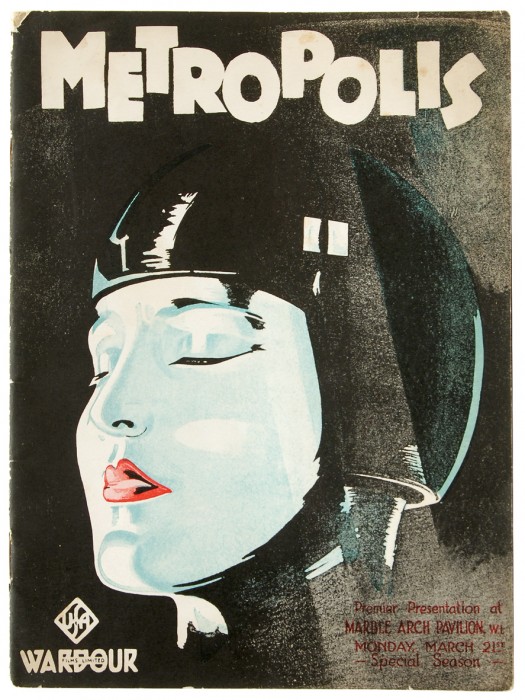
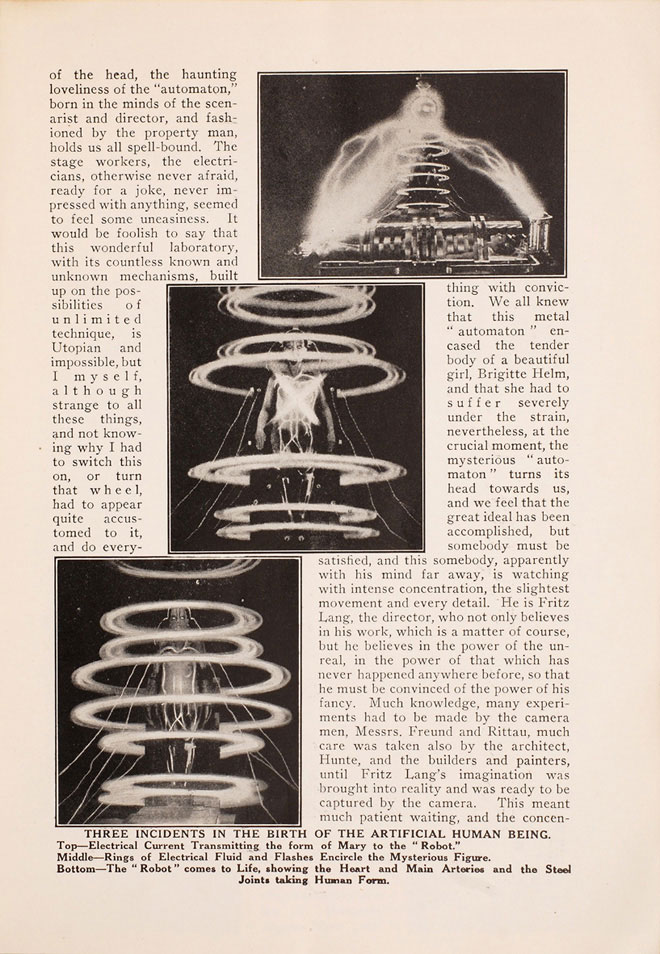
One of the very first feature-length sci-fi films ever made, Fritz Lang’s Metropolis took a daring visual approach for its time, incorporating Bauhaus and Futurist influences in thrillingly designed sets and costumes. Lang’s visual language resonated strongly in later decades. The film’s rather stunning alchemical-electric transference of a woman’s physical traits onto the body of a destructive android—the so-called Maschinenmensch—for example, began a very long trend of female robots in film and television, most of them as dangerous and inscrutable as Lang’s. And yet, for all its many imitators, Metropolis continues to deliver surprises. Here, we bring you a new find: a 32-page program distributed at the film’s 1927 premier in London and recently re-discovered.
In addition to underwriting almost one hundred years of science fiction film and television tropes, Metropolis has had a very long life in other ways: Inspiring an all-star soundtrack produced by Giorgio Moroder in 1984,with Freddie Mercury, Loverboy, and Adam Ant, and a Kraftwerk album. In 2001, a reconstructed version received a screening at the Berlin Film Festival, and UNESCO’s Memory of the World Register added it to their roster. 2002 saw the release of an exceptional Metropolis-inspired anime with the same title. And in 2010 an almost fully restored print of the long-incomplete film—recut from footage found in Argentina in 2008—appeared, adding a little more sophistication and coherence to the simplistic story line.
Even at the film’s initial reception, without any missing footage, critics did not warm to its story. For all its intense visual futurism, it has always seemed like a very quaint, naïve tale, struck through with earnest religiosity and inexplicable archaisms. Contemporary reviewers found its narrative of generational and class conflict unconvincing. H.G. Wells—“something of an authority on science fiction”—pronounced it “the silliest film” full of “every possible foolishness, cliché, platitude, and muddlement about mechanical progress and progress in general served up with a sauce of sentimentality that is all its own.” Few were kinder when it came to the story, and despite its overt religious themes, many saw it as Communist propaganda.
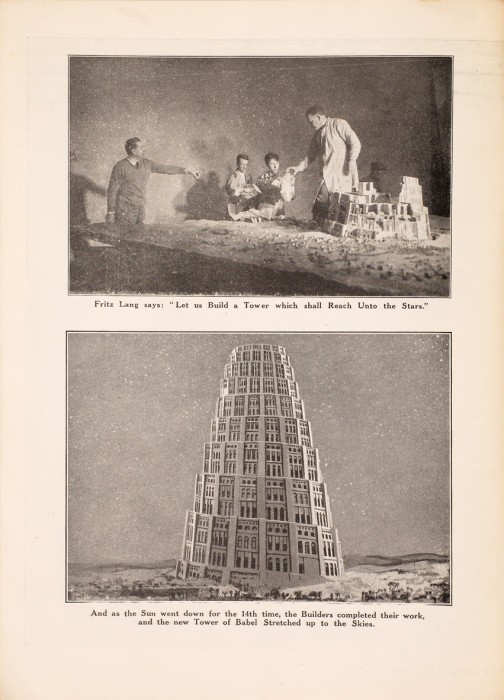
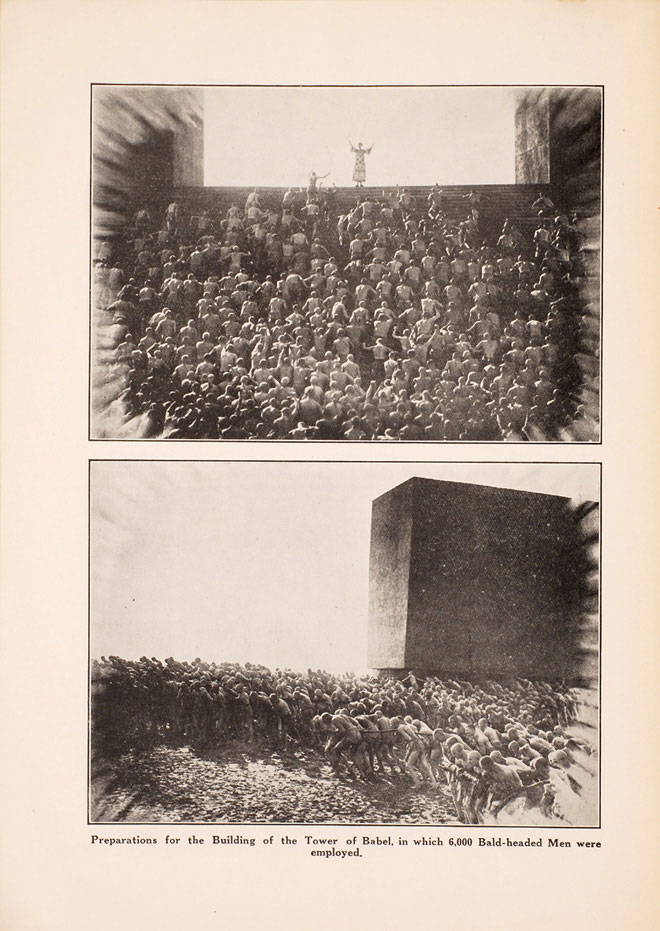
Viewed after subsequent events in 20th century Germany, many of the film’s scenes appear “disturbingly prescient,” writes the Unaffiliated Critic, such as the vision of a huge industrial machine as Moloch, in which “bald, underfed humans are led in chains to a furnace.” Lang and his wife Thea von Harbou—who wrote the novel, then screenplay—were of course commenting on industrialization, labor conditions, and poverty in Weimar Germany. Metropolis’s “clear message of classism,” as io9 writes, comes through most clearly in its arresting imagery, like that horrifying, monstrous furnace and the “looming symbol of wealth in the Tower of Babel.”
The visual effects and spectacular set pieces have worked their magic on almost everyone (Wells excluded) who has seen Metropolis. And they remain, for all its silliness, the primary reason for the movie’s cultural prevalence. Wired calls it “probably the most influential sci-fi movie in history,” remarking that “a single movie poster from the original release sold for $690,000 seven years ago, and is expected to fetch even more at an auction later this year.”
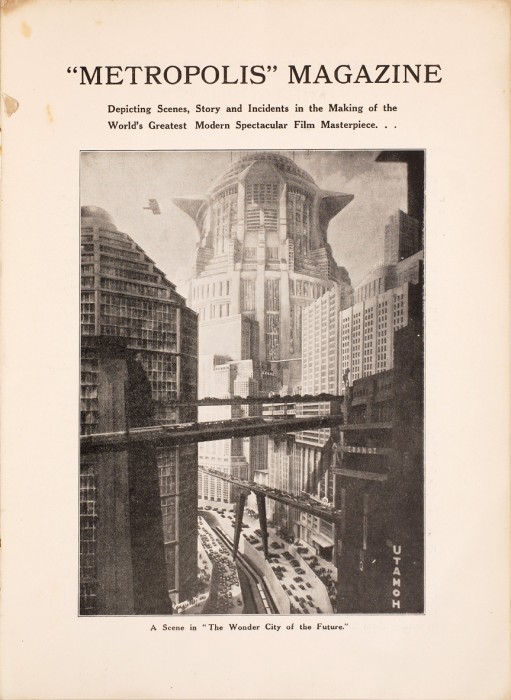
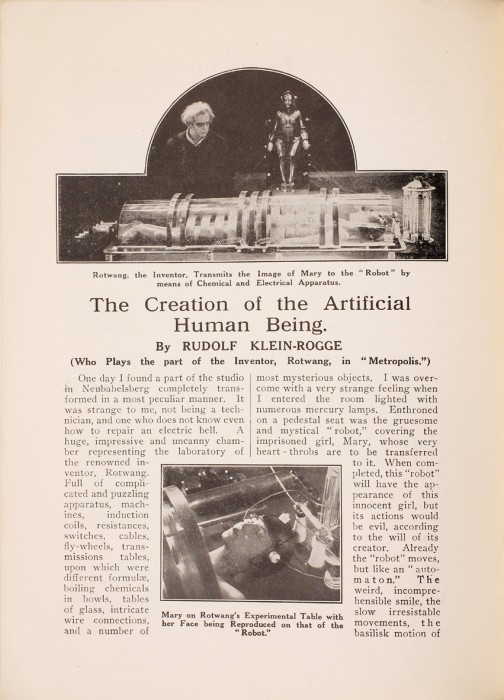
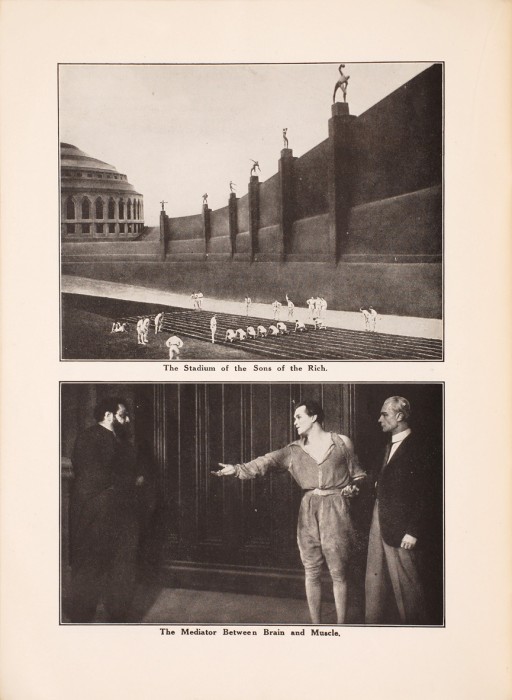
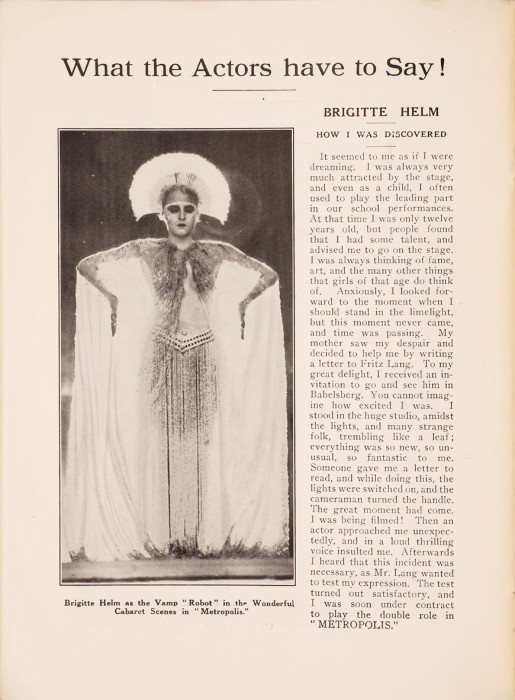
We now have another artifact from the movie’s premiere, this 32-page program, appropriately called “Metropolis” Magazine, that offers a rich feast for audiences, and text at times more interesting than the film’s script. (You can view the program in full here.) One imagines had they possessed backlit smart phones, those early moviegoers might have found themselves struggling not to browse their programs while the film screened. But, of course, Metropolis’s visual excesses would hold their attention as they still do ours. Its scenes of a futuristic city have always enthralled viewers, filmmakers, and (most) critics, such that Roger Ebert could write of “vast futuristic cities” as a staple of some of the best science fiction in his review of the 21st-century animated Metropolis—“visions… goofy and yet at the same time exhilarating.”
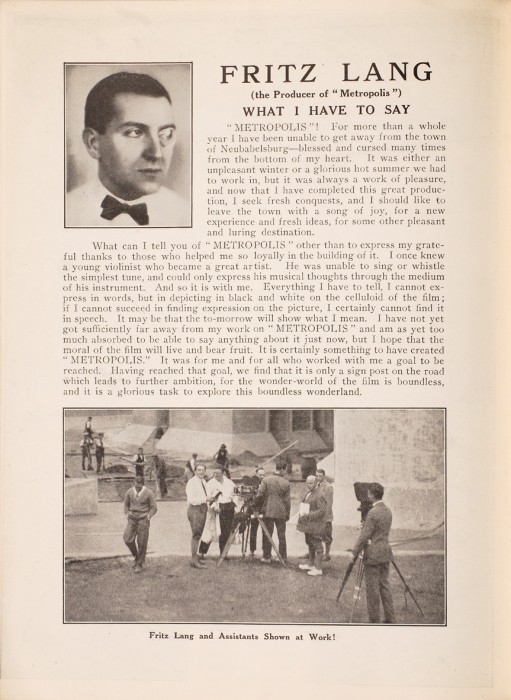
The program really is an astonishing document, a treasure for fans of the film and for scholars. Full of production stills, behind-the-scenes articles and photos, technical minutiae, short columns by the actors, a bio of Thea von Harbau, the “authoress,” excerpts from her novel and screenplay placed side-by-side, and a short article by her. There’s a page called “Figures that Speak” that tallies the production costs and cast and crew numbers (including very crude drawings and numbers of “Negroes” and “Chinese”). Lang himself weighs in, laconically, with a breezy introduction followed by a classic silent-era line: “if I cannot succeed in finding expression on the picture, I certainly cannot find it in speech.” Film history agrees, Lang found his expression “on the picture.”
“Only three surviving copies of this program are known to exist,” writes Wired, and one of them, from which these pages come, has gone on sale at the Peter Harrington rare book shop for 2,750 pounds ($4,244)—which seems rather low, given what an original Metropolis poster went for. But markets are fickle, and whatever its current or future price, ”Metropolis” Magazine is invaluable to cineastes. See all 32 pages of the program at Peter Harrington’s website.
We're hoping to rely on loyal readers, rather than erratic ads. Please click the Donate button and support Open Culture. You can use Paypal, Venmo, Patreon, even Crypto! We thank you!
Open Culture scours the web for the best educational media. We find the free courses and audio books you need, the language lessons & educational videos you want, and plenty of enlightenment in between.