It’s not hard to guess what Bob Dylan will fans will be putting on their Christmas lists this year — either the new hardcover book, The Lyrics: Since 1962, the 14-pound, 960-page book containing all the lyrics Dylan wrote, recorded, and performed throughout the years. Or the definitive edition of The Basement Tapes, the new collection featuring 6‑discs and 138 tracks.
Above, actor Jeff Bridges (you know him as “The Dude” in The Big Lebowski) narrates the story behind The Basement Tapes, tracing Dylan’s journey from Greenwich Village to the basement of “Big Pink,” the unassuming home in West Saugerties, New York where Dylan and The Band recorded those famous tapes. We don’t need to rehearse the story. Bridges does a fine job of doing that. Below, you can watch him show off some of his musical talents, playing a cover of a Dylan song, “Ring Them Bells,” at the El Rey Theatre in LA in April 2013. He’s obviously a fan.
Richard Linklater’s latest film Boyhood has earned quite a lot of press by accomplishing the unprecedented cinematic feat of telling a story over a decade long with a production over a decade long, following the same characters, played by the same growing and aging actors, the whole time through. Viewers have understandably found it a striking viewing experience, but most of Linklater’s projects do something no other film has done before. His 1990s “Indiewood” breakout Slacker(watch it online), for instance, offered not just the portrait of the so-called Generation‑X, and not just a portrait of the then-rising American countercultural Mecca of Austin, Texas, but a form of storytelling that seemed to drift freely from one character to the next, crossing town on the winds of idle, everyday, intense, and even nonsensical conversation.
And what does Waking Life do? Released in 2001, Linklater’s first animated film (he would make a second, the Philip K. Dick adaptation A Scanner Darkly, in 2006) not only further develops the neglected branch of animation known as rotoscoping, which involves drawing over live-action footage, but puts it to work for the cause of the philosophical film. But rather than approaching that enterprise straight on, the movie interprets the philosophy with which it deals through a vast cast of characters both eccentric and mundane — intellectuals, often, but also crackpots, gadflies, and just plain slackers. When they speak their thoughts aloud, as they do in the short clips featured here, they speak on themes as varied, but as intriguingly interconnected, as reality, free will, anarchy, suicide, and cinema, all of which the animation vividly illustrates.
“Waking Life could not come at a better time,” wrote Roger Ebert when the movie opened, less than a month after 9/11. “It celebrates a series of articulate, intelligent characters who seek out the meaning of their existence and do not have the answers. At a time when madmen think they have the right to kill us because of what they think they know about an afterlife, which is by definition unknowable, those who don’t know the answers are the only ones asking sane questions. True believers owe it to the rest of us to seek solutions that are reasonable in the visible world.” Some viewers will no doubt write off Waking Life’s dialogue — whether spoken by actors, professors, Linklater regulars, or utter randoms — as mere “dorm room conversation,” but the film seems to ask an important question on that very point: are you really having more interesting conversations now than you did in the dorms?
If you have a subscription to Amazon Prime, you can watch Waking Life for free right now. A version appears on Youtube for $2.99.
Hey, lovers of animation and experimental film: do you know the name Stan VanDerBeek? If not, you’ll enjoy learning it, for more reasons than that it allows you to type four capital letters. Endlessly adventurous in his quest to find new ways to craft (not to mention display) moving images, VanDerBeek, who in college encountered the likes of John Cage, Merce Cunningham, and Robert Rauschenberg, mobilized for his animation a variety of technologies that, in his day, people didn’t have much of a sense of what to do with, artistically or otherwise. “Everything that artists made art from, or with, in the second half of the 20th century, he pretty much touched,” this NPR piece quotes MIT LIST Visual Arts Center curator Joao Ribas as saying about him. “The medium, whatever he was working with, was not adequate enough. Painting was too static, and then one film was too linear, and then four films were too cumbersome.”
You can see here some of the fruits of this drive that kept VanDerBeek “constantly trying something else that could get closer and closer to what he saw.” At the top, we have a 1966 example of the animated poetry he created with Bell Labs computer graphics pioneer Ken Knowlton, using a programming language of Knowlton’s own design and a score by jazz drummer Paul Motian. But VanDerBeek built more of his reputation with his mastery of cut-and-paste animation, the kind you see in action in 1959’s Science Friction just above. Five years later, he would put out Breathdeath below, which Tate calls “a surreal fantasy based on 15th century woodcuts of The Dance of the Dead” made of “cut-up photos and newsreels, reassembled into a black comedy dedicated to Charlie Chaplin and Buster Keaton.” Does this all remind you a bit of Terry Gilliam? It should. The Monty Python animator, a notable VanDerBeek fan, named Breathdeath one of the best animated films of all time.
Chrissie Hynde knows a few things about being a female rocker. When at the tender age of 14 she saw Mitch Ryder and the Detroit Wheels play at a fairground in her hometown of Akron, Ohio, the band got into a fistfight with each other during the performance. She was hooked. “I thought,” she said to The Guardian ‘That’s got to be the life!’ ”
Not long after college at Kent State, where she was in a band with Devo’s Mark Mothersbaugh, she ended up in London. There she worked at Malcolm McLaren’s notorious store SEX alongside the future members of The Sex Pistols. She even asked Sid Vicious and Johnny Rotten to marry her for the work visa. She tried to start a band with Mick Jones of The Clash, but that didn’t take. She was kicked out of the band Masters of the Backside before they changed their name to The Damned and became famous. Then in 1978, she formed the band The Pretenders and quickly became a rock icon with hit tunes like “Don’t Get Me Wrong” and “Message of Love.”
In short, Hynde has been rocking for over 40 years now and she has some advice for aspiring lady rockers, which was originally printed as a promo for her 1994 release “Night in my Veins.”
1. Don’t moan about being a chick, refer to feminism or complain about sexist discrimination. We’ve all been thrown down the stairs, and f—ed about, but no one wants to hear a whining female. Write a loosely disguised song about it instead and clean up. ($)
2. Never pretend to know more than you do. If you don’t know chord names, refer to the dots. Don’t go near the desk unless you plan on becoming an engineer.
3. Make the other band members look and sound good. Bring out the best in them; that’s your job. Oh, and you better sound good too.
4. Do not insist in [sic] working with “females.” That’s just more b.s. Get the best man for the job. If it happens to a woman, great – you’ll have someone to go to department stores with on tour instead of making one of the road crew go with you.
5. Try not to have a sexual relationship with the band. It always ends in tears.
6. Don’t think that sticking your boobs out and trying to look f—able will help. Remember you’re in a rock and roll band. It’s not “f—me,” it’s “f—you”!
7. Don’t try to compete with the guys; it won’t impress anybody. Remember, one of the reasons they like you is because you don’t offer yet more competition to the already existing male egos.
8. If you sing, don’t “belt” or “screech.” No one wants to hear that sh–; it sounds “hysterical.”
9. Shave your legs, for chrissakes!
10. Don’t take advice from people like me. Do your own thing always.
A lot of this is just sound advice for getting along at the workplace – don’t act like you know more than you do, don’t complain, make your workmates look good but don’t doink them. But probably the key points for Hynde is number one and number seven.
In that interview with the Guardian, she indeed proved to be reluctant to “moan” about sexual discrimination in the rockdom. “There’s always been women doing this, just not that many,” she said. “I don’t know what the feminists have to say about it. Over the years, you’d hear, ‘We weren’t encouraged.’ Well, I don’t think Jeff Beck’s mother was saying, ‘Jeffrey! What are you doing up in your room? Are you rehearsing up there?’ No one was ever encouraged to play guitar in a band. But I never found it harder because I’m a woman. If anything I’ve been treated better. Guys will carry my guitars and stuff – who’s going to say no? Guys always tune my guitars, too.”
Jonathan Crow is a Los Angeles-based writer and filmmaker whose work has appeared in Yahoo!, The Hollywood Reporter, and other publications. You can follow him at @jonccrow. And check out his blog Veeptopus, featuring lots of pictures of badgers and even more pictures of vice presidents with octopuses on their heads. The Veeptopus store is here.
The Marxist Frankfurt School’s practice of negative dialectics put the “critical” in critical theory, and none of its loose band of philosopher-critics was as incisive as the dour, depressive Theodor Adorno. Against both mystical and materialist notions of history as progress, Adorno argued in his treatise Negative Dialectics that, writes Peter Thompson, “history is not the simple unfolding of some preordained noumenal realm,” but rather an open system. In other words, we can never know in advance where we are going, or should go, only that we live enmeshed in contradictions. And in the thick of late-modernity, these are engendered by the logic of consumer capitalism. For Adorno, the ultimate product of this system is what he termed the “Culture Industry”—the monolithic complex of Hollywood film, TV, radio, advertising, magazines, etc.—engineered to lull the masses into docility so that they passively accept the dictates of an authoritarian state.
The antidote to this cultural drugging, Adorno argued, was to be found in the avant-garde, in difficult and challenging works of art that appeal primarily to the intellect. In demonstration of the kind of art he meant, he even composed his own music, inspired by the work of Arnold Schoenberg. It’s very tempting to read Adorno’s attacks on jazz and rock ‘n’ roll as the bellyaching of a cantankerous snob, but there is substance to these critiques, and they deserve to be taken seriously, even if in the end to be refuted.
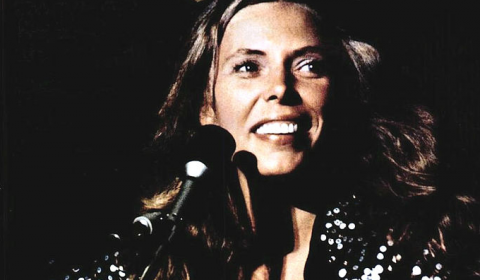
Take, for example, Adorno’s take on the protest music of the sixties. We tend to assume the importance of artists like Bob Dylan and Joan Baez (at the top, singing the spiritual “Oh Freedom”) to the anti-war movement—their songs, after all, provide the soundtrack for our documentaries and fictionalized films of the period. But Adorno felt that popular “protest music” was a contradiction in terms, given its relationship to the same Culture Industry that manufactured and disseminated advertising and propaganda. It’s obviously a problem many artists, including Dylan, have grappled with. In the short clip above, Adorno delivers his verdict on Baez:
I believe, in fact, that attempts to bring political protest together with “popular music”—that is, with entertainment music—are for the following reason doomed from the start. The entire sphere of popular music, even there where it dresses itself up in modernist guise, is to such a degree inseparable from past temperament, from consumption, from the cross-eyed transfixion with amusement, that attempts to outfit it with a new function remain entirely superficial…
Put another way—whatever else protest music is, it is also inevitably a commodity, marketed, like the most vacuous bubblegum pop, as entertainment for the masses. But it isn’t only the commodification of music that gets under Adorno’s skin, but also the standardization—the very thing that makes pop music popular. Its forms are instantly recognizable and easy to hum along to while performing mindless repetitive tasks. As he wrote in his essay “On Popular Music”: “The whole structure of popular music is standardized, even where the attempt is made to circumvent standardization, [guaranteeing] the same familiar experience.” Such formal stagnation precludes for Adorno the emergence of anything “novel,” and, therefore, anything truly revolutionary. He goes on to say specifically of anti-Vietnam protest music:
And I have to say that when somebody sets himself up, and for whatever reason sings maudlin music about Vietnam being unbearable, I find that really it is this song that is in fact unbearable, in that by taking the horrendous and making it somehow consumable, it ends up wringing something like consumption-qualities out of it.
The flattening effect of mass culture, Adorno suggests, renders every gesture performed within it—whether of protest or acquiescence—as fundamentally trivial… and marketable. His position is irritating–it tips one of our cultural sacred cows–and it’s certainly debatable; Lisa Whitaker, author of the blog Contextual Studies takes issue with it. Other writers have explained his critique in more nuanced terms. But whatever you think of them, his arguments do give us a useful framework for discussing the ways in which cultural movements seem to get instantly co-opted and turned into products: Every radical ends up on a t‑shirt; every revolutionary gets reduced to pithy quotables on coffee mugs; every movement seems reducible to handfuls of quirky memes.
For an interesting engagement with Adorno’s pop culture critique vis-à-vis the work of Dylan, see this entry in the Madame Pickwick Art Blog. And for much more of Adorno’s cranky but enlightening statements on popular culture, see this list of readings of work he produced in the forties with Max Horkheimer, as well as a later reconsideration of the “Culture Industry.” We live in an age dominated by mass popular culture, and saturated with protest. Adorno asks us to think critically about the relationships between the two, and about the efficacy of using the media and messaging of corporate capitalism as a means of resisting the oppressive structures created by corporate capitalism. But rather than Adorno’s wet blanket theorizing, I’ll leave you with Joan Baez. Whatever the usefulness of her so-called protest music, anyone who denies the beauty of her voice has surely got tin ears.
A quick note: Nature announced yesterday that it will make all of its articles free to view, read, and annotate online. That applies to the historic science journal (launched in 1869) and to 48 other scientific journals in Macmillan’s Nature Publishing Group (NPG). Other titles include Nature Genetics, Nature Medicine and Nature Physics.
All research papers from Nature will be made free to read in a proprietary screen-view format that can be annotated but not copied, printed or downloaded… The content-sharing policy … marks an attempt to let scientists freely read and share articles while preserving NPG’s primary source of income — the subscription fees libraries and individuals pay to gain access to articles.
But wait, there are a few more caveats. The archives will be made available to subscribers (e.g., researchers at universities) as well as 100 media outlets and blogs, and they can then share the articles (as read-only PDFs) with the rest of the world. This is all part of a one-year experiment.
Opening with maximum fanfare and pomp, and closing with the sound of dive bombers, “In the Flesh?,” the first track on Pink Floyd’s magnum opus The Wall announces that the two-disc concept album will be big, bombastic, and important. All that it is, but it’s also somber, groovy, even sometimes delicate, harnessing the band’s full range of strengths—David Gilmour’s minimalist funk rhythms and soaring, complex blues leads, Nick Mason’s timpani-like drum fills and thumping disco beats, and Richard Wright’s moody keyboard soundscapes. Under it all, the propulsive throb of Roger Waters’ bass—and presiding over it his jaded, nostalgic vision of personal and social alienation.
Expertly blending personal narrative with trenchant, if at times not particularly subtle, social critique, Waters’ rock opera—and it is, primarily, his—debuted just over 35 years ago on November 30, 1979. The project grew out of a collection of demos Waters wrote and recorded on his own. He presented the almost-fully formed album (minus the few collaborations with Gilmour like “Comfortably Numb”) to the band and producer Bob Ezrin, who described it as “Roger’s own project and not a group effort.” That may be so in its composition, but the final recording is a glorious group effort indeed, showcasing each member’s particular musical personality, as well as those of a host of guest musicians. The legendary stage show drew together an even larger pool of talent, such as political cartoonist Gerald Scarfe, whose animations were projected on a giant cardboard wall that slowly came down over the course of the concert.
At the top of the page, see the band play the entirety of the album at Earl’s Court in London, and just above, watch a “lost” documentary compiled from behind-the-scenes footage of that show, the last of thirty the band performed on The Wall tour, which began in Los Angeles. We get interviews with the band and crew, Waters at sound check, and “the frenetic operation of the entire load-in process.” Architect Mark Fisher describes the planning and creation of the stage show—a year in the making—from the wall itself to the huge inflatable characters made from Scarfe’s animations. It’s a fascinating look at the very first show of its kind, a huge multimedia extravaganza that blew audiences away and raised the bar for every arena rock tour that followed.
The film version of The Wall, which debuted almost three years later in 1982, was also decidedly a collaborative affair. Just above, a documentary called “The Other Side of The Wall” introduces us to “four very different talents”: Waters, Scarfe, director Alan Parker, and star Bob Geldof. (Album producer Ezrin doesn’t get a mention, though he claims to have written the film’s script.) Giving us a look at “how the final brick in The Wall fell into place,” the short film begins with Waters’ inspiration for the concept album; he tells us in his own words how it grew from his frustrations with the stadium touring for Animals. Parker discusses his artistic intention to not make “a concept movie” (though the movie seems to be exactly that), and Scarfe talks about his designs for the album and film, which Parker describes as “weird” and “psychopathic.”
The final piece of behind-the-scenes making of The Wall we bring you is the BBC Radio interview, above, that Waters’ gave in 1979. He talks about the album’s genesis, and breaks down the meaning of each song at length. Waters’ relationship with The Wall defined the rest of his career after he left Pink Floyd in 1986. In fact, since 2010, he’s been touring his version of the stage show, and has produced a documentary of its revival. But long before the current incarnation of the enduringly classic album and live spectacle, he brought a revival of The Wall to Berlin in 1990 to commemorate the fall of that city’s literal wall eight months earlier. See the full concert video of that show below. Featuring an array of guest musicians, the show approximates the musical intensity of the original 1980 tour—but nothing, of course, can substitute for the incredible energy of the original four members of the band playing together. The vision may have been all Waters, but the execution of The Wall needed Pink Floyd for its success.
Gentle reader, if you feel your knee jerking at Thug Notes, may I suggest taking a moment to gaze beyond the gold bling and du-rag favored by its fictitious host, literature lover Sparky Sweets, PhD.
A poor choice of metaphor, given the fictitious Dr. Sweets’ soft spot for baby felines. It’s not something he talks about on the show, but he frequently tweets photos of himself in their oh-so-cuddly company, tagging them #kittentherapy.
He (or perhaps head writer / producer Jared Bauer) also turns to Twitter to disseminate quotes by the likes of Cervantes (“Diligence is the mother of good fortune”) and Orwell (“Either we all live in a decent world, or nobody does”).
Thug Notes’ tagline “classic literature, original gangsta” may be its punchline, but the humor of incongruity is not its sole aim.
Comedian Greg Edwards, who plays Sparky Sweets, told The New York Times that the project is “trivializing academia’s attempt at making literature exclusionary by showing that even highbrow academic concepts can be communicated in a clear and open fashion.”
Amen. As Sparky Sweets observes following Simon’s murder in the Lord of the Flies above, “Whoo, this $hit (is) gettin’ real!”
Is there an equal or greater danger that a reluctant student might be prodded in a positive direction by Sparky’s zesty, insightful take on their assigned reading?
Resoundingly, yes.
Thug Notes’ discussion of racism as portrayed in To Kill a Mockingbird is not the longest I’ve ever heard, but it is the most straightforward and bracing. It got my blood going! I’m inspired to drag my dog eared paperback copy out and give it another read! (Maybe I’ll have a Scotch and play some classical music. Sparky does that too.)
I’m hoping the kids at the high school a couple of blocks away — who, for the record, look and sound far more like Sparky than they do me — will be encouraged to supplement their reading of this book, and others, with Thug Notes.
As an out-of-character Greg Edwards, bearing as much resemblance to Sparky Sweets as Stephen Colbert does to his most famous creation, told interviewer Tavis Smiley:
We don’t want to stop kids from reading the book. We just want to open up doors. Maybe teachers can use it. It’s hard being a teacher nowadays. You’re underpaid, you’re overworked, the classrooms are full, the kids are crazy, so throw this on and maybe it’ll spark one kid’s attention.
As of this writing, Thug Notes has tackled dozens of titles (you can watch them all here, or right below), a heaping helping of banned books, and four of Shakespeare’s plays (above).
New titles will be added every other Tuesday. I can’t wait.
Most people’s to-do lists are, almost by definition, pretty dull, filled with those quotidian little tasks that tend to slip out of our minds. Pick up the laundry. Get that thing for the kid. Buy milk, canned yams and kumquats at the local market.
Leonardo Da Vinci was, however, no ordinary person. And his to-do lists were anything but dull.
Da Vinci would carry around a notebook, where he would write and draw anything that moved him. “It is useful,” Leonardo once wrote, to “constantly observe, note, and consider.” Buried in one of these books, dating back to around the 1490s, is a to-do list. And what a to-do list.
NPR’s Robert Krulwich had it directly translated. And while all of the list might not be immediately clear, remember that Da Vinci never intended for it to be read by web surfers 500 years in the future.
[Calculate] the measurement of Milan and Suburbs
[Find] a book that treats of Milan and its churches, which is to be had at the stationer’s on the way to Cordusio
[Discover] the measurement of Corte Vecchio (the courtyard in the duke’s palace).
[Discover] the measurement of the castello (the duke’s palace itself)
Get the master of arithmetic to show you how to square a triangle.
Get Messer Fazio (a professor of medicine and law in Pavia) to show you about proportion.
Get the Brera Friar (at the Benedictine Monastery to Milan) to show you De Ponderibus (a medieval text on mechanics)
[Talk to] Giannino, the Bombardier, re. the means by which the tower of Ferrara is walled without loopholes (no one really knows what Da Vinci meant by this)
Ask Benedetto Potinari (A Florentine Merchant) by what means they go on ice in Flanders
Draw Milan
Ask Maestro Antonio how mortars are positioned on bastions by day or night.
[Examine] the Crossbow of Mastro Giannetto
Find a master of hydraulics and get him to tell you how to repair a lock, canal and mill in the Lombard manner
[Ask about] the measurement of the sun promised me by Maestro Giovanni Francese
Try to get Vitolone (the medieval author of a text on optics), which is in the Library at Pavia, which deals with the mathematic.
You can just feel Da Vinci’s voracious curiosity and intellectual restlessness. Note how many of the entries are about getting an expert to teach him something, be it mathematics, physics or astronomy. Also who casually lists “draw Milan” as an ambition?
Later to-do lists, dating around 1510, seemed to focus on Da Vinci’s growing fascination with anatomy. In a notebook filled with beautifully rendered drawings of bones and viscera, he rattles off more tasks that need to get done. Thingslike get a skull, describe the jaw of a crocodile and tongue of a woodpecker, assess a corpse using his finger as a unit of measurement.
On that same page, he lists what he considers to be important qualities of an anatomical draughtsman. A firm command of perspective and a knowledge of the inner workings of the body are key. So is having a strong stomach.
You can see a page of Da Vinci’s notebook above but be warned. Even if you are conversant in 16th century Italian, Da Vinci wrote everything in mirror script.
If you would like to sign up for Open Culture’s free email newsletter, please find it here. It’s a great way to see our new posts, all bundled in one email, each day.
If you would like to support the mission of Open Culture, consider making a donation to our site. It’s hard to rely 100% on ads, and your contributions will help us continue providing the best free cultural and educational materials to learners everywhere. You can contribute through PayPal, Patreon, and Venmo (@openculture). Thanks!
Jonathan Crow is a Los Angeles-based writer and filmmaker whose work has appeared in Yahoo!, The Hollywood Reporter, and other publications. You can follow him at @jonccrow. And check out his blog Veeptopus, featuring lots of pictures of badgers and even more pictures of vice presidents with octopuses on their heads. The Veeptopus store is here.
There’s never been a bad time to revisit Blade Runner, but now, with all the news about the in-development Blade Runner 2 breaking even as you read this, it seems like an especially appropriate time to go deeper into Ridley Scott’s piece of groundbreaking, Philip K. Dick-adapting cyberpunk cinema. Whatever you think of the prospect of a sequel, if you call yourself a Blade Runner fan, you’ll never turn down a chance for another look behind the scenes of the original.
Hence our offering today of BBC critic Mark Kermode’s documentary above, On the Edge of Blade Runner, and, via Flavorwire, a selection of original storyboards from the film. Few science-fiction movies hold up so well aesthetically after 32 years, but only because few science-fction movies had so much sheer work put into their design — we are still, I imagine, assured a steady stream of production materials to gaze upon for a long time to come.
In recent years, for instance, Sean Young, who played the replicant Rachel, released her Polaroid photos from the film’s set. And if you missed it the first time around, you’ll want to circle back to our post featuring a freely readable online version of Blade Runner Sketchbook, a collection of over 100 production drawings and pieces of artwork that originally came out alongside the film. (See it above.)
And whatever direction Blade Runner 2 takes, promising or less so, we’ll all hear a lot about it in the coming months. So to balance out the coming wave of promotion for the second one, why not watch a little of the promotion of the first one in the form of the convention reel below (produced not least to counter all the bad press the production had drawn at the time), which contains interviews with some of those responsible for Blade Runner’s most enduring qualities: Ridley Scott, “visual futurist” Syd Mead, and visual effects designer Douglas Trumbull. If all three of those guys work on the sequel, well, maybe I’ll start getting excited.
On this day in 1955, Rosa Parks took her fateful bus ride in Montgomery, Alabama.
As the story is often told, Parks was a diminutive African-American seamstress who was weary from a long day of work at a downtown department store. Her feet ached, so when the driver ordered her to give up her seat to a white man who had just gotten on the bus, Parks refused, accidently setting into motion a series of events that led to the modern Civil Rights Movement.
The problem with the story, told in that way, is that it is grossly misleading.
Besides being a seamstress, Parks was a political organizer and activist, a member of the Montgomery Voters League and secretary of the local chapter of the NAACP. And while it’s true that Parks didn’t know when she boarded the bus that day that she would commit an act of civil disobedience, when the moment arose she knew what she was doing, and why. As Parks later wrote in her autobiography:
People always say that I didn’t give up my seat because I was tired, but that isn’t true. I was not tired physically, or no more tired than I usually was at the end of a working day. I was not old, although some people have an image of me as being old then. I was forty-two. No, the only tired I was, was tired of giving in.
Parks was not the first black person to be arrested in 1955 for refusing to give up a seat on Montgomery’s racially segregated buses. There was a growing sense in the African-American community that the time was ripe for change. The previous year, the U.S. Supreme Court had issued its landmark decision in Brown v. Board of Education, declaring that segregation in public schools was unconstitutional.
The Women’s Political Council in Montgomery was already laying the groundwork for a boycott of the city bus system when it learned of Parks’ arrest. Given the respect and support Parks had within the community, the group decided it was an opportune moment to take action. A one-day boycott was held on the day of Parks’s trial (she was convicted of violating Chapter 6, Section 11 of the Montgomery City Code and ordered to pay a $10 fine plus $4 in court costs) and a longer one was launched shortly afterward, crippling the finances of the company that ran the bus system, which typically derived over 75 percent of its fare revenue from African-American passengers. That boycott lasted more than a year, until late December of 1956, when the Supreme Court upheld a lower court ruling in Browder, et al v. Gayle that the segregation of Montgomery’s bus system was unconstitutional.
The documents shown here were submitted as evidence in Browder v. Gayle. The arrest report (above) states that Parks was sitting in the white section of the bus. Actually, she had complied with the law when she first entered, sitting down behind the first 10 seats which were permanently reserved for whites. (See the chart below; the front of the bus is at the top of the chart, with the driver’s seat designated by an “X.”) Under Montgomery law, the bus driver had the discretion to move blacks farther back when the white section filled up. Black people paid the same fare as whites, but were often ordered to exit the bus after paying the fare and re-enter through the back door. In standing-room-only conditions, they were not allowed even to stand next to white people.
At rush hour on Dec. 1, 1955, the bus was filling up as Parks and three other African-Americans sat in the first row behind the white section. When a white man entered the bus, the driver James F. Blake ordered Parks and the other three to leave their seats and move back, where they would all have to stand. After hesitating, the others got up but Parks stayed seated. In The Rebellious Life of Mrs. Rosa Parks, Jeanne Theoharis reconstructs the scene:
Blake wanted the seats. “I had police powers — any driver did.” The bus was crowded and the tension heightened as Blake walked back to her. Refusing to assume a deferential position, Parks looked him straight in the eye.
Blake asked, “Are you going to stand up?”
Parks replied, “No.” She then told him she was not going to move “because I got on first and paid the same fare, and I didn’t think it was right for me to stand so someone else who got on later could sit down.”
We're hoping to rely on loyal readers, rather than erratic ads. Please click the Donate button and support Open Culture. You can use Paypal, Venmo, Patreon, even Crypto! We thank you!
Open Culture scours the web for the best educational media. We find the free courses and audio books you need, the language lessons & educational videos you want, and plenty of enlightenment in between.