About a month back, we featured George Harrison’s long lost guitar solo on “Here Comes the Sun,” and you went gaga for it. Little did we know that George Harrison’s son, Dhani, was just about ready to unveil a new iPad app called The Guitar Collection: George Harrison. It runs $9.99, and it’s only available on the iPad, which hardly makes it an instance of Open Culture. But we love The Beatles around here, and the app does something fairly special. It gives you a high-tech introduction to seven George Harrison guitars, using 360° images, sound files, videos, and lots of text and factoids. The video above offers a quick tour of the app. In the video below, Dhani Harrison explains how the the app came together on the Conan O’Brien Show. Thanks for the heads up Liz.
Jim Henson Pilots The Muppet Show with Adult Episode, “Sex and Violence” (1975)
In the early 1970s, Jim Henson was worried that the Muppets were becoming typecast as children’s entertainment. So in December of 1974 he produced a pilot episode for The Muppet Show and gave it a name that was about as far away from Sesame Street as you could get: “Sex and Violence.”
The half-hour pilot was first broadcast on ABC in March of 1975. It’s a fast-moving series of vignettes, featuring a motley cast of characters–many of whom would become familiar in later years–appearing and reappearing throughout. Sam the Eagle, Sgt. Floyd Pepper, The Swedish Chef, Statler and Waldorf, and a wrestler named The San Francisco Earthquake all make an appearance. At one point, Kermit the Frog propositions a female with the line, “I might be able to get you a job on an educational show for kids.” The story, to the extent there is one, centers around preparations for a “Seven Deadly Sins Pageant.” Alas, the pageant never quite gets off the ground. As Sam the Eagle sagely asks: “Do we really want to get into a ‘deadly sins’ situation?”
If you would like to support the mission of Open Culture, consider making a donation to our site. It’s hard to rely 100% on ads, and your contributions will help us continue providing the best free cultural and educational materials to learners everywhere. You can contribute through PayPal, Patreon, and Venmo (@openculture). Thanks!
Related Content:
Puppet Making with Jim Henson: A Primer
Jim Henson’s Zany 1963 Robot Film Uncovered by AT&T: Watch Online
Inspirations: A Short Film Celebrating the Mathematical Art of M.C. Escher
Almost two years ago, Spanish filmmaker Cristóbal Vila shot an exquisite little film, Nature by Numbers, which captured the ways in which mathematical concepts (Fibonacci Sequence, Golden Number, etc.) reveal themselves in nature. And the short then clocked a good 2.1 million views on YouTube alone.
This week, Vila returns with a new film called Inspirations. In this case, the inspiration is M.C. Escher (1898–1972), the Dutch artist who explored a wide range of mathematical ideas with his woodcuts, lithographs, and mezzotints. Although Escher had no formal training in mathematics beyond secondary school, many mathematicians counted themselves as admirers of his work. (Visit this online gallery to get better acquainted with Escher’s art, and be sure to click on the thumbnails to enlarge the images). As Vila explains, Inspirations tries to imagine Escher’s workplace, “what things would surround an artist like him, so deeply interested in science in general and mathematics in particular.” It’s a three minutes of unbridled imagination.
If you would like to support the mission of Open Culture, consider making a donation to our site. It’s hard to rely 100% on ads, and your contributions will help us continue providing the best free cultural and educational materials to learners everywhere. You can contribute through PayPal, Patreon, and Venmo (@openculture). Thanks!
“The Periodic Table Table” — All The Elements in Hand-Carved Wood
In 2011, Theo Gray (co-founder of Wolfram Research, Popular Science columnist, and element collector) won the ACS Grady Stack Award for Interpreting Chemistry for the Public. And here you can see why. In this clip, Gray introduces you to his DIY masterpiece — the world’s first “periodic table table.” Yes, we’re talking about a hand-carved wooden table that brings to life the Periodic Table, and lets you play with the elements. The project began back in 2002, and now, a decade later, Gray puts it on display in a video produced by the American Chemical Society.
Related Content:
Chemistry on YouTube: “Periodic Table of Videos” Wins SPORE Prize
Jefferson Airplane Plays on a New York Rooftop; Jean-Luc Godard Captures It (1968)
Just when you think you’ve seen everything Jean-Luc Godard has ever shot, something like this surfaces. If you’re only now considering tucking into the feast that is Godard’s filmography, don’t let his abundance of uncollected odds, ends, clips, and shorts intimidate you. Not only do they promise a little thrill down the road when you’ve already digested his major works, but they offer quick bursts at any time of the revolutionary cinematic zest with which the filmmaker took on the world. With the man alive and working, I should perhaps say “the revolutionary cinematic zest with which the filmmaker takes on the world,” but that gets into one of the most fascinating conversations that swirls around him: has Godard still got it?
Some say yes, that his latest picture Film Socialisme presents the logical continuation of all Godard has ever represented; some say no, that the Godard to watch remains the scrappy star of the 1960s’ French New Wave. In his study Everything is Cinema: The Working Life of Jean-Luc Godard, New Yorker film blogger Richard Brody somehow makes both claims.
In the chapter “Revolution (1968–1972)” he describes Godard’s improvised method of shooting a 1968 Jefferson Airplane concert:
He took over from the specialists and operated the camera from the window of Leacock-Pennebaker’s office on West Forty-fifth street, shooting the band on the roof of the Schuyler Hotel across the street. (Pennebaker recalled him to be an amateurish cameraman who could not avoid the beginner’s pitfall of frequent zooming in and out.) The performance took place without a permit, at standard rock volume: as singer Grace Slick later wrote, “We did it, deciding that the cost of getting out of jail would be less than hiring a publicist…”
Amateurish or not, a piece of the footage has surfaced on YouTube. Listen to the Airplane perform “The House at Pooneil Corners,” watch Godard’s dramatic swings of focus and zoom as he attempts to convey the spectacle of the band and the spectacle of countless surprised Manhattanites at once, and think for yourself about this peculiar intersection of two bold lines in the era’s alternative zeitgeist. As Jefferson Airplane co-founder Paul Kantner said in a 1986 interview, “Just for a while there, maybe for about 25 minutes in 1967, everything was perfect.” But these seven minutes in November 1968, from opening shouts to inevitable arrest, don’t seem so dull themselves.
If you would like to support the mission of Open Culture, consider making a donation to our site. It’s hard to rely 100% on ads, and your contributions will help us continue providing the best free cultural and educational materials to learners everywhere. You can contribute through PayPal, Patreon, and Venmo (@openculture). Thanks!
Related Content:
Listen to Grace Slick’s Hair-Raising Vocals in the Isolated Track for “White Rabbit” (1967)
A Young Jean-Luc Godard Picks the 10 BestAmerican Films Ever Made (1963)
Colin Marshall hosts and produces Notebook on Cities and Culture. Follow him on Twitter at @colinmarshall.
Harvard Thinks Big 2012: 8 All-Star Professors. 8 Big Ideas.
Earlier this month, Harvard students made their way to the Sanders Theatre for the 2012 edition of Harvard Thinks Big. It’s a TED-style event which gets pitched like this: “8 all-star professors. 8 big ideas. All ten minutes each.” You get the gist.
This year’s version had as much substance, though perhaps not quite the same sizzle, as the 2011 version, which featured talks by Steven Pinker, Lawrence Lessig, Daniel Gilbert and Elaine Scarry. Above, we have one talk from the latest Harvard Thinks Big. It features Daniel Lieberman, the renowned biologist (perhaps you know his work on barefoot running?) talking about how evolutionary biology explains why obesity is on the rise in the United States.
Other speakers at the event included Doug Melton, Eleanor Duckworth, Nicholas Christakis, Kaia Stern, Donhee Ham, Stephen Greenblatt, and Jill Lepore. The lectures can be watched via YouTube (follow the previous links) or via iTunes. Regrettably the talks by Greenblatt, Ham and Lepore haven’t made it to the web, at least not yet. When they do, we’ll mention it on our Twitter stream, where we post lots of other cultural goodies.
Related Content:
Harvard Presents Free Courses with the Open Learning Initiative
Harvard Thinks Green: Big Ideas from 6 All-Star Environment Profs
Why is the U.S. F’ed Up? 8 Lectures from Occupy Harvard Teach-In Provide Answers
The Birth of the Moon: How Did It Get There in the First Place?
The Moon is a mystery. For all its familiarity–the regularity of its phases, the fact that everywhere on Earth it looks the same–the Moon has always been an enigma, a luminous question mark rolling across the night sky.
In this new video from Cosmic Journeys, we learn about some of the latest scientific research into the structure and history of the Moon. In particular, we learn the latest ideas on what is perhaps the greatest of lunar mysteries: the question of how the Moon got there in the first place.
The leading candidate for an answer is the Giant Impact Hypothesis, which posits that sometime in the early stage of the Solar System–about four and a half billion years ago–a large proto-Earth collided with a Mars-sized body named “Theia,” causing a huge cloud of material from both bodies to fly out into space. Some of the material remained in the Earth’s orbit and coalesced into the Moon. It’s a fascinating hypothesis. To see more videos from the same series, visit the Cosmic Journeys channel on YouTube, or the SpaceRip blog.
Related Content:
A Year of the Moon in 2.5 Minutes
The Far Side of Moon: A Rare Glimpse from NASA
Watch Battleship Potemkin and Other Free Sergei Eisenstein Films
As a carless cinephile, I’ve spent hours upon hours listening to film podcasts while riding my bike or the train. Battleship Pretension, hosted by knowledgeable but still knowledge-hungry young critics Tyler Smith and David Bax, has long held top priority on these rides — and even if the title’s referent doesn’t flood your mind with memories of artistic awe, you probably get the pun. But if you want to go deeper and talk about how film editing went from grunt work to art form, you have little choice but to talk about Battleship Potemkin (1925) and its director, Sergei Eisenstein. A Russian double-threat of filmmaker and film theorist in the 1920s through the late 1940s, Eisenstein pioneered many now-essential editing techniques, figuring out how images could be arranged to serve not just a film’s story but its rhythm, its tone, and even its themes.
Like cinema itself, Eisenstein came from the theater. Unlike most of his contemporaries, he made great strides in dragging cinema out of the theater behind him, casting off staid storytelling habits in favor of the vast possibilities of the then-new medium, most of which remain uncharted even today. Tasked by his government with producing what came down to revolutionary propaganda, Eisenstein couldn’t push the thematic envelope very far. Even so, today’s filmmakers looking for ways to advance their form, or today’s filmgoers eager to learn more about how movies work, would do well to look at what Eisenstein managed to do 85 years ago, and how aesthetically exhilarating it all remains.
This you can do from the comfort of your computer by browsing Open Culture’s collection of Free Movies Online, where you’ll find links to Eisenstein pictures viewable at the click of the mouse, including the sweeping Alexander Nevsky, the doomed ¡Que viva México!, and of course, the iconic Battleship Potemkin (above). Watch a few, and you’ll see why Battleship Pretension’s listeners voted Eisenstein into the top hundred directors of all time. Smith and Bax called on yours truly to write his blurb on the list, but don’t take my word for the filmmaker’s importance; his movies, whether you catch them in a grand revival screening or on your web browser right now, show you everything you need to know.
Complete list of free Eisenstein films: Alexander Nevsky, Battleship Potemkin, October: Ten Days that Shook the World, Old and New, ¡Que viva México!, Romance Sentimentale, andStrike.
Colin Marshall hosts and produces Notebook on Cities and Culture. Follow him on Twitter at @colinmarshall.
Princeton v. Yale, 1903: The Oldest College Football Game on Film
You can thank Thomas Edison and his motion picture camera for many things: Bike Tricks Caught on Film in 1899; Footage of Mark Twain from 1909; The World’s First (and Slightly Scandalous) Hand-Tinted Motion Picture (1895); The First Kiss in Cinema, 1896; and now this — footage of the 1903 Princeton v. Yale football game. The two teams were undefeated, and 50,000 spectators were on hand. The video starts with the players taking the field (Princeton first, Yale second) and some panoramic views of Yale’s stadium. Then (around the 2:00 mark) we get to the highlights of the game.
The clip above is apparently the oldest collegiate football footage surviving today. And, in case you’re keeping score, Princeton won the game 11–6.
But if you’re counting the number of Free Courses provided by the two universities, we have the score at 38–1, with Yale coming out way on top.
via Retronaut and the Reel Mudd
Thelonious Monk, Bill Evans and More on the Classic Jazz 625 Show
In April of 1964, the British Broadcasting Corporation launched BBC Two as a highbrow alternative to its mainstream TV channel. One of the new channel’s first programs was Jazz 625, which spotlighted many of the greatest Jazz musicians of the day. Dizzy Gillespie, Thelonious Monk, Dave Brubeck, Bill Evans and others performed on the show, which featured straight-forward camera work and a minimalist set. The focus was on the music.
The title of the show referred to the channel’s 625-line UHF bandwidth, which offered higher resolution than the 405-line VHF transmission on BBC One. Among the surviving episodes is Thelonious Monk’s March 14, 1965 performance at the Marquee Club in London. You can watch a 35-minute excerpt above. The quartet features Monk on piano, Charlie Rouse on tenor saxophone, Larry Gales on bass and Ben Riley on drums. They perform four numbers:
- Straight No Chaser
- Hackensack
- Rhythm-A-Ning
- Epistrophy
You can learn the story behind Jazz 625 by reading an article by Louis Barfe at Transdiffusion. And to see more from the shows, scroll down.
The Oscar Peterson Trio:
Above is a 25-minute excerpt from the Oscar Peterson Trio’s October 1, 1964 performance. The original show, like other episodes of Jazz 625, was over an hour long. The trio features Peterson on piano, Ray Brown on bass and Ed Thigpen on drums.
The Bill Evans Trio:
Above are two 35-minute episodes, shown back-to-back, featuring the Bill Evans Trio. The two sets were recorded on March 19, 1965 and feature Evans on piano, Chuck Israels on bass and Larry Bunker on drums.
The Modern Jazz Quartet:
The Modern Jazz Quartet performed for Jazz 625 on April 28, 1964. Above is a 27-minute except, featuring the Quartet’s musical director John Lewis on piano, Milt Jackson on vibraphone, Percy Heath on bass and Connie Kay on drums. Brazilian guitarist Laurindo Almeida makes a special appearance.
30 Free Essays & Stories by David Foster Wallace on the Web
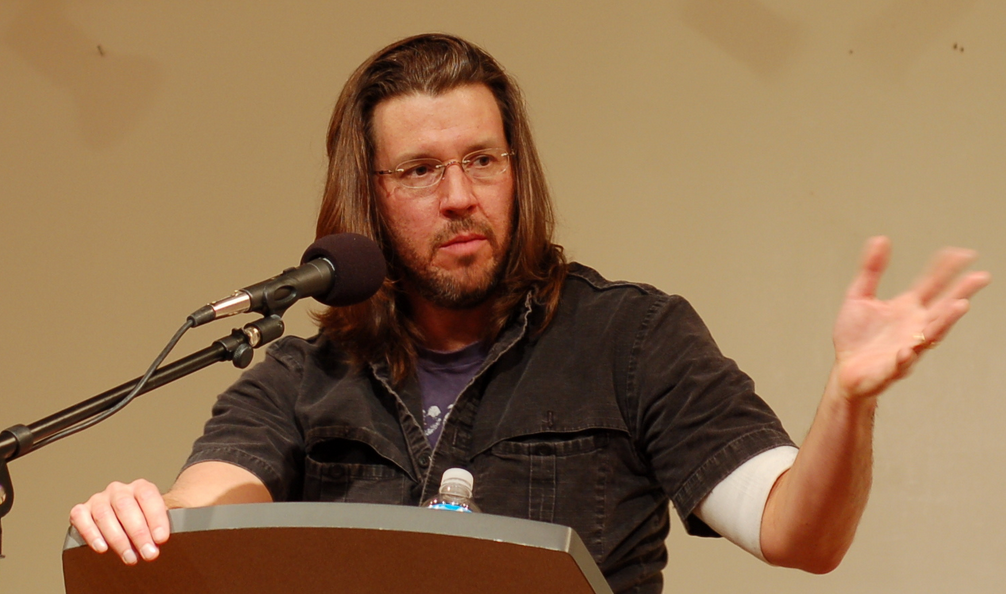
Image by Steve Rhodes, via Wikimedia Commons
We started the week expecting to publish one David Foster Wallace post. Then, because of the 50th birthday celebration, it turned into two. And now three. We spent some time tracking down free DFW stories and essays available on the web, and they’re all now listed in our collection, 800 Free eBooks for iPad, Kindle & Other Devices. But we didn’t want them to escape your attention. So here they are — 23 pieces published by David Foster Wallace between 1989 and 2011, mostly in major U.S. publications like The New Yorker, Harper’s, The Atlantic, and The Paris Review. Enjoy, and don’t miss our other collections of free writings by Philip K. Dick and Neil Gaiman.
- “9/11: The View From the Midwest” (Rolling Stone, October 25, 2001)
- “All That” (New Yorker, December 14, 2009)
- “An Interval” (New Yorker, January 30, 1995)
- “Asset” (New Yorker, January 30, 1995)
- “Backbone” An Excerpt from The Pale King (New Yorker, March 7, 2011)
- “Big Red Son” from Consider the Lobster & Other Essays
- “Brief Interviews with Hideous Men” (The Paris Review, Fall 1997)
- “Consider the Lobster” (Gourmet, August 2004)
- “David Lynch Keeps His Head” (Premiere, 1996)
- “Everything is Green” (Harpers, September 1989)
- “E Unibus Pluram: Television and U.S. Fiction” (The Review of Contemporary Fiction, June 22, 1993)
- “Federer as Religious Experience” (New York Times, August 20, 2006)
- “Good People” (New Yorker, February 5, 2007)
- “Host” (The Atlantic, April 2005)
- “Incarnations of Burned Children” (Esquire, April 21, 2009)
- “Laughing with Kafka” (Harper’s, January 1998)
- “Little Expressionless Animals” (The Paris Review, Spring 1988)
- “On Life and Work” (Kenyon College Commencement address, 2005)
- “Order and Flux in Northampton” (Conjunctions, 1991)
- “Rabbit Resurrected” (Harper’s, August 1992)
- “Several Birds” (New Yorker, June 17, 1994)
- “Shipping Out: On the (nearly lethal) comforts of a luxury cruise” (Harper’s, January 1996)
- “Tennis, trigonometry, tornadoes A Midwestern boyhood” (Harper’s, December 1991)
- “Tense Present: Democracy, English, and the wars over usage” (Harper’s, April 2001)
- “The Awakening of My Interest in Annular Systems” (Harper’s, September 1993)
- “The Compliance Branch” (Harper’s, February 2008)
- “The Depressed Person” (Harper’s, January 1998)
- “The String Theory” (Esquire, July 1996)
- “The Weasel, Twelve Monkeys And The Shrub” (Rolling Stone, April 2000)
- “Ticket to the Fair” (Harper’s, July 1994)
- “Wiggle Room” (New Yorker, March 9, 2009)
Related Content:
Free Philip K. Dick: Download 13 Great Science Fiction Stories
Neil Gaiman’s Free Short Stories
Read 17 Short Stories From Nobel Prize-Winning Writer Alice Munro Free Online
Support Us
We're hoping to rely on loyal readers, rather than erratic ads. Please click the Donate button and support Open Culture. You can use Paypal, Venmo, Patreon, even Crypto! We thank you!

Receive our Daily Email
About Us

Open Culture scours the web for the best educational media. We find the free courses and audio books you need, the language lessons & educational videos you want, and plenty of enlightenment in between.
Advertise With Us


