From Yale professor Paul North comes a chapter-by-chapter study of Karl Marx’s Capital: Critique of Political Economy, Volume 1. According to the description that accompanies the course on YouTube, this “book from 1872 is still the best guide to the predatory economic and social system within which we live. The book solves five basic mysteries in our social world. The mysteries are: why social classes struggle against one another, why human beings are in the thrall of things, how a quantity of money turns into more money without seeming to add anything, why some people are forced to work and the more they work the less they make proportional to their effort, and finally, and why it is so hard to transform the system for the better.” You can watch the 19 lectures from the course in the playlist above.
Prof. North is the co-editor of the new English translation and critical edition of Capital Volume 1, and it’s the text used in the course. If you’re interested in delving deeper into Marx’s Capital, see the David Harvey courses listed in the Relateds below.
It takes about five hours to drive from Düsseldorf to Hamburg on the Autobahn. During that stretch, you can listen to Kraftwerk’s album Autobahn seven times — or if you prefer, you can loop its eponymous opening song thirteen times. For it was “Autobahn,” more so than Autobahn, that changed the sound of music around the world in ways we still hear today. “Germany was suddenly on the musical map,” writes the Guardian’s Tim Jonze. “David Bowie – who used to ride the autobahn while listening to the record – moved to Berlin and went on to make the electronically influenced Low, “Heroes” and Lodger. Brian Eno relocated to the rural village of Forst to record with the influential avant-garde band Harmonia.” Soon would come the electronic pop of Ultravox, DAF and the Eurythmics, followed by Donna Summer and Giorgio Moroder’s floodgate-opening “I Feel Love”.
Not a bad pop-cultural coup for, as Jonze puts it, “a 22-minute 43-second song about the German road network.” At the time of its release in early 1975, Kraftwerk had put out three full albums, but what would become their signature Teutonic-electronic sound hadn’t quite taken shape. But it was already clear that their work took its inspiration from twentieth-century modernity, a subject of which no single work of man in their homeland could have been more evocative than the Autobahn.
With its origins in the Weimar Republic and its long stretches without a speed limit, the German freeway network is internationally regarded as a concrete symbol of total personal freedom, and total personal responsibility, within a highly rule-respecting culture. To the young members of Kraftwerk, who often drove the Düsseldorf-Hamburg section, it held out the promise of freedom.
So did the then-new Minimoog synthesizer, which cost as much as a Volkswagen at the time, but offered the chance to make music like nothing the public had ever heard before. “Autobahn” captured the imaginations of listeners everywhere with not just its electronic effects, but also the incongruity of their combination with instruments like the flute (a holdover from Kraftwerk’s earlier compositions) and vehicular sounds evocative of a genuine road trip — all assembled at what would then have seemed a hypnotically expansive length for a pop song. Little did even the hippest listeners of the mid-seventies, such as the Americans tuned into early free-form FM stations where no corporate programming rules applied, know that they were hearing what Jones calls “the point where electronic pop music truly began.” All car trips run out of road eventually, but humanity’s journey into the possibilities of high-tech music shows no signs of approaching its end.
Based in Seoul, Colin Marshall writes and broadcasts on cities, language, and culture. He’s the author of the newsletterBooks on Cities as well as the books 한국 요약 금지 (No Summarizing Korea) and Korean Newtro.Follow him on the social network formerly known as Twitter at @colinmarshall.
You can’t beat the market. That, at least, is the advice we all encounter early on when first we try our hand at investing. Homespun though it may sound, the idea has academic roots: the Efficient Market Hypothesis, as the economists call it, holds that the prices in any financial market already reflect all available information relevant to what’s being traded within them. In the case of the stock market, for example, everything known — or indeed, knowable — about the future prospects of a particular company is already incorporated into its stock price, or might as well be. If the EMH is true, then it must also be true that nobody can beat the market, no matter how deep their experience or developed their instinct for picking stocks.
Nobel Laureate economist Eugene Fama, who’s done more than anyone alive to refine the EFM and keep it in circulation, appears as one of the interviewees in Tune Out the Noise, the Errol Morris-directed documentary above. So do a range of other figures, mostly septuagenarian and octogenarian, whose great success in their fields owes to their having trusted the wisdom of the market. All have been involved with the investment firm Dimensional Fund Advisors, which, since its founding in the early nineteen-eighties, has been one of the engines of change in its industry. In the first half of the twentieth century, investing had an almost mystical quality about it — a quality swept away by the “data revolution” of the second half.
That revolution was powered, of course, by computers. Most of Morris’ interviewees first found themselves placed in front of one of those hulking, inscrutable machines at some point in their tertiary education, more than likely at the University of Chicago. They learned to work those early computers’ punch cards and whirring reels of tape even as electronic computing itself first found its uses in civilization. Suddenly, though it demanded painstaking collection and programming work, it had become possible to examine stock market data and determine what patterns, if any, it contained, and whether any investor had consistently outperformed the average. The answers revealed would become the premise of not just “passive” investment firms like DFA, but also of the original creation of index funds like the S&P 500.
All this may not sound like the usual terrain of Errol Morris, whose previous documentaries have profiled everyone from pet cemetery operators to former U.S. secretaries of defense to Stephen Hawking. His films aren’t without their confrontational moments, though given that Tune Out the Noise was commissioned by DFA itself, it shouldn’t come as a surprise that Morris never shifts into interrogation mode (despite using his signature Interrotron rig to shoot the interviews). Despite claiming not to know anything about investing or financial markets going in, he finds plenty of overlap with interests that have long run through his work: epistemology, for example, and the nature of scientific revolution. After all, most any field has some connection to the inexhaustible subject of how we know, what we know, and what we can’t know. “People shrink from uncertainty, but it’s uncertainty that really creates opportunity,” DFA co-founder David Booth says to Morris. “What would the world be like if there were no uncertainty? I mean, pretty dull.”
Based in Seoul, Colin Marshall writes and broadcasts on cities, language, and culture. He’s the author of the newsletterBooks on Cities as well as the books 한국 요약 금지 (No Summarizing Korea) and Korean Newtro.Follow him on the social network formerly known as Twitter at @colinmarshall.
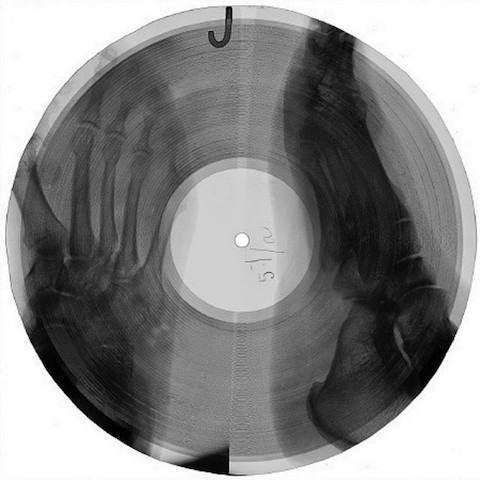
A catchy tribute to mid-century Soviet hipsters popped up a few years back in a song called “Stilyagi” by lo-fi L.A. hipsters Puro Instinct. The lyrics tell of a charismatic dude who impresses “all the girls in the neighborhood” with his “magnitizdat” and guitar. Wait, his what? His magnitizdat, man! Like samizdat, or underground press, magnitizdat—from the words for “tape recorder” and “publishing”—kept Soviet youth in the know with surreptitious recordings of pop music. Stilyagi (a post-war subculture that copied its style from Hollywood movies and American jazz and rock and roll) made and distributed contraband music in the Soviet Union. But, as an NPR piece informs us, “before the availability of the tape recorder and during the 1950s, when vinyl was scarce, ingenious Russians began recording banned bootleg jazz, boogie woogie and rock ‘n’ roll on exposed X‑ray film salvaged from hospital waste bins and archives.” See one such X‑ray “record” above, and see here the fascinating process dramatized in the first scene of a 2008 Russian musical titled, of course, Stilyagi (translated into English as “Hipsters”—the word literally means “obsessed with fashion”).
These records were called roentgenizdat (X‑ray press) or, says Sergei Khrushchev (son of Nikita), “bone music.” Author Anya von Bremzen describes them as “forbidden Western music captured on the interiors of Soviet citizens”: “They would cut the X‑ray into a crude circle with manicure scissors and use a cigarette to burn a hole. You’d have Elvis on the lungs, Duke Ellington on Aunt Masha’s brain scan….” The ghoulish makeshift discs sure look cool enough, but what did they sound like? Well, as you can hear below in the Beatles samples, a bit like old Victrola phonograph records played through tiny transistor radios on a squonky AM frequency.
Dressed in fashions copied from jazz and rockabilly albums, stilyagi learned to dance at underground nightclubs to these tinny ghosts of Western pop songs, and fought off the Komsomol—super-square Leninist youth brigades—who broke up roentgenizdat rings and tried to suppress the influence of bourgeois Western pop culture. According to Artemy Troitsky, author of Back in the USSR: The True Story of Rock in Russia, these records were also called “ribs”: “The quality was awful, but the price was low—a rouble or rouble and a half. Often these records held surprises for the buyer. Let’s say, a few seconds of American rock ’n’ roll, then a mocking voice in Russian asking: ‘So, thought you’d take a listen to the latest sounds, eh?, followed by a few choice epithets addressed to fans of stylish rhythms, then silence.”
See more images of bone music records over at Laughing Squid and Wired co-founder Kevin Kelly’s blog Street Use, and above dig some historical footage of stilyagi jitterbugging through what appears to be a kind of Soviet training film about Western influence on Soviet youth culture, produced no doubt during the Khrushchev thaw when, as Russian writer Vladimir Voinovich tells NPR, things got “a little more liberal than before.”
Note: An earlier version of this post appeared on our site in 2014.
The artificial language of Esperanto was conceived with high ideals in mind. In the eighteen-eighties, its creator L. L. Zamenhof envisioned it as the universal second language of humanity, and if it hasn’t achieved that status by now, it at least remains the world’s most widely spoken constructed auxiliary language. One factor complicating its spread is that no language, even one guided by internationalism, can remain the same for long enough in two different cultures. As in spoken and written languages, so in the concrete one of architecture — and in the case of the style known as Brutalism, that would be literal concrete. Meant to make humanity whole again after the Second World War, its buildings ended up being rather more particular, and less utopian, than their architects intended.
Examples aplenty appear in the new video above from Built Narrative, which offers what amounts to a postcard tour of Brutalist (and Brutalism-adjacent) buildings from around the world. Named for its main material béton brut, or raw concrete, the style came into its own during the rebuilding of war-ruined sections of British and continental European cities — and, over in the U.S., the rapid proliferation and expansion of college campuses — which had to be done quickly and under less-than-extravagant budgets.
Libraries, research facilities, city halls, administrative buildings, courthouses, housing projects: these are the sorts of structures that most often took Brutalist form in the nineteen-fifties, sixties, and seventies, resulting in the institutional, bureaucratic, and in some places totalitarian associations it still has today.
Some publicly loathed Brutalist buildings, like the Tricorn Centre in Portsmouth and the Third Church of Christ, Scientist in Washington, D.C. have been torn down, often after decades of negligent maintenance. Others, like the Barbican Estate in London or Habitat 67 in Montreal, are now beloved sites of pilgrimage. Widely acknowledged masters of Brutalism include Le Corbusier, who pioneered it with buildings like the Unité d’Habitation in Marseille (not Berlin, contra the caption in the video) and Kenzo Tange (pronounced “tawn-gay,” not “tang” as the narrator says it), whose work steered the Japanese version of the movement in its own subtle, sometimes playful directions. Now, thanks in part to the rapid diffusion of architectural photography made possible by social media, a new enthusiast of Brutalism seems to be born every minute. Even if they don’t believe that architecture can bring a new world into being, they still feel the pull of a future that never came — or, at any rate, hasn’t come yet.
Based in Seoul, Colin Marshall writes and broadcasts on cities, language, and culture. He’s the author of the newsletterBooks on Cities as well as the books 한국 요약 금지 (No Summarizing Korea) and Korean Newtro.Follow him on the social network formerly known as Twitter at @colinmarshall.
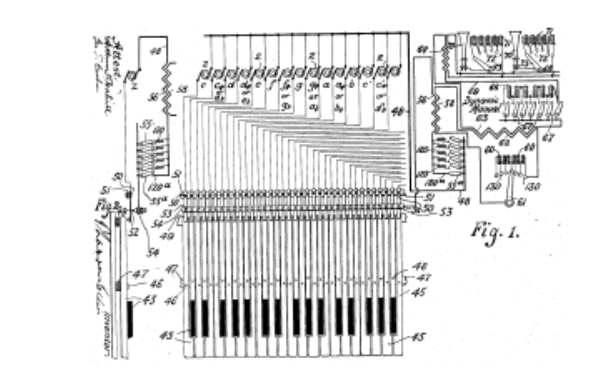
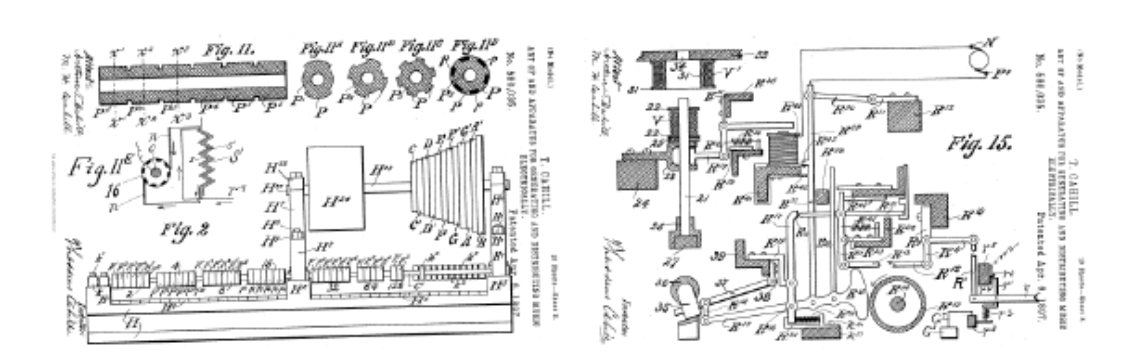
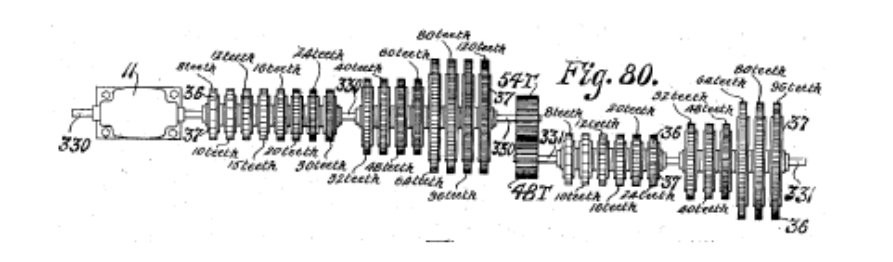
Before the New Year, we brought you footage of Russian polymathic inventor Léon Theremin demonstrating the strange instrument that bears his surname, and we noted that the Theremin was the first electronic instrument. This is not strictly true, though it is the first electronic instrument to be mass produced and widely used in original composition and performance. But like biological evolution, the history of musical instrument development is littered with dead ends, anomalies, and forgotten ancestors (such as the octobass). One such obscure oddity, the Telharmonium, appeared almost 20 years before the Theremin, and it was patented by its American inventor, Thaddeus Cahill, even earlier, in 1897. (See some of the many diagrams from the original patent below.)
Cahill, a lawyer who had previously invented devices for pianos and typewriters, created the Telharmonium—also called the Dynamaphone—to broadcast music over the telephone, making it a precursor not to the Theremin but to the later scourge of telephone hold music. “In a large way,” writes Jay Williston at Synthmuseum.com, “Cahill invented what we know of today as ‘Muzak.’”
He built the first prototype Telharmonium, the Mark I, in 1901. It weighed seven tons. The final incarnation of the instrument, the Mark III, took 50 people to build at the cost of $200,000 and was “60 feet long, weighed almost 200 tons and incorporated over 2000 electric switches…. Music was usually played by two people (4 hands) and consisted of mostly classical works by Bach, Chopin, Greig, Rossini and others.” The workings of the gargantuan machine resemble the boiler room of an industrial facility. (See several photographs here.)
Needless to say, this was a highly impractical instrument. Nevertheless, Cahill not only found willing investors for the enormous contraption, but he also staged successful demonstrations in Baltimore, then—after disassembling and moving the thing by train—in New York. By 1905, his New England Electric Music Company “made a deal with the New York Telephone Company to lay special lines so that he could transmit the signals from the Telharmonium throughout the city.” Cahill used the term “synthesizing” in his patent, which some say makes the Telharmonium the first synthesizer, though its operation was as much mechanical as electronic, using a complicated series of gears and cylinders to replicate the musical range of a piano. (See the operation explained in the video at the top.) “Raised bumps on cylinders helped create musical contour notes,” writes Popular Mechanics, “not unlike a music box, with the size of the cylinder determining the pitch.”
The huge, very loud Telharmonium Mark III ended up in the basement of the Metropolitan Opera House for a time as Cahill worked on his scheme for pumping music through the telephone lines. But this plan did not come off smoothly. “The problem was,” Popular Mechanics points out,” all cables leak off radio waves. Sending a gigantic, amplified signal on turn-of-the-20th-century phone lines was bound to cause trouble.” The Telharmonium created interference on other phone lines and even interrupted Naval radio transmissions. “Rumor has it,” the Douglas Anderson School of the Arts writes, “that a New York businessman, infuriated by the constant network interference, broke into the building where the Telharmonium was housed and destroyed it, throwing pieces of the machinery into the Hudson river below.”
The story seems unlikely, but it serves as a symbol for the instrument’s collapse. Cahill’s company folded in 1908, though the final Telharmonium supposedly remained operational until 1916. No recordings of the instrument have survived, and Thaddeus Cahill’s brother Arthur eventually sold the last prototype off for scrap in 1950 after failing to find a buyer. The entire rationale for the instrument had been supplanted by radio broadcasting. The Telharmonium may have failed to catch on, but it still had a significant impact. Its unique design inspired another important electronic instrument, the Hammond organ. And its very existence gave musical futurists a vision. The Douglas Anderson School writes:
Despite its final demise, the Telharmonium triggered the birth of electronic music—The Italian Composer and intellectual Ferruccio Busoni inspired by the machine at the height of its popularity was moved to write his “Sketch of a New Aesthetic of Music” (1907) which in turn became the clarion call and inspiration for the new generation of electronic composers such as Edgard Varèse and Luigi Russolo.
The instrument also made quite an impression on another American inventor, Mark Twain, who enthusiastically demonstrated it through the telephone during a New Year’s gathering at his home, after giving a speech about his own not inconsiderable status as an innovator and early adopter of new technologies. “Unfortunately for Thaddeus Cahill,” writes William Weir at The Hartford Courant, “Twain’s support wasn’t enough to make a success of the Telharmonium.” Learn more about the instrument’s history from this book.
Note: An earlier version of this post appeared on our site in 2016.
With his last picture The Fabelmans, Steven Spielberg told a story of his own. Given his long-held stature as more or less the personification of big-screen Hollywood entertainment, there’s only one such story he could have told: that of how he became a filmmaker. The most memorable of The Fabelmans depicts the young directorial surrogate alone in the basement of his family home, re-creating the train crash scene from The Greatest Show on Earth with an eight-millimeter camera and a Lionel set. Today, on the brink of his ninth decade with his famous productivity hardly slowing, Spielberg remains, on some level, the wide-eyed boy smashing his toys together at just the right angle. What better way to pay him tribute than to replicate his cinematic achievements in miniature?
The Fabelmans ends with its protagonist a college student, eager to drop out and go straight to Hollywood. At the same point in life, the real Spielberg was about to receive an offer from Universal Pictures to write and direct the short film that became Amblin’, which itself led to a contract to direct television productions.
He showed what he could do with episodes of Marcus Welby, M.D., The Name of the Game, and Columbo, among other series. Then he stepped up to TV movies, a form regarded as inferior in all respects to theatrical releases, but one he managed to transcend on the first try. When it first aired in 1971 as an ABC Movie of the Week, Duel presented its viewers with a harrowing, near-mythological confrontation between a middle-aged traveling salesman in a Plymouth Valiant and an unseen trucker in a hulking, smoke-belching big rig who seems bent on destroying him.
Given that its director was just 24 years old at the time, Duel very much counts as early Spielberg. Yet it’s also distilled Spielberg, a head-on treatment of middle-class normality’s sudden encounter with a force of incomprehensible menace — a theme much revisited in his work since — with cinematic rhythms precisely calculated for optimal tension and release. An aspiring filmmaker could learn much from re-creating its sequences shot-for-shot. The YouTube channel Movies Miniatures Effects does just that in the video above, which documents a remaking with 3D-printed maquettes of the final crash, after Dennis Weaver’s desperate everyman manages to outwit his pursuer. “Sheer skill needed more philosophy for a fitting resolution,” wrote David Thomson of this ending. Perhaps so, but the more than 18 million views so far racked up by its miniature version do suggest a film that more than retains its power after 45 years.
Based in Seoul, Colin Marshall writes and broadcasts on cities, language, and culture. He’s the author of the newsletterBooks on Cities as well as the books 한국 요약 금지 (No Summarizing Korea) and Korean Newtro.Follow him on the social network formerly known as Twitter at @colinmarshall.
When it comes to tourist pilgrimage sites in the United States, the Hoover Dam may not quite rank up there with the Statue of Liberty, the Lincoln Memorial, Mount Rushmore, the Grand Canyon, or Disneyland. But that’s not due to a lack of importance, nor even a lack of impressiveness. Proper appreciation of its man-made majesty, however, requires an understanding of not just the vital function it serves, but the enormous task of its construction. The guides at the Hoover Dam have been trained to explain just that to its many visitors, of course, but all of us could benefit from going in prepared with a little knowledge. Watch the hour-long video on the dam’s design and construction from Animagraffs above, and you may be prepared with enough knowledge to tell the guides a thing or two.
Animagraffs is the YoTtube channel of Jacob O’Neal, which we’ve previously featured here on Open Culture for its acclaimed explanations on a sixteenth-century explorer’s sailing ship and the Golden Gate Bridge, another iconic construction project of the Great Depression. Like those, his Hoover Dam video uses detailed 3D models based on serious research, not least into the project’s original design documents.
This allows O’Neal to show each element of the dam and its complex system of supporting infrastructure in detail and from every angle, as well as in a kind of x‑ray vision. We’ve all seen photographs of the Hoover Dam, and maybe even bought some from its gift shop, but even the most sublime aerial view doesn’t reveal as much about its ambition as a look into its inner workings.
And the ambition of the Hoover Dam is one aspect guaranteed to impress any viewers. It required thousands of workers about five years to re-shape the Nevada and Arizona landscape at a grand enough scale to make possible human control of the mighty — and, more to the point, mightily unpredictable — Colorado River. With its large turbines, the engineering and installation of which O’Neal explains in full, it managed to generate enough electricity to repay its construction cost of more than $811 million in today’s dollars by 1987, just over 50 years after it opened. And in an achievement almost impossible to believe today, it opened more than two years ahead of schedule. We hear a good deal today about the concept of “state capacity,” and how the U.S. could regain it. At the Hoover Dam, we behold state capacity quite literally made concrete.
Based in Seoul, Colin Marshall writes and broadcasts on cities, language, and culture. He’s the author of the newsletterBooks on Cities as well as the books 한국 요약 금지 (No Summarizing Korea) and Korean Newtro.Follow him on the social network formerly known as Twitter at @colinmarshall.
The phone gives us a lot but it takes away three key elements of discovery: loneliness, uncertainty and boredom. Those have always been where creative ideas come from. — Lynda Barry
In the spring of 2016, the great cartoonist and educator, Lynda Barry, did the unthinkable, prior to giving a lecture and writing class at NASA’s Goddard Space Flight Center.
She demanded that all participating staff members surrender their phones and other such personal devices.
Her victims were as jangled by this prospect as your average iPhone-addicted teen, but surrendered, agreeing to write by hand, another antiquated notion Barry subscribes to:
The delete button makes it so that anything you’re unsure of you can get rid of, so nothing new has a chance. Writing by hand is a revelation for people. Maybe that’s why they asked me to NASA – I still know how to use my hands… there is a different way of thinking that goes along with them.
Barry—who told the Onion’s AV Club that she crafted her book What It Is with an eye toward bored readers stuck in a Jiffy Lube oil-change waiting room—is also a big proponent of doodling, which she views as a creative neurological response to boredom:
Boring meeting, you have a pen, the usual clowns are yakking. Most people will draw something, even people who can’t draw. I say “If you’re bored, what do you draw?” And everybody has something they draw. Like “Oh yeah, my little guy, I draw him.” Or “I draw eyeballs, or palm trees.” … So I asked them “Why do you think you do that? Why do you think you doodle during those meetings?” I believe that it’s because it makes having to endure that particular situation more bearable, by changing our experience of time. It’s so slight. I always say it’s the difference between, if you’re not doodling, the minutes feel like a cheese grater on your face. But if you are doodling, it’s more like Brillo. It’s not much better, but there is a difference. You could handle Brillo a little longer than the cheese grater.
Meetings and classrooms are among the few remaining venues in which screen-addicted moths are expected to force themselves away from the phone’s inviting flame. Other settings—like the Jiffy Lube waiting room—require more initiative on the user’s part.
Once, we were keener students of minor changes to familiar environments, the books strangers were reading in the subway, and those strangers themselves. Our subsequent observations were known to spark conversation and sometimes ideas that led to creative projects.
Now, many of us let those opportunities slide by, as we fill up on such fleeting confections as funny videos and all-you-can-eat servings of social media.
It’s also tempting to use our phones as defacto shields any time social anxiety looms. This dodge may provide short term comfort, especially to younger people, but remember, Barry and many of her cartoonist peers, including Daniel Clowes, Simon Hanselmann, and Ariel Schrag, toughed it out by making art. That’s what got them through the loneliness, uncertainty, and boredom of their middle and high school years.
The book you hold in your hands would not exist had high school been a pleasant experience for me… It was on those quiet weekend nights when even my parents were out having fun that I began making serious attempts to make stories in comics form.
- Adrian Tomine, introduction to 32 Stories
Barry is far from alone in encouraging adults to peel themselves away from their phone dependency for their creative good.
Photographer Eric Pickersgill’sRemoved imagines a series of everyday situations in which phones and other personal devices have been rendered invisible. (It’s worth noting that he removed the offending articles from the models’ hands, rather that Photoshopping them out later.)
Computer Science Professor Calvin Newport’s book, Deep Work, posits that all that shallow phone time is creating stress, anxiety, and lost creative opportunities, while also doing a number on our personal and professional lives.
Author Manoush Zomorodi’s TED Talk on how boredom can lead to brilliant ideas, below, details a weeklong experiment in battling smartphone habits, with lots of scientific evidence to back up her findings.
But what if you wipe the slate of digital distractions only to find that your brain’s just… empty? A once occupied room, now devoid of anything but dimly recalled memes, and generalized dread over the state of the world?
The aforementioned AV Club interview with Barry offers both encouragement and some useful suggestions that will get the temporarily paralyzed moving again:
I don’t know what the strip’s going to be about when I start. I never know. I oftentimes have—I call it the word-bag. Just a bag of words. I’ll just reach in there, and I’ll pull out a word, and it’ll say “ping-pong.” I’ll just have that in my head, and I’ll start drawing the pictures as if I can… I hear a sentence, I just hear it. As soon as I hear even the beginning of the first sentence, then I just… I write really slow. So I’ll be writing that, and I’ll know what’s going to go at the top of the panel. Then, when it gets to the end, usually I’ll know what the next one is. By three sentences or four in that first panel, I stop, and then I say “Now it’s time for the drawing.” Then I’ll draw. But then I’ll hear the next one over on another page! Or when I’m drawing Marlys and Arna, I might hear her say something, but then I’ll hear Marlys say something back. So once that first sentence is there, I have all kinds of choices as to where I put my brush. But if nothing is happening, then I just go over to what I call my decoy page. It’s like decoy ducks. I go over there and just start messing around.
Note: An earlier version of this post appeared on our site in 2017.
When asked for their favorite Sesame Street segment, many children of the 70s and 80s point to Pinball Number Count. Psychedelic animation, the Pointer Sisters, odd time signatures—what’s not to love? But for the serious Sesame Street buff, the “Jazz Numbers” series above deserves the silver medal. It’s got free jazz, Yellow Submarine-style surrealistic animation, and a vocal from Grace Slick of Jefferson Airplane. How many young parents recognized her distinctive voice, I wonder?
Also known as “Jazzy Spies,” this 1969 series of animations was devoted to the numbers 2 through 10 (there was no film for “one” as it is the loneliest number that you’ll ever do), and was an essential element in Sesame Street’s first season. Highlights include the dream-like elevator door sequence of “2,” the Jackson 5 reference in “5,” and the racing fans in “10.”
Slick got involved through her first husband, Jerry Slick, who produced the segments for San Francisco-based animation studio Imagination, Inc. Headed by animator Jeff Hale, the company also produced the Pinball segments, as well as the famous anamorphic “Typewriter Guy,” the Ringmaster, and the Detective Man. Hale, by the way, has a cameo as Augie “Ben” Doggie in the well-loved Lucas parody Hardware Wars.)
The delirious music was composed and performed by Columbia jazz artist Denny Zeitlin, who would go on to score the 1979 remake of Invasion of the Body Snatchers. Zeitlin plays both piano and clavinet; accompanying him is Bobby Natanson on drums and Mel Graves on bass. According to Zeitlin, Grace Slick overdubbed her vocals later.
This wasn’t Slick’s first encounter with Jim Henson. In 1968, she and other members of Jefferson Airplane were part of a counterculture documentary called Youth ’68, the trailer for which you can groove on here.
Sesame Street, with all its primary colors, plastic merchandise, and Elmo infestation, may have lost its edge, but these early works show its revolutionary foundations.
Note: An earlier version of this post appeared on our site in 2015.
Upon hearing the names of Arthur Dove or Marsden Hartley, the saturated colors and organically askew lines of those painters’ landscapes may appear before your mind’s eye. But unless you have a special interest in American modernists of the early twentieth century, they probably don’t. The name Georgia O’Keeffe, by contrast, can hardly fail to bring a few images even to the mind of the strictly casual art appreciator: New Mexican mesas, animal skulls, and above all flowers in extreme close-up. Apart from the artistic skill and distinctive vision with which she created it, O’Keeffe’s work persists in the wider culture because of how well it happens to reproduce in a variety of contexts, including postcards, mugs, and even apparel, such as that sold at her eponymous museum in Santa Fe.
Keeping such products around is, of course, no substitute for seeing the real thing; in their physical reality, O’Keeffe’s paintings have a way of rebuffing all the interpretations with which they’ve been freighted for more than a century now. If you can’t make it out to New Mexico, the Georgia O’Keeffe Museum has been working to make every single one of her pieces (including sculptures and photographs) available for viewing online at a just-launched portal called Access O’Keeffe.
The museum describes it as a “user-friendly, searchable website with high-resolution images, visual descriptions, exhibition histories, archival materials, and research data associated with the artist’s two-volume catalogue raisonné.” The site’s visitors “can browse by color, shape, or medium, explore the context of works created before and after a specific painting, trace historic exhibitions, create lists of favorites, and download images.”
Access O’Keeffe makes it easy to find the artist’s most famous paintings, but also works that may surprise viewers who only know her mesas, skulls, and flowers. Take, for example, such nocturnally themed canvases as her early Starlight Night, from 1917, or her late Untitled (City Night), from the nineteen-seventies. O’Keeffe’s America, we must remember, isn’t limited to the desert: though she did spend most of her nearly century-long life’s second half in New Mexico, it also took her from Wisconsin to Virginia to Texas to New York, with stints in South Carolina and Hawaii. Given the importance of understanding any artist’s contexts both geographical and social, Access O’Keeffe also provides an archive of artifacts and exhibitions related to the people and organizations associated with her — Arthur Dove and Marsden Hartley included.
Based in Seoul, Colin Marshall writes and broadcasts on cities, language, and culture. He’s the author of the newsletterBooks on Cities as well as the books 한국 요약 금지 (No Summarizing Korea) and Korean Newtro.Follow him on the social network formerly known as Twitter at @colinmarshall.
We're hoping to rely on loyal readers, rather than erratic ads. Please click the Donate button and support Open Culture. You can use Paypal, Venmo, Patreon, even Crypto! We thank you!
Open Culture scours the web for the best educational media. We find the free courses and audio books you need, the language lessons & educational videos you want, and plenty of enlightenment in between.