Punk rock and heavy metal were two genres that evolved over the ‘70s, but seemed to run parallel to each other, despite sharing common fashion, sounds, and attitudes. But then there are moments in history, where everybody plays together in the same sandbox. For example, the above remastered audio, which captures the Australian band AC/DC on their first American tour, playing New York’s CBGB, synonymous now with punk and new wave music.
The date is August 24, 1977, and AC/DC were on a cross-country trip that had taken in both club dates and arenas, where they supported—yes, hard to believe, I know—REO Speedwagon. Their album Let There Be Rock had just dropped in June. The band would be in the States until the winter.
This CBGB gig finds them on the same bill as Talking Heads and the Dead Boys, according to a poster from the time. And while there’s no video for this show, you can find a few photos that document the concert here. You can feel the muggy New York summer in these photos, but also the excitement of an unforgettable gig.
At 15 minutes, the set is short, but still three minutes longer than the Ramones’ first set at the same club three years earlier. That’s pretty metal, man.
Note: An earlier version of this post appeared on our site in 2016.
Everyone in ancient Rome wore togas, surrounded themselves with pure-white marble statues, bayed for blood as gladiators fought to the death in the Colosseum, programmatically imitated the Greeks, and, after each and every debaucherous feast, excused themselves to the vomitoria, where they ritually vacated their stomachs. Or at least that’s the picture any of us here in the twenty-first century might piece together out of the impressions we happen to receive from a steady flow of sword-and-sandals movies and TV shows — not to mention the countless references that popular culture makes to the Roman Empire, which inevitably make their way into the consciousness even of those of us who don’t think about it every day.
In the new, almost 80-minute Big Think interview above, Mary Beard explains some of the ways in which we’ve been “picturing ancient Rome all wrong.” The ancient Romans lived in a world in which men kissed each other as a standard greeting (at least until a massive outbreak of herpes put a stop to it it), statuary was painted in all manner of garish colors (though just how garish remains a matter of scholarly inquiry), citizens rich enough to wear togas needed the assistance of slaves even to get dressed in the morning, and Greece took cultural influence as well as gave it. These may not yet be features of the Rome we imagine, but they could be if we make a habit of listening to Beard’s new podcast Instant Classics.
Whatever liberties they take, the depictions of the Roman Empire that entertain us today also remind us that, as Beard puts it, “Rome has never gone away in the modern world.” Nowhere is that clearer than in ever-more-frequent discussions about the fate of modern global powers. If we look at our surroundings and see Rome, perhaps that’s because the Eternal City has “given us an image of what it is to be powerful, what it is to be larger than life, what it is to be funny, what it is to be an empire, so it’s provided many of the building blocks we need to think about ourselves.” Even if we’re not the modern equivalents of Augustus, Virgil, Cicero, or even Nero — to name a few of the Romans Beard name as, for better or worse, the most important — we could all stand to make our image of Roman life a little more realistic.
Based in Seoul, Colin Marshall writes and broadcasts on cities, language, and culture. His projects include the Substack newsletterBooks on Cities and the book The Stateless City: a Walk through 21st-Century Los Angeles. Follow him on the social network formerly known as Twitter at @colinmarshall.
Even today, the Paris of the popular imagination is, for the most part, the Paris envisioned by Baron Georges-Eugène Haussmann and made a reality in the eighteen-fifties and sixties. Not that he could order the city built whole: as explained by Manuel Bravo in the new video above, Paris had already existed for about two millennia, growing larger, denser, and more intricate all the while. But as the prefect under Emperor Napoleon III, Haussmann was empowered to carve it up by force, opening “dozens of wide, long avenues that connected important parts of the city,” a layout that “mirrored the street system in Rome created 300 years earlier by Pope Sixtus V, but on a much grander scale.”
However considerable the violence it did to medieval Paris, this process of “Haussmannization” showed a certain historical consciousness. After all, the French capital was once a Roman city: Lutetia Parisorum, named for the Parisii, the Gallic tribe that had inhabited the island in the middle of the Seine that Parisians now call Île de la Cité.
As was their usual modus operandi, the conquering Romans laid a cardo maximus running from north to south, today known as Rue Saint-Jacques. Thereafter, “the rest of the original layout was lost to organic growth.” In the form Paris eventually took in the Middle Ages, “there were no public urban spaces of major significance”: no Place Dauphine, no Place des Vosges, no Place Vendôme.
Those very same Parisian squares now enjoyed by locals and tourists alike did much to develop the expectation of “aesthetic unity” in the city’s built environment, and a couple of centuries before Haussmann at that. It may not be a complete exaggeration to call Paris frozen in the Baron’s mid-nineteenth century, but as Bravo explains, a close examination of both the city’s celebrated spaces and overall form reveals the ways in which a much deeper past has done its part to shape or inspire them. An enthusiast of urban history can spend weeks, months, or even years appreciating the details that remind us that the palimpsest of Paris has never quite been overwritten, even in a place as unrelentingly examined — if seldom truly seen — as the Louvre.
Based in Seoul, Colin Marshall writes and broadcasts on cities, language, and culture. His projects include the Substack newsletterBooks on Cities and the book The Stateless City: a Walk through 21st-Century Los Angeles. Follow him on the social network formerly known as Twitter at @colinmarshall.
The press called Crowley “the wickedest man in the world,” a reputation he did more than enough to cultivate, identifying himself as the Anti-Christ and dubbing himself “The Beast 666.” (Crowley may have inspired the “rough beast” of Yeats’ “The Second Coming.”) Crowley did not achieve the literary recognition he desired, but he continued to write prolifically after Yeats and others ejected him from the Golden Dawn in 1900: poetry, fiction, criticism, and manuals of sex magic, ritual, and symbolism—some penned during famed mountaineering expeditions.
Throughout his life, Crowley was variously a mountaineer, chess prodigy, scholar, painter, yogi, and founder of a religion he called Thelema. He was also a heroin addict and by many accounts an extremely abusive cult leader. However one comes down on Crowley’s legacy, his influence on the occult and the counterculture is undeniable. To delve into the history of either is to meet him, the mysterious, bizarre, bald figure whose theories inspired everyone from L. Ron Hubbard and Anton LaVey to Jimmy Page and Ozzy Osbourne.
Without Crowley, it’s hard to imagine much of the dark weirdness of the sixties and its resulting flood of cults and esoteric art. For some occult historians, the Age of Aquarius really began sixty years earlier, in what Crowley called the “Aeon of Horus.” For many others, Crowley’s influence is inexplicable, his books incoherent, and his presence in polite conversation offensive. These are understandable attitudes. If you’re a Crowley enthusiast, however, or simply curious about this legendary occultist, you have here a rare opportunity to hear the man himself intone his poems and incantations.
“Although this recording has previously been available as a ‘Bootleg,’” say the CD liner notes from which this audio comes, “this is its first official release and to the label’s knowledge, contains the only known recording of Crowley.” Recorded circa 1920 on a wax cylinder, the audio has been digitally enhanced, although “surface noise may be evident.” (Stream them above, or on this YouTube playlist here.) Indeed, it is difficult to make out what Crowley is saying much of the time, but that’s not only to do with the recording quality, but with his cryptic language. The first five tracks comprise “The Call of the First Aethyr” and “The Call of the Second Aethyr.” Other titles include “La Gitana,” “The Pentagram,” “The Poet,” “Hymn to the American People,” and “Excerpts from the Gnostic Mass.”
It’s unclear under what circumstances Crowley made these recordings or why, but like many of his books, they combine occult liturgy, mythology, and his own literary utterances. Love him, hate him, or remain indifferent, there’s no getting around it: Aleister Crowley had a tremendous influence on the 20th century and beyond, even if only a very few people have made serious attempts to understand what he was up to with all that sex magic, blood sacrifice, and wickedly bawdy verse.
Note: An earlier version of this post appeared on our site in 2017.
Each of us has a different idea of when, exactly, the sixties ended, not as a decade, but as a distinct cultural period. Some have a notion of the “long sixties” that extends well into the seventies; if pressed for a specific final year, they could do worse than pointing to 1972, when David Bowie made his epoch-shifting appearance as Ziggy Stardust, backed by the Spiders from Mars, on the BBC’s Top of the Pops. It was also the year he released music videos for “Space Oddity,” the single that had begun to make his name at the time of the moon landing in 1969, and “Jean Genie,” the first single from Aladdin Sane, an album inspired in part by the debauchery of the American Ziggy tour he undertook after blasting off into stardom.
Having struggled in the sixties to find a suitable identity and audience, the young Bowie developed an unusually strong understanding of not just the music industry, but also the culture itself. One era was giving way to another, and nobody knew it better than he did. When all those hirsute figures in beards and denim, singing with ostentatious earnestness about love and freedom, disappeared, who would replace them?
In Bowie’s vision, the next phase belonged to clean-shaven, made-up androgynes in flamboyant designer costumes working grand, sometimes science fictional, and often inscrutable themes into what would strike concertgoers as almost complete theatrical experiences — and he would be the first and foremost among them.
Bowie, in other words, made the seventies his own, operating on his knowledge of and instincts about the media environment of that decade and how images would be made in it. By that time, he’d seen too many flashes in the pan of pop music to get complacent about his own prospects for endurance. The reception of “Space Oddity” as a novelty song did its part to motivate him to come up with his bisexual space-alien rock-star alter ego — and to motivate him to terminate that persona on stage in 1973. A couple of years before that, he had already sung of the importance of changes, a kind of manifesto that would guide his career through all the decades that remained. Never would Bowie adhere to a particular musical or aesthetic style for very long, an abiding tendency vividly on display in this playlist of 50 music videos on his official YouTube channel.
The experience of putting out music videos in the seventies placed Bowie well, especially compared to other artists of his generation, to make his mark on MTV in the eighties with a stadium-ready hit like “Let’s Dance.” The nineties found him taking the form in new directions, as with the cinephilically astute video for “Jump They Say” and the daringly action-free visual treatment of the reflective “Thursday’s Child” (from the album Hours…, which began as the soundtrack to the computer game Omikron: The Nomad Soul). Apart from this playlist, his channel also contains music videos for his later songs from the two-thousands and twenty-tens, from “New Killer Star” to “The Stars (Are Out Tonight)” to “Blackstar” — the nature of stardom having been a preoccupation since the beginning, even though he kept on changing to the very end.
Based in Seoul, Colin Marshall writes and broadcasts on cities, language, and culture. His projects include the Substack newsletterBooks on Cities and the book The Stateless City: a Walk through 21st-Century Los Angeles. Follow him on the social network formerly known as Twitter at @colinmarshall.
You’ve likely heard the reason people never smile in very old photographs. Early photography could be an excruciatingly slow process. With exposure times of up to 15 minutes, portrait subjects found it impossible to hold a grin, which could easily slip into a pained grimace and ruin the picture. A few minutes represented a marked improvement on the time it took to make the very first photograph, Nicéphore Niépce’s 1826 “heliograph.” Capturing the shapes of light and shadow outside his window, Niépce’s image “required an eight-hour exposure,” notes the Christian Science Monitor, “long enough that the sunlight reflects off both sides of the buildings.”
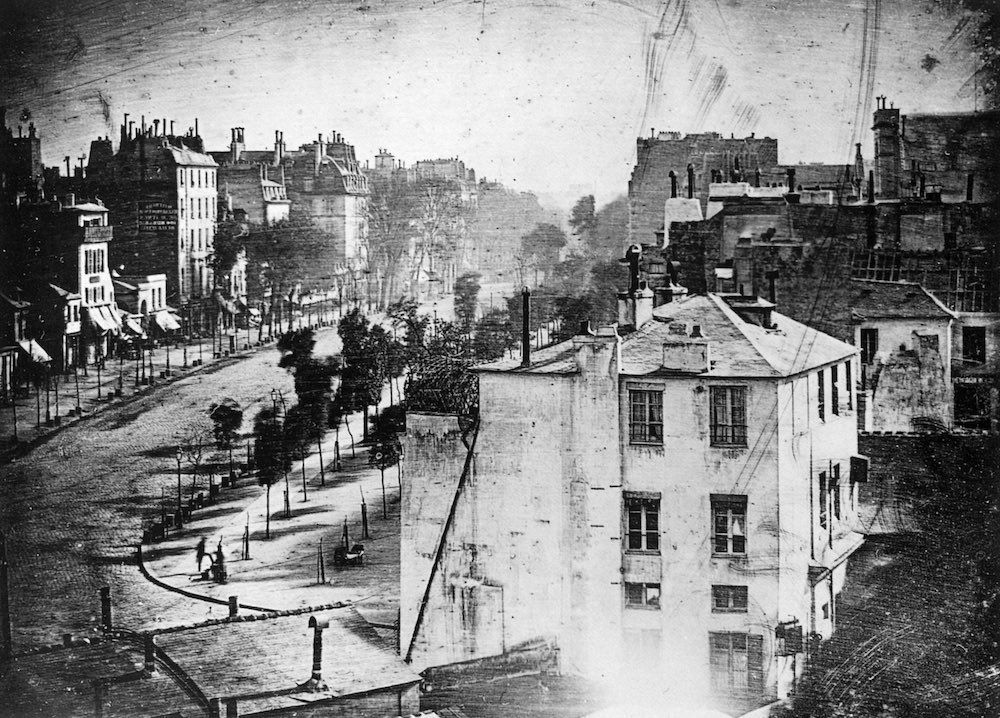
Niépce’s business and inventing partner is much more well-known: Louis Jacques Mandé Daguerre, who went on after Niépce’s death in 1833 to develop the Daguerreotype process, patenting it in 1839. That same year, the first selfie was born. And the year prior Daguerre himself took what most believe to be the very first photograph of a human, in a street scene of the Boulevard du Temple in Paris. The image shows us one of Daguerre’s early successful attempts at image-making, in which, writes NPR’s Robert Krulwich, “he exposed a chemically treated metal plate for ten minutes. Others were walking or riding in carriages down that busy street that day, but because they moved, they didn’t show up.”
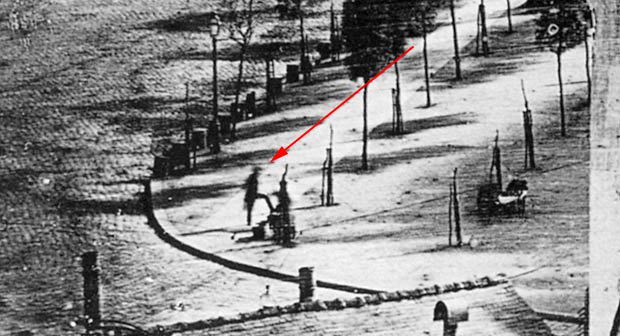
Visible, however, in the lower left quadrant is a man standing with his hands behind his back, one leg perched on a platform. A closer look reveals the fuzzy outline of the person shining his boots. A much finer-grained analysis of the photograph shows what may be other, less distinct figures, including what looks like two women with a cart or pram, a child’s face in a window, and various other passersby. The photograph marks a historically important period in the development of the medium, one in which photography passed from curiosity to revolutionary technology for both artists and scientists.
Although Daguerre had been working on a reliable method since the 1820s, it wasn’t until 1838, the Metropolitan Museum of Art explains, that his “continued experiments progressed to the point where he felt comfortable showing examples of the new medium to selected artists and scientists in the hope of lining up investors.” Photography’s most popular 19th century use—perhaps then as now—was as a means of capturing faces. But Daguerre’s earliest plates “were still life compositions of plaster casts after antique sculpture,” lending “the ‘aura’ of art to pictures made by mechanical means.” He also took photographs of shells and fossils, demonstrating the medium’s utility for scientific purposes.
If portraits were perhaps less interesting to Daguerre’s investors, they were essential to his successors and admirers. Candid shots of people moving about their daily lives as in this Paris street scene, however, proved next to impossible for several more decades. What was formerly believed to be the oldest such photograph, an 1848 image from Cincinnati, shows what appears to be two men standing at the edge of the Ohio River. It seems as though they’ve come to fetch water, but they must have been standing very still to have appeared so clearly. Photography seemed to stop time, freezing a static moment forever in physical form. Blurred images of people moving through the frame expose the illusion. Even in the stillest, stiffest of images, there is movement, an insight Eadweard Muybridge would make central to his experiments in motion photography just a few decades after Daguerre debuted his world-famous method.
Note: An earlier version of this post appeared on our site in 2017.
It may well be that the major pivot points of history are only visible to those around the bend. For those of us immersed in the present—for all of its deafening sirens of violent upheaval—the exact years future generations will use to mark our epoch remain unclear. But when we look back, certain years stand out above all others, those that historians use as arrestingly singular book titles: 1066: The Year of Conquest, 1492: The Year the World Began,1776. The first such year in the 20th century gets a particularly grim subtitle in historian Paul Ham’s 1914: The Year the World Ended.
In France, the horrors of the war prompted its survivors to remember the years before it as La Belle Epoque, a phrase—wrote the BBC’s Hugh Schofield in the centenary essay “La Belle Eqoque: Paris 1914,”—that appeared “much later in the century, when people who’d lived their gilded youths in the pre-war years started looking back and reminiscing.”
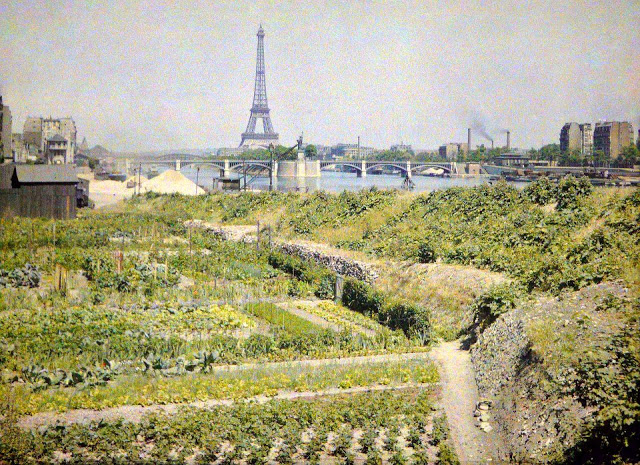
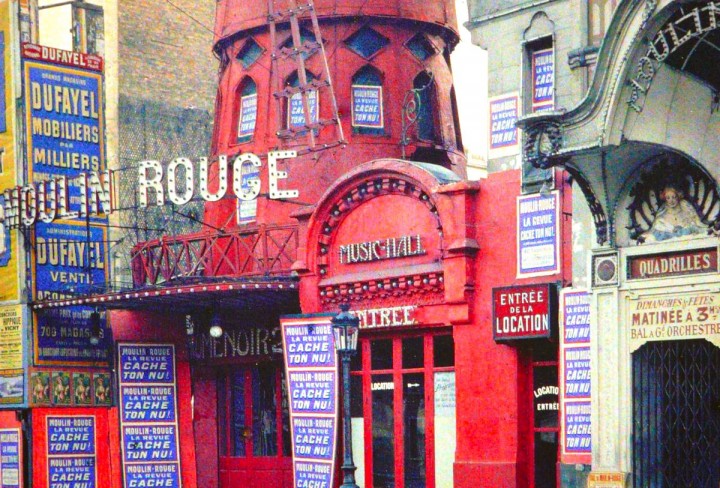
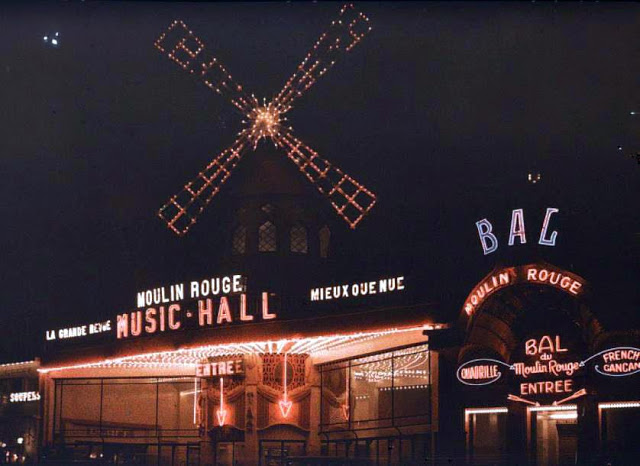
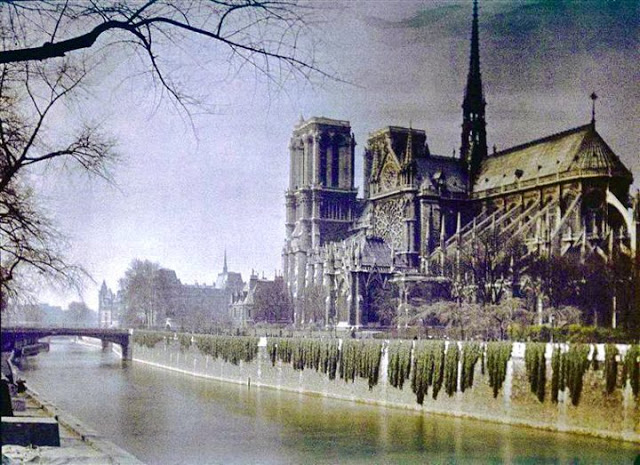
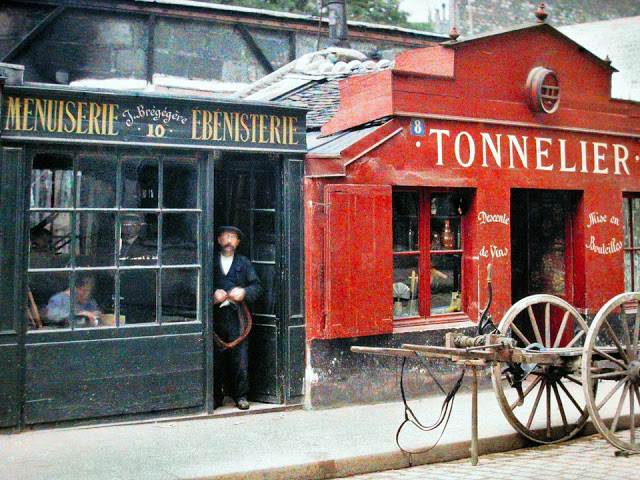
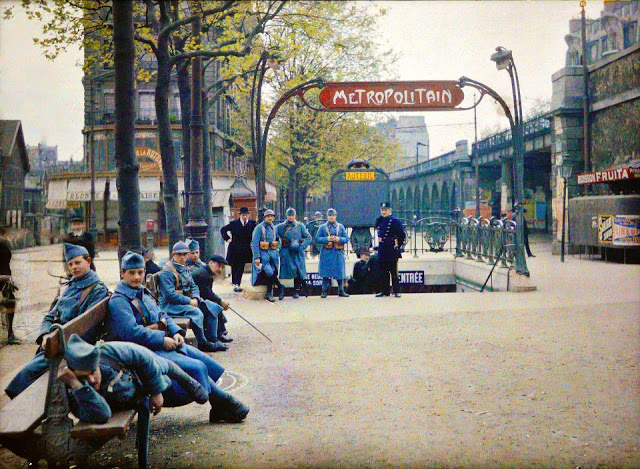
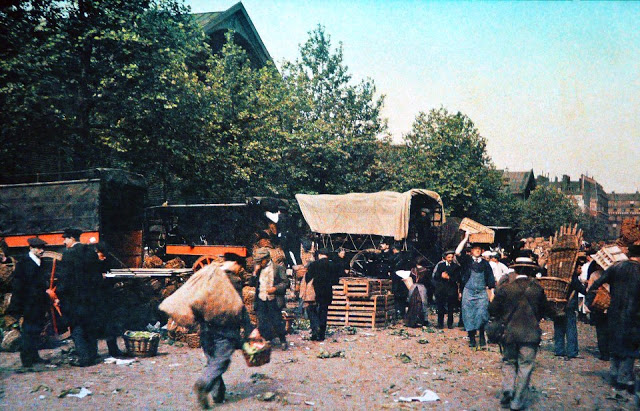
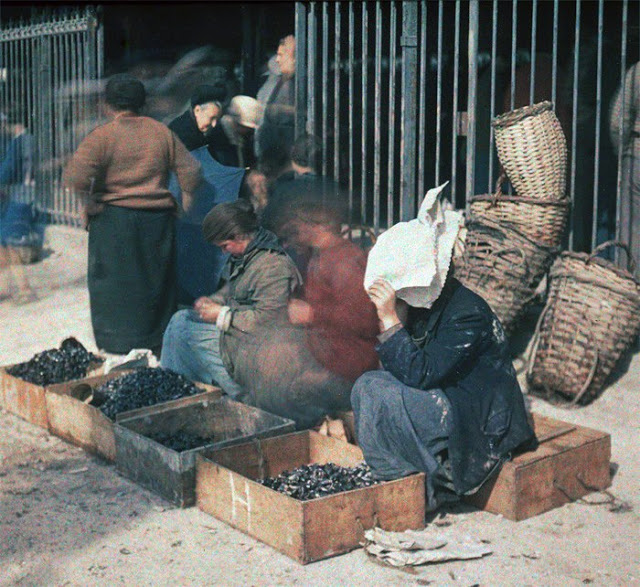
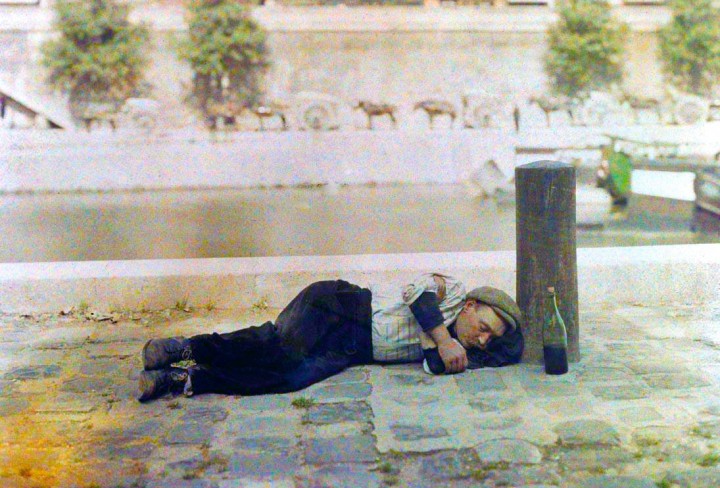
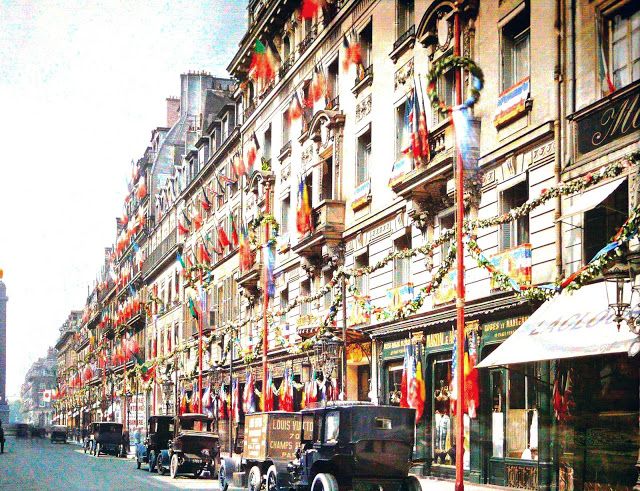
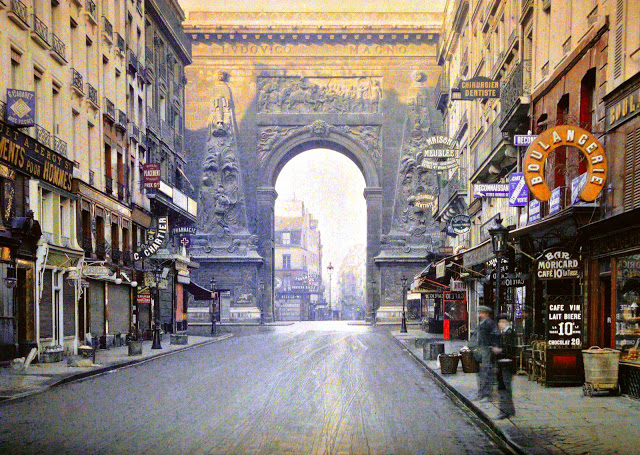
We’re used to seeing the period of 1914 in grainy, dreary black-and-white, and to seeing nostalgic celebrations of La Belle Epoque represented graphically by the lively full-color posters and advertisements one finds in décor stores. But thanks to the full color photos you see here, we can see photographs of World War I‑era Paris in full and vibrant color—images of the city 110 years ago almost just as Parisians saw it at the time. Icons like the Moulin Rouge come to life in bright daylight, above, and lighting up the night, below.
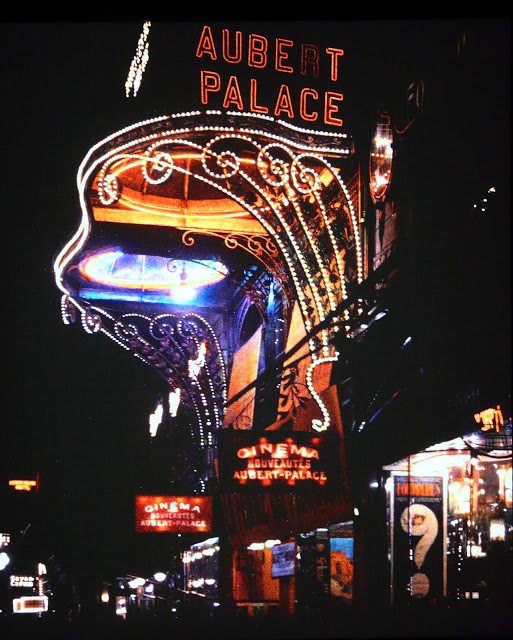
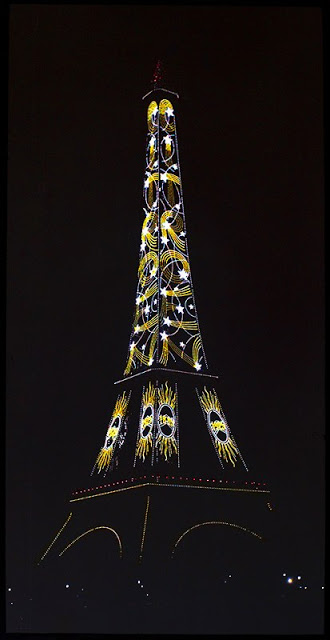
Early cinema Aubert Palace, below, in the Grands Boulevards, shimmers beautifully, as does the art-deco lighting of the Eiffel Tower, further down.
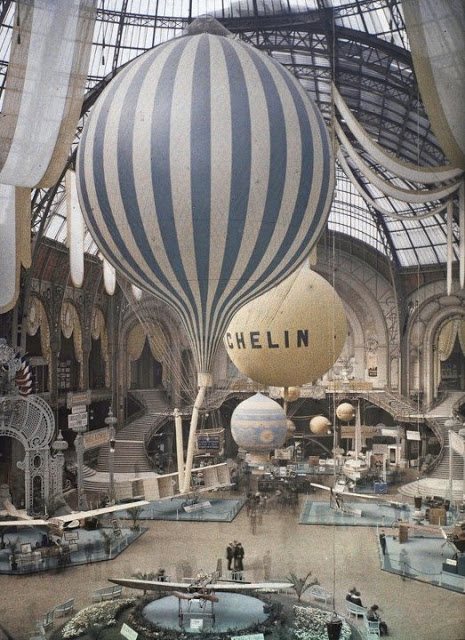
Below, hot air balloons hover in the enormous Grand Palais, and further down, a photograph of Notre Dame on a hazy day almost looks like a watercolor.
The photographs were made, writes Messy N Chic, “using Autochrome Lumière technology between 1914 and 1918 [a technique developed in 1903 by the Lumière brothers, credited as the first filmmakers]…. [T]here are around 72,000 Autochromes from the time period of places all over the world, including Paris in its true colors.”
Not all of the photographs are of famous architectural monuments or nightlife destinations. Very many show ordinary street scenes, like those above, one depicting a number of bored French soldiers, presumably awaiting deployment.
The Paris of 1914 was a European capital in major transition, in more ways than one. “Modernity was the moving spirit,” writes Schofield; “It was the time of the machine. The city’s last horse-drawn omnibus made its way from Saint-Sulpice to La Villette in January 1913.”
Schofield also points out that, like Gilded Age New York, “the public image of Paris was the creation of romantic capitalists. The reality for many was much more wretched… there were entire families living on the street, and decrepit, overcrowded housing with nonexistent sanitation.”
Modernity was leaving many behind, class conflict loomed in France as it erupted in Russia, even as the global catastrophe of World War I threatened French elites and proletariat alike, who both served and who both died at very high rates.
You can see many more of these astonishingly beautiful full-color photographs of 1914 Paris—at the end of La Belle Epoque—at Vintage Everyday and Messy N Chic.
Note: An earlier version of this post appeared on our site in 2015.
You could argue that, of all rock bands, that Pink Floyd had the least need for visual accompaniment. Sonically rich and evocatively structured, their albums evolved to offer listening experiences that verge on the cinematic in themselves. Yet from fairly early in the Floyd’s history, their artistic ambitions extended to that which could not be heard. Can you really understand their enterprise, it’s fair to ask, if you remain merely one of their listeners, never entering the visual dimension — not just their album covers, reproductions of which still grace many a dorm room wall, but also their elaborate stage shows, music videos (which they were making before that form had a name), and films? One man had more responsibility for the development of the Floyd’s visual style than any other: Ian Emes.
In 1972, Emes took it upon himself to animate their song “One of These Days” from the previous year’s album Meddle. When the finished work, “French Windows,” aired on the BBC music show The Old Grey Whistle Test, it caught the eye of the Floyd’s keyboard player Rick Wright. The group then got in touch with Emes, asking to use “French Windows” as a projection behind their concerts.
They went on to commission further work from him, for songs like “Speak to Me,” Time,” and “On the Run” from The Dark Side of the Moon. This professional connection endured for decades. When Roger Waters put on his own performances of The Wall — including the enormously scaled show in Berlin in 1990 — he had Emes direct its animated sequences. The post-Waters version of Pink Floyd even called up Emes in 2015 to ask him to make a film to accompany their final album The Endless River.
It was, in a way, the completion of a circle: “One of These Days” is a mostly instrumental song, and The Endless River is a mostly instrumental album; “French Windows” uses rotoscoping, which involves tracing over live action footage to make more realistically smooth animation, and the Endless River film presents its own live action footage in a manner that sometimes verges on the abstract. Both works create their own visual environments, which dovetails with what Emes, who died two years ago, once described as the appeal for him of the Floyd: “They went to architecture college and so I think their music creates spaces. It creates environments of sound and I was so stimulated that my mind would soar, and so I would see images that were stimulated by the music.” Their music takes a different form before the mind’s eye of each fan, but it was Emes who made his visions a part of their legacy.
Based in Seoul, Colin Marshall writes and broadcasts on cities, language, and culture. His projects include the Substack newsletterBooks on Cities and the book The Stateless City: a Walk through 21st-Century Los Angeles. Follow him on the social network formerly known as Twitter at @colinmarshall.
As many as a million people crossed the Golden Gate Bridge on foot to celebrate the 50th anniversary of its construction in 1987. More than a few of them would have remembered San Francisco as it was before it had its most iconic structure — and indeed, some would even remember walking across it once before, on its inaugural “Pedestrian Day” in 1937. Barring the possibility of unusually vigorous supercentenarians, that won’t be the case 12 years from now, on the Golden Gate Bridge’s 100th anniversary. But we’ll still be able to appreciate the enormous ambition of its builders, not least its chief design engineer Joseph Strauss, who, along with Charles Alton Ellis, made possible a project long assumed impossible.
The video from Sabin Civil Engineering at the top of the post explains every stage of the Golden Gate Bridge’s design and construction. Building a suspension bridge over the Golden Gate, the deep strait between San Francisco Bay and the Pacific Ocean, posed formidable challenges. The distinctive shape we know from so many photographs emerged in part from the need to anchor the bridge in such a way as to balance out the massive forces that would otherwise bend its towers inward, and the steel-on-steel construction of its suspenders and deck was necessary to prevent catastrophic crack formation.
The deck hangs from 250 pairs of cables, and each of the main cables that run the length of the bridge actually consists of 27,000 steel wires wound together. A system of thermal expansion joints accommodates regular elongation and shrinkage of nearly four feet.
And we haven’t even got into the underwater blasting and terrifying-looking drilling work required to put up the towers in the first place. In any case, the painstaking efforts of the engineers and laborers alike have surely been vindicated by the Golden Gate Bridge’s functionality and popularity over the past 88 years. Naturally, it’s had to undergo considerable maintenance and retrofitting in that time, and it would take a true romantic to ignore its limitations entirely. (Take its lack of rail capacity, which was neither technically nor economically feasible to incorporate during the Great Depression.) Still, when 300,000 people jammed themselves onto its deck at once on its 50th anniversary, it may have bent in the middle, but it didn’t break. That was a testament to the civil engineering acumen of Strauss and company — but let’s hope the centenary festivities are better organized.
Based in Seoul, Colin Marshall writes and broadcasts on cities, language, and culture. His projects include the Substack newsletterBooks on Cities and the book The Stateless City: a Walk through 21st-Century Los Angeles. Follow him on the social network formerly known as Twitter at @colinmarshall.
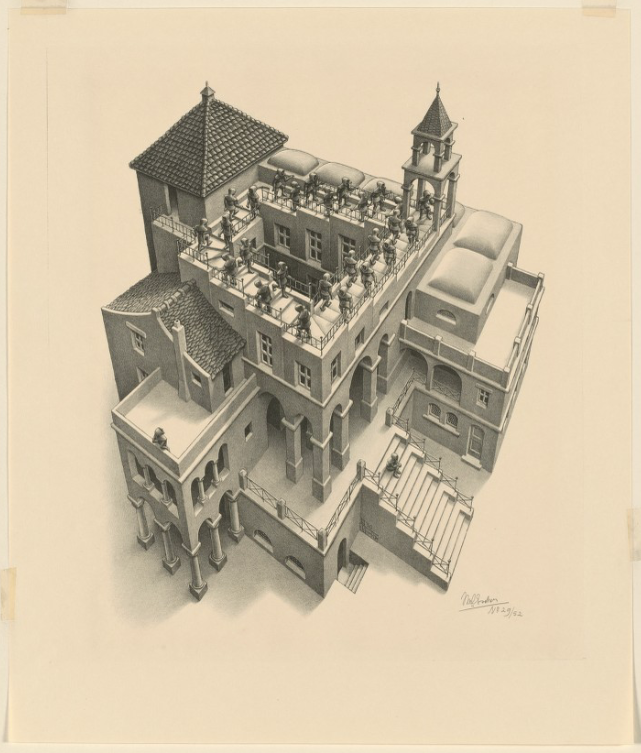
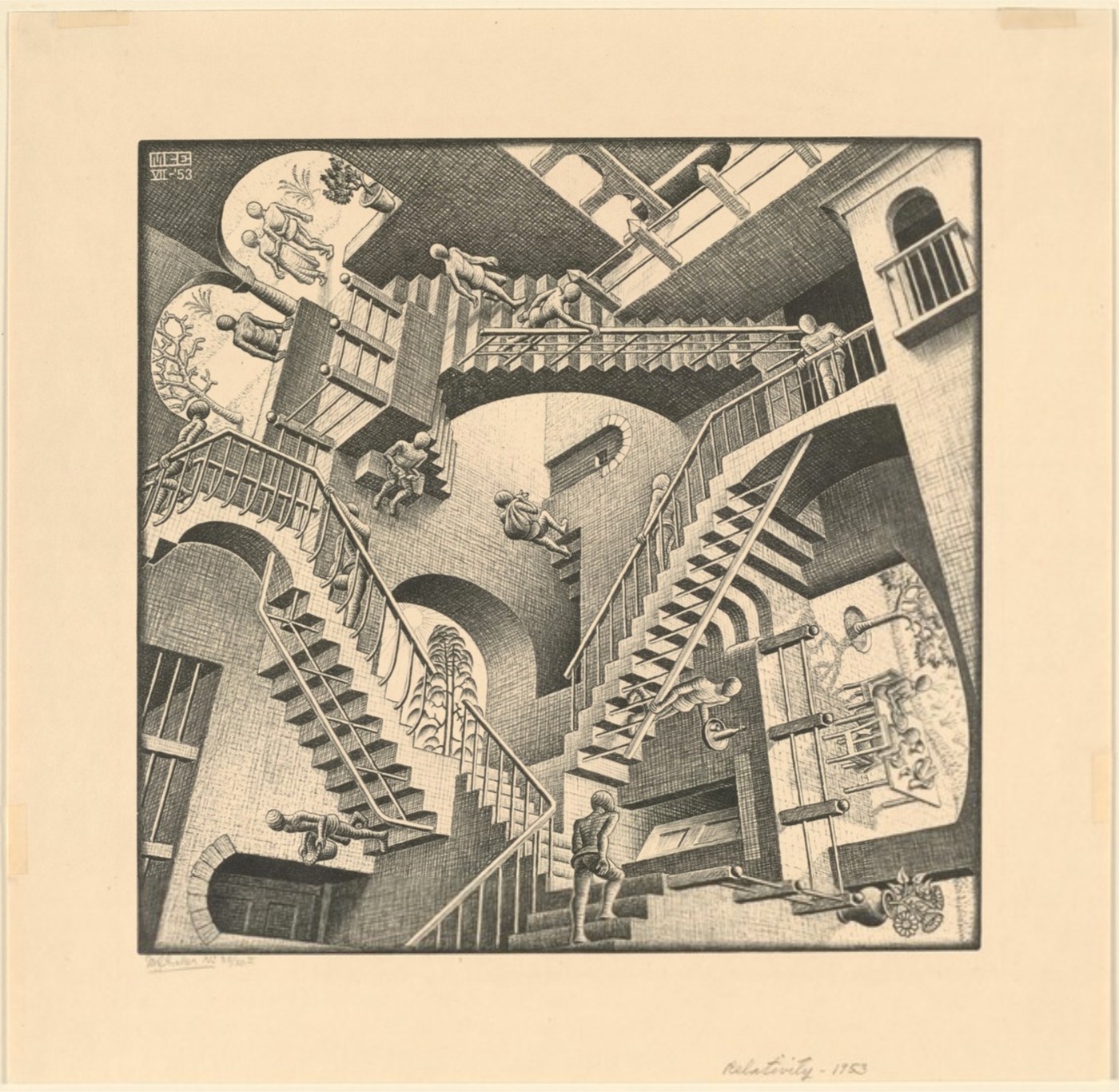
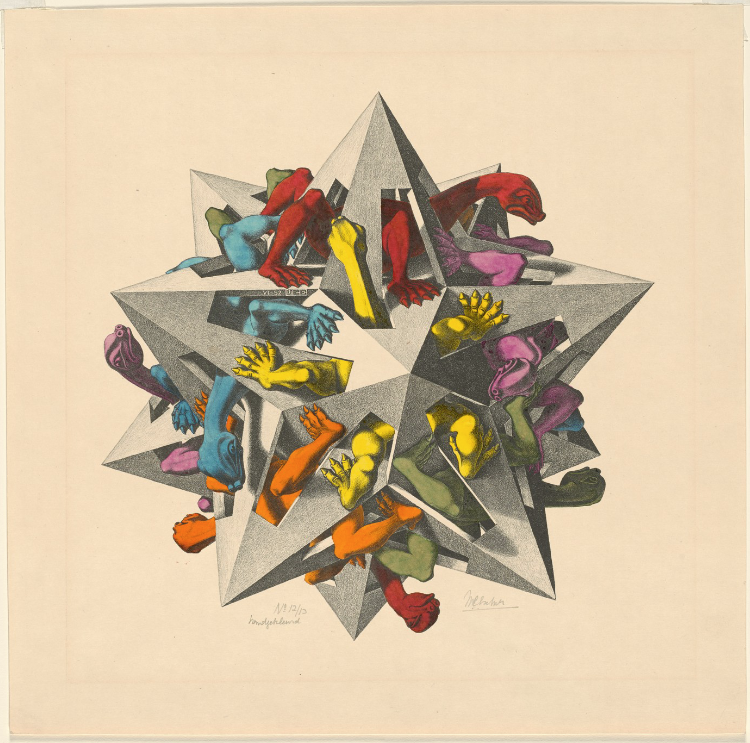
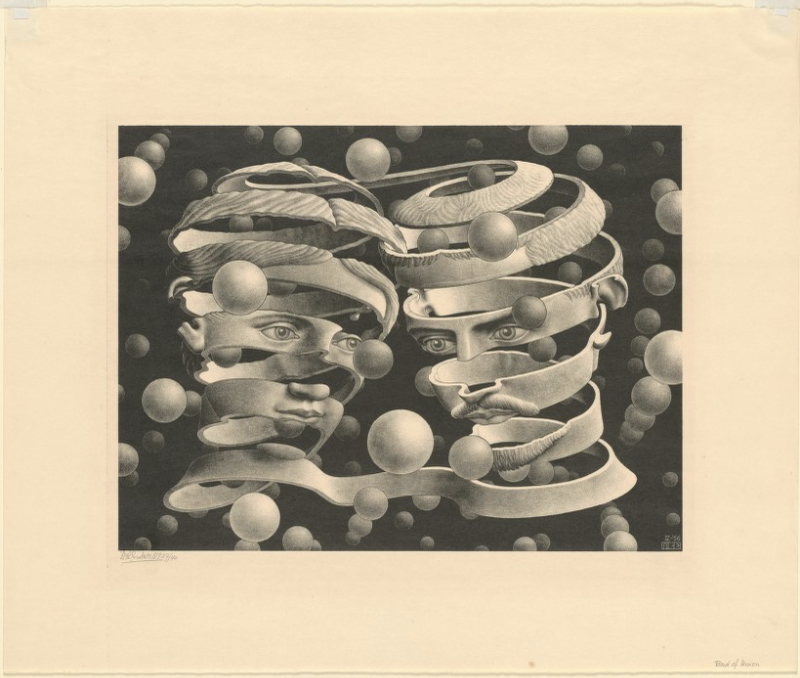
In addition to the iconic scene in Jim Henson’s Labyrinth, or appearances in animated TV shows and video games, M.C. Escher’s work has adorned the covers of albums like Mott the Hoople’s 1969 debut and the speculative fiction of Italo Calvino and Jorge Luis Borges. A big hit with hippies and 1960s college students, writes Heavy Music Artwork, his mind-bending prints became associated with “questioning accepted views of normal experience and testing the limits of perception with hallucinogenic drugs.” While he appreciated his cult following, Escher “did not encourage their mystical interpretations of his images.” Replying to one enthusiastic fan of his print Reptiles, who claimed to see in it an image of reincarnation, Escher replied, “Madame, if that’s the way you see it, so be it.”
Rather than illustrate higher states of consciousness or metaphysical entities, Bruno Ernst writes in The Magic Mirror of M.C. Escher, the artist intended to create practical, “pictorial representation of intellectual understanding.” Illustrations, that is, of philosophical and scientific thought experiments. The son of a civil engineer, Escher began his studies in architecture before moving to drawing and printmaking.
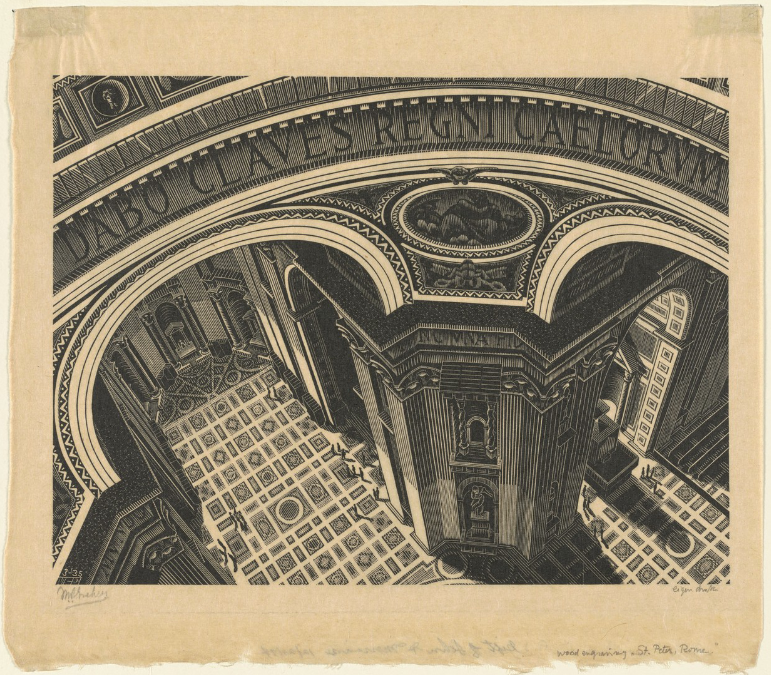
The challenge of creating built environments—even seemingly impossible ones—always seemed to occupy his mind. Along with themes from the natural world, a high percentage of his works center on buildings—inspired by formative early years in Rome and his admiration for Islamic art and Spanish architecture.
In the 50s and 60s Escher’s art piqued the interest of academics and mathematicians, an audience he found more congenial to his vision. He corresponded with scientists and incorporated their ideas into his work, meanwhile claiming to be “absolutely innocent of training or knowledge in the exact sciences.” In the 50s, Escher “dazzled” the likes of mathematicians like Roger Penrose and HSM Coxeter. In turn, notes Maev Kennedy, he “was inspired by Penrose’s perspectival triangle and Coxeter’s work on crystal symmetry.”
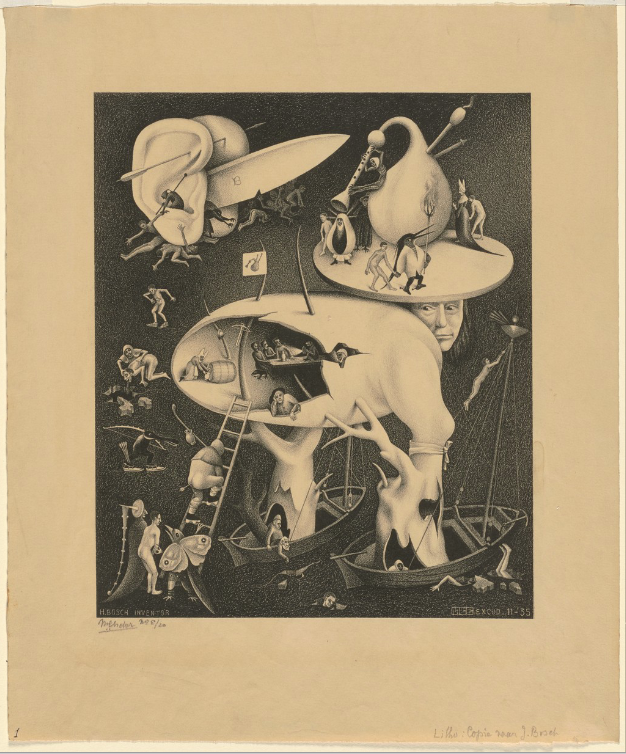
For all the excitement he created among mathematicians, it took a bit longer for Escher to get noticed in the art world. When Penrose’s uncle showed Escher’s version of the perspectival triangle to Picasso, “Picasso had heard of the British mathematician but not of the Dutch artist.” Escher’s fame spread outside of the sciences in part through the interests of the counterculture. He may have shrugged off mystical and psychedelic readings of his prints, but he had an innate penchant for the marvelously weird (see his copy of a scene, for example, from Hieronymus Bosch, above, or his surreal print Gravity, below).
See the prints pictured here and a few dozen more digitized in high resolution at Digital Commonwealth, courtesy of Boston Public Library, who scanned their Escher collection and made it available to the public. Zoom into the fine details of prints like Inside Saint Peter’s, further up—a finely rendered but otherwise not-especially-Escher-like work—and the labyrinthine Ascending and Descending at the top. Whether—as Harvard Library curator John Overholt confesses—you’re a “nerd who loves M.C. Escher” for his mathematical mind, an artist with a mystical bent who loves him for his hallucinatory qualities, or some measure of both, you’ll find exactly the Escher you’re looking for in this digital gallery.
Note: An earlier version of this post appeared on our site in 2018.
From Red Bull’s YouTube Channel: “Ski mountaineer Andrzej Bargiel becomes the first person to climb Mount Everest and ski back to Everest Base Camp without supplementary oxygen. After nearly 16 hours climbing in the high altitude “death zone” (above 8,000m where oxygen levels are dangerously low), Bargiel clipped into his skis on the summit of the tallest mountain on earth and started his descent via the South Col Route. He reached Camp II that night and rested — the summit ridge and Hillary Step had taken longer than planned, meaning darkness made it dangerous and difficult to navigate further that day. The next morning, he skied through the treacherous Khumbu Icefall — guided by a drone flown by his brother, Bartek — before safely arriving at Base Camp to become the first person to ascend and descend Mount Everest on skis with no supplementary oxygen.”
We're hoping to rely on loyal readers, rather than erratic ads. Please click the Donate button and support Open Culture. You can use Paypal, Venmo, Patreon, even Crypto! We thank you!
Open Culture scours the web for the best educational media. We find the free courses and audio books you need, the language lessons & educational videos you want, and plenty of enlightenment in between.







#/media/File:Mottthehoople1969.jpg)