Robert Reich met Bill Clinton when they were both Rhodes Scholars during the 1960s. In the 70s, Reich attended Yale Law School with Hill and Bill. And then, decades later, he served in the Clinton administration as Secretary of Labor. Somewhere along the line, the political economist picked up some drawing skills (putting him in good company with Winston Churchill and George Bush) that work nicely in our age of whiteboard animated videos. Now a professor at UC Berkeley, Reich visually debunks three economic mythologies in two minutes. This clip follows a rapidfire 2012 video, again featuring his cartooning skills, called The Truth About the Economy.
It’s easy to think we know all there is to know about Sigmund Freud. His name, after all, has become an adjective, a sure sign that someone’s legacy has embedded itself in the cultural consciousness. But did you know that the German neurologist we credit with the invention of psychoanalysis, the diagnoses of hysteria, dream interpretation, and the death drive began his career patiently dissecting eels in search of… eel testicles? Perhaps you did know that. Perhaps you only suspected it. There are few things about Freud—who also pioneered both the medical and recreational use of cocaine, joined the august British Royal Society, and unwittingly re-engineered philosophy and literary criticism—that surprise me anymore. Freud was a peculiarly talented individual.
One area in which he excelled may seem modest next to his roster of publications and celebrity acquaintances, and yet, the doctor’s skill as a medical draughtsman and maker of diagrams to illustrate his theories surely deserves some appreciation. Freud’s drawing received a book length treatment in 2006’s From Neurology to Psychoanalysis: Sigmund Freud’s Neurological Drawings and Diagrams of the Mind by Lynn Gamwell and Mark Solms. These are but a small sampling of the many works of medical art found within its covers, taken from a 2006 exhibit at the New York Academy of Medicine of the largest collection of Freud’s drawings ever assembled, in commemoration of his 150th birthday.
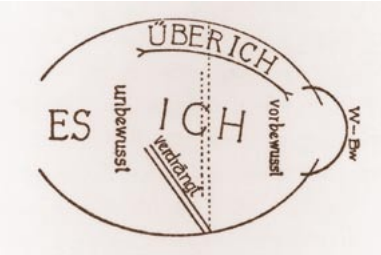
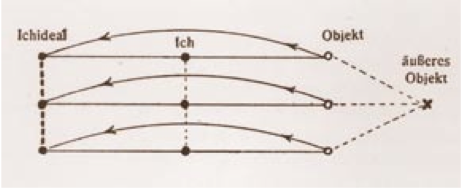
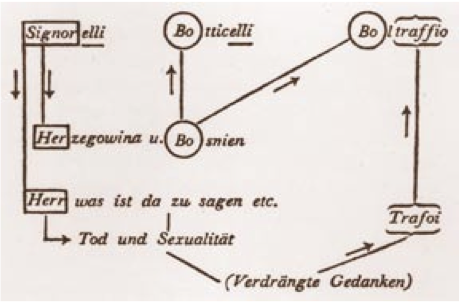
As the title of the book indicates, the drawings literally illustrate the radical shift Freud made from the hard science of neurology to a practice of his own invention. Curator Gamwell writes, “as Freud focused on increasingly complex mental functions such as disorders of language and memory, he put aside any attempt to diagram the underlying physiological structure, such as neurological pathways, and he began making schematic images of hypothetical psychological structures,” i.e. the Ego, Superego, and Id, as represented at the top in a 1933 diagram. Below it, from 1921, see “Group Psychology and the Analysis of the Ego,” a schematic that “attempts to represent relations between the major mental systems (or agencies) in a group of human minds.” And just above, see Freud’s diagram for “The Psychical Mechanism of Forgetfulness” from 1898, depicting “associative links between various conscious, preconscious and unconscious word presentations.”
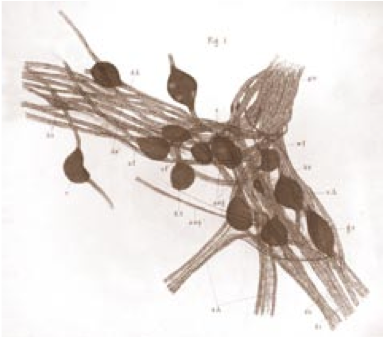
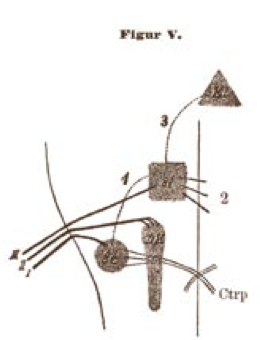
It is in these late nineteenth-century diagrams that we see Freud make the definitive move from empirically observed illustrations of physical structures—like the 1878 “Spinal Ganglia and Spinal Chord of Petromyzom” above—to relations between ideas and “conceptual entities that have no tangible existence in the physical world.” That shift, generally marked by the publication of Studies in Hysteria in 1895, caused Freud some unease. “Looking back over his career 30 years later,” writes Mark Solms, “ his longing for the comfortable respectability of his earlier career is still evident.” Even at the time, Freud would write in Studies in Hysteria that his case histories “lack the serious stamp of science.” Though his studies of eel, lamprey, and human brains involved tangible, observable phenomena, he approached the new discipline of psychoanalysis with no less rigor, stating only that the “the nature of the subject” had changed, not his method.
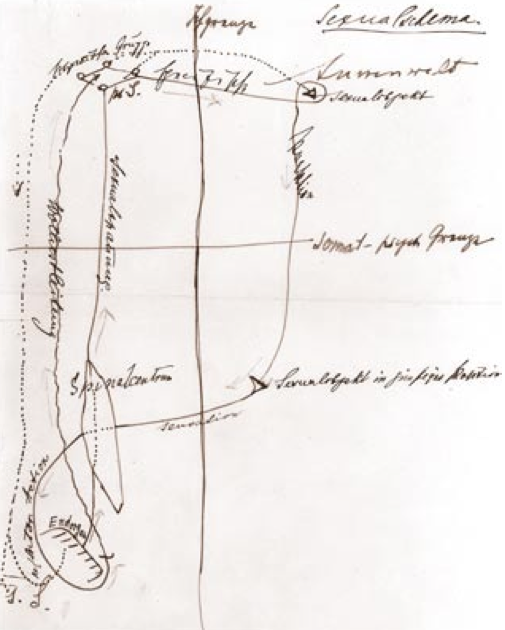
The drawings, writes Benedict Carey in the New York Times, “tell a story in three acts, from biology to psychology, from the microscope to the couch.” As Freud makes the transition, his meticulously detailed medical work, copied from glass slides, gives way to loose outlines. One drawing of the brain’s auditory system from 1886 (above) “is as spare and geometric as a Calder sculpture.” Just a few years later, Freud sketched out the diagram below in 1894, a schematic, writes Solms, of “the relationship between various normal and pathological mood states and sexual physiology.” It’s his first purely psychoanalytic drawing, sketched in a letter to a colleague, Dr. Wilhelm Fleiss.
In the later diagrams, as we see above, his tentative freehand gave way to typescript and a technical draughtsman’s precision, with some drawings resembling, in Carey’s words, “the schematic for an air-conditioning system.” Freud seems to comment on the architectural nature of these diagrams when he writes in The Interpretation of Dreams in 1900, “We are justified, in my view, in giving free reign to our speculations so long as we retain the coolness of our judgment, and do not mistake the scaffolding for the building.” It’s a warning many of Freud’s disciples may not have heeded carefully enough.
It’s how things go around here. You do some research on Samuel Beckett’s plays (see post from earlier today) and you discover there’s a naval ship dedicated to the Irish playwright. Launched in November 2013 and commissioned in May 2014, LÉ Samuel Beckett (P61) patrols Irish waters, allowing the Irish navy to conduct search and rescue operations, undertake vessel boardings, and also protect fisheries. According to an Irish site, the ship “represents an updated and lengthened version of the original RÓISÍN Class OPVs… She is built to the highest international standards in terms of safety, equipment fit, technological innovation and crew comfort.” The cost, 56 million euros.
Of course, the Irish haven’t forgotten their other great literary son. LÉ James Joyce (P62) will be launched in May 2015. And guess what, LÉ Seamus Heaney may soon be on the horizon.
Does anyone know of another nation that honors its artists in such a way?
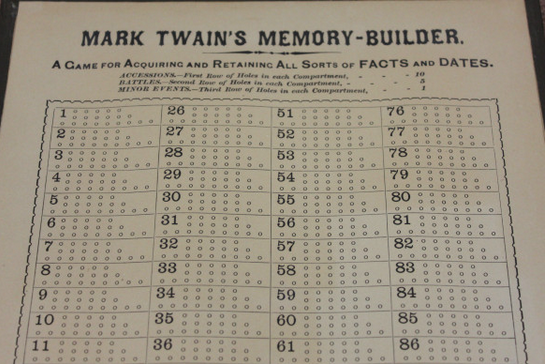
“Twain believed that memorization — a common strategy of 19th-century schooling — was a worthy, if tiresome, pursuit, and looked for ways to make it more interesting for annoyed students,” writes Slate’sRebecca Onion. This line of thinking led him to create the Memory-Builder, which he described as a “game which shall fill the children’s heads with dates without study” in an 1883 letter to a friend. He explained the background of his educational philosophy in much fuller detail in a 1914 piece from Harper’s magazine:
Sixteen years ago when my children were little creatures the governess was trying to hammer some primer histories into their heads. Part of this fun — if you like to call it that — consisted in the memorizing of the accession dates of the thirty-seven personages who had ruled England from the Conqueror down. These little people found it a bitter, hard contract. It was all dates, they all looked alike, and they wouldn’t stick. Day after day of the summer vacation dribbled by, and still the kings held the fort; the children couldn’t conquer any six of them.
This experience gave rise to a couple of different learning methods, of which the Memory-Builder (patented in 1885) would prove the best-known. Though Twain worked out a way to play it on a cribbage board converted into a historical timeline, you can play a technologically much-updated but materially identical version of the game online (with the same cribbage pins and the same strangely intense focus on those royals) at the web site of the University of Oregon’s library. Alternatively, you can play an adaptation that deals with the life and times of Twain himself at the University of Virginia’s web site.
Whether or not the Memory-Builder can help you learn your history, you’ll have to find out for yourself. Not having caught on at the time, Twain’s game didn’t get far out of the prototype stage, but the idea behind it has survived in the form of one of Twain’s many so-very-quotable quotes: “I have never let my schooling interfere with my education.” Something tells me he’d approve of seeing his game on the internet, surely the tool that has done more to get education into the learner’s own hands than anything else in human history so far. (Um, have you seen our list of 1100 Free Online Courses?)
As Samuel Beckett’s writing progressed through the ’60s, it became even more minimal, despairing, and bleak. It was as if he was paring away as much as he could to see if theater was left standing. If a painting could be one color like Ad Reinhardt, what would be the Reinhardt of theater? Jonathan Crow mentioned yesterday how Beckett’s 1969 play Breath, for instance, “runs just a minute long and features just the sound of breathing.” There is a bit more to it than that. Not a lot more, but yes, more. Here’s the play’s script in full:
Curtain.
1. Faint light on stage littered with miscellaneous rubbish. Hold for about five seconds.
2. Faint brief cry and immediately inspiration and slow increase of light together reaching maximum together in about ten seconds. Silence and hold about five seconds.
3. Expiration and slow decrease of light together reaching minimum together (light as in I) in about ten seconds and immediately cry as before. Silence and hold for about five seconds.
Beckett adds some notes:
Rubbish. No verticals, all scattered and lying.
Cry. Instant of recorded vagitus. Important that two cries be identical, switching on and off strictly synchronized light and breath.
Breath. Amplified recording.
Maximum light. Not bright. If 0 = dark and 10 = bright, light should move from about 3 to 6 and back.
The play came about when one of the most important English theater critics of his time Kenneth Tynan asked for short skits for an erotic revue he was putting on in 1969, called Oh! Calcutta. Others invitees included Jules Feiffer, John Lennon, Edna O’Brien, Jacques Levy, Sam Shepard, and Leonard Melfi. The plan was to perform each skit but keep each writer’s name a secret. Beckett reportedly wrote the play on a postcard and sent it to Tynan, then became enraged when he heard that instead of rubbish on stage, Tynan had used naked bodies *and* in fact had explicitly credited Beckett in the program. Breath wouldn’t get a proper staging until 1999 in London’s West End, as part of an evening with Beckett’s more substantial Krapp’s Last Tape. You can read reports of how the audience reacted.
Several directors have brought Breath to life. Artist Damien Hirst had a go for the 2002 Beckett on Film project. As seen above, his version has very spectacular rubbish gathered from a hospital and, glimpsed in the final seconds, a cigarette butt swastika.
Below, check out a more “traditional” interpretation of the play from the National Theatre School of Canada’s Tech Production class. After that comes a repeat of Hirst’s version, and then one more alternative, Darren Smyth’s 2009 TV static-filled attempt. (The rest of the video is a mixed bag of the Alan Parsons Project and a Tim Burton short, don’t ask why.)
Despite Beckett’s morose reputation, there’s always a black humor underneath it all. And if you’re going to ask the man to write an “erotic skit,” this is what you get, the futility of life from womb to tomb in a minute.
Ted Mills is a freelance writer on the arts who currently hosts the FunkZone Podcast. You can also follow him on Twitter at @tedmills and/or watch his films here.
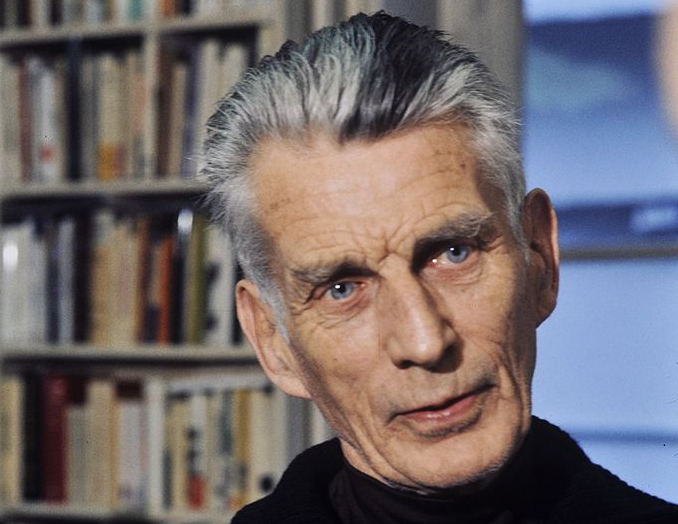
Samuel Beckett, Pic, 1″ by Roger Pic. Via Wikimedia Commons
Clad in a black turtleneck and with a shock of white hair, Samuel Beckett was a gaunt, gloomy high priest of modernism. After the 1955 premiere of Samuel Beckett’s play Waiting for Godot (watch him stage a performance here), Kenneth Tynan quipped, ”It has no plot, no climax, no denouement; no beginning, no middle and no end.” From there, Beckett’s work only got more austere, bleak and despairing. His 1969 play Breath, for instance, runs just a minute long and features just the sound of breathing.
An intensely private man, he managed to mesmerize the public even as he turned away from the limelight. When he won the Nobel Prize in 1969, his wife Suzanne, fearing the onslaught of fame that the award would bring, decried it as a “catastrophe.”
A recently published collection of his letters from 1941–1956, the period leading up to his international success with his play Waiting for Godot, casts some light on at least one corner of the man’s private life – what books were piling up on his bed stand. Below is an annotated list of what he was reading during that time. Not surprisingly, he really dug Albert Camus’s The Stranger. “Try and read it,” he writes. “I think it is important.” He dismisses Agatha Christie’s Crooked Houseas “very tired Christie” but praises Around the World in 80 Days, “It is lively stuff.” But the book he reserves the most praise for is J.D. Salinger’s Catcher in the Rye. “I liked it very much indeed, more than anything for a long time.”
You can see the full list below. It was originally published online by Cambridge University Press in 2011. Books with an asterisk next to the title can be found in our collection of 700 Free eBooks.
Andromaque* by Jean Racine: “I read Andromaque again with greater admiration than ever and I think more understanding, at least more understanding of the chances of the theatre today.”
Lautreamont and Sade by Maurice Blanchot: “Some excellent ideas, or rather starting-points for ideas, and a fair bit of verbiage, to be read quickly, not as a translator does. What emerges from it though is a truly gigantic Sade, jealous of Satan and of his eternal torments, and confronting nature more than with humankind.”
Jonathan Crow is a Los Angeles-based writer and filmmaker whose work has appeared in Yahoo!, The Hollywood Reporter, and other publications. You can follow him at @jonccrow. And check out his blog Veeptopus, featuring lots of pictures of badgers and even more pictures of vice presidents with octopuses on their heads. The Veeptopus store is here.
Meryl Streep, frequently hailed as one of our Greatest Living Actresses — she claims there’s no such thing — commands a near-encyclopedic mastery of accents.
Others may prepare for their roles by working with a dialect coach or listening to tapes of native speakers, but Streep pushes to the limit, as indicated in the conversation with author Andre Dubus III, below.
She not only learned Polish in order to play a troubled Holocaust survivor in Sophie’s Choice,she thought deeply about the way gender roles and period inform vocal presentation.
Her commitment to her craft is inadvertently to blame for popularizing the phrase “dingo’s got my baby.”
How refreshing that this versatile and accomplished actor is not precious about her skills. She gamely trotted them out for the comedian Ellen DeGeneres’ parlor game, above. Looks like fun, provided one’s not an introvert. Each player draws a card labelled with an accent, sticks it to the brim of a silly hat, then tried to guess the accent, based on her partner’s impromptu performance.
“Brooklyn?” Streep giggles when the Louisiana-born DeGeneres has a go at Boston.
Her stab at the Bronx shows off her improv chops far better than the most recent stunt DeGeneres roped her into.
Will humanity ever produce another mind quite like Buckminster Fuller’s? It doesn’t seem to have done so thus far. Even in Fuller’s own time, people couldn’t quite believe the intellectual idiosyncrasy of the inventor who came up with the geodesic dome, the Dymaxion Car, and much, much more. “Time and again,” he once said, “I am asked, ‘who else do you know who thinks the way you do, or does what you do?’ I find it very strange to have to answer, ‘I don’t know anybody else.’ It’s not because I think of myself as unique, but simply because I did choose a very different grand strategy.”
Fuller — or Bucky, his preferred nickname — says more about that grand strategy and the experiences that led him to develop it in the interviews, conducted by Studs Terkel in 1965 and 1970, from which that quote comes. You can hear it in the video above, which brings the material to life by visualizing the elements of Fuller’s life and ideas through the hand of animator Jennifer Yoo. The video recently debuted as part of The Experimenters, a three-episode series meant to animate the words of thinkers like Fuller, Jane Goodall, and Richard Feynman, concentrating on “the inspirations from each of their personal lives that helped influence their careers and earth-changing discoveries.”
Fuller enthusiasts have always insisted that his ideas have only grown more relevant with time, but now that the early 21st century has found us rethinking the way we live — how we do it and how we make spaces to do it in being perhaps Fuller’s most abiding obsession — his engagement with the concept of “continually doing more with less” really does sound smarter than ever. If you enjoy the patch of Bucky’s universe The Experimenters exposes, consider chasing these four minutes of “Buckminster Fuller on the Geodesic Life” with 42 hours of his video lecture series Everything I Know. The man didn’t just think differently from the rest of us, after all — he also thought a lot more.
Marc Maron’s WTF podcast now clocks in at 585 episodes. Certainly one I remember — and so does Maron too — is Episode 400, which featured the godfather of punk, Iggy Pop. Above, an animated Marc Maron recalls the many musicians he’s interviewed in his Los Angeles garage. And especially the summer day when Pop paid a visit, tore off his shirt, and gave his own nipple a little twist. Good times in LA.
Image by Janet McMillan appeared in The Milwaukee Record
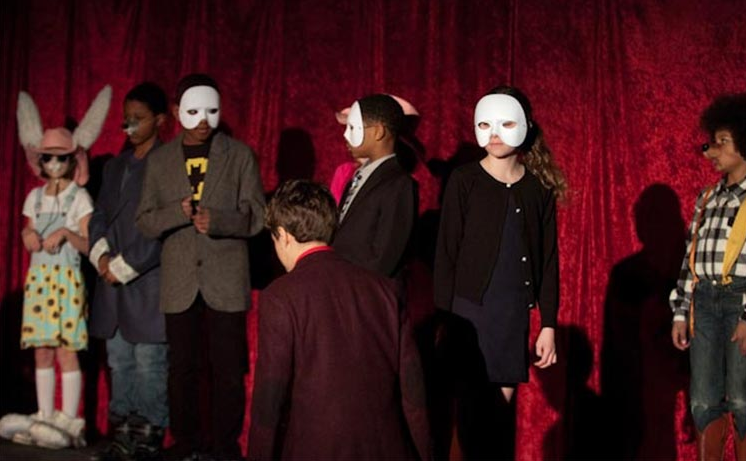
For those of us with kids, the grade school play is usually a combination of parental pride and teeth-grating nostalgic civic lesson and/or Bible study. Not so at Milwaukee, WI’s Highland Community School where super cool drama teacher Barry Weber has written and produced Judy Plays with Fire, a love letter to David Lynch and Mark Frost’s Twin Peaks and other Lynchophilia.
The play has all the hallmarks of the director–red curtains, strobe lights, smoke machines, a Badalamenti-esque score–along with a backwards-speaking character in a red suit, two earnest and upstanding detectives, lumberjacks, rabbits, mysterious people in white masks, a Log Lady-like character who talks to a Slinky, and a middle America town called “Centerville” that, like Laura Palmer, is “full of secrets.” One character mimes Nina Simone’s “Don’t Let Me Be Understood” into a LED wand–shades of Dean Stockwell in Blue Velvet. Character names like Mr. Frost and the MacLachlans nod to the creators and actors behind Twin Peaks. The entire cast is played by 4th, 5th, and 6th graders, and apart from Mr. Weber, the production is crewed by Highland students as well.
This isn’t Weber’s first go at pushing the boundaries of school theater. His student theater group put on 2014’s ZERO, a cyberpunk tale, and a post-apocalyptic zombie production in 2010 called Penguin Attack.
The production got the attention of the Milwaukee Record who sent reporter Matt Wild out to see the three performance run that finished last Friday. He even gave it a bit of a Variety-style review, saying that
“In the case of Judy, (Maeve) Haley is terrific as the inquisitive Cooper surrogate, though diminutive CJ Young steals the show as the scheming Mr. Frost. Whether he’s barking orders to his flunkies or lording over his animatronic house band, Young—who had to take time off from acting two years ago due to conflicts with basketball practice—imbues his character with a surprising amount of gravitas and menace.”
Matt Wild also talked to Weber, who spoke of his desire to give kids more challenging works.
“I want to make sure that when I write the scripts there are no ‘trees,’” Weber says, referencing grade school plays that often give students thankless roles as inanimate objects. “I want to write the kind of plays that as a kid I would have really wanted to do. I certainly didn’t know who David Lynch was when I was a kid, but I’m sure I would have really enjoyed it.”
No video has surfaced yet to match the intriguing production stills, but we’re on the lookout. In the meantime, how well do you know Judy?
Ted Mills is a freelance writer on the arts who currently hosts the FunkZone Podcast. You can also follow him on Twitter at @tedmills and/or watch his films here.
Philip K. Dick died in 1982, but readers — more readers than ever, in all probability — still thrill to his daring, unconventional imagination, and how tightly he could weave the inventions of that imagination into mundane reality. (Sometimes they wonder, as in his meeting with God, to what extent he himself could tell the two apart.) And like many strong-visioned writers of what roughly fell into the category of science fiction, Dick got consulted now and again as something of a futurist.
In 1980, David Wallechinsky, Amy Wallace, and Irving Wallace (the Book of Lists people) rounded up visions of the future from all manner of sages past and present, prescient and incompetent, in order to create The Book of Predictions. Dick’s contributions, republished in the September 2003 issue of fanzine PKD Otaku, go like this.
1983: The Soviet Union will develop an operational particle-beam accelerator, making missile attack against that country impossible. At the same time the U.S.S.R. will deploy this weapon as a satellite killer. The U.S. will turn, then, to nerve gas.
1984: The U.S. will perfect a system by which hydrogen, stored in metal hydrides, will serve as a fuel source, eliminating a need for oil.
1985: By or before this date there will be a titanic nuclear accident either in the U.S.S.R. or in the U.S., resulting in shutting down all nuclear power plants.
1986: Such satellites as HEAO‑2 will uncover vast, unsuspected high energy phenomenon in the universe, indicating that there is sufficient mass to collapse the universe back when it has reached its expansion limit.
1989: The U.S. and the Soviet Union will agree to set up one vast metacomputer as a central source for information available to the entire world; this will be essential due to the huge amount of information coming into existence.
1993: An artificial life form will be created in a lab, probably in the U.S.S.R., thus reducing our interest in locating life forms on other planets.
1995: Computer use by ordinary citizens (already available in 1980) will transform the public from passive viewers of TV into mentally alert, highly trained, information-processing experts.
1997: The first closed-dome colonies will be successfully established on Luna and Mars. Through DNA modification, quasi-mutant humans will be created who can survive under non-Terran conditions, i.e., alien environments.
1998: The Soviet Union will test a propulsion drive that moves a starship at the velocity of light; a pilot ship will set out for Proxima Centaurus, soon to be followed by an American ship.
2000: An alien virus, brought back by an interplanetary ship, will decimate the population of Earth, but leave the colonies on Luna and Mars intact.
2012: Using tachyons (particles that move backward in time) as a carrier, the Soviet Union will attempt to alter the past with scientific information.
Cherry-pickers among us will fixate on Dick’s near-hits: the development of DNA modification, a 1985 nuclear accident in the U.S.S.R. (Chernobyl happened in 1986), and computer use by ordinary citizens (though our status as “mentally alert, highly trained, information-processing experts” admittedly remains questionable). Others might prefer to highlight the most improbable, such as the eliminated need for oil, the creation of artificial life, and not just the 21st-century existence but eventual time-traveling capabilities of the Soviet Union.
Still, even in his fiction, Dick does have his moments of prophecy, especially for those who share his paranoia that we’ve unwittingly let ourselves slip into surveillance-state conditions. But I’ve always found him best, especially in the what-if-Japan-won-the-war story The Man in the High Castle, as a teller of alternate histories, whether of the past, present, or future. These predictions, stretching from just after the writer’s death to just before our time, strike me as nothing so much as the premises for the best novel Philip K. Dick never wrote.
We're hoping to rely on loyal readers, rather than erratic ads. Please click the Donate button and support Open Culture. You can use Paypal, Venmo, Patreon, even Crypto! We thank you!
Open Culture scours the web for the best educational media. We find the free courses and audio books you need, the language lessons & educational videos you want, and plenty of enlightenment in between.